
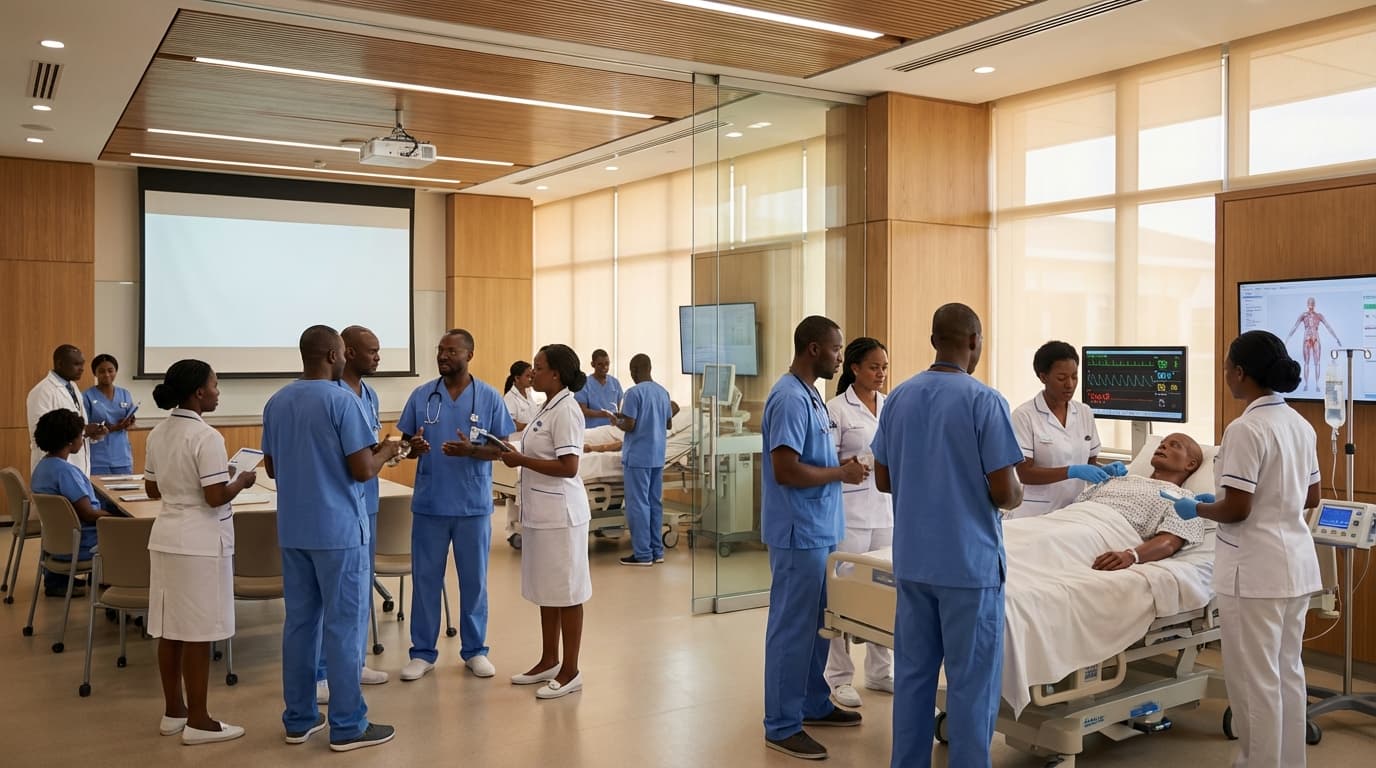
Equipment Training & Education in Morocco
Engineering Excellence & Technical Support
Comprehensive equipment training and certification programs High-standard technical execution following OEM protocols and local regulatory frameworks.
Modular Skills Development Program
Delivering specialized, modular training programs for operators and maintenance technicians on advanced agricultural machinery, focusing on practical skills for enhanced efficiency and reduced downtime. Each module is designed for targeted learning and certification.
Train-the-Trainer Academy
Establishing a 'Train-the-Trainer' academy to cultivate a network of local Moroccan instructors, equipped with the pedagogical and technical expertise to deliver ongoing, localized equipment training and support across diverse regions.
Digital Simulation & AR Training Labs
Implementing state-of-the-art digital simulation and Augmented Reality (AR) training labs, providing hands-on experience with complex equipment operations and troubleshooting in a safe, virtual environment before field deployment.
What Is Equipment Training & Education In Morocco?
Equipment training and education in Morocco refers to the provision of structured learning programs designed to impart the knowledge, skills, and competencies necessary for the safe, efficient, and effective operation, maintenance, and repair of specific industrial, commercial, or specialized equipment. This encompasses a range of pedagogical approaches, from theoretical instruction and practical demonstrations to hands-on simulation and on-the-job training. The objective is to enhance user proficiency, minimize operational risks, optimize equipment lifespan, and ensure compliance with industry standards and regulations.
| Target Audience | Typical Use Cases |
|---|---|
| Industrial Operators & Technicians | Operation of heavy machinery (e.g., construction equipment, manufacturing lines), process control systems, and specialized industrial tools. |
| Maintenance Personnel (Mechanical, Electrical, HVAC) | Repair and upkeep of industrial machinery, building systems, and specialized electro-mechanical devices. |
| Healthcare Professionals | Safe and accurate operation of medical diagnostic and therapeutic equipment (e.g., MRI scanners, ventilators, surgical robots). |
| IT & Communications Professionals | Installation, configuration, and maintenance of networking hardware, servers, and telecommunications infrastructure. |
| Agricultural Workers | Operation and maintenance of farm machinery, irrigation systems, and processing equipment. |
| Automotive Technicians | Diagnostics, repair, and servicing of modern vehicle components and systems. |
| Logistics & Warehousing Staff | Operation of material handling equipment (e.g., forklifts, automated guided vehicles), and warehouse management systems. |
| Public Sector Employees | Operation and maintenance of public utility equipment (e.g., water treatment plants, waste management machinery), and specialized government agency tools. |
Key Components of Equipment Training & Education in Morocco
- Theoretical Instruction: Covering equipment principles, operational parameters, safety protocols, and maintenance theory.
- Practical Demonstrations: Live showcases of equipment operation, routine checks, and basic troubleshooting by qualified instructors.
- Hands-on Practice: Supervised opportunities for trainees to operate, adjust, and perform maintenance tasks on actual equipment or simulators.
- Safety & Hazard Identification: Training focused on recognizing and mitigating potential risks associated with equipment usage and maintenance.
- Maintenance & Troubleshooting: Educating users on preventative maintenance schedules, diagnostic procedures, and common repair techniques.
- Compliance & Regulatory Adherence: Ensuring understanding of relevant national and international standards governing equipment operation and safety.
- Performance Evaluation: Assessing trainee competency through written exams, practical skill tests, and observational assessments.
Who Needs Equipment Training & Education In Morocco?
In Morocco, a robust demand for equipment training and education exists across a wide spectrum of industries. This training is crucial for ensuring operational efficiency, safety, regulatory compliance, and the adoption of new technologies. The target customers are diverse, ranging from individuals seeking to enhance their skills to large corporations investing in their workforce. Departments that benefit most include operations, maintenance, engineering, and safety, as they directly interact with and are responsible for the functioning and upkeep of various equipment.
| Target Customer Group | Typical Departments Involved | Examples of Equipment Requiring Training |
|---|---|---|
| Manufacturing Companies | Production, Operations, Maintenance, Quality Control | CNC machines, assembly lines, packaging machinery, robotic arms, industrial furnaces |
| Construction Firms | Operations, Site Management, Equipment Maintenance | Cranes, excavators, bulldozers, concrete mixers, scaffolding systems |
| Agricultural Cooperatives & Large Farms | Farm Operations, Technical Support, Crop Management | Tractors, harvesters, irrigation pumps, grain silos, processing units |
| Oil & Gas Exploration & Production Companies | Drilling, Production, Maintenance, Safety | Drilling rigs, pumps, valves, control systems, safety harnesses |
| Mining Operations | Extraction, Haulage, Processing, Safety | Loaders, haul trucks, crushers, conveyor belts, drills |
| Hospitals & Clinics | Biomedical Engineering, Radiology, Surgery, Nursing | MRI machines, CT scanners, ventilators, surgical robots, anesthesia machines |
| Logistics & Warehousing Providers | Warehouse Operations, Inventory Management, Fleet Management | Forklifts, reach trucks, automated storage systems, loading docks |
| Renewable Energy Project Developers | Installation, Operations & Maintenance, Engineering | Wind turbines, solar panel installation tools, inverters, grid connection equipment |
Target Customers for Equipment Training & Education in Morocco
- Manufacturing Sector: Companies involved in textile, automotive, food processing, pharmaceuticals, and general manufacturing require training for their machine operators, technicians, and engineers.
- Construction Industry: Contractors, site supervisors, and equipment operators involved in building infrastructure, roads, and residential/commercial projects.
- Agriculture Sector: Farmers, agricultural engineers, and cooperative members utilizing modern farming machinery, irrigation systems, and processing equipment.
- Oil & Gas Industry: Technicians, engineers, and operators working with specialized drilling, extraction, refining, and safety equipment.
- Mining Sector: Personnel involved in operating heavy machinery for excavation, hauling, processing, and safety procedures.
- Healthcare Sector: Biomedical engineers, hospital technicians, and medical staff requiring training on diagnostic imaging equipment, surgical instruments, and life support systems.
- Logistics & Transportation: Warehouse staff, forklift operators, truck drivers, and port workers needing to operate material handling equipment, loading machinery, and transportation vehicles.
- Renewable Energy Sector: Technicians and engineers involved in the installation, maintenance, and operation of solar panels, wind turbines, and related power generation equipment.
- Small & Medium Enterprises (SMEs): Businesses across various sectors that invest in equipment but may lack in-house expertise for comprehensive training.
- Vocational Training Centers & Educational Institutions: To equip students with practical skills demanded by the Moroccan job market.
- Government Agencies & Public Sector: Especially those involved in infrastructure development, public works, and emergency services.
Equipment Training & Education Process In Morocco
The Equipment Training & Education Process in Morocco, from initial inquiry to successful execution, is a structured workflow designed to ensure clients receive comprehensive knowledge and practical skills for operating and maintaining acquired equipment. This process is crucial for maximizing equipment lifespan, ensuring safety, and achieving optimal performance. It typically involves several key stages, starting with a client's expressed need and culminating in certified training completion.
| Stage | Description | Key Activities | Responsible Parties | Outcome |
|---|---|---|---|---|
| Inquiry & Needs Assessment | The client identifies a need for training on specific equipment and contacts the provider. | Initial contact, discussion of training requirements, identification of target audience, assessment of existing knowledge base. | Client, Equipment Supplier/Training Provider Sales/Technical Representative | Clear understanding of training objectives, scope, and target audience. |
| Proposal Development & Quotation | Based on the needs assessment, a detailed proposal is created outlining the training program. | Developing training curriculum, defining modules, specifying duration, identifying trainers, creating a detailed cost quotation. | Training Provider (Technical & Sales Team) | Comprehensive training proposal and a formal price quotation. |
| Contracting & Planning | Formal agreement between the client and the training provider. | Review and signing of training contract, establishment of payment terms, preliminary planning of training dates and location. | Client (Procurement/HR), Training Provider (Management/Legal) | Signed contract and agreed-upon contractual terms. |
| Training Material Preparation | Development or customization of training resources. | Creating/adapting manuals, presentations, practical exercises, assessment tools, visual aids (e.g., videos, simulators). | Training Provider (Technical Writers, Trainers) | Ready-to-use training materials. |
| Logistics & Scheduling | Organizing the practical aspects of the training delivery. | Confirming training venue, ensuring availability of equipment for practical sessions, scheduling trainer and participant availability, arranging travel/accommodation if necessary. | Training Provider (Logistics Coordinator), Client (Participant Coordination) | Confirmed training schedule, venue, and logistical arrangements. |
| Training Execution (Theory & Practical) | Delivery of the training program to the participants. | Conducting theoretical sessions (lectures, discussions), performing practical demonstrations, hands-on practice by participants, Q&A sessions, troubleshooting. | Certified Trainers, Participants | Knowledge transfer and skill development. |
| Assessment & Certification | Evaluating the participants' understanding and proficiency. | Administering written or practical tests, observing performance during exercises, providing feedback on areas for improvement, issuing certificates of completion. | Certified Trainers, Participants | Trainee competency evaluation and formal certification. |
| Post-Training Support & Feedback | Providing ongoing assistance and gathering insights for improvement. | Answering follow-up questions, offering refresher sessions if needed, collecting feedback from participants and client, evaluating training effectiveness, identifying areas for future program enhancements. | Training Provider (Support Team, Management), Client (Participants) | Enhanced client satisfaction, continuous improvement of training programs. |
Workflow Stages
- Inquiry & Needs Assessment
- Proposal Development & Quotation
- Contracting & Planning
- Training Material Preparation
- Logistics & Scheduling
- Training Execution (Theory & Practical)
- Assessment & Certification
- Post-Training Support & Feedback
Equipment Training & Education Cost In Morocco
The cost of equipment training and education in Morocco can vary significantly based on several key pricing factors. These include the type and complexity of the equipment, the duration and intensity of the training program, the provider's reputation and experience, the location of the training (e.g., in-house, at a training center, or online), and the number of participants. Specialized technical training for advanced machinery will generally be more expensive than introductory courses for common equipment. Similarly, hands-on, practical training often commands higher fees than theoretical sessions. Providers with established accreditation and a strong track record in the Moroccan market may also charge a premium. For budgeting purposes, it's essential to consider these variables to get an accurate estimate.
| Training Type/Equipment Category | Estimated Cost Range (MAD) | Typical Duration |
|---|---|---|
| Basic Machinery Operation (e.g., forklifts, basic industrial tools) | 800 - 2,500 MAD | 1-3 days |
| Intermediate Technical Skills (e.g., basic electrical, plumbing, welding) | 1,500 - 5,000 MAD | 3-7 days |
| Advanced Industrial Equipment (e.g., CNC machines, complex manufacturing lines) | 4,000 - 15,000+ MAD | 5-14 days or modular |
| Specialized Software/IT Equipment Training (e.g., CAD/CAM, ERP systems) | 2,000 - 10,000+ MAD | 2-7 days or customized |
| Health and Safety Equipment Training (e.g., fire safety, first aid, hazardous materials) | 600 - 3,000 MAD | 1-3 days |
| Customized Corporate Training Programs (per day, for a group) | 3,000 - 10,000+ MAD | Varies |
Key Pricing Factors for Equipment Training in Morocco
- Type and Complexity of Equipment
- Duration and Intensity of Training
- Provider's Reputation and Experience
- Training Location (In-house, Training Center, Online)
- Number of Participants
- Certification and Accreditation
Affordable Equipment Training & Education Options
Investing in equipment training and education is crucial for operational efficiency, safety, and employee development. Fortunately, various affordable options and cost-saving strategies exist to ensure your team receives the necessary knowledge without breaking the bank. Understanding value bundles and implementing smart cost-saving strategies are key to maximizing your training budget.
| Cost-Saving Strategy | Description | Impact on Training Costs |
|---|---|---|
| Leverage Online & E-Learning | Utilize online courses, webinars, and e-learning platforms. These often have lower overhead costs than in-person training. | Significantly reduces travel, accommodation, and venue rental expenses. Allows for scalable training to large groups. |
| Group Discounts & In-House Training | Negotiate discounts for multiple employees attending the same session. Explore conducting training on your own premises. | Reduces per-person costs. Eliminates travel and venue costs when training is in-house. |
| Train-the-Trainer Programs | Invest in training a few key employees who can then train and mentor others within the organization. | Creates an internal training capacity, reducing the need for external trainers for recurring needs. Long-term cost-effectiveness. |
| Partner with Equipment Manufacturers/Distributors | Many manufacturers offer training as part of the equipment purchase or at a reduced rate for their customers. | Can significantly lower the cost of specialized equipment training. Often tailored to the specific equipment. |
| Utilize Government & Industry Grants/Subsidies | Research available grants or subsidy programs for workforce development and skills training in your sector. | Can cover a substantial portion or even the entirety of training costs. |
| Prioritize Essential Training | Focus training efforts on the equipment that is most critical to operations, safety, and profitability. | Ensures budget is allocated to the highest-impact training needs, avoiding unnecessary expenditure. |
| Explore Blended Learning Approaches | Combine the cost-effectiveness of online learning with focused, short bursts of in-person, hands-on training for practical skills. | Optimizes resource utilization by minimizing the need for extensive in-person sessions. |
| Seek Community College & Vocational School Programs | Local educational institutions often offer affordable courses and certifications in equipment operation and maintenance. | Generally more cost-effective than specialized corporate training providers. |
Understanding Value Bundles in Equipment Training
- {"title":"What are Value Bundles?","description":"Value bundles are packages that combine multiple training components, resources, or services at a discounted price compared to purchasing them individually. They are designed to offer comprehensive solutions and greater overall value for a set investment."}
- {"title":"Common Bundle Components","description":"Bundles often include a combination of the following:"}
- {"title":"On-site Training + Online Modules","description":"Combines hands-on practical instruction with flexible, self-paced online learning for theoretical aspects."}
- {"title":"Basic Certification + Advanced Specialization","description":"Offers a foundational understanding and then allows for deeper dives into specific equipment operations or maintenance."}
- {"title":"Individual Training + Group Discounts","description":"Provides personalized learning with cost reductions for multiple participants."}
- {"title":"Training + Documentation/Manuals","description":"Includes access to essential reference materials alongside the instruction."}
- {"title":"Training + Ongoing Support/Consultation","description":"Extends the learning beyond the training session with access to expert advice."}
- {"title":"Benefits of Value Bundles","description":"Bundles offer predictability in costs, a more holistic learning experience, and can lead to significant savings over time."}
Verified Providers In Morocco
In the realm of healthcare tourism, finding trusted and accredited providers is paramount. For those seeking medical services in Morocco, understanding the significance of verified credentials and recognizing entities like Franance Health is crucial. These accreditations and the reputation of organizations like Franance Health are not merely bureaucratic checkboxes; they are indicators of stringent quality standards, patient safety protocols, and ethical practices. Choosing a provider with verified credentials ensures that patients are receiving care from institutions and professionals who adhere to internationally recognized benchmarks, offering peace of mind and a higher likelihood of successful treatment outcomes. Franance Health, in particular, stands out due to its commitment to excellence, rigorous vetting processes, and its role in connecting patients with the most reputable healthcare facilities and specialists across Morocco. Their credentials represent a promise of quality, transparency, and a patient-centric approach to healthcare.
| Credential Type | What it Signifies | Franance Health's Role |
|---|---|---|
| International Accreditation (e.g., JCI) | Adherence to the highest global standards in patient care, safety, and organizational management. | Franance Health prioritizes and partners with facilities holding such prestigious accreditations. |
| National Regulatory Compliance | Fulfillment of all legal and medical requirements set by Moroccan health authorities, ensuring legal operation and basic quality. | Franance Health verifies that all listed providers meet or surpass national regulatory standards. |
| Specialty Certifications | Proof of expertise and advanced training for individual doctors and departments in specific medical fields. | Franance Health carefully vets specialists based on their certifications and track record in their respective fields. |
| Franance Health's Internal Vetting Process | A proprietary evaluation system that assesses providers on criteria beyond formal accreditations, including patient feedback, technological capabilities, and ethical conduct. | This is Franance Health's core value proposition, ensuring a curated selection of the best healthcare options in Morocco. |
Why Verified Providers & Franance Health Credentials Matter
- Patient Safety: Verified providers adhere to strict safety protocols and hygiene standards, minimizing risks.
- Quality of Care: Accreditations often indicate advanced medical technology and highly skilled, qualified medical professionals.
- Ethical Practices: Credentials assure that providers operate with integrity and prioritize patient well-being.
- International Standards: Verified institutions meet or exceed globally recognized healthcare benchmarks.
- Trust and Transparency: Accreditations provide a reliable indicator of a provider's legitimacy and commitment to openness.
- Franance Health's Role: Acts as a gateway to a network of pre-vetted, accredited healthcare facilities and specialists in Morocco.
- Peace of Mind: Choosing accredited providers alleviates concerns about the quality and reliability of medical services.
- Improved Outcomes: Access to top-tier, verified facilities and professionals often leads to better treatment results.
Scope Of Work For Equipment Training & Education
This Scope of Work (SOW) outlines the requirements for comprehensive equipment training and education services. The objective is to ensure proficient and safe operation, maintenance, and troubleshooting of the specified equipment by the client's personnel. This SOW details the technical deliverables, standard specifications, and expected outcomes.
| Deliverable | Description | Standard Specification/Format | Quantity/Frequency | Acceptance Criteria |
|---|---|---|---|---|
| Training Curriculum Development | Customized curriculum tailored to the specific equipment and trainee roles. Includes modules on theory, operation, maintenance, and safety. | Modular structure with learning objectives, content outlines, and assessment methods. Delivered in PDF and editable Word document format. | One-time per equipment type/training module. | Curriculum reviewed and approved by client project manager. Clearly defines learning outcomes. |
| Training Materials | Comprehensive set of materials for trainees and trainers, including user manuals, presentations, handouts, and practical exercise guides. | High-quality, professional design. Includes diagrams, images, and step-by-step instructions. Delivered in PDF and PowerPoint format. | Sufficient copies for all trainees and trainers. Updated to reflect current equipment version. | Materials are accurate, easy to understand, and directly support the curriculum. |
| Instructor-Led Training Sessions | On-site or remote training sessions conducted by certified and experienced instructors. | Duration and format (classroom, hands-on, blended) as per agreed schedule. Includes interactive Q&A sessions. | As per agreed training schedule (e.g., X days per session, Y sessions per quarter). | Positive trainee feedback (average score above X on post-training evaluation). Measurable improvement in skill demonstration. |
| Hands-On Practical Training | Practical application of learned skills on the actual equipment or a suitable simulation. | Supervised practice sessions with instructor guidance. Focus on key operational tasks and troubleshooting scenarios. | Integrated within instructor-led sessions. Sufficient time allocated for individual practice. | Trainees successfully demonstrate proficiency in performing core operational procedures and identifying common faults. |
| Competency Assessment | Evaluation of trainee knowledge and practical skills through written tests, practical demonstrations, or simulations. | Standardized assessment tools with clear scoring rubrics. Results documented and provided to client. | One assessment per trainee per completed training module. | Minimum passing score of X% on assessments. Documented proof of competency for each trainee. |
| Training Report | Summary report detailing training activities, attendance, assessment results, and recommendations. | Professional report format, including executive summary, detailed findings, and actionable recommendations. Delivered in PDF format. | One report per training cycle or as requested by the client. | Report is comprehensive, accurate, and delivered within X business days of training completion. |
| Post-Training Support | Limited duration of follow-up support to address any immediate questions or challenges encountered by trainees after the formal training. | Remote support (email, phone) for a defined period post-training. | As per contractual agreement (e.g., 30 days post-training). | Timely and effective resolution of trainee queries. documented support interactions. |
Training Objectives
- To equip trainees with the theoretical knowledge and practical skills necessary for the safe and effective operation of the designated equipment.
- To enable trainees to perform routine maintenance and basic troubleshooting procedures.
- To familiarize trainees with the equipment's features, functionalities, and limitations.
- To ensure compliance with all relevant safety regulations and manufacturer guidelines.
- To foster a proactive approach to equipment care and operational efficiency.
Service Level Agreement For Equipment Training & Education
This Service Level Agreement (SLA) outlines the guaranteed response times and uptime for Equipment Training & Education services provided by [Your Company Name] (hereinafter referred to as "Provider") to [Client Company Name] (hereinafter referred to as "Client"). This SLA is an integral part of the Master Service Agreement between the parties.
| Service Component | Uptime Guarantee | Response Time (Business Hours) | Response Time (24/7 Support) | Severity Level | Resolution Time Target |
|---|---|---|---|---|---|
| Training Platform Availability | 99.5% (excluding Scheduled Downtime) | N/A | N/A | N/A | N/A |
| Instructor-Led Session Support | N/A | 1 Hour | 30 Minutes | Critical (Session Failure) | 2 Hours |
| Online Course Module Access | 99.0% (excluding Scheduled Downtime) | N/A | N/A | N/A | N/A |
| Technical Support for Platform Issues | N/A | 2 Business Hours | 1 Business Hour | High (Impedes major functionality) | 8 Business Hours |
| Technical Support for Platform Issues | N/A | 4 Business Hours | 2 Business Hours | Medium (Affects minor functionality) | 24 Business Hours |
| Technical Support for Platform Issues | N/A | 8 Business Hours | 4 Business Hours | Low (Cosmetic or informational) | 48 Business Hours |
| Account Management Inquiries | N/A | 4 Business Hours | N/A | N/A | 24 Business Hours |
Definitions
- Scheduled Downtime: Planned periods when the training platform or specific services will be unavailable for maintenance, upgrades, or other planned activities. Client will be notified at least [Number] days in advance.
- Unscheduled Downtime: Any period when the training platform or specific services are unavailable outside of Scheduled Downtime. This includes, but is not limited to, hardware failures, software bugs, or network outages.
- Service Credit: A monetary credit applied to Client's account as compensation for failure to meet the uptime guarantees.
- Response Time: The maximum time allowed for the Provider to acknowledge a reported issue and begin troubleshooting.
- Resolution Time: The maximum time allowed for the Provider to resolve a reported issue, depending on its severity.
Frequently Asked Questions

Ready when you are
Let's scope your Equipment Training & Education in Morocco project in Morocco.

Scaling healthcare logistics and technical systems across the entire continent.