
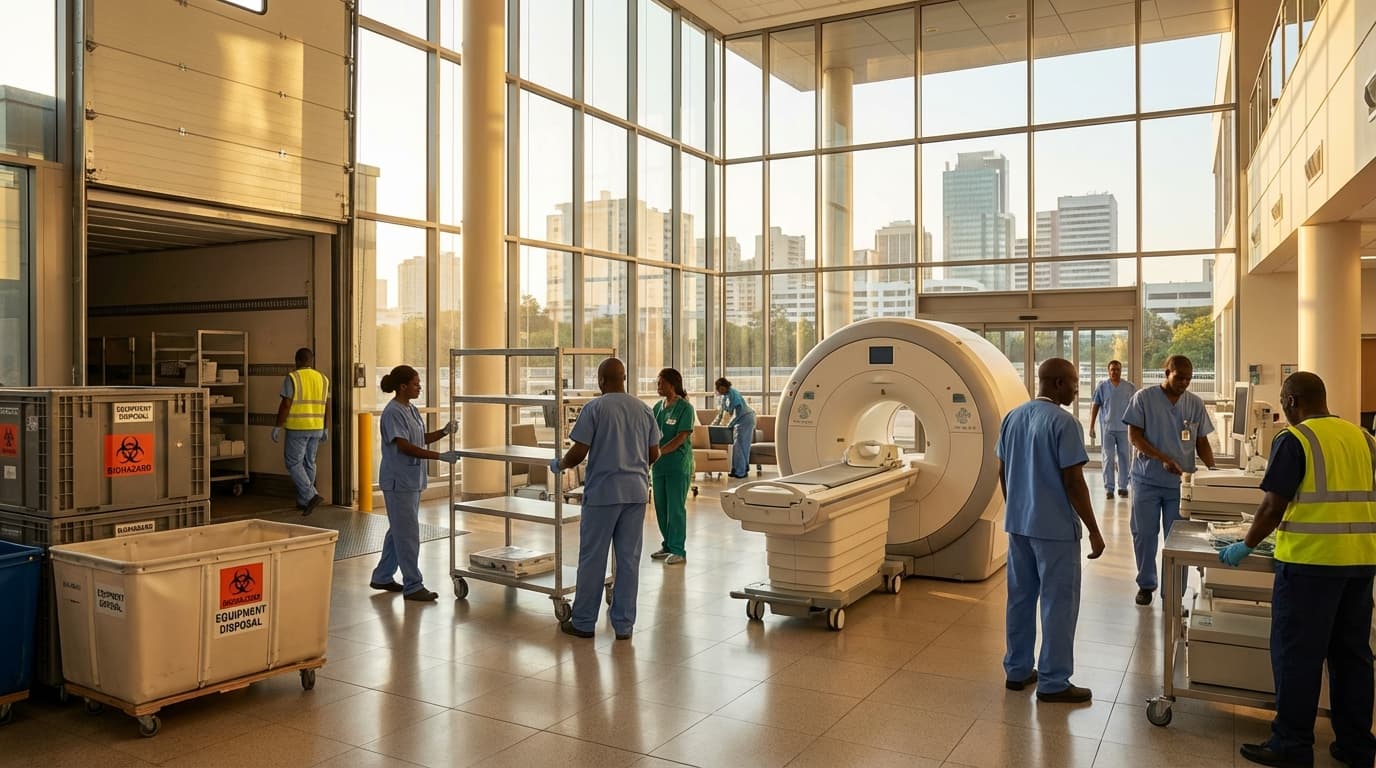
Heavy Medical Equipment De-Installation Service (MRI/CT/Cath Lab) in Morocco
Engineering Excellence & Technical Support
Heavy Medical Equipment De-Installation Service (MRI/CT/Cath Lab) High-standard technical execution following OEM protocols and local regulatory frameworks.
Shielded Decommissioning & Disposal
Expertly handle the secure de-installation of high-risk medical imaging equipment like MRI, CT, and Cath Labs in Morocco, adhering to strict radiation safety protocols and environmental regulations for compliant decommissioning and certified disposal of components.
Precision Component Extraction & Logistics
Leverage specialized tools and techniques for the precise dismantling of complex medical equipment, ensuring the integrity of valuable components. We manage intricate logistics for safe transport and export from Morocco, minimizing downtime and maximizing asset recovery.
Certified Engineering & Site Remediation
Our certified biomedical engineers possess extensive experience in de-installing advanced medical systems. We provide thorough site assessment, power down, and remediation services, ensuring a clean and safe handover of your facility in Morocco post-de-installation.
What Is Heavy Medical Equipment De-installation Service (Mri/ct/cath Lab) In Morocco?
Heavy Medical Equipment De-Installation Service (MRI/CT/Cath Lab) in Morocco refers to the specialized process of safely and systematically dismantling, packing, and preparing large-scale, complex medical imaging and interventional devices, such as Magnetic Resonance Imaging (MRI) scanners, Computed Tomography (CT) scanners, and Cardiac Catheterization (Cath Lab) systems, for relocation, disposal, or storage within Morocco. This service requires highly trained technicians with expertise in electrical, mechanical, and radiological systems, as well as adherence to stringent safety protocols and regulatory guidelines specific to medical equipment handling and transportation. The de-installation process often involves disassembling multiple components, including superconducting magnets (for MRI), X-ray tubes, patient tables, power supplies, cooling systems, and associated control consoles and infrastructure.
| Who Needs This Service | Typical Use Cases | |||
|---|---|---|---|---|
| Hospitals and Clinics | Relocation of a medical facility to a new site within Morocco. | Upgrading existing MRI, CT, or Cath Lab equipment to newer models. | Consolidating or expanding medical imaging departments. | Temporary removal of equipment for infrastructure upgrades (e.g., building renovations, power system improvements). |
| Medical Equipment Manufacturers and Distributors | Retrieval of equipment for refurbishment or resale. | Decommissioning of equipment under warranty or service contracts. | Transfer of equipment between different branches or service centers. | |
| Medical Equipment Maintenance and Service Companies | Performing de-installation as part of a larger service agreement for clients. | Facilitating equipment upgrades and replacements for their customers. | ||
| Research Institutions and Universities | Moving specialized imaging equipment for research projects or inter-institutional collaboration. | Setting up or dismantling research labs requiring these advanced modalities. | ||
| Government Health Agencies and Public Health Facilities | Relocating or upgrading imaging equipment in public hospitals and health centers across Morocco. | Managing the lifecycle of publicly owned medical assets. |
Key Aspects of Heavy Medical Equipment De-Installation Service
- Site Assessment and Planning: Preliminary evaluation of the equipment's location, accessibility, and the overall site to develop a detailed de-installation strategy, including safety measures and logistical requirements.
- System Shutdown and De-energization: Controlled shutdown of all power sources, including high-voltage and cryogenic systems, following manufacturer-specific procedures to prevent equipment damage and ensure personnel safety.
- Component Disassembly: Expert dismantling of individual sub-systems and components by certified technicians, utilizing specialized tools and techniques to maintain the integrity of each part.
- Shielding Removal: Safe removal of lead shielding or other radiation protection elements associated with CT scanners and Cath Labs.
- Cryogen Management (MRI): Professional handling and safe removal/recovery of liquid helium for MRI systems, adhering to strict safety and environmental regulations.
- Packing and Crating: Secure packing and crating of all disassembled components using appropriate materials to protect them from damage during transit and storage.
- Documentation: Comprehensive documentation of the entire de-installation process, including photographic evidence, component manifests, and condition reports.
- Waste Management: Proper disposal or recycling of any removed materials or obsolete components in accordance with Moroccan environmental laws.
- Logistics Coordination: Collaboration with specialized transport providers for the safe and compliant movement of de-installed equipment.
Who Needs Heavy Medical Equipment De-installation Service (Mri/ct/cath Lab) In Morocco?
Heavy medical equipment de-installation services, such as for MRI, CT scanners, and Cath Labs, are crucial for a variety of healthcare facilities and organizations in Morocco. This specialized service is required during periods of equipment replacement, relocation within or between facilities, or when decommissioning older units. The expertise involved ensures safe and efficient removal, minimizing disruption to patient care and adhering to strict regulatory and safety standards. This is particularly relevant for facilities undergoing upgrades, renovations, or strategic asset management.
| Target Customer/Organization Type | Key Departments Involved | Specific Equipment De-installation Needs |
|---|---|---|
| Public Hospitals (Ministry of Health) | Radiology Department, Cardiology Department, Imaging Services, Biomedical Engineering Department, Facilities Management | MRI, CT Scanners, Cath Labs (often as part of modernization programs or facility upgrades) |
| Private Hospitals and Clinics | Radiology Department, Cardiology Department, Imaging Services, Administration, Facilities Management | MRI, CT Scanners, Cath Labs (for replacements, upgrades, or expansion) |
| University Hospitals and Medical Schools | Radiology Department, Cardiology Department, Biomedical Engineering Department, Research Departments, Facilities Management | MRI, CT Scanners, Cath Labs (for research, training, and clinical service updates) |
| Radiology Centers | Radiology Department, Technical Services, Administration | MRI, CT Scanners (for upgrades, expansions, or closure of older sites) |
| Cardiology Centers | Interventional Cardiology Department, Technical Services, Administration | Cath Labs (for upgrades, replacements, or relocation) |
| Medical Equipment Suppliers and Manufacturers | Technical Support, Logistics, Installation Teams | MRI, CT Scanners, Cath Labs (for end-of-life removal, refurbishment, or relocation of demo units) |
| Healthcare Networks and Groups | Procurement, Biomedical Engineering, Operations Management | MRI, CT Scanners, Cath Labs (across multiple facilities within the network) |
Target Customers and Departments for Heavy Medical Equipment De-Installation Services in Morocco:
- Public Hospitals (Ministry of Health)
- Private Hospitals and Clinics
- University Hospitals and Medical Schools
- Radiology Centers
- Cardiology Centers
- Specialty Medical Imaging Centers
- Medical Equipment Suppliers and Manufacturers (for upgrades/relocations)
- Research Institutions with imaging capabilities
- Healthcare Networks and Groups
- Government Agencies involved in healthcare infrastructure
Heavy Medical Equipment De-installation Service (Mri/ct/cath Lab) Process In Morocco
This document outlines the comprehensive workflow for the de-installation of heavy medical equipment, specifically MRI, CT scanners, and Cath Labs, within Morocco. Our service ensures a safe, efficient, and compliant process from the initial client inquiry through the complete execution of the de-installation. We prioritize minimizing downtime for medical facilities and adhering to all relevant regulations.
| Stage | Description | Key Activities | Deliverables/Outcomes | Responsible Parties |
|---|---|---|---|---|
| The client contacts our service to request de-installation of their medical equipment. This stage involves understanding their needs and providing initial information. | Receive client inquiry (phone, email, website). Discuss equipment type, model, location, and desired timeline. Provide preliminary service overview and potential solutions. | Understanding of client requirements. Initial service feasibility assessment. | Client, Service Provider Sales/Consultation Team |
| A thorough evaluation of the installation site is conducted to identify specific requirements, potential challenges, and develop a detailed de-installation plan. | On-site visit to the medical facility. Assess equipment access points, structural integrity, power requirements, and surrounding environment. Identify necessary tools, equipment, and personnel. Develop a detailed de-installation strategy and timeline. | Detailed site assessment report. De-installation plan outlining procedures, safety protocols, and resource allocation. | Service Provider Technical Team, Site Manager |
| Based on the site assessment and de-installation plan, a comprehensive quotation is provided, followed by contract finalization. | Prepare a detailed quotation including labor, equipment, materials, and any potential unforeseen costs. Present quotation to the client for review and approval. Negotiate terms and conditions. Formalize agreement with a signed contract. | Approved quotation. Signed de-installation contract. | Service Provider Sales/Project Management Team, Client |
| Planning and execution of the safe and compliant transportation of the de-installed equipment from the facility. | Arrange specialized transport vehicles and equipment (e.g., cranes, forklifts). Secure necessary permits and licenses for transportation. Coordinate with traffic authorities if required. Plan optimal routes and schedules. | Secured transportation. Logistics plan with route and schedule. | Service Provider Logistics Team, Transportation Partners |
| The physical de-installation of the medical equipment by our skilled technicians, adhering to strict safety and procedural guidelines. | Isolate and disconnect power and essential services. Disassemble equipment according to manufacturer specifications and de-installation plan. Safely package and secure components for transport. Ensure compliance with environmental and safety regulations. | De-installed and packaged equipment. Safe work environment maintained. | Service Provider Technical Team, Certified Technicians |
| Services provided after the primary de-installation, focusing on site restoration and any necessary follow-up. | Site cleanup and restoration to its original condition (where applicable). Disposal or relocation of removed components as per client agreement. Provide advice on equipment storage or onward shipping. | Restored site. Confirmation of component disposal/relocation. | Service Provider Site Team, Project Manager |
| Comprehensive documentation of the entire process and formal handover to the client. | Prepare detailed de-installation report including photos, checklists, and any incident reports. Provide all relevant documentation to the client. Formal handover of the site and de-installed equipment. | De-installation report. All project documentation. Client sign-off. | Service Provider Project Manager, Client |
Key Stages of the De-Installation Process
- Initial Inquiry and Consultation
- Site Assessment and Planning
- Quotation and Contract Agreement
- Logistics and Transportation Arrangements
- De-Installation Execution
- Post-De-Installation Services
- Documentation and Handover
Heavy Medical Equipment De-installation Service (Mri/ct/cath Lab) Cost In Morocco
De-installing heavy medical equipment like MRI, CT scanners, and Cath Labs is a complex and specialized service. In Morocco, the cost of such services is influenced by several factors, making it challenging to provide a single, definitive price. These installations require expert technicians, specialized tools, careful handling, and adherence to strict safety and regulatory protocols. The pricing reflects the technical expertise, time commitment, potential risks involved, and logistical considerations.
| Equipment Type | Estimated Cost Range (MAD) | Notes |
|---|---|---|
| MRI (Magnetic Resonance Imaging) | 30,000 - 150,000+ | Varies significantly by magnet strength (e.g., 1.5T vs. 3T), size, and vendor. Includes specialized handling of superconducting magnets. |
| CT Scanner (Computed Tomography) | 20,000 - 80,000+ | Cost depends on the number of slices, brand, and complexity. Gantry removal and collimator systems are key cost factors. |
| Cath Lab (Catheterization Laboratory) | 40,000 - 120,000+ | Includes de-installation of imaging equipment, control consoles, patient tables, and associated infrastructure. Can be complex due to integrated systems. |
| X-ray Machines (General Purpose) | 5,000 - 25,000 | Less complex than MRI/CT/Cath Labs, but still requires trained personnel for safe removal of tube heads and support structures. |
| Ultrasound Machines (High-End) | 3,000 - 15,000 | Typically less labor-intensive, but professional de-installation is still recommended for larger or integrated systems. |
Key Pricing Factors for Medical Equipment De-Installation in Morocco:
- Equipment Type and Size: Larger and more complex machines (e.g., high-field MRI) generally incur higher de-installation costs due to their intricate components and weight. CT scanners and Cath Lab equipment also vary significantly in size and complexity.
- Location and Accessibility: The geographical location of the equipment within Morocco and the accessibility of the site for large vehicles and specialized lifting equipment play a crucial role. De-installation in remote areas or in facilities with limited access can increase costs.
- Dismantling Complexity: The degree of disassembly required to safely remove the equipment will impact the labor hours and specialized tools needed. Some equipment may require extensive dismantling into smaller components.
- Disposal or Relocation Needs: If the de-installation includes the disposal of the equipment, environmental regulations and disposal fees will add to the cost. If the equipment is being relocated to another site within Morocco or for export, packing, and transportation logistics will be factored in.
- Technical Expertise and Certification: The need for highly trained and certified technicians with experience in specific medical equipment models is a significant cost driver. Companies with a proven track record and certifications command higher fees.
- Time Constraints and Urgency: Rush de-installations or projects with tight deadlines may incur premium charges.
- Ancillary Services: Additional services such as decontamination, waste removal, electrical isolation, and basic site restoration after removal will contribute to the overall cost.
- Permits and Regulatory Compliance: Depending on the local regulations and the nature of the equipment, specific permits or inspections might be required, adding to the administrative and procedural costs.
- Condition of the Equipment: The existing condition of the equipment, including any existing damage or wear and tear, might necessitate extra precautions or specialized approaches during de-installation, potentially affecting the cost.
Affordable Heavy Medical Equipment De-installation Service (Mri/ct/cath Lab) Options
Our affordable heavy medical equipment de-installation service specializes in the safe and efficient removal of complex machinery like MRI, CT scanners, and Cath Labs. We understand the significant investment these units represent and the critical need for a cost-effective de-installation process. Our goal is to provide a seamless experience, minimizing downtime and maximizing value for your facility. We offer flexible service packages and strategic cost-saving measures to fit diverse budgetary needs.
| Cost-Saving Strategy | Description | Benefit |
|---|---|---|
| Early Booking Discounts | Schedule your de-installation well in advance to secure preferential rates. | Lower overall service cost and better scheduling flexibility. |
| Off-Peak Scheduling | De-installation during non-peak hours or days can reduce labor and logistical costs. | Significant reduction in labor charges and potential for faster service completion. |
| Bundled Services | Combine de-installation with other services like minor site remediation or data wiping to reduce mobilization costs. | Economies of scale and fewer vendor interactions. |
| Clear Site Preparation | Ensure the de-installation area is cleared and accessible before our team arrives. | Minimizes on-site time, reducing labor hours and potential delays. |
| In-House Logistics Coordination | If you have your own trusted transport partners, we can work closely with them to streamline the process. | Potentially negotiate better transport rates and have more control over the logistics phase. |
| Component Salvage Consultation | Discuss options for salvaging reusable parts, which can offset de-installation costs. | Recoup some of the initial investment in the equipment. |
| Detailed Equipment Inventory | Provide a comprehensive inventory of the equipment to be de-installed for accurate quoting. | Avoid unexpected charges and ensure precise service planning. |
Value Bundles for Heavy Medical Equipment De-Installation
- {"title":"Basic De-Install Package","description":"Includes essential de-installation of the main unit and primary components, disconnection of utilities, and basic packaging for transport. Ideal for facilities with in-house logistics or minimal additional requirements."}
- {"title":"Standard De-Install & Logistics Package","description":"Builds upon the Basic package by adding detailed documentation, labeling of all removed components, and coordination with your chosen transport provider. Includes basic site cleanup post-removal."}
- {"title":"Premium De-Install & Comprehensive Support Package","description":"Our most comprehensive offering. Includes all features of the Standard package, plus advanced component breakdown, specialized packaging for sensitive parts, full site restoration, and optional on-site supervision during loading. Ideal for complex de-installations or when minimal on-site disruption is paramount."}
- {"title":"Customizable De-Install Solutions","description":"We can tailor any package to your specific equipment and facility needs. This includes specialized handling for unique models, integration with your existing IT infrastructure de-installation, or specific disposal/recycling coordination."}
Verified Providers In Morocco
In the pursuit of quality healthcare, identifying verified providers is paramount. For those seeking reliable medical services in Morocco, understanding the credentials and benefits of opting for verified providers is crucial. Franance Health has established itself as a benchmark for excellence, ensuring patients receive top-tier care. This section delves into why Franance Health's verified providers stand out as the best choice for your health needs in Morocco.
| Franance Health Verification Component | Benefit to Patients | Indicator of Quality |
|---|---|---|
| Medical License and Certification Verification | Ensures practitioners are legally qualified and possess the necessary expertise. | Legitimacy and Competence |
| Professional Experience Assessment | Guarantees that providers have practical experience in their respective fields. | Practical Skill and Knowledge |
| Facility Compliance and Accreditation | Confirms that healthcare facilities meet essential safety, hygiene, and operational standards. | Safe and Effective Environment |
| Patient Feedback and Reputation Review | Incorporates real patient experiences to ensure consistent high-quality service and patient satisfaction. | Service Excellence and Patient Satisfaction |
| Adherence to Ethical Medical Practices | Upholds the highest ethical standards in patient care, privacy, and professional conduct. | Integrity and Trustworthiness |
Why Choose Verified Providers from Franance Health in Morocco?
- Rigorous Vetting Process: Franance Health employs a stringent selection process to onboard healthcare professionals and facilities. This includes thorough background checks, verification of licenses and certifications, and an assessment of their experience and specialization.
- Commitment to Quality Standards: Verified providers adhere to international and national quality benchmarks, ensuring that the medical care you receive is of the highest standard. This translates to better patient outcomes and a safer healthcare experience.
- Transparency and Trust: Franance Health promotes transparency in healthcare. Verified providers offer clear information about their services, pricing, and medical expertise, fostering trust and enabling informed decision-making for patients.
- Access to Specialized Care: Our network comprises a diverse range of specialists. By choosing verified providers, you gain access to a wide spectrum of medical expertise, from general practitioners to highly specialized surgeons and therapists.
- Patient-Centric Approach: Verified providers are committed to a patient-centric approach, prioritizing individual needs, comfort, and clear communication throughout the treatment journey. This ensures a supportive and empathetic healthcare experience.
- Enhanced Safety Protocols: Adherence to strict hygiene and safety protocols is a non-negotiable aspect of verification. This minimizes risks and ensures a secure environment for all patients.
Scope Of Work For Heavy Medical Equipment De-installation Service (Mri/ct/cath Lab)
This Scope of Work (SOW) details the requirements for the de-installation of heavy medical equipment, specifically Magnetic Resonance Imaging (MRI) scanners, Computed Tomography (CT) scanners, and Cardiac Catheterization (Cath Lab) systems. This document outlines the tasks, technical deliverables, and standard specifications required to safely and efficiently remove the specified equipment from its current location to a designated handover point. The service provider is responsible for all labor, equipment, tools, materials, transportation, and safety protocols necessary for the successful completion of this project.
| Phase | Task Description | Technical Deliverables | Standard Specifications/Requirements |
|---|---|---|---|
| Site Assessment & Survey | Detailed site survey report including access routes, power requirements, space constraints, and potential hazards. | Assessment must be conducted by qualified personnel. Report to include photographic evidence of the site conditions. |
| De-installation Plan Development | Comprehensive de-installation plan including detailed sequence of operations, risk assessment, safety procedures, and resource allocation. | Plan to be reviewed and approved by the client prior to commencement. Must adhere to manufacturer's service manuals and site-specific safety regulations. | |
| Permitting & Approvals | Obtain all necessary permits and approvals from relevant authorities and facility management. | Proof of permits and approvals to be provided to the client. | |
| System Power Down & Safety Lockout | Verification of complete power isolation and application of lockout/tagout procedures. | Lockout/tagout procedures must comply with OSHA or equivalent standards. Verification by a designated client representative. |
| Component Disassembly | Systematic disassembly of all equipment components according to manufacturer specifications. | Use of appropriate tools and techniques to prevent damage. Critical components to be handled with extreme care. | |
| Coolant/Gas Management (MRI/CT) | Safe and controlled removal and containment of cryogens (e.g., helium for MRI) or other specialized gases. | Procedures must comply with environmental regulations and manufacturer guidelines. Trained personnel with appropriate PPE and monitoring equipment required. | |
| Shielding Removal (MRI/CT) | Careful removal and handling of radiation shielding (e.g., lead lining for CT rooms). | Weight and size of shielding to be considered in the lifting plan. Proper containment and disposal procedures. | |
| Cabling & Infrastructure Disconnection | Safe disconnection and labeling of all power, data, and peripheral cables. | Cables to be neatly bundled and labeled for re-installation. Documentation of disconnection points. | |
| Equipment Securing & Protection | All disassembled components to be securely wrapped, padded, and protected for transit. | Use of heavy-duty wrapping materials, bubble wrap, foam, and custom cradles/crates as necessary to prevent damage during handling and transport. | |
| On-site Transportation | Safe and controlled movement of equipment from its installed location to the designated on-site handover point (e.g., loading dock). | Use of appropriate lifting equipment (e.g., gantry cranes, forklifts, pallet jacks) operated by certified personnel. Obstruction-free pathways and safety barricades. |
| Documentation of De-installation | Final de-installation report detailing all tasks performed, any encountered issues, and confirmation of successful component removal. | Report to include date-stamped photographs of each major stage of the de-installation process and final condition of equipment before handover. | |
| Client Sign-off | Formal client acceptance and sign-off of the completed de-installation service. | Sign-off to be provided on a pre-approved de-installation completion form. |
Key Objectives
- Safe and complete de-installation of specified medical equipment.
- Compliance with all relevant safety regulations and manufacturer guidelines.
- Minimization of disruption to hospital operations.
- Accurate documentation of the de-installation process.
- Delivery of equipment to the agreed-upon handover point in a secure and protected state.
Service Level Agreement For Heavy Medical Equipment De-installation Service (Mri/ct/cath Lab)
This Service Level Agreement (SLA) outlines the response times and uptime guarantees for the de-installation of heavy medical equipment, specifically MRI, CT, and Cath Lab systems. This agreement is between [Your Company Name] (hereinafter referred to as "Service Provider") and [Client Name] (hereinafter referred to as "Client").
| Service Category | Response Time (During Business Hours) | Response Time (Outside Business Hours) | Uptime Guarantee (During Scheduled De-installation Window) |
|---|---|---|---|
| MRI De-installation | 1 hour | 2 hours | 99.5% |
| CT Scanner De-installation | 1 hour | 2 hours | 99.5% |
| Cath Lab De-installation | 1.5 hours | 3 hours | 99.0% |
Key Definitions
- Downtime: Any continuous period where the de-installation service is unavailable or cannot be performed due to issues attributable to the Service Provider.
- Response Time: The maximum time allowed for the Service Provider to acknowledge a service request and initiate troubleshooting or dispatch of technicians.
- Resolution Time: The maximum time allowed to resolve the issue preventing de-installation.
- Business Hours: [Specify your company's business hours, e.g., Monday to Friday, 8:00 AM to 5:00 PM Local Time, excluding public holidays].
- Emergency: A critical failure preventing de-installation that has a significant impact on the Client's operations or scheduled timelines.
Frequently Asked Questions

Ready when you are
Let's scope your Heavy Medical Equipment De-Installation Service (MRI/CT/Cath Lab) in Morocco project in Morocco.

Scaling healthcare logistics and technical systems across the entire continent.