
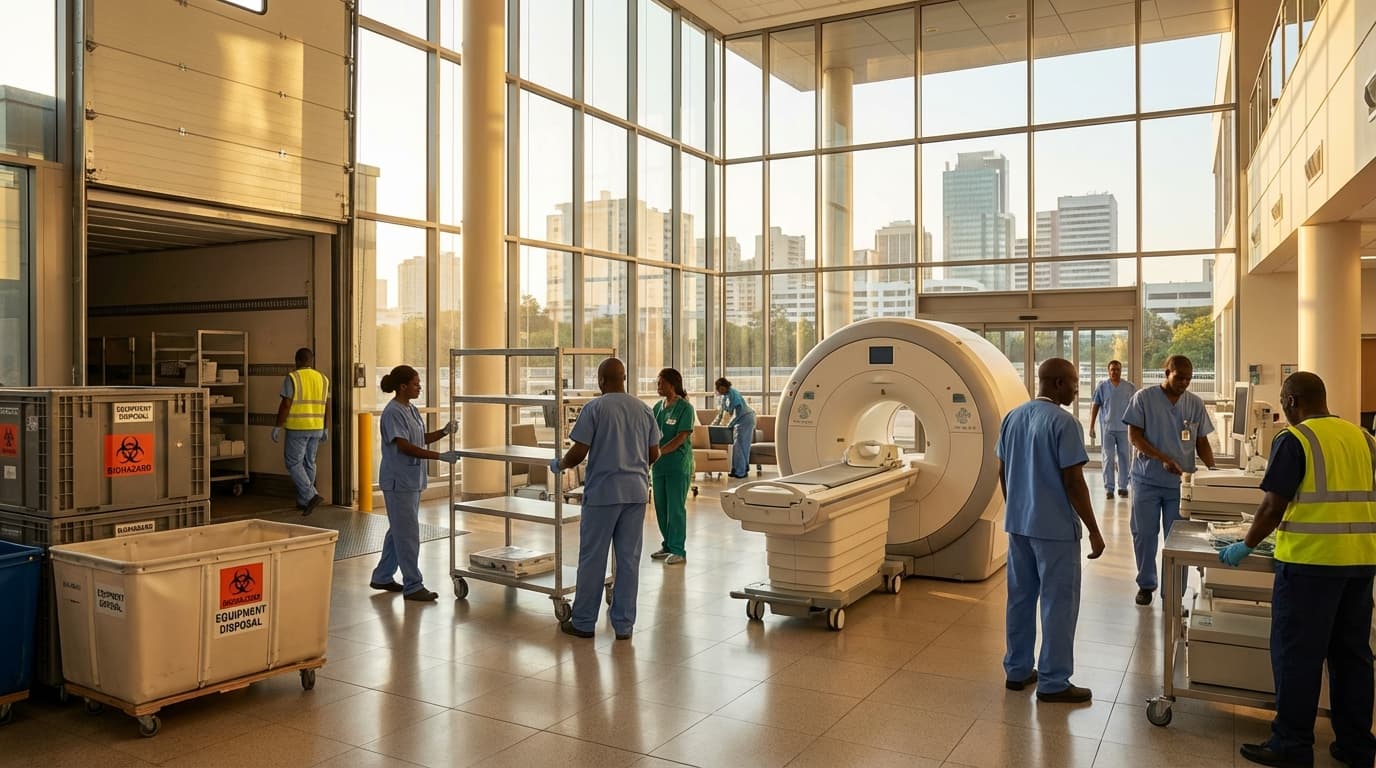
Decommissioning Service for Medical Devices in Morocco
Engineering Excellence & Technical Support
Decommissioning Service for Medical Devices High-standard technical execution following OEM protocols and local regulatory frameworks.
Secure Medical Waste Transport & Disposal
Specialized fleet and trained personnel ensure compliant and secure transportation of decommissioned medical devices, including biohazardous materials, from healthcare facilities across Morocco to certified disposal sites, adhering to stringent environmental and safety regulations.
Data Sanitization & Asset Recovery
Advanced data destruction protocols for medical devices with embedded sensitive patient information, ensuring complete compliance with privacy laws. We also offer ethical asset recovery and recycling services for reusable components, maximizing value and minimizing environmental impact.
Regulatory Compliance & Documentation
Comprehensive expertise in Moroccan healthcare and environmental regulations for medical device decommissioning. We provide meticulous documentation, including certificates of destruction and chain-of-custody records, guaranteeing full auditability and peace of mind for our clients.
What Is Decommissioning Service For Medical Devices In Morocco?
Decommissioning service for medical devices in Morocco refers to the systematic and safe process of retiring medical equipment from active clinical use and the healthcare environment. This encompasses a series of technical, administrative, and regulatory procedures designed to ensure the device is no longer functional, its data is securely managed, and its disposal or repurposing adheres to national and international standards. The primary objectives include preventing unauthorized use, protecting patient data privacy, mitigating environmental risks associated with hazardous materials, and ensuring compliance with Moroccan healthcare regulations.
This service is essential for any healthcare facility operating within Morocco that possesses medical devices nearing the end of their lifecycle, have been replaced by newer technology, are damaged beyond repair, or are no longer supported by the manufacturer. This includes hospitals, clinics, diagnostic centers, research institutions, and potentially even private medical practitioners.
Typical use cases for medical device decommissioning in Morocco involve:
- End-of-Life Management: Devices that have reached their manufacturer's stated lifespan or are no longer economically viable to repair.
- Technological Obsolescence: Replacing older models with advanced, more efficient, or feature-rich equipment.
- Damage or Malfunction: Devices that have sustained significant damage or exhibit persistent, unresolvable malfunctions.
- Regulatory Compliance: Adhering to updated Moroccan Ministry of Health regulations concerning medical device inventory and disposal.
- Data Security: Ensuring the secure erasure or destruction of sensitive patient data stored on the device's internal memory.
- Environmental Stewardship: Proper disposal of potentially hazardous components (e.g., batteries, cathode ray tubes) to prevent environmental contamination.
- Asset Management: Formalizing the removal of assets from the organization's inventory and financial records.
| Stakeholder | Role in Decommissioning | Regulatory Framework (Morocco) |
|---|---|---|
| Healthcare Facilities (Hospitals, Clinics) | Initiate decommissioning, manage internal processes, engage service providers. | Law No. 107-12 relating to the regulation of medical devices, Ministerial Orders from the Ministry of Health. |
| Medical Device Manufacturers/Distributors | Provide technical data, support end-of-life protocols, may offer buy-back or recycling programs. | Not directly involved in disposal, but their product specifications and support lifecycles influence decommissioning timing. |
| Decommissioning Service Providers | Execute the physical and technical aspects of decommissioning, data erasure, hazardous waste management, and documentation. | Must comply with all relevant Moroccan environmental, safety, and data protection laws. |
| Ministry of Health (Morocco) | Establishes regulations, oversees compliance, and may require reporting for specific device types. | Primary regulatory body for medical devices. |
| Environmental Protection Agencies | Enforce regulations on hazardous waste disposal. | Moroccan Ministry of Environment, National Agency for Water and Forests (ONEE). |
Key Stages of Medical Device Decommissioning in Morocco
- Inventory and Identification: Cataloging all devices slated for decommissioning, including model numbers, serial numbers, and location.
- Functional Assessment and Decision Making: Determining whether the device is suitable for resale, donation, recycling, or requires secure destruction.
- Data Eradication: Implementing secure data wiping protocols (e.g., DoD 5220.22-M, NIST SP 800-88) or physical destruction of storage media.
- Environmental Compliance: Segregating and disposing of hazardous materials according to Moroccan environmental laws.
- Documentation and Certification: Maintaining comprehensive records of the decommissioning process, including certificates of destruction or data erasure.
- Regulatory Reporting: Submitting necessary documentation to relevant Moroccan authorities as required.
Who Needs Decommissioning Service For Medical Devices In Morocco?
Decommissioning medical devices in Morocco is a critical process that involves the safe and compliant removal of equipment from service. This service is essential for a variety of healthcare entities and departments that manage medical technology. Proper decommissioning ensures data security, environmental responsibility, and adherence to regulatory standards. The target customers for these services are primarily those who own, operate, or manage medical devices and are nearing the end of their lifecycle or are being replaced. This includes a broad spectrum of organizations within the Moroccan healthcare ecosystem.
| Customer Type | Typical Departments Requiring Decommissioning | Reasons for Decommissioning |
|---|---|---|
| Hospitals (Public and Private) | Radiology, Cardiology, Intensive Care Units (ICU), Operating Rooms (OR), Central Sterilization Supply Department (CSSD), Information Technology (IT - for networked devices), Biomedical Engineering Department | End-of-life, technology upgrade, equipment failure, relocation, regulatory changes, space optimization |
| Clinics and Medical Centers | General Practice, Specialty Clinics (e.g., Dermatology, Ophthalmology), Diagnostic Imaging Units | Similar to hospitals, but often on a smaller scale; replacement with newer models, closure of specific services |
| Diagnostic Laboratories | Biochemistry, Hematology, Microbiology, Pathology Labs | Outdated testing equipment, transition to automated systems, obsolescence of reagents/consumables |
| Research Institutions | Various research departments utilizing specialized medical equipment | Project completion, transition to new research methodologies, equipment no longer meeting research needs |
| Government Health Agencies | Ministry of Health facilities, public health laboratories | Public health initiatives, infrastructure upgrades, standardization of equipment across public health networks |
| Medical Device Manufacturers (for returns/disposal) | Service departments, logistics, product return centers | Faulty units, recalled products, end-of-lease returns, demonstration units |
| Third-Party Equipment Leasing Companies | Asset management, fleet management | End of lease agreements, equipment refurbishment or resale, disposal of unrecoverable assets |
| Educational Institutions with Medical Programs | Simulation labs, teaching hospitals, research facilities | Curriculum updates, replacement of outdated training equipment, research projects concluding |
Target Customers for Medical Device Decommissioning in Morocco
- Hospitals (Public and Private)
- Clinics and Medical Centers
- Diagnostic Laboratories
- Research Institutions
- Government Health Agencies
- Medical Device Manufacturers (for returns/disposal)
- Third-Party Equipment Leasing Companies
- Educational Institutions with Medical Programs
Decommissioning Service For Medical Devices Process In Morocco
This document outlines the workflow for decommissioning medical devices in Morocco, from initial inquiry to final execution. The process is designed to ensure compliance with Moroccan regulations, environmental responsibility, and data security.
| Stage | Description | Key Activities | Responsible Parties | Required Documents |
|---|---|---|---|---|
| The process begins with a client (e.g., a hospital, clinic, or research facility) contacting a licensed decommissioning service provider in Morocco. | Understanding client needs, device types, and quantities. Discussing regulatory requirements. Providing an overview of the decommissioning process. | Client, Decommissioning Service Provider | Initial inquiry form (if applicable), client's internal policies |
| A thorough inspection of the client's premises to assess the devices requiring decommissioning and the site conditions. | On-site visit, detailed inventory of devices (model, serial number, condition), identification of potential hazards (e.g., chemical, biological, radioactive), assessment of access and safety protocols. | Decommissioning Service Provider (Technical Team) | Site survey report, preliminary device inventory |
| Based on the assessment, the decommissioning provider prepares a detailed proposal and quotation for the services. | Defining scope of work, outlining methodologies (e.g., disassembly, sterilization, data wiping), specifying timelines, detailing costs, including waste disposal plan, obtaining client approval. | Decommissioning Service Provider, Client | Detailed proposal, formal quotation, service agreement |
| Ensuring all activities adhere to Moroccan Ministry of Health regulations, environmental laws, and data protection standards. | Obtaining necessary permits and authorizations (if required by the specific device or waste type), confirming client's ownership and right to dispose, preparing all documentation for legal and environmental compliance. | Decommissioning Service Provider (Compliance Officer), Client | Proof of ownership, regulatory approval documentation, data destruction protocols, waste manifest templates |
| The physical process of safely and efficiently removing and preparing the medical devices for disposal or recycling. | Disassembly of devices, secure removal of hazardous components, decontamination (if necessary), data sanitization or physical destruction of storage media, safe packaging and labeling of devices/components. | Decommissioning Service Provider (Technical Team, Certified Technicians) | Method statements, safety plans, chain of custody forms |
| Responsible handling and disposal of all decommissioned devices and their components in accordance with Moroccan environmental regulations. | Segregation of waste streams (e.g., hazardous, non-hazardous, recyclable), transportation to licensed disposal/recycling facilities, adherence to cradle-to-grave tracking. | Decommissioning Service Provider (Logistics Team), Licensed Waste Management Partners | Waste manifests, disposal certificates, recycling certificates |
| Providing the client with comprehensive documentation of the entire decommissioning process and confirmation of compliant disposal. | Issuing a final report detailing all activities, devices decommissioned, methods used, and disposal locations. Providing certificates of destruction, data sanitization, and environmentally sound disposal. Closing the service agreement. | Decommissioning Service Provider | Final decommissioning report, certificates of destruction/disposal, client sign-off |
Key Stages in the Medical Device Decommissioning Process
- Inquiry and Initial Consultation
- Site Assessment and Inventory
- Proposal and Quotation
- Regulatory Compliance and Documentation
- Execution of Decommissioning
- Waste Management and Disposal
- Final Reporting and Certification
Decommissioning Service For Medical Devices Cost In Morocco
Decommissioning medical devices in Morocco involves a range of costs influenced by several critical factors. These factors determine the overall price, making it essential for healthcare facilities to obtain detailed quotes tailored to their specific needs. The process encompasses safe removal, transportation, and disposal or recycling of obsolete or non-functional medical equipment, adhering to strict environmental and safety regulations within Morocco. Costs can vary significantly based on the type and complexity of the device, its size and weight, the required disposal method (e.g., general waste, hazardous waste, recycling), the location of the facility, and the urgency of the service. Specialized equipment, such as large imaging machines or life-support systems, will inherently incur higher decommissioning costs due to the specialized handling, de-installation, and disposal protocols required. The chosen service provider's expertise, licensing, and reputation also play a role in pricing. It's crucial to partner with accredited and experienced decommissioning companies in Morocco to ensure compliance and responsible disposal.
| Device Category | Estimated Cost Range (MAD - Moroccan Dirham) | Notes |
|---|---|---|
| Small Diagnostic Devices (e.g., EKG machines, blood pressure monitors) | 500 - 1,500 MAD | Generally simpler to de-install and dispose of. |
| Mid-Sized Equipment (e.g., laboratory analyzers, portable ultrasound) | 1,500 - 5,000 MAD | May require specialized handling and specific disposal routes. |
| Large Imaging Equipment (e.g., X-ray, CT scanners, MRI machines) | 5,000 - 25,000+ MAD | Involves complex de-installation, potential for hazardous components (e.g., lead shielding), and specialized transport. Costs can escalate significantly. |
| Surgical/Life Support Equipment (e.g., ventilators, anesthesia machines) | 2,000 - 10,000 MAD | Requires careful decontamination and specific disposal protocols, especially if they contain refrigerants or other regulated substances. |
| General Furniture/Ancillary Medical Equipment | 300 - 1,000 MAD (per item/lot) | Simpler disposal, often to general waste or recycling centers if applicable. |
Key Pricing Factors for Medical Device Decommissioning in Morocco
- Type and Complexity of Medical Device
- Size and Weight of the Equipment
- Decommissioning Methodology (Disposal, Recycling, Destruction)
- Hazardous Material Content (e.g., mercury, radioactive isotopes)
- Location of the Healthcare Facility (Accessibility for removal)
- Transportation Costs to Disposal/Recycling Site
- Regulatory Compliance and Certification Fees
- Service Provider's Expertise and Reputation
- Volume of Devices to be Decommissioned
- Urgency of the Decommissioning Service
Affordable Decommissioning Service For Medical Devices Options
Decommissioning medical devices is a critical but often overlooked step in the lifecycle of healthcare equipment. It ensures data security, environmental compliance, and cost-effectiveness. Finding affordable solutions is paramount for healthcare providers operating under tight budgets. This document explores various options for affordable decommissioning services, focusing on the value of bundled services and effective cost-saving strategies.
| Decommissioning Service Option | Description | Value Bundles | Cost-Saving Strategies |
|---|---|---|---|
| On-Site Decommissioning | Service provider dispatches technicians to your facility to perform decommissioning tasks. | Bundled services can include data wiping, physical destruction, asset tagging of retired devices, and on-site reporting. | Schedule regular decommissioning events to consolidate transportation and labor costs. Train in-house staff for basic tasks like unhooking and initial asset identification. |
| Off-Site Decommissioning | Devices are transported to a certified decommissioning facility for processing. | Value bundles may include secure transportation, comprehensive data destruction (including certification), recycling, and refurbishment of viable components. | Negotiate bulk discounts for larger quantities of devices. Explore providers that offer tiered pricing based on device complexity and data sensitivity. |
| Hybrid Decommissioning | A combination of on-site and off-site services, often for large or complex inventories. | Bundles can cover initial on-site data sanitization for high-security items, followed by off-site shredding and recycling of other equipment. | Optimize by performing data wiping on-site for sensitive devices and shipping less critical equipment for off-site processing to reduce on-site technician time. |
| Provider-Specific Trade-In Programs | Manufacturers or authorized resellers offer decommissioning as part of a new equipment purchase. | Bundled within the cost of new equipment, often including data erasure and responsible disposal of old units. | Leverage these programs when upgrading equipment; negotiate favorable terms for decommissioning as part of the overall deal. |
| Independent Certified Recyclers/Disposers | Specialized companies focused on electronics recycling and secure data destruction. | Services often include certified data erasure, demanufacturing, and responsible material recovery, with options for reporting and compliance documentation. | Compare pricing from multiple certified recyclers. Inquire about potential rebates for valuable scrap materials recovered during the recycling process. |
Key Considerations for Affordable Medical Device Decommissioning:
- Data Security and HIPAA Compliance: Ensuring all sensitive patient data is irretrievably destroyed.
- Environmental Regulations: Adhering to local and national guidelines for e-waste disposal.
- Asset Tracking and Inventory Management: Maintaining accurate records of decommissioned devices.
- Cost Control: Minimizing expenses associated with transportation, labor, and disposal fees.
- Scalability: The ability to handle varying volumes of decommissioning projects.
Verified Providers In Morocco
In the realm of healthcare, trust and quality are paramount. When seeking medical services in Morocco, understanding the credentials of healthcare providers is essential. Franance Health stands out as a beacon of reliability, offering a network of verified professionals who adhere to the highest standards of care. Their rigorous vetting process ensures that patients receive not only expert medical attention but also compassionate and ethical treatment. This commitment to excellence makes Franance Health providers the best choice for your health and well-being in Morocco.
| Provider Credential | Franance Health Verification | Benefits for Patients |
|---|---|---|
| Medical Licenses and Certifications | Verified and current | Ensures legitimate and qualified medical practitioners. |
| Professional Experience | Thoroughly reviewed for relevant experience | Guarantees a high level of practical skill and knowledge. |
| Specialty Training and Qualifications | Confirmed and accredited | Provides access to specialized medical expertise for complex conditions. |
| Ethical Conduct and Patient Feedback | Monitored and assessed | Ensures compassionate, trustworthy, and patient-focused care. |
| Continuing Medical Education (CME) | Proof of ongoing professional development required | Ensures providers are up-to-date with the latest medical advancements. |
Why Franance Health Providers are the Best Choice in Morocco:
- Rigorous Verification Process: Franance Health meticulously vets all its affiliated healthcare professionals, ensuring they meet stringent criteria for qualifications, experience, and ethical practice.
- Commitment to Quality Care: Their providers are dedicated to delivering evidence-based medicine and personalized treatment plans, prioritizing patient outcomes.
- Patient-Centric Approach: Franance Health emphasizes a compassionate and respectful approach to healthcare, ensuring patients feel heard, understood, and well-cared for.
- Access to Specialized Expertise: Their network includes a diverse range of specialists, providing access to a broad spectrum of medical services and treatments.
- Adherence to International Standards: Franance Health providers often align with international best practices in healthcare delivery, offering a globally recognized level of care.
Scope Of Work For Decommissioning Service For Medical Devices
This Scope of Work (SOW) outlines the requirements for the decommissioning of medical devices. It covers the technical deliverables, standard specifications, and associated processes to ensure safe, compliant, and environmentally responsible removal and disposal of these assets. The objective is to detail all necessary steps from initial assessment to final documentation, ensuring the integrity of patient data and adherence to regulatory standards.
| Category | Deliverable/Specification | Description | Standard/Regulatory Reference |
|---|---|---|---|
| Site Assessment | Site Survey Report | Detailed report of the site, including device inventory, access routes, power requirements, and any environmental concerns. | Internal Protocols, Client SOPs |
| Site Assessment | Decommissioning Plan | Comprehensive plan detailing the sequence of operations, timelines, resource allocation, safety procedures, and risk mitigation strategies. | Internal Protocols, Client SOPs, ISO 14971 (Risk Management) |
| Data Sanitization | Data Destruction Certificate | Document confirming the complete and irretrievable erasure or destruction of all patient data stored on the device. | HIPAA (Health Insurance Portability and Accountability Act), GDPR (General Data Protection Regulation), NIST SP 800-88 Rev. 1 |
| Data Sanitization | Methodology Documentation | Detailed description of the data sanitization/destruction methods employed (e.g., overwriting, degaussing, physical destruction). | NIST SP 800-88 Rev. 1, Manufacturer's Specifications |
| Physical Removal | Device Decontamination Record | Record confirming that the device has been decontaminated according to relevant health and safety guidelines. | OSHA (Occupational Safety and Health Administration), Local Health Regulations |
| Physical Removal | Asset Tracking and Manifest | List of all devices decommissioned, including serial numbers, asset tags, and destination for disposal/recycling. | Internal Inventory Management, Client Asset Management Systems |
| Physical Removal | Packaging and Transportation Plan | Specifications for safe packaging and transportation of devices, especially if hazardous materials are involved. | DOT (Department of Transportation) Regulations, IATA (International Air Transport Association) Dangerous Goods Regulations (if applicable) |
| Environmental Disposal | Waste Transfer Note/Consignment Note | Legal document accompanying waste shipments, detailing the type of waste, quantity, and disposal facility. | Environmental Protection Agency (EPA) Regulations, Local Waste Management Regulations |
| Environmental Disposal | Recycling Certificate | Document from an accredited recycling facility confirming the responsible processing of device components. | R2 (Responsible Recycling) Standard, e-Stewards Standard |
| Environmental Disposal | Hazardous Waste Disposal Certificate | If applicable, documentation confirming the proper disposal of any hazardous components. | EPA Regulations, Local Hazardous Waste Management Regulations |
| Documentation | Final Project Report | Comprehensive report summarizing all decommissioning activities, including challenges encountered, resolutions, and compliance confirmation. | Client Requirements, Internal SOPs |
| Documentation | Chain of Custody Records | Documentation tracking the movement and handling of devices and their components from origin to final disposal/recycling. | Internal Protocols, Regulatory Requirements |
Key Stages of Medical Device Decommissioning
- Site Assessment and Planning
- Data Sanitization and Destruction
- Physical Disassembly and Removal
- Environmental Disposal and Recycling
- Documentation and Reporting
Service Level Agreement For Decommissioning Service For Medical Devices
This Service Level Agreement (SLA) outlines the response times and uptime guarantees for the Decommissioning Service for Medical Devices provided by [Your Company Name] to [Client Company Name]. This SLA is an addendum to the Master Services Agreement (MSA) dated [MSA Date].
| Service Component | Response Time (Business Hours) | Response Time (24x7) | Uptime Guarantee | Service Credit |
|---|---|---|---|---|
| Decommissioning Service Initiation Request | 4 Business Hours | N/A | N/A | N/A |
| Critical Incident Support | 1 Hour | 1 Hour | 99.9% | 5% of monthly service fee for each 1% downtime below guarantee |
| Major Incident Support | 4 Business Hours | 8 Business Hours | 99.9% | 3% of monthly service fee for each 1% downtime below guarantee |
| Minor Incident Support | 8 Business Hours | 24 Business Hours | 99.9% | 1% of monthly service fee for each 1% downtime below guarantee |
Definitions
- Decommissioning Service: The process of securely and compliantly removing medical devices from service, including data sanitization, physical disposal/recycling, and documentation.
- Downtime: The period during which the Decommissioning Service is unavailable for scheduled or unscheduled events, excluding Scheduled Maintenance.
- Response Time: The maximum time allowed for [Your Company Name] to acknowledge and begin working on a reported Incident.
- Resolution Time: The maximum time allowed for [Your Company Name] to resolve a reported Incident.
- Incident: Any event that causes or may cause an interruption to or a reduction in the quality of the Decommissioning Service.
- Critical Incident: An Incident that renders a significant portion of the Decommissioning Service unusable, impacting patient safety or regulatory compliance.
- Major Incident: An Incident that significantly impacts the Decommissioning Service, but does not pose an immediate threat to patient safety or regulatory compliance.
- Minor Incident: An Incident that has a minimal impact on the Decommissioning Service and can be worked around.
- Scheduled Maintenance: Pre-announced periods during which the Decommissioning Service may be temporarily unavailable for upgrades or planned maintenance. Notification of Scheduled Maintenance will be provided at least [Notification Period, e.g., 48] hours in advance.
- Service Credits: Financial compensation provided to the Client in the event that [Your Company Name] fails to meet the guaranteed uptime levels.
- Business Hours: [Specify Business Hours, e.g., Monday to Friday, 9:00 AM to 5:00 PM Local Time], excluding public holidays.
Frequently Asked Questions

Ready when you are
Let's scope your Decommissioning Service for Medical Devices in Morocco project in Morocco.

Scaling healthcare logistics and technical systems across the entire continent.