
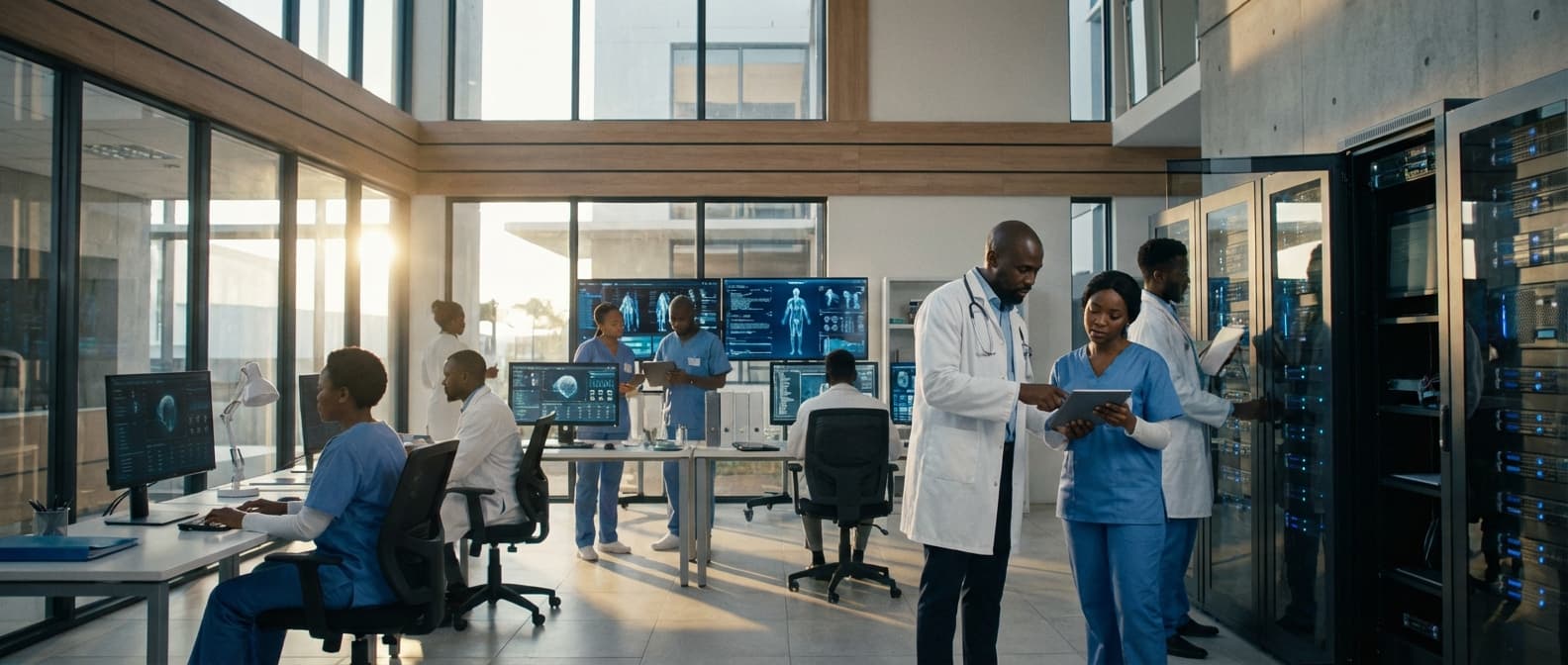
Medical IT Consultation in Morocco
Engineering Excellence & Technical Support
Strategic technology consulting to optimize healthcare operations, streamline workflows, and integrate cutting-edge medical information systems. High-standard technical execution following OEM protocols and local regulatory frameworks.
Cloud Migration & Optimization
Leveraging secure, HIPAA-compliant cloud solutions to enhance data accessibility, scalability, and disaster recovery for Moroccan healthcare providers. We optimize existing cloud infrastructure for cost-efficiency and performance.
Cybersecurity & Data Protection
Implementing robust cybersecurity frameworks and compliance strategies to safeguard sensitive patient data against evolving threats, ensuring adherence to Moroccan and international privacy regulations.
EHR/EMR Integration & Interoperability
Facilitating seamless integration of Electronic Health Records (EHR) and Electronic Medical Records (EMR) systems, promoting data interoperability between disparate systems to improve patient care coordination and operational efficiency.
What Is Medical It Consultation In Morocco?
Medical IT Consultation in Morocco refers to the provision of expert advice, strategic planning, and implementation support concerning information technology within the healthcare sector. This encompasses a broad range of services aimed at optimizing the use of technology to enhance patient care, streamline administrative processes, improve data security, and ensure compliance with national and international healthcare regulations. It involves assessing current IT infrastructures, identifying needs and challenges, and recommending solutions that align with organizational goals and budgetary constraints. The overarching objective is to leverage technology for improved operational efficiency, diagnostic accuracy, patient outcomes, and overall healthcare delivery effectiveness.
| Service Recipient | Needs/Challenges Addressed | Typical Use Cases |
|---|---|---|
| Hospitals (Public & Private) | Legacy system integration, data silos, inefficient patient management, cybersecurity threats, regulatory reporting. | Implementing Electronic Health Records (EHR), optimizing Picture Archiving and Communication Systems (PACS), deploying hospital information systems (HIS), establishing telemedicine platforms, enhancing cybersecurity posture. |
| Clinics & Polyclinics | Limited IT resources, manual record-keeping, lack of patient scheduling efficiency, compliance requirements. | Adopting Electronic Medical Records (EMR), implementing practice management software, setting up secure patient portals, cloud-based IT solutions. |
| Diagnostic Laboratories | Manual result reporting, sample tracking inefficiencies, data integrity concerns, integration with HIS/EMR. | Implementing Laboratory Information Systems (LIS), automating result dissemination, ensuring data accuracy and traceability, integrating with hospital systems. |
| Radiology Centers | Inefficient image archiving and retrieval, lack of remote access to images, interoperability issues. | Deploying PACS, implementing teleradiology solutions, integrating with EMR/HIS, optimizing image storage and retrieval workflows. |
| Pharmaceutical Companies | Clinical trial data management, pharmacovigilance systems, supply chain IT, R&D data analytics. | Developing secure data management platforms for clinical trials, implementing pharmacovigilance software, optimizing supply chain visibility, leveraging data analytics for R&D. |
| Government Health Agencies | Public health data aggregation, disease surveillance systems, health informatics policy development, e-health infrastructure. | Developing national health registries, implementing epidemic surveillance systems, advising on health IT policy, establishing secure data exchange frameworks. |
| Medical Device Manufacturers | Integrating IT into medical devices, data security for connected devices, regulatory compliance for software as a medical device (SaMD). | Designing secure connectivity for IoT medical devices, ensuring compliance with medical device software regulations, developing data transmission protocols. |
Key Aspects of Medical IT Consultation in Morocco
- Needs Assessment and Gap Analysis: Evaluating existing IT systems, infrastructure, and workflows to identify deficiencies and areas for improvement.
- Strategic IT Planning: Developing long-term IT strategies aligned with organizational objectives, including technology roadmaps, budgeting, and resource allocation.
- System Selection and Implementation: Advising on and overseeing the procurement, customization, and deployment of healthcare IT solutions (e.g., EHR/EMR, PACS, LIS, HIS).
- IT Infrastructure Design and Optimization: Recommending and implementing robust network, server, storage, and cybersecurity solutions tailored for healthcare environments.
- Data Management and Analytics: Establishing protocols for data collection, storage, integrity, and utilization for clinical decision support and research.
- Regulatory Compliance and Security: Ensuring adherence to Moroccan healthcare IT regulations, data privacy laws (e.g., GDPR principles applied in a Moroccan context where applicable), and cybersecurity best practices.
- Interoperability Solutions: Facilitating seamless data exchange between different healthcare systems and stakeholders.
- Digital Transformation Initiatives: Guiding healthcare organizations through the adoption of new technologies like telemedicine, AI in diagnostics, and mobile health solutions.
- Training and Change Management: Developing and delivering training programs to ensure effective adoption and utilization of new IT systems by healthcare professionals.
- IT Project Management: Overseeing the planning, execution, and completion of IT projects within healthcare settings.
Who Needs Medical It Consultation In Morocco?
In Morocco's rapidly evolving healthcare landscape, medical IT consultation is becoming indispensable for a wide range of organizations. These services help healthcare providers leverage technology to improve patient care, streamline operations, enhance data security, and ensure compliance with national and international regulations. The demand spans both public and private sectors, with a particular focus on facilities that are either looking to modernize their existing systems or implement new digital solutions. This includes hospitals seeking to integrate electronic health records (EHRs), clinics aiming to optimize appointment scheduling and patient communication, and diagnostic centers looking to enhance imaging and data management. Furthermore, medical IT consultants play a crucial role in cybersecurity, helping to protect sensitive patient data from increasingly sophisticated threats. They also assist in implementing telemedicine solutions, expanding access to healthcare in remote areas, and in ensuring the effective use of medical devices and software.
| Target Customer Segment | Key Needs/Challenges | Relevant Departments/Roles |
|---|---|---|
| Public Hospitals | System integration (EHRs, PACS), cybersecurity, infrastructure upgrades, cost optimization, regulatory compliance, digital transformation strategy. | IT Department, Administration, Clinical Departments, Compliance Officers, Procurement. |
| Private Hospitals | Patient experience enhancement, operational efficiency, revenue cycle management, advanced analytics, competitive technology adoption, data security. | IT Department, Administration, Patient Services, Finance, Clinical Leads, Marketing. |
| Specialty Clinics | Workflow optimization for specific specialties, specialized software integration (e.g., PACS for radiology), patient portal development, telehealth implementation. | Clinic Management, IT Support, Medical Staff, Front Desk/Reception. |
| General Practitioner Clinics | Affordable EHR solutions, appointment management systems, basic cybersecurity, patient communication tools, compliance with local health regulations. | Practice Manager, GP Physicians, Administrative Staff. |
| Diagnostic Laboratories & Imaging Centers | Laboratory Information Systems (LIS), Picture Archiving and Communication Systems (PACS), data integrity, secure data sharing, integration with hospital systems, compliance with medical imaging standards. | Laboratory Director, IT Manager, Radiologists, Technicians, Administration. |
| Medical Research Institutions | Data management and analysis platforms, secure research data storage, compliance with research ethics and data privacy, collaborative research tools. | Research Directors, IT Department, Data Analysts, Principal Investigators. |
| Telemedicine Providers | Platform development and optimization, secure video conferencing, remote patient monitoring integration, data privacy and HIPAA compliance (or equivalent), scalability. | IT Development Team, Operations Manager, Clinical Leads, Cybersecurity Specialist. |
Target Customers for Medical IT Consultation in Morocco
- Public Hospitals
- Private Hospitals
- Specialty Clinics (e.g., cardiology, oncology, pediatrics)
- General Practitioner Clinics
- Diagnostic Laboratories and Imaging Centers
- Medical Research Institutions
- Pharmaceutical Companies (for data management and compliance)
- Healthcare Startups
- Government Health Agencies
- Telemedicine Providers
Medical It Consultation Process In Morocco
The Medical IT Consultation Process in Morocco outlines the systematic workflow undertaken by IT consulting firms to address the technology needs of healthcare organizations within the country. This process is designed to ensure that healthcare providers receive tailored, efficient, and compliant IT solutions that enhance patient care, operational efficiency, and data security. The workflow typically spans from the initial client inquiry to the final execution and ongoing support of implemented IT strategies.
| Stage | Description | Key Activities | Deliverables |
|---|---|---|---|
| Inquiry & Initial Contact | The beginning of the engagement where a healthcare organization expresses interest in IT consulting services. | Receiving inquiry via website, email, phone call, or referral; Initial conversation to understand basic needs and scope. | Confirmation of receipt of inquiry; Scheduling of initial meeting. |
| Needs Assessment & Discovery | A thorough understanding of the client's current IT infrastructure, challenges, goals, and regulatory requirements (e.g., Moroccan health data regulations). | On-site visits or remote interviews; Review of existing systems and documentation; Stakeholder interviews; Analysis of workflows and pain points. | Detailed needs assessment report; Gap analysis; Identification of key requirements. |
| Proposal Development | Based on the assessment, a tailored solution is proposed, outlining the scope of work, methodologies, timelines, and costs. | Defining project objectives and scope; Recommending specific IT solutions (e.g., EHR implementation, cybersecurity upgrades, network infrastructure); Estimating resources and timelines; Costing the project. | Formal proposal document; Detailed project plan; Budget breakdown. |
| Contract Negotiation & Agreement | Formalizing the engagement with a legally binding contract that outlines terms, conditions, and service level agreements (SLAs). | Review and negotiation of proposal terms; Finalizing pricing and payment schedules; Signing of the Service Level Agreement (SLA) and contract. | Signed contract and SLA. |
| Planning & Design | Developing a detailed roadmap for the implementation of the agreed-upon IT solutions. | System architecture design; Software selection or customization; Infrastructure planning; Security policy development; Project management planning. | Detailed design documents; Technical specifications; Project execution plan. |
| Implementation & Deployment | The actual installation, configuration, and integration of the IT solutions within the healthcare organization. | Hardware and software installation; System configuration; Data migration; Integration with existing systems; Network setup. | Deployed IT solutions; Configured systems. |
| Testing & Quality Assurance | Ensuring that the implemented solutions function as intended, are secure, and meet all specified requirements. | Unit testing; Integration testing; User acceptance testing (UAT); Security testing; Performance testing. | Test reports; UAT sign-off. |
| Training & Handover | Equipping the healthcare staff with the knowledge and skills to effectively use the new IT systems. | Developing training materials; Conducting training sessions for end-users and IT staff; Providing system documentation. | Trained staff; User manuals and system documentation. |
| Post-Implementation Support & Optimization | Providing ongoing technical support, maintenance, and continuous improvement of the IT solutions. | Troubleshooting and issue resolution; System monitoring and maintenance; Performance optimization; Regular system updates and upgrades; Strategic IT roadmap adjustments. | Ongoing support services; Performance reports; Optimization recommendations. |
Key Stages of the Medical IT Consultation Process in Morocco:
- Inquiry & Initial Contact
- Needs Assessment & Discovery
- Proposal Development
- Contract Negotiation & Agreement
- Planning & Design
- Implementation & Deployment
- Testing & Quality Assurance
- Training & Handover
- Post-Implementation Support & Optimization
Medical It Consultation Cost In Morocco
Consulting on Medical IT in Morocco involves a range of costs influenced by several key factors. These factors determine the overall investment required for a healthcare organization to leverage technology effectively. The pricing is typically presented in Moroccan Dirhams (MAD).
| Service Type | Estimated Price Range (MAD) | Description |
|---|---|---|
| Initial IT Infrastructure Assessment | 3,000 - 10,000 MAD | Review of current hardware, software, and network for basic suitability and identification of immediate needs. |
| EHR/EMR System Consultation (Selection & Implementation Planning) | 8,000 - 30,000 MAD | Guidance on choosing the right EHR system, vendor selection, and initial planning for deployment. Does not include vendor fees or full implementation. |
| Cybersecurity Strategy for Healthcare | 7,000 - 25,000 MAD | Assessment of current security posture, identification of vulnerabilities, and development of a robust cybersecurity plan tailored for medical data. |
| Telemedicine Platform Consultation | 5,000 - 15,000 MAD | Advice on selecting and integrating telemedicine solutions, platform features, and workflow optimization. |
| Data Management and Analytics Consultation | 6,000 - 20,000 MAD | Strategies for managing patient data effectively, improving data quality, and leveraging analytics for insights. |
| Full-Scale IT Strategy & Digital Transformation | 20,000 - 70,000+ MAD | Comprehensive planning for a complete overhaul or significant upgrade of a healthcare organization's IT ecosystem, including multi-year roadmaps. |
| Hourly Consulting Rate (General) | 300 - 1,000 MAD/hour | For ad-hoc advice, problem-solving, or specific tasks outside of a defined project scope. |
| Daily Consulting Rate (Senior/Specialist) | 2,000 - 5,000 MAD/day | For intensive, on-site work by experienced professionals. |
Key Pricing Factors for Medical IT Consultation in Morocco:
- Scope of Services: The complexity and breadth of the consultation are primary drivers. This can range from a basic assessment of existing infrastructure to the implementation of a comprehensive electronic health record (EHR) system, cybersecurity strategy, or telemedicine platform.
- Consultant's Expertise and Reputation: Highly experienced consultants or specialized firms with a proven track record in healthcare IT, particularly within the Moroccan context, will command higher fees.
- Project Duration: Longer engagement periods naturally increase the overall cost. This is often calculated on a daily or hourly basis.
- Project Complexity and Scale: The size of the healthcare facility (e.g., small clinic vs. large hospital), the number of users, and the number of integrated systems all contribute to complexity and, therefore, cost.
- Technology Stack Involved: The specific IT solutions being considered (e.g., cloud-based EHR, on-premise servers, specialized medical imaging software) will influence the consultation. Integration challenges between different systems also add to the cost.
- Travel and Accommodation (if applicable): For consultants traveling to remote locations or requiring extensive on-site presence, these expenses will be factored into the total cost.
- Deliverables Expected: The level of detail and types of outputs required from the consultation (e.g., detailed reports, implementation roadmaps, training materials) can affect pricing.
- Urgency of the Project: Rush projects may incur premium charges.
- Regulatory Compliance Requirements: Ensuring compliance with local healthcare regulations and data privacy laws (e.g., those related to patient data) can add layers of complexity to the consultation.
Affordable Medical It Consultation Options
Navigating the complex world of medical IT can be daunting, especially for practices seeking to optimize their technology without breaking the bank. Fortunately, several affordable medical IT consultation options exist, focusing on delivering high value and implementing cost-saving strategies. These solutions are designed to address the unique needs of healthcare organizations, from small clinics to larger practices, ensuring improved efficiency, enhanced security, and compliance with regulations like HIPAA.
| Service Component | Typical Cost-Saving Benefit | Value Bundle Example |
|---|---|---|
| Proactive Monitoring & Maintenance | Reduces downtime, prevents costly emergency repairs | Security & Compliance Package |
| Cloud-Based EHR/Storage | Lower upfront infrastructure costs, pay-as-you-go scalability | EHR Optimization & Cloud Management |
| Remote Help Desk Support | Faster resolution times, reduced travel costs for technicians | Basic Support & Maintenance |
| HIPAA Compliance Audits & Remediation | Avoids hefty fines and legal repercussions | Security & Compliance Package |
| Strategic IT Planning | Aligns technology investments with business goals, avoids wasteful spending | Full-Service IT Management |
| Managed Security Services | Continuous threat detection and prevention, expert oversight without in-house specialists | Security & Compliance Package |
Value Bundles and Cost-Saving Strategies in Medical IT Consultation
- {"title":"Understanding Value Bundles","description":"Value bundles are pre-packaged IT services offered at a fixed price, providing a comprehensive solution for specific needs. They aim to offer cost predictability and ensure all essential IT components are addressed. Bundles often include a combination of support, security, and strategic planning services tailored for the healthcare industry."}
- {"title":"Types of Value Bundles","description":"Bundles can vary widely but commonly include: \n- Basic Support & Maintenance: Routine system checks, help desk support, software updates.\n- Security & Compliance Packages: Firewall management, antivirus, data backup, HIPAA risk assessments, vulnerability scanning.\n- Cloud Migration & Management: Planning and execution of cloud adoption, ongoing cloud infrastructure management.\n- EHR/EMR Optimization: Performance tuning, user training, workflow analysis specific to electronic health record systems.\n- Full-Service IT Management: A holistic approach covering all aspects of IT infrastructure and support."}
- {"title":"Key Cost-Saving Strategies Employed by Consultants","description":"Affordable IT consultants leverage various strategies to keep costs down for their clients while maximizing value."}
- {"title":"Proactive vs. Reactive Support","description":"Focusing on preventative maintenance and early issue detection significantly reduces costly downtime and emergency repairs."}
- {"title":"Leveraging Cloud Solutions","description":"Cloud-based services (e.g., EHR, storage, communication) often have lower upfront costs and scalable subscription models compared to on-premise infrastructure."}
- {"title":"Open-Source Software Exploration","description":"Where appropriate and secure, exploring robust open-source alternatives for certain software needs can reduce licensing fees."}
- {"title":"Strategic Technology Investments","description":"Consultants help identify the most impactful technology upgrades that offer the best return on investment, avoiding unnecessary expenditures."}
- {"title":"Vendor Negotiation and Management","description":"Experienced consultants can negotiate better pricing with IT vendors and manage these relationships effectively."}
- {"title":"Managed Services Agreements (MSAs)","description":"MSAs offer predictable monthly costs for a defined set of IT services, allowing for better budgeting and eliminating surprise expenses. This often includes remote monitoring and management."}
- {"title":"Training and Empowerment","description":"Educating staff on IT best practices and basic troubleshooting can reduce the frequency of support requests and empower users."}
- {"title":"Customized Solutions","description":"Instead of one-size-fits-all, consultants can tailor solutions to specific practice needs, ensuring you only pay for what you truly require."}
Verified Providers In Morocco
In the pursuit of reliable and high-quality healthcare, identifying verified providers is paramount. For those seeking medical services in Morocco, understanding the significance of credentials and why they are the best choice is crucial. This document outlines the hallmarks of verified providers and specifically highlights the Franance Health credentials as a benchmark of excellence.
| Credential Category | Franance Health's Commitment | Why It Matters for Patients |
|---|---|---|
| Licensing and Regulatory Compliance | Franance Health exclusively partners with facilities and practitioners holding valid licenses from the Moroccan Ministry of Health and adhering to all national healthcare regulations. | Ensures legal operation and adherence to fundamental patient safety and quality standards mandated by the Moroccan government. |
| International Accreditation | Where applicable, Franance Health prioritizes partners who have achieved or are pursuing internationally recognized accreditations (e.g., JCI, ISO standards). | Demonstrates a commitment to world-class standards in patient care, safety, and operational efficiency, often exceeding local requirements. |
| Specialist Certifications | All medical professionals affiliated with Franance Health undergo rigorous verification of their specialist board certifications and professional memberships. | Guarantees that patients are treated by highly qualified and experienced specialists in their respective fields, leading to more accurate diagnoses and effective treatments. |
| Advanced Technology and Facilities | Franance Health selects providers equipped with state-of-the-art medical technology and well-maintained facilities. | Facilitates accurate diagnostics, minimally invasive procedures, and a comfortable and safe healing environment, contributing to better patient outcomes. |
| Patient-Centric Approach and Ethics | A core tenet of Franance Health is partnering with institutions that uphold the highest ethical standards and a patient-centric approach to care. | Ensures compassionate treatment, transparency in communication, respect for patient rights, and a focus on individual needs and preferences throughout the healthcare journey. |
What Makes a Healthcare Provider Verified?
- Accreditation by recognized national or international bodies.
- Licensure and compliance with Moroccan Ministry of Health regulations.
- Adherence to strict ethical and professional standards.
- Continuous professional development and training for staff.
- Positive patient feedback and a demonstrable history of positive outcomes.
- Robust quality assurance and patient safety protocols.
Scope Of Work For Medical It Consultation
This Scope of Work (SOW) outlines the services to be provided by [Consultant Name/Company Name] (hereinafter referred to as 'Consultant') to [Client Name/Organization Name] (hereinafter referred to as 'Client') for Medical IT Consultation. The primary objective of this engagement is to assess, recommend, and potentially assist with the implementation of IT solutions that enhance the efficiency, security, and compliance of the Client's healthcare operations. This SOW details the technical deliverables, standard specifications, and project timelines.
| Technical Deliverable | Description | Standard Specifications/Requirements | Estimated Timeline |
|---|---|---|---|
| Current State IT Infrastructure Assessment Report | A comprehensive report detailing the existing IT hardware, software, network infrastructure, security posture, and EMR/EHR system performance. | Includes detailed inventory, vulnerability analysis, performance metrics, and compliance status (e.g., HIPAA, HITECH). | Week 1-2 |
| Gap Analysis Report | Identifies discrepancies between the current IT state and desired future state, focusing on operational efficiency, security risks, and compliance requirements. | Clearly outlines areas needing improvement and potential impact of non-compliance. | Week 3 |
| IT Strategy and Roadmap Document | A high-level strategic plan outlining recommended IT investments, technology adoption, and phased implementation for the next 3-5 years. | Aligns with Client's business objectives, patient care goals, and regulatory requirements. | Week 4 |
| Solution Design Document | Detailed technical specifications for recommended solutions, including hardware, software, networking, cloud services, and security measures. | Includes architecture diagrams, integration plans, data flow diagrams, and vendor recommendations. Must adhere to interoperability standards (e.g., HL7, FHIR). | Week 5-6 |
| Security Policy and Procedure Review/Development | Assessment of existing security policies and development of new or updated policies and procedures to meet industry best practices and regulatory mandates. | Covers access control, data encryption, incident response, business continuity, and disaster recovery. Compliant with HIPAA Security Rule. | Week 5-7 |
| EMR/EHR Optimization Plan | Recommendations for improving the functionality, usability, and data integrity of the Client's Electronic Medical Record/Electronic Health Record system. | Includes workflow analysis, training needs assessment, and potential module enhancements. Aims to improve clinical decision support and patient engagement. | Week 6-7 |
| Implementation Plan (Optional) | A detailed project plan for the implementation of recommended IT solutions, including timelines, resource allocation, and change management strategies. | Defines milestones, critical path, risk mitigation strategies, and communication protocols. | Week 7-8 (if applicable) |
| Post-Implementation Review Report | An evaluation of the implemented solutions against the initial objectives, identifying lessons learned and areas for ongoing optimization. | Includes performance metrics, user feedback, and recommendations for future improvements. | Week 10-12 (if applicable) |
Project Phases and Activities
- Phase 1: Discovery and Assessment
- Phase 2: Strategic Planning and Recommendation
- Phase 3: Solution Design and Specification
- Phase 4: Implementation Support (Optional)
- Phase 5: Post-Implementation Review and Optimization
Service Level Agreement For Medical It Consultation
This Service Level Agreement (SLA) outlines the agreed-upon service levels for Medical IT Consultation, focusing on response times for critical incidents and general support requests, as well as guaranteed uptime for essential IT services.
| Service Category | Response Time Target | Uptime Guarantee | Notes |
|---|---|---|---|
| Critical Incident Support | 15 minutes (acknowledgement) | N/A (Focus on rapid resolution) | 24/7 availability. Aim for resolution within 2 hours for 90% of incidents. |
| High Priority Incident Support | 1 hour (acknowledgement) | N/A (Focus on prompt resolution) | Standard business hours (8 AM - 6 PM, Mon-Fri). After-hours support available for critical systems. |
| Standard Support Request | 4 business hours (acknowledgement) | N/A | Standard business hours (8 AM - 6 PM, Mon-Fri). |
| EHR System Uptime | N/A | 99.9% | Excludes scheduled maintenance windows. Downtime notifications provided 48 hours in advance. |
| PACS System Uptime | N/A | 99.8% | Excludes scheduled maintenance windows. Downtime notifications provided 48 hours in advance. |
| Network Infrastructure Uptime | N/A | 99.95% | Ensures core network connectivity for all medical services. |
Key Definitions
- Critical Incident: An event that causes a complete outage of a core medical IT system (e.g., Electronic Health Record (EHR) system, Picture Archiving and Communication System (PACS)), rendering it unusable for patient care.
- High Priority Incident: An event that significantly impacts the functionality of a medical IT system, affecting multiple users or critical workflows, but not causing a complete outage.
- Standard Support Request: A request for assistance with non-critical issues, configuration changes, or general IT advice.
- Uptime: The percentage of time a specified IT service is operational and accessible.
- Response Time: The time elapsed between the acknowledgement of a support request or incident and the initiation of active troubleshooting or resolution efforts by the IT support team.
Frequently Asked Questions

Ready when you are
Let's scope your Medical IT Consultation in Morocco project in Morocco.

Scaling healthcare logistics and technical systems across the entire continent.