
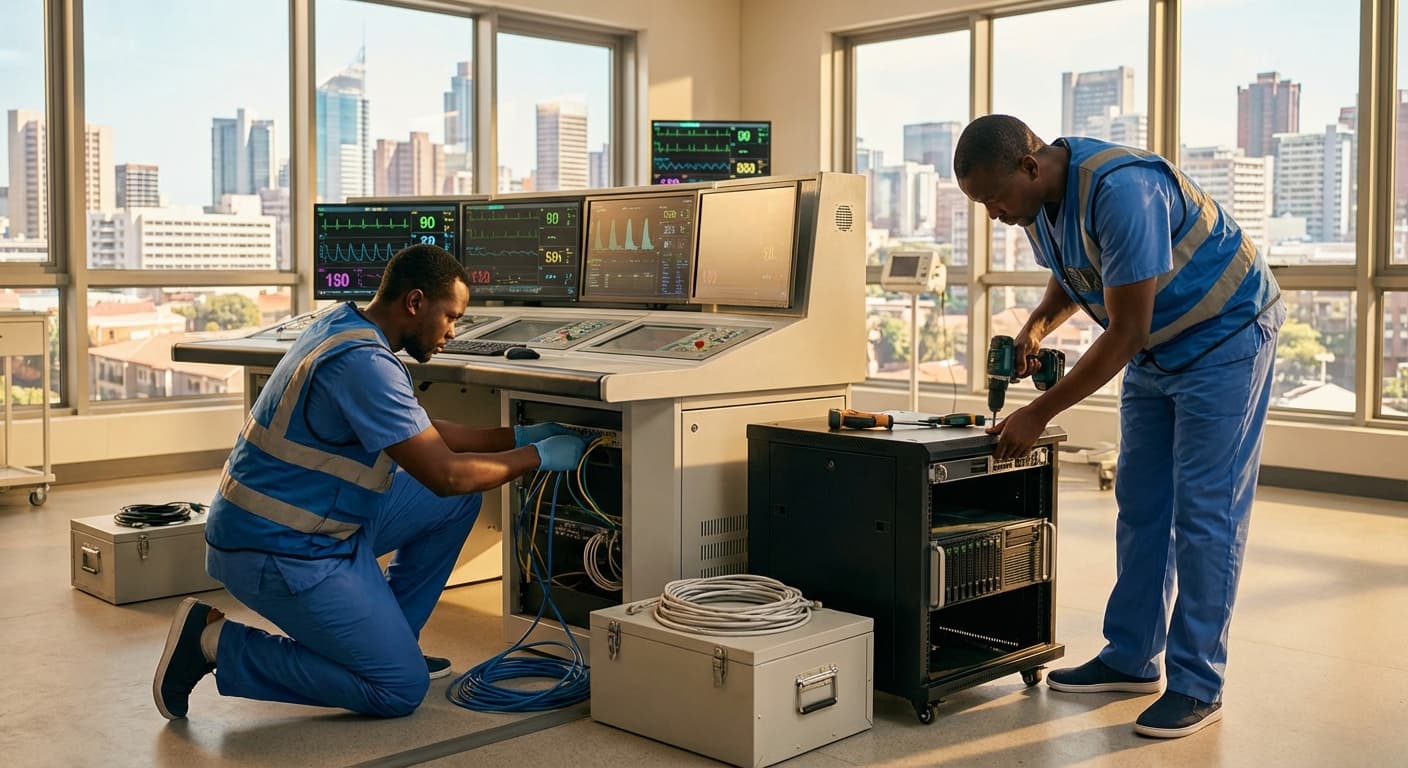
ICU Central Monitoring Station Installation Service in Morocco
Engineering Excellence & Technical Support
ICU Central Monitoring Station Installation Service High-standard technical execution following OEM protocols and local regulatory frameworks.
Advanced Network Infrastructure for Real-time Data
We engineer robust and secure IP-based network architectures specifically designed for high-bandwidth, low-latency transmission of critical patient data from ICU devices to the central monitoring station. Our installations ensure seamless integration and unparalleled reliability, supporting continuous data flow for immediate critical event detection and response.
Tailored Device Integration & Standardization
Our service excels at integrating a diverse range of ICU medical devices (ventilators, monitors, pumps) from various manufacturers into a unified monitoring platform. We implement standardized protocols and custom middleware solutions to ensure all patient vital signs and alarms are accurately and consistently displayed at the central station, regardless of device origin.
Redundant Systems for Uninterrupted Uptime
We design and implement high-availability solutions, including redundant power supplies, network links, and server configurations, to guarantee continuous operation of the ICU central monitoring station. Our focus on fault tolerance ensures that even in the event of a component failure, critical patient data remains accessible and monitoring remains uninterrupted, safeguarding patient safety.
What Is Icu Central Monitoring Station Installation Service In Morocco?
ICU Central Monitoring Station Installation Service in Morocco refers to the comprehensive process of deploying, configuring, and commissioning a centralized hub designed to receive, display, and analyze real-time patient physiological data from multiple Intensive Care Unit (ICU) beds within a healthcare facility. This service ensures that critical patient parameters (e.g., ECG, SpO2, NIBP, respiration, temperature, invasive pressures) are continuously monitored and trended from a single, dedicated location, facilitating early detection of patient deterioration and optimizing clinical response.
| Requirement | Description | Justification | Typical Users |
|---|---|---|---|
| Hospitals with ICUs | Healthcare facilities operating Intensive Care Units with multiple monitored beds. | To enhance patient safety, improve clinical workflow efficiency, and enable proactive patient management in critical care settings. | Critical Care Physicians, ICU Nurses, Respiratory Therapists, Biomedical Engineers. |
| New Hospital Construction/Renovation | Healthcare projects involving the establishment of new ICUs or significant upgrades to existing ones. | Ensures state-of-the-art monitoring capabilities are integrated from the design phase, optimizing space and infrastructure. | Hospital Administrators, Project Managers, Clinical Engineering Departments. |
| Expansion of ICU Capacity | Facilities increasing the number of ICU beds or reconfiguring existing layouts. | Requires scalable and integrated monitoring solutions to manage a larger patient cohort effectively. | Hospital Operations Managers, Clinical Leads. |
| Technological Upgrades | Healthcare institutions seeking to replace outdated or end-of-life central monitoring systems. | To leverage advancements in monitoring technology, improve data accuracy, enhance connectivity, and comply with current medical standards. | Information Technology Departments, Biomedical Departments. |
Key Components and Processes Involved:
- Site Survey and Assessment: Evaluation of existing infrastructure, network capabilities, power requirements, and physical space for the central monitoring station and associated cabling.
- Hardware Installation: Deployment of central monitors, servers, workstations, display screens, network switches, and uninterruptible power supplies (UPS).
- Software Configuration and Integration: Installation and configuration of patient monitoring software, including establishing secure network connections to bedside monitors and Electronic Health Record (EHR) systems for data flow.
- Network Setup and Cabling: Installation of robust and reliable network infrastructure (wired and/or wireless) to ensure seamless data transmission between bedside monitors and the central station.
- System Testing and Calibration: Rigorous testing of data acquisition, display, alarm functionalities, and data archiving to ensure accuracy and reliability.
- User Training: Comprehensive training for clinical staff (nurses, physicians, technicians) on the operation, data interpretation, and alarm management of the central monitoring system.
- Documentation and Handover: Provision of detailed system documentation, including network diagrams, configuration settings, user manuals, and maintenance procedures.
- Ongoing Support and Maintenance: Post-installation support, troubleshooting, software updates, and preventative maintenance services.
Who Needs Icu Central Monitoring Station Installation Service In Morocco?
ICU Central Monitoring Station (CMS) installation services are crucial for healthcare facilities that aim to provide advanced, continuous, and integrated patient care in critical settings. These systems allow for the remote and simultaneous observation of multiple intensive care unit patients' vital signs, enabling faster response times to critical events and optimizing the utilization of nursing staff. In Morocco, the demand for such sophisticated medical technology is growing due to the nation's commitment to modernizing its healthcare infrastructure and improving the quality of critical care services.
| Target Customer Type | Specific Departments/Units | Key Needs/Benefits | Examples in Morocco (Hypothetical/General) |
|---|---|---|---|
| Major University Hospitals | ICU (Intensive Care Unit), CCU (Cardiac Care Unit), NICU (Neonatal Intensive Care Unit), PICU (Pediatric Intensive Care Unit) | Enhanced patient safety, early detection of deterioration, improved workflow for intensivists and nurses, data integration with EMRs (Electronic Medical Records). | e.g., CHU Ibn Sina (Rabat), CHU Hassan II (Fes) |
| Private Tertiary Hospitals | ICU, Post-Anesthesia Care Unit (PACU), Critical Care Units | Competitive advantage through advanced technology, efficient resource allocation, high-quality patient outcomes, specialized care delivery. | e.g., Clinique Internationale Marrakech, Polyclinique Agdal (Rabat) |
| Regional General Hospitals | ICU, Emergency Departments with critical care capabilities | Standardization of care, improved capacity to manage severe cases, support for remote consultation capabilities. | e.g., Hospitals in major cities like Casablanca, Tangier, Agadir. |
| Specialized Cardiac Centers | CCU, Cardiac Surgery ICUs | Continuous monitoring of complex cardiac conditions, immediate alerts for arrhythmias or hemodynamic instability, integration with cardiac diagnostic tools. | e.g., Specialized cardiac units within larger hospitals or dedicated cardiac clinics. |
| Pediatric and Neonatal Centers | NICU, PICU | Precise monitoring of fragile infants and children, integration with specialized neonatal/pediatric equipment, alarm management tailored for vulnerable populations. | e.g., Pediatric wings of university hospitals or dedicated children's medical centers. |
Target Customers and Departments for ICU Central Monitoring Station Installation Services in Morocco
- Hospitals (Public and Private): The primary clients are hospitals that operate intensive care units and wish to upgrade their monitoring capabilities.
- Large Healthcare Networks and Groups: Organizations managing multiple healthcare facilities across Morocco.
- Government Healthcare Initiatives: Facilities established or upgraded under government programs focused on improving critical care access and quality.
- New Hospital Developments: Greenfield projects requiring state-of-the-art ICU infrastructure.
- Existing Hospitals with Outdated Systems: Facilities looking to replace or supplement older, less integrated monitoring solutions.
Icu Central Monitoring Station Installation Service Process In Morocco
This document outlines the typical workflow for installing an ICU Central Monitoring Station service in Morocco, from the initial customer inquiry to the final execution and handover. The process is designed to ensure a smooth and efficient implementation, meeting the specific needs of healthcare facilities.
| Phase | Description | Key Activities | Responsible Parties |
|---|---|---|---|
| The process begins with a healthcare facility expressing interest in an ICU Central Monitoring Station. This phase involves understanding their preliminary needs and providing an overview of the service. | Receive inquiry, conduct introductory meeting, understand basic requirements, answer initial questions. | Client (Hospital/Clinic), Service Provider (Sales/Technical Team) |
| A detailed on-site evaluation to assess the existing infrastructure, identify specific requirements, and determine technical specifications for the monitoring system. | Conduct site survey, assess network infrastructure, power availability, room layout, patient bed count, required monitoring parameters, integration with existing systems (e.g., EMR). | Service Provider (Technical Engineers), Client (IT Department, Biomedical Engineering, Clinical Staff) |
| Based on the site assessment, a comprehensive proposal is developed, outlining the proposed solution, technical specifications, deliverables, timeline, and cost. | Develop detailed technical proposal, create cost breakdown and quotation, present proposal to client for review and feedback. | Service Provider (Sales & Technical Teams), Client (Procurement Department, Management) |
| Formalization of the project through a legally binding contract outlining terms, conditions, scope of work, payment schedule, and service level agreements. | Negotiate contract terms, sign Service Level Agreement (SLA) and Master Service Agreement (MSA), confirm payment terms. | Client (Legal Department, Management), Service Provider (Legal Department, Management) |
| Development of a detailed project plan, including timelines, resource allocation, milestones, and communication protocols. | Create project schedule, define project team roles and responsibilities, establish communication channels and reporting frequency. | Service Provider (Project Manager), Client (Key Stakeholders) |
| Ordering, receiving, and ensuring the timely delivery of all necessary hardware and software components to the installation site in Morocco. | Procure monitoring stations, bedside monitors, sensors, network equipment, software licenses. Manage import/export logistics and customs clearance. | Service Provider (Procurement Team, Logistics Department), Client (Facilitate site access) |
| The physical installation of the central monitoring station and bedside units, along with the configuration of the software to meet the hospital's specific needs. | Install central monitoring server and workstations, connect bedside monitors to the network, install and configure monitoring software, set up user accounts and access permissions. | Service Provider (Installation Technicians, Network Engineers, Software Engineers), Client (Biomedical Engineering, IT Department) |
| Thorough testing of the entire system to ensure all components function correctly and meet performance benchmarks. Validation against defined requirements. | Perform system diagnostics, test data transmission, verify alarm functionalities, conduct functional testing with simulated patient data, perform load testing. | Service Provider (Testing Engineers, Project Manager), Client (Clinical Staff, Biomedical Engineering) |
| Comprehensive training for clinical and technical staff on the operation, maintenance, and troubleshooting of the central monitoring station. Formal handover of the system. | Conduct user training for nurses and physicians, provide technical training for IT and biomedical staff, deliver user manuals and documentation, conduct final system handover. | Service Provider (Trainers, Project Manager), Client (Clinical Staff, IT Department, Biomedical Engineering) |
| Ongoing support to address any issues, perform routine maintenance, and provide updates to ensure optimal system performance and longevity. | Provide helpdesk support, schedule preventive maintenance, offer software updates and upgrades, conduct performance reviews. | Service Provider (Support Team, Maintenance Technicians), Client (IT Department, Biomedical Engineering) |
ICU Central Monitoring Station Installation Service Workflow
- Inquiry & Initial Consultation
- Site Assessment & Requirements Gathering
- Proposal & Quotation Development
- Contracting & Agreement
- Project Planning & Scheduling
- Equipment Procurement & Logistics
- Installation & Configuration
- Testing & Commissioning
- Training & Handover
- Post-Installation Support & Maintenance
Icu Central Monitoring Station Installation Service Cost In Morocco
Installing an ICU central monitoring station in Morocco involves a range of costs influenced by several key factors. These factors collectively determine the final price, making it essential for healthcare facilities to understand them when budgeting for such a critical infrastructure upgrade. The complexity of the system, the number of patient monitoring beds integrated, the specific brand and technological features of the equipment, and the required level of integration with existing hospital IT infrastructure are all significant drivers of cost. Furthermore, the scope of the installation service, including site preparation, cabling, software configuration, system testing, and ongoing maintenance agreements, will also impact the overall investment. The expertise and reputation of the installation provider, as well as their geographical location within Morocco, can also play a role in pricing.
| Cost Component | Typical Price Range (MAD - Moroccan Dirham) | Notes |
|---|---|---|
| Central Monitoring Station Hardware (Server, Workstations, Displays) | 50,000 - 250,000+ | Varies greatly based on brand, processing power, and number of displays. |
| Patient Monitor Units (for each bed) | 15,000 - 60,000 per unit | Depends on parameters monitored (ECG, SpO2, NIBP, invasive BP, etc.) and brand. |
| Network Infrastructure (Cabling, Switches, Routers) | 10,000 - 50,000+ | Dependent on the size of the ICU and existing network capacity. |
| Software Licensing (for monitoring, data management, reporting) | 20,000 - 150,000+ | Perpetual licenses or subscription models. Features like EMR integration increase cost. |
| Installation and Configuration Services | 25,000 - 100,000+ | Includes physical setup, network configuration, software deployment, and initial testing. |
| Site Preparation (if required) | 5,000 - 30,000+ | Includes electrical work, ventilation, and potentially structural modifications. |
| Staff Training | 5,000 - 20,000+ | Covers operation of the central station and patient monitors. |
| Warranty and Annual Maintenance Contract (AMC) | 10% - 15% of total equipment cost annually | Essential for ongoing support and system upkeep. |
| Total Estimated Project Cost (Small to Medium ICU) | 200,000 - 800,000+ | This is a broad estimate and can vary significantly. |
| Total Estimated Project Cost (Large ICU with advanced features) | 800,000 - 2,500,000+ | For comprehensive systems with high bed counts and advanced integration. |
Key Pricing Factors for ICU Central Monitoring Station Installation in Morocco:
- System Complexity and Scalability
- Number of Patient Monitoring Beds
- Equipment Brand and Technology Features
- Integration with Existing Hospital IT (HIS/EMR)
- Scope of Installation Services
- Site Preparation and Infrastructure Needs
- Software Licensing and Configuration
- Training for Hospital Staff
- Warranty and Ongoing Maintenance Contracts
- Provider's Expertise and Reputation
- Geographical Location within Morocco
Affordable Icu Central Monitoring Station Installation Service Options
Establishing an Intensive Care Unit (ICU) Central Monitoring Station is a critical investment for any healthcare facility. It enhances patient safety, streamlines workflow, and optimizes resource allocation. This guide explores affordable installation service options, focusing on value bundles and cost-saving strategies to ensure you get the most out of your budget.
| Value Bundle Option | Description | Potential Cost Savings (vs. A La Carte) | Ideal For |
|---|---|---|---|
| Basic Essentials Bundle | Includes core monitoring software, essential hardware (server, workstations), basic network setup, and initial staff training. Focuses on fundamental monitoring capabilities. | 10-15% | Smaller ICUs, facilities with existing network infrastructure, budget-conscious organizations. |
| Integrated Workflow Bundle | Builds upon the basic bundle by integrating with existing EMR/EHR systems, advanced alarm management, and potentially nurse call system integration. Enhances data flow and response times. | 15-20% | Medium to large ICUs, facilities seeking to optimize clinical workflows and reduce manual data entry. |
| Comprehensive Care Bundle | The most robust option, including all features of the integrated bundle plus advanced analytics, remote monitoring capabilities, integration with diagnostic equipment, and extended training programs. Offers a complete solution for complex ICU environments. | 20-25% | Large, high-acuity ICUs, research-focused institutions, organizations prioritizing advanced data insights and patient outcomes. |
Key Components of an ICU Central Monitoring Station Installation:
- Central Monitoring Software & Hardware Acquisition
- Network Infrastructure Setup & Integration
- Workstation & Display Configuration
- Physician & Nurse Call System Integration
- Data Archiving & Retrieval Solutions
- Training for Medical & IT Staff
- Ongoing Maintenance & Support Services
Verified Providers In Morocco
Ensuring access to reliable healthcare is paramount, especially when navigating a foreign healthcare system. In Morocco, discerning verified providers is crucial for peace of mind and optimal patient outcomes. Franance Health stands out as a leading platform dedicated to connecting individuals with rigorously vetted and highly qualified healthcare professionals. Their comprehensive credentialing process guarantees that all listed providers meet the highest standards of medical expertise, ethical practice, and regulatory compliance within Morocco. Choosing Franance Health means opting for transparency, trust, and a superior healthcare experience.
| Provider Type | Key Franance Health Credentials Verified | Benefits for Patients |
|---|---|---|
| Medical Doctors (General Practitioners & Specialists) | Valid Moroccan Medical License, Specialization Certifications, Hospital Affiliations, Peer Reviews, Criminal Background Checks | Accurate diagnosis, effective treatment plans, access to specialized care, trusted medical advice. |
| Hospitals & Clinics | Accreditation by Moroccan Ministry of Health, Compliance with Safety & Hygiene Standards, Availability of Advanced Medical Equipment, Qualified Nursing Staff | Safe and sterile environments, access to state-of-the-art technology, comprehensive medical services, high-quality patient care. |
| Dentists & Dental Clinics | Dental Practice License, Specialization in Dentistry, Compliance with Sterilization Protocols, Use of Modern Dental Equipment | Oral health expertise, advanced dental procedures, comfortable and hygienic dental treatment. |
| Pharmacies | Official Pharmacy License, Verified Pharmaceutical Inventory, Qualified Pharmacists | Authentic medications, professional pharmaceutical advice, safe dispensing practices. |
Why Franance Health Providers Are the Best Choice:
- Rigorous Verification Process: Franance Health employs an exhaustive vetting system, scrutinizing each provider's licenses, certifications, educational background, and professional history.
- Expert Medical Professionals: Access a curated network of doctors, specialists, and healthcare facilities renowned for their expertise and commitment to patient care.
- International Standards of Care: Providers listed on Franance Health adhere to international best practices and ethical guidelines, ensuring quality treatment.
- Streamlined Access: Franance Health simplifies the process of finding and booking appointments with trusted Moroccan healthcare providers.
- Patient Testimonials and Reviews: Gain confidence through authentic feedback from other patients who have benefited from Franance Health's network.
Scope Of Work For Icu Central Monitoring Station Installation Service
This Scope of Work (SOW) outlines the requirements for the installation service of an Intensive Care Unit (ICU) Central Monitoring Station (CMS). The service includes the supply, installation, configuration, testing, and commissioning of all hardware and software components necessary for a fully functional ICU CMS. The objective is to provide a reliable and efficient system for real-time patient monitoring, alarm management, and data trending, enhancing patient care and clinical decision-making within the ICU.
| Technical Deliverable | Description | Standard Specification / Requirement |
|---|---|---|
| Central Monitoring Station (CMS) Server | The central server that aggregates and processes patient data from all connected ICU beds. | High availability, redundant power supplies, enterprise-grade hardware, sufficient processing power (e.g., Intel Xeon equivalent or higher), RAM (e.g., 32GB or more), and storage (e.g., RAID configuration with SSDs for OS and application, large capacity HDDs for historical data). Operating System: Latest stable version of Windows Server or Linux. |
| CMS Workstations | Operator workstations for nurses and physicians to view patient data, manage alarms, and access historical trends. | High-resolution monitors (e.g., 24-inch or larger, 1920x1080 resolution or higher), robust workstations (e.g., Intel Core i5/i7 equivalent or higher, 16GB RAM, SSD for OS). Support for multiple concurrent users. Ergonomic design considerations. |
| Network Infrastructure | All necessary cabling, switches, and network configuration to ensure reliable and secure data transmission. | High-speed Ethernet (Gigabit or higher), dedicated VLAN for monitoring traffic, secure network protocols (e.g., TLS/SSL), adherence to hospital IT security policies. Sufficient port density on switches for all connected devices. CAT6a or higher cabling. |
| Patient Monitoring Devices Interface Modules | Hardware or software interfaces that connect bedside monitors to the CMS. | Compatibility with existing bedside monitor models (e.g., Philips, GE Healthcare, Nihon Kohden, etc.). Support for standard communication protocols (e.g., HL7, HL7-FHIR, DICOM). Secure data transfer. |
| Alarm Management System | Software and hardware components for intelligent alarm notification, prioritization, and escalation. | Configurable alarm thresholds, audible and visual alarms on CMS workstations and potentially bedside units, integration with hospital communication systems (e.g., pagers, mobile devices), alarm log with timestamps and acknowledgement information. Compliance with relevant alarm management standards. |
| Data Archiving and Retrieval System | Secure storage and retrieval of historical patient monitoring data. | Scalable storage solution, long-term data retention capabilities (e.g., 1-5 years or as per hospital policy), efficient data retrieval for trending and analysis. Encrypted data storage. |
| Software Installation and Configuration | Installation and setup of the CMS software, including patient data display, alarm management, trending, and reporting modules. | Latest stable version of the CMS software, user-defined configurations for patient layouts, alarm parameters, and reporting templates. Role-based access control. |
| System Integration and Testing | Verification of seamless data flow and functionality between all components. | End-to-end testing including simulated patient data, alarm generation and management, data trending, and reporting. Unit testing, integration testing, and system testing. User Acceptance Testing (UAT). |
| User Training Materials | Comprehensive documentation and training sessions for clinical and IT staff. | User manuals, administrator guides, quick reference guides, hands-on training sessions. Training should cover system operation, alarm management, data interpretation, and basic troubleshooting. |
| As-Built Documentation | Detailed documentation of the final installed system, including network diagrams, hardware specifications, and software configurations. | Accurate representation of the installed system, including all components, their locations, and interconnections. Updated network topology diagrams. |
Key Service Activities
- Site Survey and Assessment
- Equipment Procurement and Delivery
- Installation of Monitoring Devices and Sensors
- Network Cabling and Connectivity
- Server and Workstation Setup
- Software Installation and Configuration
- System Integration and Testing
- User Training
- Documentation and Handover
- Post-Installation Support
Service Level Agreement For Icu Central Monitoring Station Installation Service
This Service Level Agreement (SLA) outlines the response times and uptime guarantees for the installation service of the ICU Central Monitoring Station provided by [Your Company Name] to [Client Name]. This SLA is an integral part of the overall Service Agreement and contract between the parties.
| Service Component | Response Time Target (During Service Hours) | Resolution Time Target (Estimated) | Uptime Guarantee |
|---|---|---|---|
| Emergency Incident Response | Within 1 hour of notification | Within 4 business hours of initiation of troubleshooting | N/A (Focus is on rapid response and resolution) |
| Non-Emergency Incident Response | Within 4 business hours of notification | Within 1 business day of initiation of troubleshooting | N/A (Focus is on timely resolution) |
| System Uptime Guarantee (Post-Installation) | N/A | N/A | 99.5% during the warranty period (excluding scheduled downtime) |
| Scheduled Downtime Communication | Minimum 48 hours notice | N/A | N/A |
Key Definitions
- Installation Service: Refers to the entire process of setting up, configuring, and testing the ICU Central Monitoring Station as per the agreed-upon project scope.
- Central Monitoring Station (CMS): The core system responsible for receiving, displaying, and alerting on patient vital sign data from connected bedside monitors within the ICU.
- Service Hours: [Specify Service Hours, e.g., Monday to Friday, 9:00 AM to 5:00 PM Local Time, excluding public holidays].
- Emergency Incident: Any critical system failure or malfunction that renders the CMS completely inoperable, impacting the ability to monitor ICU patients.
- Non-Emergency Incident: Any issue that degrades CMS performance or functionality but does not result in complete system failure. This includes, but is not limited to, intermittent connectivity issues, minor software glitches, or performance degradations.
- Scheduled Downtime: Planned maintenance or upgrades for the CMS, communicated to the Client in advance.
- Unscheduled Downtime: Any downtime that is not Scheduled Downtime, including Emergency Incidents and Non-Emergency Incidents that lead to system unavailability.
Frequently Asked Questions

Ready when you are
Let's scope your ICU Central Monitoring Station Installation Service in Morocco project in Morocco.

Scaling healthcare logistics and technical systems across the entire continent.