
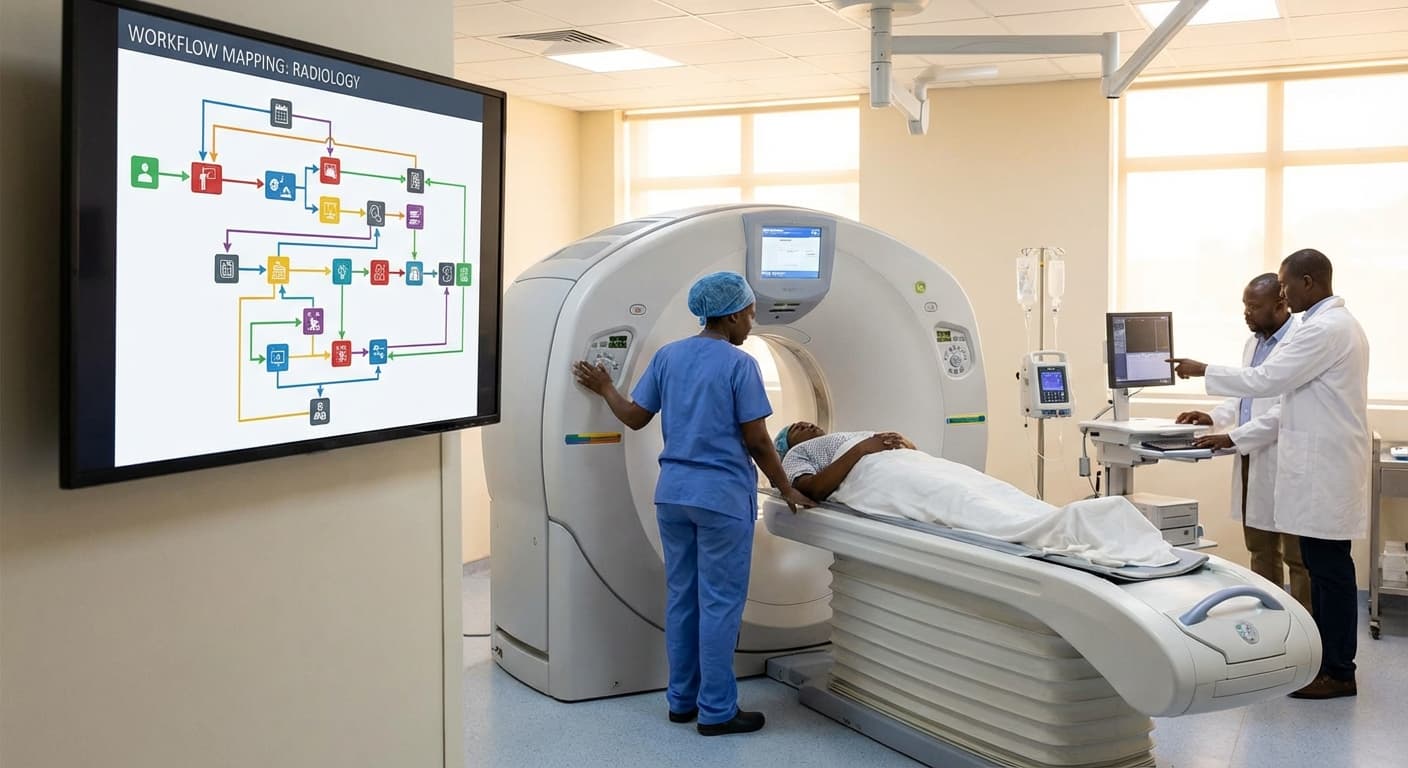
Department Workflow Mapping Service (Radiology/ICU/OT/Lab/Dialysis) in Morocco
Engineering Excellence & Technical Support
Department Workflow Mapping Service (Radiology/ICU/OT/Lab/Dialysis) High-standard technical execution following OEM protocols and local regulatory frameworks.
Streamlined Imaging Pathways (Radiology)
Optimized patient flow and resource allocation within Radiology departments, reducing wait times and improving diagnostic turnaround. Our service maps the entire journey from referral to report, identifying bottlenecks and implementing efficient digital workflows for enhanced patient care and operational efficiency across Moroccan hospitals.
Critical Care Coordination (ICU)
Designed to enhance communication and resource management in Intensive Care Units. We map complex patient pathways, staff handovers, and critical equipment utilization to ensure timely interventions, reduced errors, and improved patient outcomes in high-acuity settings throughout Morocco.
Laboratory Efficiency Enhancement
Mapping laboratory processes from sample collection to final results. Our service identifies areas for automation, quality control improvements, and faster diagnostic reporting, ensuring reliable and timely results for all Moroccan healthcare facilities, contributing to better treatment decisions.
What Is Department Workflow Mapping Service (Radiology/icu/ot/lab/dialysis) In Morocco?
Department Workflow Mapping Service (Radiology/ICU/OT/Lab/Dialysis) in Morocco refers to a structured analytical process aimed at documenting, visualizing, and optimizing the operational sequences and interdependencies within specific hospital departments. This service systematically outlines the patient journey, staff activities, information flow, and resource utilization from admission to discharge or completion of a service. The objective is to identify bottlenecks, inefficiencies, redundant steps, and areas for improvement to enhance patient care quality, operational efficiency, and cost-effectiveness within these critical medical units. The methodology typically involves a combination of interviews with stakeholders, direct observation, process analysis, and the creation of detailed workflow diagrams and standard operating procedures (SOPs).
| Department | Typical Workflow Mapping Focus Areas | Key Improvement Objectives |
|---|---|---|
| Radiology | Patient scheduling and registration, imaging request processing, imaging acquisition protocols, image interpretation and reporting turnaround times, PACS integration, contrast media management, equipment utilization, radiation safety protocols. | Reduced patient wait times for imaging and reports, improved radiologist productivity, enhanced image quality and diagnostic accuracy, optimized equipment scheduling, minimized radiation exposure risks. |
| Intensive Care Unit (ICU) | Patient admission and handover protocols, multidisciplinary team rounds, monitoring and intervention sequences, medication administration, ventilator management, infection control procedures, documentation and communication flows, discharge planning. | Improved patient outcomes, reduced length of stay, enhanced team communication and coordination, minimized adverse events (e.g., infections, falls), optimized resource allocation (staff, equipment). |
| Operating Theatre (OT) | Surgical scheduling and pre-operative assessment, patient preparation and anesthesia induction, surgical procedure steps, instrument and equipment sterilization and management, post-operative recovery and handover, sterile processing workflows. | Optimized surgical schedule adherence, reduced operating room turnover times, minimized surgical site infections, improved surgical team efficiency, enhanced patient safety during surgical procedures. |
| Laboratory | Sample collection and accessioning, test ordering and processing, analytical procedures, quality control and assurance, result validation and reporting, specimen storage and disposal, laboratory information system (LIS) integration. | Reduced turnaround times for lab results, improved accuracy and reliability of test results, minimized pre-analytical errors, optimized reagent and consumable utilization, enhanced LIS functionality and data integrity. |
| Dialysis | Patient scheduling and preparation, dialysis prescription and delivery, monitoring of vital signs and fluid balance, management of access sites, post-dialysis care, equipment maintenance and cleaning, infection control protocols. | Ensured timely and efficient dialysis treatments, optimized patient comfort and safety, minimized complications, improved staff efficiency and workflow, adherence to infection control standards. |
Who Needs This Service?
- Hospital Administrators and Management Teams in Morocco seeking to improve departmental performance and overall hospital efficiency.
- Department Heads and Clinical Leads (Radiology, ICU, OT, Lab, Dialysis) responsible for the operational effectiveness and patient outcomes within their respective units.
- Healthcare IT professionals tasked with integrating new systems or optimizing existing ones to align with optimized workflows.
- Quality Improvement and Patient Safety Officers aiming to reduce errors, improve patient flow, and enhance patient satisfaction.
- Consulting firms and project managers involved in healthcare infrastructure development, renovation, or process re-engineering in Morocco.
- Government health ministries and regulatory bodies overseeing healthcare service delivery standards.
Who Needs Department Workflow Mapping Service (Radiology/icu/ot/lab/dialysis) In Morocco?
In Morocco's evolving healthcare landscape, optimizing operational efficiency is paramount for delivering high-quality patient care. Department workflow mapping services, specifically tailored for critical areas like Radiology, Intensive Care Units (ICU), Operating Theatres (OT), Laboratories, and Dialysis centers, play a crucial role in achieving this. These services identify bottlenecks, streamline processes, improve resource allocation, and ultimately reduce costs and enhance patient outcomes. The need for such services is driven by the desire for greater predictability, reduced errors, and a more seamless patient journey within these specialized departments.
| Target Customer | Key Departments Benefiting | Specific Needs Addressed |
|---|---|---|
| Public Hospitals (e.g., CHU - Centres Hospitaliers Universitaires) | Radiology, ICU, OT, Lab, Dialysis | Managing high patient volumes, resource optimization, standardization of complex procedures, reducing diagnostic turnaround times. |
| Private Hospitals and Clinics | Radiology, ICU, OT, Lab, Dialysis | Competitive advantage through efficient service delivery, patient satisfaction, cost control, implementing best practices. |
| Specialized Medical Centers (e.g., Oncology Centers, Cardiac Centers) | Radiology (for diagnostics/imaging), ICU (for post-operative care), OT (for specific procedures), Lab (for specialized testing) | Integrating complex workflows, ensuring timely and accurate diagnostics, efficient patient management during critical phases of treatment. |
| Diagnostic Imaging Centers | Radiology | Optimizing imaging appointment scheduling, radiologist workflow, report turnaround time, equipment utilization. |
| Clinical Laboratories | Laboratory | Streamlining sample processing, improving test turnaround times, reducing errors, optimizing staff and equipment allocation. |
| Dialysis Centers | Dialysis | Efficient patient scheduling, machine allocation, staff deployment, ensuring patient safety and comfort during treatments. |
| Healthcare Networks and Groups | All listed departments across multiple facilities | Harmonizing workflows across different sites, sharing best practices, achieving economies of scale, ensuring consistent service quality. |
Who Needs Department Workflow Mapping Service (Radiology/ICU/OT/Lab/Dialysis) in Morocco?
- Hospitals and Clinics seeking to improve efficiency and reduce operational costs in specialized departments.
- Healthcare organizations aiming to enhance patient flow and reduce wait times.
- Facilities looking to standardize procedures and ensure consistent quality of care.
- Institutions facing challenges with staff burnout due to inefficient processes.
- Hospitals planning for expansion or the introduction of new technologies.
- Healthcare providers focused on meeting international quality standards and accreditations.
Department Workflow Mapping Service (Radiology/icu/ot/lab/dialysis) Process In Morocco
This document outlines the standard workflow for engaging the Department Workflow Mapping Service for Radiology, Intensive Care Unit (ICU), Operating Theatre (OT), Laboratory, and Dialysis departments within healthcare facilities in Morocco. The service aims to analyze, document, and optimize existing operational processes to enhance efficiency, patient safety, and resource utilization.
| Stage | Description | Key Activities | Responsible Parties | Deliverables |
|---|---|---|---|---|
| Inquiry & Initial Consultation | The initial point of contact where a healthcare facility expresses interest in the workflow mapping service. | Contacting the service provider, scheduling an introductory meeting, discussing general objectives and potential benefits. | Healthcare Facility Management/Department Heads, Service Provider Representatives | Understanding of service offering, preliminary agreement on engagement. |
| Needs Assessment & Scope Definition | A deeper dive to understand the specific challenges and desired outcomes of the facility. | On-site or virtual meetings, interviews with key stakeholders, preliminary walk-throughs of departments, defining specific areas for mapping (e.g., patient flow in ICU, sample processing in Lab). | Service Provider Consultants, Healthcare Facility Management/Department Heads/Key Staff | Detailed project scope, defined objectives, identified departments/processes to be mapped, estimated timeline and resources. |
| Data Collection & Analysis | Gathering comprehensive information about the current state of the workflows. | Observation of daily operations, interviews with frontline staff (nurses, technicians, doctors, administrators), review of existing documentation (SOPs, protocols, forms), time studies, data analysis (e.g., patient wait times, resource utilization). | Service Provider Consultants, Healthcare Facility Staff (facilitating access and providing information) | Raw data, observational notes, collected documents, initial performance metrics. |
| Workflow Mapping & Documentation | Visually representing the current processes and documenting them in detail. | Creating process flowcharts (e.g., using BPMN), documenting roles and responsibilities, identifying decision points and dependencies, detailing handoffs between departments/individuals. | Service Provider Consultants | Detailed process maps (visual and narrative), documented standard operating procedures (current state). |
| Gap Identification & Recommendation Development | Analyzing the documented workflows to identify inefficiencies, bottlenecks, and areas for improvement. | Benchmarking against best practices, identifying deviations from optimal processes, brainstorming potential solutions, developing specific recommendations for process optimization, technology integration, or training. | Service Provider Consultants, potentially with input from Healthcare Facility Quality/Improvement Teams | List of identified gaps/inefficiencies, proposed recommendations for improvement (short-term and long-term). |
| Report Presentation & Validation | Presenting the findings and recommendations to the healthcare facility for review and feedback. | Formal presentation of the workflow analysis report, Q&A session with stakeholders, incorporating feedback and making necessary revisions. | Service Provider Consultants, Healthcare Facility Management/Department Heads/Key Staff | Finalized workflow mapping report with validated recommendations. |
| Implementation Support (Optional) | Assisting the facility in putting the recommended changes into practice. | Developing implementation plans, providing training to staff on new processes, facilitating pilot testing of new workflows, providing ongoing guidance and troubleshooting. | Service Provider Consultants, Healthcare Facility Implementation Team/Staff | Implemented changes, trained staff, initial feedback on new processes. |
| Follow-up & Evaluation (Optional) | Assessing the impact of the implemented changes and identifying further areas for refinement. | Measuring key performance indicators (KPIs) post-implementation, conducting follow-up audits, gathering feedback on the effectiveness of the changes, providing recommendations for continuous improvement. | Service Provider Consultants, Healthcare Facility Quality/Improvement Teams | Evaluation report, data on improved KPIs, recommendations for ongoing optimization. |
Workflow Stages
- Inquiry & Initial Consultation
- Needs Assessment & Scope Definition
- Data Collection & Analysis
- Workflow Mapping & Documentation
- Gap Identification & Recommendation Development
- Report Presentation & Validation
- Implementation Support (Optional)
- Follow-up & Evaluation (Optional)
Department Workflow Mapping Service (Radiology/icu/ot/lab/dialysis) Cost In Morocco
Understanding the cost of Department Workflow Mapping services in Morocco, particularly for critical areas like Radiology, ICU, OT (Operating Theatre), Lab, and Dialysis, involves several key pricing factors. These services are essential for optimizing efficiency, identifying bottlenecks, and improving patient care within these high-stakes departments. The cost is not a fixed figure but rather a variable based on the scope, complexity, and duration of the project, as well as the expertise of the consulting firm or individual providing the service. In Morocco, costs are typically quoted in Moroccan Dirhams (MAD).
| Department Type | Estimated Cost Range (MAD) | Notes |
|---|---|---|
| Radiology | 15,000 - 60,000+ | Complexity depends on imaging modalities, patient throughput, and integration with other departments. |
| ICU (Intensive Care Unit) | 20,000 - 80,000+ | High complexity due to critical care, advanced equipment, and multidisciplinary teams. Extensive data collection and analysis required. |
| OT (Operating Theatre) | 25,000 - 75,000+ | Focus on scheduling, patient flow, sterile processing, and staff coordination. Can vary based on the number of ORs and specialties. |
| Lab (Pathology/Clinical) | 12,000 - 50,000+ | Depends on the volume and complexity of tests, automation levels, and turnaround time requirements. |
| Dialysis | 10,000 - 40,000+ | Relatively standardized processes, but can vary with patient load, machine availability, and patient management protocols. |
| General Hospital Workflow Assessment (Cross-departmental) | 50,000 - 200,000+ | Covers multiple departments and interdepartmental dependencies. Significantly higher cost due to broader scope. |
Key Pricing Factors for Department Workflow Mapping in Morocco:
- Scope and Complexity of the Department: Mapping a highly specialized and complex department like the ICU or OT will inherently be more expensive than a less intricate department due to the number of processes, equipment, and personnel involved. The number of sub-processes and their interdependencies significantly impacts the cost.
- Size and Number of Staff: Larger departments with more staff and patient flow require more extensive observation, data collection, and analysis, thus increasing the overall cost. The geographical spread of a department (e.g., multiple locations within a hospital) also adds to complexity.
- Current State Assessment Depth: The level of detail required in the current state analysis is a major cost driver. This can range from high-level process overviews to in-depth, granular mapping of every single step, including time studies and resource utilization analysis.
- Desired Future State Design: Developing and designing the optimal future state workflow requires significant expertise and iterative refinement. This includes proposing new processes, technology integrations, and organizational changes. The number of proposed improvements and their complexity will influence the price.
- Duration of the Project: Workflow mapping is not a short-term engagement. The longer the project duration, the higher the cost. This includes time for initial consultations, data gathering, analysis, design workshops, validation, and final report generation.
- Consulting Firm's Reputation and Expertise: Established consulting firms with a proven track record in healthcare workflow optimization in Morocco or similar markets will command higher fees than smaller, less experienced providers. Specialized knowledge in specific departments (e.g., medical imaging technology for Radiology) can also be a premium.
- Deliverables Required: The specific outputs expected from the service will impact the cost. This can include detailed process maps, bottleneck reports, efficiency recommendations, training materials, implementation roadmaps, and post-implementation support.
- Technology and Tools Used: Some consultants may utilize specialized software for workflow modeling and simulation, which can add to the overall project cost. However, these tools can also lead to more accurate and efficient analysis.
- Location and Accessibility: While less of a primary driver, the ease of access to the facility and any associated travel and accommodation costs for consultants will be factored in.
- Urgency of the Project: Expedited projects may incur premium charges due to the need for rapid resource allocation and intensified efforts.
- Data Collection Methods: The methods employed for data collection (e.g., direct observation, interviews, surveys, system log analysis) and their intensity will affect the time and resources required.
Affordable Department Workflow Mapping Service (Radiology/icu/ot/lab/dialysis) Options
Our Affordable Department Workflow Mapping Service offers a comprehensive solution to optimize operations in critical hospital departments including Radiology, ICU, Operating Theatre (OT), Laboratory, and Dialysis. We meticulously analyze your existing processes, identify bottlenecks, and propose data-driven improvements to enhance efficiency, reduce errors, and lower costs. Our service provides clear visual representations of your workflows, enabling better understanding and communication across teams. We offer flexible value bundles tailored to your specific needs and provide actionable cost-saving strategies.
| Value Bundle | Description | Key Deliverables | Target Departments | Estimated Price Range (USD) |
|---|---|---|---|---|
| Foundation Workflow Mapping | Basic mapping of core departmental processes. | Core workflow diagrams, initial bottleneck identification. | Radiology, Lab | $1,500 - $3,000 |
| Standard Workflow Optimization | Detailed mapping with focus on efficiency improvements and standardization. | Detailed workflow diagrams, bottleneck analysis with preliminary solutions, standardization recommendations. | Radiology, ICU, OT, Lab | $3,000 - $6,000 |
| Comprehensive Workflow Transformation | In-depth analysis, optimization, and strategic recommendations for significant operational improvements. | Full workflow mapping, root cause analysis of inefficiencies, detailed optimization plans, technology integration suggestions, risk assessment, implementation roadmap. | ICU, OT, Dialysis, Full Hospital Unit | $6,000 - $12,000+ |
| On-Demand Consultation & Refinement | Targeted consultation for specific workflow challenges or refinement of existing maps. | Expert advice, targeted process adjustments, update of existing diagrams. | All Departments | Hourly Rate: $150 - $300 |
Key Features of Our Workflow Mapping Service:
- Comprehensive analysis of existing departmental workflows.
- Identification of inefficiencies, bottlenecks, and areas for improvement.
- Development of clear, visual workflow diagrams (e.g., flowcharts, swimlane diagrams).
- Recommendations for process optimization and standardization.
- Focus on enhancing patient safety and quality of care.
- Data-driven insights for informed decision-making.
- Training and support for implementation of recommended changes.
- Scalable solutions to fit various departmental sizes and complexities.
Verified Providers In Morocco
In the realm of healthcare tourism, identifying reliable and accredited providers is paramount. Morocco, with its burgeoning medical sector, offers a range of facilities and practitioners. Franance Health has established itself as a trusted intermediary, meticulously vetting and partnering with healthcare professionals and institutions in Morocco. Their rigorous credentialing process ensures that patients seeking medical treatment in Morocco are connected with providers who meet the highest standards of quality, safety, and ethical practice. This commitment to verification makes Franance Health the optimal choice for those prioritizing a secure and effective healthcare journey.
| Credential Category | Franance Health's Verification Standard | Patient Benefit |
|---|---|---|
| Medical Licenses and Certifications | Ensures all practitioners hold valid and up-to-date professional licenses and specialized certifications. | Guarantees that treatments are administered by qualified and legally permitted professionals. |
| Professional Experience and Specialization | Confirms extensive experience in relevant medical fields and specialized training. | Provides access to highly skilled doctors with proven expertise in specific treatments. |
| Hospital and Clinic Accreditation | Verifies that partner facilities meet national and/or international accreditation standards (e.g., ISO, JCI equivalent). | Ensures access to state-of-the-art facilities with robust quality management and patient safety systems. |
| Patient Testimonials and Feedback | Collects and analyzes anonymized patient feedback to gauge satisfaction and identify areas of excellence. | Offers insights into the provider's patient care quality and overall experience. |
| Ethical Practice and Compliance | Confirms adherence to ethical medical codes and relevant Moroccan healthcare regulations. | Assures patients of fair treatment, privacy, and professional conduct. |
Why Franance Health is the Best Choice for Verified Providers in Morocco
- Rigorous Vetting Process: Franance Health employs a comprehensive evaluation system to assess the qualifications, experience, and accreditations of all partner providers.
- Focus on Quality and Safety: Prioritizing patient well-being, Franance Health only partners with facilities and doctors that demonstrate a commitment to international quality and safety protocols.
- Transparency and Trust: Franance Health provides clear and accessible information about their verified providers, fostering trust and confidence for patients.
- Streamlined Access to Care: By pre-selecting and verifying providers, Franance Health simplifies the process of finding and booking appointments with reputable healthcare professionals.
- Patient-Centric Approach: The company's core mission revolves around ensuring a positive and successful healthcare experience for every patient.
Scope Of Work For Department Workflow Mapping Service (Radiology/icu/ot/lab/dialysis)
This Scope of Work (SOW) outlines the services to be provided for a comprehensive workflow mapping initiative across key hospital departments: Radiology, Intensive Care Unit (ICU), Operating Theatre (OT), Laboratory, and Dialysis. The primary objective is to thoroughly document, analyze, and optimize existing workflows to enhance efficiency, reduce errors, and improve patient care delivery. This SOW details the technical deliverables and their standard specifications.
| Deliverable | Description | Standard Specification |
|---|---|---|
| Current State Workflow Maps (Per Department) | Detailed visual diagrams illustrating all steps, decision points, roles, and information flow within the existing processes for Radiology, ICU, OT, Lab, and Dialysis. | Utilize industry-standard notation (e.g., BPMN 2.0, ANSI/APICS Flowcharting). Maps will be clear, concise, and easily understandable. Each map will include a legend explaining symbols used. Software used will be specified (e.g., Visio, Lucidchart, Bizagi). A version control system will be implemented. |
| Process Narratives (Per Department) | Textual descriptions accompanying each workflow map, providing further context, details of specific actions, system interactions, and interdependencies. | Narratives will be written in clear, unambiguous language. Each narrative will correspond directly to a section or a specific path within the workflow map. Documented in standard office productivity software (e.g., Microsoft Word, Google Docs). |
| Stakeholder Interviews & Workshops Summary | Documented summaries of key findings, insights, and concerns raised during interviews and workshops with department personnel, clinicians, administrators, and IT staff. | Summaries will capture consensus and divergent views, identified pain points, and suggested improvements. Delivered in a structured report format, organized by department and stakeholder group. |
| Gap Analysis Report | A comprehensive report identifying discrepancies between current state processes and desired future state objectives, best practices, or regulatory requirements. | Report will highlight specific areas of inefficiency, risk, or non-compliance. Includes qualitative and quantitative analysis where applicable. Presented as a formal report document. |
| Key Performance Indicator (KPI) Framework | Definition of measurable metrics for evaluating workflow performance within each department. Examples include turnaround time, error rates, patient wait times, resource utilization. | KPIs will be SMART (Specific, Measurable, Achievable, Relevant, Time-bound). The framework will include baseline current state values and target future state values. Documented in a structured report or spreadsheet format. |
| Initial Future State Recommendations (High-Level) | Conceptual outlines and proposed changes to current workflows based on the gap analysis and identified opportunities for optimization. Not a fully designed future state, but directional recommendations. | Recommendations will be presented as a series of proposed process modifications. Includes rationale and potential benefits. Delivered as a presentation deck and/or a formal report section. |
| Data Dictionary & Glossary | A compilation of terms, definitions, data elements, and abbreviations used within the workflow maps and documentation to ensure consistency. | Ensures common understanding across all project participants. Format: Spreadsheet or dedicated document. |
| Project Status Reports | Regular updates on project progress, milestones achieved, risks, issues, and upcoming activities. | Weekly or bi-weekly reports delivered in a consistent format (e.g., email, project management tool update). Includes dashboard elements where appropriate. |
Objectives of Workflow Mapping Service
- To create accurate and detailed visual representations (flowcharts) of current state processes for each specified department.
- To identify bottlenecks, inefficiencies, redundancies, and potential areas for improvement within existing workflows.
- To define and document key performance indicators (KPIs) and metrics for workflow evaluation.
- To facilitate communication and collaboration among departmental staff, stakeholders, and the implementation team.
- To provide a foundational understanding for the development of future state optimized workflows.
- To ensure adherence to regulatory requirements and best practices relevant to each department.
Service Level Agreement For Department Workflow Mapping Service (Radiology/icu/ot/lab/dialysis)
This Service Level Agreement (SLA) outlines the guaranteed response times and uptime for the Department Workflow Mapping Service provided to the Radiology, Intensive Care Unit (ICU), Operating Theatre (OT), Laboratory, and Dialysis departments. This service aims to optimize departmental processes through comprehensive workflow analysis and documentation.
| Service Component | Response Time Guarantee | Uptime Guarantee | Notes |
|---|---|---|---|
| Initial Workflow Analysis Request Acknowledgement | Within 4 business hours | N/A | Acknowledgement of receipt and initial scoping meeting scheduling. |
| Initial Workflow Mapping Report Delivery | Within 10 business days (per department) | N/A | Delivery of the documented current state workflow and initial findings. |
| Optimized Workflow Proposal Delivery | Within 5 business days of initial report approval | N/A | Delivery of proposed future state workflows based on agreed improvements. |
| Workflow Mapping Service Availability | N/A | 99.5% (during standard business hours) | Standard business hours are defined as Monday to Friday, 9:00 AM - 5:00 PM, excluding public holidays. |
| Urgent Workflow Consultation (post-mapping) | Within 2 business hours | N/A | For critical issues or rapid clarification needs identified after initial mapping. |
| Documentation Updates/Revisions (Minor) | Within 3 business days | N/A | Corrections or minor adjustments to delivered documentation. |
Service Scope and Objectives
- Comprehensive mapping of current state workflows for Radiology, ICU, OT, Lab, and Dialysis.
- Identification of bottlenecks, inefficiencies, and areas for improvement.
- Development of optimized future state workflows.
- Provision of detailed workflow documentation and reports.
- Consultation and support during the implementation phase of revised workflows.
Frequently Asked Questions

Ready when you are
Let's scope your Department Workflow Mapping Service (Radiology/ICU/OT/Lab/Dialysis) in Morocco project in Morocco.

Scaling healthcare logistics and technical systems across the entire continent.