
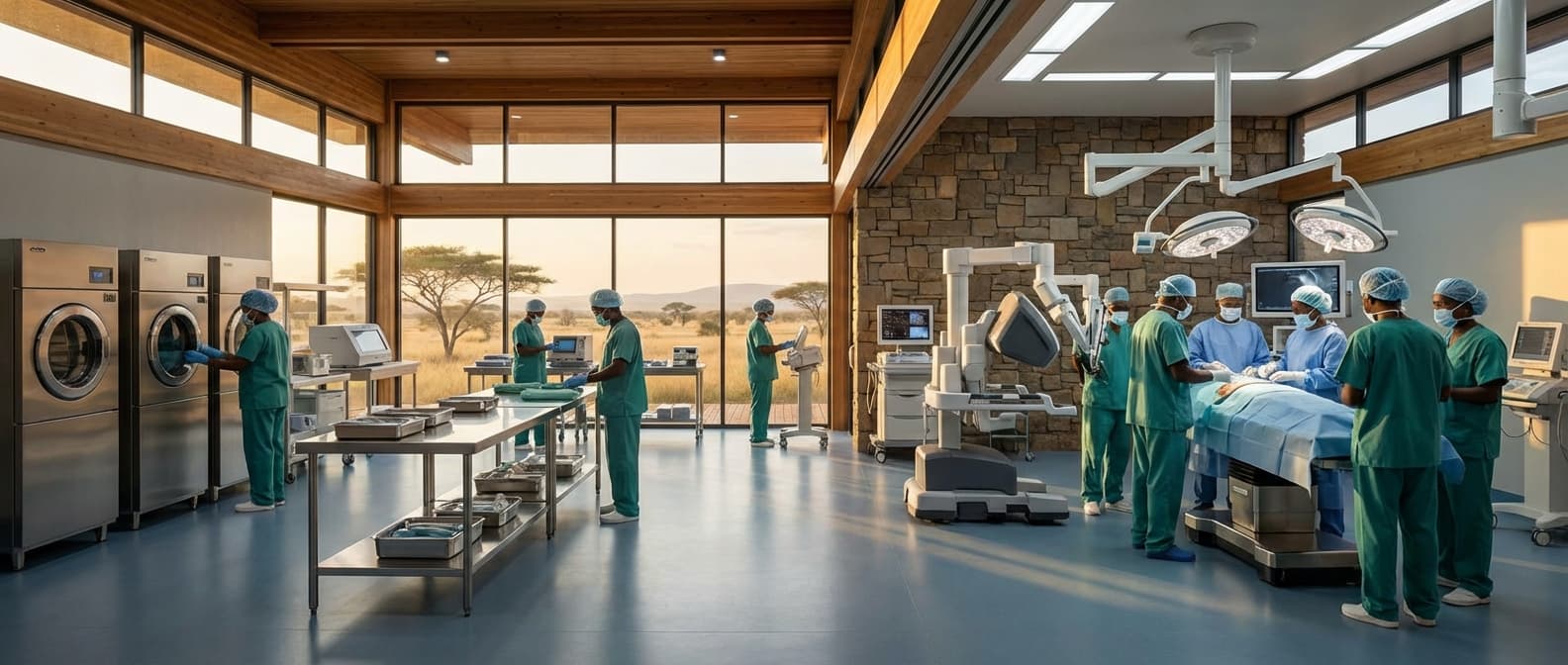
CSSD Design & Validation in Morocco
Engineering Excellence & Technical Support
CSSD workflow design, validation and process development High-standard technical execution following OEM protocols and local regulatory frameworks.
Advanced Sterilization Equipment Integration
Expertise in selecting and integrating state-of-the-art autoclaves, washer-disinfectors, and sterile processing equipment tailored to Moroccan healthcare facility needs, ensuring compliance with international standards and optimal workflow efficiency.
Validation & Decontamination Protocols
Developing and implementing rigorous validation protocols (IQ, OQ, PQ) for CSSD equipment and processes. Specializing in effective decontamination strategies for a wide range of medical instruments, critical for preventing healthcare-associated infections (HAIs) in the Moroccan context.
Infection Control & Safety Design
Designing CSSD layouts and operational workflows that prioritize infection control and staff safety. Implementing best practices for material flow, air pressure differentials, and sterile barrier management to meet the specific demands of healthcare environments in Morocco.
What Is Cssd Design & Validation In Morocco?
CSSD (Central Sterile Services Department) Design and Validation in Morocco encompasses the strategic planning, architectural layout, and subsequent verification processes for facilities dedicated to the decontamination, sterilization, and sterile storage of medical devices. This service is critical for ensuring patient safety, regulatory compliance, and operational efficiency within healthcare settings. It involves a comprehensive approach to defining the functional requirements, workflow optimization, equipment selection, environmental controls, and validation protocols for a CSSD, tailored to the Moroccan regulatory landscape and healthcare infrastructure.
| Who Needs CSSD Design & Validation? | Typical Use Cases |
|---|---|
| Hospitals (Public and Private) | Design of new hospital CSSDs or renovation of existing ones. |
| Surgical Centers and Clinics | Establishing or upgrading sterilization capabilities for specialized procedures. |
| Dental Practices (Large-scale) | Ensuring compliance with sterilization standards for multiple instruments. |
| Medical Device Manufacturers (for reprocessing) | Designing facilities for the reprocessing of reusable medical devices. |
| Government Healthcare Agencies | Developing national guidelines and standards for CSSD operations and facility design. |
| International Aid Organizations | Implementing or upgrading CSSD infrastructure in developing regions of Morocco. |
Key Components of CSSD Design & Validation
- Needs Assessment & Feasibility Study: Evaluating current and future sterilization needs, available space, budget constraints, and regulatory requirements.
- Functional Design & Layout Planning: Optimizing workflows (dirty to clean transitions), space allocation for different processing areas (decontamination, packaging, sterilization, storage), and efficient material flow.
- Equipment Specification & Selection: Defining technical specifications for washer-disinfectors, ultrasonic cleaners, sterilizers (steam, low-temperature, etc.), packaging equipment, and sterile storage solutions.
- HVAC & Environmental Control Design: Establishing appropriate air pressure differentials, temperature, humidity, and air changes per hour (ACPH) for each CSSD zone.
- Plumbing & Utility Requirements: Specifying water quality (purified water), steam generation, electrical power, and drainage systems.
- Waste Management Planning: Integrating procedures for the safe disposal of biohazardous waste.
- Validation Protocol Development: Creating detailed plans for Installation Qualification (IQ), Operational Qualification (OQ), and Performance Qualification (PQ) of all equipment and processes.
- Commissioning & Validation Execution: Overseeing the installation, testing, and documentation of validation studies to confirm that the CSSD meets predefined specifications and regulatory standards.
- Training Program Design: Developing training materials and programs for CSSD personnel on operational procedures, equipment use, and infection control practices.
- Regulatory Compliance Review: Ensuring adherence to Moroccan Ministry of Health regulations, international standards (e.g., ISO 13485, ISO 17665), and best practices in sterilization.
Who Needs Cssd Design & Validation In Morocco?
Central Sterile Supply Departments (CSSDs) are critical hubs within healthcare facilities, ensuring the safety and efficacy of medical procedures through the proper sterilization of reusable medical devices. In Morocco, the demand for expert CSSD design and validation is growing, driven by a commitment to elevate healthcare standards and comply with international best practices. This expertise is essential for facilities aiming to optimize their sterile processing operations, minimize risks of healthcare-associated infections (HAIs), and ensure the longevity and efficiency of their equipment.
| Target Customer Type | Specific Departments/Units within the Facility | Key Needs Addressed by CSSD Design & Validation |
|---|---|---|
| Public Hospitals | Surgical Departments, Intensive Care Units (ICUs), Emergency Departments, Outpatient Clinics, Labor & Delivery Wards, Oncology Units | Ensuring adequate capacity and workflow for high-volume sterilization needs. Compliance with national healthcare regulations. Optimizing space utilization and staff efficiency. Implementing infection control protocols. |
| Private Hospitals & Clinics | Operating Theaters, Specialized Surgical Centers (e.g., Ophthalmology, Orthopedics), Diagnostic Imaging Units, Fertility Clinics | Meeting patient expectations for high-quality care and safety. Enhancing competitive advantage through state-of-the-art facilities. Streamlining processes to improve turnaround times. Investing in advanced sterilization technologies. |
| University Hospitals & Medical Training Centers | Research Laboratories, Teaching Hospitals, Simulation Centers | Providing a safe and reliable environment for medical education and research. Ensuring adherence to strict sterilization protocols for delicate instruments. Training future healthcare professionals on best practices. |
| Specialized Healthcare Facilities | Dialysis Centers, Dental Clinics, Veterinary Hospitals (with surgical services) | Addressing specific sterilization requirements for specialized equipment. Maintaining infection control standards for vulnerable patient populations. Ensuring compliance with regulatory bodies. |
| Medical Device Manufacturers & Suppliers | Research & Development, Quality Assurance, Post-Market Surveillance | Validating sterilization processes for new medical devices. Ensuring devices can be effectively sterilized by end-users. Providing technical support and training on sterilization for their products. |
| Government Health Ministries & Regulatory Bodies | Healthcare Facility Licensing & Accreditation, Public Health Initiatives | Developing and enforcing national standards for CSSD operations. Conducting audits and inspections to ensure compliance. Promoting best practices in infection prevention and control. |
Who Needs CSSD Design & Validation in Morocco? Target Customers & Departments
- The need for specialized CSSD design and validation services in Morocco extends across a spectrum of healthcare providers.
- These services are particularly crucial for facilities seeking to build new CSSDs, renovate existing ones, or ensure their current operations meet stringent quality and safety benchmarks.
Cssd Design & Validation Process In Morocco
The CSSD (Central Sterile Supply Department) Design & Validation Process in Morocco is a comprehensive, multi-stage workflow ensuring that sterile processing facilities meet stringent international and local standards for patient safety and infection control. This process begins with a detailed client inquiry and culminates in a fully validated and operational CSSD. The workflow involves several key phases: initial consultation, conceptual design, detailed design, equipment selection, procurement, installation, commissioning, and finally, validation.
| Phase | Description | Key Activities | Stakeholders Involved | Deliverables |
|---|---|---|---|---|
| Inquiry & Needs Assessment | The initial stage where a healthcare facility expresses interest in designing or upgrading their CSSD. This involves understanding their current needs, future projections, and specific requirements. | Initial meeting, site visit, discussion of capacity, workflow, existing infrastructure, budget, and regulatory expectations. | Client (Hospital Management, CSSD Manager, Biomedical Engineers), Design Consultant. | Needs Assessment Report, Preliminary Requirements Document. |
| Conceptual Design & Feasibility Study | Developing a high-level layout and operational concept for the CSSD, considering workflow, space allocation, and initial budget estimations. | Space planning, preliminary layout drawings, defining functional zones (decontamination, packaging, sterilization, storage), initial equipment list, preliminary cost estimation. | Design Consultant, Client, Architectural Team. | Conceptual Design Report, Feasibility Study, Preliminary Budget. |
| Detailed Design & Engineering | Creating detailed architectural, mechanical, electrical, and plumbing (MEP) drawings, specifications, and technical documentation for the CSSD. | Production of detailed floor plans, elevations, sections, MEP schematics, utility requirements, material specifications, compliance checks with Moroccan and international standards (e.g., ISO, HTM). | Design Consultant, MEP Engineers, Architects, Structural Engineers, Client. | Full set of detailed design drawings, technical specifications, Bill of Quantities (BOQ). |
| Equipment Specification & Selection | Defining the specific technical requirements and selecting the appropriate sterilization and ancillary equipment. | Writing detailed equipment specifications, evaluating vendor proposals, technical evaluations, site visits to observe equipment in operation, final equipment selection. | Design Consultant, Procurement Department, CSSD Staff, Equipment Vendors. | Equipment Specifications, Vendor Evaluation Reports, Purchase Recommendations. |
| Procurement & Manufacturing | The process of ordering, manufacturing, and delivering the selected equipment and materials for the CSSD. | Issuing purchase orders, manufacturing lead times, quality control during manufacturing, shipping and logistics coordination. | Client (Procurement), Equipment Manufacturers, Material Suppliers. | Procured Equipment and Materials. |
| Installation & Pre-commissioning | Physically installing the equipment and systems within the designed CSSD space and conducting initial checks. | Civil works, MEP connections, equipment placement, functional checks of individual components, system integration checks. | Installation Teams, MEP Engineers, Equipment Manufacturers' Technicians, Project Manager, Client Representative. | Installed Equipment, Pre-commissioning Reports. |
| Commissioning & Performance Testing | Testing the operational readiness and performance of all installed systems and equipment under simulated working conditions. | Testing of sterilization cycles, water systems, ventilation, lighting, and all integrated equipment to ensure they function as per specifications. | Commissioning Engineers, Equipment Manufacturers' Technicians, Client's Technical Team, Project Manager. | Commissioning Reports, Performance Test Results. |
| Validation & Qualification | The formal process of documenting that the CSSD design, installation, and operational performance meet all predetermined standards and regulatory requirements. This typically involves IQ (Installation Qualification), OQ (Operational Qualification), and PQ (Performance Qualification). | IQ: Verifying that equipment is installed correctly according to design specifications. OQ: Verifying that the equipment operates within its defined parameters. PQ: Verifying that the CSSD consistently performs its intended function under normal operating conditions using actual products and cycles. | Validation Specialists, Client's Quality Assurance Team, CSSD Staff, Regulatory Bodies (if applicable). | IQ, OQ, PQ Protocols and Reports, Validation Master Plan (VMP), Validation Certificates. |
| Handover & Training | Formally transferring the operational CSSD to the client and providing comprehensive training to the staff. | Project handover documentation, operational manuals, staff training on equipment operation, maintenance, and sterile processing protocols. | Project Manager, Design Consultant, Client, CSSD Staff. | Handover Documentation, Training Records. |
| Post-Validation Support & Monitoring | Ongoing support and monitoring to ensure the CSSD continues to operate effectively and efficiently. | Maintenance schedules, performance monitoring, troubleshooting, periodic re-validation, and continuous improvement initiatives. | Client, CSSD Staff, Service Engineers, Design Consultant (for support). | Maintenance Logs, Performance Reports, Re-validation Schedules. |
CSSD Design & Validation Process Stages in Morocco
- Inquiry & Needs Assessment
- Conceptual Design & Feasibility Study
- Detailed Design & Engineering
- Equipment Specification & Selection
- Procurement & Manufacturing
- Installation & Pre-commissioning
- Commissioning & Performance Testing
- Validation & Qualification
- Handover & Training
- Post-Validation Support & Monitoring
Cssd Design & Validation Cost In Morocco
Designing and validating a Central Sterile Services Department (CSSD) is a critical and complex undertaking in healthcare facilities. In Morocco, the cost associated with these services is influenced by a variety of factors, leading to a considerable range in pricing. These factors include the scale and complexity of the CSSD, the specific services required for validation, the chosen service providers, and the level of technological integration. Understanding these elements is crucial for accurate budgeting and successful project execution. The following discussion outlines the key pricing factors and provides estimated cost ranges in Moroccan Dirhams (MAD).
| Service Component | Estimated Cost Range (MAD) | Notes |
|---|---|---|
| CSSD Design (Conceptual to Detailed) | 30,000 - 150,000+ | Varies significantly with size, complexity, and level of detail. Includes architectural plans, workflow, equipment specification. |
| Process Validation (Per Sterilization Method) | 15,000 - 50,000+ | Covers validation of specific sterilization cycles (e.g., steam, plasma). Includes documentation, testing, and reporting. |
| Equipment Qualification (IQ/OQ/PQ) (Per Major Equipment) | 10,000 - 40,000+ | Installation Qualification, Operational Qualification, Performance Qualification for autoclaves, washers, etc. |
| Environmental Monitoring (Initial & Ongoing) | 5,000 - 25,000+ | Air quality, surface testing, water testing. Initial setup and potentially ongoing monitoring contract. |
| Staff Training and Competency Assessment | 5,000 - 20,000+ | Training on new equipment, protocols, and sterile processing techniques. |
| Full CSSD Validation Package (Small to Medium Facility) | 80,000 - 300,000+ | Combines design review, process validation, equipment qualification, and initial environmental monitoring for a typical smaller CSSD. |
| Full CSSD Validation Package (Large to Specialized Facility) | 250,000 - 700,000+ | For larger hospitals with high throughput or specialized processing needs, including advanced technologies. |
| Consultancy Fees (Hourly/Daily Rate) | 1,500 - 5,000+ per day/hour | Depends on the consultant's experience and the complexity of the task. |
Key Pricing Factors for CSSD Design & Validation in Morocco
- Scope of Design Services: This encompasses architectural planning, layout optimization for workflow efficiency, selection of appropriate equipment, and integration of ventilation and utility systems. Larger or more complex CSSDs, requiring specialized workflows for different types of instruments, will incur higher design costs.
- Validation Services: This is a comprehensive process ensuring the CSSD meets international standards for decontamination, sterilization, and packaging. It typically includes process validation, equipment qualification (IQ/OQ/PQ), environmental monitoring, and staff competency assessment. The number of sterilization cycles to validate and the types of sterilization methods employed (e.g., steam, low-temperature plasma) will impact validation costs.
- Size and Capacity of the CSSD: The physical footprint of the CSSD and its daily processing capacity directly influence the design and validation effort. A larger department processing more instruments will naturally have higher associated costs.
- Level of Technology and Automation: The integration of advanced automated cleaning systems, tracking software (e.g., RFID), and sophisticated sterilization equipment will increase both initial design and validation complexity, and therefore cost.
- Consultant/Service Provider Expertise and Reputation: Experienced and reputable CSSD design and validation consultants or companies in Morocco often command higher fees due to their proven track record, specialized knowledge, and adherence to international standards.
- Location of the Healthcare Facility: While not as significant as other factors, the geographical location within Morocco might have minor influences on logistics and travel costs for consultants, especially in more remote areas.
- Regulatory Requirements and Standards: Adherence to specific Moroccan healthcare regulations and international standards (e.g., ISO, AAMI) is a prerequisite. The stringency of these standards can affect the complexity and duration of the validation process.
- Project Management and Supervision: The level of project management required, including on-site supervision during design implementation and validation, will also contribute to the overall cost.
Affordable Cssd Design & Validation Options
Designing and validating a Central Sterile Services Department (CSSD) is a critical undertaking for any healthcare facility, directly impacting patient safety and operational efficiency. Achieving an optimal CSSD often comes with significant upfront investment. However, various affordable design principles and validation strategies exist to minimize costs without compromising quality or regulatory compliance. This document outlines value bundles and cost-saving strategies for CSSD design and validation.
| Strategy | Description | Potential Cost Savings |
|---|---|---|
| Modular Design | Phased expansion capabilities, flexible layouts. | Reduced initial capital outlay, avoids over-capacity costs. |
| Standardized Equipment Bundles | Pre-selected, integrated equipment packages from manufacturers. | Volume discounts, reduced procurement time, streamlined installation. |
| Pre-Engineered Components | Prefabricated wall systems, modular rooms. | Reduced on-site labor, faster construction, fewer site-specific modifications. |
| Lean Workflow Design | Optimized material flow, minimized movement and waste. | Increased staff productivity, reduced operational inefficiencies, lower resource consumption. |
| Energy-Efficient Systems | High-efficiency sterilizers, washers, LED lighting. | Lower utility bills (electricity, water), reduced environmental impact. |
| Outsourced Validation | Engaging third-party specialists for validation tasks. | Avoids in-house capital investment in specialized equipment and training for infrequent needs. |
| Phased Validation | Prioritized validation of critical systems, staged implementation. | Spreads validation costs over time, allows for immediate operational use of essential services. |
| Repurposing Existing Space | Modifying and upgrading existing areas. | Significantly lower capital expenditure compared to new construction. |
| Comprehensive Staff Training | Thorough training on equipment operation, infection control, and workflows. | Reduced errors, fewer equipment breakdowns, improved compliance, less rework. |
| Targeted Automation | Instrument tracking systems, automated documentation. | Reduced labor costs, improved accuracy, enhanced traceability, fewer manual errors. |
| Consultant Expertise | Engaging experienced CSSD design consultants. | Avoidance of costly design flaws, identification of cost-effective materials and equipment. |
| Data-Informed Design | Using operational data and industry benchmarks. | Ensures investment in features that provide the most significant operational and financial benefits. |
Key Value Bundles & Cost-Saving Strategies
- Modular & Scalable Design: Opt for a modular design that allows for phased expansion as the facility's needs grow. This avoids over-investment in a large facility that may not be fully utilized initially. Consider flexible layouts that can be adapted to new technologies or workflows.
- Standardized Equipment Packages: Instead of custom-ordering individual pieces of equipment, explore bundled packages from manufacturers. These often come with discounts, integrated installation, and comprehensive training, reducing procurement and implementation costs.
- Pre-Engineered & Prefabricated Components: Utilize pre-engineered sterile processing rooms or prefabricated wall systems. These can significantly reduce on-site construction time, labor costs, and potential for errors. They also ensure adherence to specific hygiene and airflow requirements.
- Lean Workflow Optimization: Implement Lean principles during the design phase to streamline material flow, minimize movement, and reduce waste. A well-designed lean CSSD can operate more efficiently with fewer resources.
- Energy-Efficient Equipment & Lighting: Invest in energy-efficient sterilizers, washers, and lighting systems. While the initial cost may be slightly higher, the long-term operational savings on utilities can be substantial.
- Strategic Outsourcing: For certain validation tasks, consider outsourcing to specialized third-party companies. This can be more cost-effective than maintaining in-house expertise for infrequent validation needs.
- Phased Validation Approach: Instead of validating all equipment and processes at once, consider a phased approach. Prioritize critical equipment and processes for initial validation, and then expand as new areas or equipment are brought online.
- Leveraging Existing Infrastructure: Where possible, repurpose existing spaces or upgrade current infrastructure rather than building entirely new. Careful assessment can identify cost-effective integration opportunities.
- Comprehensive Training Programs: Investing in thorough staff training upfront can prevent costly errors, rework, and equipment damage, ultimately saving money and improving compliance.
- Technology Integration & Automation: Explore cost-effective automation solutions for tasks like instrument tracking or documentation. While there's an initial investment, the long-term labor savings and error reduction can be significant.
- Consultant Collaboration: Work with CSSD design consultants who specialize in cost-effective solutions. Their expertise can help avoid costly design mistakes and identify budget-friendly alternatives.
- Data-Driven Decision Making: Use data from existing operations and industry benchmarks to inform design choices. This ensures investments are made in areas that will yield the greatest return in efficiency and cost savings.
Verified Providers In Morocco
Navigating the Moroccan healthcare landscape can be daunting, especially when seeking trusted and qualified medical professionals. Franance Health is a leading platform dedicated to connecting individuals with verified healthcare providers across Morocco. Our rigorous vetting process ensures that every listed provider meets the highest standards of professional competence, ethical practice, and patient care. By choosing Franance Health, you are opting for peace of mind, knowing you are accessing the best the Moroccan healthcare system has to offer.
| Provider Type | Franance Health Verification Criteria | Benefits for Patients |
|---|---|---|
| Doctors (General & Specialists) | Valid medical license, Board certifications, Proof of continuous professional development, Peer review where applicable. | Access to highly qualified and experienced medical professionals across diverse specialties. |
| Clinics & Hospitals | Accreditation status (if applicable), Compliance with national health regulations, Evidence of modern facilities and equipment, Patient safety protocols. | Hospitals and clinics committed to providing safe, effective, and high-quality medical services. |
| Diagnostic Centers | Certification of equipment, Qualified technical staff, Adherence to quality control standards, Accurate and timely reporting. | Reliable diagnostic services utilizing advanced technology and skilled personnel. |
| Therapists & Allied Health Professionals | Relevant professional licenses and registrations, Demonstrated training and experience, Ethical practice guidelines adherence. | Access to a range of therapeutic services from trusted and qualified practitioners. |
Why Franance Health Credentials Mean Excellence:
- Rigorous Verification Process: We meticulously check medical licenses, certifications, and professional backgrounds.
- Specialty Expertise: Access a comprehensive network of specialists across all major medical fields.
- Patient Reviews & Ratings: Transparent feedback from real patients helps you make informed decisions.
- Commitment to Quality: Our partners uphold the highest ethical and professional standards.
- Accessibility & Convenience: Easily find and book appointments with top Moroccan doctors and clinics.
Scope Of Work For Cssd Design & Validation
This Scope of Work (SOW) outlines the design and validation services for a Central Sterile Supply Department (CSSD), including technical deliverables and adherence to standard specifications. The goal is to ensure a state-of-the-art, efficient, and compliant CSSD facility that meets all regulatory and operational requirements.
| Phase | Key Activities | Technical Deliverables | Standard Specifications/References |
|---|---|---|---|
| Design Phase | Needs Assessment, Space Planning, Workflow Analysis, Equipment Identification, Preliminary Layouts | Functional Requirements Document, Process Flow Diagrams, Preliminary Layout Drawings, Equipment Schedule (Initial) | HTM 01-01 (UK), AS/NZS 4187 (Australia/New Zealand), ISO 13485, Local Health Authority Guidelines |
| Detailed Design Phase | Finalized Layout, Equipment Specification, MEP Integration, Material Selection, Detailed Drawings | Final Layout Drawings (Floor Plans, Elevations), Detailed Equipment Specifications (Technical Data Sheets), MEP Schematics, Material Specifications, Construction Drawings | HTM 01-01 (UK), AS/NZS 4187 (Australia/New Zealand), ISO 13485, ASHRAE Standards, Local Building Codes |
| Procurement & Installation Support | Bid Document Preparation, Vendor Evaluation, Installation Oversight, Commissioning Support | Tender Documents, Equipment Comparison Matrix, Installation Verification Checklists, Commissioning Reports (Preliminary) | Manufacturer's Installation Manuals, Local Electrical/Plumbing Codes |
| Validation Phase | IQ (Installation Qualification), OQ (Operational Qualification), PQ (Performance Qualification), Process Validation | IQ Protocols and Reports, OQ Protocols and Reports, PQ Protocols and Reports, Process Validation Master Plan and Reports, Revalidation Strategy | HTM 01-01 (UK), AS/NZS 4187 (Australia/New Zealand), ISO 17665 (Sterilization), ISO 11135 (Ethylene Oxide Sterilization), Manufacturer's Validation Guides |
| Operational Readiness | Staff Training, SOP Development, Documentation Finalization, Handover | Training Materials, Standard Operating Procedures (SOPs) for CSSD workflows, Competency Assessments, Final CSSD Manual, As-Built Drawings | HTM 01-01 (UK), AS/NZS 4187 (Australia/New Zealand), Internal Quality Management System |
Key Areas Covered by the Scope of Work
- Facility Design and Layout Optimization
- Equipment Specification and Selection
- Workflow Analysis and Process Design
- Validation Protocols and Execution
- Training and Documentation
- Compliance with Standards and Regulations
Service Level Agreement For Cssd Design & Validation
This Service Level Agreement (SLA) outlines the guaranteed response times and uptime for the CSSD (Central Sterile Supply Department) Design & Validation services provided by [Your Company Name]. This SLA applies to all clients engaging our CSSD Design & Validation services.
| Service Component | Response Time Guarantee | Uptime Guarantee |
|---|---|---|
| Initial Consultation Request (within 24 business hours) | Acknowledgement within 4 business hours. | N/A |
| Design Document Submission (Draft) | Within [X] business days of project kickoff or client feedback incorporation. | N/A |
| Validation Protocol Development | Within [Y] business days of finalized design approval. | N/A |
| Validation Testing Scheduling | Within [Z] business days of protocol approval. | N/A |
| Critical Technical Support (during validation execution) | On-site or remote support within 2 business hours of critical issue notification. | N/A |
| Validation Report Submission | Within [A] business days of completion of all validation testing. | N/A |
| General Inquiries/Non-Critical Support | Response within 8 business hours. | N/A |
Scope of Services Covered
- Initial CSSD design consultations and schematic development.
- Detailed design documentation, including layout, equipment selection, and workflow optimization.
- Validation protocol development for CSSD processes and equipment.
- Execution of validation testing (IQ/OQ/PQ).
- Validation report generation and review.
- Post-validation support and troubleshooting related to the validated design.
Frequently Asked Questions

Ready when you are
Let's scope your CSSD Design & Validation in Morocco project in Morocco.

Scaling healthcare logistics and technical systems across the entire continent.