
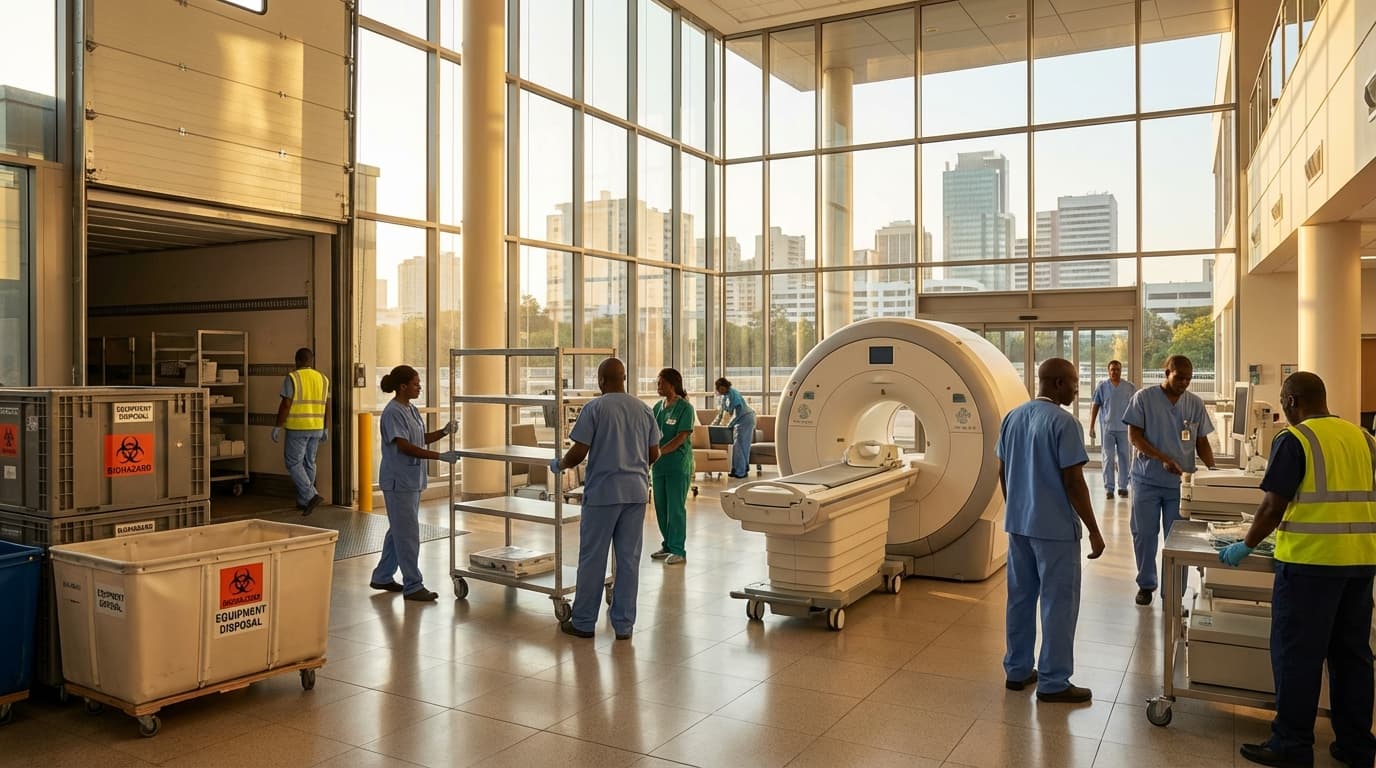
Heavy Medical Equipment De-Installation Service (MRI/CT/Cath Lab) in Mauritius
Engineering Excellence & Technical Support
Heavy Medical Equipment De-Installation Service (MRI/CT/Cath Lab) High-standard technical execution following OEM protocols and local regulatory frameworks.
Precision De-Installation & Logistics
Our specialized team in Mauritius employs meticulous planning and execution for the safe de-installation of high-value medical imaging equipment (MRI, CT, Cath Labs). We manage complex rigging, dismantling, and transportation logistics, ensuring minimal disruption to your facility and secure transit to its next destination.
Advanced Component Handling
We possess the expertise and specialized tools required to handle sensitive and intricate components of MRI, CT, and Cath Lab systems. From superconducting magnets to delicate imaging detectors, our technicians adhere to stringent protocols to prevent damage and preserve equipment integrity during de-installation.
Compliance & Safety Certified
Operating under strict international safety standards and local regulations in Mauritius, our de-installation services prioritize the well-being of personnel and the integrity of your facility. We provide comprehensive documentation and certification, assuring you of a compliant and secure de-installation process for your critical medical equipment.
What Is Heavy Medical Equipment De-installation Service (Mri/ct/cath Lab) In Mauritius?
Heavy Medical Equipment De-Installation Service (MRI/CT/Cath Lab) in Mauritius refers to the specialized process of safely and systematically dismantling, preparing for transport, and removing large, complex, and high-value medical imaging and interventional equipment such as Magnetic Resonance Imaging (MRI) scanners, Computed Tomography (CT) scanners, and Cardiac Catheterization (Cath Lab) systems. This service is crucial for healthcare facilities undergoing relocation, facility upgrades, equipment replacement, or closure. It requires a highly trained and certified team with expertise in handling delicate and sensitive components, managing heavy lifting and rigging, and adhering to stringent safety protocols and regulatory requirements specific to medical environments and their associated infrastructure.
| Who Needs This Service? | Typical Use Cases | Mauritian Context Considerations |
|---|---|---|
| Hospitals (Public and Private) | Relocation of a hospital wing or entire facility. | Ensuring compliance with Mauritian Ministry of Health regulations. |
| Diagnostic Imaging Centers | Upgrading to newer, more advanced equipment models. | Availability of specialized, certified technicians and equipment in Mauritius. |
| Research Institutions | Consolidating or closing research facilities. | Managing import/export regulations for medical equipment if applicable. |
| Equipment Manufacturers/Distributors | Performing site preparation for new installations by removing older systems. | Logistical challenges and infrastructure for heavy transport across the island. |
| Healthcare Facility Management Companies | Managing equipment lifecycle and transitions for multiple clients. | Coordinating with local infrastructure providers (e.g., power, HVAC) for seamless transitions. |
Key Components of Heavy Medical Equipment De-Installation:
- Site Assessment and Planning: Thorough evaluation of the existing installation site, including access routes, structural integrity, power requirements, and environmental controls. Development of a detailed de-installation plan.
- System Decommissioning: Safely shutting down and disconnecting all power, cooling, and data interfaces. Neutralization of any hazardous materials (e.g., cryogens in MRI).
- Component Disassembly: Meticulous breakdown of the equipment into manageable sections, often requiring specialized tools and techniques to avoid damage.
- Shielding and Containment Removal: Safe removal of any specialized shielding (e.g., lead shielding for CT/Cath Lab, RF shielding for MRI).
- Packaging and Protection: Proper wrapping, crating, and securing of all dismantled components to prevent damage during transit.
- Logistics and Transportation Planning: Coordination of specialized transportation solutions, including heavy haulage and rigging services, to move the equipment from the site.
- Documentation and Certification: Comprehensive record-keeping of the de-installation process, including photographic evidence and certification of compliance with safety standards.
Who Needs Heavy Medical Equipment De-installation Service (Mri/ct/cath Lab) In Mauritius?
In Mauritius, the need for specialized heavy medical equipment de-installation services for MRI, CT scanners, and Cath Labs arises from a variety of critical situations and facility management needs. These complex machines require expert handling for safe and compliant removal, relocation, or disposal. This service is essential for healthcare providers facing upgrades, renovations, equipment replacements, or even facility closures.
| Scenario | Equipment Type | Department/Customer | Reason for De-Installation |
|---|---|---|---|
| Hospital Renovation/Expansion | MRI, CT Scanner, Cath Lab | Radiology, Cardiology, Facility Management | To clear space for construction, upgrade existing infrastructure, or temporarily relocate equipment. |
| Equipment Upgrade/Replacement | MRI, CT Scanner, Cath Lab | Radiology, Cardiology, Biomedical Engineering | To safely remove the old unit before the installation of a new, more advanced model. |
| Facility Closure/Consolidation | MRI, CT Scanner, Cath Lab | Asset Management, Hospital Administration | To decommission and remove valuable assets for resale, donation, or responsible disposal. |
| Equipment Relocation within or between Facilities | MRI, CT Scanner, Cath Lab | Facility Management, Biomedical Engineering | To move the equipment to a new wing, a different hospital, or for a temporary setup. |
| End of Lease/Service Agreement | MRI, CT Scanner, Cath Lab | Procurement, Equipment Manufacturer | To return the equipment as per contractual obligations or to facilitate a new leasing arrangement. |
| Technological Obsolescence | MRI, CT Scanner, Cath Lab | Radiology, Cardiology, Hospital Administration | When older technology is no longer viable or cost-effective to maintain and operate. |
Target Customers and Departments in Mauritius Requiring Heavy Medical Equipment De-Installation
- {"items":["Major Public Hospitals (e.g., Victoria Hospital, Jawaharlal Nehru Hospital)","Leading Private Hospitals and Clinics (e.g., Clinique Darné, Apollo Bramwell Hospital, Wellkin Hospital)","Specialized Diagnostic Imaging Centers","Medical Equipment Manufacturers and Distributors (for returns, upgrades, or relocation)","Government Health Ministries and Agencies (for public health infrastructure projects or decommissioning)","Asset Management and Liquidation Companies (involved in selling or disposing of medical assets)","Research Institutions and Universities with medical imaging facilities"],"title":"Target Customers"}
- {"items":["Radiology/Medical Imaging Departments (MRI, CT Scan)","Cardiology Departments (Cath Labs)","Oncology Departments (requiring PET-CT, often with complex installation/de-installation)","Neurology Departments (advanced MRI applications)","Surgical Departments (especially those utilizing intraoperative imaging)","Facility Management and Engineering Departments (responsible for infrastructure and asset management)","Procurement and Biomedical Engineering Departments (managing equipment lifecycles)"],"title":"Target Departments within Healthcare Facilities"}
Heavy Medical Equipment De-installation Service (Mri/ct/cath Lab) Process In Mauritius
This document outlines the typical workflow for a Heavy Medical Equipment De-Installation Service (MRI/CT/Cath Lab) in Mauritius, from the initial client inquiry to the successful completion of the de-installation. The process involves meticulous planning, specialized expertise, and adherence to safety and regulatory standards. It is crucial to engage experienced and certified professionals for such critical operations to minimize risks and ensure equipment integrity.
| Stage | Description | Key Activities | Responsible Parties | Deliverables |
|---|---|---|---|---|
| The client contacts the service provider to discuss their de-installation needs. | Understanding client requirements, equipment type, location, and desired timeline. Initial discussion on scope and potential challenges. | Client, Service Provider (Sales/Technical Team) | Confirmation of understanding of client needs, preliminary scope definition. |
| A comprehensive on-site evaluation to determine the feasibility and requirements for de-installation. | Detailed inspection of the equipment, surrounding infrastructure (power, ventilation, structural support), access routes, egress points, and any potential obstacles. Assessment of safety hazards. | Service Provider (Technical Engineers, Project Manager) | Site assessment report, identification of potential challenges and necessary resources. |
| Based on the assessment, a detailed proposal and pricing are provided to the client. | Development of a detailed scope of work, cost estimation, timeline projection, and submission of a formal quotation. Negotiation and signing of the service contract. | Service Provider (Sales/Project Management), Client | Formal quotation, signed service contract, detailed scope of work. |
| Developing a meticulous plan for the de-installation process, including safety protocols. | Creation of a detailed project plan, including step-by-step de-installation procedures, safety checklists, emergency response plans, and identification of specialized tools and equipment required. Risk mitigation strategies are formalized. | Service Provider (Project Manager, Technical Team) | Comprehensive de-installation plan, risk assessment report, safety protocols. |
| Securing any necessary permits or approvals from relevant authorities in Mauritius. | Identifying and applying for any required permits from local authorities (e.g., for traffic management if equipment removal impacts public roads, environmental permits if applicable). | Service Provider (Project Manager, potentially with Client assistance) | Obtained permits and approvals. |
| Ensuring all necessary resources and preparations are in place before commencing de-installation. | Mobilization of the specialized de-installation team, sourcing and transporting specialized tools and lifting equipment, setting up temporary power (if needed), and ensuring the site is prepared for safe operations. | Service Provider (Project Manager, Technical Team) | Ready de-installation team, necessary tools and equipment on-site, prepared work area. |
| The physical process of dismantling and safely disconnecting the medical equipment. | Following the detailed plan, carefully disconnecting all components (e.g., magnets, gantry, control consoles, patient tables), electrical and cooling systems, and ensuring safe handling of heavy and sensitive parts. Adherence to strict safety procedures. | Service Provider (Specialized De-installation Technicians) | Dismantled and safely disconnected equipment components. |
| Properly packaging and securing all removed components for transport. | Using specialized packaging materials and techniques to protect the equipment from damage during transit. Securing components to prevent movement. Labeling for identification. | Service Provider (Technical Team) | Securely packaged and labeled equipment components. |
| Finalizing the de-installation and handing over the cleared site. | Ensuring the de-installation area is clean and safe, verifying all equipment has been removed, providing the client with a final report documenting the de-installation process, including photographs and any relevant certifications. | Service Provider (Project Manager), Client | Cleaned and safe de-installation site, final de-installation report, proof of completion. |
| Offering continued support as needed by the client. | Assisting with logistics for equipment transportation to a new location or storage, providing documentation for future re-installation, and addressing any client queries. | Service Provider (Project Manager, Customer Support) | Resolved post-de-installation queries, facilitated onward logistics (if agreed). |
Heavy Medical Equipment De-Installation Service Workflow
- Inquiry & Initial Consultation
- Site Assessment & Feasibility Study
- Quotation & Contract Finalization
- Detailed Planning & Risk Assessment
- Permits & Approvals (if applicable)
- Pre-De-installation Preparations
- Equipment De-installation
- Packaging & Securing Equipment
- Site Handover & Documentation
- Post-De-installation Support
Heavy Medical Equipment De-installation Service (Mri/ct/cath Lab) Cost In Mauritius
De-installing heavy medical equipment like MRI, CT scanners, and Cath Labs is a complex and specialized service requiring significant expertise, specialized tools, and adherence to strict safety protocols. The cost of such a service in Mauritius is influenced by several key factors. These include the type and model of the equipment, its size and weight, the complexity of its installation (e.g., the need for structural modifications, specialized power, or cooling systems), the accessibility of the equipment within the facility, and the logistical challenges involved in transportation. Furthermore, the experience and reputation of the de-installation company, along with any necessary disposal or relocation services, will also impact the overall price. It's crucial to obtain detailed quotes from multiple qualified service providers to ensure competitive pricing and a smooth de-installation process.
| Equipment Type | Estimated De-installation Cost Range (MUR) | Notes |
|---|---|---|
| CT Scanner (e.g., 16-slice to 64-slice) | 150,000 - 400,000 | Varies based on specific model, weight, and accessibility. May require significant power/cooling disconnection. |
| MRI Scanner (e.g., 1.5T) | 300,000 - 750,000+ | Significantly higher due to magnet removal, shielding, and complex electrical/cooling. Lead shielding removal is a major factor. |
| Cath Lab (Angiography/Interventional X-ray) | 250,000 - 600,000 | Involves dismantling multiple components, including C-arm, console, generator, and detectors. Lead shielding also a consideration. |
| Other Heavy Medical Equipment (e.g., Linear Accelerators, PET Scanners) | Varies widely, typically > 400,000 | These are highly specialized and often require custom de-installation plans. Costs can be significantly higher than MRI/CT. |
Key Pricing Factors for Heavy Medical Equipment De-Installation in Mauritius
- Equipment Type and Model (MRI, CT, Cath Lab, etc.)
- Equipment Size and Weight
- Complexity of Original Installation (structural, power, cooling)
- Accessibility of Equipment within the Facility
- Logistical Challenges (e.g., narrow corridors, elevator access)
- De-installation Company's Experience and Reputation
- Need for Specialized Tools and Equipment
- Safety and Environmental Compliance Requirements
- Disposal or Relocation Services (if required)
- Dismantling and Reassembly Requirements (for relocation)
Affordable Heavy Medical Equipment De-installation Service (Mri/ct/cath Lab) Options
Finding affordable options for de-installing large medical equipment like MRI, CT scanners, and Cath Labs can be a significant concern for healthcare facilities. This service requires specialized expertise, trained technicians, and careful logistical planning to ensure safety and compliance. This guide outlines how to approach finding cost-effective solutions, including understanding value bundles and implementing smart cost-saving strategies.
| Value Bundle Components | Typical Inclusions | Cost-Saving Potential |
|---|---|---|
| Basic De-installation: | Dismantling and disconnection from utilities. | Lower upfront cost, but may require separate arrangements for transportation and disposal. |
| Standard De-installation + Removal: | Includes basic de-installation plus removal from the premises (e.g., to a loading dock). | Good balance of convenience and cost, often a good starting point for comparison. |
| Full-Service De-installation (Turnkey): | Includes de-installation, rigging, packaging, transportation to a specified location, and potentially disposal or storage. | Higher initial cost but offers maximum convenience and peace of mind. Can save on coordinating multiple vendors. |
| Refurbishment/Resale Integration: | De-installation coupled with services for equipment refurbishment, resale, or donation. | Can offset de-installation costs by recouping value from the old equipment. |
Key Considerations for Affordable Medical Equipment De-Installation
- Specialized Expertise is Non-Negotiable: While cost is important, never compromise on the qualifications of the de-installation team. Improper handling can lead to irreparable damage to the equipment, the facility, or even pose safety risks.
- Understand the Scope of Work: Clearly define what is included in the de-installation. This typically involves dismantling, disconnection from utilities, packaging, and removal from the premises. Clarify if transportation, rigging, or disposal are part of the quoted price.
- Assess Equipment Condition: The age and complexity of the equipment can influence de-installation time and cost. Older or highly integrated systems may require more intricate procedures.
- Facility Access and Logistics: Consider the physical constraints of your facility, including doorway sizes, elevator access, and the availability of loading docks. These factors can impact rigging and transportation costs.
- Regulatory Compliance: Ensure the de-installation service adheres to all relevant safety regulations and environmental guidelines, especially for hazardous materials that might be present.
- Timeline and Urgency: Emergency or expedited de-installations will almost always incur higher costs. Planning in advance allows for more competitive pricing.
- Service Area: The geographic location of your facility can affect travel costs for the de-installation team.
Verified Providers In Mauritius
In Mauritius, ensuring you receive quality healthcare from trusted sources is paramount. 'Verified Providers' signifies a commitment to excellence and adherence to stringent standards. Franance Health stands out as a premier organization that not only meets but often exceeds these verification benchmarks. Their dedication to patient care, ethical practices, and continuous improvement makes them a leading choice for medical services in Mauritius.
| Category | Franance Health Verification Standard | Benefit to Patients |
|---|---|---|
| Medical Professionals | Certified, Licensed, and Peer-Reviewed | Access to highly skilled and ethical doctors, nurses, and specialists. |
| Healthcare Facilities | Accredited and Compliant with International Standards | Assurance of safe, hygienic, and technologically advanced medical environments. |
| Specialty Services | Proven Expertise and Successful Outcomes | Confidence in receiving specialized care for complex medical conditions. |
| Patient Experience | Focus on Compassion and Clear Communication | A supportive and understanding healthcare journey. |
Why Franance Health is the Best Choice for Verified Providers in Mauritius:
- Rigorous Accreditation and Licensing: Franance Health partners exclusively with healthcare facilities and professionals who hold the highest levels of accreditation and licensing recognized both locally in Mauritius and internationally.
- Commitment to Patient Safety: All verified providers associated with Franance Health prioritize patient safety through advanced protocols, regular training, and adherence to best practices in infection control and medical procedures.
- Exceptional Clinical Expertise: Franance Health meticulously vets its network of providers, ensuring they possess outstanding clinical expertise, up-to-date knowledge, and a proven track record of successful patient outcomes.
- Patient-Centric Approach: Beyond clinical excellence, Franance Health's verified providers are chosen for their dedication to a compassionate, patient-centric approach, emphasizing clear communication, personalized care, and respect for individual needs.
- Transparent and Ethical Practices: Franance Health upholds the highest ethical standards, ensuring transparency in pricing, treatment options, and provider qualifications for all its partnered facilities and practitioners.
- Access to Advanced Technology and Facilities: Through its network, Franance Health provides access to modern medical technologies and well-equipped facilities, enhancing diagnostic accuracy and treatment efficacy.
Scope Of Work For Heavy Medical Equipment De-installation Service (Mri/ct/cath Lab)
This Scope of Work (SOW) outlines the requirements for the de-installation of heavy medical equipment, specifically Magnetic Resonance Imaging (MRI) scanners, Computed Tomography (CT) scanners, and Cardiac Catheterization (Cath Lab) systems. The service encompasses the safe and professional disconnection, dismantling, and preparation for transport of these complex and sensitive units. This SOW also details the technical deliverables and standard specifications to be adhered to throughout the de-installation process.
| Phase | Description | Key Activities | Technical Deliverables | Standard Specifications / Requirements |
|---|---|---|---|---|
| Initial assessment of the equipment and the de-installation environment. | Site survey, review of equipment manuals, identification of access routes, power requirements, and any potential hazards. | De-installation plan document, risk assessment report. | Manufacturer's de-installation manual, site-specific safety protocols, adherence to local building codes. |
| Safely shutting down and disconnecting all power and auxiliary systems. | Controlled power-off sequence, disconnection of main power supply, auxiliary power units, and emergency stop systems. | Confirmation of power isolation, labeled power cables. | Manufacturer's recommended shutdown procedures, lockout/tagout procedures, electrical safety standards (e.g., NFPA 70E). |
| Careful dismantling of the equipment into manageable components. | Disconnection of data cables, cooling lines, RF cables, and structural components. Removal of patient table, gantry, magnet (if applicable), and console. | Component inventory list, labeled and protected components, detailed photographic documentation of disassembly. | Manufacturer's approved disassembly procedures, use of appropriate tools and lifting equipment, ESD (Electrostatic Discharge) precautions. |
| Safe draining and disconnection of all cooling systems (e.g., helium, water). | Controlled draining of coolant, purging of lines, and disconnection of pumps and chillers. | Documentation of coolant type and quantity, proper containment and disposal of used coolant, leak-free disconnection. | Manufacturer's procedures for coolant handling and disposal, environmental regulations for refrigerant handling (if applicable). |
| Securing and packaging of all dismantled components for transit. | Padding, crating, or wrapping of sensitive components, labeling of all packages with contents and handling instructions. | Securely packaged components, weight and dimension manifest for each package. | Industry best practices for medical equipment packing, impact-resistant packaging, clear labeling of fragile items and directional arrows. |
| Finalizing all documentation and formally handing over the de-installed equipment. | Completion of de-installation report, inventory verification, photographs of the final state of the equipment and the site. | Signed de-installation completion certificate, final report including all documentation, handover of all packaged components to the designated transport provider. | Client-approved documentation format, clear chain of custody. |
Key Objectives of the De-Installation Service
- Ensure the safe and complete disconnection of all power, data, and cooling systems.
- Dismantle equipment according to manufacturer specifications and industry best practices.
- Preserve the integrity and functionality of all components for potential re-installation or disposal.
- Document the de-installation process thoroughly.
- Prepare the equipment for secure transportation.
- Adhere to all relevant safety regulations and environmental guidelines.
Service Level Agreement For Heavy Medical Equipment De-installation Service (Mri/ct/cath Lab)
This Service Level Agreement (SLA) outlines the terms and conditions for the de-installation of heavy medical equipment, specifically Magnetic Resonance Imaging (MRI), Computed Tomography (CT), and Cardiac Catheterization (Cath Lab) systems. It defines the expected response times for service requests and uptime guarantees for any residual services or support provided during the de-installation process.
| Service Component | Response Time (Business Hours) | Uptime Guarantee |
|---|---|---|
| Initial Site Assessment & Planning | 24 Business Hours | N/A (Planning phase) |
| On-site De-installation Commencement (Post-Assessment Approval) | 48 Business Hours | N/A (Active service) |
| Emergency Technical Support (During De-installation Process) | 4 Business Hours | 99.5% Availability of technical personnel during scheduled de-installation window. |
| Post-De-installation Support (e.g., documentation, site sign-off) | 72 Business Hours | N/A (Completion phase) |
Scope of Service
- De-installation of specified heavy medical equipment (MRI, CT, Cath Lab).
- Safe and compliant disconnection of power, data, and cooling systems.
- Disassembly and preparation for transport.
- Site remediation to a pre-agreed state.
- Coordination with client stakeholders and transport providers.
Frequently Asked Questions

Ready when you are
Let's scope your Heavy Medical Equipment De-Installation Service (MRI/CT/Cath Lab) in Mauritius project in Mauritius.

Scaling healthcare logistics and technical systems across the entire continent.