
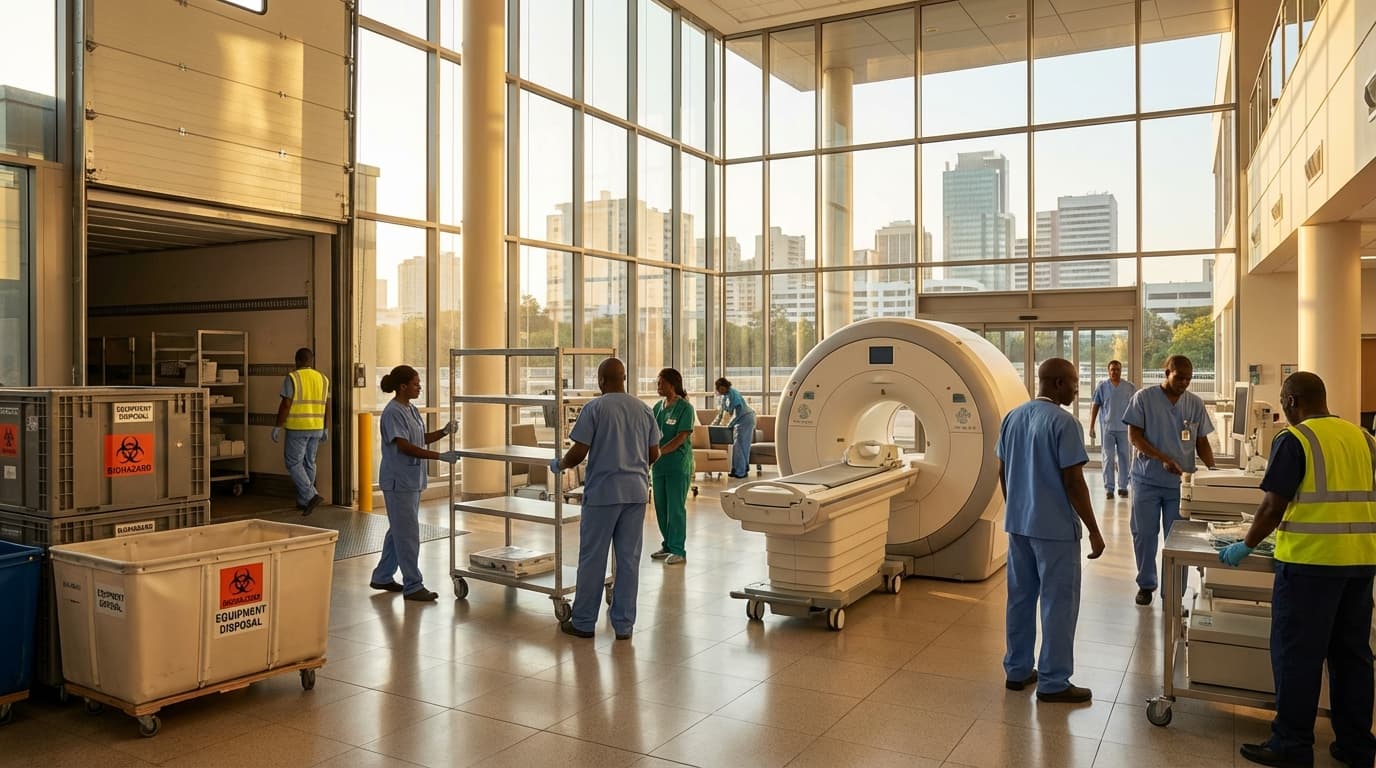
Decommissioning Service for Medical Devices in Mauritius
Engineering Excellence & Technical Support
Decommissioning Service for Medical Devices High-standard technical execution following OEM protocols and local regulatory frameworks.
Secure Chain of Custody & Data Erasure
Our comprehensive service ensures a tamper-proof chain of custody from pickup to final disposal, with certified data erasure protocols compliant with HIPAA and GDPR standards, guaranteeing patient privacy and regulatory adherence in Mauritius.
Expert Decommissioning & Regulatory Compliance
Leveraging specialized tools and trained technicians, we perform safe and efficient decommissioning of complex medical equipment, adhering strictly to Mauritian health and safety regulations and environmental standards.
Environmental Responsibility & Asset Recovery
We prioritize environmentally sound disposal methods, including recycling and responsible material handling. Our process also identifies opportunities for ethical asset recovery and refurbishment, maximizing value and minimizing landfill impact for Mauritian healthcare facilities.
What Is Decommissioning Service For Medical Devices In Mauritius?
Decommissioning service for medical devices in Mauritius refers to the formal process of retiring a medical device from active use, ensuring its safe and compliant disposal or repurposing. This service is critical for healthcare facilities and manufacturers operating within the Mauritian regulatory framework, as mandated by the Ministry of Health and Wellness and relevant legislation. The process involves a comprehensive set of procedures aimed at neutralizing the device's functionality, safeguarding sensitive data, and adhering to environmental and safety standards for end-of-life management.
| Who Needs Decommissioning Service? | Typical Use Cases | |||||
|---|---|---|---|---|---|---|
| Hospitals and Clinics: Healthcare institutions requiring the removal of outdated, malfunctioning, or end-of-life medical equipment. | Radiology Departments: Decommissioning of X-ray machines, CT scanners, MRI units, and related imaging equipment. | Laboratories: Retirement of analytical instruments, centrifuges, and other diagnostic laboratory devices. | Surgical Centers: Disposal of surgical equipment, anesthesia machines, and patient monitoring systems. | Medical Device Manufacturers/Distributors: Managing returned, obsolete, or damaged inventory within Mauritius. | Research Institutions: End-of-life management for specialized research instrumentation. | Government Health Agencies: Oversight and management of medical equipment within public health facilities. |
| Technological Obsolescence: Devices no longer meeting current performance standards or requiring excessive maintenance. | End of Manufacturer Support: Equipment for which spare parts or technical support are no longer available. | Upgrade or Replacement Cycles: Replacing older technology with newer, more advanced medical devices. | Regulatory Compliance: Disposing of devices that no longer meet current safety or efficacy standards. | Facility Closures or Renovations: Removal of all medical equipment during the shutdown or significant alteration of a healthcare facility. | Malfunctioning or Unrepairable Equipment: Devices that have sustained irreparable damage or are deemed uneconomical to repair. |
Key Components of Medical Device Decommissioning Service:
- Inventory and Identification: Meticulous cataloging of all devices slated for decommissioning, including serial numbers, model numbers, purchase dates, and maintenance history.
- Risk Assessment and Planning: Evaluating potential hazards associated with the device (e.g., biohazards, chemical residues, electrical risks) and developing a tailored decommissioning plan.
- Data Sanitization/Destruction: Secure erasure or physical destruction of any stored patient data or proprietary information to comply with privacy regulations (e.g., GDPR-equivalents).
- Functional Neutralization: Rendering the device inoperable through disassembly, removal of critical components, or controlled destruction to prevent unauthorized use or repair.
- Environmental Disposal/Recycling: Adhering to Mauritian environmental regulations for the disposal of electronic waste and medical equipment, prioritizing recycling and responsible waste management.
- Certification and Documentation: Providing official documentation of the decommissioning process, including certificates of destruction or disposal, for regulatory compliance and auditing purposes.
- Logistics and Transportation: Safe and compliant transportation of devices to designated disposal or recycling facilities.
Who Needs Decommissioning Service For Medical Devices In Mauritius?
Medical device decommissioning is a critical process in Mauritius, involving the safe and compliant retirement of outdated, damaged, or no longer needed medical equipment. This ensures patient safety, data security, and environmental responsibility. Various entities in Mauritius require these specialized services.
| Customer Type | Key Departments Involved | Specific Needs |
|---|---|---|
| Hospitals (Public and Private) | Biomedical Engineering Department, IT Department, Radiology, Cardiology, Pathology, Sterilization, Procurement, Administration | Disposal of imaging equipment (X-ray, MRI, CT scanners), patient monitoring systems, surgical instruments, laboratory analyzers, anesthesia machines, old IT systems associated with devices (e.g., PACS servers). |
| Clinics and Polyclinics | Clinic Management, Clinical Staff, IT Support (if applicable) | Decommissioning of smaller diagnostic equipment, patient care devices, administrative hardware connected to medical systems. |
| Diagnostic Laboratories | Laboratory Management, Biomedical Technicians, IT Department | Retiring old analyzers, microscopes, centrifuges, and any associated data storage or processing units. |
| Research Institutions | Research Departments, Laboratory Managers, IT Security | Safe disposal of specialized research equipment, ensuring sensitive research data is handled appropriately. |
| Medical Equipment Suppliers and Distributors | Logistics, Warehousing, Technical Service Department | Managing end-of-life or returned equipment, ensuring responsible disposal or refurbishment. |
| Government Health Agencies | Public Health Departments, Procurement and Asset Management, IT Divisions | Overseeing decommissioning across public health facilities, managing large-scale equipment lifecycles, and ensuring regulatory compliance. |
Target Customers and Departments for Medical Device Decommissioning Services in Mauritius
- Hospitals (Public and Private)
- Clinics and Polyclinics
- Diagnostic Laboratories
- Research Institutions
- Medical Equipment Suppliers and Distributors (for end-of-life inventory management)
- Government Health Agencies
Decommissioning Service For Medical Devices Process In Mauritius
This document outlines the standard workflow for decommissioning medical devices in Mauritius. This process ensures that medical devices are safely and responsibly removed from service, adhering to regulatory requirements and environmental best practices. The workflow is divided into distinct phases, from initial inquiry to the final execution of decommissioning.
| Phase | Description | Key Activities | Responsible Party | Key Deliverables |
|---|---|---|---|---|
| The process begins when a healthcare facility or organization expresses interest in decommissioning medical devices. | Contacting the service provider, discussing the scope of work, identifying device types and quantities. | Healthcare Facility | Initial expression of interest, list of devices to be decommissioned. |
| A thorough assessment of the devices and the facility is conducted to develop a detailed decommissioning plan. | Site visit, inventory verification, risk assessment, determining decommissioning methods, scheduling. | Service Provider, Healthcare Facility | Decommissioning plan, risk assessment report, proposed schedule. |
| Based on the assessment, a formal quotation is provided, and upon acceptance, an agreement is established. | Preparing a detailed quotation, negotiating terms and conditions, signing the service agreement. | Service Provider, Healthcare Facility | Formal quotation, signed service agreement. |
| The service provider prepares the site for safe and efficient decommissioning activities. | Mobilizing equipment and personnel, ensuring necessary safety measures are in place, cordoning off the work area. | Service Provider | Prepared work environment, safety protocols in place. |
| Critical steps to ensure the security and safety of sensitive information and the device itself. | Disconnecting devices from power and network, performing secure data wiping or physical destruction of storage media (if applicable). | Service Provider | Verified data sanitization records, isolated devices. |
| The actual process of dismantling and removing the medical devices from the facility. | Disassembly, removal of hazardous components, safe extraction of devices. | Service Provider | Decommissioned devices removed from site. |
| Ensuring the safe and compliant transport of decommissioned devices. | Packaging, labeling, and transportation to the designated disposal or recycling facility in accordance with regulations. | Service Provider | Transport manifests, compliance documentation. |
| The environmentally responsible management of the decommissioned devices. | Segregating materials, appropriate disposal of hazardous waste, recycling of non-hazardous components. | Service Provider | Waste disposal certificates, recycling records. |
| Providing comprehensive documentation of the entire decommissioning process. | Issuing certificates of decommissioning, waste disposal certificates, and other relevant compliance documents. | Service Provider | Certificate of Decommissioning, waste disposal certificates. |
| A conclusive report summarizing the decommissioning activities and outcomes is provided to the client. | Providing a comprehensive report detailing the devices decommissioned, methods used, disposal/recycling information, and compliance. | Service Provider | Final decommissioning report. |
Decommissioning Service for Medical Devices Process in Mauritius
- Inquiry and Initial Consultation
- Assessment and Planning
- Quotation and Agreement
- Site Visit and Preparation
- Device Isolation and Data Sanitization
- Physical Decommissioning and Removal
- Transportation and Logistics
- Disposal or Recycling
- Documentation and Certification
- Final Reporting
Decommissioning Service For Medical Devices Cost In Mauritius
Decommissioning of medical devices in Mauritius is a crucial process to ensure safe and environmentally responsible disposal. The cost is influenced by several factors, primarily the type and complexity of the device, its size and weight, the required disposal method (e.g., incineration, recycling, hazardous waste management), and the specific service provider. The market in Mauritius for these services is growing, with both specialized companies and general waste management firms offering these solutions. It's important to obtain detailed quotes from multiple providers to compare services and pricing effectively.
| Device Category | Estimated Cost Range (MUR) | Notes |
|---|---|---|
| Small Diagnostic Equipment (e.g., Blood Pressure Monitors, Thermometers) | 1,000 - 3,000 | Generally straightforward disposal, often handled as e-waste or non-hazardous waste. |
| Medium Electronic Medical Devices (e.g., ECG Machines, Patient Monitors) | 3,000 - 8,000 | May contain more complex electronic components, requiring specialized e-waste recycling. |
| Large Imaging Equipment (e.g., X-ray Machines, Ultrasound Machines - excluding very large/complex ones) | 8,000 - 25,000 | Can involve hazardous materials like lead shielding or specific refrigerants. May require professional dismantling. |
| Specialized/High-Value Equipment (e.g., MRI, CT Scanners, Laser Devices) | 25,000 - 100,000+ | Highly complex, often containing hazardous materials (e.g., cryogens, heavy metals). Requires expert dismantling, transportation, and specialized disposal. Costs can vary significantly based on specific components and decommissioning requirements. |
| Sterilization Equipment (e.g., Autoclaves) | 5,000 - 15,000 | May require handling of residual steam or cleaning agents. Disposal of metal components and electronics. |
| Laboratory Equipment (e.g., Centrifuges, Microscopes) | 2,000 - 7,000 | Varies based on complexity and materials. Hazardous waste considerations if used with biological or chemical substances. |
| Medical Waste Bins/Containers (Large Volume) | 500 - 2,000 per unit (volume dependent) | Disposal of contaminated containers, often requires specialized handling and incineration. |
Key Pricing Factors for Medical Device Decommissioning in Mauritius:
- Device Type and Complexity: Simple devices like basic diagnostic tools will be less expensive to decommission than complex imaging equipment (e.g., MRI, CT scanners) or devices with hazardous components (e.g., mercury, radioactive isotopes).
- Size and Weight: Larger and heavier devices often incur higher transportation and disposal costs.
- Disposal Method: Different disposal methods have varying costs. Incineration for biohazardous materials is typically more expensive than general recycling. Handling of hazardous waste requires specialized procedures and compliance, adding to the cost.
- Condition of the Device: Devices requiring extensive dismantling or preparation for disposal might incur additional labor costs.
- Volume of Decommissioning: A larger batch of devices might benefit from economies of scale, potentially reducing the per-unit cost.
- Service Provider's Expertise and Certifications: Reputable providers with specialized certifications in medical waste management or electronics recycling may command higher prices due to their adherence to strict regulations and quality standards.
- Geographic Location: While less significant in a small island nation like Mauritius, the location of the facility where the devices are stored relative to the disposal site can have a minor impact on transportation costs.
- Environmental Compliance and Reporting: Costs associated with ensuring full compliance with Mauritian environmental regulations and providing necessary documentation for disposal.
Affordable Decommissioning Service For Medical Devices Options
Decommissioning medical devices is a critical, often overlooked, step in their lifecycle. Proper decommissioning ensures data security, environmental compliance, and the secure disposal of valuable components. Finding affordable options is essential for healthcare facilities managing tight budgets. This document outlines value bundles and cost-saving strategies for medical device decommissioning services.
| Cost-Saving Strategy | Description | Potential Savings |
|---|---|---|
Understanding Value Bundles in Medical Device Decommissioning
- {"title":"What are Value Bundles?","description":"Value bundles are service packages that combine multiple decommissioning tasks into a single, often discounted, offering. Instead of paying for individual services like data sanitization, physical destruction, and recycling separately, you purchase a comprehensive package from a single provider."}
- {"title":"Benefits of Value Bundles","description":"Value bundles simplify the procurement process, streamline logistics by coordinating multiple services, and typically offer a lower overall cost compared to procuring each service independently. They also ensure a consistent and compliant decommissioning process across all devices."}
- {"title":"Common Components of Decommissioning Value Bundles","description":"These bundles can include: data sanitization/destruction, physical dismantling and shredding, asset tracking and reporting, environmental recycling and disposal, certificate of destruction/disposal, and potential asset resale or refurbishment options."}
Verified Providers In Mauritius
In Mauritius, discerning individuals seeking reliable and high-quality healthcare services are increasingly prioritizing verified providers. Franance Health stands out in this landscape, not just as a provider, but as a benchmark for excellence and trust. Their commitment to stringent credentialing and a patient-centric approach solidifies their position as the premier choice for healthcare.
| Aspect of Verification | Franance Health's Standard | Benefit to Patients |
|---|---|---|
| Licensing & Regulatory Compliance | All practitioners hold valid, up-to-date licenses issued by the Medical Council of Mauritius and relevant international bodies. | Ensures legal and ethical practice, protecting patients from unqualified individuals. |
| Specialized Training & Certifications | Verification of advanced degrees, fellowships, and board certifications in their respective specialties. | Access to highly skilled specialists for complex medical needs and personalized treatment. |
| Professional Experience | Thorough background checks and verification of past employment and practice history. | Confidence in receiving care from experienced and reputable medical professionals. |
| Commitment to Quality Improvement | Active participation in peer review processes and adherence to quality assurance protocols. | Continuous improvement in service delivery and patient care outcomes. |
| Technological Integration & Safety | Adherence to strict protocols for the use of advanced medical technology and patient safety measures. | Access to modern, safe, and effective diagnostic and treatment tools. |
Why Franance Health Credentials Matter
- Rigorous Qualification & Certification: Franance Health meticulously vets all its healthcare professionals. This includes verifying medical licenses, specialized certifications, and advanced training, ensuring practitioners meet and exceed international standards.
- Experience & Specialization: Beyond basic qualifications, Franance Health prioritizes practitioners with proven track records and specialized expertise in various medical fields. This allows for targeted and effective treatment plans.
- Adherence to Ethical Standards: A core tenet of Franance Health is an unwavering commitment to ethical medical practice. This translates to transparency, patient confidentiality, and a focus on patient well-being above all else.
- Continuous Professional Development: The healthcare landscape is constantly evolving. Franance Health mandates and supports ongoing training and development for its team, keeping them at the forefront of medical advancements.
- Patient Testimonials & Outcomes: The true measure of a healthcare provider's quality lies in the satisfaction and successful outcomes of their patients. Franance Health consistently receives positive feedback, reflecting their dedication to superior care.
Scope Of Work For Decommissioning Service For Medical Devices
This document outlines the Scope of Work (SOW) for decommissioning medical devices, detailing the technical deliverables and standard specifications required to ensure safe, secure, and environmentally responsible removal of these assets from service. The process includes secure data erasure, physical dismantling, transportation, and disposal or recycling.
| Deliverable | Description | Standard Specifications/Requirements |
|---|---|---|
| Decommissioning Plan | A detailed plan outlining the sequence of operations, safety protocols, timelines, and resource allocation for the decommissioning project. | Includes risk assessment, hazard identification, environmental impact assessment, waste management plan, and stakeholder communication strategy. Must adhere to relevant local, national, and international regulations (e.g., HIPAA, GDPR, environmental protection laws). |
| Data Erasure Certificate | Proof of secure and complete erasure of all sensitive data from medical devices. | Must comply with industry standards such as NIST SP 800-88 Rev. 1 (Guidelines for Media Sanitization). Methodologies may include overwriting, degaussing, or physical destruction of storage media. Certificate to include device serial numbers, date of erasure, and method used. |
| Decommissioned Device Inventory | A comprehensive list of all devices decommissioned, including make, model, serial number, and condition. | Format: Spreadsheet (e.g., CSV, Excel) or database export. Details should align with client's asset management system. |
| Decommissioning Service Report | A final report summarizing the entire decommissioning process, including activities performed, any deviations from the plan, and a summary of waste streams. | Must include details on the number of devices processed, methods of disposal/recycling, and confirmation of compliance with all applicable regulations. Includes photographic evidence where relevant. |
| Waste Manifests/Certificates of Disposal | Documentation confirming the proper and legal disposal or recycling of device components and materials. | Includes manifests for hazardous waste, certificates of destruction for sensitive components, and recycling certificates. Must adhere to environmental regulations for e-waste and medical waste disposal. |
| Chain of Custody Documentation | Records tracking the movement of devices and their components from the client's site to the final disposal/recycling facility. | Must be maintained throughout the process, detailing pick-up times, transport vehicles, drivers, and drop-off locations. Ensures accountability and security. |
| Site Restoration Plan/Report | A plan for restoring the decommissioned space to a safe and clean condition, or a report confirming completion. | May include removal of mounting hardware, cleaning of surfaces, and verification that no hazardous materials remain. Based on pre-decommissioning site survey. |
| Safety and Environmental Compliance Audit Report | Evidence of adherence to all safety and environmental regulations throughout the decommissioning process. | Internal or third-party audits. Includes documentation of personnel training, personal protective equipment (PPE) usage, and adherence to emergency procedures. |
Key Phases of Medical Device Decommissioning
- Site Assessment and Planning
- Data Security and Erasure
- Physical Dismantling and Removal
- Transportation and Logistics
- Disposal, Recycling, and Documentation
Service Level Agreement For Decommissioning Service For Medical Devices
This Service Level Agreement (SLA) outlines the response times and uptime guarantees for the Decommissioning Service for Medical Devices provided by [Your Company Name] to [Client Company Name]. This SLA is an addendum to the Master Services Agreement (MSA) dated [Date of MSA].
| Service Component | Uptime Guarantee | Downtime Exclusions | Remedy for SLA Breach |
|---|---|---|---|
| Decommissioning Project Planning & Scheduling | 99.5% uptime (excluding scheduled maintenance) | Downtime caused by client-side issues, force majeure events, or failure to provide necessary access/information. | Service credits equal to 5% of the monthly fee for the affected service for each 30-minute increment of downtime exceeding 4 hours in a calendar month. |
| On-site Decommissioning Execution (per scheduled appointment) | N/A (Performance based on agreed project timelines) | Delays caused by client-side issues, unexpected site conditions, or client staff unavailability. | If the decommissioning appointment is rescheduled by [Your Company Name] within 48 hours of the scheduled time (without client agreement), a credit of 10% of the service fee for that specific appointment will be applied. |
| Data Sanitization & Verification | 99.9% availability of sanitization tools/personnel | Failure of client-provided equipment, network issues outside [Your Company Name]'s control. | Service credits equal to 2% of the monthly fee for the affected service for each 1-hour increment of unavailability exceeding 2 hours in a calendar month. |
| Secure Disposal Coordination | 99.0% availability of coordination services | Delays caused by third-party disposal vendors, client-provided inaccurate information. | Service credits equal to 3% of the monthly fee for the affected service for each 24-hour period of delay exceeding 72 hours in a calendar month. |
Key Definitions
- {"item":"Decommissioning Service: The process of safely and securely rendering a medical device non-operational, including data sanitization, physical destruction (if applicable), and proper disposal in accordance with relevant regulations."}
- {"item":"Incident: Any event that disrupts or degrades the Decommissioning Service, preventing [Client Company Name] from proceeding with scheduled decommissioning activities or causing a delay in service delivery."}
- {"item":"Downtime: The period during which the Decommissioning Service is unavailable and [Client Company Name] is unable to initiate or continue a decommissioning process due to a failure on the part of [Your Company Name]."}
- {"item":"Scheduled Maintenance: Pre-planned maintenance activities that may temporarily impact service availability. [Your Company Name] will provide reasonable advance notice for all scheduled maintenance."}
- {"item":"Criticality Level: A classification of incidents based on their impact on [Client Company Name]'s operations and patient safety. The levels are defined in the 'Incident Response Times' section."}
Frequently Asked Questions

Ready when you are
Let's scope your Decommissioning Service for Medical Devices in Mauritius project in Mauritius.

Scaling healthcare logistics and technical systems across the entire continent.