
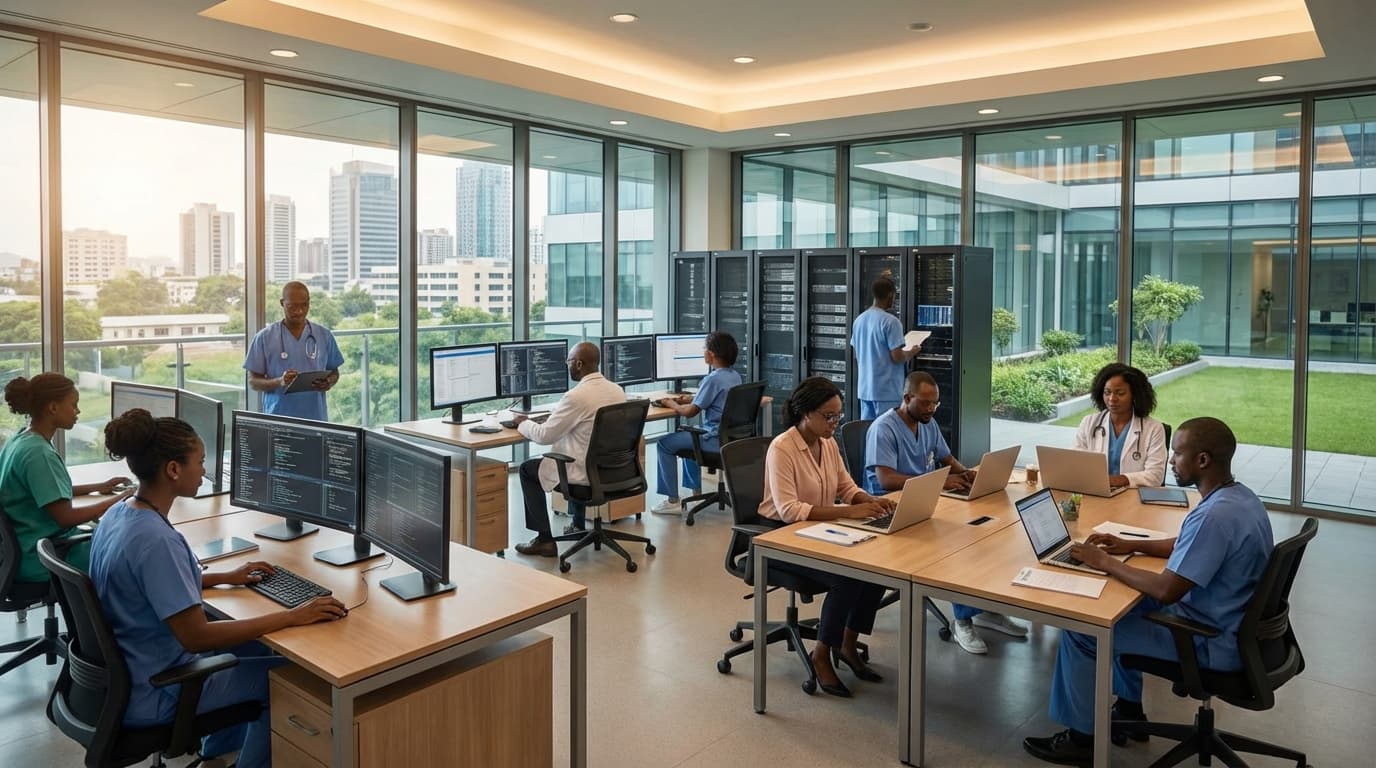
Radiology Reader & Reporting Support in Mauritius
Engineering Excellence & Technical Support
Remote radiology reading and reporting services High-standard technical execution following OEM protocols and local regulatory frameworks.
AI-Powered Diagnostic Assistance
Leveraging cutting-edge artificial intelligence to enhance diagnostic accuracy and speed for radiologists, supporting the analysis of medical images and identifying potential anomalies for faster, more reliable reporting.
Streamlined Reporting Workflow
Implementing advanced reporting tools and templates that automate repetitive tasks, integrate seamlessly with PACS systems, and provide structured reporting capabilities, significantly reducing turnaround times for radiology reports.
Secure Cloud-Based Image Archiving & Access
Providing a secure and compliant cloud infrastructure for the archiving, retrieval, and secure sharing of radiological images and reports, ensuring accessibility for authorized personnel across Mauritius while adhering to data privacy regulations.
What Is Radiology Reader & Reporting Support In Mauritius?
Radiology Reader & Reporting Support in Mauritius refers to the provision of specialized services that assist healthcare professionals, primarily radiologists and referring physicians, in the interpretation of medical imaging studies and the generation of comprehensive, accurate, and timely diagnostic reports. This service leverages advanced technology and skilled personnel to enhance the efficiency and quality of radiological diagnostics within the Mauritian healthcare ecosystem.
| Who Needs It? | Typical Use Cases | ||||
|---|---|---|---|---|---|
| Hospitals and Clinics in Mauritius: | Addressing shortages of specialized radiologists, particularly during off-hours or for niche subspecialties. | Improving diagnostic turnaround times, especially for emergency cases. | Providing access to high-level expertise for complex or rare conditions. | Enhancing the overall quality and consistency of radiology reporting. | Supporting smaller facilities that may not have full-time radiologists on staff. |
| Individual Referring Physicians (e.g., Orthopedic Surgeons, Neurologists, Oncologists): | Obtaining expert second opinions on challenging cases. | Expediting the diagnostic process for timely treatment planning. | Accessing subspecialty interpretation when local resources are limited. | ||
| Healthcare Providers with High Imaging Volumes: | Optimizing workflow and reducing backlogs in radiology departments. | Leveraging technology to manage peak demand periods. | |||
| Patients Seeking Enhanced Diagnostic Accuracy: | Ensuring their imaging studies are interpreted by the most qualified experts, regardless of location. |
Key Components of Radiology Reader & Reporting Support:
- Remote Interpretation (Tele-radiology): Enabling radiologists to interpret imaging studies (X-ray, CT, MRI, Ultrasound, etc.) from a remote location, overcoming geographical barriers and potential radiologist shortages.
- Second Opinion Services: Offering independent expert review of complex or critical imaging findings to provide an additional layer of diagnostic certainty.
- Subspecialty Expertise: Access to radiologists with specific expertise in areas such as neuroradiology, musculoskeletal radiology, pediatric radiology, breast imaging, and interventional radiology, which may not be readily available locally.
- Reporting Template & Standardization: Utilizing standardized reporting formats and advanced reporting software to ensure consistency, completeness, and adherence to best practices.
- Quality Assurance & Peer Review: Implementing robust quality control mechanisms, including peer review of reports and image quality assessment, to maintain high diagnostic standards.
- Turnaround Time (TAT) Management: Focusing on achieving and exceeding defined TAT benchmarks for report delivery, critical for timely patient management.
- Integration with PACS/RIS: Seamless integration with existing Picture Archiving and Communication Systems (PACS) and Radiology Information Systems (RIS) for efficient workflow.
- Multilingual Reporting: The capacity to generate reports in English and potentially other relevant languages to cater to diverse patient populations and referring physicians.
Who Needs Radiology Reader & Reporting Support In Mauritius?
Radiology Reader & Reporting Support services are crucial for enhancing diagnostic accuracy, improving workflow efficiency, and addressing potential shortages of specialized radiologists in Mauritius. These services can significantly benefit various healthcare institutions and professionals across the island nation.
| Customer Type | Specific Departments/Needs | Benefits of Support | ||||||
|---|---|---|---|---|---|---|---|---|
| Public Hospitals (e.g., Victoria Hospital, Sir Seewoosagur Ramgoolam National Hospital) | Emergency Department (24/7 coverage for urgent scans) | Orthopedics (complex fracture interpretation) | Neurology (stroke, head injury analysis) | Oncology (tumor staging and monitoring) | General Radiology (routine X-rays, CTs, MRIs) | Addressing radiologist workload during peak times | Improving turnaround time for critical reports | Ensuring consistent quality of interpretations |
| Private Hospitals & Healthcare Groups (e.g., Clinique Bon Pasteur, Apollo Bramwell Hospital) | All radiology-related departments | Handling high patient volume | Providing subspecialty expertise (e.g., neuroradiology, musculoskeletal radiology) | Reducing internal reporting backlogs | Enhancing patient satisfaction through faster results | Supporting advanced imaging modalities | ||
| Independent Diagnostic & Imaging Centers | General Radiology | Specialized Imaging (Mammography, Ultrasound, CT, MRI) | Providing a secondary opinion for complex cases | Offering overflow support during busy periods | Ensuring consistent reporting standards across multiple locations | |||
| Specialty Clinics (e.g., Cardiology, Oncology, Orthopedics Clinics) | Specific imaging needs (e.g., cardiac CT, MRI for joint issues) | Access to subspecialist radiologists for precise interpretations | Faster diagnoses for targeted patient care | Supporting specialized treatment planning | ||||
| Rural Health Centers & Smaller Clinics | Basic X-ray and Ultrasound interpretation | Overcoming limitations of local radiologist availability | Providing access to expert opinions without patient travel | Improving diagnostic capabilities in remote areas | ||||
| Telemedicine Providers | Remote interpretation of various imaging modalities | Extending reach of radiology services across the island | Facilitating rapid consultations | Enabling efficient remote patient management |
Target Customers and Departments in Mauritius for Radiology Reader & Reporting Support
- Hospitals and Clinics
- Private Diagnostic Centers
- Specialty Medical Centers
- Public Health Facilities
- Emergency Departments
- Outpatient Services
- Telemedicine Providers
- Medical Schools (for training and research)
Radiology Reader & Reporting Support Process In Mauritius
This document outlines the workflow for the Radiology Reader & Reporting Support Process in Mauritius. This process is designed to facilitate efficient and accurate medical imaging interpretation and reporting by radiologists, with support provided by administrative and technical personnel.
| Stage | Description | Responsible Party | Key Activities | Potential Challenges | Output |
|---|---|---|---|---|---|
| Inquiry & Request Initiation | The process begins when a clinician requires a radiology report for a patient examination. | Referring Clinician, Reception/Admissions | Clinician submits a request (electronic or paper-based). | Incomplete or unclear request details. | Completed radiology request form/electronic order. |
| Patient & Image Data Preparation | Gathering all necessary patient information and the actual imaging data. | Radiology Department Admin/Technologist | Verify patient demographics, retrieve previous relevant reports/images, ensure images are accessible on the PACS (Picture Archiving and Communication System). | Missing patient history, poor image quality, PACS issues. | Patient's imaging studies loaded and ready for review on PACS. |
| Radiologist Assignment & Review | Assigning the case to an appropriate radiologist and the initial review of images. | Radiology Department Coordinator/Radiologist | Case is assigned based on subspecialty and workload. Radiologist performs initial image interpretation. | Overburdened radiologists, lack of subspecialty expertise for complex cases. | Initial findings and impression documented mentally or on preliminary notes. |
| Reporting & Dictation | The radiologist dictates their findings and conclusions. | Radiologist | Dictates the radiology report, including findings, impression, and recommendations. | Poor dictation quality, technical issues with dictation equipment. | Audio recording of the radiology report. |
| Transcription & Editing | Converting the dictated audio into a written report. | Medical Transcriptionist, Radiologist/Reporting Support Staff | Transcribes the audio. Radiologist or designated staff reviews and edits for accuracy and completeness. | Transcription errors, delays in transcription, difficulty understanding dictation. | Draft radiology report. |
| Quality Assurance & Finalization | Ensuring the report meets professional standards and is accurate. | Radiologist, Quality Control Staff | Radiologist performs a final read and sign-off on the report. QC staff may perform checks on formatting and basic accuracy. | Oversight errors, lack of standardized QC checks. | Finalized and signed radiology report. |
| Report Distribution & Archival | Delivering the report to the referring clinician and securely storing it. | Radiology Department Admin/IT | Report is sent electronically (e.g., via EMR/HIS) or physically to the referring clinician. Report is archived in the PACS/RIS (Radiology Information System). | Delayed delivery, IT system failures, inadequate archival protocols. | Delivered radiology report, archived patient records. |
Key Stages of the Radiology Reader & Reporting Support Process
- Inquiry & Request Initiation
- Patient & Image Data Preparation
- Radiologist Assignment & Review
- Reporting & Dictation
- Transcription & Editing
- Quality Assurance & Finalization
- Report Distribution & Archival
Radiology Reader & Reporting Support Cost In Mauritius
The cost of radiology reader and reporting support in Mauritius is influenced by several key factors, impacting the overall pricing. These factors include the complexity and type of imaging modalities used (e.g., X-ray, CT, MRI, Ultrasound), the volume of studies requiring interpretation, the required turnaround time for reports, the level of expertise of the radiologist, and whether the service is provided remotely or on-site. Furthermore, the inclusion of advanced AI-powered diagnostic tools or specialized reporting services can also influence the cost. Pricing is typically quoted in Mauritian Rupees (MUR).
| Service Type/Volume | Estimated Price Range (MUR) | Notes |
|---|---|---|
| Per Study Interpretation (Basic Modalities - e.g., X-ray) | MUR 500 - MUR 1,500 | Varies based on complexity and volume discounts. |
| Per Study Interpretation (Advanced Modalities - e.g., CT/MRI) | MUR 1,500 - MUR 5,000+ | Higher complexity, specialized interpretation. |
| Daily/Hourly On-site Radiologist Support | MUR 8,000 - MUR 25,000+ | Depends on radiologist's experience and duration. |
| Monthly Retainer for Remote Reporting Services | Starting from MUR 50,000 - MUR 200,000+ | Often based on a pre-agreed volume or service level agreement (SLA). |
| AI-powered Diagnostic Support (Add-on) | Variable (often a percentage of reporting cost or per-study fee) | Can range from a few hundred to a few thousand MUR per month depending on the system and usage. |
Key Pricing Factors for Radiology Reader & Reporting Support in Mauritius
- Imaging Modality Complexity (X-ray, CT, MRI, Ultrasound, etc.)
- Volume of Studies/Interpretations
- Required Turnaround Time for Reports (e.g., routine vs. STAT)
- Radiologist Expertise and Specialization
- Service Delivery Model (Remote vs. On-site)
- Inclusion of AI-powered diagnostic tools
- Ancillary services (e.g., consultation, interventional radiology support)
Affordable Radiology Reader & Reporting Support Options
Radiology practices and healthcare facilities are increasingly seeking cost-effective solutions for radiology reading and reporting. The demand for efficient and accurate interpretation of medical images, coupled with the need to manage operational expenses, has led to the development of various affordable options. This includes leveraging technology, outsourcing, and carefully designed service packages. Value bundles and strategic cost-saving measures are crucial for optimizing these services.
| Value Bundle Type | Components | Cost-Saving Strategies | Key Benefits | ||||||||||||
|---|---|---|---|---|---|---|---|---|---|---|---|---|---|---|---|
| Teleradiology Core Package | 24/7 interpretation of X-rays, CT, MRI. Basic report generation. Standard turnaround times. | Reduced recruitment/staffing costs. Eliminates need for overnight on-site staff. Flexible scaling of read volume. | Improved turnaround times for routine studies. Access to a wider pool of specialists. Consistent coverage. | AI-Assisted Workflow Optimization | AI flagging of critical findings. Automated preliminary reports for common studies. Prioritization of urgent scans. | Reduced radiologist reading time per case. Improved accuracy and reduced oversight needs. Faster identification of critical findings. | Increased radiologist throughput. Enhanced patient safety through quicker identification of critical results. Potential for reduced errors. | Comprehensive Reporting Suite | Advanced reporting templates. Voice recognition integration. Quality assurance and peer review tools. Integration with EMR/EHR. | Streamlined reporting process. Reduced dictation/transcription costs. Improved report quality and consistency. Better data integration. | Enhanced efficiency in report generation. Higher quality and more standardized reports. Improved communication with referring physicians. | On-Demand Specialist Support | Access to sub-specialty radiologists for complex cases. Second opinions. Consultation services. | Avoids the need for full-time, high-cost sub-specialists. Provides expert opinion when needed, reducing unnecessary hiring. | Access to specialized expertise for challenging cases. Improved diagnostic accuracy for complex studies. Enhanced confidence in diagnoses. |
Affordable Radiology Reader & Reporting Support Options
- Teleradiology Services: Outsourcing image interpretation to remote radiologists. This can significantly reduce overhead costs associated with in-house staffing, infrastructure, and recruitment.
- AI-Powered Diagnostic Support Tools: Artificial intelligence can assist radiologists by flagging potential abnormalities, prioritizing urgent cases, and improving efficiency. While there's an initial investment, AI can reduce interpretation time and improve accuracy, leading to long-term cost savings.
- Hybrid Reading Models: Combining in-house radiologists with teleradiology support. This allows for flexible staffing and ensures coverage during peak times or staff shortages.
- Standardized Reporting Templates: Utilizing pre-defined templates for common interpretations can streamline the reporting process, reduce dictation time, and ensure consistency.
- Managed Services for PACS/RIS: Outsourcing the management and maintenance of Picture Archiving and Communication Systems (PACS) and Radiology Information Systems (RIS) can free up IT resources and reduce infrastructure costs.
- Training and Skill Development Programs: Investing in training existing staff to handle a broader range of imaging modalities or reporting tasks can be more cost-effective than hiring new specialists.
- Cloud-Based Solutions: Migrating to cloud-based PACS and reporting platforms can reduce the need for expensive on-premise hardware and IT maintenance.
- Partnerships and Group Purchasing Organizations (GPOs): Collaborating with other practices or joining GPOs can lead to bulk purchasing discounts on equipment, software, and services.
Verified Providers In Mauritius
In Mauritius, finding healthcare providers with verified credentials is paramount for ensuring quality and trustworthy medical services. Franance Health stands out as a premier platform that meticulously vets its network of healthcare professionals. This rigorous credentialing process not only safeguards patients but also elevates the standard of healthcare delivery across the island nation. When seeking medical assistance, understanding what makes a provider 'verified' and why Franance Health's approach is superior offers peace of mind and confidence in your healthcare decisions.
| Credential Type | Franance Health Verification Standard | Importance for Patients |
|---|---|---|
| Medical License | Valid and active license issued by the relevant Mauritian regulatory body (e.g., Medical Council). | Ensures the provider is legally permitted to practice medicine and has met foundational competency requirements. |
| Educational Qualifications | Verification of degrees and diplomas from recognized and accredited medical schools and universities. | Confirms the provider has undergone formal and recognized medical training. |
| Professional Certifications & Specializations | Validation of board certifications and any specialized training relevant to their practice area. | Indicates advanced expertise and commitment to a specific field of medicine. |
| Good Standing & Disciplinary History | Checks for any past disciplinary actions or sanctions from professional bodies. | Provides assurance of ethical practice and a clean professional record. |
| Continuing Medical Education (CME) | While not always a direct verification point, a history of active participation in CME is often reviewed. | Demonstrates a commitment to staying current with medical advancements and best practices. |
Why Franance Health's Verified Providers are the Best Choice:
- Rigorous Verification Process: Franance Health employs a multi-faceted verification protocol that goes beyond basic checks. This includes validating medical licenses, educational qualifications from accredited institutions, professional certifications, and a history of good standing within the medical community.
- Commitment to Patient Safety: By ensuring all listed providers meet stringent criteria, Franance Health prioritizes patient safety and minimizes the risk of encountering unqualified or uncredentialed practitioners.
- Access to Trusted Specialists: The platform connects patients with a comprehensive network of verified doctors, dentists, therapists, and other healthcare specialists across various medical disciplines, ensuring you can find the right expert for your needs.
- Transparency and Trust: Franance Health fosters transparency by making credential information readily accessible, allowing patients to make informed choices based on verifiable qualifications.
- Enhanced Patient Experience: Knowing that a provider has been thoroughly vetted by a reputable entity like Franance Health significantly reduces patient anxiety and contributes to a more positive healthcare experience.
- Continuous Monitoring: Franance Health's commitment extends beyond initial verification. They often engage in continuous monitoring of their network to ensure providers maintain their high standards and keep their credentials up-to-date.
Scope Of Work For Radiology Reader & Reporting Support
This Scope of Work (SOW) outlines the requirements for Radiology Reader & Reporting Support services. The objective is to provide expert radiological interpretation and reporting to support healthcare providers in timely and accurate patient diagnosis and treatment planning. This document details the technical deliverables and standard specifications expected from the service provider.
| Technical Deliverable | Standard Specification | Description | Acceptance Criteria |
|---|---|---|---|
| Radiology Reports | HL7/DICOM/PDF Format | Comprehensive written reports detailing findings, impressions, and recommendations for each interpreted study. | Reports are generated within 48 hours of image receipt, are clear, concise, and adhere to established reporting templates and best practices. 98% of reports are delivered on time and free from critical errors. |
| Image Interpretation | Real-time or near real-time access to PACS | Expert interpretation of various radiological modalities (X-ray, CT, MRI, Ultrasound, Nuclear Medicine, etc.) by board-certified radiologists. | Interpretation is accurate, consistent, and supported by relevant medical literature and guidelines. Findings are accurately reflected in the generated report. |
| Quality Assurance Reports | Monthly/Quarterly QA Reports | Regular reports detailing key performance indicators (KPIs) such as turnaround time, accuracy rates, and adherence to protocols. | QA reports are provided monthly, summarizing performance metrics and identifying areas for improvement. KPIs meet or exceed agreed-upon targets. |
| Communication Logs | Secure Electronic Communication | Documentation of any critical findings communicated to referring physicians or other healthcare providers. | All critical findings are communicated promptly (within specified timeframe, e.g., 1 hour) with a record of communication maintained. |
| System Integration | API/HL7 Integration | Seamless integration with client's existing Picture Archiving and Communication System (PACS) and Electronic Health Record (EHR) systems. | Successful data exchange (orders, images, reports) between the service provider's systems and the client's systems without significant interruption or data loss. Successful transmission and reception of 99.9% of integrated data. |
| Data Security & Compliance | HIPAA/GDPR Compliant | Adherence to all relevant data privacy and security regulations (e.g., HIPAA, GDPR). Encryption of data in transit and at rest. | No breaches or unauthorized access to patient data. Successful completion of independent security audits. All data handling practices are demonstrably compliant with applicable regulations. |
Key Service Areas
- Radiology Image Interpretation
- Diagnostic Report Generation
- Quality Assurance and Peer Review
- Workflow Integration and Communication
- Data Security and Compliance
Service Level Agreement For Radiology Reader & Reporting Support
This Service Level Agreement (SLA) outlines the performance standards and guarantees for the Radiology Reader & Reporting Support service. It defines the expected response times for critical issues and the guaranteed uptime for the reporting platform.
| Issue Severity | Response Time Target | Resolution Time Target | Uptime Guarantee |
|---|---|---|---|
| Critical (System Outage, major reporting disruption) | 15 minutes | 2 hours | 99.9% (excluding scheduled maintenance) |
| High (Significant feature failure, major workflow impact) | 1 hour | 4 business hours | 99.7% |
| Medium (Minor feature malfunction, moderate workflow impact) | 4 business hours | 2 business days | 99.5% |
| Low (Cosmetic issue, minor usability concern) | 8 business hours | 5 business days | 99.0% |
Key Performance Indicators (KPIs)
- Response Time: The maximum time allowed to acknowledge and begin working on a reported issue.
- Resolution Time: The maximum time allowed to resolve a reported issue, depending on its severity.
- Uptime Guarantee: The percentage of time the reporting platform is expected to be available and fully functional.
Frequently Asked Questions

Ready when you are
Let's scope your Radiology Reader & Reporting Support in Mauritius project in Mauritius.

Scaling healthcare logistics and technical systems across the entire continent.