
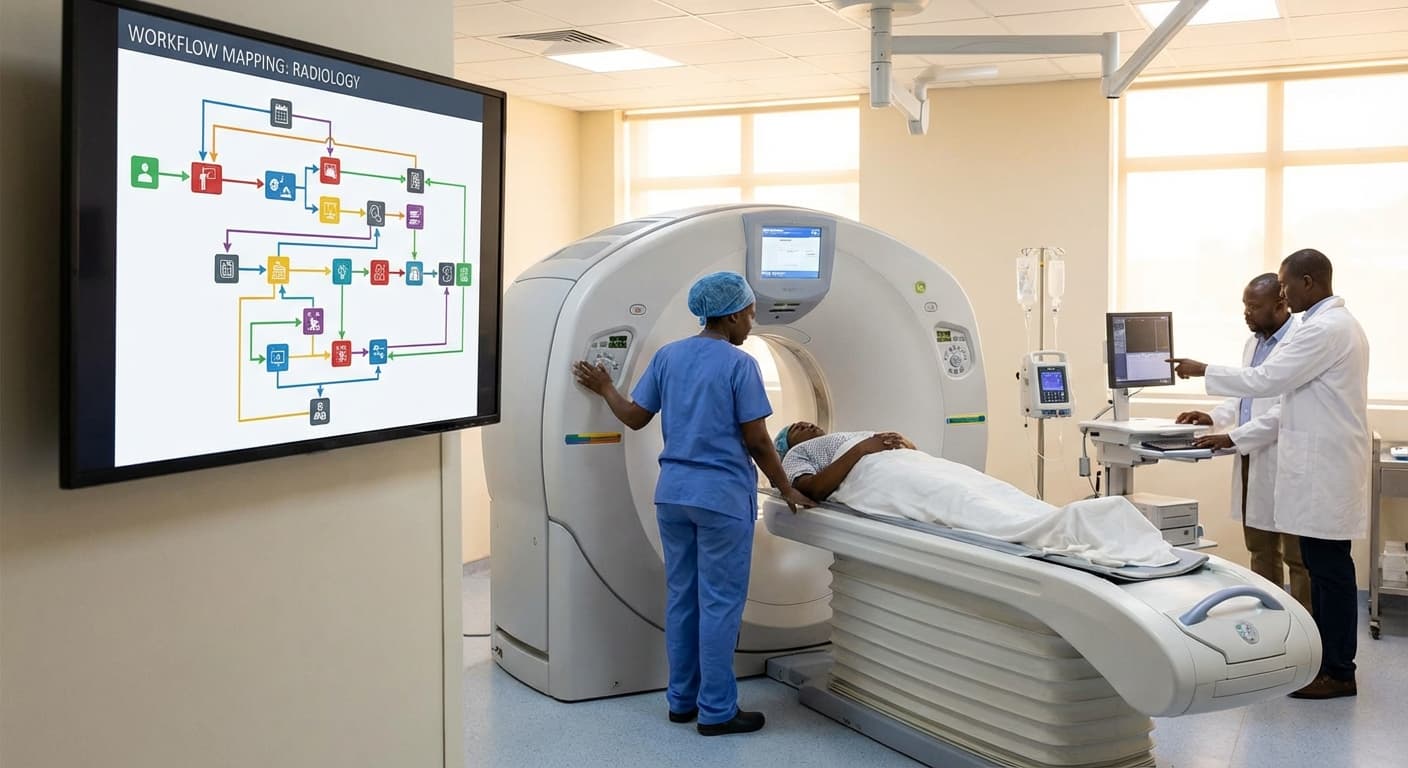
Department Workflow Mapping Service (Radiology/ICU/OT/Lab/Dialysis) in Mauritius
Engineering Excellence & Technical Support
Department Workflow Mapping Service (Radiology/ICU/OT/Lab/Dialysis) High-standard technical execution following OEM protocols and local regulatory frameworks.
Streamlined Patient Journeys
Visualize and optimize critical patient pathways across Radiology, ICU, OT, Lab, and Dialysis departments in Mauritius. Our service identifies bottlenecks and enhances handover protocols for faster, safer patient care.
Resource Optimization
Gain clarity on resource utilization (staff, equipment, beds) within high-demand Mauritian departments. Our workflow mapping highlights inefficiencies and supports data-driven decisions for improved allocation and reduced costs.
Enhanced Interdepartmental Collaboration
Break down silos and foster seamless communication between Radiology, ICU, OT, Lab, and Dialysis in Mauritian hospitals. Our mapping service clarifies dependencies and interconnections, leading to a more cohesive and responsive healthcare ecosystem.
What Is Department Workflow Mapping Service (Radiology/icu/ot/lab/dialysis) In Mauritius?
Department Workflow Mapping Service, in the context of healthcare facilities in Mauritius, refers to a systematic methodology for analyzing, documenting, and optimizing the operational processes within specific clinical departments, such as Radiology, Intensive Care Units (ICU), Operating Theatres (OT), Laboratories, and Dialysis Centers. This service employs a range of techniques to visualize the flow of patients, information, materials, and resources through each stage of a department's function. The primary objective is to identify inefficiencies, bottlenecks, redundancies, and potential risks, thereby enabling targeted improvements in areas such as patient safety, turnaround times, resource utilization, and overall operational effectiveness. It is a critical component of performance management and quality improvement initiatives within healthcare institutions.
| Department Type | Who Needs It | Typical Use Cases |
|---|---|---|
| Radiology | Radiology departments aiming to improve patient throughput, reduce report turnaround times, optimize equipment utilization, and enhance image archival and retrieval processes. | Streamlining patient scheduling and registration, optimizing image acquisition protocols, automating report generation, improving radiologist workflow, and managing contrast media inventory. |
| ICU | ICUs focused on reducing patient length of stay, improving interdisciplinary communication, minimizing adverse events, optimizing bed management, and enhancing the delivery of critical care. | Mapping patient admission and discharge processes, analyzing communication pathways between physicians, nurses, and allied health professionals, optimizing medication administration, and identifying critical equipment needs and availability. |
| OT | Operating Theatres seeking to maximize surgical case scheduling, reduce operating room downtime, improve instrument sterilization and turnaround, enhance patient safety during surgical procedures, and optimize resource allocation. | Analyzing surgical scheduling and pre-operative patient preparation, mapping instrument sterilization and case setup workflows, identifying delays in patient transfer to/from the OR, and optimizing post-operative patient recovery processes. |
| Laboratory | Clinical laboratories aiming to accelerate sample processing and test result delivery, improve accuracy and reduce errors, optimize reagent and consumable management, and enhance laboratory information system (LIS) integration. | Mapping sample collection, transportation, accessioning, testing, and reporting workflows, optimizing instrument calibration and maintenance schedules, managing specimen traceability, and improving quality control procedures. |
| Dialysis | Dialysis units focused on optimizing patient scheduling and throughput, ensuring timely and efficient dialysis treatments, managing equipment maintenance and availability, and improving patient comfort and safety. | Mapping patient dialysis scheduling, pre-dialysis assessment, dialysis treatment initiation and completion, and post-dialysis recovery processes, optimizing water treatment system maintenance, and managing dialysis machine utilization. |
Key Components of Department Workflow Mapping Service:
- Process Identification and Definition
- Stakeholder Engagement and Data Collection (interviews, observations, surveys)
- Process Visualization (flowcharts, swimlane diagrams, value stream maps)
- Bottleneck and Inefficiency Analysis
- Root Cause Analysis of identified issues
- Development of Optimized Workflow Models
- Implementation Planning and Support
- Monitoring and Continuous Improvement Frameworks
Who Needs Department Workflow Mapping Service (Radiology/icu/ot/lab/dialysis) In Mauritius?
In Mauritius, healthcare facilities across various critical departments are seeking to optimize their operations and enhance patient care through efficient workflow management. A dedicated Department Workflow Mapping Service is crucial for identifying bottlenecks, standardizing procedures, and improving resource allocation within specialized areas like Radiology, Intensive Care Units (ICU), Operating Theatres (OT), Laboratories, and Dialysis Centers. This service empowers these departments to achieve greater accuracy, reduce turnaround times, minimize errors, and ultimately, improve patient outcomes.
| Department | Target Customers/Users | Key Benefits of Workflow Mapping |
|---|---|---|
| Radiology Departments | Radiologists, Radiographers, Technicians, Administrative Staff, Referring Physicians | Reduced patient wait times for imaging and reports, improved image quality control, efficient scheduling of equipment and staff, streamlined report generation and distribution. |
| Intensive Care Units (ICU) | Intensivists, Critical Care Nurses, Respiratory Therapists, Pharmacists, Allied Health Professionals, Hospital Administrators | Enhanced patient safety protocols, optimized response times to critical events, improved interdisciplinary communication, efficient management of complex patient care pathways, reduced staff burnout. |
| Operating Theatres (OT) | Surgeons, Anesthesiologists, Operating Room Nurses, Surgical Technologists, Sterilization Technicians, Hospital Management | Minimized surgical delays, optimized instrument and equipment utilization, improved patient flow through the surgical suite, enhanced infection control measures, streamlined scheduling and resource allocation. |
| Laboratory Services | Pathologists, Medical Laboratory Technicians, Phlebotomists, IT Support, Clinicians (for sample orders and results) | Faster turnaround times for diagnostic tests, improved sample integrity and tracking, reduced errors in testing and reporting, optimized reagent and supply management, enhanced quality assurance. |
| Dialysis Centers | Nephrologists, Dialysis Nurses, Technicians, Patient Care Coordinators, Administrative Staff | Streamlined patient scheduling and session management, optimized equipment maintenance and availability, improved patient comfort and safety, efficient medication administration, enhanced communication with referring physicians. |
Who Needs Department Workflow Mapping Service in Mauritius?
- Radiology Departments
- Intensive Care Units (ICU)
- Operating Theatres (OT)
- Laboratory Services
- Dialysis Centers
Department Workflow Mapping Service (Radiology/icu/ot/lab/dialysis) Process In Mauritius
This document outlines the standard workflow for the Department Workflow Mapping Service, specifically tailored for departments within healthcare facilities in Mauritius. The service aims to analyze, document, and optimize existing operational processes within Radiology, Intensive Care Units (ICU), Operating Theatres (OT), Laboratories, and Dialysis Units. The process begins with an initial inquiry from a healthcare institution and concludes with the delivery of a comprehensive workflow map and recommendations.
| Phase | Stage | Description | Key Activities | Deliverables | Responsible Parties |
|---|---|---|---|---|---|
| Initiation | Inquiry & Initial Consultation | The healthcare institution expresses interest in workflow mapping for one or more departments. An initial meeting is held to understand their needs, scope, and objectives. | Receive inquiry, Schedule introductory meeting, Discuss objectives and scope, Clarify service offerings, Provide preliminary information. | Meeting minutes, Service proposal outline. | Client (Hospital Administration/Department Head), Service Provider (Workflow Mapping Team) |
| Planning | Scope Definition & Agreement | Formalize the agreement and clearly define the specific workflows to be mapped, the departments involved, timelines, and resources. | Detailed scope definition, Contract/Service Level Agreement (SLA) finalization, Project team formation (both client and provider), Kick-off meeting scheduling. | Signed Contract/SLA, Detailed Project Plan, Defined KPIs. | Client (Hospital Administration), Service Provider (Project Manager, Senior Analyst) |
| Information Gathering | Current State Analysis | Gather comprehensive information about the existing workflows. This involves observation, interviews, and documentation review. | On-site observation of processes, Interviews with staff at all levels, Review of existing SOPs and documentation, Data collection (patient flow, turnaround times, resource utilization). | Raw data, Interview notes, Observation logs, Existing process documentation. | Service Provider (Analysts, Subject Matter Experts), Client (Department Staff) |
| Analysis | Workflow Documentation & Bottleneck Identification | Document the 'as-is' workflows using standardized notations and identify areas of inefficiency, redundancy, and potential risks. | Develop 'as-is' workflow diagrams (e.g., BPMN), Analyze data for key performance indicators (KPIs), Identify bottlenecks, delays, and pain points, Conduct root cause analysis for identified issues. | 'As-is' workflow diagrams, Bottleneck report, Preliminary findings and recommendations. | Service Provider (Analysts, Process Engineers) |
| Design | Future State Design & Optimization | Develop proposed 'to-be' workflows that address the identified inefficiencies and align with best practices and client objectives. | Brainstorming sessions for improvement, Design 'to-be' workflow diagrams, Incorporate technology and automation possibilities, Define new SOPs and roles, Simulation of proposed workflows (if applicable). | 'To-be' workflow diagrams, Proposed SOPs, Recommended technology solutions, Optimized process flows. | Service Provider (Process Engineers, IT Consultants), Client (Department Heads, Key Staff) |
| Execution | Implementation Support (Optional) | Provide guidance and support for the implementation of the 'to-be' workflows, which may include training and change management. | Develop implementation plan, Conduct training sessions, Provide on-site support during rollout, Monitor initial adoption. | Implementation plan, Training materials, Post-implementation monitoring reports. | Service Provider (Implementation Specialists, Trainers), Client (Department Staff, HR) |
| Closure | Final Report & Handover | Present the final workflow maps, findings, and recommendations. The project is formally closed once the deliverables are accepted. | Prepare comprehensive final report, Present findings and recommendations to stakeholders, Handover all documentation and deliverables, Conduct post-project review. | Final Workflow Mapping Report, Executable Recommendations, Project Closure Document. | Service Provider (Project Manager, Lead Analyst), Client (Hospital Administration, Department Heads) |
Key Departments Covered by the Service
- Radiology
- Intensive Care Unit (ICU)
- Operating Theatre (OT)
- Laboratory
- Dialysis Unit
Department Workflow Mapping Service (Radiology/icu/ot/lab/dialysis) Cost In Mauritius
The cost of Department Workflow Mapping Services for specialized hospital departments like Radiology, ICU, OT (Operating Theatre), Lab (Laboratory), and Dialysis in Mauritius can vary significantly. This service involves a detailed analysis and documentation of existing processes, identification of bottlenecks and inefficiencies, and recommendations for optimization to improve patient flow, resource utilization, and overall departmental performance. The pricing is influenced by several key factors, making a precise, one-size-fits-all figure impossible without a specific project scope.
| Department Type | Estimated Cost Range (MUR) | Notes |
|---|---|---|
| Radiology | MUR 80,000 - MUR 250,000+ | Depends on the scope (e.g., just imaging vs. entire patient journey from referral to reporting). |
| ICU (Intensive Care Unit) | MUR 100,000 - MUR 300,000+ | High complexity due to critical patient care and multidisciplinary involvement. |
| OT (Operating Theatre) | MUR 120,000 - MUR 350,000+ | Involves intricate scheduling, sterile procedures, and multiple specialists. |
| Lab (Laboratory) | MUR 70,000 - MUR 220,000+ | Focus on sample handling, testing processes, and result reporting. |
| Dialysis | MUR 90,000 - MUR 280,000+ | Includes patient scheduling, equipment management, and treatment protocols. |
Key Pricing Factors for Department Workflow Mapping Services in Mauritius
- Department Complexity and Size: Larger departments with more intricate processes and a higher volume of patient interactions will naturally incur higher mapping costs.
- Scope of the Project: This can range from mapping a single, specific workflow (e.g., patient registration in the ICU) to a comprehensive end-to-end mapping of the entire department's operations.
- Level of Detail Required: Basic process flowcharts versus detailed time-and-motion studies, data analysis, and stakeholder interviews will impact the effort and cost.
- Consultant Expertise and Reputation: Highly experienced consultants or specialized firms with a proven track record in healthcare workflow optimization will command higher fees.
- Data Collection and Analysis Tools: The use of advanced software for simulation, process mining, or data analytics can add to the overall cost but can also yield more robust insights.
- Reporting and Deliverables: The format and depth of the final reports, recommendations, and any proposed implementation roadmaps will influence the pricing.
- Project Timeline and Urgency: Expedited projects may incur premium charges.
- Number of Stakeholders Involved: The time spent interviewing and gathering input from various staff members (doctors, nurses, technicians, administrators) contributes to the overall effort.
- Location of the Hospital/Department: While generally consistent across Mauritius, travel and accommodation costs for consultants if the facility is remote could be a minor factor.
Affordable Department Workflow Mapping Service (Radiology/icu/ot/lab/dialysis) Options
Our Affordable Department Workflow Mapping Service offers comprehensive solutions for optimizing operations in Radiology, ICU, OT, Lab, and Dialysis units. We understand the critical need for efficient, cost-effective processes in these high-stakes environments. Our service focuses on identifying bottlenecks, streamlining tasks, and implementing best practices to enhance productivity, reduce errors, and ultimately lower operational costs. We offer flexible value bundles tailored to specific departmental needs and provide expert guidance on cost-saving strategies that can be integrated directly into your mapped workflows.
| Value Bundle | Included Services | Target Department | Estimated Value / Cost-Saving Potential |
|---|---|---|---|
| Basic Efficiency Mapping | Core workflow analysis, identification of 3-5 major bottlenecks, basic process flowchart. | Radiology, Lab | 10-15% reduction in turnaround time, improved staff allocation. |
| Standard Optimization Bundle | In-depth workflow mapping, bottleneck resolution strategies, recommended process improvements, initial KPI setup. | Radiology, Lab, Dialysis | 15-20% reduction in operational costs, reduced error rates by 5-10%, improved patient flow. |
| Advanced Integrated Workflow | Comprehensive analysis and redesign, technology integration consultation, detailed SOP development, staff training module outline, ongoing KPI monitoring framework. | ICU, OT, Lab, Dialysis | 20-30% reduction in operational costs, significant improvements in patient safety and care quality, optimized resource utilization. |
| Custom Departmental Solution | Fully tailored to specific departmental needs, covering all aspects from initial analysis to implementation support and continuous improvement. | All Departments | Maximized cost savings and efficiency gains, tailored to unique operational challenges. |
Key Service Components & Value Proposition
- Comprehensive Workflow Analysis: Detailed mapping of current processes, identifying inefficiencies, redundancies, and potential risks.
- Customized Workflow Design: Development of optimized workflows incorporating best practices and lean principles.
- Technology Integration Recommendations: Identifying opportunities to leverage existing or new technologies for automation and improved data flow.
- Staff Training & Change Management Support: Facilitating smooth adoption of new workflows through targeted training and stakeholder engagement.
- Performance Metrics & Monitoring: Establishing key performance indicators (KPIs) to track the effectiveness of implemented changes.
- Significant Cost Reduction Potential: Direct impact on reducing waste, minimizing errors, optimizing resource utilization, and improving patient throughput.
- Enhanced Patient Care & Safety: Streamlined processes lead to quicker turnaround times, reduced wait times, and improved accuracy in diagnostic and treatment procedures.
- Scalable Solutions: Services adaptable to departments of all sizes and complexities.
Verified Providers In Mauritius
In the quest for reliable and high-quality healthcare in Mauritius, identifying verified providers is paramount. Franance Health stands out as a premier choice, offering a comprehensive network of accredited healthcare professionals and facilities. This commitment to verification ensures that patients receive care that meets the highest international standards of safety, efficacy, and professionalism. Choosing Franance Health means opting for a system built on trust, transparency, and a dedication to optimal health outcomes for all.
| Provider Type | Verification Criteria | Franance Health Advantage |
|---|---|---|
| Hospitals & Clinics | Compliance with Ministry of Health regulations, international accreditation (e.g., JCI, ISO), advanced infrastructure, safety records. | Franance Health partners exclusively with facilities that meet or exceed these stringent benchmarks, ensuring state-of-the-art care and patient safety. |
| Specialist Doctors | Valid medical licenses, board certifications, years of experience, peer testimonials, disciplinary record checks. | Our network features specialists meticulously vetted for their expertise and ethical practice, guaranteeing access to leading medical minds in Mauritius. |
| Diagnostic Services (Labs & Imaging) | Accreditation by relevant authorities, quality control measures, advanced equipment, certified technicians. | Franance Health ensures access to reliable diagnostic services through providers who uphold the highest standards of accuracy and technological advancement. |
| Emergency Services | Availability of 24/7 care, trained emergency medical personnel, well-equipped ambulances, established transfer protocols. | We collaborate with emergency providers committed to rapid response and efficient, life-saving interventions, providing peace of mind when you need it most. |
Why Franance Health is the Best Choice for Verified Providers:
- Rigorous Accreditation Process: Franance Health employs a multi-stage vetting system that includes thorough credential checks, peer reviews, and ongoing performance monitoring.
- Commitment to Quality Care: Our network comprises specialists and institutions known for their expertise, advanced medical technologies, and patient-centric approaches.
- Transparency and Trust: We provide clear information about our providers' qualifications and specialties, fostering informed decision-making for patients.
- Comprehensive Network: Access to a wide range of medical services, from general practitioners to highly specialized surgeons, all within a trusted network.
- Patient Safety Focus: Adherence to strict safety protocols and continuous improvement initiatives to ensure the well-being of every patient.
Scope Of Work For Department Workflow Mapping Service (Radiology/icu/ot/lab/dialysis)
This Scope of Work (SOW) outlines the services to be provided by the Workflow Mapping Service provider for various hospital departments, including Radiology, Intensive Care Unit (ICU), Operating Theatre (OT), Laboratory, and Dialysis. The objective is to comprehensively map existing workflows, identify inefficiencies, and propose optimized processes. The service will result in detailed process documentation and actionable recommendations for improvement.
| Phase | Activities | Deliverables | Standard Specifications |
|---|---|---|---|
| Kick-off meeting, stakeholder identification, detailed project plan development, data collection strategy. | Project Charter, Detailed Project Plan, Stakeholder Register. | Project Charter: To include scope, objectives, stakeholders, high-level timeline, and communication plan. Detailed Project Plan: To include specific tasks, timelines, resource allocation, and risk assessment. Stakeholder Register: To list all key individuals and their roles/responsibilities. |
| Observation of processes, interviews with staff, review of existing documentation, data gathering (patient flow, resource utilization, etc.). | Current State Workflow Maps (as-is), Process Narratives, Data Summary Reports. | Workflow Maps: Utilize standard flowcharting notation (e.g., BPMN 2.0) to visually represent each process. Include swimlanes for roles/departments. Process Narratives: Detailed written descriptions of each step, including inputs, outputs, decision points, and actors. Data Summary Reports: Quantifiable data on process performance (e.g., turnaround times, error rates, resource allocation). |
| Analysis of current state maps and data, root cause analysis of identified issues, benchmarking against best practices. | Gap Analysis Report, Bottleneck Identification Report, Opportunity Assessment. | Gap Analysis Report: Clearly outlines discrepancies between current and desired state (if preliminary ideal state is defined). Bottleneck Identification Report: Pinpoints specific points of delay or congestion within workflows. Opportunity Assessment: Lists potential areas for improvement and their potential impact. |
| Collaborative workshops with stakeholders, development of optimized workflows, incorporation of technology/automation solutions, risk assessment for new workflows. | Future State Workflow Maps (to-be), Proposed Process Improvements, Technology/Automation Recommendations, Risk Mitigation Plan. | Future State Workflow Maps: Clearly depict the optimized process, incorporating approved changes. Proposed Process Improvements: Detailed description of recommended changes to procedures and protocols. Technology/Automation Recommendations: Specific suggestions for software, hardware, or automation tools, with justification. Risk Mitigation Plan: Strategies to address potential challenges in implementing the new workflows. |
| Consolidation of all deliverables, final report generation, presentation of findings and recommendations. | Final Comprehensive Report, Presentation Deck, Executive Summary. | Final Comprehensive Report: Includes all previous deliverables, detailing the entire mapping process, findings, and recommendations. Presentation Deck: Summarizes key findings, proposed solutions, and expected benefits for executive and departmental review. Executive Summary: Concise overview of the project, key findings, and recommendations for senior leadership. |
Project Objectives
- To accurately document the current state of workflows within each specified department.
- To identify bottlenecks, redundancies, and areas of inefficiency in existing processes.
- To collaboratively develop optimized future-state workflows incorporating best practices and technological advancements where applicable.
- To provide clear and actionable recommendations for workflow improvement, including potential technology adoption or process re-engineering.
- To ensure seamless integration of new workflows with existing hospital systems and protocols.
Service Level Agreement For Department Workflow Mapping Service (Radiology/icu/ot/lab/dialysis)
This Service Level Agreement (SLA) outlines the agreed-upon service levels for the Department Workflow Mapping Service, specifically covering the Radiology, Intensive Care Unit (ICU), Operating Theatre (OT), Laboratory (Lab), and Dialysis departments. This SLA defines response times for critical issues and uptime guarantees for the workflow mapping platform and associated support.
| Service Component | Uptime Guarantee | Definition of Uptime | Exclusions from Uptime |
|---|---|---|---|
| Workflow Mapping Platform Availability | 99.5% | The platform is accessible and functional for authorized users to view, edit, and generate workflow documentation. | Scheduled maintenance windows, planned or unplanned outages due to third-party service providers (e.g., internet connectivity, cloud hosting provider), and issues arising from user-specific configurations or hardware. |
| Support Desk Availability | 99.0% | The support desk is staffed and available to receive and acknowledge support requests during defined business hours. | Public holidays and outside of defined business hours. |
Scope of Service
- The Department Workflow Mapping Service encompasses the analysis, documentation, and optimization of workflows within the Radiology, ICU, OT, Lab, and Dialysis departments.
- This service includes but is not limited to: initial workflow assessment, mapping current state processes, identifying bottlenecks and inefficiencies, proposing optimized workflows, and facilitating the implementation of recommended changes.
- The service delivery relies on the availability of the workflow mapping platform and timely access to departmental stakeholders and relevant data.
Frequently Asked Questions

Ready when you are
Let's scope your Department Workflow Mapping Service (Radiology/ICU/OT/Lab/Dialysis) in Mauritius project in Mauritius.

Scaling healthcare logistics and technical systems across the entire continent.