
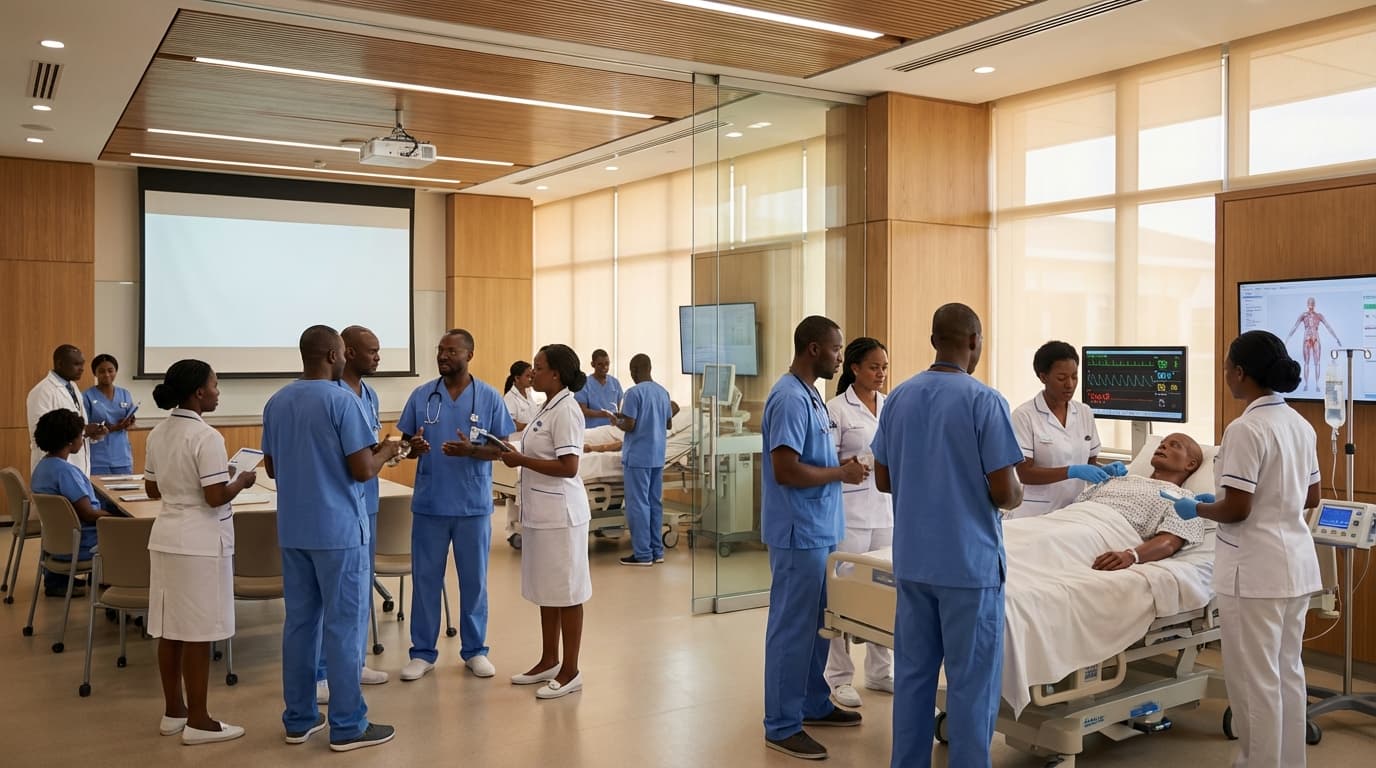
Equipment Training & Education in Mauritania
Engineering Excellence & Technical Support
Comprehensive equipment training and certification programs High-standard technical execution following OEM protocols and local regulatory frameworks.
Digital Learning Hub for Heavy Machinery
Developed and launched an interactive online platform hosting comprehensive training modules, simulation exercises, and certification pathways for critical heavy machinery operation and maintenance in Mauritania. This initiative ensures standardized, accessible, and up-to-date technical skills development for local workforce.
Mobile Training Units for Remote Site Operations
Deployed a fleet of fully-equipped mobile training units, complete with virtual reality simulators and hands-on equipment, to remote mining and infrastructure project sites across Mauritania. This significantly reduces travel time and costs, enabling continuous skill enhancement for field technicians and operators in challenging environments.
Localized Safety & Operational Excellence Program
Implemented a region-specific training curriculum focusing on advanced safety protocols, best operational practices, and efficient troubleshooting for key industrial equipment. Leveraging local language content and culturally relevant scenarios, this program has demonstrably improved safety records and equipment uptime in Mauritanian industries.
What Is Equipment Training & Education In Mauritania?
Equipment Training & Education in Mauritania refers to structured programs designed to impart the necessary knowledge, skills, and proficiencies for the safe, efficient, and effective operation, maintenance, and troubleshooting of various types of equipment. This encompasses theoretical instruction, practical hands-on sessions, and ongoing competency assessment. The primary objective is to enhance workforce capabilities, minimize operational risks, ensure regulatory compliance, and optimize equipment longevity and performance within the Mauritanian economic landscape.
| Who Needs Equipment Training & Education? | Typical Use Cases & Sectors | |||||
|---|---|---|---|---|---|---|
| Operators: Personnel directly responsible for the day-to-day use of machinery and systems. | Maintenance Technicians: Individuals tasked with the upkeep, repair, and servicing of equipment. | Supervisors & Managers: To oversee operations, ensure compliance, and understand the capabilities and limitations of the equipment. | Safety Officers: To understand potential hazards associated with equipment and implement appropriate safety measures. | New Employees: To onboard individuals with essential operational and safety knowledge. | Companies adopting new technologies or equipment: To bridge skill gaps and ensure smooth integration. | Individuals seeking career advancement: To acquire specialized skills and certifications. |
| Mining & Extractive Industries: Training on heavy machinery (excavators, haul trucks), drilling equipment, processing plants, and safety systems. | Oil & Gas Sector: Operation and maintenance of drilling rigs, exploration equipment, offshore platforms, refining units, and pipeline infrastructure. | Construction Industry: Operation of cranes, earthmoving equipment, power tools, scaffolding, and site safety. | Agriculture: Use and maintenance of tractors, harvesters, irrigation systems, and specialized farming machinery. | Manufacturing & Industrial Plants: Training on production machinery, assembly lines, robotic systems, and quality control equipment. | Transportation & Logistics: Operation of forklifts, warehouse machinery, and specialized loading/unloading equipment. | Energy Sector (Renewable & Conventional): Installation, operation, and maintenance of power generation equipment (turbines, solar panels, generators). |
Key Components of Equipment Training & Education
- Theoretical Instruction: Covers equipment principles, operational procedures, safety protocols (including hazard identification and mitigation), regulatory requirements, and diagnostic methodologies.
- Practical/Hands-on Training: Involves direct engagement with the equipment, supervised operation, maintenance tasks (preventive and corrective), calibration, and emergency response simulations.
- Competency Assessment: Formal evaluation through written examinations, practical skill demonstrations, and performance monitoring to verify understanding and proficiency.
- Certification & Documentation: Issuance of certificates upon successful completion, validating the trainee's qualifications and maintaining training records.
- On-the-Job Training (OJT) & Mentorship: Integration of training within the operational environment, often facilitated by experienced personnel.
- Refresher & Advanced Training: Periodic sessions to reinforce skills, introduce new technologies or procedures, and foster continuous professional development.
- Customized Training Modules: Development of bespoke training programs tailored to specific equipment models, industry sectors, and organizational needs.
Who Needs Equipment Training & Education In Mauritania?
Equipment training and education are crucial for a wide range of individuals and organizations in Mauritania to ensure safe, efficient, and productive use of machinery and technology. This is particularly vital in sectors that drive the Mauritanian economy and those that require specialized skills for operation and maintenance. Investing in training mitigates risks, enhances operational uptime, and fosters a more skilled workforce.
| Industry/Sector | Target Customers | Key Departments/Roles Requiring Training | |||||||||||||||||||||||||||||||||
|---|---|---|---|---|---|---|---|---|---|---|---|---|---|---|---|---|---|---|---|---|---|---|---|---|---|---|---|---|---|---|---|---|---|---|---|
| Mining and Extractive Industries | Mining companies, exploration firms, service providers | Machine Operators (excavators, haul trucks, drills), Maintenance Technicians, Supervisors, Safety Officers, Geologists (for specialized equipment) | Oil and Gas Exploration and Production | Oil companies, drilling contractors, service companies | Drilling Crew, Wellhead Technicians, Refinery Operators, Pipeline Engineers, HSE (Health, Safety, and Environment) Personnel | Agriculture and Agribusiness | Large-scale farms, agricultural cooperatives, equipment suppliers | Tractor and Harvester Operators, Irrigation Technicians, Farm Managers, Agricultural Engineers, Equipment Maintenance Staff | Construction and Infrastructure Development | Construction companies, public works departments, engineering firms | Heavy Equipment Operators (cranes, bulldozers, pavers), Construction Managers, Site Supervisors, Safety Inspectors, Civil Engineers | Transportation and Logistics | Port authorities, shipping companies, trucking firms, airlines | Crane Operators, Forklift Operators, Vehicle Mechanics, Logistics Managers, Warehouse Supervisors, Air Traffic Controllers (for specialized equipment) | Fisheries and Marine Industries | Fishing companies, shipyards, maritime training centers | Fishermen (for navigation and fishing gear), Boat Mechanics, Port Crane Operators, Maritime Engineers | Energy and Utilities | Power generation companies, water treatment facilities, electricity distribution networks | Power Plant Operators, Turbine Technicians, Water Treatment Plant Operators, Electricians, Substation Technicians | Healthcare | Hospitals, clinics, medical equipment suppliers | Radiology Technicians, Laboratory Technicians, Biomedical Engineers, Operating Room Staff (for specialized medical devices) | Manufacturing and Industrial Production | Factories, workshops, industrial processing plants | Machine Operators (assembly lines, CNC machines), Production Supervisors, Quality Control Technicians, Maintenance Engineers | Telecommunications | Telecom operators, infrastructure providers | Tower Climbers, Network Technicians, Field Engineers, Equipment Installers | Education and Vocational Training Institutions | Technical schools, universities, training centers | Instructors, Trainers, Curriculum Developers, Students in technical programs | Government and Public Administration | Various ministries and agencies | Public works personnel, disaster management teams, national security (for specialized equipment operation and maintenance) |
Target Customers & Departments for Equipment Training & Education in Mauritania
- Individuals seeking to enter or advance in vocational fields.
- Companies and organizations across various industries.
- Government agencies responsible for infrastructure and public services.
Equipment Training & Education Process In Mauritania
The Equipment Training & Education Process in Mauritania, from initial inquiry to successful execution, involves a structured workflow designed to ensure effective knowledge transfer and practical skill development for operating specific equipment. This process is crucial for safety, efficiency, and maximizing the lifespan of valuable assets. It typically begins with a clear identification of training needs, followed by a vendor selection, curriculum development, scheduling, delivery, and finally, evaluation and certification. Each stage is critical for a successful outcome.
| Stage | Description | Key Activities | Responsible Parties | Potential Challenges |
|---|---|---|---|---|
| Inquiry & Needs Assessment | The formal request for training and a detailed understanding of the required skills and knowledge. | Client identifies equipment, number of trainees, skill gaps, desired outcomes, and budget. Documenting existing knowledge levels. | Client organization (e.g., operations manager, HR department), potential trainees. | Unclear scope of training needs. Lack of detailed documentation of existing skills. |
| Vendor Identification & Selection | Finding and choosing the most suitable training provider based on expertise, experience, and cost. | Researching potential training institutions or individual experts. Requesting proposals (RFPs) and quotations. Evaluating proposals based on curriculum, instructor qualifications, references, and pricing. Contract negotiation. | Client organization (procurement, technical departments). | Limited availability of specialized training providers in Mauritania. Difficulty in verifying vendor credibility. |
| Curriculum Development & Customization | Designing or adapting the training program to meet specific needs and equipment. | Reviewing vendor's standard curriculum. Collaborating with the vendor to tailor content to specific equipment models, operational environments, and safety regulations in Mauritania. Incorporating hands-on practical exercises. | Training vendor, client organization (subject matter experts). | Misalignment between curriculum and actual operational requirements. Insufficient practical content. |
| Logistics & Scheduling | Arranging all practical aspects for the training sessions. | Confirming dates and duration. Booking training venue (on-site or off-site). Arranging for equipment availability for practical sessions. Coordinating trainee attendance and travel/accommodation if necessary. Ensuring necessary safety equipment is available. | Training vendor, client organization. | Equipment downtime during training. Scheduling conflicts with operational demands. Travel and accommodation issues for trainees or instructors. |
| Training Delivery & Execution | The actual delivery of the training program. | Theoretical instruction (lectures, presentations, Q&A). Demonstrations by instructors. Supervised hands-on practice by trainees. Problem-solving scenarios. Emphasis on safety protocols. | Training vendor (instructors). | Language barriers. Varying learning speeds of trainees. Inadequate supervision during practical sessions. |
| Assessment & Evaluation | Measuring the effectiveness of the training and the trainees' comprehension and skill acquisition. | Written tests, quizzes. Practical skill assessments (observation of performance). Feedback forms from trainees. Post-training performance monitoring (optional). | Training vendor, client organization. | Subjective assessment of practical skills. Difficulty in measuring long-term retention. |
| Certification & Follow-up | Providing formal recognition of completed training and addressing ongoing needs. | Issuing certificates of completion or competency. Providing post-training support or refresher courses if required. Reviewing training feedback for future improvements. | Training vendor, client organization. | Lack of standardized certification recognition. Limited budget for follow-up training. |
Key Stages of the Equipment Training & Education Process
- Inquiry & Needs Assessment
- Vendor Identification & Selection
- Curriculum Development & Customization
- Logistics & Scheduling
- Training Delivery & Execution
- Assessment & Evaluation
- Certification & Follow-up
Equipment Training & Education Cost In Mauritania
The cost of equipment training and education in Mauritania is influenced by several key factors, leading to a range of pricing for various programs and certifications. Understanding these elements is crucial for organizations and individuals seeking to invest in skills development. The local currency, the Mauritanian Ouguiya (MRU), is the primary medium of exchange for these services. Pricing can vary significantly based on the complexity of the equipment, the duration of the training, the expertise of the instructors, the location of the training facility, and whether the training is provided by a specialized training institute, a vocational school, or directly by the equipment manufacturer or their local agents. Smaller, more generalized training sessions on basic equipment operation might be relatively affordable, while in-depth, specialized training for complex industrial machinery, medical equipment, or advanced IT hardware will command higher fees. The inclusion of practical, hands-on sessions, access to state-of-the-art simulators, and the provision of certification upon successful completion also contribute to the overall cost.
| Training Category | Typical Duration | Estimated Price Range (MRU) | Notes |
|---|---|---|---|
| Basic Equipment Operation (e.g., office machinery, basic tools) | 1-3 days | 5,000 - 15,000 MRU | Covers fundamental operation and safety. May be provided by suppliers. |
| Intermediate Equipment Skills (e.g., specific software, general construction equipment) | 3-7 days | 15,000 - 40,000 MRU | Focuses on more detailed functionalities and common applications. Offered by vocational centers and specialized institutes. |
| Advanced/Specialized Equipment Training (e.g., industrial machinery, medical devices, complex IT hardware) | 1-4 weeks (or modular) | 40,000 - 150,000+ MRU | Highly technical, often requires certified instructors and specialized facilities. Manufacturer-led training can be at the higher end. |
| Certification Programs (e.g., specific industry certifications) | Varies (can be integrated with other training) | Included in training cost or an additional 10,000 - 30,000 MRU | Cost dependent on the recognized body and the rigor of the exam. |
| Customized Corporate Training | Negotiable | Per-project basis, often starting from 100,000 MRU | Tailored to specific organizational needs, equipment, and employee levels. |
Key Pricing Factors for Equipment Training in Mauritania:
- Equipment Complexity and Specialization
- Training Duration and Intensity
- Instructor Expertise and Qualifications
- Training Provider Type (Institute, Vocational School, Manufacturer)
- Location and Accessibility of Training Facility
- Inclusion of Hands-on Practice and Simulators
- Certification and Accreditation
- Group Size and Customized Programs
- Demand and Market Availability
Affordable Equipment Training & Education Options
Investing in proper equipment training is crucial for safety, efficiency, and maximizing the lifespan of your machinery. Fortunately, there are several affordable options available. Value bundles often combine training with equipment purchases or offer discounted rates for multiple courses. Cost-saving strategies include leveraging online resources, group discounts, and seeking out government or industry-specific grants. Understanding these options can significantly reduce the financial burden of essential equipment education.
| Strategy | Description | Cost-Saving Benefit | Example |
|---|---|---|---|
| Value Bundles | Training packages often bundled with new equipment purchases or as part of a service agreement. Can also include multiple training modules at a reduced price. | Discounted overall cost when training is included with a larger purchase or a comprehensive package. | A new forklift purchase includes 5 hours of certified operator training at no additional charge. |
| Group Discounts | Organizations can often negotiate lower per-person rates when booking training for multiple employees. | Reduces the per-individual cost of training. | A construction company sends 10 employees for an advanced excavator course and receives a 15% group discount. |
| Online Learning Platforms | Utilizing digital platforms that offer self-paced courses, recorded webinars, and virtual simulations. | Eliminates travel costs, venue expenses, and allows for flexible scheduling. | An HVAC technician completes a new refrigeration system training module online from their office. |
| Train-the-Trainer Programs | Investing in a few key employees to become certified trainers within your organization. | Reduces reliance on external trainers for ongoing needs, lowering long-term training expenses. | A manufacturing plant trains two experienced operators to become internal trainers for assembly line machinery. |
| Government & Industry Grants/Subsidies | Exploring financial aid opportunities offered by government agencies or industry-specific organizations for workforce development and training. | Can significantly offset or fully cover training costs. | A small business utilizes a state grant to fund specialized welding certification for its employees. |
| Open Enrollment Courses | Attending scheduled training sessions offered to the public or individuals from various companies. | Often more affordable than private, on-site training, especially for smaller groups. | An individual attends a public OSHA safety course at a local training center. |
| Cross-Training & Skill Swapping | Encouraging employees to learn adjacent equipment skills from colleagues, often through mentorship. | Develops a more versatile workforce with reduced need for formal, specialized training for every role. | A warehouse employee learns to operate a pallet jack from a more experienced colleague. |
Affordable Equipment Training & Education Options
- Online Courses and Webinars
- Manufacturer-Provided Training
- Vocational Schools and Community Colleges
- Industry Association Workshops
- On-the-Job Training (OJT) with Mentorship
- Government and Non-Profit Programs
Verified Providers In Mauritania
In the quest for reliable healthcare, understanding the credentials and certifications of healthcare providers is paramount. In Mauritania, a growing emphasis is being placed on verified and accredited medical services to ensure patient safety and quality of care. Franance Health stands out as a premier entity, upholding rigorous standards and offering a comprehensive network of services. This document explores the significance of verified providers in Mauritania and highlights why Franance Health's credentials position them as the best choice for your healthcare needs.
| Franance Health Credential | Significance for Patients in Mauritania | Why it Represents the Best Choice |
|---|---|---|
| Accreditation by International Healthcare Standards Bodies (e.g., JCI, ISO) | Demonstrates adherence to globally recognized benchmarks for quality and patient safety, assuring that facilities and processes meet stringent international requirements. | Provides unparalleled assurance of world-class care, offering peace of mind that patients are receiving treatment aligned with the highest global medical standards. |
| Network of Certified Medical Professionals | Ensures that all doctors, nurses, and specialists within the Franance Health network possess valid licenses, specialized training, and have undergone continuous professional development. | Guarantees access to highly qualified and experienced healthcare professionals who are up-to-date with the latest medical advancements and practices. |
| Partnerships with Reputable Mauritanian Hospitals and Clinics | Indicates that Franance Health collaborates with healthcare facilities that have undergone their own verification processes and meet specific quality metrics. | Offers a curated selection of trusted healthcare institutions, ensuring that patients are treated in facilities that are safe, well-equipped, and professionally managed. |
| Commitment to Patient-Centric Care and Ethical Practices | Reflects a dedication to patient rights, privacy, and ethical medical conduct, fostering a supportive and respectful healthcare experience. | Prioritizes the well-being and dignity of each patient, ensuring a positive and empowering healthcare journey that respects individual needs and values. |
| Telemedicine and Remote Consultation Capabilities | Leverages technology to provide accessible healthcare solutions, extending reach and convenience for patients, especially in remote areas. | Enhances accessibility and convenience, allowing patients to connect with qualified medical experts regardless of their geographical location, facilitating timely consultations and follow-ups. |
Why Verified Providers Matter in Mauritania:
- Ensuring Patient Safety: Verified providers adhere to established protocols and best practices, minimizing risks associated with medical procedures.
- Quality of Care: Accreditation and verification often indicate a commitment to continuous improvement and the delivery of high-standard medical services.
- Trust and Transparency: Verified credentials offer patients confidence in the competence and legitimacy of their healthcare providers.
- Access to Specialized Services: Many verified organizations facilitate access to a wider range of specialized medical expertise.
- Regulatory Compliance: Verification often means providers meet or exceed local and international healthcare regulations.
Scope Of Work For Equipment Training & Education
This Scope of Work (SOW) outlines the requirements for comprehensive equipment training and education. The objective is to ensure that designated personnel gain the necessary knowledge and practical skills to operate, maintain, and troubleshoot the specified equipment safely and effectively. This includes both theoretical instruction and hands-on practical sessions. The training program will be tailored to different user groups, ranging from basic operators to advanced maintenance technicians. Standard specifications for the deliverables are detailed below.
| Deliverable | Description | Format | Acceptance Criteria | Responsibility |
|---|---|---|---|---|
| Training Curriculum | Detailed outline of training modules, learning objectives, content, and duration for each user group. | PDF Document | Approved by client before commencement of training. | Training Provider |
| Training Manuals | Comprehensive guide covering equipment operation, maintenance procedures, troubleshooting steps, and safety guidelines. | Digital (PDF) and/or Printed Copies | Content accuracy verified by client's technical team. Clear and concise language. | Training Provider |
| Practical Training Sessions | Hands-on sessions utilizing actual or simulated equipment to reinforce theoretical knowledge and develop practical skills. | Live Demonstrations and Supervised Practice | Participants demonstrate proficiency in key operational and maintenance tasks. | Training Provider & Client Personnel |
| Competency Assessment | Methods to evaluate trainee understanding and practical skills, including theoretical tests and hands-on evaluations. | Written Quizzes, Practical Tests, Observation Checklists | Minimum passing score (e.g., 80%) for trainees. Objective scoring based on defined criteria. | Training Provider |
| Training Completion Certificates | Formal recognition of successful completion of the training program for each participant. | Printed Certificates | Issued to all participants who meet the defined competency standards. | Training Provider |
| Post-Training Report | Summary of training activities, participant performance, feedback analysis, and recommendations for further training or support. | PDF Document | Submitted within 7 days of training completion. Actionable insights included. | Training Provider |
Technical Deliverables
- Training curriculum document (including learning objectives, modules, and duration)
- Training materials (presentations, manuals, handouts, visual aids)
- Practical training exercises and scenarios
- Competency assessment tools (quizzes, practical tests, observation checklists)
- Trainer qualifications and experience documentation
- Training environment setup and required equipment
- Post-training support plan (e.g., access to subject matter experts, refresher courses)
- Training attendance and completion records
- Training feedback forms and analysis reports
Service Level Agreement For Equipment Training & Education
This Service Level Agreement (SLA) outlines the performance standards for the Equipment Training & Education services provided by [Your Company Name] to [Client Company Name]. It specifically details response times for support requests and guarantees for the availability of training resources.
| Service Component | Uptime Guarantee | Response Time (Business Hours) | Resolution Target (Business Hours) |
|---|---|---|---|
| Online Learning Platform/Portal | 99.5% | 2 Business Hours | 8 Business Hours |
| Access to Digital Training Materials (e.g., PDFs, Videos) | 99.8% | 4 Business Hours | N/A (Content accessibility is generally immediate upon authentication) |
| Simulation Software/Environment | 99.0% | 3 Business Hours | 12 Business Hours |
| Scheduled Virtual Training Sessions (Platform Stability) | 99.5% | 1 Business Hour (Pre-session check) | N/A (Focus is on platform availability for the scheduled time) |
| Technical Support for Scheduled Training Sessions (Instructor/Platform issues) | N/A | 30 Minutes (during the session) | N/A (Immediate troubleshooting during the session) |
Key Service Definitions
- Training Resources: Refers to all digital and physical materials, platforms, and environments made available for the purpose of training on specified equipment. This includes but is not limited to online learning modules, simulation software, video tutorials, documentation, and dedicated training labs.
- Scheduled Training Session: A pre-arranged training session conducted at a specific date and time, either in-person or virtual, with a designated instructor.
- Technical Support Request: A request submitted by [Client Company Name] to [Your Company Name] for assistance related to the operation, access, or troubleshooting of training resources or scheduled training sessions.
- Business Hours: Monday to Friday, 9:00 AM to 5:00 PM [Client's Time Zone], excluding public holidays.
- Response Time: The maximum time allowed for [Your Company Name] to acknowledge receipt of a Technical Support Request and initiate investigation.
- Resolution Time: The maximum time allowed for [Your Company Name] to resolve a Technical Support Request, bringing the affected training resource or session back to a fully functional state.
Frequently Asked Questions

Ready when you are
Let's scope your Equipment Training & Education in Mauritania project in Mauritania.

Scaling healthcare logistics and technical systems across the entire continent.