
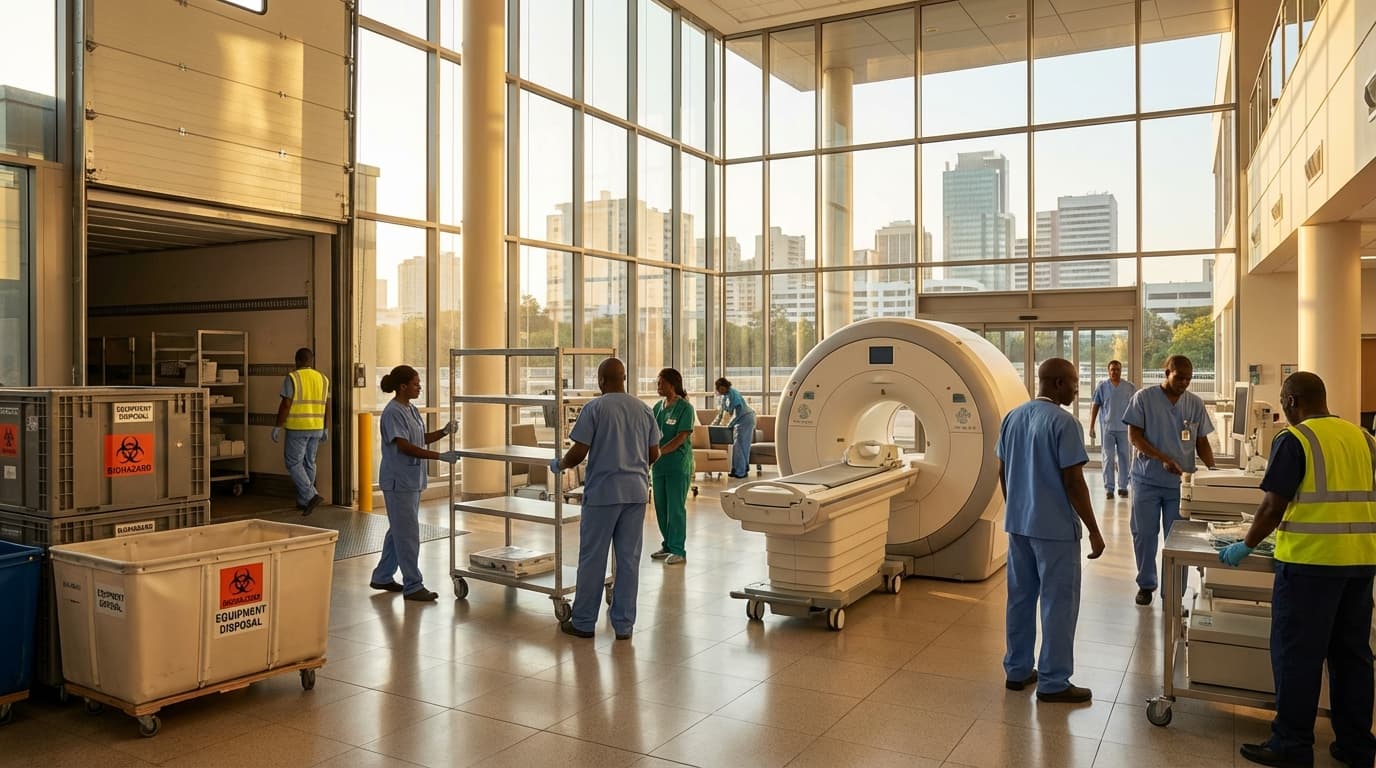
Medical Equipment Relocation Service (Move & Re-Install) in Mauritania
Engineering Excellence & Technical Support
Medical Equipment Relocation Service (Move & Re-Install) High-standard technical execution following OEM protocols and local regulatory frameworks.
Specialized Medical Transport Fleet
Our custom-designed, climate-controlled fleet ensures the safe and secure transit of sensitive medical equipment across Mauritania, maintaining optimal conditions throughout the journey.
Certified Re-Installation & Calibration
Our expert technicians provide meticulous re-installation and calibration services for all types of medical devices, ensuring full operational readiness and compliance with regulatory standards in your new Mauritanian facility.
Nationwide Logistics & Site Survey Expertise
Leveraging extensive knowledge of Mauritanian infrastructure, we conduct comprehensive site surveys to plan efficient routes and identify any logistical challenges, guaranteeing a seamless relocation experience to any location within the country.
What Is Medical Equipment Relocation Service (Move & Re-install) In Mauritania?
Medical Equipment Relocation Service (Move & Re-Install) in Mauritania refers to a specialized logistical operation encompassing the secure transportation and subsequent operational recommissioning of medical devices and apparatus within, to, or from facilities located in the Islamic Republic of Mauritania. This service is distinct from general freight movement due to the inherent sensitivity, precision, and often critical nature of medical equipment, requiring adherence to stringent protocols for handling, environmental control, and post-relocation validation.
The service involves a multi-stage process: detailed pre-relocation assessment (including inventory, condition report, and site surveys at origin and destination), specialized packing and crating to mitigate environmental and physical shock, secure and climate-controlled transportation, uncrating and positioning at the new site, and crucially, the technical re-installation and calibration to ensure full operational functionality. This often includes verification against manufacturer specifications and potentially functional testing by qualified technicians.
Who needs it:
- Healthcare Facilities: Hospitals, clinics, diagnostic centers, laboratories, and specialized medical units undergoing renovation, expansion, or complete relocation.
- Research Institutions: Organizations involved in medical research that require the movement of sophisticated analytical or experimental equipment.
- Government Agencies: Public health departments or military medical corps tasked with transferring medical assets.
- Medical Device Manufacturers & Distributors: Companies needing to move equipment for installation at new client sites, showrooms, or during end-of-lease returns.
- Emergency Response Organizations: Entities requiring rapid deployment of medical equipment to temporary or new operational bases.
| Typical Use Cases | Equipment Categories | Key Considerations |
|---|---|---|
| Hospital or Clinic Relocation (e.g., new building) | Diagnostic Imaging (MRI, CT, X-ray), Surgical suites (operating tables, anesthesia machines), Laboratory equipment (analyzers, centrifuges), Patient monitoring systems, Sterilizers | Minimizing downtime, ensuring patient safety, maintaining imaging accuracy, compliance with radiation safety regulations |
| Renovation of specific departments | Endoscopy equipment, Dialysis machines, Dental chairs and X-ray units, Physiotherapy equipment | Phased relocation to maintain partial operations, strict infection control during transfer |
| Installation of new medical technology | Advanced robotic surgery systems, Next-generation sequencing machines, High-frequency ultrasound devices | On-site integration with existing IT infrastructure, specialized training for technicians, ensuring warranty activation |
| Relocation of research laboratories | Electron microscopes, Mass spectrometers, Gene sequencers, Cell culture incubators, Biosafety cabinets | Preservation of sterile environments, protection of sensitive optics and electronics, adherence to biohazard protocols |
| Asset decommissioning and transfer | Older generation imaging devices, refurbished equipment for secondary sites | Cost-effective transportation, ensuring equipment remains functional for its intended lifespan at the new location |
Key Components of Medical Equipment Relocation Service:
- Pre-move assessment and site surveys
- De-installation and preparation for transport
- Specialized packing, crating, and labeling
- Secure, climate-controlled transportation logistics
- On-site unpacking and positioning
- Professional re-installation and connection
- Calibration, alignment, and functional testing
- Post-installation validation and documentation
- Disposal of packing materials
- Coordination with facility management and IT departments
Who Needs Medical Equipment Relocation Service (Move & Re-install) In Mauritania?
In Mauritania, the specialized medical equipment relocation and re-installation service addresses a critical need for organizations and facilities that require the safe and efficient movement of sensitive and often complex medical machinery. This service is essential for maintaining operational continuity and ensuring the integrity of valuable medical assets during transitions. The primary beneficiaries are entities undergoing renovations, expansions, or seeking to consolidate facilities, as well as those that have acquired new or pre-owned medical equipment requiring expert installation.
| Customer Type | Key Departments Involved | Reasons for Relocation/Re-installation |
|---|---|---|
| Hospitals & Clinics | Radiology, Surgery, Laboratories, ICU, Pharmacy, Administration | Renovations, expansions, departmental consolidation, equipment upgrades, new facility setup, closure of old wings |
| Diagnostic Imaging Centers | Imaging Technicians, Operations Management, IT | Expansion, relocation to larger premises, acquisition of new imaging technologies |
| Laboratories (Medical & Research) | Lab Technicians, Researchers, Facility Management, IT | Facility upgrades, research project relocation, equipment modernization, biosafety level changes |
| Government Health Ministries | Planning & Infrastructure, Public Health Programs, Procurement | Establishment of new health centers, redistribution of equipment, infrastructure projects |
| NGOs & Humanitarian Organizations | Logistics, Program Management, Medical Staff | Deployment to new project sites, establishing field hospitals, setting up mobile clinics, emergency response |
| Medical Training Institutions | Academic Departments, Simulation Lab Management, IT, Estates | Renovation of training facilities, consolidation of resources, relocation of specialized teaching equipment |
| Equipment Manufacturers/Distributors | Field Service, Sales, Logistics, Installation Teams | Client installations, equipment servicing and refurbishment moves, demonstrating equipment at new sites |
| Pharmaceutical Companies | R&D Departments, Lab Management, Facilities Engineering | Relocation of research facilities, expansion of R&D capabilities, consolidation of laboratory spaces |
Target Customers and Departments in Mauritania
- {"title":"Hospitals and Clinics (Public & Private)","description":"This is the largest segment. Hospitals and clinics often upgrade, renovate, or expand, necessitating the relocation of imaging equipment (MRI, CT scanners), surgical suites, laboratory equipment, and patient monitoring systems. Both public health institutions and private healthcare providers will utilize this service."}
- {"title":"Diagnostic Imaging Centers","description":"Specialized centers focusing on X-ray, ultrasound, CT, and MRI services will require relocation services when expanding, moving to new locations, or acquiring new advanced imaging modalities."}
- {"title":"Laboratories (Medical & Research)","description":"Clinical diagnostic labs and medical research facilities house a wide array of sensitive equipment like centrifuges, spectrophotometers, PCR machines, and incubators that demand careful handling and precise re-installation."}
- {"title":"Government Health Ministries & Agencies","description":"Government bodies responsible for public health infrastructure may require relocation services for equipment deployed in various regional health centers or during the establishment of new public health facilities."}
- {"title":"Non-Governmental Organizations (NGOs) & Humanitarian Organizations","description":"NGOs operating mobile clinics, field hospitals, or establishing new healthcare initiatives in remote areas will need to transport and set up medical equipment securely."}
- {"title":"Medical Training and Educational Institutions","description":"Universities, colleges, and training centers with medical schools or nursing programs that have simulation labs or practical training equipment will require relocation services for these specialized assets."}
- {"title":"Equipment Manufacturers & Distributors","description":"Companies that sell and install new medical equipment, or those that service and refurbish pre-owned equipment, may outsource relocation and re-installation to specialized providers."}
- {"title":"Pharmaceutical Companies (for R&D facilities)","description":"Companies with in-house research and development laboratories for drug discovery and testing may need to relocate sensitive analytical and testing equipment."}
Medical Equipment Relocation Service (Move & Re-install) Process In Mauritania
This document outlines the comprehensive workflow for a Medical Equipment Relocation Service (Move & Re-Install) in Mauritania. It details the process from the initial client inquiry to the successful completion and handover of the relocated medical equipment. The service focuses on ensuring the safe, efficient, and compliant relocation of sensitive medical devices, minimizing downtime for healthcare facilities.
| Phase | Step | Description | Key Activities | Responsible Parties | Deliverables/Outcomes |
|---|---|---|---|---|---|
| Inquiry & Initial Consultation | 1.1 Client Inquiry | The process begins with a healthcare facility or individual contacting the relocation service provider. | Receive inquiry via phone, email, or website. | Client, Service Provider | Initial contact established. |
| Inquiry & Initial Consultation | 1.2 Needs Assessment & Consultation | Understanding the scope of the relocation, types of equipment, and client expectations. | Discuss equipment list, origin, destination, timelines, specific requirements (e.g., sterile environments, power needs). | Client, Service Provider (Sales/Technical Team) | Clear understanding of relocation scope. |
| Site Assessment & Planning | 2.1 On-Site Survey (Origin) | Physical inspection of the current location of the equipment. | Assess accessibility, space, rigging requirements, existing infrastructure, potential challenges at the origin. | Service Provider (Technical Team, Logistics Manager) | Detailed site survey report. |
| Site Assessment & Planning | 2.2 On-Site Survey (Destination) | Physical inspection of the new location where the equipment will be re-installed. | Assess accessibility, space, power supply, ventilation, network connectivity, environmental conditions at the destination. | Service Provider (Technical Team, Logistics Manager) | Detailed site survey report. |
| Site Assessment & Planning | 2.3 Relocation Plan Development | Creating a comprehensive plan outlining all aspects of the relocation. | Develop detailed move schedule, packing strategy, transportation routes, re-installation sequence, risk mitigation plan, contingency plans. | Service Provider (Project Manager, Technical Team) | Approved Relocation Plan. |
| Quotation & Agreement | 3.1 Quotation Generation | Providing a detailed cost estimate based on the site assessments and relocation plan. | Calculate costs for labor, specialized packing materials, transportation, insurance, re-installation, testing, calibration. | Service Provider (Sales/Estimating Team) | Formal quotation. |
| Quotation & Agreement | 3.2 Contract Negotiation & Signing | Formalizing the agreement between the client and the service provider. | Review terms and conditions, scope of work, payment schedule, liability, insurance coverage. Sign contract. | Client, Service Provider | Signed Service Agreement. |
| Pre-Relocation Preparations | 4.1 Equipment Preparation | Ensuring equipment is ready for safe dismantling and transport. | Power down procedures, internal cleaning, securing loose parts, necessary software backups. | Client (with guidance from Service Provider) | Equipment prepared for dismantling. |
| Pre-Relocation Preparations | 4.2 Resource Allocation | Gathering necessary personnel, equipment, and materials. | Mobilize specialized technical staff, movers, riggers, obtain specialized packing materials, transport vehicles, safety equipment. | Service Provider (Logistics Manager, Project Manager) | All resources in place. |
| Pre-Relocation Preparations | 4.3 Permits & Approvals | Securing any necessary permits or authorizations for transport and installation. | Coordinate with relevant Mauritanian authorities (e.g., customs, transport ministries) for transit and import/export if applicable. | Service Provider (with Client assistance if needed) | All required permits obtained. |
| Dismantling & Packing | 5.1 Professional Dismantling | Carefully disassembling complex medical equipment. | Following manufacturer guidelines, documenting connections, labeling parts and cables meticulously. | Service Provider (Certified Technicians) | Equipment safely dismantled. |
| Dismantling & Packing | 5.2 Specialized Packing | Protecting equipment from damage during transit. | Using anti-static materials, shock-absorbent padding, custom crates, moisture-resistant wrapping, according to equipment sensitivity. | Service Provider (Packing Specialists) | Equipment securely packed. |
| Transportation | 6.1 Loading & Securing | Safely loading packed equipment onto transport vehicles. | Utilizing appropriate lifting equipment, securing cargo to prevent movement during transit. | Service Provider (Movers, Drivers) | Equipment loaded and secured. |
| Transportation | 6.2 Transit & Monitoring | Transporting equipment to the destination. | Adhering to planned routes, monitoring environmental conditions (temperature, humidity) if required, real-time tracking. | Service Provider (Drivers, Logistics Manager) | Equipment in transit. |
| Unpacking & Re-installation | 7.1 Unloading & Positioning | Safely unloading equipment at the destination and placing it in its designated location. | Careful handling, using appropriate lifting and maneuvering equipment. | Service Provider (Movers, Technicians) | Equipment in its designated location. |
| Unpacking & Re-installation | 7.2 Unpacking & Re-assembly | Carefully unpacking and reassembling the equipment. | Following disassembly documentation, connecting components correctly, ensuring all parts are accounted for. | Service Provider (Certified Technicians) | Equipment re-assembled. |
| Testing & Calibration | 8.1 Pre-Installation Checks | Verifying the integrity of the equipment after re-installation. | Visual inspection, checking power and data connections. | Service Provider (Certified Technicians) | Equipment integrity confirmed. |
| Testing & Calibration | 8.2 Functional Testing | Ensuring all functions of the equipment operate as intended. | Running diagnostic tests, performing simulated procedures, verifying all operational modes. | Service Provider (Certified Technicians) | Equipment functions verified. |
| Testing & Calibration | 8.3 Calibration & Validation | Adjusting and verifying the accuracy and performance of critical equipment. | Performing manufacturer-specified calibrations, validating performance against established standards, generating calibration certificates. | Service Provider (Certified Technicians/Biomedical Engineers) | Equipment calibrated and validated. |
| Training & Handover | 9.1 User Training | Providing training to the healthcare facility staff on the re-installed equipment. | Demonstrating operation, new features, maintenance procedures, safety protocols. | Service Provider (Certified Technicians/Application Specialists) | Staff trained on equipment operation. |
| Training & Handover | 9.2 Final Handover & Documentation | Formally handing over the re-installed equipment and associated documentation. | Signing off on the completion of work, providing all relevant manuals, warranty information, calibration certificates, and a final project report. | Client, Service Provider | Project completion acknowledged, documentation provided. |
| Post-Relocation Support | 10.1 Post-Installation Follow-up | Offering support after the relocation to address any immediate issues. | On-call support for initial operational questions or minor adjustments. | Service Provider (Support Team) | Client satisfaction confirmed. |
| Post-Relocation Support | 10.2 Warranty & Maintenance | Providing information and support for ongoing equipment maintenance. | Explaining warranty terms, offering ongoing maintenance contracts. | Service Provider (Service Department) | Long-term support established. |
Medical Equipment Relocation Process in Mauritania
- Inquiry & Initial Consultation
- Site Assessment & Planning
- Quotation & Agreement
- Pre-Relocation Preparations
- Dismantling & Packing
- Transportation
- Unpacking & Re-installation
- Testing & Calibration
- Training & Handover
- Post-Relocation Support
Medical Equipment Relocation Service (Move & Re-install) Cost In Mauritania
Relocating medical equipment in Mauritania can involve a significant logistical undertaking, and the cost is heavily influenced by several factors. These include the type and size of the equipment, the distance of the move, the complexity of the installation and calibration required, and the specialized services needed, such as disassembly, reassembly, and specialized handling. The market for such services in Mauritania is still developing, meaning a wide range of pricing can be observed, often requiring direct quotes from providers. It's crucial to obtain detailed proposals outlining all inclusions to avoid unexpected charges.
| Service Component | Estimated Cost Range (MRU - Mauritanian Ouguiya) | Notes |
|---|---|---|
| Initial Consultation & Site Survey | 5,000 - 15,000 | Often waived if a service contract is signed. |
| Disassembly (per unit, basic) | 10,000 - 30,000 | Varies by complexity and size. High-end equipment can be significantly more. |
| Specialized Packing & Crating | 15,000 - 50,000+ | Depends on equipment fragility and size. Custom crating is more expensive. |
| Transportation (local, within city) | 20,000 - 60,000 | For standard-sized equipment. Longer distances or specialized vehicles increase cost. |
| Transportation (inter-city/long-distance) | 50,000 - 200,000+ | Highly dependent on mileage and mode of transport. |
| Reassembly (per unit, basic) | 10,000 - 30,000 | Similar to disassembly costs, depends on complexity. |
| Installation & Basic Testing | 20,000 - 70,000 | For standard medical devices. Complex machinery requires specialized engineers. |
| Calibration & Fine-Tuning | 30,000 - 100,000+ | Crucial for diagnostic and therapeutic equipment. Price varies by precision required. |
| Insurance (e.g., 1% of equipment value) | Variable | Typically a percentage of the declared value of the equipment. |
| Contingency / Unforeseen Issues | 5% - 15% of total | Recommended for unexpected challenges. |
Key Factors Influencing Medical Equipment Relocation Costs in Mauritania
- Equipment Type & Size: Larger, more complex, or highly sensitive equipment (e.g., MRI machines, CT scanners, large laboratory analyzers) will incur higher costs due to specialized handling, packing, and transportation requirements.
- Distance of Relocation: Moving equipment within the same city will be significantly less expensive than inter-city or long-distance relocations across Mauritania.
- Disassembly & Reassembly: The need for professional disassembly and reassembly by qualified technicians will add to the labor costs. This is particularly relevant for intricate medical devices.
- Installation & Calibration: Post-relocation, many medical devices require expert installation and calibration to ensure proper functioning. This service is a major cost driver.
- Specialized Transportation: Some equipment may require temperature-controlled vehicles, vibration-dampening systems, or specialized lifting equipment, all of which increase the price.
- Insurance: Adequate insurance coverage for the valuable medical equipment during transit and installation is essential and contributes to the overall cost.
- Downtime & Urgency: If the relocation needs to be completed quickly or with minimal disruption to clinical operations, expedited services and off-hour work may incur premium charges.
- Provider Expertise & Reputation: Established and experienced medical equipment relocation specialists may charge more due to their proven track record, specialized tools, and trained personnel.
- Permits & Regulations: Depending on the equipment and location, certain permits or adherence to specific health and safety regulations might be necessary, potentially adding to the administrative cost.
Affordable Medical Equipment Relocation Service (Move & Re-install) Options
Moving sensitive and specialized medical equipment requires a professional touch. Our Affordable Medical Equipment Relocation Service (Move & Re-Install) is designed to provide safe, efficient, and cost-effective solutions for healthcare facilities, clinics, and individual practitioners. We understand the critical nature of your equipment and the need for minimal disruption to your operations. This service encompasses the careful packing, secure transportation, and precise re-installation of your medical devices at their new location, ensuring they are ready for immediate use.
| Cost-Saving Strategy | Description | Benefit |
|---|---|---|
| Off-Peak Scheduling | Scheduling your move during non-peak hours or days (e.g., weekends, evenings, holidays) can often result in lower labor and transportation costs. | Reduced overall service fees due to lower demand on resources. |
| Consolidated Moves | If relocating multiple pieces of equipment or an entire facility, consolidating all items into a single, well-planned move can be more economical than multiple smaller shipments. | Lower per-item transportation costs and streamlined logistics. |
| Pre-Move Preparation by Client | Assisting with minor preparatory tasks, such as pre-labeling equipment, disconnecting non-specialized components (if trained and permitted), or clearing access routes, can reduce on-site labor time. | Reduced labor charges from the relocation service. |
| Long-Term Contracts/Repeat Business | For healthcare systems with ongoing relocation needs, establishing long-term service agreements or offering repeat business can unlock discounted rates. | Preferential pricing and dedicated account management. |
| Bundled Services | Opting for a comprehensive value bundle that includes packing, moving, and re-installation often comes with a bundled discount compared to booking each service separately. | Significant savings compared to unbundled services. |
| Clear Communication & Accurate Inventory | Providing a detailed and accurate inventory of all equipment to be moved allows for precise quoting and resource allocation, preventing unexpected charges. | Eliminates hidden costs and ensures a more predictable budget. |
Value Bundles: Maximizing Your Investment
- Standard Move & Re-Install: Includes professional packing of designated equipment, transportation to the new site, and basic re-installation (connection to existing utilities, power-up and initial calibration checks).
- Premium Move & Re-Install: Builds on the standard package with specialized climate-controlled transport, advanced on-site setup and calibration by certified technicians, and optional de-installation/re-installation of ancillary equipment and consumables.
- Full Facility Relocation Package: A comprehensive solution for larger moves, encompassing all medical equipment, office furniture, patient records, and IT infrastructure. This bundle often includes project management, detailed site surveys, and flexible scheduling to minimize downtime.
- Specialty Equipment Add-on: Customizable packages for highly sensitive or complex equipment such as MRI machines, CT scanners, surgical robots, or laboratory centrifuges. These often include specialized rigging, vibration-dampening transport, and manufacturer-certified technicians for re-calibration.
Verified Providers In Mauritania
In Mauritania, ensuring you receive quality healthcare from trusted professionals is paramount. This is where verified providers, particularly those with Franance Health credentials, stand out. Franance Health is a rigorous certification process that identifies and validates healthcare providers who meet the highest standards of medical expertise, ethical practice, and patient care. Choosing a Franance Health-credentialed provider in Mauritania means opting for reliability, safety, and a commitment to your well-being. Their stringent vetting ensures that these professionals are not only qualified but also dedicated to delivering exceptional medical services.
| Provider Type | Franance Health Verification Benefit | Example of Services Offered |
|---|---|---|
| General Practitioners | Guaranteed foundational medical knowledge and diagnostic skills for primary care. | Routine check-ups, management of common illnesses, referrals to specialists. |
| Specialist Physicians (e.g., Cardiologists, Dermatologists) | Confirms advanced training and proven competence in a specific medical area. | Diagnosis and treatment of complex conditions within their specialty. |
| Surgeons | Verified surgical proficiency, adherence to safety protocols, and successful patient outcomes. | Performing necessary surgical procedures with precision and care. |
| Nurses | Ensures high standards of patient care, clinical support, and professional conduct. | Administering medications, wound care, patient monitoring, and health education. |
Why Franance Health Credentials Represent the Best Choice in Mauritania:
- Unparalleled Expertise: Franance Health credentialing rigorously assesses the clinical knowledge and practical skills of healthcare providers, ensuring they possess the highest levels of expertise in their respective fields.
- Commitment to Ethics: The certification process emphasizes ethical conduct and patient-centered care, guaranteeing that providers prioritize your health and well-being with integrity.
- Patient Safety Focus: Verified providers undergo thorough background checks and regular evaluations, minimizing risks and ensuring a safe healthcare environment.
- Adherence to International Standards: Franance Health aligns with global best practices in healthcare, assuring you that you are receiving care that meets internationally recognized benchmarks.
- Enhanced Trust and Reliability: Holding a Franance Health credential signifies a provider's dedication to excellence, making them a dependable choice for your medical needs.
Scope Of Work For Medical Equipment Relocation Service (Move & Re-install)
This Scope of Work (SOW) outlines the requirements for a comprehensive medical equipment relocation service, encompassing the safe de-installation, transportation, and re-installation of various medical devices. The service provider will be responsible for all aspects of the move, ensuring minimal disruption to clinical operations and adherence to all relevant safety and technical standards.
| Category | Specific Tasks | Technical Deliverables | Standard Specifications |
|---|---|---|---|
| Planning & Assessment | Site survey, inventory verification, route planning, risk assessment, communication with stakeholders. | Detailed Move Plan, Equipment Inventory List (with serial numbers, locations), Risk Mitigation Strategy. | Adherence to industry best practices for logistical planning; compliance with hospital protocols for access and safety. |
| De-installation | Disconnecting power, data, water, and other utilities; disassembling equipment as per manufacturer guidelines; documenting connection points. | Properly labeled disconnected cables and components; secure and safe detachment of all services; photographic/video evidence of de-installation process. | seguir manufacturer's de-installation manuals and procedures; adherence to electrical safety standards (e.g., IEC 60601-1); use of appropriate tools and PPE. |
| Packaging & Transportation | Securing sensitive components; using specialized packaging materials (e.g., anti-static, shock-absorbent); transport in climate-controlled, secured vehicles. | Individually packaged and labeled equipment; secure bracing and padding within transport vehicles; adherence to temperature and humidity control requirements. | Use of industry-standard medical equipment crating and padding; compliance with transportation regulations for medical devices; insurance coverage for transit. |
| Re-installation | Positioning equipment in designated areas; reconnecting power, data, and other utilities; reassembling equipment. | Correctly positioned equipment; properly connected utilities; reassembled according to manufacturer specifications. | seguir manufacturer's installation manuals; adherence to electrical safety standards; proper grounding and surge protection; verification of all connections. |
| Testing & Validation | Performing functional tests; conducting calibration checks; verifying performance against baseline data (if available); user acceptance testing (UAT). | Completed Functional Test Reports; Calibration Certificates; UAT Sign-off forms; documented performance metrics. | seguir manufacturer's test procedures; use of calibrated test equipment; performance verification against manufacturer's specifications; compliance with relevant regulatory standards (e.g., FDA, CE). |
| Documentation & Handover | Providing all move-related documentation; training on new equipment placement (if applicable); final sign-off. | Comprehensive Move Report; updated asset inventory; training materials (if provided); signed Handover Certificate. | Clear and concise documentation; retention of records as per agreed-upon period; effective communication during handover. |
Key Service Components
- Pre-move planning and site assessment
- De-installation of medical equipment
- Safe packaging and transportation
- On-site delivery and positioning
- Re-installation and re-calibration of medical equipment
- Post-installation testing and validation
- Documentation and handover
Service Level Agreement For Medical Equipment Relocation Service (Move & Re-install)
This Service Level Agreement (SLA) outlines the performance standards for the Medical Equipment Relocation Service (Move & Re-Install). It defines the response times for incidents and the uptime guarantees for re-installed equipment. This SLA is between [Client Name/Organization] ('Client') and [Service Provider Name] ('Provider').
| Service Component | Priority Level | Response Time (Acknowledgement & Initial Action) | Target Resolution Time (Full Functionality Restored) | Uptime Guarantee (Post Re-Installation) |
|---|---|---|---|---|
| Medical Equipment Relocation & Re-Installation (Move & Re-Install) | Critical Equipment | 1 Business Hour | 4 Business Hours | 99.5% Uptime (within 24 hours post-re-installation, excluding scheduled maintenance) |
| Medical Equipment Relocation & Re-Installation (Move & Re-Install) | Non-Critical Equipment | 4 Business Hours | 8 Business Hours | 98.0% Uptime (within 48 hours post-re-installation, excluding scheduled maintenance) |
| Emergency Support (Post-Re-Installation) | Critical Equipment | 30 Minutes | 2 Business Hours | N/A (focus is on immediate resolution) |
| Emergency Support (Post-Re-Installation) | Non-Critical Equipment | 1 Business Hour | 4 Business Hours | N/A (focus is on timely resolution) |
Key Definitions
- Incident: Any event that causes or may cause an interruption to the normal operation or availability of medical equipment after relocation and re-installation.
- Downtime: The period during which medical equipment is not operational or available for its intended use.
- Response Time: The maximum time allowed for the Provider to acknowledge and begin working on an Incident.
- Resolution Time: The maximum time allowed for the Provider to restore the medical equipment to full operational status.
- Critical Equipment: Medical equipment designated as essential for patient care or life support, requiring immediate attention.
- Non-Critical Equipment: Medical equipment that does not fall under the 'Critical Equipment' designation.
Frequently Asked Questions

Ready when you are
Let's scope your Medical Equipment Relocation Service (Move & Re-Install) in Mauritania project in Mauritania.

Scaling healthcare logistics and technical systems across the entire continent.