
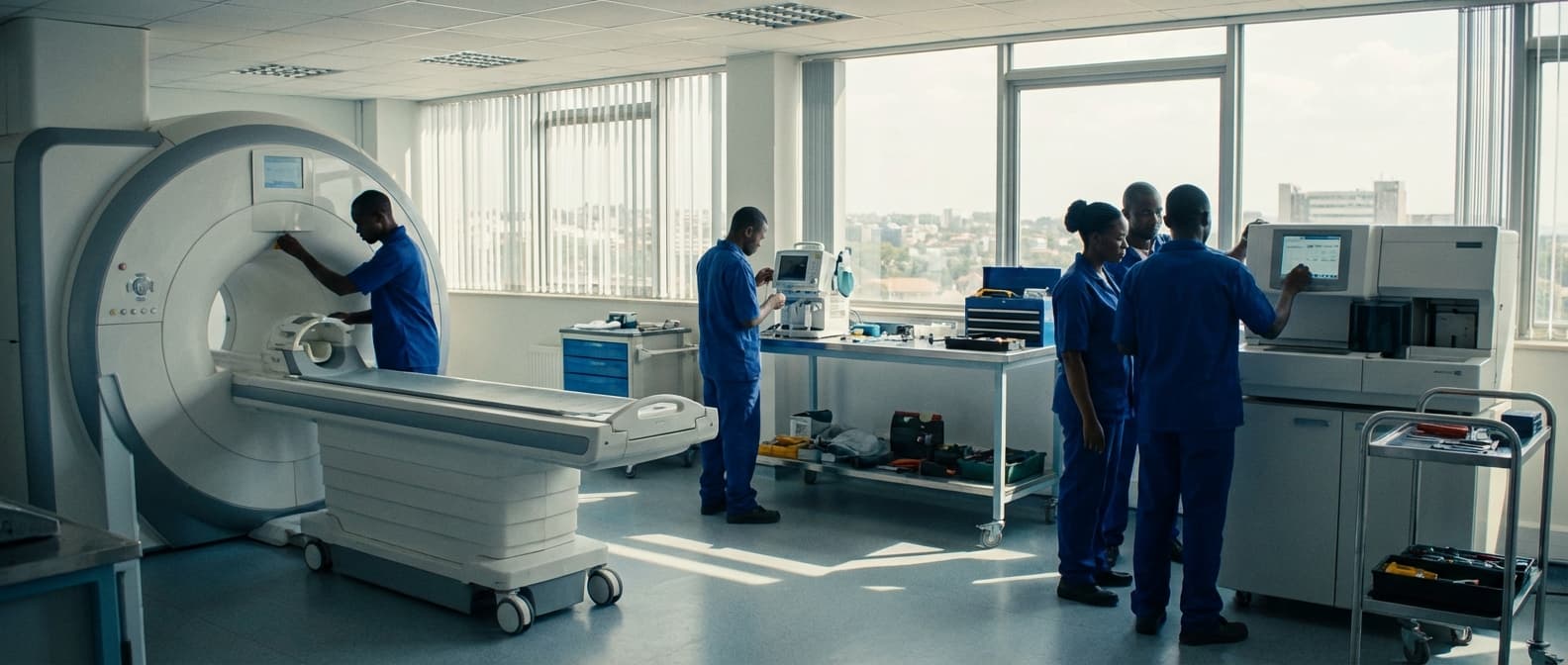
Uptime, Downtime & Root-Cause Analysis Reporting Service in Mauritania
Engineering Excellence & Technical Support
Uptime, Downtime & Root-Cause Analysis Reporting Service High-standard technical execution following OEM protocols and local regulatory frameworks.
Proactive Uptime Maximization
Leveraging real-time network monitoring and predictive analytics, our Mauritania-focused service identifies potential service disruptions before they impact your operations. We ensure mission-critical systems maintain peak performance, minimizing costly downtime and maximizing your business continuity.
Rapid Downtime Resolution & Mitigation
In the event of an outage, our dedicated response teams in Mauritania are equipped with advanced diagnostics and a deep understanding of local infrastructure. We provide swift identification of the issue and implement targeted solutions to restore services efficiently, significantly reducing the duration and impact of downtime.
In-depth Root-Cause Analysis & Prevention
Beyond immediate fixes, our comprehensive reporting service delves into the granular details of every incident. We conduct thorough root-cause analysis, providing actionable insights and strategic recommendations to prevent recurrence and enhance the overall resilience of your IT infrastructure within the Mauritanian landscape.
What Is Uptime, Downtime & Root-cause Analysis Reporting Service In Mauritania?
In Mauritania, an Uptime, Downtime & Root-Cause Analysis (RCA) Reporting Service is a specialized offering designed to monitor, document, and investigate the operational availability and unavailability of IT systems, network infrastructure, and critical business applications. This service provides comprehensive insights into system performance, identifies the underlying causes of failures, and facilitates preventative measures to enhance reliability and minimize business disruption.
| Metric | Description | Impact |
|---|---|---|
| Uptime Percentage | The proportion of time a system or service is operational and accessible. | Directly correlates to service availability and customer/user experience. |
| Downtime Duration | The cumulative time a system or service is unavailable. | Represents potential revenue loss, decreased productivity, and reputational damage. |
| Mean Time Between Failures (MTBF) | The average time between a repairable system's successive failures. | Indicates the reliability of a system. |
| Mean Time To Recover (MTTR) | The average time it takes to restore a failed system to operational status. | Measures the efficiency of incident response and repair processes. |
| Incident Frequency | The number of downtime incidents within a specified period. | Highlights systemic issues or areas requiring immediate attention. |
| Root Cause Category | Classification of the underlying cause of downtime (e.g., Hardware Failure, Software Bug, Network Congestion, Human Error, Security Incident). | Informs targeted remediation and prevention strategies. |
Typical Use Cases
- Proactive Performance Monitoring: Identifying potential bottlenecks or degradation in service before they result in an outage.
- Post-Incident Investigation: Thoroughly understanding why a system failed to prevent recurrence.
- SLA Enforcement and Verification: Demonstrating to clients or internal stakeholders that service levels are being met.
- Capacity Planning: Analyzing historical downtime and performance data to predict future infrastructure needs.
- Security Incident Analysis: Investigating downtime that may be linked to cyberattacks or breaches.
- Disaster Recovery Planning and Testing: Using incident data to refine and validate disaster recovery strategies.
- IT Infrastructure Optimization: Identifying recurring issues with specific hardware, software, or network components for targeted upgrades or replacements.
- Regulatory Compliance Reporting: Providing auditable records of system availability for compliance purposes.
Who Needs Uptime, Downtime & Root-cause Analysis Reporting Service In Mauritania?
In today's increasingly digital and interconnected world, ensuring the consistent availability and optimal performance of IT systems is paramount for any organization. Downtime, whether planned or unexpected, can lead to significant financial losses, reputational damage, and decreased customer satisfaction. To mitigate these risks and proactively address issues, organizations in Mauritania require robust Uptime, Downtime & Root-Cause Analysis Reporting Services. These services provide the visibility and insights necessary to maintain high availability, identify the underlying causes of disruptions, and implement preventative measures for future stability.
| Target Customer Group | Key Departments Involved | Specific Needs & Benefits |
|---|---|---|
| Telecommunications Companies | Network Operations Center (NOC), IT Operations, Customer Service, Engineering | Minimize service outages, ensure network availability, rapid fault detection, SLA compliance, reduced churn, improved customer experience. |
| Financial Institutions (Banks, Insurance) | IT Operations, Security Operations Center (SOC), Compliance, Risk Management, Branch Operations | Prevent transaction failures, ensure data integrity, meet regulatory uptime requirements, protect against financial losses, maintain customer trust. |
| Government & Public Sector Agencies | IT Department, E-Government Initiatives, Public Service Delivery Units, Infrastructure Management | Ensure continuity of essential services (e.g., online portals, citizen services), data security, efficient resource allocation, transparent reporting. |
| Energy & Utilities Companies | Operations Control Center, IT Infrastructure, SCADA/ICS Support, Field Operations | Maintain grid stability, prevent service disruptions, ensure critical infrastructure uptime, safety compliance, rapid incident response. |
| Healthcare Providers | IT Department, Clinical Operations, Hospital Administration, Patient Services | Guarantee availability of Electronic Health Records (EHR), medical equipment connectivity, patient data security, uninterrupted critical care services. |
| E-commerce & Retail Businesses | IT Operations, E-commerce Platform Management, Logistics, Marketing, Customer Support | Maximize online sales, prevent cart abandonment, ensure smooth transaction processing, maintain inventory accuracy, positive customer shopping experience. |
| Mining & Industrial Sector | Operations Management, IT Infrastructure, Process Control Systems, Maintenance | Prevent production halts, ensure operational efficiency, maintain safety systems, optimize asset performance, reduce downtime costs. |
| Cloud Service Providers & Data Centers | Infrastructure Management, Operations, Network Engineering, Customer Support | Guarantee high availability for hosted services, meet customer SLAs, proactive identification of potential failures, optimized resource utilization. |
Who Needs Uptime, Downtime & Root-Cause Analysis Reporting Service in Mauritania?
- Businesses heavily reliant on their IT infrastructure for operations and revenue generation.
- Organizations aiming to improve customer satisfaction and loyalty through consistent service delivery.
- Companies seeking to optimize IT operational efficiency and reduce support costs.
- Sectors with regulatory compliance requirements tied to system availability.
- IT departments focused on proactive problem-solving and continuous improvement.
- Organizations experiencing recurring or prolonged IT disruptions.
- Businesses looking to make data-driven decisions regarding IT investments and resource allocation.
Uptime, Downtime & Root-cause Analysis Reporting Service Process In Mauritania
This document outlines the typical workflow for an Uptime, Downtime & Root-Cause Analysis (RCA) Reporting Service Process in Mauritania, from initial inquiry to final execution and reporting. The service aims to provide clients with detailed insights into system availability, identify the causes of disruptions, and recommend corrective actions.
| Stage | Description | Key Activities | Deliverables | Mauritanian Context Considerations |
|---|---|---|---|---|
| Inquiry & Scope Definition | The client initiates contact to request Uptime, Downtime, and RCA reporting services. The service provider clarifies the client's needs, identifies the systems/applications to be monitored, and defines the scope of the service. | Initial consultation, understanding client requirements, identifying critical assets, defining service level agreements (SLAs), proposal generation. | Service proposal, Statement of Work (SOW), agreed-upon SLAs. | Understanding local business practices, language nuances (French, Arabic), and the regulatory environment in Mauritania. |
| Data Collection & Monitoring Setup | Based on the agreed scope, the service provider sets up the necessary monitoring tools and configurations to collect real-time data on system performance, availability, and potential issues. | Installing monitoring agents, configuring network probes, setting up log aggregation, defining alert thresholds, establishing secure data access. | Monitoring infrastructure, configured dashboards, initial baseline performance metrics. | Considering local internet connectivity and bandwidth limitations, ensuring compatibility with existing IT infrastructure prevalent in Mauritania, potential need for local presence or remote support capabilities. |
| Incident Detection & Triage | The monitoring system continuously collects data. When predefined thresholds are breached or anomalies are detected, an incident is automatically triggered and escalated. | Real-time data analysis, automated alert generation, initial incident assessment, impact evaluation, stakeholder notification. | Incident tickets, alert notifications, initial incident reports. | Establishing clear communication channels with local IT teams, understanding escalation procedures within Mauritanian organizations, ensuring timely and reliable alert delivery. |
| Root-Cause Analysis (RCA) | For significant downtime events, a thorough RCA is conducted to determine the underlying cause. This involves investigating logs, system configurations, network traffic, and potentially interviewing relevant personnel. | Data analysis (logs, metrics, traces), fault isolation, contributing factor identification, timeline reconstruction, causal chain mapping. | Detailed RCA report, including contributing factors, immediate cause, and potential long-term causes. | Access to on-site personnel for interviews (if applicable), understanding local operational procedures, potential reliance on remote diagnostic tools due to geographical distances. |
| Reporting & Recommendations | A comprehensive report is generated, summarizing uptime/downtime statistics, detailing the RCA findings, and providing actionable recommendations to prevent recurrence. | Compiling uptime and downtime metrics, presenting RCA findings clearly, developing preventive and corrective recommendations, tailoring recommendations to client's operational environment. | Final Uptime/Downtime Report, RCA Report with Remediation Recommendations. | Presenting reports in a culturally appropriate manner, ensuring recommendations are practical and feasible within the Mauritanian economic and technological landscape, providing translated reports if required. |
| Follow-up & Verification | The service provider follows up with the client to ensure implemented recommendations are effective and to verify sustained system uptime and performance improvements. | Tracking implementation of recommendations, re-evaluating system performance, providing ongoing monitoring and support, documenting lessons learned. | Verification reports, updated SLAs, continuous improvement plans. | Building long-term relationships with clients, adapting to evolving business needs in Mauritania, potential for ongoing managed services. |
Key Stages of the Uptime, Downtime & RCA Reporting Service Process
- Inquiry & Scope Definition
- Data Collection & Monitoring Setup
- Incident Detection & Triage
- Root-Cause Analysis (RCA)
- Reporting & Recommendations
- Follow-up & Verification
Uptime, Downtime & Root-cause Analysis Reporting Service Cost In Mauritania
Providing Uptime, Downtime, and Root-Cause Analysis (RCA) reporting services in Mauritania involves several key cost drivers. These services are crucial for businesses to understand system reliability, identify performance bottlenecks, and proactively prevent future issues. The pricing structure in Mauritania, as with many service-based industries, is influenced by factors such as the complexity of the infrastructure being monitored, the frequency and depth of reporting required, the level of expertise of the service provider, and the ongoing commitment. Local currency (Mauritanian Ouguiya - MRU) pricing will reflect these elements, aiming to provide value while accounting for the provider's operational costs and expertise.
| Service Component | Estimated Cost Range (MRU) | Notes |
|---|---|---|
| Basic Uptime/Downtime Monitoring & Reporting (e.g., monthly summary) | 15,000 - 40,000 MRU/month | Covers monitoring of a limited number of critical systems, providing straightforward uptime percentages and incident logs. |
| Intermediate Uptime/Downtime & Basic RCA Reporting (e.g., weekly/bi-weekly, identifying common causes) | 40,000 - 90,000 MRU/month | Includes more frequent reporting, performance metrics, and identification of recurring downtime patterns. May involve basic investigation into causes. |
| Comprehensive Uptime/Downtime & In-depth RCA Reporting (e.g., real-time alerts, detailed monthly reports, proactive analysis) | 90,000 - 250,000+ MRU/month | Encompasses full-spectrum monitoring, proactive issue identification, detailed forensic RCA for complex incidents, performance optimization recommendations, and potentially incident response support. |
| Setup and Configuration Fee | 50,000 - 200,000 MRU (one-time) | Depending on the complexity of integrating monitoring tools with the client's existing infrastructure. |
| Ad-hoc RCA Investigation (per incident) | 20,000 - 75,000 MRU | For specific, complex incidents requiring dedicated investigation outside of a regular service contract. |
Key Pricing Factors for Uptime, Downtime & RCA Reporting Services in Mauritania
- Infrastructure Complexity: The number and type of systems (servers, applications, networks, databases) to be monitored directly impacts the effort and tools required. More complex environments demand more resources.
- Reporting Frequency and Granularity: Daily, weekly, monthly, or real-time reports with varying levels of detail (e.g., simple uptime percentages vs. in-depth performance metrics and trend analysis) will affect pricing.
- Depth of Root-Cause Analysis (RCA): The extent to which RCA is performed. Basic identification of recurring issues versus detailed forensic analysis involving multiple team members and tools will have different cost implications.
- Service Level Agreements (SLAs): The guaranteed uptime levels and response times for critical issues will influence the operational overhead and thus the cost.
- Provider Expertise and Reputation: Highly skilled and experienced IT professionals with a proven track record will command higher rates.
- Tools and Technology: The cost of specialized monitoring software, analytics platforms, and associated licenses will be factored into the service price.
- Scope of Services: Whether the service includes proactive monitoring, alert management, incident response, or just reporting.
- Contract Duration: Longer-term contracts often come with discounted rates compared to short-term engagements.
- On-site vs. Remote Support: While most monitoring can be remote, any requirement for on-site presence for investigation or implementation will increase costs.
Affordable Uptime, Downtime & Root-cause Analysis Reporting Service Options
This document outlines affordable options for Uptime, Downtime, and Root-Cause Analysis (RCA) reporting services. We understand the critical need for businesses to monitor their service availability, quickly identify and resolve issues, and prevent recurrence. This guide focuses on delivering high-value solutions without breaking the bank, emphasizing flexible service packages and cost-saving strategies.
| Service Bundle Tier | Included Services | Key Features | Ideal For | Estimated Cost Range (Monthly) |
|---|---|---|---|---|
| Essential Uptime Monitoring | Basic Uptime Checks | Scheduled checks, simple alerts (email/SMS), basic status dashboards. | Startups, small businesses with limited infrastructure. | $25 - $75 |
| Standard Downtime & Alerting | Uptime Monitoring, Downtime Alerts, Basic RCA | Frequent checks, advanced alerts (integrations), incident logging, automated initial diagnostic steps, historical uptime reports. | Growing businesses, SMBs requiring quick issue resolution. | $75 - $250 |
| Professional RCA & Performance Insights | Comprehensive Monitoring, Advanced RCA, Performance Analytics | Real-time monitoring, detailed incident timelines, automated root-cause identification tools, performance metrics, trend analysis, custom reporting, dedicated support. | Medium to large enterprises, businesses with complex IT environments and high availability requirements. | $250 - $750+ |
| Enterprise-Grade & Predictive | All Standard Features + Predictive Analytics, Proactive Health Checks, SLA Management, Custom Integrations | AI-powered anomaly detection, predictive failure analysis, comprehensive SLA tracking, deep system diagnostics, dedicated account management, comprehensive RCA workshops. | Large enterprises, mission-critical applications, organizations prioritizing minimal downtime and continuous optimization. | Custom Pricing (Contact Us) |
Key Benefits of Uptime, Downtime & RCA Reporting:
- Proactive issue detection and rapid response.
- Reduced financial losses due to service interruptions.
- Improved customer satisfaction and trust.
- Enhanced operational efficiency and stability.
- Data-driven insights for continuous improvement.
- Compliance with service level agreements (SLAs).
Verified Providers In Mauritania
In Mauritania, access to reliable and credentialed healthcare providers is paramount for individuals and organizations seeking quality medical services. Franance Health stands out as a leading network, meticulously vetting its providers to ensure the highest standards of care. This rigorous credentialing process guarantees that Franance Health network providers possess the necessary qualifications, experience, and ethical standing to deliver exceptional healthcare. Choosing a Franance Health verified provider means opting for a healthcare professional who has undergone thorough background checks, verification of their medical licenses and certifications, and a review of their professional history. This commitment to verification offers peace of mind and ensures that patients receive safe, effective, and patient-centered medical attention from trusted practitioners within Mauritania.
| Provider Type | Verification Criteria Met by Franance Health | Why it's the Best Choice |
|---|---|---|
| General Practitioners | Valid medical license, board certification (if applicable), clean disciplinary record. | Ensures you are treated by a qualified doctor with a fundamental understanding of a wide range of health issues. |
| Specialists (e.g., Cardiologists, Dermatologists) | All GP criteria plus proof of specialized training, relevant fellowships, and experience in their specific area. | Access to advanced, expert care for specific medical conditions from highly trained professionals. |
| Surgeons | All Specialist criteria plus evidence of successful surgical outcomes, hospital privileges, and ongoing professional development in surgical techniques. | Entrust your surgical needs to experienced surgeons who have demonstrated proficiency and a commitment to patient well-being. |
| Dentists | Valid dental license, relevant certifications, and adherence to dental health regulations. | Receive comprehensive and safe dental care from licensed and reputable dental practitioners. |
| Nurses | Verified nursing license, current certifications (e.g., BLS, ACLS), and a background check. | Benefit from skilled and compassionate nursing care provided by credentialed professionals dedicated to patient support. |
Key Benefits of Choosing Franance Health Verified Providers in Mauritania
- Guaranteed Qualification: All providers have their medical licenses and certifications independently verified.
- Enhanced Patient Safety: Rigorous background checks minimize risks and ensure adherence to ethical medical practices.
- Trustworthy Expertise: Verification confirms relevant experience and a proven track record in their respective fields.
- Access to Quality Care: Connect with healthcare professionals committed to delivering high standards of medical treatment.
- Peace of Mind: Eliminates the uncertainty of finding reliable healthcare by relying on a trusted network.
Scope Of Work For Uptime, Downtime & Root-cause Analysis Reporting Service
This Scope of Work (SOW) outlines the requirements for a Uptime, Downtime & Root-Cause Analysis (RCA) Reporting Service. The service aims to provide comprehensive and actionable insights into system availability, identify the causes of service disruptions, and propose corrective and preventative measures. This document details the technical deliverables and standard specifications required for the successful execution of this service.
| Deliverable | Description | Standard Specifications | Frequency/Trigger | Format |
|---|---|---|---|---|
| Uptime/Downtime Report | A summary of system availability, detailing periods of operation and interruption for specified services. | Includes overall uptime percentage, downtime duration, specific affected services, and timestamps of incidents. Reports should be broken down by service/application/infrastructure component as agreed upon. Data must be derived from agreed-upon monitoring tools. | Weekly (cumulative) and Monthly (summary) | PDF, CSV |
| Downtime Incident Log | A detailed record of each unscheduled downtime event. | Each entry must include: Incident ID, Start Timestamp, End Timestamp, Duration, Affected Service(s), Severity Level, Initial Assessment/Impact, and Assigned Analyst. | Per incident (within 1 hour of incident detection) | CSV, Database Entry |
| Root-Cause Analysis (RCA) Report | A comprehensive analysis of the underlying causes of each downtime incident. | Includes: Incident Summary, Timeline of Events, Problem Statement, Root Cause Identification (e.g., using 5 Whys, Fishbone diagram), Contributing Factors, Impact Assessment, Corrective Actions Taken, Preventative Measures Proposed, and Lessons Learned. Must clearly distinguish between direct and root causes. | Per significant downtime incident (Severity 2 or higher, or defined by agreement). Report due within 48-72 hours of incident resolution. | PDF, Word Document |
| Trend Analysis Report | An aggregated analysis of downtime incidents over a defined period to identify recurring issues and patterns. | Highlights: Most frequent downtime causes, most affected services, peak downtime periods (time of day, day of week), common contributing factors. Includes recommendations for systemic improvements. | Quarterly | PDF, Presentation Slides |
| Monitoring Data Feed | Access to or export of raw monitoring data that underpins the uptime/downtime calculations. | Data should be granular and support validation of reported metrics. Access via API or scheduled file exports as agreed. | Continuous access or daily/weekly export | API Endpoint, CSV/JSON files |
Key Objectives of the Service
- Accurately track and report system uptime and downtime percentages across defined service components.
- Conduct thorough root-cause analysis for all unscheduled downtime incidents.
- Provide timely and clear reports to stakeholders, enabling informed decision-making.
- Identify trends and patterns in downtime to proactively address potential issues.
- Contribute to the overall improvement of system reliability and performance.
Service Level Agreement For Uptime, Downtime & Root-cause Analysis Reporting Service
This Service Level Agreement (SLA) outlines the guaranteed uptime, acceptable downtime, and the process for root-cause analysis (RCA) reporting for the Uptime, Downtime & Root-Cause Analysis Reporting Service (hereinafter referred to as 'the Service'). This SLA is effective as of [Effective Date] and is between [Your Company Name] (hereinafter referred to as 'Provider') and [Client Company Name] (hereinafter referred to as 'Client').
| Service Component/Metric | Uptime Guarantee | Response Time (for Critical Incidents) | Resolution Time Target (for Critical Incidents) | Downtime Exclusions |
|---|---|---|---|---|
| Core Service Availability | 99.9% monthly | 15 minutes | 4 hours | Scheduled Maintenance, Client-induced issues, Force Majeure events |
| Data Reporting & Access | 99.9% monthly | 30 minutes | 8 hours | Scheduled Maintenance, Third-party service dependencies, Client network issues |
| Root-Cause Analysis Reporting | N/A (dependent on incident resolution) | N/A | Within 48 hours of incident resolution | N/A |
Key Definitions
- Uptime: The percentage of time the Service is operational and accessible to the Client during a given Measurement Period.
- Downtime: The percentage of time the Service is unavailable or significantly degraded, preventing the Client from accessing or utilizing its core functionalities during a given Measurement Period.
- Scheduled Maintenance: Pre-announced periods during which the Service may be temporarily unavailable for updates, upgrades, or routine maintenance. Scheduled Maintenance is excluded from Uptime calculations.
- Unscheduled Downtime: Any Downtime that is not Scheduled Maintenance. This includes hardware failures, software issues, network outages, or security incidents impacting the Service.
- Root-Cause Analysis (RCA): A systematic process for identifying the underlying cause(s) of an incident or failure. The RCA report will detail the incident, its impact, the steps taken to resolve it, and preventative measures to avoid recurrence.
- Measurement Period: A calendar month during which Uptime and Downtime are measured.
- Response Time: The time it takes for the Provider to acknowledge a critical incident reported by the Client.
- Resolution Time: The time it takes for the Provider to restore the Service to its operational state after an Unscheduled Downtime incident.
Frequently Asked Questions

Ready when you are
Let's scope your Uptime, Downtime & Root-Cause Analysis Reporting Service in Mauritania project in Mauritania.

Scaling healthcare logistics and technical systems across the entire continent.