
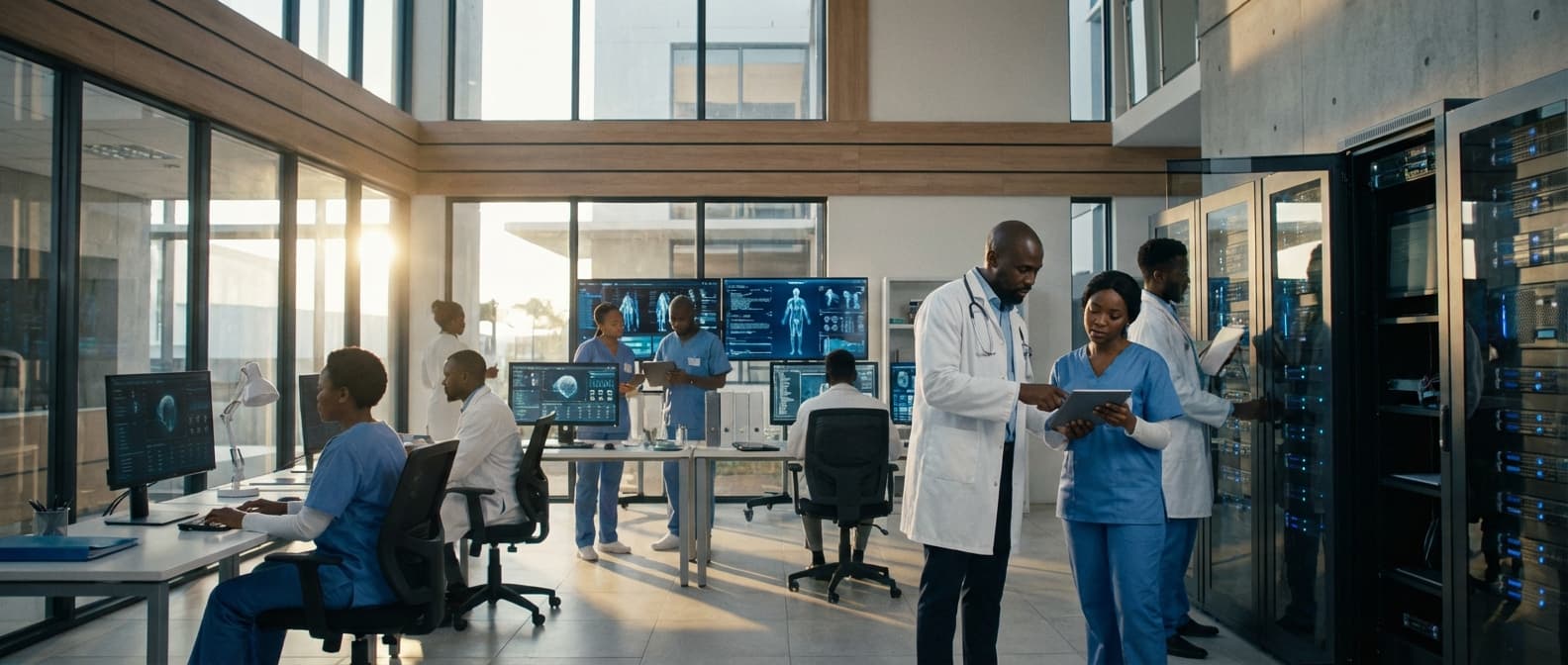
Medical IT Consultation in Mauritania
Engineering Excellence & Technical Support
Strategic technology consulting to optimize healthcare operations, streamline workflows, and integrate cutting-edge medical information systems. High-standard technical execution following OEM protocols and local regulatory frameworks.
Cloud-Based EMR Deployment
Implementing secure, scalable cloud-based Electronic Medical Record (EMR) systems tailored to Mauritania's infrastructure, enhancing data accessibility, interoperability, and patient care delivery across remote and urban healthcare facilities.
Data Security & Compliance Audit
Conducting comprehensive audits of existing IT infrastructure to ensure robust data security, patient privacy compliance with international standards (e.g., HIPAA, GDPR where applicable), and developing actionable strategies for mitigation and ongoing adherence.
Healthcare IT Infrastructure Modernization
Advising on and overseeing the modernization of on-premises and hybrid IT infrastructure, including network upgrades, secure server deployments, and implementing robust disaster recovery solutions to ensure uninterrupted critical healthcare services.
What Is Medical It Consultation In Mauritania?
Medical IT Consultation in Mauritania refers to the provision of specialized information technology expertise to healthcare organizations within the country. This service focuses on assessing, designing, implementing, and managing IT infrastructure and solutions tailored to the unique operational, regulatory, and resource constraints of the Mauritanian healthcare sector. It encompasses strategic planning, system selection, cybersecurity enhancement, data management optimization, and the adoption of digital health technologies to improve patient care, operational efficiency, and public health outcomes. The goal is to leverage technology to address challenges such as limited access to specialized care, improving data integrity, and streamlining administrative processes in a developing healthcare landscape.
| Who Needs Medical IT Consultation in Mauritania? | Typical Use Cases |
|---|---|
| Public Hospitals and Clinics: To enhance patient record management, improve diagnostic capabilities, and enable remote specialist consultations. | Implementing a centralized patient registry for improved health surveillance and disease outbreak management. Establishing telemedicine links between primary care centers and tertiary hospitals for specialist advice. |
| Private Healthcare Providers: To optimize patient flow, streamline billing and administrative processes, and adopt modern diagnostic technologies. | Deploying cloud-based practice management software for efficient appointment scheduling and revenue cycle management. Integrating PACS (Picture Archiving and Communication System) for digital imaging. |
| Ministry of Health and Public Health Agencies: To develop national health information systems, support epidemiological surveillance, and improve healthcare policy formulation. | Building a national health data repository for evidence-based policy making. Implementing a system for real-time monitoring of infectious diseases across the country. |
| Non-Governmental Organizations (NGOs) focused on Health: To establish IT infrastructure for remote healthcare delivery and data collection in underserved areas. | Setting up mobile clinics with integrated data collection tools. Deploying satellite internet solutions for remote health posts to connect with central databases. |
| Medical Training and Research Institutions: To facilitate access to digital resources, support research data management, and enhance simulation-based training. | Implementing digital libraries and research databases. Developing virtual patient simulation platforms for medical education. |
Key Components of Medical IT Consultation in Mauritania
- Needs Assessment and Gap Analysis: Evaluating existing IT infrastructure, identifying operational bottlenecks, and determining areas for improvement and technology adoption.
- Strategic IT Planning: Developing long-term IT roadmaps aligned with organizational goals, national health priorities, and budget constraints.
- EHR/EMR System Implementation and Optimization: Selecting, deploying, and customizing Electronic Health Record (EHR) or Electronic Medical Record (EMR) systems to improve patient data management and accessibility.
- Telemedicine and Remote Healthcare Solutions: Designing and implementing platforms for remote consultations, diagnostics, and patient monitoring to extend healthcare reach, particularly in remote regions.
- Cybersecurity and Data Privacy: Implementing robust security measures to protect sensitive patient data against breaches and ensuring compliance with relevant data protection regulations.
- Network Infrastructure Design and Management: Ensuring reliable and secure network connectivity for seamless data flow and system operation.
- IT Infrastructure Modernization: Recommending and facilitating the upgrade of outdated hardware and software to enhance performance and security.
- Data Analytics and Business Intelligence: Implementing solutions for analyzing health data to identify trends, improve decision-making, and support public health initiatives.
- Digital Health Literacy and Training: Providing training programs for healthcare professionals to effectively utilize new IT systems and digital health tools.
- Vendor Selection and Management: Assisting in the procurement and management of IT hardware, software, and service providers.
Who Needs Medical It Consultation In Mauritania?
Medical IT consultation in Mauritania is crucial for a wide range of healthcare stakeholders aiming to leverage technology for improved patient care, operational efficiency, and data security. These services are particularly valuable for organizations navigating the complexities of digital transformation, seeking to implement or optimize electronic health records (EHRs), enhance cybersecurity, or integrate new medical technologies.
| Customer Type | Key Departments Requiring Consultation |
|---|---|
| Hospitals and Clinics | IT Department, Administration, Clinical Departments (e.g., Radiology, Pathology, Pharmacy), Patient Records Management, Biomedical Engineering |
| Government Health Ministries and Agencies | Information Technology Units, Public Health Departments, Policy and Planning Divisions, Data Management and Statistics Units |
| Diagnostic Laboratories and Imaging Centers | Laboratory Management, IT Support, Technical Staff, Operations Management |
| Pharmaceutical and Medical Device Companies | IT Department, Research and Development, Sales and Support, Regulatory Affairs |
| NGOs and International Health Organizations | Program Management, Data Officers, IT Support, Field Operations |
| Educational and Research Institutions | IT Services, Research Administration, Faculty, Library Services |
Target Customers and Departments for Medical IT Consultation in Mauritania
- {"title":"Hospitals and Clinics","description":"This is the primary target group, encompassing both public and private healthcare facilities. They require expertise in areas such as EHR implementation and optimization, network infrastructure, cybersecurity, telemedicine solutions, and medical device integration."}
- {"title":"Government Health Ministries and Agencies","description":"National and regional health authorities need IT consultation for developing and implementing national health information systems, establishing data standards, ensuring data privacy and security across the healthcare ecosystem, and supporting public health initiatives through technology."}
- {"title":"Diagnostic Laboratories and Imaging Centers","description":"These specialized facilities benefit from IT consultation for laboratory information systems (LIS), Picture Archiving and Communication Systems (PACS), data management for diagnostic results, and secure data sharing with referring physicians."}
- {"title":"Pharmaceutical and Medical Device Companies","description":"Companies involved in the distribution and support of medical technology may seek consultation on integrating their products with existing hospital IT systems, ensuring regulatory compliance for digital health solutions, and establishing secure remote support mechanisms."}
- {"title":"Non-Governmental Organizations (NGOs) and International Health Organizations","description":"Organizations operating in the health sector in Mauritania, particularly those focused on specific diseases or community health, often require IT support for managing patient data, implementing mobile health (mHealth) solutions, and improving data collection and reporting for program effectiveness."}
- {"title":"Educational and Research Institutions","description":"Medical schools and research centers need IT consultation for building robust IT infrastructure to support research data management, enabling digital learning platforms, and facilitating collaboration among researchers."}
Medical It Consultation Process In Mauritania
The Medical IT Consultation Process in Mauritania outlines the structured workflow followed when a healthcare organization or professional in Mauritania seeks IT expertise for their medical facilities. This process ensures that client needs are thoroughly understood, appropriate solutions are identified and implemented, and ongoing support is provided.
| Stage | Key Activities | Deliverables | Typical Duration |
|---|---|---|---|
| Initial Inquiry & Needs Assessment | Client contacts consultant, initial discussion of challenges and goals. | Brief understanding of client needs. | 1-3 business days |
| Discovery & Requirement Gathering | Detailed meetings, site visits, documentation review, stakeholder interviews. | Detailed requirements document, scope of work draft. | 1-2 weeks |
| Solution Design & Proposal Development | Designing technical architecture, software selection, cost estimation. | Formal proposal with solution details, timeline, and budget. | 2-4 weeks |
| Proposal Review & Contract Negotiation | Client feedback, Q&A, negotiation of terms and conditions. | Signed contract. | 1-2 weeks |
| Implementation & Deployment | Hardware installation, software configuration, system integration, data migration. | Fully functional IT system. | Weeks to months, depending on complexity |
| User Training & Change Management | Developing training materials, conducting training sessions, supporting adoption. | Trained staff, reduced resistance to change. | Concurrent with implementation and post-go-live |
| Testing & Quality Assurance | Functional testing, security audits, performance benchmarks, user acceptance testing. | Test reports, bug fixes, UAT sign-off. | 1-4 weeks |
| Go-Live & Post-Implementation Support | System launch, immediate troubleshooting, initial user assistance. | Stable live system, resolved initial issues. | 1-2 weeks (intensive support) |
| Monitoring, Evaluation & Optimization | System performance tracking, user feedback collection, system updates. | Performance reports, optimization recommendations, ongoing service. | Ongoing |
Workflow Stages of Medical IT Consultation in Mauritania
- Initial Inquiry & Needs Assessment: The process begins with a formal or informal inquiry from a client seeking IT solutions. This could be for setting up new IT infrastructure, upgrading existing systems, implementing electronic health records (EHRs), cybersecurity enhancements, or other specialized medical IT needs. The initial contact involves understanding the client's core challenges, objectives, and existing IT landscape.
- Discovery & Requirement Gathering: A dedicated consultation session is scheduled to delve deeper into the client's specific requirements. This stage involves detailed discussions with key stakeholders (doctors, administrators, IT staff), site visits (if applicable), and a comprehensive analysis of current workflows, existing hardware/software, budget constraints, and regulatory compliance needs specific to Mauritanian healthcare. The goal is to create a detailed scope of work.
- Solution Design & Proposal Development: Based on the gathered requirements, the IT consulting firm designs a tailored IT solution. This might include recommendations for hardware, software (EHRs, PACS, LIS), network infrastructure, cloud services, data security measures, and training programs. A formal proposal is then prepared, outlining the proposed solution, its benefits, timelines, cost breakdown, and expected outcomes.
- Proposal Review & Contract Negotiation: The client reviews the proposal, and discussions are held to address any questions or concerns. Negotiations may occur regarding scope, budget, or timelines. Once both parties reach an agreement, a formal contract is signed, detailing the terms of service, deliverables, payment schedule, and responsibilities.
- Implementation & Deployment: This is the execution phase where the agreed-upon IT solutions are installed, configured, and deployed. This can involve setting up new servers, installing and customizing EHR software, configuring network devices, migrating data, and integrating different systems. Rigorous testing is performed at each stage to ensure functionality and performance.
- User Training & Change Management: A crucial part of the implementation is training the healthcare staff on how to use the new IT systems effectively and securely. This stage also involves change management strategies to help the organization adapt to new workflows and technologies, minimizing disruption to patient care.
- Testing & Quality Assurance: Comprehensive testing is conducted to validate that the implemented solutions meet all the specified requirements and function as intended. This includes functional testing, performance testing, security testing, and user acceptance testing (UAT) with the client's end-users.
- Go-Live & Post-Implementation Support: Upon successful testing and client approval, the system goes live. The initial period after go-live is critical for addressing any emergent issues, providing immediate support, and ensuring a smooth transition. Ongoing support, maintenance, and updates are then provided as per the contract.
- Monitoring, Evaluation & Optimization: The IT systems are continuously monitored for performance, security, and user satisfaction. Regular evaluations are conducted to identify areas for improvement or optimization. This feedback loop helps in refining the solutions and ensuring their long-term effectiveness and alignment with the evolving needs of the Mauritanian healthcare sector.
Medical It Consultation Cost In Mauritania
The cost of medical IT consultations in Mauritania can vary significantly based on several key factors. These include the complexity of the IT issue, the experience and specialization of the IT consultant, the duration of the consultation, and the urgency of the service required. Generally, expect pricing to be in Mauritanian Ouguiya (MRU). Smaller, less experienced consultants or those focusing on basic troubleshooting will be at the lower end of the spectrum, while highly specialized consultants with extensive experience in healthcare IT infrastructure, cybersecurity for medical data, or Electronic Health Record (EHR) implementation will command higher rates. Travel expenses might also be factored in for on-site consultations, especially if the medical facility is located outside major urban centers like Nouakchott. The scope of work, whether it's a one-off problem assessment or a long-term project, will also influence the overall cost.
| Service Type / Complexity | Estimated Hourly Rate (MRU) | Estimated Project Rate (MRU) |
|---|---|---|
| Basic IT Support & Troubleshooting (e.g., network connectivity, software issues) | 500 - 1,500 MRU | N/A (typically hourly or per incident) |
| Mid-Level IT Consultation (e.g., hardware upgrades, basic cybersecurity assessment, printer setup) | 1,200 - 3,000 MRU | 5,000 - 25,000 MRU |
| Advanced IT Consultation (e.g., EHR system selection/implementation, complex network design, data security strategy, compliance audits) | 2,500 - 6,000+ MRU | 20,000 - 100,000+ MRU (highly dependent on project scale) |
| Specialized Healthcare IT (e.g., medical imaging systems integration, telemedicine platform setup) | 3,000 - 7,000+ MRU | Negotiable based on unique requirements and vendor involvement |
Key Pricing Factors for Medical IT Consultations in Mauritania:
- Complexity of the IT issue (e.g., basic network troubleshooting vs. complex EHR integration)
- Experience and specialization of the IT consultant (e.g., general IT vs. healthcare-specific expertise)
- Duration of the consultation (hourly, daily, or project-based)
- Urgency of the service required (standard vs. emergency call-outs)
- Location of the medical facility (on-site vs. remote, travel expenses)
- Scope of work (one-time assessment vs. ongoing support/project management)
Affordable Medical It Consultation Options
Healthcare organizations, especially smaller clinics and practices, often face budget constraints when it comes to implementing and managing essential Information Technology (IT) systems. Affordable medical IT consultation is crucial for ensuring compliance, enhancing patient care through technology, and maintaining operational efficiency without breaking the bank. Understanding value bundles and employing smart cost-saving strategies are key to achieving these goals.
| Strategy | Description | Benefit | Considerations |
|---|---|---|---|
| Value Bundles | Packages combining multiple IT services (e.g., proactive monitoring, helpdesk support, cybersecurity basics) for a set monthly fee. | Predictable costs, comprehensive coverage, potential for discounts compared to purchasing services individually. | Ensure the bundle's services align with your specific needs; avoid paying for unnecessary features. |
| Prioritize Essential Services | Focus on IT needs critical for patient care, compliance, and core operations (e.g., EHR functionality, data security). | Maximizes ROI by investing in services that directly impact business outcomes and mitigate risks. | Requires a thorough assessment of current and future IT requirements. |
| Leverage Open-Source Software | Explore free or low-cost open-source alternatives for certain IT functions (e.g., some CRM or project management tools). | Significant cost reduction in software licensing fees. | May require more in-house technical expertise for setup and maintenance; vendor support might be community-based. |
| Negotiate Service Level Agreements (SLAs) | Clearly define response times, uptime guarantees, and issue resolution processes in your contracts. | Ensures you receive the expected level of service and provides recourse if expectations aren't met, preventing costly downtime. | Requires a good understanding of your operational needs and potential IT failures. |
| Phased Implementation | Roll out new IT systems or upgrades in stages rather than a large, upfront investment. | Spreads costs over time, allows for learning and adjustments, and reduces the risk of large-scale failure. | Requires careful planning and project management to ensure seamless integration between phases. |
| Outsource Non-Core IT Functions | Delegate tasks like network management, data backups, or software updates to external consultants. | Frees up internal resources, provides access to specialized skills, and can be more cost-effective than hiring full-time staff. | Choose a reputable provider with experience in the healthcare sector. |
| Cloud Computing | Migrate data storage, applications, and infrastructure to cloud-based platforms. | Reduces capital expenditure on hardware, lowers maintenance costs, and offers scalability. | Ensure HIPAA compliance of cloud providers and understand data governance policies. |
Key Affordable Medical IT Consultation Options
- On-Demand IT Support: Pay for services as needed, ideal for organizations with fluctuating IT demands.
- Managed IT Services (Tiered Plans): Predictable monthly fees covering a defined set of IT services, often with different levels of support to suit varying budgets.
- Project-Based Consultation: Engaging experts for specific projects like EHR implementation, cybersecurity audits, or network upgrades.
- Remote IT Support: Leveraging the expertise of consultants located remotely to reduce overhead and travel costs.
- Cloud-Based Solutions: Utilizing cloud platforms for data storage, applications, and IT infrastructure can significantly lower upfront hardware and maintenance costs.
- Specialized Niche Consultants: Engaging consultants with expertise in specific areas like HIPAA compliance or medical billing software can be more cost-effective than generalists.
Verified Providers In Mauritania
In Mauritania, ensuring access to quality healthcare is paramount. When seeking medical services, identifying verified providers is crucial for patient safety and effective treatment. Franance Health has emerged as a leading name, distinguished by its stringent credentialing process and unwavering commitment to excellence. This dedication translates into a superior healthcare experience for individuals and families.
| Credential Type | Franance Health Verification Standard | Importance for Patients |
|---|---|---|
| Medical Licenses | Verified with Mauritanian Ministry of Health and relevant professional bodies. | Confirms legal authorization to practice medicine, ensuring adherence to national standards. |
| Educational Degrees | Authenticity confirmed through recognized institutions and official transcripts. | Guarantees that providers have received foundational medical education from accredited programs. |
| Specialty Certifications | Validated with respective medical boards and professional organizations. | Ensures providers possess advanced knowledge and skills in their specific area of expertise. |
| Professional Experience | Background checks and references from previous employers and peers. | Provides insight into practical application of knowledge and established track record of care. |
| Ethical Conduct & Background Checks | Thorough investigation for any disciplinary actions or criminal history. | Safeguards patients by ensuring providers operate with integrity and professionalism. |
Why Franance Health is the Best Choice:
- Rigorous Verification Process: Franance Health employs a multi-layered approach to verify the credentials of its healthcare professionals. This includes thorough background checks, validation of educational degrees and licenses, and confirmation of specialized training and certifications.
- Commitment to Excellence: Beyond basic qualifications, Franance Health prioritizes providers who demonstrate a commitment to ongoing professional development, ethical practice, and patient-centered care.
- Comprehensive Network: Franance Health offers access to a diverse network of specialists and general practitioners across various medical disciplines, ensuring that patients can find the right care for their specific needs.
- Patient-Centric Approach: The organization emphasizes a patient-first philosophy, focusing on clear communication, empathy, and providing a supportive environment throughout the healthcare journey.
- Improved Health Outcomes: By partnering with only the most qualified and dedicated professionals, Franance Health aims to contribute to improved health outcomes for the population of Mauritania.
Scope Of Work For Medical It Consultation
This Scope of Work (SOW) outlines the services to be provided by [Consulting Firm Name] (hereinafter referred to as "Consultant") to [Client Organization Name] (hereinafter referred to as "Client") for Medical IT Consultation. The project aims to assess, design, and/or implement IT solutions to improve the efficiency, security, and functionality of the Client's healthcare operations. This SOW details the technical deliverables and associated standard specifications.
| Deliverable Title | Description | Technical Specifications/Standards | Timeline (Weeks) |
|---|---|---|---|
| Current State Assessment Report | Comprehensive analysis of the existing IT infrastructure, including hardware, software, networks, security protocols, and data management practices. | Includes network diagrams, asset inventory, security vulnerability assessment report, compliance gap analysis against HIPAA/HITECH standards. Benchmarking against industry best practices (e.g., HIMSS EMRAM). | 2-4 |
| IT Strategy and Roadmap | A high-level strategic plan outlining recommended IT investments, technology adoption timelines, and resource allocation to achieve business objectives. | Alignment with organizational goals, cost-benefit analysis for proposed solutions, risk mitigation strategies, phased implementation plan. | 1-2 |
| Solution Design Document | Detailed technical design for recommended IT solutions, including system architecture, integration plans, data flow diagrams, and user interface mockups (if applicable). | System specifications (e.g., EMR/EHR modules, PACS, RIS, telehealth platforms), interoperability standards (e.g., HL7, FHIR), cybersecurity frameworks (e.g., NIST CSF), disaster recovery/business continuity plans, scalability requirements. | 3-5 |
| Implementation Plan | A detailed project plan for the deployment of recommended IT solutions, including task breakdowns, resource assignments, change management procedures, and testing protocols. | Project management methodologies (e.g., Agile, Waterfall), vendor selection criteria, testing phases (unit, integration, user acceptance), training plans, go-live strategy. | 1-2 |
| Security and Compliance Audit Report | An assessment of the Client's adherence to HIPAA, HITECH, and other relevant data security and privacy regulations. Includes findings and remediation recommendations. | HIPAA Security Rule requirements, HIPAA Privacy Rule requirements, NIST Cybersecurity Framework, Data Breach Notification Rule compliance. Audit trails and logging standards. | 2-3 |
| Training Materials and Sessions | Development of user-friendly training materials and delivery of training sessions for end-users on new IT systems and workflows. | Role-based training modules, interactive learning methods, post-training support documentation, competency assessment methods. | As per implementation plan |
| Post-Implementation Review Report | An evaluation of the implemented solutions' performance against defined objectives, including user feedback and recommendations for ongoing optimization. | Performance metrics (e.g., system uptime, user adoption rates, workflow efficiency improvements), user satisfaction surveys, lessons learned documentation. | 1-2 |
Project Objectives
- To evaluate the current IT infrastructure and identify areas for improvement.
- To design and recommend appropriate IT solutions tailored to the Client's specific needs.
- To ensure compliance with relevant healthcare regulations (e.g., HIPAA, HITECH).
- To enhance data security and patient privacy.
- To optimize clinical workflows through technology integration.
- To provide recommendations for future IT strategy and development.
Service Level Agreement For Medical It Consultation
This Service Level Agreement (SLA) outlines the terms and conditions governing the provision of Medical IT Consultation services by [Provider Name] to [Client Name]. It specifically addresses response times for support requests and uptime guarantees for critical IT systems supporting medical operations.
| Service Component | Priority Level | Response Time Target (Acknowledgment) | Resolution Target | Uptime Guarantee |
|---|---|---|---|---|
| Critical System Outage (e.g., EHR, PACS downtime) | High | 15 minutes | 4 hours | 99.9% (monthly) |
| Urgent System Issue (e.g., slow performance impacting workflow) | Medium | 1 hour | 8 business hours | 99.5% (monthly) |
| Routine IT Consultation Request (e.g., software inquiry, minor configuration) | Low | 4 business hours | 2 business days | N/A (focus on response time) |
| Scheduled Maintenance Window | N/A | 24-hour advance notification | Defined by maintenance plan | Excludes scheduled downtime |
Key Service Level Objectives
- Response Times: Guarantees the timeframe within which support requests will be acknowledged and initial action will be taken.
- Uptime Guarantees: Defines the minimum percentage of time that critical IT systems will be operational and accessible.
- Service Definitions: Clearly defines what constitutes a support request and what systems are considered critical.
Frequently Asked Questions

Ready when you are
Let's scope your Medical IT Consultation in Mauritania project in Mauritania.

Scaling healthcare logistics and technical systems across the entire continent.