
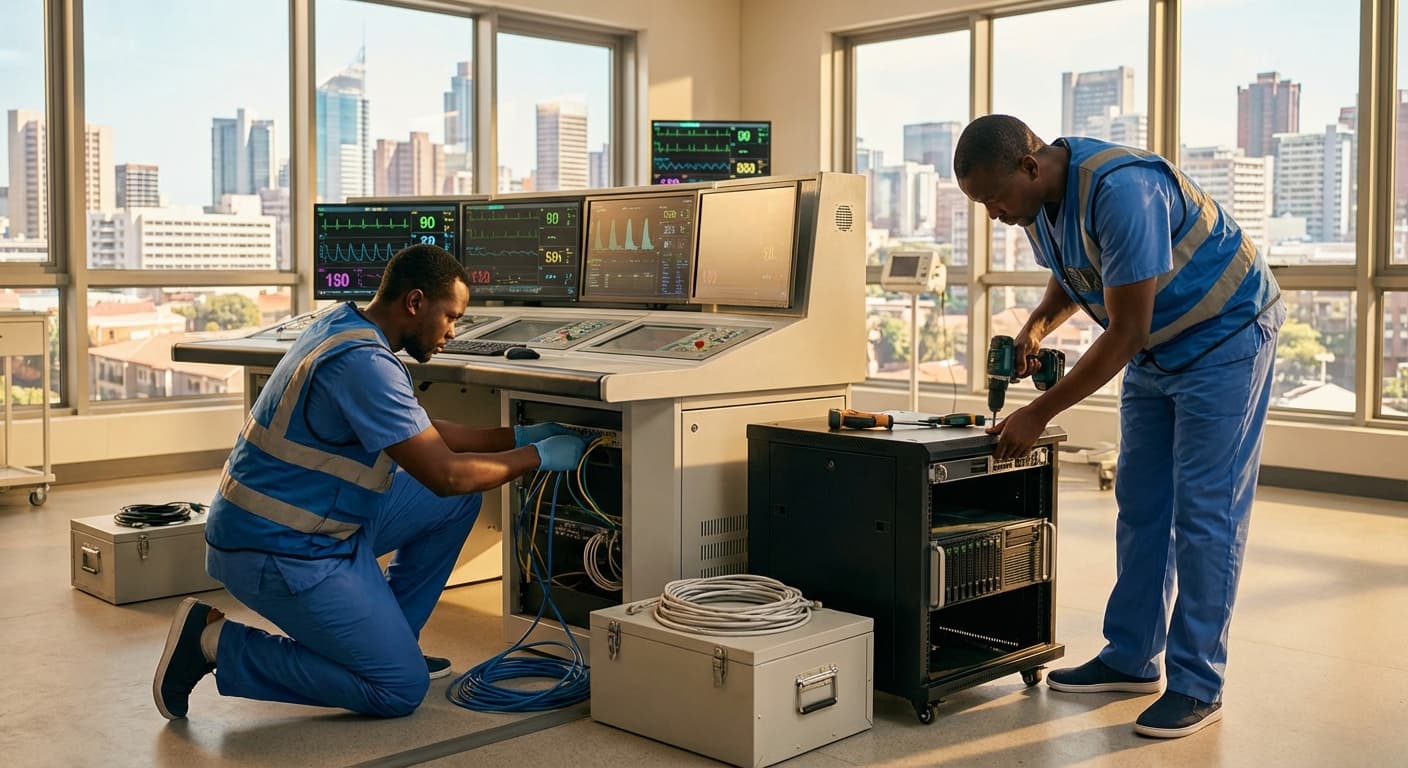
ICU Central Monitoring Station Installation Service in Mauritania
Engineering Excellence & Technical Support
ICU Central Monitoring Station Installation Service High-standard technical execution following OEM protocols and local regulatory frameworks.
Robust Network Infrastructure
We deploy resilient, high-bandwidth wired and wireless networks specifically designed for real-time, mission-critical medical data transmission, ensuring continuous, uninterrupted monitoring of ICU patients across Mauritania.
Scalable & Secure System Architecture
Our installations feature modular, future-proof monitoring systems that can be easily scaled to accommodate growing hospital needs. We prioritize data security with advanced encryption and access control protocols, safeguarding patient privacy.
Integrated Alarm Management & Redundancy
We implement intelligent alarm prioritization and multi-level redundancy for critical system components, minimizing downtime and ensuring that vital patient alerts are always received, even in challenging environments.
What Is Icu Central Monitoring Station Installation Service In Mauritania?
The ICU Central Monitoring Station Installation Service in Mauritania refers to the comprehensive process of designing, procuring, installing, configuring, and commissioning a centralized system for real-time patient monitoring within Intensive Care Units (ICUs). This service ensures that critical patient vital signs and physiological data are collected, transmitted, displayed, and analyzed at a central location, facilitating enhanced clinical oversight, rapid response to deteriorating conditions, and improved patient outcomes. The service encompasses hardware deployment, software integration, network infrastructure setup, power and environmental considerations, and user training for healthcare professionals.
| Requirement | Description | Typical Use Cases | |||
|---|---|---|---|---|---|
| Who Needs It? | Hospitals and healthcare facilities in Mauritania operating or planning to establish Intensive Care Units (ICUs), Critical Care Units (CCUs), or other high-acuity patient care areas. | Deployment in new ICU constructions, upgrades to existing ICU monitoring systems, or expansion of critical care services. | |||
| Typical Use Cases | Real-time continuous surveillance of multiple critically ill patients, enabling early detection of adverse events and prompt intervention. | Facilitating remote patient observation by a central nursing team, optimizing staff allocation and response times. | Collecting and archiving patient physiological data for clinical review, research, and quality improvement initiatives. | Enhancing patient safety through standardized alarm management and reduced risk of missed critical changes in patient status. | Supporting telemedicine initiatives by allowing remote access to patient data for specialist consultation. |
Key Components and Scope of ICU Central Monitoring Station Installation Service:
- System Design and Architecture: Site assessment, determination of monitoring needs, selection of compatible monitoring devices (e.g., ECG, SpO2, NIBP, EtCO2, invasive pressure), and design of the network topology and data flow.
- Hardware Procurement and Deployment: Sourcing and installation of central monitoring units, bedside monitors, network switches, servers, workstations, and associated cabling.
- Software Installation and Configuration: Deployment of the central monitoring software, configuration of alarms, patient data management, trend analysis tools, and integration with existing hospital information systems (HIS) or electronic health records (EHR) if applicable.
- Network Infrastructure Setup: Establishing a robust and secure network (wired or wireless) capable of handling high volumes of real-time data transmission from multiple patient monitoring devices.
- Power and Environmental Considerations: Ensuring reliable power supply (including UPS and backup generators) and appropriate environmental controls (temperature, humidity) for sensitive electronic equipment.
- Testing, Calibration, and Commissioning: Rigorous testing of all components, calibration of sensors, and final commissioning of the system to ensure optimal performance and accuracy.
- User Training and Support: Comprehensive training for physicians, nurses, and biomedical engineers on system operation, alarm management, data interpretation, and basic troubleshooting.
- Documentation and Handover: Provision of detailed system documentation, including user manuals, technical schematics, and maintenance procedures.
Who Needs Icu Central Monitoring Station Installation Service In Mauritania?
The installation of an ICU Central Monitoring Station (CMS) is a critical infrastructural upgrade for healthcare facilities in Mauritania, especially those aiming to enhance critical care capabilities and patient outcomes. This service caters to a specific set of healthcare providers and departments that are either currently underdeveloped in their critical care services or are looking to significantly improve their existing infrastructure.
| Target Customer Type | Key Departments Benefiting | Rationale for Installation |
|---|---|---|
| Tertiary Care Hospitals | Intensive Care Unit (ICU), Coronary Care Unit (CCU), Neuro-ICU, Surgical ICU, Medical ICU | To provide continuous, real-time oversight of multiple critically ill patients, enabling early detection of deterioration and prompt intervention, thereby improving patient survival rates and resource utilization. |
| Specialized Medical Centers (e.g., Cardiology, Neurology) | Cardiac Catheterization Lab recovery, Post-Neurological Surgery Recovery, Transplant Units | To monitor patients with specific high-risk conditions, ensuring specialized care and immediate response to any complications arising from their primary condition or treatment. |
| Government-Owned Public Hospitals | General ICU, Emergency Department (for critical stabilization), Post-Anesthesia Care Unit (PACU) | To enhance the capacity of public healthcare to manage a larger volume of critical patients, improve the quality of care delivered, and reduce mortality rates for common critical illnesses. |
| Large Private Healthcare Providers | ICU, CCU, Trauma Units, High-Dependency Units (HDUs) | To offer premium critical care services, attract international patients, and maintain a competitive edge by providing advanced patient monitoring and management technology. |
| Newly Established or Expanding Hospitals | All critical care units as per design specifications | To build a future-proof critical care infrastructure that supports advanced diagnostics, treatment protocols, and efficient staff deployment from the ground up. |
Target Customers for ICU Central Monitoring Station Installation Service in Mauritania
- Tertiary Care Hospitals: These are the primary beneficiaries, offering comprehensive medical services and often housing the most complex patient cases requiring intensive monitoring.
- Specialized Medical Centers: Facilities focusing on specific areas like cardiology, neurology, or oncology will benefit from integrated ICU monitoring to manage post-operative or critically ill patients within their specialties.
- Government-Owned Public Hospitals: As the backbone of the national healthcare system, public hospitals, particularly those in major cities and regional hubs, are prime candidates for upgrading their ICU capabilities to serve a broader population.
- Large Private Healthcare Providers: Private hospitals and clinics investing in advanced medical technology to attract patients and offer high-quality critical care services.
- Newly Established or Expanding Hospitals: Healthcare facilities in the planning or construction phase that prioritize state-of-the-art critical care infrastructure from the outset.
- Disaster Response and Emergency Medical Services (EMS) Facilities: While less common for dedicated CMS installation, facilities involved in mass casualty incident management might consider robust, scalable monitoring solutions that can integrate with a central hub.
- Research and Teaching Hospitals: Institutions focused on medical education and research will require advanced monitoring systems to facilitate both clinical practice and scientific inquiry.
Icu Central Monitoring Station Installation Service Process In Mauritania
This document outlines the comprehensive service process for installing an ICU Central Monitoring Station in Mauritania, from the initial client inquiry to the final execution and handover. The process is designed to ensure a smooth, efficient, and compliant installation, meeting the specific needs of healthcare facilities in Mauritania.
| Phase | Key Activities | Deliverables | Estimated Duration (Indicative) | Responsible Parties |
|---|---|---|---|---|
| Needs Assessment, Information Gathering, Service Explanation | Understanding of Client Needs, Preliminary Requirements Document | 1-3 Days | Client, Service Provider |
| On-Site Assessment, Equipment Specification, Gap Analysis | Detailed Site Survey Report, Finalized Equipment List, Infrastructure Requirements | 3-7 Days | Service Provider (Technical Team), Client |
| Proposal Generation, Cost Estimation, Contract Negotiation | Formal Proposal, Detailed Quotation, Signed Service Contract | 3-5 Days | Service Provider, Client |
| Project Planning, Equipment Ordering, Logistics & Importation | Detailed Project Plan, Procurement Orders, Shipping Documents | 2-8 Weeks (dependent on import/logistics) | Service Provider (Project Manager), Vendors |
| Site Prep, Hardware/Software Installation, Network Integration | Installed and Configured Central Monitoring System | 1-3 Weeks (dependent on complexity) | Service Provider (Installation Team), Client (for site access) |
| Functional, Integration, Performance & User Acceptance Testing | Test Reports, User Sign-off | 3-7 Days | Service Provider (Technical Team), Client (UAT Team) |
| Technical & Clinical Training, Documentation Delivery | Trained Staff, User Manuals, Warranty Certificates, Final Handover Document | 2-5 Days | Service Provider (Trainers/Engineers), Client Staff |
| Warranty Support, On-site/Remote Support, Preventive Maintenance | Ongoing System Reliability, Maintenance Records | Continuous (as per contract) | Service Provider (Support Team), Client |
ICU Central Monitoring Station Installation Service Process in Mauritania
- 1. Inquiry & Initial Consultation:
- Client Contact: Facility initiates contact (phone, email, website form).
- Needs Assessment: Understanding of the facility's requirements, including the number of ICU beds, specific monitoring parameters, existing infrastructure, budget, and desired timeline.
- Preliminary Information Gathering: Collection of site details (location, floor plans, power availability, network infrastructure).
- Service Explanation: Providing an overview of the installation process, service scope, and potential equipment options.
- 2. Site Survey & Requirements Definition:
- On-Site Visit: Our technical team visits the facility in Mauritania.
- Detailed Assessment: Comprehensive evaluation of the physical space, electrical systems, network connectivity, environmental conditions (temperature, humidity), and potential installation challenges.
- Equipment Specification: Finalizing the exact type and quantity of central monitoring station hardware, software, and patient monitors based on the site survey and client needs.
- Technical Documentation Review: Examining existing blueprints and IT infrastructure documentation.
- Gap Analysis: Identifying any deficiencies in existing infrastructure that need to be addressed for seamless integration.
- 3. Proposal & Quotation:
- Detailed Proposal Generation: Creation of a comprehensive proposal outlining the scope of work, equipment to be supplied, installation plan, timeline, responsibilities of both parties, and warranty information.
- Cost Estimation: Providing a detailed quotation for all hardware, software, installation labor, training, and any necessary site modifications.
- Client Review & Negotiation: Presenting the proposal and quotation to the client for review, discussion, and potential negotiation.
- Contract Signing: Upon agreement, formalizing the service contract between the client and our company.
- 4. Planning & Procurement:
- Project Management Setup: Assigning a dedicated project manager and technical team.
- Detailed Installation Plan: Developing a granular plan with specific tasks, dependencies, and timelines.
- Equipment Procurement: Ordering and sourcing all specified monitoring station hardware and patient monitors.
- Logistics & Importation: Managing the shipping, customs clearance, and importation of equipment into Mauritania, adhering to all local regulations.
- Pre-Installation Preparation: Arranging for any necessary civil works or infrastructure upgrades at the client's site.
- 5. Installation & Configuration:
- Site Preparation: Executing any pre-agreed civil works, network cabling, or power outlet installations.
- Hardware Installation: Setting up the central monitoring station console, servers, workstations, and any associated networking equipment.
- Patient Monitor Deployment: Installing and connecting patient monitors at each ICU bed.
- Network Integration: Configuring the system to seamlessly integrate with the hospital's existing network infrastructure, ensuring secure data transmission.
- Software Installation & Configuration: Installing and customizing the central monitoring software, including setting up user profiles, alarms, and data storage parameters.
- Initial System Testing: Performing basic functional tests to ensure all components are operational.
- 6. System Testing & Validation:
- Comprehensive Functional Testing: Rigorous testing of all monitoring parameters, alarm functionalities, data logging, and reporting capabilities.
- Integration Testing: Verifying the seamless communication between patient monitors and the central station.
- Performance Testing: Assessing system responsiveness and stability under simulated load conditions.
- User Acceptance Testing (UAT): Involving hospital staff to test the system and confirm it meets their operational requirements.
- Calibration: Ensuring all connected devices are accurately calibrated.
- 7. Training & Handover:
- Technical Training: Providing in-depth training to the hospital's IT and biomedical engineering staff on system operation, maintenance, and basic troubleshooting.
- Clinical User Training: Training ICU nurses and physicians on how to effectively use the central monitoring station for patient care, alarm management, and data interpretation.
- Documentation Handover: Providing all relevant user manuals, technical documentation, warranty certificates, and maintenance schedules.
- Final Sign-off: Obtaining formal acceptance and sign-off from the client, confirming successful installation and training.
- 8. Post-Installation Support & Maintenance:
- Warranty Support: Providing support as per the agreed warranty terms.
- Remote Monitoring (if applicable): Offering remote monitoring services for proactive issue detection.
- On-Site Support: Availability of on-site technical support for urgent issues.
- Preventive Maintenance: Offering scheduled preventive maintenance services to ensure optimal system performance and longevity.
- Software Updates & Upgrades: Managing and implementing software updates and system upgrades as needed.
Icu Central Monitoring Station Installation Service Cost In Mauritania
The installation of an ICU Central Monitoring Station in Mauritania is a complex undertaking with costs that can vary significantly based on several key factors. These factors influence the overall price, from the initial equipment selection to the intricate setup and ongoing support. Understanding these elements is crucial for accurate budgeting and project planning. The primary cost drivers include the sophistication and brand of the monitoring equipment, the number of patient beds to be integrated, the complexity of the hospital's existing infrastructure, the need for specialized networking and data management solutions, and the labor and expertise required for installation and configuration. Furthermore, the geographical location within Mauritania can impact logistical costs for equipment delivery and personnel travel. While a precise average is difficult to pinpoint due to these variables, a general estimation for a basic to mid-range installation can be provided, with higher-end, feature-rich systems incurring substantially more expense.
| Installation Scope | Estimated Price Range (MRU) | Notes |
|---|---|---|
| Basic ICU Central Monitoring Station (e.g., for 4-6 beds, standard parameters) | 3,000,000 - 7,500,000 | This range typically covers essential monitoring parameters for a small ICU unit. May involve less sophisticated equipment or fewer advanced features. Does not include extensive IT integration. |
| Mid-Range ICU Central Monitoring Station (e.g., for 8-12 beds, comprehensive parameters, basic IT integration) | 7,500,000 - 15,000,000 | Includes a wider range of monitoring capabilities, potentially better quality equipment, and some level of integration with hospital IT systems. Suitable for a moderately sized ICU. |
| Advanced/High-End ICU Central Monitoring Station (e.g., for 16+ beds, comprehensive parameters, advanced IT integration, specialized modules) | 15,000,000 - 30,000,000+ | Features top-tier equipment, extensive integration with EHR/PACS, advanced data analytics, and the capacity for a larger ICU or specialized units. Costs can escalate significantly with customization and premium brands. |
| Add-ons and Customization (e.g., advanced hemodynamic monitoring, software licenses, extended training) | Varies widely | These are typically added to the base system cost and depend on the specific needs and selections made by the hospital. |
Key Pricing Factors for ICU Central Monitoring Station Installation in Mauritania
- Equipment Brand and Technology: High-end, feature-rich systems from reputable international manufacturers (e.g., Philips, GE Healthcare, Mindray) will command higher prices than more basic or locally sourced alternatives.
- Number of Patient Beds: The core cost is directly proportional to the number of beds that need to be connected to the central monitoring station.
- System Complexity and Features: Advanced features such as integrated EKG, SpO2, NIBP, invasive pressure monitoring, capnography, and even advanced hemodynamic monitoring will increase costs.
- Integration with Existing Hospital IT Infrastructure: Seamless integration with the hospital's Electronic Health Record (EHR) system, Picture Archiving and Communication System (PACS), and other IT networks can involve significant customization and labor costs.
- Networking and Data Storage Requirements: The need for robust network infrastructure, data servers, and secure data storage solutions to handle real-time patient data will add to the overall expense.
- Installation and Configuration Labor: The complexity of the installation, including cabling, mounting, and initial system setup, along with the expertise of the technicians, directly impacts labor costs.
- Training and Commissioning: Comprehensive training for hospital staff on operating and maintaining the system is a critical component of the installation service and adds to the overall cost.
- Warranties and Maintenance Contracts: Extended warranties and ongoing maintenance agreements are often bundled with installation services and contribute to the initial investment.
- Logistics and Site Preparation: Transportation of equipment to the hospital site, especially in remote areas, and any necessary modifications to the physical space (e.g., power, ventilation) will incur additional costs.
- Regulatory Compliance and Certification: Ensuring the system meets local healthcare regulations and obtaining necessary certifications can also be a factor in pricing.
Affordable Icu Central Monitoring Station Installation Service Options
Setting up an Intensive Care Unit (ICU) Central Monitoring Station (CMS) is a critical infrastructure upgrade that demands significant investment. However, by understanding the available service options, exploring value bundles, and implementing cost-saving strategies, healthcare facilities can achieve an effective and affordable CMS installation. This guide outlines key considerations for selecting the right service, maximizing value, and minimizing expenditure without compromising patient care or system reliability.
| Service Option | Description | Value Proposition / Cost-Saving Potential |
|---|---|---|
| Standard Installation Package | Includes the core hardware, software, and basic setup for a predetermined number of beds. Typically offers a fixed price. | Cost-Saving: Predictable upfront cost, good for facilities with well-defined and stable needs. Simplifies budgeting. |
| Value Bundles / Integrated Solutions | Combines CMS hardware and software with related peripherals (e.g., bedside monitors, telemetry units, workstations) and often includes installation, training, and basic support for a bundled price. | Cost-Saving: Significant discounts compared to purchasing components individually. Streamlines procurement and reduces vendor management. Often includes essential add-ons at a reduced cost. |
| Phased Implementation Service | Breaks down the CMS installation into manageable stages, allowing for deployment across different units or functionalities over time. Suitable for larger projects or budget-constrained facilities. | Cost-Saving: Spreads capital expenditure over a longer period, easing immediate financial strain. Allows for learning and adjustments between phases. |
| Managed Services / Cloud-Based Solutions | Outsourcing the management, maintenance, and often the hosting of the CMS to a third-party provider. Can be subscription-based. | Cost-Saving: Shifts capital expenditure to operational expenditure (OPEX), which can be more budget-friendly. Reduces the need for in-house IT expertise and hardware maintenance. Predictable monthly costs. |
| Refurbished or Certified Pre-Owned Equipment Option | Utilizing high-quality, refurbished CMS hardware and software from reputable sources. Often comes with a warranty and is significantly cheaper than new equipment. | Cost-Saving: Substantial reduction in initial hardware acquisition costs. Requires careful vetting of suppliers to ensure reliability and warranty coverage. |
| Customizable Service Plans | Vendors offer flexible plans where you can select specific modules, features, and support levels to match your exact requirements. Can also include options for phased upgrades. | Cost-Saving: Avoids paying for features or services that are not needed. Allows for tailored solutions that optimize resource allocation. |
Key Considerations for Affordable ICU CMS Installation
- Needs Assessment: Accurately defining the required number of beds, monitoring parameters, data storage, and integration needs is paramount. Overestimating can lead to unnecessary costs, while underestimating can result in system limitations.
- Scalability and Future-Proofing: Opting for a CMS that can easily scale with future expansion or technological advancements can save costs in the long run by avoiding complete system replacements.
- Integration with Existing Systems: Seamless integration with EMR/EHR, PACS, and other hospital information systems can reduce manual data entry, improve workflow efficiency, and potentially lower IT support costs.
- Vendor Reputation and Support: Choosing reputable vendors with proven track records in healthcare IT and robust customer support is crucial. Long-term support costs and response times can significantly impact the total cost of ownership.
- Training and User Adoption: Adequate training for clinical and IT staff ensures efficient utilization of the CMS, minimizing errors and maximizing the return on investment. Poor user adoption can negate the benefits of the system.
- Maintenance and Service Agreements: Understanding the terms and costs of ongoing maintenance and service agreements is essential for long-term budget planning. Negotiating favorable terms can lead to substantial savings.
Verified Providers In Mauritania
In the pursuit of reliable and high-quality healthcare in Mauritania, identifying verified providers is paramount. Franance Health stands out as a beacon of trust and excellence, offering a comprehensive network of healthcare professionals and facilities that meet stringent credentialing standards. This commitment to verification ensures that patients receive safe, effective, and ethical medical care. Choosing Franance Health means prioritizing your well-being with providers who are not only licensed and qualified but also dedicated to upholding the highest medical practices. Their rigorous vetting process encompasses thorough background checks, validation of medical licenses and certifications, and ongoing performance reviews, guaranteeing a consistently superior healthcare experience.
| Service Area | Franance Health Provider Benefits | Patient Assurance |
|---|---|---|
| General Medicine | Access to experienced and board-certified general practitioners. | Reliable first point of contact for common health concerns. |
| Specialty Care (e.g., Cardiology, Pediatrics, Dermatology) | Network of highly qualified specialists with verified expertise. | Access to advanced diagnostics and treatment for specific medical needs. |
| Surgical Services | Partnerships with accredited surgical centers and experienced surgeons. | Confidence in the safety and effectiveness of surgical procedures. |
| Diagnostic Services (e.g., Imaging, Laboratory) | Utilization of state-of-the-art facilities with certified technicians. | Accurate and timely results for effective diagnosis. |
| Emergency Care | Collaboration with well-equipped emergency departments and trained medical staff. | Prompt and professional care during critical health situations. |
Why Franance Health Credentials Represent the Best Choice:
- Rigorous Vetting Process: Franance Health employs an exhaustive credentialing process that goes beyond basic licensing, ensuring all providers meet the highest standards of expertise and ethical conduct.
- Certified and Licensed Professionals: Every doctor, specialist, and facility within the Franance Health network is fully licensed and certified, with their credentials meticulously verified.
- Commitment to Quality Care: Providers are selected based on their proven track record, patient satisfaction, and adherence to best medical practices, ensuring a high standard of care.
- Specialized Expertise: Franance Health partners with a diverse range of specialists, allowing patients access to a wide array of medical services and tailored treatment plans.
- Patient Safety First: The verification process prioritizes patient safety by ensuring providers are up-to-date with medical advancements and follow strict safety protocols.
- Transparent Information: Franance Health provides clear and accessible information about their providers' credentials, empowering patients to make informed healthcare decisions.
Scope Of Work For Icu Central Monitoring Station Installation Service
This Scope of Work (SOW) outlines the requirements for the installation service of an Intensive Care Unit (ICU) Central Monitoring Station (CMS). The service includes the complete setup, configuration, testing, and commissioning of the CMS hardware and software, ensuring seamless integration with existing or new ICU patient monitoring devices. The objective is to provide a robust and reliable central monitoring solution for enhanced patient care and timely intervention.
| Technical Deliverable | Description | Standard Specifications / Requirements |
|---|---|---|
| Installed ICU Central Monitoring Station Hardware | Fully functional central workstations, servers, and network infrastructure for real-time patient data display and analysis. | Latest generation hardware with sufficient processing power, memory, and storage. Redundant power supplies. Secure network interfaces (e.g., Gigabit Ethernet). Compliance with relevant hospital IT security policies. |
| Configured CMS Software Suite | Operating system, patient monitoring application, database, and any integrated third-party software necessary for CMS operation. | Latest stable version of the CMS software. Compatibility with patient monitor data formats. Secure user access control. Audit trails for all system activities. HL7 or FHIR compatibility for potential EMR integration (if specified). |
| Integrated Patient Monitoring Devices | Successful connection and data streaming from specified ICU patient monitoring devices to the CMS. | Bi-directional communication where applicable. Support for industry standard protocols (e.g., HL7, DICOM, proprietary vendor protocols). Data integrity validation. Alarm forwarding and acknowledgement from CMS. |
| Network Infrastructure | Secure and reliable network connectivity for all CMS components and patient monitoring devices. | Dedicated VLAN or segregated network. Firewall configuration for security. Sufficient bandwidth for real-time data. QoS prioritization for critical patient data. Network monitoring tools. |
| System Testing Reports | Documentation detailing the results of all functional, performance, and stress testing. | Test scripts used. Pass/fail criteria. Detailed results with timestamps. Sign-off by system integrator and hospital representative. |
| User Acceptance Testing (UAT) Sign-off | Formal acceptance of the installed CMS by hospital clinical and IT stakeholders. | Documented UAT plan. Defined test scenarios. Signed UAT completion form by authorized personnel. |
| Commissioning Report & Handover Documentation | Formal report confirming the successful commissioning and operational readiness of the CMS. | Final system configuration details. As-built drawings. Operator and administrator manuals. Warranty information. Training materials. |
| Training Program Completion Records | Evidence of training conducted for relevant hospital personnel. | Training agenda. Attendance records. Post-training assessment results (if applicable). |
Key Activities and Responsibilities
- Site assessment and survey to determine optimal CMS placement and network connectivity requirements.
- Procurement and delivery of all necessary CMS hardware, including central workstations, servers, network switches, and associated cabling.
- Installation of CMS hardware, including mounting, cabling, and power connections.
- Installation and configuration of CMS software, including operating systems, monitoring applications, and database setup.
- Integration of CMS with existing or new ICU patient monitoring devices (e.g., ventilators, ECG monitors, invasive BP modules).
- Network configuration to ensure secure and reliable data transmission between patient monitors and the CMS.
- System testing, including functional testing, performance testing, and stress testing.
- User Acceptance Testing (UAT) with hospital clinical staff to validate system functionality and usability.
- Commissioning of the CMS, including final sign-off and handover.
- Provision of comprehensive training for hospital IT staff and clinical end-users on CMS operation and maintenance.
- Documentation of the installation, configuration, and network setup.
- Post-installation support for a defined warranty period.
Service Level Agreement For Icu Central Monitoring Station Installation Service
This Service Level Agreement (SLA) outlines the response times and uptime guarantees for the Installation Service of the ICU Central Monitoring Station provided by [Your Company Name]. This SLA is incorporated by reference into the Master Services Agreement (MSA) between [Your Company Name] and [Client Company Name].
| Service Component | Response Time Objective (RTO) | Uptime Guarantee (during installation period) | Notes |
|---|---|---|---|
| Initial system failure (installation incomplete/unusable) | 2 hours from verified notification | N/A (focus on resolution) | Applies to critical system functionality preventing installation progress. |
| Critical error affecting installation progress | 4 hours from verified notification | N/A (focus on resolution) | Includes issues preventing data flow or essential configuration. |
| Non-critical error affecting installation progress | 8 business hours from verified notification | N/A (focus on resolution) | Issues that do not halt the entire installation process but require attention. |
| Scheduled maintenance windows (if applicable) | As per agreed schedule | N/A | Must be communicated at least 48 hours in advance. |
| System availability during installation | N/A | 99.5% | This refers to the availability of the installation environment and supporting systems, not the fully operational ICU Central Monitoring Station which is under installation. |
Scope of Service
- Installation of the ICU Central Monitoring Station hardware and software.
- Configuration and initial setup of the system.
- Integration with existing hospital IT infrastructure (as defined in the Statement of Work).
- Basic user training for designated hospital personnel.
- Pre-activation testing and validation.
Frequently Asked Questions

Ready when you are
Let's scope your ICU Central Monitoring Station Installation Service in Mauritania project in Mauritania.

Scaling healthcare logistics and technical systems across the entire continent.