
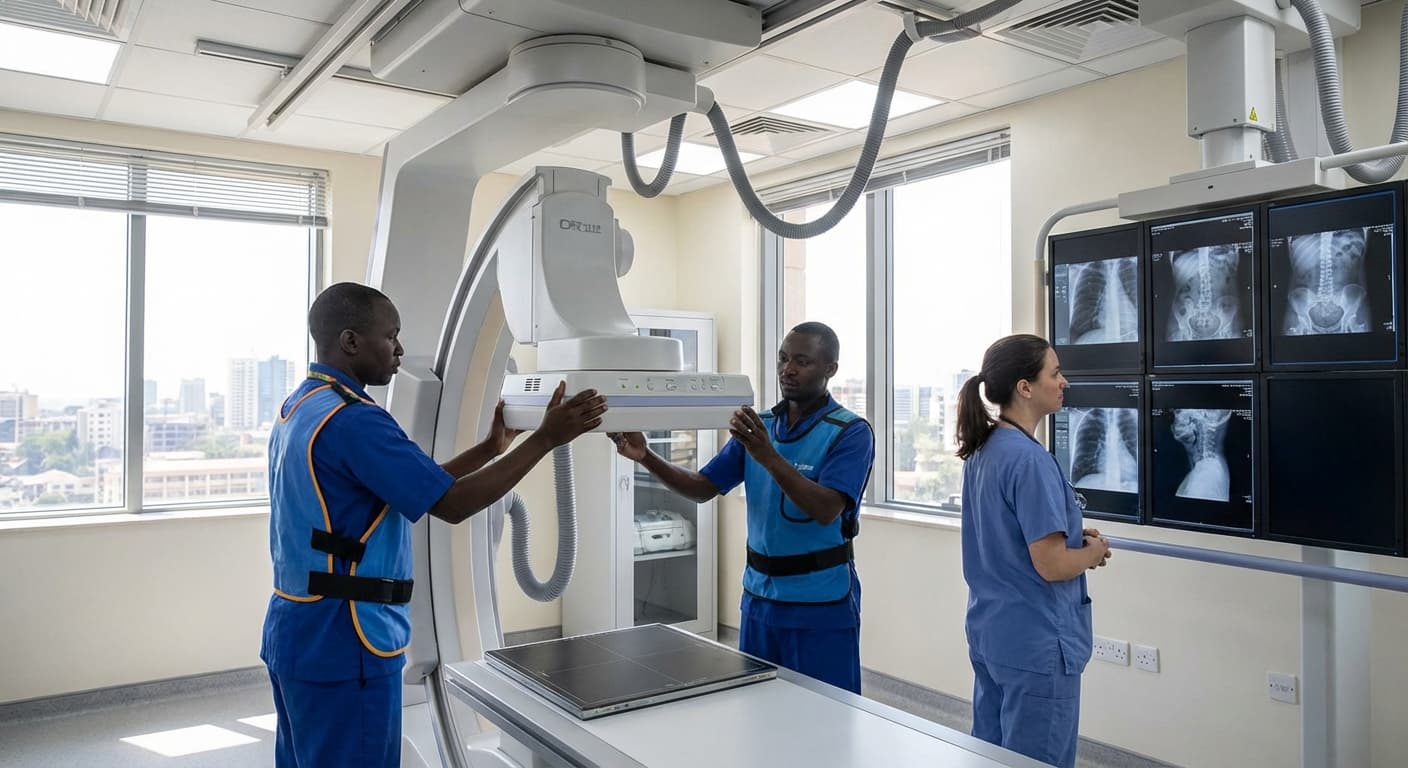
Digital X-Ray Installation Service (Fixed DR) in Mauritania
Engineering Excellence & Technical Support
Digital X-Ray Installation Service (Fixed DR) High-standard technical execution following OEM protocols and local regulatory frameworks.
Nationwide Coverage & Local Expertise
Our Digital X-Ray installation services extend across all regions of Mauritania, from Nouakchott to remote areas. We leverage a deep understanding of local infrastructure and logistical challenges to ensure seamless deployments, backed by on-the-ground technical teams for prompt and efficient service.
Robust Installation & Rigorous Testing
We specialize in the fixed Digital Radiography (DR) system installation, adhering to international standards for precision and safety. Our process includes comprehensive site surveys, structural assessments, electrical integrity checks, and advanced calibration to guarantee optimal image quality and system reliability from day one.
Secure Data Integration & Training
Beyond hardware, we provide secure integration of your DR system with existing PACS and HIS. Our service includes comprehensive operator training for your medical staff, ensuring efficient workflow, data management, and adherence to cybersecurity best practices for protected health information in Mauritania.
What Is Digital X-ray Installation Service (Fixed Dr) In Mauritania?
Digital X-ray Installation Service (Fixed DR) in Mauritania refers to the comprehensive process of acquiring, setting up, and integrating a fixed Digital Radiography (DR) system within a healthcare facility in Mauritania. This service encompasses the physical installation of the X-ray generator, detector (either a direct or indirect conversion flat panel detector), acquisition workstation, and associated imaging software. It also includes the necessary electrical, structural, and network infrastructure modifications to support the system's operation. The service aims to provide healthcare providers with a modern, efficient, and high-quality diagnostic imaging solution, replacing or augmenting traditional film-based radiography or older computed radiography (CR) systems.
| Who Needs This Service? | Typical Use Cases | ||||
|---|---|---|---|---|---|
| Hospitals (Public and Private): Requiring advanced diagnostic imaging capabilities for a wide range of medical conditions. | Radiology Departments: Seeking to upgrade from older analog or CR systems to digital DR for improved workflow and image quality. | Specialized Clinics (e.g., Orthopedics, Pulmonology): Needing high-resolution imaging for specific anatomical regions. | Emergency Departments: Benefiting from rapid image acquisition for timely diagnosis in critical care situations. | Rural Healthcare Centers: Aiming to provide advanced diagnostic services that may not have been previously available locally. | Diagnostic Imaging Centers: Expanding their service offerings with state-of-the-art radiography equipment. |
| Chest X-rays (Thoracic imaging): For diagnosis of pneumonia, tuberculosis, lung nodules, and other pulmonary conditions. | Skeletal Imaging (Orthopedics): For fracture detection, joint assessments, and evaluation of bone abnormalities. | Abdominal Imaging: For diagnosis of conditions like bowel obstruction, organ enlargement, or foreign body detection. | Trauma Imaging: Rapid acquisition of images in emergency settings for assessment of injuries. | Pediatric Imaging: Utilizing lower radiation doses and faster acquisition times for young patients. | Routine Medical Examinations: Incorporating digital X-ray for general health screening and diagnostic purposes. |
Key Components of Fixed DR Installation Service:
- Site Survey and Planning: Assessment of existing infrastructure, power requirements, radiation shielding needs, and space allocation.
- System Procurement and Delivery: Sourcing and transportation of the fixed DR unit, including X-ray tube, generator, flat panel detector, and workstation.
- Physical Installation: Mounting of X-ray tube, installation of the detector in a fixed bucky or table, and setup of the control console/workstation.
- Electrical and Networking Integration: Connection to power supply, grounding, and integration with the facility's Picture Archiving and Communication System (PACS) and/or Hospital Information System (HIS).
- Software Configuration and Calibration: Installation and configuration of imaging acquisition software, image processing parameters, and system calibration for optimal image quality and dose efficiency.
- Radiation Safety Compliance: Ensuring all installations meet national and international radiation safety standards, including shielding verification.
- Testing and Quality Assurance: Comprehensive testing of all system functionalities, image acquisition, and output to verify performance.
- User Training: Providing training to radiographers and technicians on system operation, image acquisition protocols, and basic troubleshooting.
- Post-Installation Support: Offering initial support and troubleshooting after the system is operational.
Who Needs Digital X-ray Installation Service (Fixed Dr) In Mauritania?
Digital X-ray (Fixed DR) installation services are crucial for healthcare facilities in Mauritania looking to upgrade their diagnostic imaging capabilities. This technology offers significant advantages over traditional film-based X-rays, including faster image acquisition, improved image quality, reduced radiation exposure, and enhanced workflow efficiency. These benefits directly translate to better patient care and more streamlined operations within a medical setting.
| Department | Specific Needs Addressed by Fixed DR Installation | Key Benefits for the Department |
|---|---|---|
| Radiology Department | Replacement of outdated film-based systems, digital archiving and retrieval of images, integration with PACS (Picture Archiving and Communication System), improved image processing and manipulation capabilities. | Faster turnaround times for reports, reduced storage space requirements, easier consultation with specialists, improved diagnostic accuracy due to enhanced image quality. |
| Emergency Department (ED) | Rapid image acquisition and display for immediate diagnosis, quick patient throughput, ability to share images electronically with other departments or specialists. | Faster decision-making in critical situations, improved patient management and treatment initiation, reduced wait times for patients. |
| Orthopedics Department | High-resolution imaging for detailed bone and joint visualization, precise measurements for surgical planning and post-operative assessment. | Enhanced accuracy in fracture diagnosis and alignment assessment, improved surgical outcomes, better patient education regarding their condition. |
| Pediatrics Department | Reduced radiation dose for children, faster imaging to minimize patient discomfort and anxiety, improved ability to detect subtle abnormalities in growing bones. | Safer imaging for young patients, improved patient cooperation during examinations, earlier detection of developmental issues. |
| Oncology Department | Imaging for staging and monitoring of cancer, assessment of treatment response, detailed visualization of soft tissues and lesions. | More accurate staging and treatment planning, improved ability to track disease progression or regression, better patient management protocols. |
| Surgical Departments (e.g., General Surgery, Neurosurgery) | Intra-operative imaging capabilities (depending on system integration), pre-operative planning, post-operative evaluation of surgical sites. | Improved surgical precision, reduced complications, faster recovery times, verification of surgical success. |
Target Customers for Digital X-Ray Installation Service (Fixed DR) in Mauritania:
- Public Hospitals and Clinics: Government-run healthcare facilities that serve the majority of the population. Upgrading to digital X-ray systems would improve their capacity and quality of diagnostic services, especially in remote areas.
- Private Hospitals and Clinics: Larger private healthcare providers that aim to offer advanced diagnostic services and compete on quality. They often have the financial resources to invest in modern medical equipment.
- Specialized Diagnostic Imaging Centers: Facilities dedicated to radiology and imaging services, seeking to enhance their technological offerings and attract a wider patient base.
- Medical Training and Research Institutions: Universities and colleges with medical programs that require up-to-date imaging technology for teaching, training future radiologists and technicians, and conducting research.
- Military and Defense Medical Facilities: Healthcare units serving military personnel, often requiring robust and efficient diagnostic tools.
- International Aid and Non-Governmental Organization (NGO) Health Projects: Organizations implementing healthcare initiatives in Mauritania that may include the establishment or upgrading of medical infrastructure.
Digital X-ray Installation Service (Fixed Dr) Process In Mauritania
This document outlines the comprehensive workflow for a Digital X-Ray Installation Service (Fixed DR) in Mauritania, covering the entire process from initial customer inquiry to successful system execution and handover.
| Phase | Key Steps | Description | Responsible Parties | Key Deliverables |
|---|---|---|---|---|
| Phase 1: Inquiry & Consultation | Initial Contact & Needs Assessment | Customer expresses interest; initial discussion to understand requirements, existing infrastructure, and desired DR system specifications. | Customer, Sales Representative | Understanding of customer needs, initial system recommendations |
| Phase 1: Inquiry & Consultation | Product Demonstration/Information Sharing | Providing detailed information on available Fixed DR systems, their features, benefits, and potential applications. | Sales Representative, Technical Expert (if needed) | Informed customer, preliminary system choice |
| Phase 2: Site Assessment & Planning | Site Survey | On-site visit to evaluate the installation location, power supply, radiation shielding requirements, room dimensions, and network infrastructure. | Technical Engineer, Project Manager | Detailed site survey report, identification of potential challenges |
| Phase 2: Site Assessment & Planning | System Design & Integration Plan | Developing a detailed plan for the DR system's placement, cabling, power integration, and any necessary structural modifications. | Technical Engineer, Project Manager | System layout diagram, integration plan |
| Phase 3: Quotation & Agreement | Prepare Detailed Quotation | Based on site assessment and chosen system, generating a comprehensive quotation including equipment, installation, training, and any ancillary services. | Sales Department, Project Manager | Formal quotation |
| Phase 3: Quotation & Agreement | Contract Negotiation & Signing | Discussing terms and conditions, finalizing the contract, and obtaining signatures from both parties. | Sales Department, Legal Department (if applicable), Customer | Signed contract, Service Level Agreement (SLA) |
| Phase 4: Procurement & Logistics | Equipment Order | Placing the order for the selected Fixed DR system and any associated components with the manufacturer or supplier. | Procurement Department | Purchase Order (PO) issued |
| Phase 4: Procurement & Logistics | Logistics & Shipping | Managing the transportation of equipment to Mauritania, including customs clearance and delivery to the installation site. | Logistics Department, Customs Broker | Equipment delivered to site |
| Phase 5: Pre-Installation Preparation | Site Preparation | Executing any necessary civil works, power upgrades, or network infrastructure modifications identified during the site assessment. | Installation Team, Local Contractors (if needed) | Site ready for installation |
| Phase 5: Pre-Installation Preparation | Equipment Staging & Verification | Receiving and verifying all delivered equipment against the order, ensuring no damage or missing parts. | Installation Team | Inventory of received equipment |
| Phase 6: Installation & Configuration | Physical Installation | Mounting the DR detector, X-ray generator, console, and other components according to the approved design plan. | Installation Team (certified technicians) | Physically installed DR system components |
| Phase 6: Installation & Configuration | System Configuration & Network Integration | Configuring the DR software, integrating it with the Picture Archiving and Communication System (PACS) and/or Hospital Information System (HIS), and establishing network connectivity. | Installation Team, IT Specialist | Configured DR system and network connectivity |
| Phase 7: Testing & Calibration | System Testing | Performing comprehensive tests to ensure all components are functioning correctly and the system meets performance specifications. | Installation Team, Quality Assurance (QA) Specialist | Successful system functionality tests |
| Phase 7: Testing & Calibration | Image Quality Calibration | Calibrating the DR system to ensure optimal image quality, dose optimization, and compliance with diagnostic standards. | Installation Team, Medical Physicist (if required) | Calibrated image quality |
| Phase 8: Training & Handover | Operator Training | Providing hands-on training to radiographers and technicians on the operation, basic troubleshooting, and maintenance of the DR system. | Training Specialist, Installation Team | Trained personnel |
| Phase 8: Training & Handover | System Handover & Acceptance | Formal handover of the operational DR system to the customer, including all documentation and ensuring customer acceptance. | Project Manager, Customer Representative | Signed handover certificate, operational DR system |
| Phase 9: Post-Installation Support & Maintenance | Warranty Period | Providing warranty support for a defined period, addressing any defects or issues that may arise. | Technical Support Team | Resolved warranty issues |
| Phase 9: Post-Installation Support & Maintenance | Ongoing Maintenance & Service Contracts | Offering optional maintenance contracts for regular servicing, preventive maintenance, and timely repairs to ensure long-term system performance. | Service Department, Technical Support Team | Executed maintenance visits, service reports |
Digital X-Ray Installation Service (Fixed DR) - Mauritania Workflow
- Phase 1: Inquiry & Consultation
- Phase 2: Site Assessment & Planning
- Phase 3: Quotation & Agreement
- Phase 4: Procurement & Logistics
- Phase 5: Pre-Installation Preparation
- Phase 6: Installation & Configuration
- Phase 7: Testing & Calibration
- Phase 8: Training & Handover
- Phase 9: Post-Installation Support & Maintenance
Digital X-ray Installation Service (Fixed Dr) Cost In Mauritania
The cost of installing a Fixed Digital Radiography (DR) X-ray system in Mauritania can vary significantly based on several factors. These include the specific model and brand of the DR system, the existing infrastructure of the healthcare facility, the complexity of the installation, and the service provider's expertise and overhead. It's essential to obtain detailed quotes from multiple reputable suppliers to ensure competitive pricing and the best value for your investment.
| Category | Estimated Price Range (Mauritanian Ouguiya - MRU) | Notes |
|---|---|---|
| Basic Fixed DR System (Entry-level) | 15,000,000 - 25,000,000 MRU | Includes a standard detector, generator, workstation, and basic software. Assumes minimal site preparation. |
| Mid-Range Fixed DR System | 25,000,000 - 40,000,000 MRU | Offers better image quality, more advanced features, potentially wireless detectors, and moderate site preparation. |
| High-End Fixed DR System | 40,000,000 - 70,000,000+ MRU | Top-tier systems with advanced imaging capabilities, premium detectors, sophisticated software, and potentially integrated PACS. Assumes significant site preparation may be required. |
| Installation & Site Preparation (Variable) | 2,000,000 - 10,000,000+ MRU | Highly dependent on the existing infrastructure. Includes electrical work, shielding, and construction if needed. |
| Training & After-Sales Support (Annual) | 500,000 - 2,000,000+ MRU | Costs for initial comprehensive training and ongoing service contracts. |
| Import Duties & Taxes (Estimated) | 10% - 30% of CIF value | This is a significant variable and depends on current government regulations and the declared value of the equipment. |
Key Pricing Factors for Fixed DR X-ray Installation in Mauritania:
- DR System Model and Brand: High-end, feature-rich systems from leading international manufacturers will naturally command higher prices than more basic models or those from less established brands.
- Detector Technology: The type of flat-panel detector (e.g., CsI vs. a-Se, wired vs. wireless) and its size will impact the overall cost.
- X-ray Generator and Tube: The power and quality of the X-ray generator and tube are crucial components that influence the system's price.
- Workstation and Software: The included imaging acquisition software, PACS (Picture Archiving and Communication System) compatibility, and the quality of the viewing workstation are important cost considerations.
- Existing Infrastructure: The readiness of the installation site is a major factor. This includes: * Room preparation: Requirements for shielding (lead lining), electrical upgrades, ventilation, and space modifications. * Power supply: Ensuring a stable and adequate power supply, potentially requiring UPS (Uninterruptible Power Supply) systems. * Network connectivity: For PACS integration and data transfer.
- Installation Complexity: Difficult access to the site, the need for specialized lifting equipment, or extensive structural modifications will increase labor costs.
- Training: The extent of training provided to radiographers and technicians on system operation and basic maintenance can be a separate cost component.
- Warranty and After-Sales Support: The length and comprehensiveness of the warranty, as well as the availability and cost of ongoing maintenance and technical support, should be factored in.
- Import Duties and Taxes: These will apply to the imported medical equipment and can add a significant percentage to the final cost.
- Service Provider's Overhead and Profit Margin: Different companies will have varying cost structures and pricing strategies.
Affordable Digital X-ray Installation Service (Fixed Dr) Options
Discover affordable digital X-ray installation services for your Fixed DR (Digital Radiography) system. We understand the importance of integrating advanced imaging technology without breaking your budget. This guide outlines value bundles and cost-saving strategies to help you make an informed decision.
| Value Bundle Option | Included Services | Potential Cost Savings | Ideal For |
|---|---|---|---|
| Basic Installation Package | DR detector mounting & integration, workstation setup, basic software configuration, initial user training. | Lowest upfront cost, focused on core functionality. | Clinics with established IT infrastructure and minimal customization needs. |
| Standard Workflow Bundle | Basic Package + PACS viewer integration, image archiving setup, advanced software features configuration, extended user training. | Balanced pricing, optimizes workflow efficiency. | Practices aiming for seamless integration with existing Picture Archiving and Communication Systems (PACS). |
| Comprehensive Integration Suite | Standard Bundle + EMR/EHR integration, advanced network configuration, custom report templates, ongoing technical support subscription. | Higher initial investment, significant long-term efficiency gains and risk mitigation. | Larger healthcare facilities or those requiring deep integration with existing IT systems. |
Key Benefits of Affordable Fixed DR Installation:
- Reduced upfront investment for essential diagnostic tools.
- Improved diagnostic accuracy and patient care through digital imaging.
- Streamlined workflow and increased operational efficiency.
- Potential for long-term cost savings through reduced film usage and processing.
- Access to expert installation and support services at competitive prices.
Verified Providers In Mauritania
Navigating the healthcare landscape in a foreign country can be daunting. Ensuring you are accessing quality care from reliable professionals is paramount. In Mauritania, identifying 'Verified Providers' is key to a safe and effective healthcare experience. This guide focuses on Franance Health credentials and illuminates why they stand out as the best choice for your medical needs.
| Criterion | Franance Health Verification Means... | Why it's the Best Choice |
|---|---|---|
| Licensing & Certification | Provider holds valid and current medical licenses and certifications recognized by relevant authorities. | Ensures they are legally qualified and authorized to practice medicine. |
| Qualifications & Training | Thorough review of educational background, specialized training, and experience. | Confirms they possess the necessary expertise for their field of practice. |
| Clinical Protocols & Standards | Assessment of adherence to established international and national medical guidelines and protocols. | Indicates a commitment to providing up-to-date and effective treatments. |
| Patient Safety Measures | Evaluation of infection control, patient identification, medication management, and emergency preparedness. | Prioritizes your well-being and minimizes risks during your care. |
| Ethical Conduct | Verification of ethical practices, patient rights, and professional integrity. | Guarantees respectful and trustworthy medical interactions. |
| Facility Standards (if applicable) | For institutions, assessment of infrastructure, equipment, and hygiene. | Ensures a safe and functional environment for treatment. |
Understanding Verified Providers and Franance Health
- What are Verified Providers? Verified Providers are healthcare professionals and facilities that have undergone a rigorous vetting process by a credible organization. This process typically involves checking licenses, certifications, qualifications, and adherence to established medical standards and ethical practices.
- Who is Franance Health? Franance Health is a reputable international healthcare accreditation and verification body. They are known for their commitment to setting high standards in healthcare delivery, patient safety, and professional competence across various regions, including Africa.
- Why Franance Health Credentials Matter: When a healthcare provider in Mauritania holds Franance Health credentials, it signifies that they have met a stringent set of criteria. This independent verification offers patients a significant degree of assurance regarding the quality and safety of the services they will receive.
- Key Benefits of Choosing Franance Health Verified Providers:
- Enhanced Patient Safety: Adherence to international safety protocols and best practices.
- High Standard of Care: Demonstrated commitment to evidence-based medicine and quality outcomes.
- Professional Competence: Verification of qualifications, training, and ongoing professional development.
- Ethical Practices: Assurance of ethical conduct and patient-centered care.
- Reduced Risk: Minimizes the risk of receiving substandard or unsafe medical treatment.
- Peace of Mind: Provides confidence and reduces anxiety when seeking medical services abroad.
Scope Of Work For Digital X-ray Installation Service (Fixed Dr)
This Scope of Work (SOW) outlines the services required for the professional installation of a Fixed Digital Radiography (DR) X-ray system. It details the technical deliverables and standard specifications to ensure a successful and compliant implementation. This SOW is intended for qualified and licensed installation service providers.
| Technical Deliverable | Standard Specification / Requirement | Verification Method |
|---|---|---|
| Installed Fixed DR System | Fully functional and operational DR system (generator, detector, workstation, software) meeting manufacturer's specifications and client requirements. | System demonstration, image quality tests, functionality checks. |
| Calibrated X-ray Generator | Accurate and consistent kVp, mAs, and time settings. Within +/- 5% of set values. | kVp meter, mAs meter, timer calibration. |
| Aligned Collimator | Concentric light field with X-ray beam for all field sizes. Within +/- 2% of SID. | Collimator alignment tools, light field/X-ray field comparison. |
| Functional DR Detector | No dead pixels, consistent response across the panel, correct sensitivity and dynamic range as per manufacturer specs. Signal-to-noise ratio (SNR) within acceptable limits. | Detector uniformity tests, phantom imaging, noise analysis. |
| Operational Image Acquisition Workstation | Installed and configured with necessary software, drivers, and user profiles. Fast boot-up and image loading times. | Workstation performance benchmarks, software functionality check. |
| DICOM Compliance | Adherence to DICOM 3.0 standards for image storage (SC), send (C-STORE), and query/retrieve (C-FIND, C-MOVE). Correct DICOM header information. | DICOM conformance statement verification, network connectivity tests with PACS/RIS. |
| Network Integration | Seamless connectivity to hospital HIS/RIS/PACS. Stable and secure data transfer. Defined IP addressing and subnet mask. | Network ping tests, data transfer tests, firewall review. |
| Radiation Safety Report | Documented radiation survey results confirming compliance with national and local regulations. Shielding integrity verified. | Radiation survey meter readings, issued report by qualified physicist. |
| User Training Completion Certificate | Acknowledgement of satisfactory completion of training by clinical staff. | Signed training attendance sheets or certificates. |
| As-Built Drawings | Accurate representation of the installed system, including cable routing, component placement, and power outlets. | Site walk-through with client, review of drawings. |
| System Handover Document | Signed document by client and installer confirming successful completion of all SOW requirements. | Formal handover meeting and signature. |
Project Phases and Key Activities
- 1. Site Assessment and Preparation:
- Conduct a thorough on-site assessment of the designated installation area.
- Verify physical space, power requirements, network connectivity, and environmental conditions (temperature, humidity).
- Identify and address any potential structural modifications or environmental controls needed.
- Ensure compliance with radiation safety regulations and local building codes.
- 2. Equipment Delivery and Unpacking:
- Coordinate equipment delivery with the client and manufacturer.
- Safely transport and unpack all components of the Fixed DR system.
- Inspect all components for visible damage upon arrival.
- 3. System Installation and Configuration:
- Mount and secure the X-ray generator, tube, and collimator according to manufacturer specifications.
- Install the DR detector panel (fixed to the table or wall stand).
- Connect and configure all necessary cabling (power, network, control).
- Install and configure the image acquisition workstation, DICOM gateway, and PACS connectivity.
- Set up and configure system software, including user profiles and acquisition parameters.
- 4. System Testing and Calibration:
- Perform initial power-on and system self-tests.
- Conduct detailed equipment calibration and alignment procedures.
- Perform image quality testing using phantoms and reference images.
- Verify all system functionalities, including generator output, collimator function, and detector response.
- 5. Integration and Network Connectivity:
- Integrate the DR system with the existing hospital network (HIS/RIS/PACS).
- Test DICOM send/receive functionality to and from the PACS.
- Configure IP addresses, subnet masks, and other network settings.
- Ensure secure network communication protocols are implemented.
- 6. Radiation Safety Verification and Shielding Assessment:
- Conduct a radiation survey to verify shielding effectiveness.
- Ensure compliance with regulatory requirements for radiation safety.
- Provide a report detailing radiation levels and compliance.
- 7. User Training:
- Provide comprehensive training to clinical staff on system operation, image acquisition, and basic troubleshooting.
- Training shall cover routine operation, image optimization, and emergency procedures.
- 8. Documentation and Handover:
- Provide all relevant system documentation, including user manuals, technical specifications, and as-built drawings.
- Complete a formal handover to the client, confirming successful installation and operational readiness.
- Obtain client sign-off on the completion of the installation.
- 9. Post-Installation Support (Optional/As Agreed):
- Provide initial post-installation support for a defined period.
Service Level Agreement For Digital X-ray Installation Service (Fixed Dr)
This Service Level Agreement (SLA) outlines the response times and uptime guarantees for the Digital X-Ray Installation Service (Fixed DR). This SLA is an integral part of the overall service contract between [Provider Name] and [Client Name].
| Service Component | Response Time (Business Hours) | Resolution Time Target (Business Hours) | Uptime Guarantee |
|---|---|---|---|
| Installation & Initial Configuration | Within 4 business hours of scheduled appointment | N/A (completion based on project scope) | N/A |
| Critical System Failure (e.g., inability to acquire images) | Within 2 business hours | Within 8 business hours | 99.5% |
| Major System Malfunction (e.g., image quality issues, significant workflow disruption) | Within 4 business hours | Within 16 business hours | 99.5% |
| Minor System Issue (e.g., software glitch, minor performance degradation) | Within 8 business hours | Within 24 business hours | 99.5% |
| Routine Inquiries & Support | Within 1 business day | N/A (addressed as per inquiry complexity) | N/A |
Scope of Service
- Installation and configuration of the fixed Digital Radiography (DR) X-ray system.
- Initial system testing and calibration.
- User training on the operation of the DR system.
- Post-installation support for a defined period.
Frequently Asked Questions

Ready when you are
Let's scope your Digital X-Ray Installation Service (Fixed DR) in Mauritania project in Mauritania.

Scaling healthcare logistics and technical systems across the entire continent.