
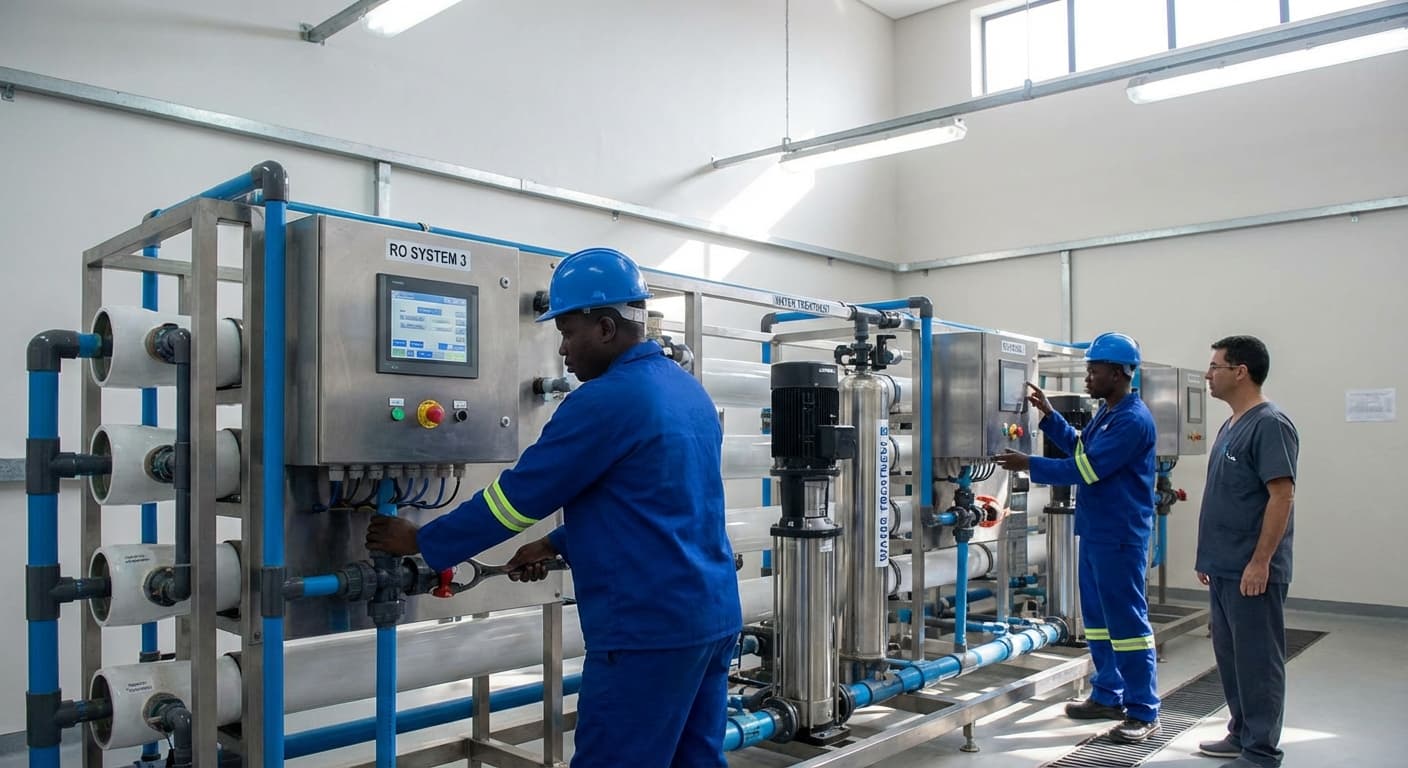
Dialysis RO/Water Treatment Plant Installation Service in Mauritania
Engineering Excellence & Technical Support
Dialysis RO/Water Treatment Plant Installation Service High-standard technical execution following OEM protocols and local regulatory frameworks.
Advanced RO Membrane Integration
Our expert technicians in Mauritania meticulously install and optimize cutting-edge Reverse Osmosis (RO) membranes, ensuring the highest purity water standards for dialysis. This includes precise pre-treatment calibration to maximize membrane lifespan and efficiency in the unique environmental conditions of Mauritania.
Precision Flow & Pressure Management
We guarantee optimal system performance through meticulous installation of flow meters, pressure gauges, and control valves. Our Mauritanian-based team ensures precise calibration to meet specific dialysis machine requirements and maintain consistent water delivery, crucial for patient safety and treatment efficacy.
Robust UV Sterilization & Monitoring
Our installations incorporate high-performance Ultraviolet (UV) sterilization units, integrated with real-time monitoring systems. This provides an essential layer of microbiological protection for dialysis water, safeguarding patients against potential contaminants, and ensuring compliance with international healthcare standards in Mauritania.
What Is Dialysis Ro/water Treatment Plant Installation Service In Mauritania?
Dialysis RO/Water Treatment Plant Installation Service in Mauritania refers to the specialized engineering and construction process of setting up Reverse Osmosis (RO) and associated water purification systems specifically designed for hemodialysis units and medical facilities in the country. This service encompasses the entire lifecycle from initial site assessment and system design to the physical installation, commissioning, and handover of the water treatment infrastructure. The objective is to produce ultrapure water that meets stringent medical standards, essential for patient safety and effective hemodialysis treatment by removing contaminants, pyrogens, and endotoxins that could cause adverse reactions or infections. The installation involves integrating RO membranes, sediment filters, carbon filters, water softeners, deionization units, UV sterilization, and distribution piping, all meticulously calibrated and tested to ensure consistent water quality and operational reliability.
| Who Needs This Service | Typical Use Cases | |||
|---|---|---|---|---|
| Dialysis Centers/Units: Hospitals and standalone clinics providing hemodialysis treatment for patients with renal failure. | Medical Facilities with Dialysis Programs: Larger hospitals that offer hemodialysis as part of their broader nephrology services. | New Healthcare Infrastructure Projects: Construction of new hospitals or medical complexes in Mauritania that will include dialysis capabilities. | Upgrades or Expansions of Existing Dialysis Facilities: Replacing outdated water treatment systems or increasing capacity to meet growing patient demand. | Government Health Initiatives: Public health programs aimed at improving access to dialysis treatment across the country. |
| Production of Dialysis-Grade Water: The primary use case, ensuring the delivery of safe and effective dialysate for hemodialysis procedures. | Patient Safety: Preventing complications such as pyrogenic reactions, infections, and electrolyte imbalances caused by substandard water quality. | Compliance with Medical Standards: Adhering to national and international regulations governing water quality for dialysis. | Operational Efficiency: Ensuring a consistent and reliable supply of purified water, minimizing downtime and disruptions to patient care. | Cost-Effectiveness: Investing in a robust water treatment system to reduce the long-term risks and costs associated with poor water quality. |
Key Components of Dialysis RO/Water Treatment Plant Installation:
- Site Survey and Assessment: Evaluating existing water sources (municipal, well, etc.), water quality analysis, space availability, and power requirements.
- System Design and Engineering: Developing a tailored treatment schematic based on water analysis, required throughput, and relevant international/local standards (e.g., AAMI, ISO).
- Procurement and Logistics: Sourcing high-quality components, including RO membranes, pumps, filters, tanks, control systems, and piping, and managing their transportation to the site in Mauritania.
- Mechanical Installation: Assembling and integrating all filtration, purification, and sterilization modules, including plumbing and pipework connections.
- Electrical and Control System Integration: Wiring control panels, sensors, and actuators; programming and configuring the system's automation for optimal performance and safety.
- Commissioning and Validation: Thorough testing of the installed system to verify water quality parameters (TOC, conductivity, bacterial counts, etc.), flow rates, and operational stability. This often includes performance qualification (PQ) and operational qualification (OQ).
- Training: Educating facility personnel on the operation, routine maintenance, and troubleshooting of the water treatment plant.
- Documentation and Handover: Providing comprehensive operation and maintenance manuals, design documents, and validation reports.
Who Needs Dialysis Ro/water Treatment Plant Installation Service In Mauritania?
Dialysis RO/Water Treatment Plant Installation Services in Mauritania are crucial for ensuring the consistent availability of purified water, a vital component for safe and effective hemodialysis. These services cater to the specialized needs of healthcare facilities and organizations that operate or plan to operate dialysis centers. The demand stems from the increasing prevalence of kidney disease and the need for advanced medical infrastructure. Properly treated water is paramount to prevent complications and ensure patient well-being during dialysis treatments.
| Customer Type | Primary Need | Key Departmental Stakeholders |
|---|---|---|
| Public Hospitals | Reliable and cost-effective water treatment for existing and expanding dialysis units. | Administration, Medical Director, Engineering, Infection Control |
| Private Hospitals | High-quality, advanced water purification systems to meet patient expectations and regulatory standards. | Administration, Medical Director, Biomedical Engineering, Finance |
| Renal Centers/Dialysis Clinics | Dedicated and compliant RO systems specifically for dialysis, ensuring consistent supply. | Clinic Management, Biomedical Engineering, Facilities Management |
| NGOs & International Aid Organizations | Installation of water treatment solutions in underserved regions or for humanitarian projects. | Program Management, Procurement, Medical Teams |
| Government Health Ministries | Developing national standards, supporting public health infrastructure, and regulating water quality. | Policy & Planning Division, Public Health Department, Procurement Unit |
Target Customers and Departments for Dialysis RO/Water Treatment Plant Installation Service in Mauritania
- {"items":["Public Hospitals","Private Hospitals","Renal Centers/Dialysis Clinics","Non-Governmental Organizations (NGOs) involved in healthcare","Government Health Ministries and Agencies","International Aid Organizations","Medical Equipment Suppliers and Distributors (for resale/bundled services)","New Healthcare Facility Developers"],"title":"Target Customers"}
- {"items":["Administration/Procurement Department (for decision-making and budgeting)","Medical Director's Office (for clinical oversight and requirements)","Engineering/Facilities Management Department (for site assessment, utility integration, and maintenance planning)","Infection Control Department (for ensuring water quality standards and patient safety)","Biomedical Engineering Department (for integration with dialysis machines and ongoing maintenance)","Finance Department (for budget allocation and payment processing)"],"title":"Key Departments Involved"}
Dialysis Ro/water Treatment Plant Installation Service Process In Mauritania
This document outlines the standard workflow for Dialysis Reverse Osmosis (RO) / Water Treatment Plant Installation Services in Mauritania, from the initial inquiry to the final execution and handover. It details the key stages, activities, and deliverables involved to ensure a smooth and efficient installation process.
| Stage | Key Activities | Deliverables / Outcomes | Key Stakeholders Involved |
|---|---|---|---|
| Initial Inquiry & Consultation | Client contacts the service provider with requirements for a dialysis RO/water treatment plant. Initial discussions to understand needs, capacity, and location. | Understanding of client requirements, preliminary scope definition. | Client (Hospital/Clinic Management, Biomedical Engineers), Service Provider (Sales/Technical Team) |
| Site Assessment & Feasibility Study | On-site visit to assess water source quality, available space, power supply, drainage, and existing infrastructure. Determine technical feasibility and identify potential challenges. | Detailed site report, water quality analysis report, identification of site-specific requirements and potential constraints. | Service Provider (Technical Engineers, Site Surveyors), Client (Facility Manager, Biomedical Engineers) |
| Proposal & Quotation | Based on site assessment, a detailed proposal is prepared, including system design, equipment specifications, installation plan, timeline, and cost breakdown. A formal quotation is submitted to the client. | Comprehensive technical proposal, detailed quotation, preliminary project schedule. | Service Provider (Sales Team, Engineering Team), Client (Procurement Department, Management) |
| Contracting & Agreement | Upon client acceptance of the proposal and quotation, a formal contract or service agreement is drafted and signed, outlining terms and conditions, payment schedule, warranty, and responsibilities. | Signed contract/service agreement, payment schedule confirmation. | Client (Legal Department, Management), Service Provider (Legal Department, Management) |
| Design & Engineering | Detailed engineering design of the RO/water treatment plant, including P&ID (Piping and Instrumentation Diagrams), electrical schematics, layout drawings, and material selection based on the agreed specifications and site conditions. | Finalized design drawings (P&ID, electrical, layout), Bill of Materials (BOM). | Service Provider (Design Engineers, Process Engineers) |
| Procurement & Logistics | Ordering of all necessary equipment, components, and materials from approved suppliers. Arranging for shipping, customs clearance, and transportation of goods to the site in Mauritania. | All equipment and materials procured and delivered to the site, customs clearance documentation. | Service Provider (Procurement Team, Logistics Team), Client (for necessary import permits/documentation support) |
| Pre-installation Activities | Site preparation, including necessary civil works (e.g., concrete pads, pipe trenches), electrical panel installation, and ensuring adequate access for equipment delivery and installation. | Prepared installation site, necessary utility connections (power, water inlet) ready. | Client (Maintenance/Facilities Team), Service Provider (Installation Team) |
| On-site Installation | Assembly and installation of the RO/water treatment plant components, including membranes, pumps, piping, electrical wiring, and control systems according to the design drawings and manufacturer's guidelines. | Physically installed RO/water treatment plant, connected to utilities. | Service Provider (Installation Team, Technicians), Client (to facilitate access and provide support) |
| Commissioning & Testing | System startup, flushing, and rigorous testing to verify performance against design specifications. This includes water quality testing (TDS, conductivity, etc.), flow rate verification, and pressure checks. Adjustments are made as needed. | Fully functional RO/water treatment plant, water quality meeting dialysis standards, operational test reports. | Service Provider (Commissioning Engineers, Quality Control Team), Client (Biomedical Engineers for validation) |
| Training | Comprehensive training for the client's technical staff on the operation, routine maintenance, troubleshooting, and safety procedures of the installed RO/water treatment plant. | Trained client personnel, operation and maintenance manuals. | Service Provider (Training Specialists), Client (Operators, Biomedical Technicians) |
| Handover & Documentation | Formal handover of the installed and commissioned plant to the client. Provision of all relevant documentation, including as-built drawings, operation & maintenance manuals, warranty certificates, and test reports. | Signed handover certificate, complete project documentation package. | Service Provider (Project Manager), Client (Facility Management, Biomedical Department) |
| Post-installation Support & Maintenance | Ongoing support, including scheduled preventative maintenance, spare parts supply, troubleshooting assistance, and emergency repair services as per the service agreement. | Continued optimal plant performance, accessible technical support, available spare parts. | Service Provider (Maintenance Team, Technical Support), Client (to schedule maintenance and report issues) |
Dialysis RO/Water Treatment Plant Installation Service Process in Mauritania
- Initial Inquiry & Consultation
- Site Assessment & Feasibility Study
- Proposal & Quotation
- Contracting & Agreement
- Design & Engineering
- Procurement & Logistics
- Pre-installation Activities
- On-site Installation
- Commissioning & Testing
- Training
- Handover & Documentation
- Post-installation Support & Maintenance
Dialysis Ro/water Treatment Plant Installation Service Cost In Mauritania
Installing a Reverse Osmosis (RO) and Water Treatment Plant for dialysis in Mauritania involves a range of costs influenced by several key factors. These facilities are critical for providing safe, purified water essential for hemodialysis, and their installation requires specialized equipment and expertise. The pricing can vary significantly based on the scale of the operation, the complexity of the treatment system, the quality of components used, and the specific location within Mauritania. It's important to note that these are estimations, and obtaining detailed quotes from specialized suppliers and installers is crucial for accurate budgeting.
| System Size/Capacity (Example) | Estimated Installation Cost Range (MRU) | Notes |
|---|---|---|
| Small Clinic (e.g., 5-10 Dialysis Stations, < 500 L/day output) | 1,500,000 - 3,500,000 | Basic pre-filtration, single-stage RO, UV sterilization. May involve standard components. Assumes minimal site modification. |
| Medium Clinic/Hospital Wing (e.g., 15-25 Dialysis Stations, 500-1500 L/day output) | 3,500,000 - 7,000,000 | Multi-stage RO, enhanced pre-filtration, potentially DI polishing, advanced monitoring. More robust components and potentially some site work. |
| Large Hospital/Dedicated Dialysis Center (e.g., 30+ Dialysis Stations, >1500 L/day output) | 7,000,000 - 15,000,000+ | High-capacity, fully automated systems, redundant components, advanced purification (e.g., double pass RO, ultrafiltration), comprehensive monitoring, and potential integration with building management systems. Significant site preparation likely. |
Key Pricing Factors for Dialysis RO/Water Treatment Plant Installation in Mauritania:
- {"title":"System Capacity and Size","description":"The volume of purified water required per day (e.g., liters per hour or day) directly impacts the size and number of RO membranes, pumps, tanks, and filtration stages needed. Larger capacity systems naturally incur higher costs."}
- {"title":"Treatment Technology and Stages","description":"The level of water purification required will determine the complexity of the system. This can include pre-filtration (sediment, carbon), RO membranes, post-treatment (UV sterilization, deionization), and water storage. More advanced multi-stage systems are more expensive."}
- {"title":"Equipment Quality and Brand","description":"High-quality, reputable brands often come with a higher upfront cost but offer better reliability, longevity, and performance. The choice between industrial-grade and more basic components will affect pricing."}
- {"title":"Installation and Labor Costs","description":"Specialized technicians with experience in water treatment and dialysis systems are required. Their fees, travel expenses (if any), and the duration of the installation will contribute to the overall cost. Local labor rates in Mauritania will also play a role."}
- {"title":"Site Preparation and Infrastructure","description":"The existing infrastructure of the dialysis center or hospital plays a significant role. Costs can increase if extensive plumbing modifications, electrical upgrades, or specialized foundations are required to accommodate the plant."}
- {"title":"Ancillary Equipment and Accessories","description":"This includes items like water storage tanks, distribution piping, monitoring systems (e.g., conductivity meters, pressure gauges), backup power solutions, and potentially water softeners if the raw water quality is poor."}
- {"title":"Permitting and Regulatory Compliance","description":"Obtaining necessary permits and ensuring compliance with local health and environmental regulations can incur administrative fees and may require specific certifications for the installed system."}
- {"title":"Maintenance and Service Contracts","description":"While not strictly an installation cost, many suppliers offer post-installation maintenance and service contracts, which should be factored into the long-term budget. These can vary in price based on the scope of service."}
- {"title":"Supplier and Location","description":"Whether sourcing from local Mauritanian suppliers or international vendors, and the specific city or region of installation within Mauritania, can impact shipping, logistics, and overall pricing."}
Affordable Dialysis Ro/water Treatment Plant Installation Service Options
Finding affordable dialysis RO/water treatment plant installation services is crucial for healthcare facilities looking to ensure patient safety and operational efficiency without breaking the bank. This guide explores various service options, highlights the value of bundled packages, and provides effective cost-saving strategies. A well-maintained and properly installed RO system is paramount for dialysis, as it removes impurities from tap water that could be harmful to patients. Understanding the components and installation process can empower you to make informed decisions and negotiate better terms.
| Value Bundle Components | Potential Cost Savings | Key Benefits |
|---|---|---|
| Initial Consultation & Needs Assessment + System Design & Sourcing + Installation + Initial Water Quality Testing + Basic Operator Training | Reduced administrative overhead by consolidating multiple service providers. Bulk purchasing discounts on equipment. Streamlined project management leading to fewer delays and associated costs. | Comprehensive solution from a single point of contact. Ensured compatibility and integrated performance. Quicker project turnaround. Basic competency for staff operating the system. |
| Installation + Extended Warranty Package + Preventative Maintenance Contract (1-3 years) + Remote Monitoring Setup | Lower long-term operational costs through proactive maintenance and reduced risk of expensive emergency repairs. Predictable budgeting for maintenance expenses. Discounts on bundled warranty and maintenance services. | Minimized downtime and increased system reliability. Extended peace of mind regarding system performance. Early detection of potential issues, preventing major failures. Data-driven insights into system performance. |
| System Upgrade Planning & Consultation + Installation of New RO Membranes & Filters + Deionization (DI) Polishing Unit Integration + Advanced Operator Training + System Performance Audit | Improved water quality leading to better patient outcomes and reduced risk of complications. Increased energy efficiency with optimized system components. Potential for grants or tax incentives for upgrading to more efficient technology. | Enhanced dialysis treatment efficacy. Reduced operational costs through improved efficiency. Highly skilled operators capable of managing complex systems. Verification of system meeting stringent quality standards. |
Affordable Dialysis RO/Water Treatment Plant Installation Service Options
- Modular vs. Custom-Built Systems: Modular systems offer standardization and quicker installation, often at a lower initial cost. Custom-built systems are designed for specific needs but can be more expensive upfront.
- Local vs. National Installers: Local providers may offer more personalized service and quicker response times for maintenance, while national companies might have greater purchasing power and wider expertise.
- Manufacturer-Direct Installation: Some RO system manufacturers offer their own installation services, which can ensure seamless integration and warranty adherence.
- Third-Party Installation Specialists: Independent companies specializing in water treatment installations can offer competitive pricing and a broad range of system compatibility.
- DIY Installation (with caution): While technically possible for very simple systems, DIY installation for dialysis RO is strongly discouraged due to the critical nature of water purity for patient health and potential voiding of warranties.
Verified Providers In Mauritania
In Mauritania, ensuring you are accessing healthcare services from verified and reputable providers is paramount for your well-being. Franance Health stands out as a leading entity that rigorously vets healthcare professionals and facilities. Their comprehensive credentialing process goes beyond surface-level checks, ensuring that all affiliated providers meet stringent standards of expertise, ethical practice, and patient safety. This commitment to quality verification means that when you choose a provider recommended by Franance Health, you are selecting a healthcare professional or institution that has undergone thorough scrutiny and consistently demonstrated excellence. This dedication to a verified network significantly reduces the risk of encountering substandard care and instills confidence in the patient, allowing them to focus on their health journey with peace of mind.
| Franance Health Verification Aspect | What it Means for You | Why it's Crucial |
|---|---|---|
| Medical License and Board Certification Verification | Confirms the provider is legally qualified and has achieved a recognized level of expertise in their specialty. | Ensures foundational competence and prevents unqualified individuals from practicing. |
| Continuous Professional Development (CPD) Review | Indicates the provider actively stays updated with the latest medical advancements and best practices. | Guarantees you are receiving care based on current, evidence-based medicine. |
| Peer Review and Reputation Assessment | Evaluates the provider's standing within the medical community based on their practice and patient outcomes. | Provides an independent assessment of the provider's skill and reliability. |
| Criminal Background Checks and Ethical Conduct Review | Ensures the provider has a clean record and adheres to a strong ethical framework. | Protects patient safety and promotes a trustworthy healthcare environment. |
| Facility Accreditation and Compliance Checks (if applicable) | Verifies that healthcare facilities meet international standards for safety, hygiene, and operational efficiency. | Ensures a safe and well-equipped environment for your treatment. |
Why Franance Health Credentials Represent the Best Choice:
- Rigorous Vetting Process: Franance Health employs a multi-faceted approach to credentialing, examining qualifications, experience, certifications, and adherence to ethical guidelines.
- Commitment to Patient Safety: Their verification ensures providers meet established safety protocols and maintain a high standard of care.
- Expertise and Specialization: Franance Health identifies and partners with specialists who possess proven expertise in their respective fields.
- Ethical Practice Standards: Providers are assessed for their commitment to patient rights, confidentiality, and professional integrity.
- Reduced Risk and Enhanced Trust: Choosing a Franance Health-verified provider offers a significant reduction in uncertainty and builds a foundation of trust in the healthcare experience.
- Access to Quality Care: Their network is curated to provide access to the most competent and reliable healthcare services available in Mauritania.
Scope Of Work For Dialysis Ro/water Treatment Plant Installation Service
This Scope of Work (SOW) outlines the services required for the installation of a Dialysis Reverse Osmosis (RO)/Water Treatment Plant. The objective is to ensure the provision of high-purity water meeting all relevant medical standards for dialysis treatments. This SOW details the technical deliverables, standard specifications, and responsibilities of the service provider.
| Phase/Activity | Description | Technical Deliverables | Standard Specifications/Requirements |
|---|---|---|---|
| Site Survey and Assessment | On-site evaluation of existing infrastructure, water source quality, available space, power supply, and drainage. | Site survey report with recommendations for plant placement, utility connections, and potential challenges. | Detailed assessment of water source quality (pH, TDS, hardness, chlorine, etc.) against relevant standards (e.g., AAMI, ISO). |
| Design and Engineering | Development of detailed plant layout, P&ID (Piping and Instrumentation Diagrams), electrical schematics, and component selection. | Finalized engineering drawings, P&IDs, electrical schematics, bill of materials (BOM). | Compliance with medical device regulations, water quality standards (e.g., AAMI/ASAIO standards for dialysis water), and local building codes. |
| Procurement of Materials and Equipment | Sourcing and acquisition of all necessary components, including RO membranes, filters, pumps, tanks, piping, valves, and control systems. | Procured equipment and materials list with manufacturer specifications and certifications. | Use of NSF/ANSI-certified materials for potable water contact. High-purity grade components suitable for medical applications. |
| Installation and Assembly | Physical installation of the RO/Water Treatment Plant according to approved designs, including piping, electrical connections, and component mounting. | Completed physical installation of the RO/Water Treatment Plant system. | Adherence to installation best practices, proper pipe joining techniques, electrical safety standards (e.g., NEC), and manufacturer installation guidelines. |
| Pre-Commissioning and Testing | Initial system checks, flushing, leak testing, and verification of individual component functionality. | Pre-commissioning test reports, flushing logs, and preliminary operational checks. | Verification of system integrity, absence of leaks, and basic operational parameters. |
| Commissioning and Validation | System start-up, performance testing, water quality analysis, and validation to ensure it meets specified purity levels. | Commissioning report, water quality analysis certificates (at multiple stages), validation reports, and operational parameters log. | Water quality to meet or exceed AAMI standards (TDS < 1 ppm, Endotoxins < 0.25 EU/mL, microbial count < 10 CFU/mL, no pyrogens). Performance curves for RO membranes. Pressure and flow rate verification. |
| Training | On-site training for facility staff on system operation, routine maintenance, troubleshooting, and water quality monitoring. | Training manuals, attendance records, and post-training assessment results. | Comprehensive training covering daily operations, filter replacement, alarm management, and basic maintenance procedures. |
| Documentation and Handover | Provision of all relevant project documentation, including as-built drawings, O&M manuals, warranties, and spare parts list. | Complete project handover package, including O&M manuals, spare parts list, warranties, and as-built drawings. | Clear and concise documentation, readily accessible for future reference and maintenance. |
Key Project Phases and Deliverables
- Site Survey and Assessment
- Design and Engineering
- Procurement of Materials and Equipment
- Installation and Assembly
- Pre-Commissioning and Testing
- Commissioning and Validation
- Training
- Documentation and Handover
Service Level Agreement For Dialysis Ro/water Treatment Plant Installation Service
This Service Level Agreement (SLA) outlines the response times and uptime guarantees for the installation service of Dialysis Reverse Osmosis (RO) and Water Treatment Plants. This SLA is between [Your Company Name] (hereinafter referred to as "Provider") and [Client Company Name] (hereinafter referred to as "Client") for the installation services provided for the Dialysis RO/Water Treatment Plant located at [Client Site Address].
| Service Component | Response Time Target | Resolution Time Target | Uptime Guarantee |
|---|---|---|---|
| Initial Installation and Commissioning: (From Project Kick-off to Handover) | 1 Business Day: For initial site survey and planning. | As per Project Schedule: Defined and agreed upon in the Project Plan. | 98% Uptime (excluding scheduled testing periods) |
| Post-Installation Critical Issues: (e.g., major system failure impacting immediate operation during the warranty/defect liability period) | 2 Business Hours: For critical operational failures. | 8 Business Hours: To diagnose and initiate repair/resolution. | N/A (Focus is on rapid response and resolution) |
| Post-Installation Non-Critical Issues: (e.g., minor performance degradation, component adjustments) | 1 Business Day: For non-critical operational issues. | 3 Business Days: To diagnose and schedule repair/resolution. | N/A (Focus is on timely addressing) |
Key Definitions
- Installation Service: Refers to the entire process of delivering, setting up, connecting, testing, and commissioning the Dialysis RO/Water Treatment Plant at the Client's designated site.
- Scheduled Downtime: Planned maintenance or upgrades to the RO/Water Treatment Plant, agreed upon in advance by both Provider and Client.
- Unscheduled Downtime: Any interruption of the RO/Water Treatment Plant's operational functionality not due to Scheduled Downtime, or issues arising from the installation process itself.
- Response Time: The maximum time allowed for the Provider's technical team to acknowledge and begin addressing a reported issue after it has been officially communicated by the Client.
- Resolution Time: The maximum time allowed for the Provider to resolve a reported issue and restore the RO/Water Treatment Plant to its full operational capacity.
- Uptime Guarantee: The percentage of time the RO/Water Treatment Plant is expected to be operational and functioning correctly during the installation period.
Frequently Asked Questions

Ready when you are
Let's scope your Dialysis RO/Water Treatment Plant Installation Service in Mauritania project in Mauritania.

Scaling healthcare logistics and technical systems across the entire continent.