
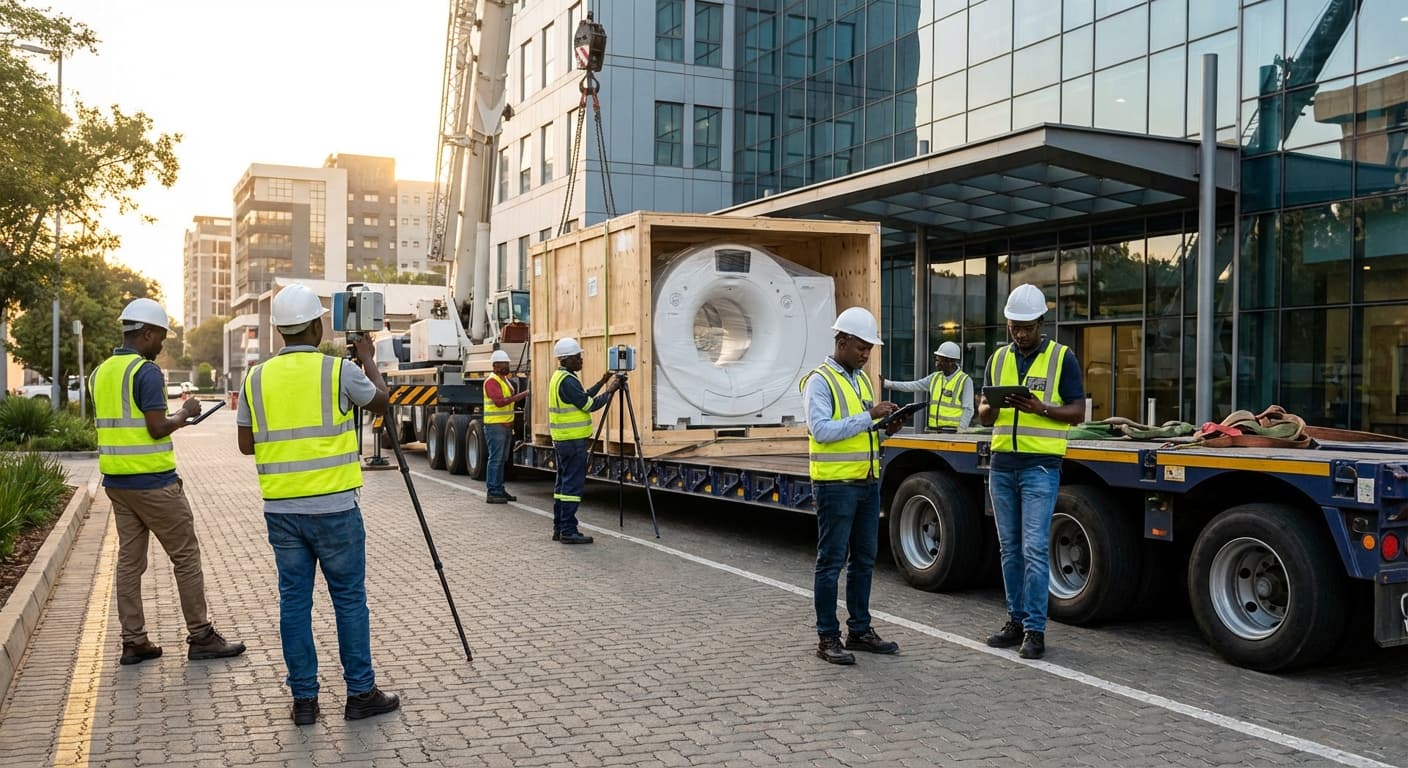
Route Survey & Rigging Plan Service for Heavy Medical Equipment in Mauritania
Engineering Excellence & Technical Support
Route Survey & Rigging Plan Service for Heavy Medical Equipment High-standard technical execution following OEM protocols and local regulatory frameworks.
Precision Route Reconnaissance
Leveraging advanced GIS mapping and on-site surveys, our service meticulously plans the safest and most efficient routes for heavy medical equipment transport across Mauritania's diverse terrain, accounting for road conditions, weight limits, and potential environmental challenges.
Engineered Rigging & Lifting Solutions
Our expert rigging engineers design customized lifting and securing plans for oversized and sensitive medical machinery. We utilize specialized equipment and adhere to stringent safety protocols to ensure zero risk of damage or operational failure during every phase of handling.
Comprehensive Permitting & Logistics
We manage all necessary permits, traffic management plans, and stakeholder coordination required for the transportation of heavy medical equipment in Mauritania, ensuring seamless integration with local authorities and minimizing transit delays.
What Is Route Survey & Rigging Plan Service For Heavy Medical Equipment In Mauritania?
Route Survey & Rigging Plan Service for Heavy Medical Equipment in Mauritania is a specialized logistical undertaking focused on the safe and efficient transportation and installation of large, complex, and high-value medical devices. This service is critical due to the unique challenges presented by the Mauritanian infrastructure, climate, and regulatory environment, as well as the inherent sensitivity and weight of medical equipment. It encompasses a comprehensive assessment of the entire journey, from port of arrival or manufacturing site to the final installation location within a healthcare facility, and includes the detailed planning and execution of lifting, moving, and positioning operations. The primary objective is to mitigate risks associated with damage to equipment, infrastructure, personnel, and to ensure minimal disruption to healthcare operations.
| Who Needs This Service? | Typical Use Cases | |||
|---|---|---|---|---|
| Healthcare Providers: Hospitals, clinics, and diagnostic centers (both public and private) in Mauritania acquiring new, large-scale medical equipment such as MRI scanners, CT scanners, linear accelerators, large X-ray machines, and specialized operating theater suites. | Medical Equipment Manufacturers & Distributors: Companies responsible for delivering and installing their products in Mauritania, requiring expert local knowledge for logistics and specialized handling. | Government Agencies & NGOs: Organizations involved in public health initiatives and infrastructure development projects that include the deployment of significant medical technologies. | Construction & Engineering Firms: Contractors responsible for the installation of medical equipment within newly constructed or renovated healthcare facilities. | |
| Installation of high-field MRI and CT scanners: Requiring specialized transport due to weight and sensitive components, and precise placement within shielded rooms. | Deployment of linear accelerators for radiotherapy: Involving heavy, complex machinery with strict vibration and alignment tolerances, often requiring dedicated bunkers. | Transportation and installation of large angiography suites: With intricate imaging systems and hydraulic components. | Relocation of existing heavy medical equipment within or between facilities: Requiring a thorough re-assessment of routes and rigging plans. | Importation of modular medical units or prefabricated imaging suites: Necessitating coordinated transport and precise site integration. |
Key Components of Route Survey & Rigging Plan Service:
- Route Survey:
- Infrastructure Assessment: Evaluating road conditions, bridge load capacities, tunnel clearances, street furniture (traffic lights, signs, utility lines), and potential obstructions along the entire transport path.
- Geotechnical Analysis: Assessing ground stability and load-bearing capacity at critical points, including entry/exit points of facilities and temporary staging areas.
- Environmental Impact Assessment: Identifying potential environmental hazards such as extreme weather conditions (sandstorms, heat), and their impact on equipment and transportation.
- Permitting and Regulatory Compliance: Navigating local Mauritanian regulations for oversized and overweight loads, securing necessary permits from relevant authorities (transport, police, municipal).
- Security Assessment: Evaluating the security risks along the route and implementing appropriate security measures.
- Site Accessibility Analysis: Determining the feasibility of access for specialized transport vehicles and lifting equipment into the healthcare facility and the specific installation area.
- Rigging Plan Development:
- Equipment Analysis: Detailed understanding of the medical equipment's dimensions, weight distribution, center of gravity, lifting points, and any specific handling requirements.
- Load Calculation and Stress Analysis: Engineering calculations to determine the required lifting capacities of cranes, hoists, and other rigging equipment, considering safety factors.
- Equipment Selection: Specifying appropriate lifting and transport machinery (e.g., heavy-duty cranes, specialized trailers, hydraulic gantries, forklifts) based on route and site constraints.
- Method Statement Formulation: Documenting the step-by-step procedures for lifting, moving, and positioning the equipment, including pre-lift checks, rigging configurations, and post-installation procedures.
- Risk Assessment and Mitigation: Identifying potential rigging-related hazards and developing specific mitigation strategies.
- Personnel Competency Verification: Ensuring all personnel involved in rigging operations are adequately trained and certified.
- Contingency Planning: Developing backup plans for unforeseen circumstances such as equipment failure, adverse weather, or access issues.
Who Needs Route Survey & Rigging Plan Service For Heavy Medical Equipment In Mauritania?
Route Survey & Rigging Plan Service for Heavy Medical Equipment in Mauritania: Identifying the Essential Clients and Their Needs
| Target Customer | Relevant Departments | Specific Needs/Challenges |
|---|---|---|
| Hospitals & Healthcare Facilities | Facilities Management, Biomedical Engineering, Procurement, Operations | Safe installation of large diagnostic imaging equipment (MRI, CT scanners), operating room systems, radiotherapy units. Ensuring minimal disruption to ongoing patient care during delivery and installation. Compliance with building codes and safety regulations. Planning for future equipment upgrades or relocations. |
| Government Health Ministries & Agencies | Planning & Development, Procurement, Infrastructure, Public Health | Overseeing the acquisition and deployment of major medical infrastructure across the nation. Ensuring equitable access to advanced medical technology. Standardizing installation procedures for public hospitals. Managing national healthcare projects requiring heavy equipment. |
| Medical Equipment Manufacturers & Distributors | Logistics, Technical Support, Sales, Project Management | Ensuring the safe and timely delivery of their high-value, sensitive equipment to remote or challenging locations in Mauritania. Providing compliant and professional installation services that maintain warranty integrity. Mitigating risks associated with transit and on-site handling. Offering turnkey solutions to their clients. |
| Construction & Infrastructure Companies | Project Management, Engineering, Site Operations | Integrating specialized medical facilities into new hospital builds or renovations. Coordinating heavy equipment delivery with construction timelines and site access. Ensuring structural integrity and space planning for oversized medical machinery. Collaborating with specialized rigging and survey teams. |
| Logistics & Shipping Companies | Oversized Cargo Department, Project Logistics, Operations | Handling the complex transportation of heavy and oversized medical equipment to and within Mauritania. Requiring detailed route surveys to identify obstacles, weight limits, and necessary permits. Developing precise rigging and lifting plans for safe loading, unloading, and placement at the final destination. Ensuring compliance with international and local shipping regulations. |
| Research & Development Institutions | Technical Operations, Facilities Management, Scientific Directors | Installing specialized laboratory equipment, analytical instruments, and other heavy scientific machinery that requires precise placement and environmental controls. Ensuring secure installation for sensitive research equipment. |
| Emergency & Disaster Relief Organizations | Logistics, Operations, Medical Teams | Rapid deployment of temporary or permanent medical facilities and equipment in response to emergencies or natural disasters. Requiring swift and efficient route planning and rigging for immediate operational setup. |
Target Customers & Departments
- Hospitals & Healthcare Facilities
- Government Health Ministries & Agencies
- Medical Equipment Manufacturers & Distributors
- Construction & Infrastructure Companies (involved in healthcare projects)
- Logistics & Shipping Companies (specializing in oversized/heavy cargo)
- Research & Development Institutions (requiring specialized equipment installation)
- Emergency & Disaster Relief Organizations
Route Survey & Rigging Plan Service For Heavy Medical Equipment Process In Mauritania
This service encompasses the meticulous planning and execution of transporting and installing heavy medical equipment within Mauritania. It ensures that complex logistical challenges are addressed proactively, from the initial site assessment to the final placement of the equipment. The workflow is designed to be comprehensive, safe, and efficient, catering to the unique environmental and infrastructural conditions of Mauritania.
| Phase | Key Activities | Deliverables | Responsible Party |
|---|---|---|---|
| Inquiry & Consultation | Client inquiry, scope definition, initial needs assessment | Project scope document, preliminary quotation | Client, Service Provider |
| Site Survey | On-site data collection (routes, access, installation area), photographic/video documentation | Site survey report, route assessment data | Service Provider (Survey Team) |
| Route Survey & Analysis | Identification of optimal transport routes, load capacity analysis, obstruction identification | Route survey report with maps and identified challenges | Service Provider (Logistics Specialists) |
| Rigging Plan Development | Equipment selection, lift plan creation, safety protocol design | Detailed rigging plan, safety manual | Service Provider (Rigging Engineers) |
| Permitting & Approvals | Application and acquisition of necessary permits from Mauritanian authorities | All required permits and approvals | Service Provider (Permitting Department) |
| Equipment Procurement & Mobilization | Sourcing and deployment of specialized transport and lifting equipment | Mobilized equipment and crew | Service Provider (Operations Team) |
| Pre-Execution Briefing | Team coordination, safety training, role assignment | Briefing minutes, training records | Service Provider (Project Manager) |
| Execution | Loading, transport, unloading, and installation of medical equipment | Safely installed equipment | Service Provider (Execution Crew) |
| Post-Execution Review & Handover | Final inspection, documentation of completion, client sign-off | Project completion report, handover certificate | Service Provider, Client |
| De-mobilization & Restoration | Removal of equipment, site cleanup, any necessary restoration | Restored site, de-mobilized equipment | Service Provider (Operations Team) |
Workflow from Inquiry to Execution
- Inquiry & Initial Consultation: The process begins with the client's inquiry regarding the transport and installation of heavy medical equipment in Mauritania. This involves understanding the specific equipment, its dimensions, weight, intended location, and any initial project timelines. A preliminary discussion will clarify the scope of work and identify key stakeholders.
- Site Survey Request & Data Collection: Upon agreement to proceed, a detailed site survey is commissioned. This survey involves a team of experienced engineers and logistics specialists visiting the intended installation site(s) in Mauritania. They will meticulously collect data on: Access routes, road conditions, bridge load capacities, potential obstructions (e.g., power lines, narrow streets, building entrances), terrain, site accessibility for heavy machinery, and the proposed final installation location within the facility. Detailed photographic and video documentation will be generated.
- Route Survey & Analysis: Based on the collected site data, a comprehensive route survey is conducted. This involves identifying the safest and most efficient transport routes from the point of entry into Mauritania (e.g., port, border crossing) to the final destination. Factors considered include road quality, speed limits, traffic patterns, seasonal weather impacts, and any necessary temporary infrastructure modifications or permits. Load calculations for bridges and other structures will be performed.
- Rigging Plan Development: A detailed rigging plan is developed by certified rigging engineers. This plan outlines: The specific lifting and handling equipment required (e.g., cranes, heavy-duty dollies, specialized transport vehicles), their capacities, and deployment strategies. Detailed lift plans, including load charts, center of gravity calculations, and rigging accessory specifications. Safety procedures, including exclusion zones, communication protocols, and emergency response plans. The sequence of operations for loading, transporting, and unloading the equipment.
- Permitting & Approvals: Necessary permits and approvals from relevant Mauritanian authorities (e.g., transport ministries, local government) will be obtained. This may include permits for oversized loads, road closures, or specific construction activities. The service provider will manage this complex and often time-consuming process.
- Equipment Procurement & Mobilization: Based on the rigging plan, all necessary specialized equipment, including transport vehicles, cranes, and rigging gear, will be procured or leased. These resources will be mobilized to the project site in Mauritania, often requiring significant logistical coordination.
- Pre-Execution Briefing & Training: A pre-execution briefing will be held with the entire project team, including local labor. This will cover the rigging plan, safety procedures, communication protocols, and the specific roles and responsibilities of each team member. Any necessary specialized training for local personnel will be conducted.
- Execution: Transport & Rigging: This is the core operational phase. The heavy medical equipment will be carefully loaded, transported along the approved route, and meticulously positioned and installed at its final location according to the developed rigging plan. Continuous monitoring and adherence to safety protocols are paramount.
- Post-Execution Review & Handover: Upon successful installation, a post-execution review is conducted to ensure all objectives have been met and that the equipment is safely and correctly positioned. A formal handover to the client will take place, along with any relevant documentation and reports from the survey and execution phases.
- De-mobilization & Site Restoration: All specialized equipment will be de-mobilized from the site. Any temporary modifications made to infrastructure during the transport or installation will be restored to their original condition where necessary.
Route Survey & Rigging Plan Service For Heavy Medical Equipment Cost In Mauritania
Providing route survey and rigging plan services for heavy medical equipment in Mauritania involves several critical factors that influence the overall cost. These services are essential to ensure the safe and efficient transportation and installation of complex and valuable medical machinery, often requiring specialized expertise and equipment. The pricing is typically determined by a combination of logistical challenges, technical requirements, and the duration of the project.
Key Pricing Factors:
- Equipment Size and Weight: Larger and heavier equipment will necessitate more robust rigging solutions, potentially larger cranes, specialized transport vehicles, and a more extensive survey to identify suitable routes and potential obstacles. This directly impacts labor, equipment rental, and planning complexity.
- Route Complexity and Distance: The distance the equipment needs to travel within Mauritania and the nature of the terrain are significant cost drivers. Navigating urban areas with traffic, narrow streets, or unpaved roads requires more meticulous planning and potentially temporary infrastructure modifications. Remote locations will incur higher transportation costs for personnel and equipment.
- Accessibility and Site Conditions: The ease of access to both the pick-up and delivery locations is crucial. Difficult site access, such as steep inclines, soft ground, or confined spaces, will demand specialized equipment and more intensive rigging operations. Obstacles at the site, like existing structures or landscaping, also add to the complexity and cost.
- Required Rigging Techniques and Equipment: The specific rigging techniques employed (e.g., crane lifts, hydraulic jacking, specialized skidding systems) and the types of equipment needed (e.g., mobile cranes, gantry cranes, specialized dollies, lifting frames) are a major component of the cost. The availability and rental cost of these specialized assets in Mauritania will play a role.
- Survey and Planning Scope: The depth of the route survey, including detailed mapping, obstacle identification, traffic management planning, and civil engineering assessments (if needed for bridge load capacities or road reinforcement), will impact the man-hours and expertise required. Similarly, the complexity of the rigging plan, including detailed lifting diagrams, load calculations, and risk assessments, contributes to the overall cost.
- Personnel Expertise and Number of Technicians: Highly skilled and experienced rigging engineers, surveyors, and technicians are essential for these operations. The number of personnel required, their daily rates, and the duration of their engagement will be factored into the pricing. Specialized certifications may also influence rates.
- Permits and Approvals: Obtaining necessary permits for road closures, oversized transport, or specific lifting operations can incur administrative fees and delays, which add to the project cost.
- Insurance: Adequate insurance coverage for the equipment, personnel, and the operation itself is a mandatory cost component.
- Contingency Planning: Unforeseen challenges can arise during route surveys and rigging operations. A good service provider will build in a contingency allowance to address potential issues, which is reflected in the final quote.
Pricing Ranges in Mauritanian Ouguiya (MRU):
It's important to note that these are estimated ranges and can vary significantly based on the specific project details. A detailed assessment is always required for an accurate quote.
For a typical medium-sized heavy medical equipment installation, encompassing a moderate distance and complexity:
- Route Survey Service: This could range from 150,000 MRU to 500,000 MRU. This would typically include route mapping, identification of major obstacles, and preliminary feasibility assessments.
- Rigging Plan Service: This might range from 200,000 MRU to 700,000 MRU. This encompasses detailed lifting plans, load calculations, equipment specification, and risk assessment.
- Combined Route Survey & Rigging Plan Service (Comprehensive Project Management): For a more integrated service, including on-site supervision during the execution of the rigging plan, the cost could range from 500,000 MRU to 1,500,000 MRU or more. This would include all the above, plus on-site coordination and problem-solving.
Factors that can push costs to the higher end:
- Extremely large or heavy equipment (e.g., MRI scanners, CT scanners with significant weight).
- Long-distance transportation across challenging terrains or remote areas.
- Operations in densely populated urban centers requiring extensive traffic management and multiple permits.
- Sites with very limited access or requiring significant site preparation.
- Emergency or time-sensitive operations.
- The need for specialized, high-capacity cranes or lifting equipment not readily available locally, requiring importation.
It is highly recommended to obtain multiple quotes from experienced service providers in Mauritania who specialize in heavy lifting and logistics for medical equipment. They will be able to conduct a thorough site visit and provide a precise cost estimate tailored to your specific project requirements.
| Service Component | Estimated Cost Range (MRU) |
|---|---|
| Route Survey Service (Basic) | 150,000 - 500,000 |
| Rigging Plan Service (Detailed) | 200,000 - 700,000 |
| Combined Route Survey & Rigging Plan (Comprehensive, incl. on-site coordination) | 500,000 - 1,500,000+ |
Factors Influencing Route Survey & Rigging Plan Costs for Heavy Medical Equipment in Mauritania
- Equipment Size & Weight
- Route Complexity & Distance
- Accessibility & Site Conditions
- Rigging Techniques & Equipment Required
- Survey & Planning Scope
- Personnel Expertise & Number of Technicians
- Permits & Approvals
- Insurance
- Contingency Planning
Affordable Route Survey & Rigging Plan Service For Heavy Medical Equipment Options
Navigating the complexities of transporting and installing heavy medical equipment requires meticulous planning to ensure safety, efficiency, and cost-effectiveness. Our Affordable Route Survey & Rigging Plan Service provides comprehensive solutions tailored to your specific needs, minimizing risks and maximizing value. We understand that budget is a critical factor, especially in the healthcare sector. Therefore, we've designed our services with flexible value bundles and strategic cost-saving measures to make expert planning accessible.
| Cost-Saving Strategy | Description | Benefit |
|---|---|---|
| Early Planning Discount | Book your route survey and rigging plan well in advance of the equipment's arrival. | Reduces rush fees and allows for more thorough planning, potentially identifying early cost-saving opportunities. |
| Package Deals | Opting for our value bundles instead of individual services. | Bundles are priced at a discount compared to purchasing each component separately. |
| Standardized Template Usage | Leveraging our pre-developed, industry-standard templates for rigging plans and surveys. | Speeds up the planning process and reduces customization costs. |
| Remote Consultation Options | For initial assessments and some planning stages, where feasible. | Minimizes travel expenses for our team, directly translating to lower costs for you. |
| Equipment Reusability Assessment | During the rigging plan, we assess if existing lifting or rigging equipment can be utilized. | Avoids unnecessary rental or purchase costs for new equipment. |
| Bulk Service Agreements | For healthcare facilities planning multiple equipment installations over a period. | Negotiate discounted rates for ongoing or bulk service commitments. |
| Simplified Site Assessment (for Essentials Bundle) | Client provides detailed site information and photos. | Reduces the need for extensive on-site surveys by our team, lowering costs for simpler projects. |
Value Bundles Explained
- {"title":"Essentials Bundle","description":"Ideal for straightforward moves of standard heavy medical equipment. Includes a detailed route survey for a single location, basic rigging assessment, and a foundational rigging plan document. Perfect for clients who have a clear understanding of their site and equipment."}
- {"title":"Pro Bundle","description":"Designed for more complex installations or when multiple pieces of equipment are involved. This bundle features a comprehensive route survey for multiple locations (e.g., from loading dock to final installation site), a detailed rigging assessment with equipment recommendations, and a fully documented rigging plan with safety protocols."}
- {"title":"Premium Bundle","description":"Our most comprehensive offering, suitable for highly specialized or extremely heavy equipment, or when working in challenging environments. Includes advanced site assessments (e.g., structural integrity checks), detailed 3D modeling of the rigging process, on-site supervision during rigging, and a complete risk management report. Also includes contingency planning and dedicated project management."}
- {"title":"Custom Bundle","description":"For unique projects or when specific elements from different bundles are required. We work with you to create a bespoke service package that precisely matches your budget and operational needs. This ensures you only pay for what you truly need."}
Verified Providers In Mauritania
In Mauritania, ensuring you are accessing healthcare services from verified providers is paramount for your well-being. Franance Health stands out as a trusted name, offering a network of credentials that signify the highest standards of quality, professionalism, and patient care. Choosing Franance Health means opting for reliability, expertise, and a commitment to your health journey. Their rigorous verification process and dedication to excellence make them the premier choice for healthcare in Mauritania.
| Credential Category | What it Signifies | Benefit to Patients |
|---|---|---|
| Medical Licensing and Registration | Ensures providers are legally authorized to practice medicine in Mauritania. | Guarantees adherence to national medical regulations and ethical standards. |
| Specialty Board Certifications | Confirms a provider has met rigorous standards of knowledge and skill in their specific medical field. | Ensures access to highly specialized and expert medical advice and treatment. |
| Accreditation of Facilities | Indicates that healthcare institutions meet established standards for quality, safety, and patient care. | Provides assurance of a safe, well-equipped, and professionally managed healthcare environment. |
| Continuing Medical Education (CME) | Demonstrates a provider's commitment to staying updated with the latest medical research, techniques, and technologies. | Ensures patients receive care based on current best practices and cutting-edge medical knowledge. |
| Professional Affiliations and Memberships | Indicates involvement in reputable medical societies and organizations, often signifying peer recognition and adherence to professional codes of conduct. | Suggests a commitment to professional development and collaborative advancement in healthcare. |
| Patient Feedback and Reviews (Managed by Franance Health) | Provides insights into patient satisfaction, communication, and overall experience. | Helps patients make informed choices and offers a mechanism for continuous service improvement. |
Why Franance Health Credentials Represent the Best Choice:
- Uncompromising Quality Assurance: Franance Health meticulously vets all its affiliated healthcare providers, ensuring they meet stringent international and local standards for medical practice, equipment, and patient safety.
- Expertise and Specialization: Their network comprises highly qualified and experienced medical professionals across various specialties, guaranteeing you access to the right expertise for your specific health needs.
- Patient-Centric Approach: Franance Health prioritizes the patient experience, emphasizing compassionate care, clear communication, and ethical medical practices. This means you can expect a supportive and respectful healthcare journey.
- Transparency and Trust: The verification process builds trust. Patients can be confident that providers associated with Franance Health have undergone thorough background checks and credential reviews, mitigating risks and ensuring peace of mind.
- Access to Advanced Facilities: Franance Health partners with facilities equipped with modern technology and adhering to best practices, enabling accurate diagnoses and effective treatments.
- Continuous Improvement and Education: Providers within the Franance Health network are often encouraged or required to engage in ongoing professional development, ensuring they remain at the forefront of medical advancements.
- Reduced Risk of Fraud and Misinformation: By choosing a verified provider through Franance Health, you significantly reduce the risk of encountering unqualified individuals or receiving substandard care.
- Streamlined Access to Care: Franance Health aims to simplify the process of finding reliable healthcare, offering a curated list of trusted professionals and institutions.
Scope Of Work For Route Survey & Rigging Plan Service For Heavy Medical Equipment
This Scope of Work (SOW) outlines the services required for the Route Survey and Rigging Plan for the transportation and installation of heavy medical equipment. The objective is to ensure safe, efficient, and compliant movement and placement of critical medical assets from their arrival point to their final installation location within the facility.
| Section | Description | Technical Deliverables | Standard Specifications / Considerations |
|---|---|---|---|
| 1.0 Route Survey | Assessment of the entire path from the point of entry (e.g., loading dock, main entrance) to the final installation site. This includes all internal pathways, doorways, corridors, elevator shafts, and any external access routes. |
|
|
| 2.0 Rigging Plan Development | Creation of a comprehensive plan detailing the methods, equipment, and procedures for safely lifting, moving, and positioning the heavy medical equipment. |
|
|
| 3.0 Safety & Risk Assessment | Proactive identification and mitigation of all potential safety hazards associated with the route and rigging operations. |
|
|
| 4.0 Final Report and Documentation | Compilation of all findings, plans, and recommendations into a formal report. |
|
|
Key Objectives and Deliverables
- Comprehensive route assessment and identification of potential obstacles and hazards.
- Development of a detailed rigging and lifting plan, including equipment selection, load calculations, and safety procedures.
- Creation of route maps, visual aids, and annotated plans.
- Provision of a final report summarizing findings and recommendations.
- Adherence to all relevant local, national, and international safety standards and regulations.
Service Level Agreement For Route Survey & Rigging Plan Service For Heavy Medical Equipment
This Service Level Agreement (SLA) outlines the response times and uptime guarantees for the Route Survey & Rigging Plan Service provided for the installation of heavy medical equipment. This agreement is designed to ensure efficient and reliable service delivery, minimizing disruption to healthcare operations.
| Service Component | Priority Level | Response Time Target | Uptime Guarantee | Notes |
|---|---|---|---|---|
| Initial Request Acknowledgment (Route Survey) | Critical (e.g., imminent installation, critical equipment) | 2 Business Hours | N/A | Confirmation of receipt and assignment of a survey team. |
| Initial Request Acknowledgment (Route Survey) | High (e.g., scheduled installation, planning phase) | 4 Business Hours | N/A | Confirmation of receipt and assignment of a survey team. |
| Initial Request Acknowledgment (Route Survey) | Standard (e.g., general inquiry, preliminary planning) | 8 Business Hours | N/A | Confirmation of receipt and assignment of a survey team. |
| Commencement of Route Survey (On-site or remote assessment) | Critical | 24 Business Hours from Acknowledgment | N/A | Initiation of the survey process to gather necessary data. |
| Commencement of Route Survey (On-site or remote assessment) | High | 48 Business Hours from Acknowledgment | N/A | Initiation of the survey process to gather necessary data. |
| Commencement of Route Survey (On-site or remote assessment) | Standard | 72 Business Hours from Acknowledgment | N/A | Initiation of the survey process to gather necessary data. |
| Delivery of Draft Rigging Plan | Critical | 5 Business Days from Survey Completion | N/A | Provision of a preliminary rigging plan for client review. |
| Delivery of Draft Rigging Plan | High | 7 Business Days from Survey Completion | N/A | Provision of a preliminary rigging plan for client review. |
| Delivery of Draft Rigging Plan | Standard | 10 Business Days from Survey Completion | N/A | Provision of a preliminary rigging plan for client review. |
| Final Rigging Plan Delivery | Critical | 3 Business Days from Approval of Draft Plan | N/A | Issuance of the final, approved rigging plan. |
| Final Rigging Plan Delivery | High | 5 Business Days from Approval of Draft Plan | N/A | Issuance of the final, approved rigging plan. |
| Final Rigging Plan Delivery | Standard | 7 Business Days from Approval of Draft Plan | N/A | Issuance of the final, approved rigging plan. |
| Availability of Planning Portal/Consultation Platform | All | N/A | 99.5% | Ensures access to online resources and communication channels for planning discussions, excluding scheduled maintenance. |
| Emergency Support (Urgent Planning Clarification) | Critical | 1 Business Hour | N/A | Availability of a designated contact for urgent clarification during critical installation phases. |
Service Level Objectives
- Response Times: The time taken to acknowledge and initiate work on a service request.
- Uptime Guarantees: The assurance of availability of the service for essential planning and consultation activities.
Frequently Asked Questions

Ready when you are
Let's scope your Route Survey & Rigging Plan Service for Heavy Medical Equipment in Mauritania project in Mauritania.

Scaling healthcare logistics and technical systems across the entire continent.