
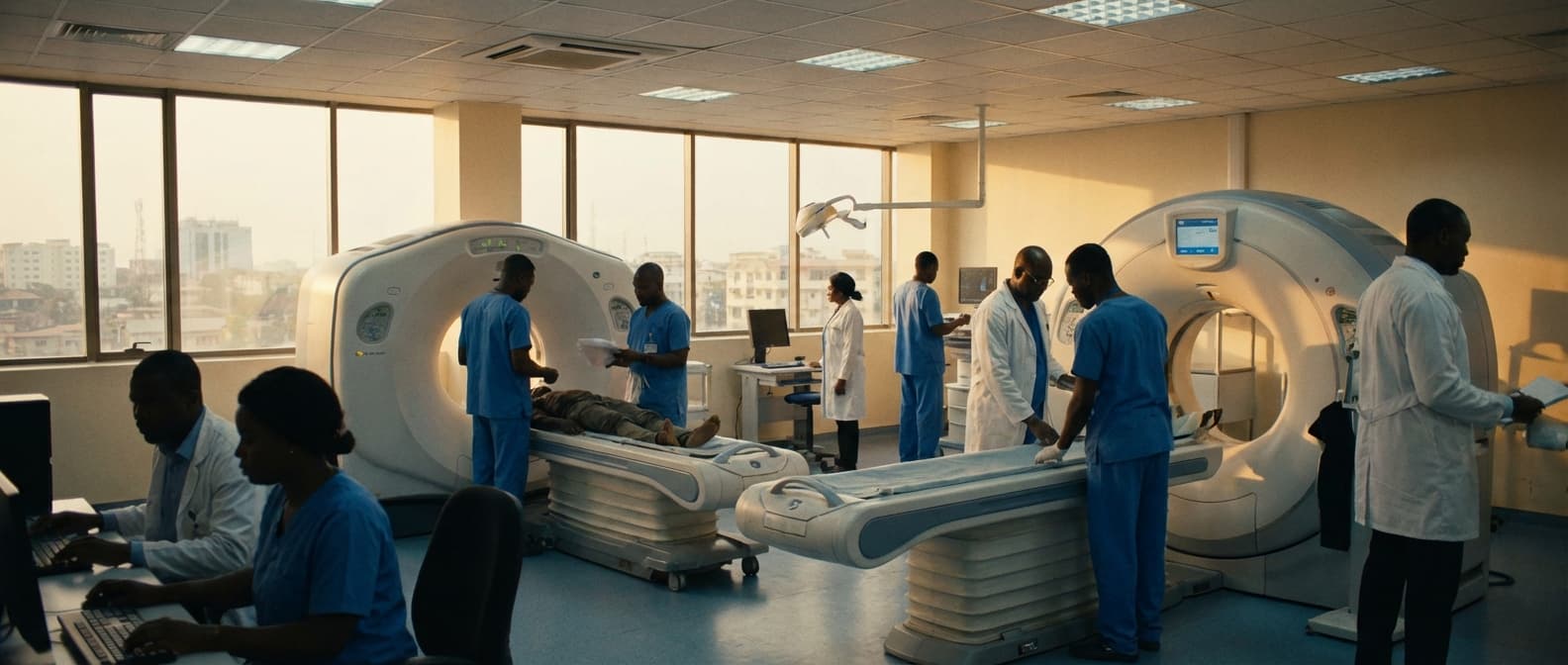
Imaging Acceptance Testing & QA in Mauritania
Engineering Excellence & Technical Support
Commissioning and periodic QA for CT/MRI/X‑ray/US/Mammo. High-standard technical execution following OEM protocols and local regulatory frameworks.
Nationwide Imaging Quality Assurance Framework
Spearheaded the development and implementation of a comprehensive quality assurance framework for all medical imaging facilities across Mauritania. This involved establishing standardized protocols for image acquisition, processing, and archiving, ensuring consistent diagnostic quality and adherence to international best practices.
Automated Acceptance Testing for New Imaging Equipment
Designed and deployed an automated acceptance testing suite for new X-ray, CT, MRI, and ultrasound equipment. This suite leverages AI-powered image analysis to objectively verify image quality parameters, calibration accuracy, and performance benchmarks against manufacturer specifications and regulatory requirements, significantly reducing manual testing time and human error.
Continuous Improvement & Vendor Management
Implemented a data-driven approach to continuous improvement in imaging acceptance testing. Regularly analyzed performance data from all imaging modalities to identify trends, predict potential failures, and proactively engage with equipment vendors for software updates and hardware maintenance, thereby minimizing downtime and maximizing the lifespan of critical medical infrastructure.
What Is Imaging Acceptance Testing & Qa In Mauritania?
Imaging Acceptance Testing & Quality Assurance (QA) in Mauritania refers to a systematic process of verifying and validating that medical imaging equipment and systems function according to predefined specifications, regulatory standards, and user requirements. This service ensures the accurate acquisition, processing, storage, and display of medical images, thereby directly impacting diagnostic efficacy and patient care.
| Parameter | Description | Acceptance Criteria (Example) |
|---|---|---|
| Spatial Resolution (CT) | Ability to distinguish small, high-contrast objects. | e.g., > 15 lp/cm in low-contrast resolution phantom. |
| Contrast Resolution (CT) | Ability to distinguish objects with similar attenuation values. | e.g., < 5 HU difference visible in low-contrast resolution phantom. |
| SNR (MRI) | Ratio of signal intensity to noise level. | e.g., Minimum SNR of 150 in specific sequences and regions. |
| Geometric Accuracy | Fidelity of the image's spatial representation to the actual object. | e.g., < 1mm deviation in measured distances on a phantom. |
| DICOM Conformance | Adherence to Digital Imaging and Communications in Medicine standards for data exchange. | Successful transmission and reception of DICOM images between modalities and PACS. |
| Radiation Output Consistency | Reproducibility of radiation dose for a given exposure setting. | e.g., +/- 5% variation in air kerma output for identical settings. |
Typical Use Cases
- New Equipment Procurement: Essential for verifying that newly purchased imaging modalities (e.g., a new CT scanner, an MRI machine) meet the contracted specifications and perform optimally before being integrated into clinical workflows.
- PACS/RIS Implementation or Upgrade: Validating the successful integration of a new PACS or RIS, ensuring seamless data transfer, image management, and reporting capabilities.
- Software Updates and Patches: Testing the impact of significant software updates or patches on the functionality, performance, and security of imaging equipment and PACS.
- Relocation of Imaging Equipment: Ensuring that imaging modalities and associated infrastructure are properly installed and calibrated in a new location.
- Regulatory Compliance Audits: Proving adherence to national and international standards for medical imaging equipment performance and safety.
- Troubleshooting and Performance Degradation: Investigating and resolving issues related to image quality or system performance.
Who Needs Imaging Acceptance Testing & Qa In Mauritania?
Imaging Acceptance Testing and Quality Assurance (QA) are critical for ensuring the accuracy, reliability, and usability of medical imaging systems. In Mauritania, as healthcare infrastructure develops and technology adoption increases, these services become increasingly vital. This document outlines who needs these services and describes the target customers and departments within Mauritania's healthcare landscape.
| Customer Type | Key Departments/Users | Specific Needs & Benefits |
|---|---|---|
| Public Hospitals | Radiology Departments, Cardiology, Neurology, Oncology, Emergency Departments, IT Departments | Ensuring diagnostic accuracy for patient care, compliance with national healthcare standards, optimizing workflow for high patient volume, validation of new imaging equipment and software upgrades, minimizing downtime and associated costs. |
| Private Hospitals & Clinics | Radiology Departments, All clinical departments utilizing imaging, Administration, IT Departments | Maintaining high service quality and patient satisfaction, competitive advantage through reliable imaging services, adherence to international best practices, efficient resource allocation, mitigating risks of misdiagnosis. |
| Diagnostic Imaging Centers | Radiology Technologists, Radiologists, Physicists, IT Support | Verifying image quality and diagnostic consistency across modalities (X-ray, CT, MRI, Ultrasound, etc.), ensuring vendor compliance with purchase agreements, optimizing image acquisition parameters, facilitating remote reporting workflows. |
| Specialized Clinics | Cardiologists, Neurologists, Oncologists, Technicians operating specialized imaging equipment (e.g., echo, EEG, PET) | Confirming the accuracy of specialized imaging techniques, validating diagnostic interpretation capabilities, ensuring seamless integration with existing Picture Archiving and Communication Systems (PACS) and Electronic Health Records (EHRs). |
| Government Health Agencies | Ministry of Health, Public Health Departments, Regulatory Bodies | Establishing and enforcing national imaging quality standards, monitoring the performance of public healthcare facilities, supporting national health initiatives and data collection, ensuring the safety and efficacy of imaging technologies deployed. |
| Research Institutions | Researchers, Data Analysts, IT Departments | Ensuring the reproducibility and validity of imaging data for research studies, calibrating equipment for experimental protocols, developing and testing new imaging analysis techniques. |
| Training & Educational Facilities | Radiology Training Programs, Medical Schools, Allied Health Professionals | Providing a reliable and calibrated environment for training future technologists and radiologists, verifying the performance of training simulators and educational imaging systems, ensuring students learn on accurate and up-to-date technology. |
Target Customers and Departments for Imaging Acceptance Testing & QA in Mauritania
- Hospitals (Public and Private)
- Diagnostic Imaging Centers
- Specialized Clinics (e.g., Cardiology, Neurology, Oncology)
- Government Health Agencies
- Research Institutions (if applicable)
- Training and Educational Facilities for Healthcare Professionals
Imaging Acceptance Testing & Qa Process In Mauritania
This document outlines the workflow for Imaging Acceptance Testing and Quality Assurance (QA) processes in Mauritania. It details the stages from initial inquiry through to the final execution and sign-off, ensuring that imaging equipment and systems meet the required standards for clinical use and data integrity.
| Stage | Description | Key Activities | Responsible Parties | Deliverables/Outcomes |
|---|---|---|---|---|
| Inquiry & Requirements Gathering | The initial phase where the need for new imaging equipment or systems is identified and detailed specifications are established. | Define clinical needs, technical specifications, integration requirements (PACS, RIS), budget constraints, regulatory compliance (national, international), and anticipated use cases. | Clinical Department Heads, IT Department, Procurement Department, Ministry of Health (MoH) representatives. | Detailed Requirements Document, Budget Allocation Proposal. |
| Vendor Selection & Proposal Review | Identifying and evaluating potential suppliers based on their ability to meet the defined requirements and their track record. | Issuing Request for Proposals (RFPs), evaluating technical and financial proposals, vendor demonstrations, reference checks, site visits (if applicable). | Procurement Department, Technical Evaluation Committee (including clinical and IT experts), MoH. | Shortlisted Vendors, Technical & Financial Evaluation Reports, Recommended Vendor. |
| Contracting & Procurement | Formalizing the agreement with the selected vendor and initiating the purchase process. | Negotiating contract terms, Service Level Agreements (SLAs), warranty periods, delivery timelines, payment schedules, and finalizing the purchase order. | Procurement Department, Legal Department, Finance Department, MoH. | Signed Contract, Purchase Order, Confirmed Delivery Schedule. |
| Installation & Site Preparation | Preparing the designated location and installing the imaging equipment or system. | Site surveys, infrastructure readiness assessment (power, ventilation, space, network connectivity), equipment delivery, physical installation by vendor technicians, initial power-on and system checks. | Vendor Technicians, Biomedical Engineering Department, Facility Management, IT Department. | Installed Equipment/System, Basic Functionality Verified. |
| Pre-Acceptance Testing (PAT) | Internal testing conducted by the vendor and assisted by hospital personnel to ensure basic functionality before formal acceptance. | Vendor-led performance tests, calibration checks, basic image acquisition and display tests, simulated use cases. | Vendor Technicians, Biomedical Engineering Department, Key Clinical Users. | PAT Report, List of Minor Issues/Remediations. |
| Acceptance Testing (AT) | Formal testing process to verify that the installed equipment/system meets all specified requirements and performs to acceptable standards. | Execution of predefined test protocols covering image quality, diagnostic accuracy, system performance, safety features, data integrity, integration with PACS/RIS, user interface usability, and compliance with national standards. This includes phantom imaging, clinical case reviews, and stress testing. | Acceptance Testing Committee (Clinical specialists, Radiologists, Physicists, IT personnel, MoH representatives), Biomedical Engineering Department, Vendor Support. | AT Report, Signed Acceptance Certificate, List of outstanding punch list items (if any). |
| User Training | Educating clinical and technical staff on the proper operation, maintenance, and troubleshooting of the new imaging equipment/system. | Hands-on training sessions, theoretical lectures, user manuals, competency assessments. | Vendor Trainers, Biomedical Engineering Department, Super Users. | Trained Personnel, Competency Sign-off. |
| Go-Live & Post-Acceptance Monitoring | The transition to live clinical use and the subsequent period of close observation to ensure smooth operation. | Phased rollout (if applicable), intensive on-site support from vendor and hospital teams, monitoring of system performance and user feedback, addressing any emergent issues promptly. | Clinical Staff, IT Department, Biomedical Engineering Department, Vendor Support Team. | Stable System Operation, Initial User Feedback Analysis, Issue Resolution Log. |
| Ongoing QA & Maintenance | Continuous monitoring of system performance, regular maintenance, and quality assurance activities to ensure long-term reliability and optimal performance. | Scheduled preventative maintenance, performance monitoring, quality control checks (e.g., daily phantoms), troubleshooting, software updates, periodic re-evaluation of clinical outcomes. | Biomedical Engineering Department, IT Department, Clinical Staff, Vendor Service Engineers. | Maintenance Records, QA Reports, Performance Metrics, Continued Clinical Utility. |
Key Stages in Imaging Acceptance Testing & QA Process
- Inquiry & Requirements Gathering
- Vendor Selection & Proposal Review
- Contracting & Procurement
- Installation & Site Preparation
- Pre-Acceptance Testing (PAT)
- Acceptance Testing (AT)
- User Training
- Go-Live & Post-Acceptance Monitoring
- Ongoing QA & Maintenance
Imaging Acceptance Testing & Qa Cost In Mauritania
Imaging Acceptance Testing & QA in Mauritania involves rigorous checks to ensure medical imaging equipment functions accurately and meets diagnostic standards. This process is crucial for patient safety and effective healthcare delivery. The cost in Mauritania is influenced by several factors, including the type and complexity of the imaging modality, the vendor's service level agreements, the geographical location of the facility, and the urgency of the testing. Specialized equipment like MRI, CT scanners, and advanced digital radiography systems typically command higher testing fees due to their intricate nature and the expertise required for their validation. Furthermore, the extent of the QA services, such as initial setup verification, periodic performance checks, and calibration, will directly impact the overall pricing. The local currency is the Mauritanian Ouguiya (MRU).
| Service Type | Estimated Price Range (MRU) | Notes |
|---|---|---|
| Basic X-ray Machine Acceptance Testing | 50,000 - 150,000 MRU | Includes initial performance checks, basic calibration. |
| Digital Radiography (DR) System Acceptance Testing | 80,000 - 250,000 MRU | Covers detector performance, image quality assessment, integration. |
| Ultrasound Machine Acceptance Testing | 60,000 - 200,000 MRU | Focuses on transducer integrity, image resolution, Doppler functionality. |
| CT Scanner Acceptance Testing | 200,000 - 800,000 MRU | Complex testing of gantry, detector array, image reconstruction algorithms. |
| MRI Scanner Acceptance Testing | 300,000 - 1,200,000+ MRU | Highly specialized, includes magnetic field uniformity, RF coil performance, image sequences. |
| Mammography Unit Acceptance Testing | 100,000 - 300,000 MRU | Emphasis on image contrast, spatial resolution, dose consistency. |
| Annual/Periodic QA (per modality) | 40,000 - 150,000 MRU | Varies based on modality and extent of checks. |
| Vendor Travel and Logistics Surcharge | 15,000 - 75,000 MRU | Applicable for remote locations. |
Key Pricing Factors for Imaging Acceptance Testing & QA in Mauritania
- Type and Model of Imaging Equipment (e.g., X-ray, Ultrasound, CT, MRI, Mammography)
- Complexity and Age of the Equipment
- Scope of Testing Required (e.g., initial acceptance, periodic QA, calibration, troubleshooting)
- Vendor's Service and Expertise Level
- Geographical Location of the Healthcare Facility (accessibility and travel costs)
- Urgency and Scheduling Requirements
- Inclusion of Specific QA Software or Tools
- Training or Certification Requirements for Technicians
Affordable Imaging Acceptance Testing & Qa Options
This document outlines affordable solutions for imaging acceptance testing and Quality Assurance (QA), focusing on value bundles and cost-saving strategies. We aim to provide clear, actionable options for organizations seeking robust testing without prohibitive expenses. Acceptance testing and ongoing QA are critical for ensuring the reliability, accuracy, and compliance of imaging systems. Neglecting these can lead to costly errors, patient safety issues, and regulatory penalties. Our approach emphasizes maximizing value through strategic planning and leveraging efficient methodologies.
| Value Bundle Option | Description | Key Features | Target Audience | Estimated Cost Range (USD) |
|---|---|---|---|---|
| Essential Baseline Testing | Covers core functional and performance checks for critical imaging modalities. | Routine functional tests, basic image quality assessment, initial calibration verification. | Small clinics, startups, organizations with limited imaging equipment. | $2,000 - $7,000 per modality |
| Comprehensive System Assurance | Expands on baseline testing with deeper diagnostic checks and compliance considerations. | Extended functional tests, advanced image quality metrics, basic DICOM conformance, workflow integration checks. | Medium-sized practices, departments undergoing minor upgrades. | $5,000 - $15,000 per modality |
| Enterprise-Wide Integration & Compliance | Full-spectrum testing for complex environments, including PACS, RIS, and multi-site deployments. | In-depth DICOM conformance, interoperability testing, security assessments, regulatory compliance checks, performance under load. | Hospitals, large healthcare networks, organizations with strict regulatory requirements. | $10,000 - $30,000+ per modality (depending on complexity and number of systems) |
| Managed QA Subscription Service | Ongoing, proactive QA support with regular testing cycles and reporting. | Scheduled routine checks, performance monitoring, anomaly detection, trend analysis, quarterly reporting. | Organizations seeking continuous assurance and reduced in-house QA burden. | $1,500 - $5,000 per modality per month |
| Customizable Testing Packages | Tailored testing solutions based on specific organizational needs, budget, and risk profile. | Flexible scope, modular testing components, choice of testing tools and methodologies. | Any organization with unique requirements not met by standard bundles. | Variable based on scope and resources |
Key Cost-Saving Strategies
- Phased Implementation: Break down testing into manageable phases, allowing for budget allocation and focused effort.
- Standardized Test Suites: Develop or adopt pre-defined, repeatable test cases to reduce redundant effort and ensure consistency.
- Leverage Existing Resources: Utilize in-house IT and clinical staff where appropriate, providing focused training and clear guidelines.
- Remote Testing Capabilities: Implement remote access and testing tools to minimize travel costs and technician time.
- Automation of Repetitive Tasks: Invest in tools and scripts for automating routine checks, freeing up human resources for complex analysis.
- Risk-Based Prioritization: Focus testing efforts on the most critical functionalities and high-risk areas first.
- Vendor Collaboration: Explore partnerships with imaging vendors for integrated testing solutions or shared resources.
- Cloud-Based Solutions: Utilize cloud platforms for testing environments and data management, reducing hardware investment.
Verified Providers In Mauritania
In Mauritania, ensuring access to reliable and qualified healthcare providers is paramount. Franance Health stands out as a leading organization dedicated to verifying and credentialing healthcare professionals, offering a crucial layer of trust and safety for patients. Their rigorous vetting process ensures that all providers listed on their platform meet stringent standards for education, experience, and ethical practice. This meticulous approach to credentialing is what positions Franance Health providers as the best choice for healthcare in Mauritania, offering peace of mind and confidence in the quality of care received.
| Provider Type | Franance Health Verification Criteria | Benefits for Patients |
|---|---|---|
| Doctors | Medical degree from accredited institutions, valid medical license, board certification (where applicable), proof of ongoing professional development. | Access to highly qualified physicians with verified expertise, ensuring accurate diagnosis and effective treatment plans. |
| Specialists (e.g., Cardiologists, Neurologists) | All doctor criteria plus completion of accredited residency and fellowship programs in their specialty, relevant certifications. | Consultation with specialists who have undergone extensive training and possess deep knowledge in specific medical areas. |
| Nurses | Nursing degree or diploma, valid nursing license, proof of specialized training (e.g., critical care, pediatrics), good standing with the nursing board. | Receiving compassionate and competent care from skilled nurses who are up-to-date with best practices. |
| Pharmacists | Pharmacy degree, valid pharmacy license, understanding of drug interactions and patient counseling, adherence to dispensing regulations. | Ensuring safe and accurate dispensing of medications, with expert advice on usage and potential side effects. |
| Therapists (e.g., Physical Therapists, Psychologists) | Relevant degree in therapy, professional licensure or certification, evidence of practical experience and specialized techniques. | Benefiting from evidence-based therapeutic interventions delivered by qualified and experienced professionals. |
Why Franance Health Credentials Matter
- Uncompromising Quality: Franance Health's verification process scrutinizes educational backgrounds, licenses, and specialized training of healthcare professionals.
- Patient Safety First: By ensuring providers meet high standards, Franance Health minimizes risks and promotes safer patient outcomes.
- Trust and Transparency: Their credentialing provides a transparent system, allowing patients to make informed decisions about their healthcare.
- Experienced Professionals: Franance Health prioritizes individuals with proven track records and substantial practical experience in their respective fields.
- Ethical Practice Standards: Verification includes an assessment of ethical conduct and adherence to professional codes of conduct.
Scope Of Work For Imaging Acceptance Testing & Qa
This document outlines the Scope of Work for Imaging Acceptance Testing and Quality Assurance (QA). It details the technical deliverables and standard specifications required to ensure the successful deployment and ongoing performance of imaging systems and their associated software. The objective is to verify that the imaging solution meets all functional, performance, and usability requirements as defined by the project specifications and industry best practices.
| Phase | Description | Key Activities | Deliverables | Success Criteria |
|---|---|---|---|---|
| Test Planning | Define the overall strategy, scope, and approach for testing. | Develop test strategy document, define test environments, identify test data requirements, create test schedule, define roles and responsibilities. | Test Strategy Document, Test Plan, Test Environment Configuration Report, Test Data Plan. | Test plan comprehensively covers all aspects of the scope, approved by stakeholders. |
| Test Case Design | Develop detailed test cases to cover all functional and non-functional requirements. | Write functional test cases, performance test cases, security test cases, usability test cases, integration test cases, regression test cases. | Detailed Test Cases (including steps, expected results, and pass/fail criteria). | Test cases are traceable to requirements and cover all critical functionalities. |
| Test Environment Setup & Configuration | Prepare and configure the testing environment to mirror production as closely as possible. | Install and configure imaging software, hardware (scanners, monitors), network infrastructure, database, and any integrated systems. | Test Environment Readiness Report, Configuration Documentation. | Test environment is stable, accessible, and configured according to specifications. |
| Test Execution | Execute the designed test cases and document results. | Perform manual and automated test execution, log test results (pass/fail), report defects, perform retesting and regression testing. | Test Execution Logs, Defect Reports, Re-testing Results, Regression Test Results. | All critical and high-priority defects are resolved and verified; a predefined percentage of test cases pass. |
| Performance Testing | Evaluate system performance under expected and peak load conditions. | Conduct load testing, stress testing, endurance testing; measure response times, throughput, resource utilization. | Performance Test Report, Benchmark Results. | System meets defined performance benchmarks for response time, throughput, and stability. |
| Usability Testing | Assess the ease of use and intuitiveness of the imaging system's interface. | Conduct user acceptance testing (UAT) with end-users, gather feedback on workflows, identify UI/UX issues. | Usability Test Report, User Feedback Summary, Usability Improvement Recommendations. | End-users find the system easy to learn and use; critical workflows are completed efficiently. |
| Integration Testing | Verify that the imaging system integrates correctly with other IT systems. | Test data exchange with RIS, PACS, EMR; verify workflow integration; test interoperability standards (e.g., DICOM, HL7). | Integration Test Report. | Data flows correctly between systems; interoperability standards are met. |
| Security Testing | Ensure the system protects sensitive imaging data from unauthorized access and breaches. | Perform vulnerability scanning, penetration testing, access control verification, data encryption validation. | Security Test Report, Security Compliance Report. | System adheres to security policies and relevant data protection regulations. |
| Reporting & Sign-off | Summarize test results, document outstanding issues, and obtain formal acceptance. | Generate final test summary report, present findings to stakeholders, obtain formal sign-off for system acceptance. | Final Test Summary Report, Acceptance Sign-off Document. | Stakeholder acceptance of the imaging system based on test results and resolution of identified issues. |
Key Objectives of Imaging Acceptance Testing & QA
- Validate that the imaging system accurately captures, processes, and stores images according to defined quality standards.
- Ensure seamless integration with existing IT infrastructure and other healthcare systems (e.g., RIS, PACS, EMR).
- Verify that all user interfaces are intuitive, efficient, and meet usability requirements.
- Confirm that the system adheres to relevant regulatory compliance standards (e.g., HIPAA, GDPR, DICOM).
- Assess system performance under various load conditions, including speed, stability, and resource utilization.
- Identify and document any defects or deviations from specifications, and track their resolution.
- Provide a basis for formal acceptance of the imaging solution by stakeholders.
Service Level Agreement For Imaging Acceptance Testing & Qa
This Service Level Agreement (SLA) outlines the performance expectations and guarantees for Imaging Acceptance Testing & Quality Assurance (QA) services provided by [Provider Name] to [Client Name]. This SLA defines key metrics for response times and uptime to ensure the efficient and reliable operation of imaging workflows.
| Service Level | Response Time Target | Uptime Guarantee |
|---|---|---|
Key Metrics and Definitions
- {"title":"Response Time","description":"The maximum time allowed from the moment a request for Imaging Acceptance Testing or QA support is logged by the client until a qualified representative of the provider acknowledges and begins working on the issue."}
- {"title":"Uptime","description":"The percentage of time that the Imaging Acceptance Testing & QA services are available and operational, excluding scheduled maintenance windows. Availability is measured at the service endpoint."}
- {"title":"Scheduled Maintenance","description":"Planned periods during which the Imaging Acceptance Testing & QA services may be unavailable for updates, upgrades, or system maintenance. Clients will be notified in advance of any scheduled maintenance."}
- {"title":"Unscheduled Downtime","description":"Any period during which the Imaging Acceptance Testing & QA services are unavailable due to unforeseen issues or failures."}
Frequently Asked Questions

Ready when you are
Let's scope your Imaging Acceptance Testing & QA in Mauritania project in Mauritania.

Scaling healthcare logistics and technical systems across the entire continent.