
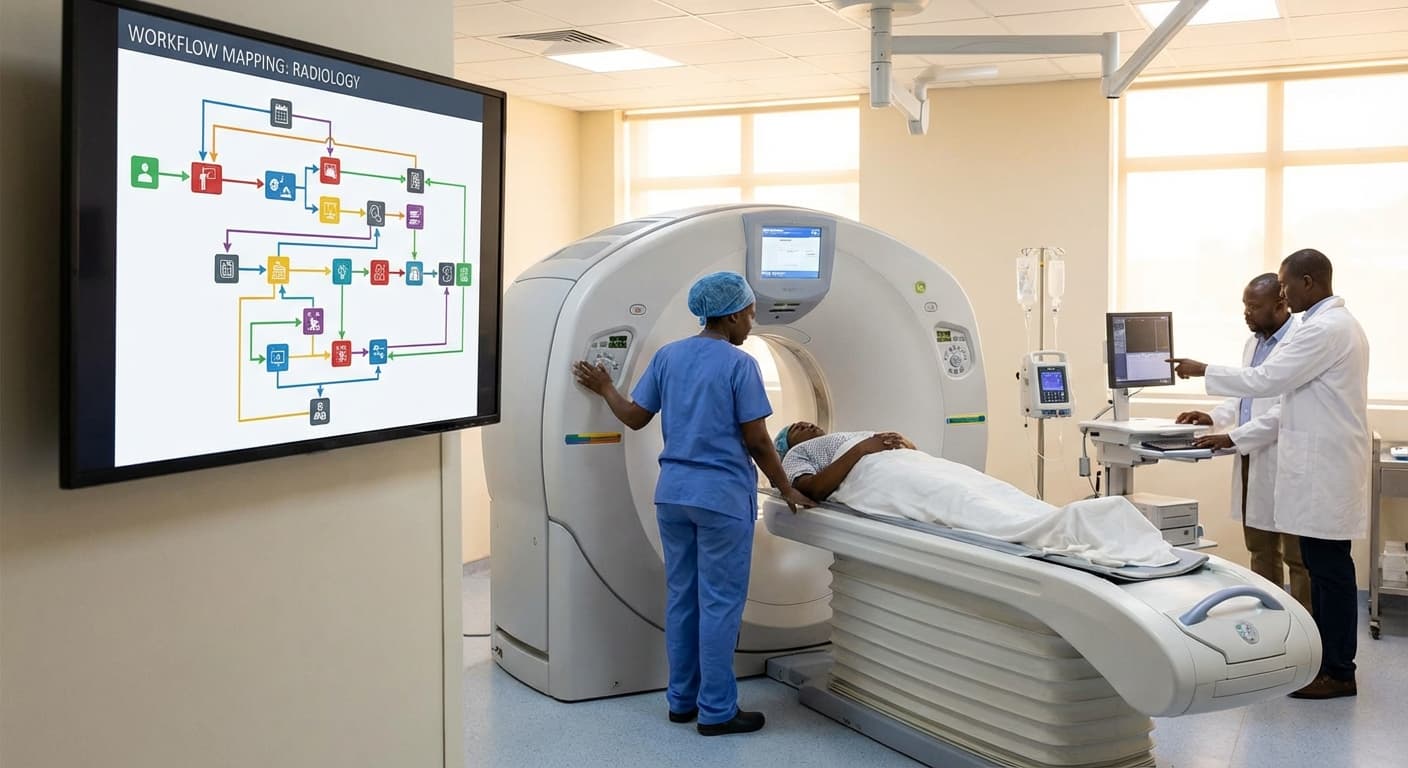
Department Workflow Mapping Service (Radiology/ICU/OT/Lab/Dialysis) in Mauritania
Engineering Excellence & Technical Support
Department Workflow Mapping Service (Radiology/ICU/OT/Lab/Dialysis) High-standard technical execution following OEM protocols and local regulatory frameworks.
Optimized Patient Flow in Mauritanian Radiology Departments
Streamlined patient journeys from referral to report generation, reducing wait times and improving throughput in Radiology departments across Mauritania. Our workflow mapping identifies bottlenecks and implements efficient resource allocation for faster diagnostic imaging and timely patient care.
Enhanced Critical Care Coordination in Mauritanian ICUs
Mapping critical care pathways within Mauritanian Intensive Care Units to ensure seamless patient transfers, optimal team communication, and immediate access to vital resources. This service standardizes protocols, minimizes delays in treatment, and improves patient outcomes in high-acuity settings.
Elevating Operational Efficiency in Mauritanian Operating Theatres
Digitally mapping and analyzing operating theatre workflows in Mauritania to maximize utilization, reduce cancellations, and improve surgical team synergy. Our service focuses on optimizing scheduling, instrument management, and patient preparation for safer and more efficient surgical procedures.
What Is Department Workflow Mapping Service (Radiology/icu/ot/lab/dialysis) In Mauritania?
Department Workflow Mapping Service (Radiology/ICU/OT/Lab/Dialysis) in Mauritania refers to the systematic analysis, documentation, and optimization of the processes and procedures undertaken within critical hospital departments. This service aims to visualize the flow of patients, information, materials, and resources through these departments to identify inefficiencies, bottlenecks, and areas for improvement in operational effectiveness, patient safety, and resource utilization. The service involves a comprehensive study of existing workflows, stakeholder interviews, process observation, data collection, and the development of detailed workflow diagrams and standard operating procedures (SOPs). The ultimate goal is to enhance departmental performance through a data-driven, structured approach.
| Department | Who Needs It | Typical Use Cases |
|---|---|---|
| Radiology | Radiology departments seeking to streamline patient scheduling, image acquisition, interpretation, reporting, and archival processes. Hospital administration aiming to improve imaging throughput and reduce radiologist workload. | Reducing patient wait times for diagnostic imaging. Optimizing PACS (Picture Archiving and Communication System) integration. Improving reporting turnaround times. Enhancing radiographer efficiency. Implementing new imaging technologies or protocols. |
| ICU (Intensive Care Unit) | ICU management and clinical teams focused on improving patient care delivery, monitoring, and resource allocation. Hospitals aiming to reduce ICU length of stay and associated costs. | Optimizing patient admission and discharge processes. Streamlining multidisciplinary team rounds. Enhancing medication administration protocols. Improving alarm management. Ensuring efficient utilization of critical care beds and equipment. |
| OT (Operating Theatre) | Surgical departments, anesthesiology, and nursing staff responsible for scheduling, preparation, intraoperative procedures, and post-operative recovery. Hospital administration focused on maximizing operating room utilization and minimizing procedure delays. | Improving surgical scheduling and case load management. Streamlining patient preparation and handover to OT. Optimizing instrument and supply management. Reducing operating room turnaround times between cases. Enhancing communication between surgical teams and support staff. |
| Laboratory | Clinical laboratory directors, technologists, and phlebotomy staff. Hospitals aiming to improve sample processing, testing turnaround times, and result accuracy. Ensuring compliance with quality standards. | Optimizing specimen collection, transport, and accessioning. Streamlining pre-analytical, analytical, and post-analytical phases of testing. Improving laboratory information system (LIS) integration. Reducing TAT (Turnaround Time) for critical tests. Implementing new diagnostic assays or automation. |
| Dialysis | Nephrology departments, dialysis unit managers, and nursing staff. Facilities focused on ensuring efficient patient throughput, effective treatment delivery, and patient safety during dialysis sessions. | Streamlining patient scheduling for dialysis sessions. Optimizing pre-dialysis assessment and post-dialysis care. Improving equipment maintenance and sterilization processes. Enhancing medication management. Ensuring efficient management of water treatment systems. |
Key Components of Department Workflow Mapping Service
- Process Identification and Scoping: Defining the boundaries and key activities within the specific department's operational scope.
- Stakeholder Engagement: Interviewing and consulting with clinical staff, administrative personnel, and management to understand current practices and challenges.
- As-Is Workflow Documentation: Visually representing existing processes using standard notation (e.g., BPMN) to depict sequences, decision points, and parallel activities.
- Data Collection and Analysis: Gathering quantitative and qualitative data on key performance indicators (KPIs) such as patient throughput, turnaround times, error rates, and resource utilization.
- Bottleneck and Inefficiency Identification: Analyzing the documented workflows and collected data to pinpoint areas causing delays, increased costs, or reduced quality of care.
- To-Be Workflow Design: Developing optimized future-state workflows that address identified inefficiencies, incorporate best practices, and leverage technological advancements.
- SOP Development and Implementation: Creating clear, concise, and actionable Standard Operating Procedures to guide staff in executing the optimized workflows.
- Training and Change Management: Providing training to staff on new processes and facilitating the adoption of changes.
- Monitoring and Continuous Improvement: Establishing mechanisms for ongoing performance tracking and iterative refinement of workflows.
Who Needs Department Workflow Mapping Service (Radiology/icu/ot/lab/dialysis) In Mauritania?
Department workflow mapping is a crucial process for optimizing operations within any healthcare facility. This service specifically targets healthcare departments that have complex, multi-step processes with critical patient care dependencies. By meticulously documenting, analyzing, and redesigning workflows, these departments can achieve significant improvements in efficiency, accuracy, patient safety, and resource utilization. In Mauritania, where healthcare infrastructure is evolving, the implementation of robust workflow mapping can provide a competitive advantage and elevate the standard of care across key specialized departments.
| Target Customer | Department | Key Benefits of Workflow Mapping |
|---|---|---|
| Public Hospitals | Radiology | Reduced patient wait times, improved report turnaround, efficient equipment utilization. |
| Private Hospitals | ICU | Enhanced critical care response, clearer communication protocols, reduced risk of medical errors. |
| Specialty Clinics | OT | Optimized surgical scheduling, improved resource allocation, smoother patient transitions. |
| Diagnostic Centers | Lab | Increased sample processing speed, improved accuracy, enhanced quality assurance. |
| Government Healthcare Initiatives | Dialysis | Better patient management, efficient allocation of limited resources, improved patient outcomes. |
| International Aid Organizations (supporting Mauritanian healthcare) | All Listed Departments | Standardization of processes, capacity building, evidence-based operational improvements. |
Who Needs Department Workflow Mapping Service (Radiology/ICU/OT/Lab/Dialysis) in Mauritania?
- Hospitals and Clinics in Mauritania seeking to enhance operational efficiency and patient care.
- Radiology Departments aiming to streamline imaging request processing, patient scheduling, and report generation.
- Intensive Care Units (ICUs) focused on improving patient monitoring, emergency response protocols, and interdisciplinary communication.
- Operating Theatres (OTs) looking to optimize surgical scheduling, instrument preparation, and post-operative care handoffs.
- Diagnostic Laboratories striving for faster turnaround times, reduced errors in sample processing, and improved quality control.
- Dialysis Centers working to enhance patient scheduling, treatment administration, and the management of patient flow.
Department Workflow Mapping Service (Radiology/icu/ot/lab/dialysis) Process In Mauritania
This document outlines the standard workflow for requesting and executing a Department Workflow Mapping Service within the medical departments (Radiology, ICU, OT, Lab, Dialysis) in Mauritania. The service aims to analyze, document, and optimize existing operational processes to improve efficiency, reduce errors, and enhance patient care.
| Phase | Stage | Description | Key Activities | Responsible Party | Deliverables | Timeline (Indicative) |
|---|---|---|---|---|---|---|
| Phase 1: Initiation | Inquiry | The process begins with an interested department identifying a need for workflow mapping. | Department expresses interest, outlines general areas of concern. | Department Head/Representative | Informal expression of need | 1-2 days |
| Initial Consultation | A preliminary meeting to understand the department's specific challenges and objectives. | Discuss goals, current pain points, and desired outcomes of workflow mapping. | Service Provider & Department Representative | Meeting minutes, preliminary understanding of needs | 2-3 days | |
| Phase 2: Planning | Scope Definition | Clearly defining the boundaries and specific processes to be mapped. | Identify target workflows (e.g., patient admission in ICU, sample processing in Lab, scheduling in OT). | Service Provider & Department Representative | Scope document | 3-5 days |
| Proposal Development | Creating a detailed proposal outlining the service methodology, timeline, resources, and cost. | Methodology, timeline, resource allocation, cost estimation, deliverables. | Service Provider | Formal proposal | 5-7 days | |
| Contracting and Agreement | Formalizing the engagement with the service provider. | Review and sign the service agreement. | Department/Hospital Administration & Service Provider | Signed contract | 7-10 days | |
| Phase 3: Execution | Data Collection | Gathering comprehensive information about the current workflow. | Interviews with staff, observation of processes, review of existing documentation, data analysis (e.g., turnaround times, error rates). | Service Provider & Department Staff | Raw data, interview notes, observational logs | 1-2 weeks (depending on complexity) |
| Process Analysis | Analyzing the collected data to identify inefficiencies, bottlenecks, and areas for improvement. | Root cause analysis, identification of redundancies, analysis of communication flows. | Service Provider | Analysis report, identification of key issues | 1 week | |
| Workflow Design and Mapping | Developing visual representations (flowcharts, diagrams) of the current and proposed future state workflows. | Creating detailed process maps, defining roles and responsibilities, identifying technology requirements. | Service Provider | Current state workflow maps, proposed future state workflow maps | 1-2 weeks | |
| Validation and Feedback | Presenting the mapped workflows and proposed changes to the department for review and feedback. | Workshops, review sessions, incorporating feedback from stakeholders. | Service Provider & Department Staff | Validated workflow maps, consolidated feedback | 3-5 days | |
| Phase 4: Implementation & Review | Implementation Planning | Developing a plan for implementing the optimized workflows. | Defining action items, assigning responsibilities, setting implementation timelines, training needs. | Service Provider & Department Management | Implementation plan | 5-7 days |
| Execution and Monitoring | Assisting the department in implementing the new workflows and monitoring their effectiveness. | Training, coaching, ongoing observation, collecting performance data. | Department Management & Service Provider (support role) | Implemented workflows, initial performance data | Ongoing (e.g., 1-3 months) | |
| Reporting and Review | Providing a final report on the project and conducting a post-implementation review. | Final project report, recommendations for continuous improvement, lessons learned. | Service Provider | Final report, lessons learned document | 1 week |
Department Workflow Mapping Service Process in Mauritania
- Inquiry and Initial Consultation
- Scope Definition and Proposal
- Data Collection and Analysis
- Workflow Design and Mapping
- Validation and Feedback
- Implementation Planning
- Execution and Monitoring
- Reporting and Review
Department Workflow Mapping Service (Radiology/icu/ot/lab/dialysis) Cost In Mauritania
The cost of Department Workflow Mapping Services in Mauritania for specialized departments like Radiology, ICU, OT (Operating Theatre), Lab, and Dialysis can vary significantly. These services are crucial for optimizing efficiency, identifying bottlenecks, and improving patient care within these critical hospital units. The pricing is influenced by a combination of factors specific to the project scope, the provider's expertise, and the complexity of the department's operations.
| Department Type | Estimated Cost Range (MRU per Department) | Notes on Range |
|---|---|---|
| Radiology | 150,000 - 400,000 MRU | Costs vary based on the number of imaging modalities, complexity of patient throughput, and reporting requirements. |
| ICU (Intensive Care Unit) | 200,000 - 550,000 MRU | Higher costs due to critical nature, patient monitoring complexity, multi-disciplinary team coordination, and equipment integration. |
| OT (Operating Theatre) | 180,000 - 450,000 MRU | Depends on the number of operating rooms, surgical specialties, sterilization processes, and pre/post-operative patient flow. |
| Lab (Pathology/Clinical Laboratory) | 100,000 - 300,000 MRU | Influenced by the volume and types of tests performed, automation levels, specimen handling, and turnaround times. |
| Dialysis | 120,000 - 350,000 MRU | Factors include patient capacity, machine utilization, water treatment processes, and patient management workflows. |
Key Pricing Factors for Department Workflow Mapping in Mauritania:
- Scope of the Project: The size and complexity of the department(s) being mapped are primary drivers. Mapping a single, smaller lab will cost less than mapping an entire ICU with multiple patient zones and intricate processes.
- Number of Departments: Engagements that involve multiple departments (e.g., Radiology and OT simultaneously) will naturally incur higher costs due to increased data collection, analysis, and reporting requirements.
- Current State Analysis Depth: The level of detail required for the 'as-is' workflow analysis. This can range from high-level process identification to granular task-by-task mapping, including time studies and resource utilization.
- Future State Design Complexity: The effort involved in designing and proposing optimized future workflows. This can include recommending new technologies, staffing models, or process re-engineering.
- Provider's Expertise and Reputation: Established consulting firms or specialized healthcare efficiency consultants with a proven track record in Mauritania or similar markets will generally command higher fees.
- Data Collection Methods: The methods employed for data gathering, such as interviews, direct observation, time-and-motion studies, surveys, and analysis of existing electronic health records (EHR) or hospital information systems (HIS).
- Reporting and Deliverables: The format and comprehensiveness of the final reports and deliverables. This might include detailed process maps, bottleneck analysis, recommendations, implementation roadmaps, and training materials.
- Travel and Accommodation: If the consultants are based outside the immediate vicinity of the hospital or require extensive on-site presence, travel and accommodation costs will be factored in.
- Technology and Tools Used: The specialized software or tools used for workflow mapping and analysis can influence pricing.
- Project Timeline: Urgent or accelerated projects may incur premium charges.
Affordable Department Workflow Mapping Service (Radiology/icu/ot/lab/dialysis) Options
Our Affordable Department Workflow Mapping Service provides essential process analysis for critical hospital departments, including Radiology, ICU, Operating Theatre (OT), Laboratory, and Dialysis. We help you visualize, optimize, and streamline your operations, leading to increased efficiency, reduced errors, and significant cost savings. Our service goes beyond simple mapping; we offer actionable insights and strategic recommendations tailored to your unique environment. We understand that budget is a key consideration, which is why we've developed flexible value bundles and cost-saving strategies to make this vital service accessible to all departments.
| Value Bundle | Description | Included Services | Target Department | Price Range (Indicative) |
|---|---|---|---|---|
| Essential Workflow Snapshot | A foundational mapping of your current key processes. | Initial workflow diagramming, identification of bottlenecks, basic recommendations. | Any (Radiology, ICU, OT, Lab, Dialysis) | $1,500 - $3,000 |
| Optimized Process Streamlining | In-depth analysis with actionable strategies for improvement. | Comprehensive workflow mapping, root cause analysis, detailed optimization plans, stakeholder interviews. | Any (Radiology, ICU, OT, Lab, Dialysis) | $3,000 - $6,000 |
| Integrated Departmental Flow | Mapping workflows across interconnected departments. | Cross-departmental workflow analysis, interdependencies mapping, integrated optimization strategies. | Radiology & OT, ICU & Lab, etc. | $5,000 - $10,000 |
| Customized Solution Package | Tailored to your specific needs and complex requirements. | Bespoke mapping, advanced analytics, change management support, ongoing monitoring options. | Any (with unique needs) | Custom Quote |
Our Workflow Mapping Service Benefits:
- Enhanced Efficiency & Throughput
- Reduced Patient Wait Times
- Improved Resource Utilization
- Minimized Errors & Rework
- Strengthened Communication & Collaboration
- Data-Driven Decision Making
- Compliance & Safety Enhancement
Verified Providers In Mauritania
In the realm of healthcare in Mauritania, identifying reliable and credentialed providers is paramount for ensuring quality patient care. Franance Health stands out as a beacon of trust, consistently demonstrating a commitment to excellence through its rigorous credentialing processes. This commitment translates directly into patient confidence, as verified providers offer a guarantee of competence, ethical practice, and adherence to international healthcare standards. Choosing Franance Health-credentialed providers means opting for a superior healthcare experience, characterized by skilled professionals, advanced medical practices, and a patient-centric approach.
| Key Areas of Franance Health Credentialing | What it Means for Patients |
|---|---|
| Educational & Professional Qualifications: Thorough verification of degrees, diplomas, and licenses from recognized institutions. | Assurance that providers possess the foundational knowledge and legal authorization to practice medicine. |
| Clinical Experience & Competence: Assessment of practical skills, surgical techniques, and patient management capabilities. | Confidence in the provider's ability to accurately diagnose and effectively treat medical conditions. |
| Adherence to Best Practices & Protocols: Evaluation of compliance with established medical guidelines and safety procedures. | Minimization of risks and assurance of care delivered according to current, evidence-based standards. |
| Ethical Conduct & Professionalism: Review of professional history for any disciplinary actions and commitment to patient-centered care. | Trustworthy relationships with healthcare professionals who prioritize patient rights and dignity. |
| Continuing Medical Education (CME): Requirement for ongoing learning to stay updated with medical advancements. | Access to care informed by the latest research, technologies, and treatment modalities. |
Why Franance Health Credentials Represent the Best Choice in Mauritania:
- Rigorous Vetting Process: Franance Health employs a comprehensive and multi-faceted vetting system for all its providers. This includes verification of educational qualifications, professional licenses, work history, and certifications to ensure only the most competent individuals are accredited.
- Commitment to Ethical Practice: Credentials signify adherence to a strict code of ethics and professional conduct. Franance Health-credentialed providers are committed to patient well-being, privacy, and transparent communication.
- Upholding International Standards: Franance Health aligns its credentialing criteria with globally recognized healthcare benchmarks, ensuring that patients in Mauritania receive care that meets international quality and safety expectations.
- Enhanced Patient Trust and Safety: The 'Franance Health Verified' mark provides a clear indicator of quality, empowering patients to make informed decisions and fostering greater trust in the healthcare system.
- Continuous Professional Development: Maintaining Franance Health credentials often requires ongoing engagement in professional development and continuing education, ensuring providers remain at the forefront of medical advancements and best practices.
- Access to Specialized Expertise: Franance Health's network includes a diverse range of medical specialists, all rigorously credentialed, offering patients access to high-quality care for various medical needs.
- Improved Health Outcomes: By ensuring providers meet high standards, Franance Health contributes to better diagnostic accuracy, effective treatment plans, and ultimately, improved health outcomes for patients in Mauritania.
Scope Of Work For Department Workflow Mapping Service (Radiology/icu/ot/lab/dialysis)
This Scope of Work (SOW) outlines the services to be provided for a comprehensive workflow mapping initiative across critical hospital departments, including Radiology, Intensive Care Unit (ICU), Operating Theatre (OT), Laboratory, and Dialysis. The primary objective is to document, analyze, and optimize existing workflows to enhance efficiency, reduce errors, improve patient care, and identify opportunities for technological integration and process improvement. This document details the technical deliverables and standard specifications for the successful completion of this service.
| Phase | Activity | Description | Deliverables | Standard Specifications & Methodologies |
|---|---|---|---|---|
| Phase 1: Discovery & Planning | Project Kick-off | Initiate the project, confirm scope, objectives, and stakeholder roles. Establish communication protocols. | Project Charter, Stakeholder Register, Communication Plan. | Agile methodologies, RACI matrix for stakeholder roles. |
| Phase 1: Discovery & Planning | Current State Workflow Identification | Engage with department stakeholders to identify all key processes, activities, roles, and decision points within Radiology, ICU, OT, Lab, and Dialysis. | Initial Process Inventory. | Interviews, Workshops, Observation, Document Review. |
| Phase 2: Workflow Mapping | Detailed Workflow Documentation | Visually map each identified workflow using standardized notation, capturing sequence, inputs, outputs, decision branches, and dependencies. | Current State Workflow Diagrams (per department). | BPMN 2.0 (Business Process Model and Notation) for graphical representation. Standardized swimlane diagrams to delineate roles. |
| Phase 2: Workflow Mapping | Data Gathering & Analysis | Collect relevant data points such as time taken for activities, error rates, resource utilization, and patient throughput. | Data Collection Templates, Raw Data Repository. | Quantitative and qualitative data collection methods. |
| Phase 2: Workflow Mapping | Process Analysis & Bottleneck Identification | Analyze documented workflows and collected data to pinpoint areas of inefficiency, delays, errors, and high-risk activities. | Bottleneck Analysis Report, Risk Assessment Matrix. | Value Stream Mapping (VSM) techniques, Pareto analysis, Root Cause Analysis (RCA). |
| Phase 3: Future State Design | Future State Workflow Design | Collaboratively design optimized future state workflows addressing identified inefficiencies and incorporating best practices and potential technology solutions. | Future State Workflow Diagrams (per department). | Lean Six Sigma principles, Design Thinking, User-centered design. |
| Phase 3: Future State Design | Recommendations for Improvement | Develop specific, actionable recommendations for process changes, technology adoption, training needs, and policy updates. | Recommendations Report, Technology Integration Proposals. | Cost-benefit analysis for proposed changes. |
| Phase 4: Validation & Handover | Stakeholder Validation | Present mapped workflows and recommendations to stakeholders for review, feedback, and validation. | Validated Workflow Diagrams, Feedback Summary. | Iterative review process with formal sign-off. |
| Phase 4: Validation & Handover | Final Deliverable Compilation | Consolidate all documentation, diagrams, reports, and recommendations into a comprehensive final package. | Final Project Report, Comprehensive Workflow Repository. | Organized and easily navigable digital format (e.g., PDF, process modeling software export). |
| Phase 4: Validation & Handover | Knowledge Transfer & Training | Conduct sessions to transfer knowledge of the mapping methodology and documented processes to internal teams. | Training Materials, 'Train the Trainer' sessions. | User manuals, process documentation guides. |
Project Objectives
- Accurate and detailed mapping of current state workflows for each specified department.
- Identification of bottlenecks, inefficiencies, redundancies, and potential risks within existing processes.
- Development of future state workflow recommendations for improved operational performance.
- Facilitation of knowledge transfer to internal stakeholders for ongoing process management.
- Provision of actionable insights for technology adoption and system integration.
- Enhancement of inter-departmental communication and collaboration.
Service Level Agreement For Department Workflow Mapping Service (Radiology/icu/ot/lab/dialysis)
This Service Level Agreement (SLA) outlines the guaranteed response times and uptime for the Department Workflow Mapping Service, specifically for the Radiology, Intensive Care Unit (ICU), Operating Theater (OT), Laboratory, and Dialysis departments. The service aims to provide efficient and accurate mapping of departmental workflows to identify bottlenecks, improve processes, and enhance overall operational efficiency.
| Service Component | Response Time Guarantee | Uptime Guarantee | Notes |
|---|---|---|---|
| Initial Consultation and Project Kick-off | Within 2 business days of request receipt | N/A (One-time event) | Requires user availability for scheduling. |
| Submission of Raw Workflow Data/Information | N/A (User-initiated) | N/A (User-initiated) | Timeliness of data submission by the department directly impacts project timelines. |
| Delivery of Draft Workflow Diagrams | Within 5 business days of receiving complete data for a specific workflow segment | N/A (Project deliverable) | Complexity of the workflow may influence this timeline, to be communicated upfront. |
| Incorporation of Feedback on Draft Diagrams | Within 3 business days of receiving consolidated feedback | N/A (Project deliverable) | Requires clear and actionable feedback from the department. |
| Delivery of Final Workflow Maps and Recommendations | Within 5 business days of final diagram approval | N/A (Project deliverable) | Includes detailed documentation. |
| Ad-hoc Workflow Query Support | Within 1 business day for urgent queries, 2 business days for non-urgent queries | 99.5% during business hours (Monday-Friday, 8:00 AM - 5:00 PM) | |
| Scheduled Workflow Review and Update Sessions | Within 7 business days of scheduled request | 99.5% during business hours (Monday-Friday, 8:00 AM - 5:00 PM) | |
| System Availability for Collaboration Tools (if applicable) | N/A | 99.8% (excluding scheduled maintenance) |
Scope of Service
- Workflow Analysis and Documentation for Radiology Department.
- Workflow Analysis and Documentation for Intensive Care Unit (ICU).
- Workflow Analysis and Documentation for Operating Theater (OT).
- Workflow Analysis and Documentation for Laboratory Department.
- Workflow Analysis and Documentation for Dialysis Department.
- Identification of key processes, touchpoints, and resource utilization.
- Development of visual workflow diagrams (e.g., flowcharts, process maps).
- Recommendations for process improvement and optimization.
- Regular review and update of mapped workflows.
Frequently Asked Questions

Ready when you are
Let's scope your Department Workflow Mapping Service (Radiology/ICU/OT/Lab/Dialysis) in Mauritania project in Mauritania.

Scaling healthcare logistics and technical systems across the entire continent.