
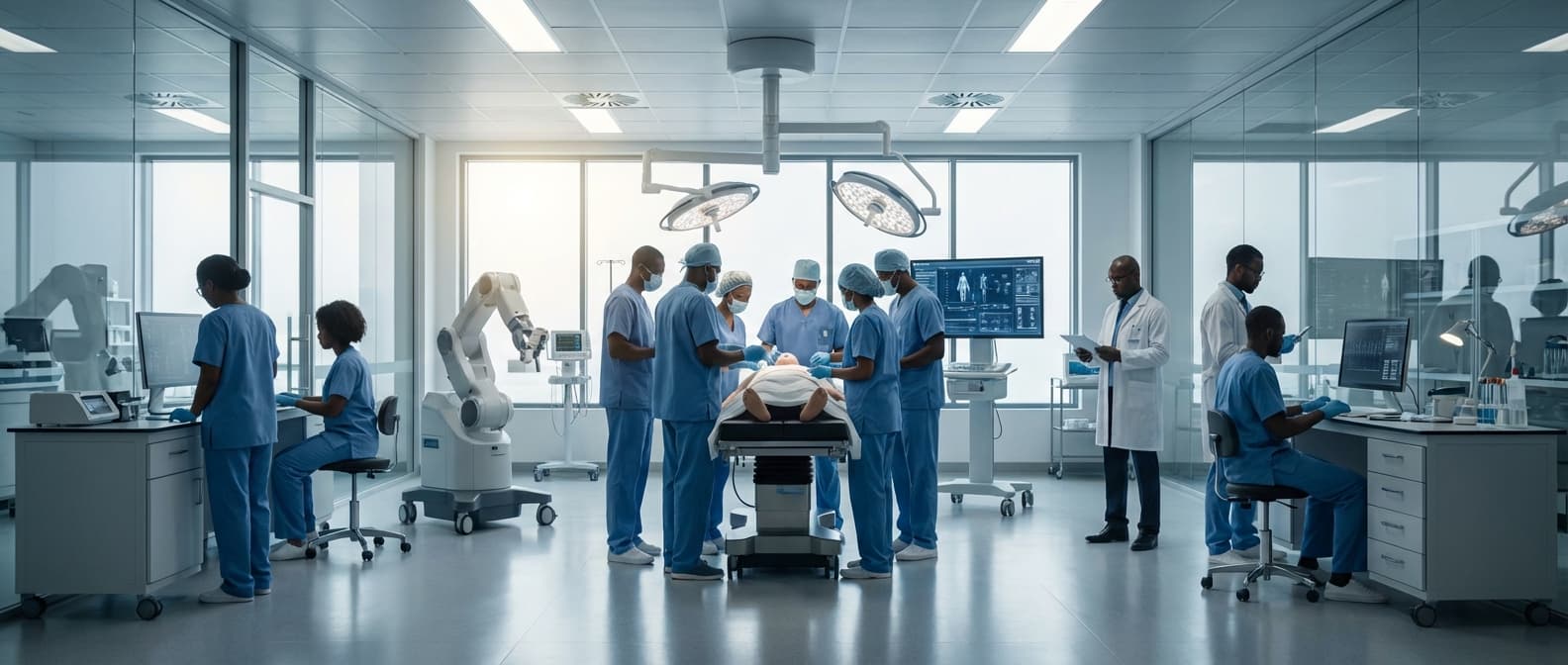
Biomedical Staffing Augmentation in Mauritania
Engineering Excellence & Technical Support
Onsite biomedical engineers and PACS administrators High-standard technical execution following OEM protocols and local regulatory frameworks.
Expert Medical Personnel Augmentation
Rapid deployment of highly qualified physicians, nurses, and specialized medical technicians to address critical staffing shortages in Mauritanian healthcare facilities, ensuring continuity of care and access to essential medical services.
Specialized Healthcare Skill Integration
Augmenting existing healthcare teams with niche specialists (e.g., radiologists, oncologists, critical care intensivists) to enhance diagnostic capabilities and treatment protocols, particularly in underserved regions of Mauritania.
On-Demand Clinical Support Solutions
Providing flexible and scalable biomedical staffing solutions for projects, research initiatives, and emergency response efforts across Mauritania, ensuring that healthcare institutions have the necessary personnel to meet evolving demands.
What Is Biomedical Staffing Augmentation In Mauritania?
Biomedical Staffing Augmentation in Mauritania refers to the strategic provision of specialized, temporary, and qualified biomedical personnel to healthcare facilities and research institutions. This service aims to address critical workforce shortages, enhance operational efficiency, and ensure the effective deployment and maintenance of complex biomedical equipment and technologies within the Mauritanian healthcare landscape. It encompasses a range of activities designed to supplement existing in-house capabilities and expertise.
| Who Needs Biomedical Staffing Augmentation? | Typical Use Cases | ||||
|---|---|---|---|---|---|
| Public and Private Hospitals: Especially those experiencing staff shortages or needing to manage a high volume of biomedical equipment. | Regional and Rural Clinics: Often lacking specialized biomedical expertise due to geographical isolation and limited local talent pools. | Specialized Medical Centers (e.g., diagnostic imaging, cardiology): Requiring technicians with deep knowledge of specific, advanced equipment. | Research and Development Institutions: Needing support for experimental setups and specialized laboratory instrumentation. | Medical Equipment Suppliers and Distributors: Requiring temporary technicians for installation, maintenance, and training at client sites. | Government Health Ministries and Agencies: Seeking to bolster the capacity of the national healthcare infrastructure during specific campaigns or to address widespread needs. |
| Emergency Equipment Maintenance and Repair: Responding to urgent equipment failures to minimize downtime and ensure continuous patient care. | Installation and Commissioning of New Medical Devices: Ensuring that newly acquired sophisticated equipment is properly set up, calibrated, and functional. | Preventive Maintenance Programs: Supplementing in-house teams to ensure regular servicing and calibration of the biomedical equipment inventory. | Project-Specific Support: Providing expertise for the implementation of new healthcare technologies or the expansion of services. | Training and Skill Development for Existing Staff: Empowering local biomedical teams with advanced knowledge and practical skills. | Outbreak Response and Public Health Initiatives: Deploying specialized personnel to support rapid deployment of medical resources and services during health crises. |
Key Components of Biomedical Staffing Augmentation
- Talent Sourcing and Vetting: Identifying, recruiting, and rigorously vetting biomedical professionals with specific skill sets (e.g., clinical engineers, biomedical technicians, specialized equipment operators, laboratory technologists) to meet the unique demands of Mauritanian healthcare settings.
- Skill-Specific Placement: Deploying augmented staff with expertise in areas such as medical device repair and maintenance, calibration, installation of new equipment, operation of advanced diagnostic and therapeutic systems, and laboratory support.
- Flexible Engagement Models: Offering various contract durations and service levels, from short-term project-based assignments to longer-term supplementary staffing, tailored to the fluctuating needs of institutions.
- Regulatory Compliance and Training: Ensuring that augmented staff possess the necessary certifications and undergo any required on-site training to adhere to Mauritanian healthcare regulations and specific institutional protocols.
- Knowledge Transfer and Capacity Building: Facilitating the transfer of technical knowledge and best practices from augmented personnel to permanent staff, thereby enhancing the long-term capabilities of the host institution.
Who Needs Biomedical Staffing Augmentation In Mauritania?
Biomedical staffing augmentation in Mauritania is crucial for ensuring the efficient operation and optimal utilization of medical equipment across the country's healthcare sector. This service provides specialized technical expertise to supplement existing hospital and clinic teams, addressing skill gaps, managing workload fluctuations, and supporting the implementation of new technologies. The demand for such augmentation stems from a variety of factors, including the limited availability of highly trained biomedical engineers and technicians, the growing complexity of medical devices, and the need for specialized maintenance and calibration services.
| Target Customer Group | Key Departments Requiring Augmentation | Specific Needs Addressed |
|---|---|---|
| Public Hospitals | Biomedical Engineering Department, Radiology, Cardiology, Intensive Care Units (ICUs), Operating Theaters, Laboratories | Maintenance and repair of critical equipment, calibration services, installation of new devices, training for in-house staff, proactive equipment management, compliance with regulatory standards. |
| Private Hospitals and Clinics | Similar to Public Hospitals, with a focus on efficiency and patient throughput. | Ensuring minimal downtime for revenue-generating equipment, specialized diagnostic equipment support, rapid response to equipment failures, cost-effective maintenance solutions. |
| Specialized Medical Centers | Departments focused on specific technologies (e.g., MRI, CT scan, linear accelerators). | Expertise in highly complex and sensitive equipment, specialized calibration and repair, upgrades and retrofitting of advanced systems, ensuring optimal image quality and patient safety. |
| NGOs and International Organizations | Healthcare facilities established in remote or underserved areas. | Providing essential technical support where local expertise is scarce, training local personnel for sustainability, managing equipment donated from various sources, ensuring operational readiness of medical missions. |
| Medical Device Manufacturers/Distributors | Technical Support and Service Departments. | Augmenting their existing service teams for large-scale installations, providing specialized training for their own technicians, fulfilling contractual obligations for maintenance and repair, managing peak demand periods. |
Target Customers for Biomedical Staffing Augmentation in Mauritania:
- Public Hospitals (Ministry of Health facilities)
- Private Hospitals and Clinics
- Specialized Medical Centers (e.g., diagnostic imaging centers, cardiac units)
- Non-Governmental Organizations (NGOs) operating healthcare facilities
- International Organizations involved in healthcare development
- Medical Device Manufacturers and Distributors (for installation, training, and after-sales support)
- Research Institutions with medical equipment needs
Biomedical Staffing Augmentation Process In Mauritania
The Biomedical Staffing Augmentation Process in Mauritania involves a structured workflow designed to efficiently meet the healthcare sector's need for specialized biomedical personnel. This process begins with an inquiry from a healthcare facility requiring additional biomedical expertise. The inquiry is then assessed, followed by a rigorous candidate sourcing and vetting procedure. Successful candidates are onboarded, deployed, and their performance is monitored throughout their engagement. Post-deployment, feedback is collected to refine future augmentation efforts.
| Stage | Description | Key Activities | Responsible Party |
|---|---|---|---|
| Inquiry & Needs Assessment | Formal request from a healthcare facility for temporary or project-based biomedical staffing augmentation. | Submit request form, define required roles, qualifications, duration, and budget. Initial needs analysis and scope definition. | Healthcare Facility, Staffing Agency |
| Candidate Sourcing | Identifying and attracting potential candidates with the required biomedical expertise. | Leveraging internal databases, professional networks, job boards, and recruitment agencies. Proactive talent pool development. | Staffing Agency |
| Screening & Vetting | Evaluating candidates' qualifications, experience, and suitability for the role. | Resume review, technical assessments, interviews (technical and behavioral), background checks, and verification of credentials. | Staffing Agency |
| Selection & Offer | Presenting the most suitable candidates to the healthcare facility and extending an offer. | Shortlisting candidates, presenting profiles to the facility, facilitating client interviews, negotiating terms and conditions, extending employment offer. | Staffing Agency, Healthcare Facility |
| Onboarding & Mobilization | Preparing the selected candidate for deployment. | Completing HR formalities, visa/work permit acquisition (if applicable), pre-deployment training, equipment provisioning, and travel arrangements. | Staffing Agency, Candidate |
| Deployment & Service Delivery | The candidate begins their role at the healthcare facility, providing biomedical services. | On-site orientation at the facility, performing assigned duties, adhering to facility protocols and standards. | Augmented Staff, Healthcare Facility |
| Performance Monitoring & Support | Ensuring the augmented staff member is performing effectively and addressing any issues. | Regular check-ins with the augmented staff and the facility, performance feedback sessions, providing ongoing support and resolving operational challenges. | Staffing Agency, Healthcare Facility |
| Feedback & Evaluation | Concluding the engagement and gathering feedback for continuous improvement. | Post-deployment review with the facility and the augmented staff, collecting feedback on the process and performance, invoicing, and knowledge transfer for future engagements. | Staffing Agency, Healthcare Facility, Augmented Staff |
Biomedical Staffing Augmentation Workflow in Mauritania
- Inquiry & Needs Assessment
- Candidate Sourcing
- Screening & Vetting
- Selection & Offer
- Onboarding & Mobilization
- Deployment & Service Delivery
- Performance Monitoring & Support
- Feedback & Evaluation
Biomedical Staffing Augmentation Cost In Mauritania
Biomedical staffing augmentation in Mauritania involves supplementing existing healthcare facilities with qualified biomedical personnel on a temporary or contract basis. This can include roles such as biomedical technicians, engineers, and specialists for equipment maintenance, calibration, installation, and training. The cost of such augmentation is influenced by several dynamic factors, leading to a range of pricing in Mauritanian Ouguiya (MRU).
| Staffing Role | Experience Level | Estimated Daily Rate (MRU) | Estimated Monthly Rate (MRU) |
|---|---|---|---|
| Biomedical Technician (General Maintenance) | Junior (1-3 years) | 15,000 - 25,000 | 200,000 - 350,000 |
| Biomedical Technician (General Maintenance) | Mid-Level (3-7 years) | 25,000 - 40,000 | 350,000 - 550,000 |
| Biomedical Technician (General Maintenance) | Senior (7+ years) | 40,000 - 60,000 | 550,000 - 800,000 |
| Biomedical Engineer (Specialized) | Mid-Level (5-10 years) | 50,000 - 80,000 | 700,000 - 1,100,000 |
| Biomedical Engineer (Specialized) | Senior (10+ years) | 80,000 - 120,000+ | 1,100,000 - 1,600,000+ |
| Specialized Equipment Technician (e.g., Imaging, Anesthesia) | Experienced | 60,000 - 100,000+ | 800,000 - 1,400,000+ |
Key Pricing Factors for Biomedical Staffing Augmentation in Mauritania
- Skill Set and Specialization: The demand for and rarity of specific biomedical skills significantly impact cost. Highly specialized roles (e.g., advanced imaging equipment maintenance) command higher rates than general technicians.
- Experience Level: Senior biomedical professionals with extensive experience and proven track records will generally have higher hourly or daily rates compared to junior or entry-level staff.
- Duration of Engagement: Longer-term contracts may offer slightly lower weekly or monthly rates due to the guaranteed commitment, while short-term or emergency placements often come at a premium.
- Scope of Work: The complexity and breadth of responsibilities assigned to the augmented staff are crucial. Tasks involving intricate repairs, extensive troubleshooting, or on-site training will be priced higher than routine preventive maintenance.
- Geographic Location: While Mauritania has a relatively centralized healthcare infrastructure, placements in remote or less accessible regions might incur additional logistical costs (travel, accommodation) that are factored into the overall price.
- Provider Type: Whether the staffing is sourced directly from local recruitment agencies, international specialized firms, or through governmental programs can influence pricing structures and overheads.
- Urgency of Need: Urgent requests for staffing, especially during crises or unexpected equipment failures, typically result in higher fees due to the expedited recruitment and deployment process.
- Equipment Complexity and Type: The sophistication and criticality of the biomedical equipment requiring maintenance or support can influence the required skill level and thus the cost. Specialized equipment often requires specialized, and thus more expensive, expertise.
- Training and Certification Requirements: If the augmented staff require specific certifications or on-site training on particular equipment before deployment, these costs will be included.
Affordable Biomedical Staffing Augmentation Options
Hospitals and healthcare organizations are increasingly looking for ways to optimize their staffing budgets without compromising the quality of care. Biomedical staffing augmentation offers a flexible and cost-effective solution. This involves bringing in external biomedical professionals on a temporary or project basis to supplement existing teams, cover specialized skill gaps, or manage fluctuating workloads. The key to maximizing value lies in understanding and leveraging 'value bundles' and implementing smart cost-saving strategies.
| Cost-Saving Strategy | Description | Impact on Affordability |
|---|---|---|
| Flexible Staffing Models | Utilizing temporary, contract, or part-time staff based on actual need, avoiding the overhead of full-time employees (benefits, training, office space). | Reduces fixed labor costs, allowing for better budget allocation based on demand. |
| Outsourcing Specialized Tasks | Contracting out complex or niche tasks (e.g., advanced imaging equipment repair, specific software integration) to external specialists who can perform them more efficiently. | Leverages external expertise, potentially reducing the need for expensive in-house training or specialized equipment. |
| Shared Service Models | Collaborating with other healthcare facilities to share the costs of specialized biomedical engineering services or equipment. | Distributes costs among multiple organizations, making high-cost services more accessible. |
| Performance-Based Contracts | Structuring agreements where payment is tied to specific performance metrics, such as equipment uptime, repair turnaround time, or cost savings achieved. | Ensures value for money and incentivizes efficient service delivery. |
| Leveraging Technology for Efficiency | Utilizing augmented staff who are proficient with modern asset management software, diagnostic tools, and remote support technologies. | Increases efficiency, reduces travel time, and enables faster problem resolution, leading to lower overall service costs. |
| Strategic Vendor Partnerships | Developing long-term relationships with reputable staffing augmentation providers who offer competitive pricing and reliable service. | Can lead to volume discounts, preferential rates, and a deeper understanding of your organization's specific needs. |
Key Value Bundles for Biomedical Staffing Augmentation
- On-Demand Technical Support: Rapid deployment of certified technicians for equipment repair, maintenance, and calibration, reducing downtime and operational disruptions.
- Project-Specific Expertise: Access to specialized skills for new technology integration, system upgrades, or large-scale equipment rollouts, without the long-term commitment of hiring.
- Preventive Maintenance Programs: Outsourcing routine preventive maintenance to experienced professionals, ensuring equipment longevity and compliance, often at a lower cost than in-house execution.
- Compliance and Accreditation Assistance: Engaging experts to ensure biomedical equipment meets regulatory standards (e.g., Joint Commission) and supports accreditation efforts.
- Training and Skill Development Support: Utilizing augmented staff to provide on-the-job training to existing teams, enhancing their capabilities and knowledge base.
- Remote Monitoring and Support: Leveraging remote capabilities for certain troubleshooting and diagnostic tasks, reducing the need for on-site presence and associated travel costs.
Verified Providers In Mauritania
In Mauritania, ensuring access to high-quality healthcare is paramount. The presence of verified providers offers crucial reassurance to individuals seeking medical services. Franance Health stands out as a leading entity in this regard, rigorously vetting its network of healthcare professionals and facilities to guarantee adherence to stringent quality standards. This meticulous credentialing process by Franance Health signifies their commitment to patient safety and excellence in care, making them a trusted partner for healthcare needs in Mauritania.
| Provider Type | Franance Health Verification Criteria | Benefits for Patients |
|---|---|---|
| Hospitals & Clinics | Accreditation status, infection control protocols, availability of essential equipment, staff-to-patient ratios, patient satisfaction scores. | Access to well-equipped facilities with trained staff, reduced risk of complications, improved treatment outcomes. |
| Specialist Physicians | Board certification, medical license, years of practice, peer reviews, continuing medical education. | Consultations with highly qualified experts in their respective fields, accurate diagnoses, effective treatment plans. |
| Diagnostic Laboratories | Quality control measures, accreditation by relevant bodies, accuracy and turnaround time of tests, technology used. | Reliable and timely diagnostic results, supporting accurate medical decision-making. |
| Pharmacies | Proper licensing, drug dispensing protocols, storage conditions, qualified pharmacists. | Access to genuine and safely stored medications, professional advice on drug usage. |
Why Franance Health Credentials Represent the Best Choice:
- Rigorous Vetting Process: Franance Health employs a comprehensive and stringent credentialing process for all its associated providers.
- Adherence to International Standards: Providers are evaluated against globally recognized benchmarks for quality and safety in healthcare.
- Focus on Expertise and Experience: Franance Health prioritizes practitioners with proven track records and specialized knowledge.
- Commitment to Patient Safety: The credentialing process includes checks for ethical conduct, proper licensing, and patient care protocols.
- Continuous Monitoring and Re-evaluation: Franance Health does not rely on a one-time check; ongoing monitoring ensures sustained quality.
- Access to Trusted Healthcare: Patients benefit from a curated network of reliable and competent healthcare professionals.
Scope Of Work For Biomedical Staffing Augmentation
This Scope of Work (SOW) outlines the requirements for augmenting our biomedical staffing needs. The objective is to secure qualified and experienced biomedical professionals to support various operational and project-based initiatives within the organization. This SOW details the technical deliverables expected and the standard specifications that candidates must meet.
| Technical Deliverable | Standard Specification | Key Performance Indicators (KPIs) |
|---|---|---|
| Equipment Installation & Commissioning Reports | Detailed reports including model, serial number, installation date, test results (functional, safety, performance), and technician certification. Compliance with manufacturer guidelines and relevant standards (e.g., IEC 60601 series). | Timeliness of installation (within X days of arrival), successful completion rate of functional and safety tests (e.g., >98%). |
| Preventative Maintenance (PM) Schedules & Completion Records | Adherence to manufacturer-recommended PM schedules and organizational policies. Records must include date of service, tasks performed, parts used, and technician sign-off. Documentation of all deviations and justifications. | PM completion rate (e.g., >95% of scheduled PMs completed on time), reduction in equipment downtime attributable to PM failures. |
| Corrective Maintenance (CM) & Repair Logs | Accurate and detailed logs of all CM activities, including reported issue, troubleshooting steps, root cause analysis, parts replaced, time to repair (TTR), and technician notes. Compliance with organizational incident reporting procedures. | Average Time to Repair (ATTR) for critical equipment (e.g., < Y hours), first-time fix rate (e.g., >90%). |
| Equipment Inventory & Asset Management Updates | Regular and accurate updates to the biomedical equipment inventory database, including additions, removals, transfers, and status changes. Ensures data integrity and compliance with asset tracking policies. | Accuracy of inventory data (e.g., >99%), timely update of asset status post-service. |
| Training Materials & Session Records (for End-Users/Staff) | Development of clear, concise, and user-friendly training materials (manuals, presentations, videos) for new equipment or significant updates. Documentation of training sessions, attendee lists, and feedback. | User competency scores post-training (e.g., >85%), reduction in user-reported errors related to equipment operation. |
| Regulatory Compliance & Safety Audit Reports | Documentation of adherence to all relevant national and international medical device regulations (e.g., FDA, MDR). Reports from internal and external safety audits, including identified non-conformities and remediation plans. | Zero major regulatory non-compliance findings, successful completion of scheduled safety audits. |
| Medical Equipment Planning Documentation (for New Projects) | Detailed technical specifications for new equipment procurement, including performance requirements, integration capabilities, safety features, and total cost of ownership considerations. Analysis of vendor proposals against specifications. | Alignment of procured equipment with technical specifications (e.g., 100%), successful integration of new equipment into existing infrastructure. |
| Biomedical Information System (BIS) Integration & Data Reporting | Successful integration of medical device data into the BIS as required, ensuring data accuracy and accessibility for reporting and analysis. Development of custom reports as needed. | Availability and accuracy of critical device data in BIS, timely generation of required reports. |
Key Personnel Roles & Responsibilities
- Biomedical Engineer: Responsible for the installation, calibration, maintenance, and repair of medical equipment. This includes troubleshooting complex technical issues and ensuring compliance with safety regulations.
- Biomedical Technician: Assists Biomedical Engineers with routine maintenance, repairs, and inventory management of medical devices. Focuses on preventative maintenance and responding to immediate equipment needs.
- Clinical Informatics Specialist (Biomedical Focus): Bridges the gap between clinical needs and biomedical technology. Focuses on the integration and optimization of medical devices within electronic health record (EHR) systems and clinical workflows.
- Medical Equipment Planner: Contributes to the planning and procurement of new medical equipment for facilities. Involves needs assessment, market research, and technical specification development.
- Quality Assurance Specialist (Biomedical): Oversees and ensures adherence to quality standards and regulatory requirements for medical devices and their associated processes. Conducts audits and develops corrective action plans.
Service Level Agreement For Biomedical Staffing Augmentation
This Service Level Agreement (SLA) outlines the response times and uptime guarantees for biomedical staffing augmentation services provided by [Your Company Name] to [Client Company Name]. This SLA is an appendix to the Master Service Agreement (MSA) dated [MSA Date].
| Service Component | Service Level Objective (SLO) | Measurement Metric | Reporting Frequency |
|---|---|---|---|
| Staffing Request Acknowledgment | Within 1 business hour of receipt | Time from request submission to acknowledgment by designated contact | Monthly |
| Critical Staffing Issue Resolution | Within 4 business hours | Time from issue reporting to resolution (e.g., replacement staff identified, issue mitigated) | As Occurs / Monthly Summary |
| Scheduled Staff Uptime | 99.5% | Percentage of scheduled hours for augmented staff where they are available and performing duties, excluding pre-approved leave or client-caused interruptions. | Monthly |
| Non-Critical Staffing Inquiry Response | Within 8 business hours | Time from inquiry submission to a substantive response | Monthly |
Key Performance Indicators (KPIs)
- Response Time: The maximum time allowed for [Your Company Name] to acknowledge and begin addressing a staffing request or issue.
- Uptime Guarantee: The percentage of time that a contracted biomedical professional is available and performing duties as scheduled.
- Resolution Time: The maximum time allowed to resolve critical issues affecting the availability or performance of augmented staff.
Frequently Asked Questions

Ready when you are
Let's scope your Biomedical Staffing Augmentation in Mauritania project in Mauritania.

Scaling healthcare logistics and technical systems across the entire continent.