
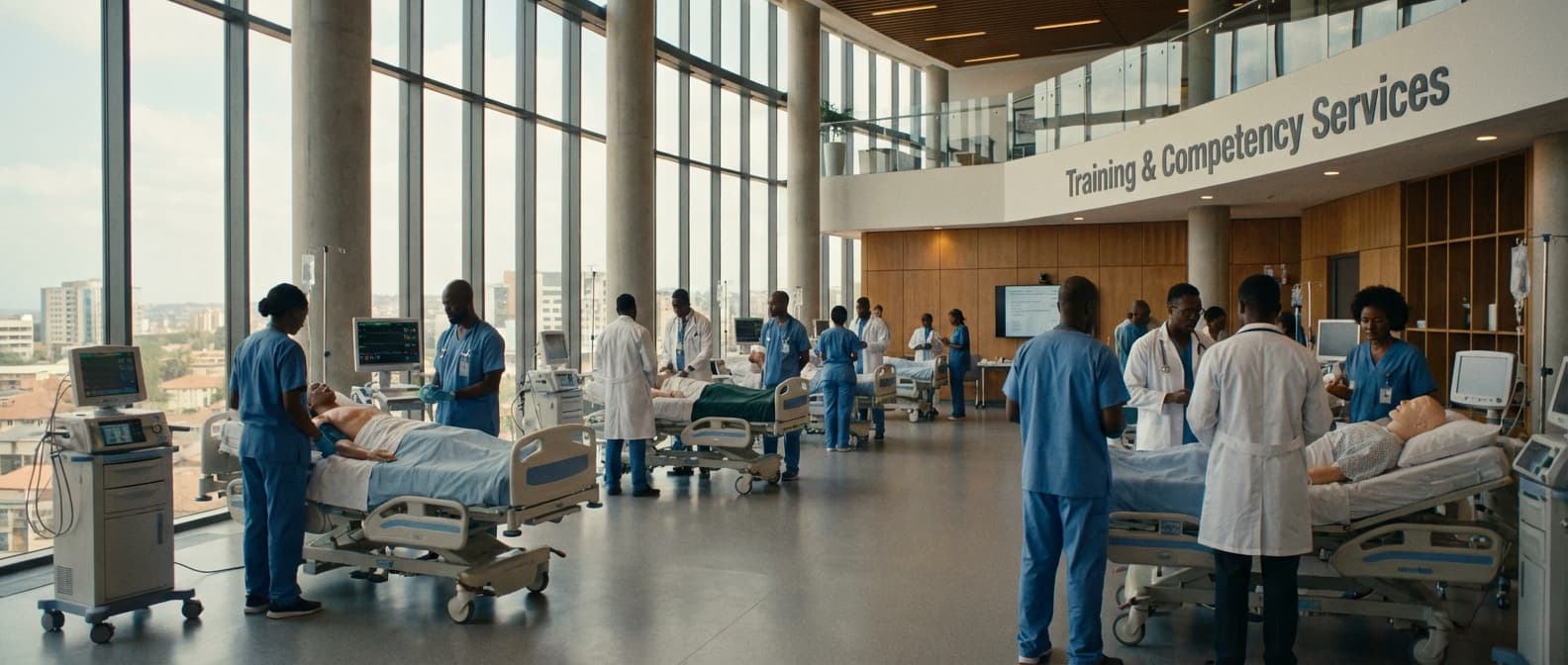
Ventilator User Training Service (Nurses) in Mali
Engineering Excellence & Technical Support
Ventilator User Training Service (Nurses) High-standard technical execution following OEM protocols and local regulatory frameworks.
Mastering Basic Ventilation Modes
Learn to confidently set and adjust essential ventilator modes (e.g., Volume Control, Pressure Control) crucial for initial patient stabilization and optimizing oxygen delivery in Malian healthcare settings.
Interpreting Key Ventilator Waveforms & Alarms
Develop the skills to accurately read pressure, flow, and volume waveforms, and respond promptly and effectively to common ventilator alarms, ensuring patient safety and timely interventions.
Routine Ventilator Maintenance & Troubleshooting
Gain practical knowledge on performing essential daily checks, basic cleaning procedures, and identifying/resolving common ventilator malfunctions to ensure reliable equipment performance and continuity of care.
What Is Ventilator User Training Service (Nurses) In Mali?
Ventilator User Training Service (Nurses) in Mali refers to a specialized educational program designed to equip registered nurses with the knowledge and practical skills necessary for the safe and effective operation of mechanical ventilators. This service addresses the critical need for proficient healthcare professionals in managing patients requiring ventilatory support, a common requirement in critical care settings. The training focuses on understanding ventilator principles, performing set-up and calibration, patient interface management, alarm troubleshooting, and weaning protocols, all within the context of Malian healthcare infrastructure and resource availability. Emphasis is placed on evidence-based practices adapted to local constraints, ensuring nurses can independently and competently utilize ventilators to improve patient outcomes.
| Target Audience | Need/Rationale | Typical Use Cases | ||||
|---|---|---|---|---|---|---|
| Registered Nurses (RNs) working in Intensive Care Units (ICUs), Emergency Departments (EDs), Operating Rooms (ORs), and high-dependency units. | To ensure competent and safe operation of mechanical ventilators, thereby improving patient outcomes and reducing morbidity/mortality associated with respiratory failure. Addresses skill gaps and the need for standardized ventilator management protocols. | Management of patients with acute respiratory failure (e.g., pneumonia, ARDS, COPD exacerbations, sepsis-induced respiratory distress). | Post-operative care for patients requiring mechanical ventilation to maintain oxygenation and ventilation. | Support for patients during diagnostic procedures requiring sedation and respiratory support. | Management of neurological conditions affecting respiratory drive (e.g., stroke, spinal cord injury). | Stabilization of critically ill patients in emergency situations prior to transfer or definitive treatment. |
Key Components of Ventilator User Training Service (Nurses) in Mali
- Principles of Mechanical Ventilation: Understanding gas exchange, respiratory mechanics, and modes of ventilation (e.g., Volume Control, Pressure Control, Pressure Support).
- Ventilator System Components: Familiarization with the physical parts of various ventilator models commonly found in Malian hospitals.
- Patient Interface Management: Proper selection and application of endotracheal tubes, tracheostomy tubes, and non-invasive ventilation masks.
- Ventilator Set-up and Calibration: Step-by-step procedures for initiating and configuring the ventilator for individual patient needs.
- Monitoring and Assessment: Continuous evaluation of patient's physiological response to ventilation, including blood gas analysis and waveform interpretation.
- Alarm Management and Troubleshooting: Recognition of common alarms, identification of root causes, and implementation of appropriate interventions.
- Weaning Protocols: Understanding criteria and methodologies for gradually reducing ventilator support and facilitating liberation.
- Infection Prevention and Control: Implementing measures to prevent ventilator-associated pneumonia (VAP) and other healthcare-associated infections.
- Emergency Procedures: Responding to critical events such as circuit disconnections, equipment failure, and patient deterioration.
- Documentation and Record-Keeping: Accurate and comprehensive charting of ventilator settings, patient responses, and interventions.
Who Needs Ventilator User Training Service (Nurses) In Mali?
This document outlines the necessity and target audience for ventilator user training services for nurses in Mali. Effective and safe operation of mechanical ventilators is critical for patient care, especially in resource-limited settings. Nurses, as the primary caregivers interacting with these devices, require comprehensive training to ensure optimal patient outcomes and minimize risks.
| Department | Rationale for Training | Key Responsibilities |
|---|---|---|
| Intensive Care Units (ICU)/Critical Care Units (CCU) | Highest concentration of ventilated patients, complex cases, need for continuous monitoring and adjustment. | Initiating ventilation, monitoring patient response, troubleshooting alarms, weaning from ventilation, managing complications. |
| Emergency Departments (ED) | Rapid assessment and stabilization of critically ill patients requiring immediate ventilation. | Emergency intubation and ventilation initiation, initial ventilator settings, transport of ventilated patients within the facility. |
| Operating Rooms (OR) | Ventilation during surgical procedures, requiring precise control and monitoring. | Setting up and managing ventilators for anesthesia, immediate post-operative ventilation needs. |
| Maternal and Child Health (MCH) Units (if applicable) | Ventilation needs for neonates and children with respiratory distress. | Specialized training for pediatric and neonatal ventilators, unique physiological considerations. |
| General Wards (for intermittent or non-invasive ventilation) | Managing patients who may require non-invasive ventilation (NIV) or short-term invasive ventilation. | Recognizing the need for ventilation, basic NIV setup and monitoring, escalation of care. |
Target Customers and Departments
- Nurses working in critical care units.
- Nurses in emergency departments.
- Nurses in operating rooms.
- Nurses in any department where mechanical ventilation may be required.
- Nurses in referral hospitals and district hospitals.
- Nurses in specialized units (e.g., neonatal intensive care units, pediatric intensive care units - if applicable).
- Nurses involved in patient transport with ventilation needs.
Ventilator User Training Service (Nurses) Process In Mali
This document outlines the workflow for the Ventilator User Training Service for nurses in Mali. It details the process from initial inquiry to the successful execution and completion of the training.
| Phase | Step | Description | Responsible Party | Key Outputs/Deliverables |
|---|---|---|---|---|
| Inquiry & Needs Assessment |
| Healthcare facility/individual expresses interest in ventilator user training for nurses. | Prospective Trainee (Hospital/Nurse), Training Provider | Expression of interest, preliminary contact details |
| Inquiry & Needs Assessment |
| Detailed discussion to understand specific training needs, number of nurses, existing knowledge, and desired learning outcomes. Assessment of available equipment and facility infrastructure. | Training Provider, Prospective Trainee | Needs assessment report, list of required training modules |
| Proposal Development & Submission |
| Based on the needs assessment, the training provider develops a comprehensive training proposal including curriculum, methodology, duration, trainers, materials, and cost. | Training Provider | Formal training proposal document |
| Proposal Development & Submission |
| Prospective trainee reviews the proposal. Negotiations may occur regarding scope, cost, and schedule. | Prospective Trainee, Training Provider | Feedback on proposal, agreed-upon adjustments |
| Proposal Development & Submission |
| Finalized proposal is formally submitted for approval by the healthcare facility's management or relevant authority. | Prospective Trainee (Internal Approval) | Approved training proposal |
| Agreement & Contracting |
| A formal training agreement is drafted outlining terms, conditions, responsibilities, payment schedules, and liabilities. | Training Provider, Prospective Trainee (Legal/Procurement) | Draft training agreement |
| Agreement & Contracting |
| Both parties review and sign the training agreement. | Prospective Trainee, Training Provider | Signed training agreement |
| Training Material Preparation |
| Finalizing training modules, presentations, handouts, and practical demonstration guides based on the agreed scope. | Training Provider | Finalized training curriculum and materials |
| Training Material Preparation |
| Ensuring availability of ventilators (training models or actual), simulation equipment, and other necessary resources. | Training Provider, Prospective Trainee (as per agreement) | Training equipment and resources secured |
| Logistics & Scheduling |
| Finalizing training dates, times, and location (on-site at the facility or a designated training center). | Training Provider, Prospective Trainee | Confirmed training schedule and venue |
| Logistics & Scheduling |
| Nurses are officially registered for the training program. | Prospective Trainee (HR/Training Dept.) | List of registered participants |
| Logistics & Scheduling |
| Communicating training details, prerequisites, and any pre-reading materials to registered participants. | Training Provider | Participant information packets |
| Training Delivery |
| Lectures, presentations, and discussions covering ventilator principles, operation, patient monitoring, and safety protocols. | Training Provider (Trainer) | Knowledge transfer |
| Training Delivery |
| Hands-on demonstrations of ventilator setup, operation, mode selection, troubleshooting, and emergency procedures. | Training Provider (Trainer) | Skill demonstration |
| Training Delivery |
| Nurses practice using ventilators under trainer supervision, often involving simulated patient scenarios. | Training Provider (Trainer), Trainees | Skill development and application |
| Assessment & Certification |
| Written or oral tests to evaluate understanding of theoretical concepts. | Training Provider | Assessment scores |
| Assessment & Certification |
| Practical observation and simulation-based assessments to evaluate proficiency in operating the ventilator. | Training Provider | Skills assessment results |
| Assessment & Certification |
| Upon successful completion of assessments, certificates are issued to the nurses. | Training Provider | Training certificates |
| Post-Training Follow-up & Evaluation |
| Collecting feedback from participants and their supervisors on the effectiveness of the training. | Training Provider, Trainees, Supervisors | Training evaluation reports |
| Post-Training Follow-up & Evaluation |
| Providing ongoing support, addressing queries, and potentially offering refresher courses as needed. | Training Provider | Sustained competence |
Ventilator User Training Service (Nurses) Process in Mali - Workflow
- Inquiry & Needs Assessment
- Proposal Development & Submission
- Agreement & Contracting
- Training Material Preparation
- Logistics & Scheduling
- Training Delivery
- Assessment & Certification
- Post-Training Follow-up & Evaluation
Ventilator User Training Service (Nurses) Cost In Mali
Providing accurate and up-to-date cost information for specialized training services like Ventilator User Training for Nurses in Mali is challenging due to several dynamic factors. These costs are not fixed and can fluctuate significantly based on the provider, the duration and depth of the training, the location within Mali, and the specific equipment being used for hands-on practice. Generally, expect costs to be presented in the Malian CFA franc (XOF).
| Training Type/Duration | Estimated Cost Range (XOF) | Notes |
|---|---|---|
| Basic Ventilator Familiarization (1-2 days) | 75,000 - 150,000 | Focus on basic principles, common settings, and initial patient setup. |
| Intermediate Ventilator Management (3-5 days) | 150,000 - 300,000 | Covers various modes, weaning strategies, and common troubleshooting. |
| Advanced Critical Care Ventilation (5+ days) | 300,000 - 600,000+ | Includes complex modes, advanced diagnostics, ventilator-associated pneumonia prevention, and specific patient populations. |
| Customized/On-site Training (per day, group) | 200,000 - 500,000+ | Highly variable based on scope, duration, and number of participants. May include travel and accommodation for trainers. |
Key Pricing Factors for Ventilator User Training (Nurses) in Mali:
- Training Provider: The reputation and accreditation of the training institution or organization will heavily influence the price. Established medical training centers or international organizations may charge more than smaller, local initiatives.
- Duration and Intensity: A comprehensive, multi-day course covering various ventilation modes, troubleshooting, and emergency protocols will naturally be more expensive than a shorter, introductory session.
- Curriculum Content: The depth and breadth of the curriculum, including theoretical knowledge, practical simulations, and case studies, will impact the cost.
- Location of Training: Training conducted in major cities like Bamako might have different overhead costs compared to more remote areas. Travel and accommodation for trainers could also be factored in if the training is off-site.
- Equipment Availability and Usage: If the training requires hands-on practice with advanced or specialized ventilators, the cost of using or accessing this equipment might be incorporated.
- Trainer Expertise and Qualifications: Highly experienced and qualified medical professionals (e.g., intensivists, respiratory therapists) as trainers will command higher fees.
- Materials and Resources: The provision of training manuals, assessment tools, and online resources can contribute to the overall cost.
- Group Size: Training for larger groups might offer a per-person discount, while smaller, more personalized sessions could be priced higher on an individual basis.
- Accreditation and Certification: If the training leads to a recognized certification, this often adds to the cost due to the administrative and assessment processes involved.
- Government or NGO Subsidies: In some cases, training may be subsidized by government health initiatives or non-governmental organizations, leading to reduced costs for participants.
Affordable Ventilator User Training Service (Nurses) Options
Providing comprehensive and affordable ventilator user training for nurses is crucial for patient safety and efficient healthcare delivery. This service focuses on equipping nurses with the knowledge and skills to operate various ventilator models effectively, troubleshoot common issues, and understand critical ventilation parameters. We offer flexible training solutions designed to meet the diverse needs and budgets of healthcare facilities. Our value bundles are structured to provide significant cost savings while ensuring high-quality, hands-on training.
| Cost-Saving Strategy | Description | Impact on Affordability |
|---|---|---|
| Bulk Training Discounts | Reduced per-nurse cost when training larger groups from the same facility simultaneously. | Significantly lowers overall training expenditure. |
| Train-the-Trainer Program | Empowers selected facility staff to deliver ongoing in-house training, reducing reliance on external services for recurring needs. | Long-term cost reduction and increased training autonomy. |
| Blended Learning Approach | Combines online modules (e-learning for foundational knowledge) with in-person hands-on practice sessions, optimizing instructor time and facility resources. | Reduces on-site training duration and associated travel/accommodation costs. |
| Equipment Agnostic Training (with model-specific add-ons) | Core curriculum covers universal ventilator principles, with optional, cost-effective modules for specific ventilator models used by the facility. | Avoids the expense of training on every single model if not all are in use, while still ensuring proficiency on critical equipment. |
| Flexible Scheduling | Training can be scheduled during off-peak hours or in smaller, manageable sessions to minimize disruption to patient care and reduce overtime costs. | Maintains operational efficiency and avoids costly staff shortages. |
| Partnership Programs | Long-term contracts with healthcare systems or hospital networks for a consistent, predictable training pipeline, often at preferential rates. | Secures discounted pricing and dedicated service levels for sustained training needs. |
Value Bundles for Affordable Ventilator User Training (Nurses)
- {"title":"Essential Skills Bundle","description":"Covers fundamental ventilator operation, basic modes of ventilation, patient connection, initial setup, and emergency procedures. Ideal for new graduates or nurses transitioning to critical care."}
- {"title":"Advanced Modes & Troubleshooting Bundle","description":"Expands on the Essential Skills Bundle, introducing advanced ventilation modes (e.g., Pressure Support, BiPAP, APAP), common waveform analysis, alarms and troubleshooting, and weaning parameters. Suitable for experienced critical care nurses seeking to deepen their expertise."}
- {"title":"Comprehensive Ventilator Management Bundle","description":"The most complete package, integrating all aspects from basic to advanced ventilation, including pharmacology's impact on ventilation, patient monitoring integration, non-invasive ventilation strategies, and special population considerations (e.g., pediatrics, neonates). Includes scenario-based simulations and competency assessments."}
- {"title":"Customizable On-Demand Bundle","description":"Allows facilities to select specific modules or topics based on their unique equipment and patient populations. This flexible option ensures training is tailored to exact needs."}
Verified Providers In Mali
When seeking healthcare services in Mali, particularly those that require a high degree of trust and expertise, identifying 'Verified Providers' is crucial. This verification process ensures that healthcare professionals and facilities meet stringent standards for quality, safety, and ethical practice. Among the leading entities that facilitate such verification is Franance Health. Their rigorous credentialing process not only validates the qualifications of medical practitioners but also scrutinizes the operational standards of healthcare facilities. This meticulous approach makes Franance Health credentials a strong indicator of reliable and high-quality healthcare in Mali, positioning them as the best choice for patients seeking assurance and excellence.
| Benefit | Description | Why it's the Best Choice |
|---|---|---|
| Quality Assurance | Franance Health's verification guarantees that providers have met recognized benchmarks for medical competence and patient care. | Ensures you receive treatment from qualified and skilled professionals. |
| Patient Safety | The stringent assessment of facilities and practices minimizes risks associated with healthcare delivery. | Reduces the likelihood of complications and promotes a secure healing environment. |
| Trust and Transparency | Their credentialing process offers a clear and verifiable indication of a provider's legitimacy and expertise. | Builds confidence and reduces uncertainty when choosing a healthcare provider. |
| Access to Excellence | Franance Health often partners with leading healthcare institutions and specialists in Mali. | Provides access to the highest caliber of medical services and advanced treatments available. |
| Peace of Mind | Knowing that a provider has undergone a thorough verification process offers significant reassurance. | Allows you to focus on your recovery without worrying about the quality or legitimacy of your care. |
Key Aspects of Franance Health Verification:
- Comprehensive Practitioner Assessment: Franance Health rigorously examines the academic qualifications, professional licenses, and clinical experience of healthcare providers.
- Facility Standards Evaluation: They assess healthcare facilities for adherence to safety protocols, equipment maintenance, hygiene standards, and patient care infrastructure.
- Ethical Practice Compliance: A thorough review of ethical conduct and patient rights protection is a cornerstone of their verification process.
- Continuous Monitoring: Franance Health often implements ongoing monitoring to ensure that verified providers and facilities maintain their standards over time.
- Patient Confidence Building: Their verification serves as a trusted mark, empowering patients to make informed decisions about their healthcare.
Scope Of Work For Ventilator User Training Service (Nurses)
This Scope of Work (SOW) outlines the requirements for providing comprehensive ventilator user training services specifically tailored for registered nurses. The training aims to equip nurses with the necessary knowledge and skills to safely and effectively operate, monitor, and manage patients requiring mechanical ventilation. This SOW details the technical deliverables, standard specifications, and expected outcomes of the training program.
| Technical Deliverable | Standard Specification | Description | Target Audience | Evaluation Method |
|---|---|---|---|---|
| Training Curriculum | Comprehensive, modular, and evidence-based. | Includes theoretical concepts, practical application, and case studies covering ventilator modes, settings, monitoring, troubleshooting, and weaning protocols. | Registered Nurses (RNs) across various specialties (ICU, ER, Med-Surg with ventilator capabilities). | Curriculum review by clinical education experts and nursing leadership. |
| Training Materials | High-quality, user-friendly, and accessible. | Includes presentations, handouts, user manuals, video demonstrations, and interactive learning modules. Materials will be provided in digital and/or print formats. | All trained nurses. | Feedback surveys on material clarity and usefulness. |
| Hands-on Simulation Sessions | Realistic, interactive, and competency-based. | Utilizing high-fidelity manikins and actual or simulated ventilators to practice skills such as setting up, adjusting ventilator parameters, responding to alarms, and managing simulated patient scenarios. | All trained nurses. | Direct observation of skills proficiency by certified instructors. |
| Knowledge Assessment | Objective and valid. | Includes pre- and post-training quizzes, multiple-choice questions, and scenario-based questions to evaluate theoretical understanding. | All trained nurses. | Minimum passing score (e.g., 80%) required for certification. |
| Skills Competency Checklist | Standardized and observable. | A checklist used by instructors to assess and document the demonstration of critical skills during simulation sessions. | All trained nurses. | Successful completion of all critical steps on the checklist. |
| Training Certification | Formal and verifiable. | Issuance of a certificate upon successful completion of both knowledge assessment and skills competency evaluation, indicating the scope of training received. | Nurses achieving satisfactory scores and competency. | Issuance of official certificates. |
| Post-Training Support Resources | Accessible and ongoing. | Provision of access to online resources, Q&A sessions with experts, or refresher course opportunities to reinforce learning and address emerging questions. | All trained nurses. | User engagement with provided resources. |
| Training Report | Comprehensive and actionable. | A report detailing training dates, locations, number of participants, assessment results, and any recommendations for further training or improvement. | Healthcare Institution's management and education department. | Delivery of a final report within a specified timeframe (e.g., 2 weeks post-training). |
Objectives of the Ventilator User Training Service (Nurses)
- To provide nurses with a thorough understanding of ventilator principles of operation and functionality.
- To train nurses on the safe initiation, management, and discontinuation of mechanical ventilation.
- To enable nurses to identify and respond to common ventilator-associated complications and alarms.
- To ensure nurses can accurately interpret ventilator settings and patient parameters.
- To promote evidence-based best practices in ventilator care.
- To enhance nurses' confidence and competence in managing ventilated patients.
Service Level Agreement For Ventilator User Training Service (Nurses)
This Service Level Agreement (SLA) outlines the guaranteed response times and uptime for the Ventilator User Training Service provided to nurses. This SLA is designed to ensure that users receive timely support and that the training platform is consistently available for scheduled sessions and self-paced learning.
| Service Component | Response Time Guarantee | Uptime Guarantee | Measurement Period |
|---|---|---|---|
| Live Training Session Support (Urgent Issues) | 15 minutes | 99.5% | 24x7x365 |
| Technical Support (Non-Urgent Issues, e.g., platform access, content issues) | 4 business hours | 99.5% | Business Hours (Mon-Fri, 8 AM - 5 PM, excluding holidays) |
| Platform Availability (for self-paced learning and scheduled sessions) | N/A | 99.5% | 24x7x365 |
Key Performance Indicators (KPIs)
- Response Time: The time taken to acknowledge and begin addressing a support request.
- Uptime: The percentage of time the Ventilator User Training Service is operational and accessible.
Frequently Asked Questions

Ready when you are
Let's scope your Ventilator User Training Service (Nurses) in Mali project in Mali.

Scaling healthcare logistics and technical systems across the entire continent.