
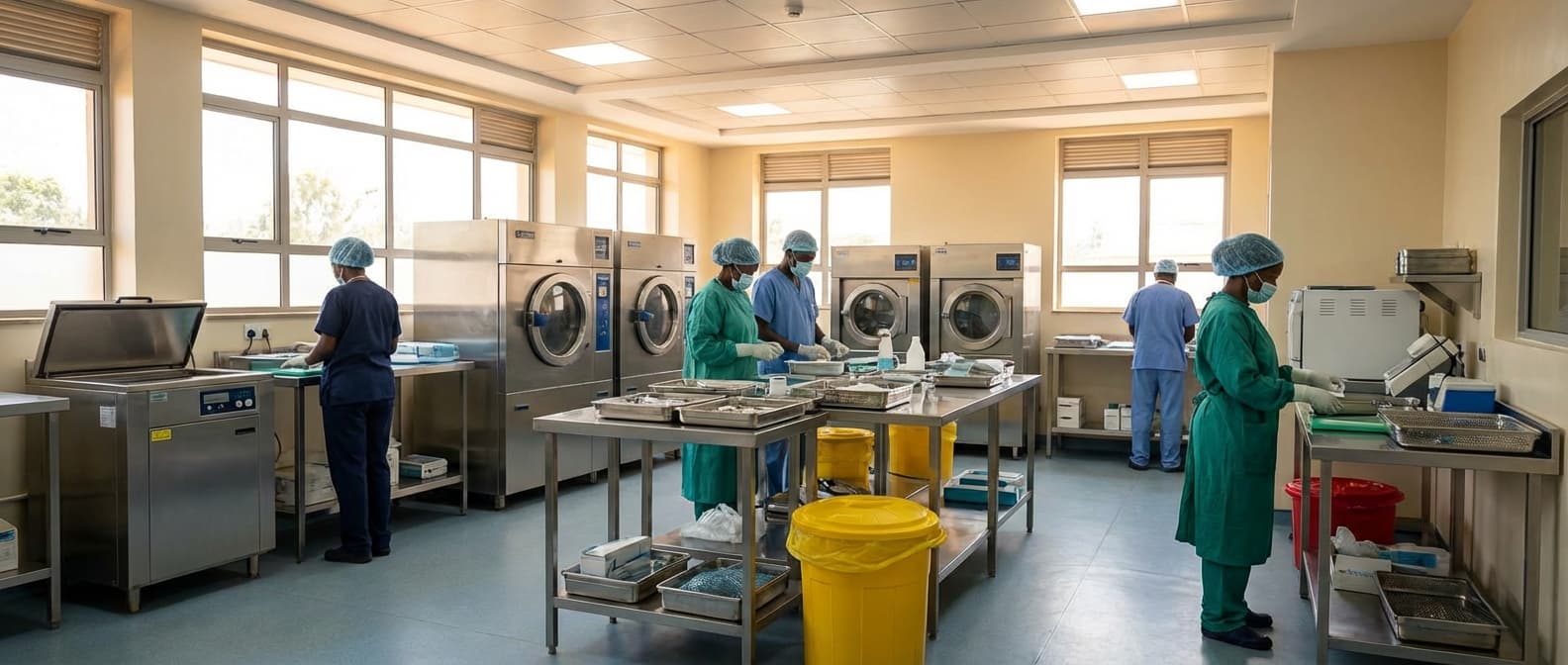
Infection-Control Readiness Support Service for Reusable Equipment in Mali
Engineering Excellence & Technical Support
Infection-Control Readiness Support Service for Reusable Equipment High-standard technical execution following OEM protocols and local regulatory frameworks.
Advanced Autoclave & Steam Sterilization Training
Provided intensive hands-on training to Malian healthcare technicians on the proper operation, maintenance, and validation of steam sterilizers (autoclaves). This ensures effective inactivation of all microorganisms on critical and semi-critical reusable medical equipment, significantly reducing the risk of nosocomial infections.
Enhanced PPE Protocol Implementation
Developed and delivered comprehensive training modules on the correct selection, use, and disposal of Personal Protective Equipment (PPE) for staff handling reusable medical devices. This initiative establishes robust barriers against pathogen transmission during cleaning, disinfection, and sterilization processes.
Reusable Equipment Traceability System Deployment
Implemented a digital traceability system to track the lifecycle of reusable medical equipment from patient use through reprocessing and sterilization. This allows for efficient inventory management, identification of any equipment requiring re-processing, and supports root cause analysis for potential breaches in sterilization protocols.
What Is Infection-control Readiness Support Service For Reusable Equipment In Mali?
Infection-Control Readiness Support Service for Reusable Equipment (ICRSE) in Mali refers to a comprehensive package of technical assistance and capacity-building designed to ensure that healthcare facilities maintain and utilize reusable medical equipment in a manner that prevents the transmission of healthcare-associated infections (HAIs). This service is critical for bolstering the safety and efficacy of healthcare delivery within the Malian context, where resource limitations and a high burden of infectious diseases necessitate robust infection prevention and control (IPC) measures.
| Stakeholder/Entity | Need for ICRSE | Typical Use Cases |
|---|---|---|
| Public Healthcare Facilities (Hospitals, Health Centers) | Essential for preventing HAIs, ensuring patient safety, and maintaining the functionality of critical medical equipment. Crucial in settings with high patient turnover and limited access to disposable alternatives. | Reprocessing of surgical instruments, endoscopes, syringes, needles, thermometers, and other reusable medical devices used in diagnosis, treatment, and patient care. |
| Private Healthcare Providers | Ensures compliance with national IPC guidelines and international best practices, thereby enhancing the quality and safety of services offered to patients. | Similar to public facilities, with a focus on consistent application of reprocessing protocols across all patient interactions. |
| Ministry of Health and Local Health Authorities | Supports the development and enforcement of national IPC policies and standards, contributes to national health security, and facilitates effective resource allocation for IPC initiatives. | Development of national guidelines for reusable equipment reprocessing, training of trainers programs, and oversight of IPC implementation in healthcare facilities. |
| Non-Governmental Organizations (NGOs) and International Partners | Provides a framework for targeted interventions and capacity building in IPC, especially in resource-limited settings or during public health emergencies. | Implementing IPC programs in remote or underserved areas, supporting the rehabilitation of reprocessing units, and providing essential equipment and training to healthcare facilities. |
| Healthcare Workers (Nurses, Technicians, Doctors, Environmental Services Staff) | Enhances their knowledge, skills, and adherence to safe reprocessing practices, reducing the risk of occupational exposure to pathogens. | Directly involved in the daily cleaning, disinfection, and sterilization of reusable equipment according to established SOPs and training received. |
Key Components of ICRSE
- Assessment of current IPC practices for reusable equipment management.
- Development and implementation of Standard Operating Procedures (SOPs) for cleaning, disinfection, sterilization, storage, and handling of reusable medical devices.
- Provision of training and competency assessment for healthcare workers involved in equipment reprocessing.
- Guidance on the selection, procurement, and maintenance of appropriate reprocessing equipment and consumables.
- Support for establishing and maintaining a robust monitoring and evaluation system for IPC compliance.
- Technical advice on the management of reprocessing areas (e.g., ventilation, workflow design).
- Assistance with waste management protocols related to reusable equipment reprocessing.
- Facilitation of access to essential IPC supplies and consumables.
Who Needs Infection-control Readiness Support Service For Reusable Equipment In Mali?
Infection-control readiness for reusable medical equipment in Mali is a critical area for improving healthcare safety and preventing the spread of infections. This is particularly relevant in settings where resources may be limited and the burden of infectious diseases is high. Target customers for such a support service would be facilities and entities involved in the provision and management of healthcare, with specific departments playing a key role in implementing and benefiting from these services.
| Primary Target Customer | Key Departments Involved | Specific Needs/Roles |
|---|---|---|
| Hospitals | Infection Prevention and Control (IPC) Unit, Central Sterile Supply Department (CSSD), Surgical Ward, Operating Rooms, Pharmacy, Nursing Departments | Ensuring consistent adherence to sterilization and disinfection protocols, training staff, equipment maintenance and validation, developing SOPs. |
| Health Centers & Clinics | Nursing Staff, Clinical Officers, Facility Managers, Local Health Supervisors | Basic training on cleaning and disinfection, access to appropriate supplies and equipment, basic infection control guidance. |
| Maternity & Child Health Centers | Midwives, Pediatric Nurses, IPC Focal Points | Specific protocols for delivery instruments, neonatal care equipment, safe handling of reusable items. |
| Surgical Centers & Operating Theaters | Surgeons, Anesthetists, Scrub Nurses, CSSD Technicians | High-level disinfection and sterilization validation, advanced training, maintenance of specialized equipment. |
| Dental Clinics | Dentists, Dental Assistants, Clinic Managers | Protocols for dental instruments, handpieces, and other reusable dental items. |
| Laboratories | Laboratory Technicians, Lab Managers | Sterilization of glassware, slides, and reusable diagnostic equipment, biohazard management. |
| NGOs & International Health Organizations | Program Managers, Medical Coordinators, Field Staff | Ensuring their implemented projects meet infection control standards, capacity building of local partners, procurement of essential supplies. |
| Ministry of Health (MoH) & Regional Health Directorates | IPC Department, Planning and Monitoring Units, Procurement Departments, Training Units | Developing national guidelines, supporting policy implementation, resource allocation, training curriculum development, oversight and evaluation. |
| Medical Training Institutions | Faculty (especially in nursing, medicine, and public health), Students, Simulation Lab Technicians | Integrating infection control principles into curricula, providing practical training on equipment reprocessing, demonstrating best practices. |
Target Customers & Departments for Reusable Equipment Infection-Control Readiness Support Service in Mali
- Hospitals: All levels of hospitals, from large urban centers to smaller district hospitals, are primary beneficiaries.
- Health Centers & Clinics: Primary healthcare facilities that often serve a large portion of the population.
- Maternity & Child Health Centers: Facilities with a high volume of reusable instruments and a vulnerable patient population.
- Surgical Centers & Operating Theaters: Environments where meticulous sterilization and disinfection are paramount.
- Dental Clinics: Regularly utilize reusable instruments requiring thorough infection control.
- Laboratories: Handle reusable glassware and equipment that needs to be free of contamination.
- Non-Governmental Organizations (NGOs) & International Health Organizations: Organizations implementing health programs and providing medical supplies or training.
- Ministry of Health (MoH) & Regional Health Directorates: Government bodies responsible for setting standards, policy, and overseeing healthcare infrastructure.
- Medical Training Institutions: Schools and universities that train healthcare professionals and have practical training facilities.
Infection-control Readiness Support Service For Reusable Equipment Process In Mali
This document outlines the workflow for the Infection-Control Readiness Support Service for Reusable Equipment Processes in Mali. It details the steps involved from the initial inquiry by a healthcare facility or stakeholder to the successful execution of support services aimed at strengthening infection prevention and control (IPC) practices related to reusable medical equipment.
| Phase | Key Activities | Responsible Parties | Deliverables | Timeline |
|---|---|---|---|---|
| Inquiry and Needs Assessment | Initial contact by healthcare facility/stakeholder; preliminary discussion of IPC challenges with reusable equipment; identification of potential support needs. | Healthcare Facility/Stakeholder, Service Provider (e.g., Ministry of Health IPC Unit, NGO) | Initial meeting minutes, preliminary needs identified. | Immediate upon contact |
| Service Request and Prioritization | Formal submission of a service request; assessment of request against established criteria (e.g., urgency, impact, resource availability); prioritization of support requests. | Healthcare Facility/Stakeholder, Service Provider | Registered service request, priority level assigned. | 1-3 business days after inquiry |
| Planning and Resource Allocation | Detailed planning of support activities; identification of required personnel, materials, and budget; allocation of resources. | Service Provider | Detailed work plan, budget, allocated team. | 3-5 business days after prioritization |
| On-site Assessment and Gap Analysis | Team visits the facility; observes current practices for reusable equipment decontamination, sterilization, storage, and handling; identifies specific gaps and challenges based on national guidelines and best practices. | Service Provider Team (IPC experts, technicians) | On-site assessment report, detailed gap analysis matrix. | 1-2 weeks (depending on facility size and complexity) |
| Development of Customized Action Plan | Based on the gap analysis, a tailored action plan is developed with specific, measurable, achievable, relevant, and time-bound (SMART) objectives and interventions. | Service Provider Team, in consultation with Facility Management | Customized Action Plan document. | 1 week after on-site assessment |
| Training and Capacity Building | Conducts hands-on training sessions for healthcare workers on proper IPC procedures for reusable equipment (e.g., cleaning, disinfection, sterilization, packaging, storage, handling). | Service Provider Trainers, Healthcare Facility Staff | Training modules, trained personnel, attendance records. | Variable (ongoing during intervention phase) |
| Technical Support and Mentorship | Provides direct technical assistance, troubleshooting, and ongoing mentorship to facility staff to implement the action plan and address challenges in real-time. | Service Provider Experts/Mentors, Facility Staff | On-the-job guidance, problem-solving support. | Variable (ongoing during intervention phase) |
| Supply Chain and Infrastructure Support (as needed) | Assesses and advises on needs for appropriate cleaning and sterilization supplies, equipment maintenance, and infrastructure improvements; facilitates procurement or referral if necessary. | Service Provider, Ministry of Health, Local Suppliers/Partners | Recommendations for supplies/equipment, procurement support (if applicable). | Variable (integrated with other phases) |
| Monitoring and Evaluation | Regularly monitors the implementation of the action plan; collects data on key IPC indicators; assesses progress and identifies areas for improvement. | Service Provider Team, Facility IPC Committee | Monitoring reports, data dashboards, updated gap analysis. | Ongoing throughout the intervention and follow-up phases |
| Reporting and Follow-up | Submits comprehensive reports to stakeholders on services provided, progress achieved, and recommendations; schedules follow-up visits to ensure sustainability of improvements. | Service Provider | Final service delivery report, follow-up visit reports. | End of intervention phase, and scheduled follow-ups |
| Sustainability and Continuous Improvement | Works with facility to establish mechanisms for ongoing self-monitoring, quality improvement, and regular IPC training to ensure long-term adherence to best practices. | Facility Management, Facility IPC Committee, Service Provider (advisory) | Established self-monitoring tools, updated IPC policies, staff competency assessment plan. | Ongoing |
Workflow for Infection-Control Readiness Support Service for Reusable Equipment Process in Mali
- Inquiry and Needs Assessment
- Service Request and Prioritization
- Planning and Resource Allocation
- On-site Assessment and Gap Analysis
- Development of Customized Action Plan
- Training and Capacity Building
- Technical Support and Mentorship
- Supply Chain and Infrastructure Support (as needed)
- Monitoring and Evaluation
- Reporting and Follow-up
- Sustainability and Continuous Improvement
Infection-control Readiness Support Service For Reusable Equipment Cost In Mali
This document outlines the pricing factors and ranges for an Infection-Control Readiness Support Service for Reusable Equipment in Mali. The service aims to ensure that healthcare facilities have the necessary protocols, training, and equipment maintenance to safely reprocess reusable medical devices, minimizing the risk of healthcare-associated infections. Pricing is influenced by a combination of service components, facility characteristics, and the complexity of the reusable equipment inventory. The local currency for pricing is the Malian Franc (XOF).
| Service Component / Scenario | Estimated Price Range (XOF) | Notes |
|---|---|---|
| Basic Training Module (e.g., 2-day workshop for 10 staff on general reprocessing principles) | 150,000 - 300,000 | Covers core principles, does not include specific equipment training or site assessment. |
| Comprehensive Training (e.g., 5-day workshop for 20 staff, including specific equipment handling and troubleshooting) | 400,000 - 800,000 | Includes practical sessions and basic protocol review. |
| Protocol Development and Review (for a small clinic or department) | 200,000 - 500,000 | Focuses on establishing or updating standard operating procedures. |
| Equipment Inventory and Readiness Assessment (for a medium-sized facility) | 300,000 - 700,000 | Involves on-site evaluation of existing equipment and reprocessing practices. |
| Full Readiness Support Package (for a medium-sized hospital: training, protocol development, equipment assessment, 3-month follow-up) | 1,500,000 - 3,500,000 | A comprehensive solution for establishing robust infection control practices. |
| Ongoing Consultation and Auditing (per quarter, for a medium-sized facility) | 250,000 - 600,000 | Includes site visits, debriefings, and recommendations. |
| Specialized Endoscope Reprocessing Support (per facility, including training and protocol review) | 500,000 - 1,200,000 | Addresses the unique challenges and high-risk nature of endoscopes. |
| Travel and Per Diem (per consultant, per day, outside of major urban centers) | 50,000 - 150,000 | Variable based on distance and accommodation costs. |
Key Pricing Factors:
- Scope of Services: The breadth and depth of the infection control support provided (e.g., training only, protocol development, equipment assessment, auditing, ongoing consultation).
- Facility Size and Complexity: The number of beds, the types of departments (e.g., surgical, emergency, maternity), and the volume of reusable equipment used.
- Type and Volume of Reusable Equipment: The variety of instruments (e.g., surgical instruments, endoscopes, respiratory equipment), their quantity, and their reprocessing requirements (e.g., high-level disinfection vs. sterilization).
- Training Needs: The number of staff requiring training, the duration of the training sessions, and the need for specialized training on specific equipment or processes.
- Equipment Assessment and Auditing: The extent of the assessment, including on-site evaluations, inventory verification, and adherence to reprocessing standards.
- Location and Accessibility: Travel costs and logistics for service personnel to reach remote or difficult-to-access facilities.
- Frequency of Service: One-time setup vs. ongoing support contracts (e.g., quarterly audits, monthly consultations).
- Customization: Tailoring of services to meet the specific needs and budget of each healthcare facility.
- Local Market Conditions: Competitor pricing and the overall economic environment in Mali.
- Supply Chain and Availability of Consumables: While the service primarily focuses on expertise, the availability and cost of associated reprocessing consumables (if factored in) can indirectly influence pricing.
Affordable Infection-control Readiness Support Service For Reusable Equipment Options
This service aims to enhance the infection control readiness for healthcare facilities utilizing reusable medical equipment. We understand the budgetary constraints many organizations face, and our tiered value bundles are designed to offer comprehensive support at various price points. Our cost-saving strategies focus on preventing costly outbreaks, optimizing reprocessing workflows, and leveraging technology for efficiency.
| Cost-Saving Strategy | Description | Impact on Reusable Equipment Infection Control |
|---|---|---|
| Preventative Outbreak Management | Proactive identification and mitigation of potential infection risks associated with reusable equipment. | Reduces the significant financial and reputational costs associated with healthcare-associated infections (HAIs), including extended patient stays, increased treatment expenses, and legal liabilities. |
| Optimized Reprocessing Workflows | Streamlining the cleaning, disinfection, and sterilization processes to ensure efficiency and compliance. | Minimizes equipment downtime, leading to better asset utilization and reduced need for expensive rentals or premature replacements. Ensures staff time is used effectively. |
| Technological Integration & Monitoring | Leveraging real-time tracking and reporting systems for equipment and process adherence. | Improves traceability, reduces manual errors, and provides data-driven insights for continuous improvement. Helps identify bottlenecks and areas for cost reduction. |
| Standardized Training Programs | Providing consistent, up-to-date, and effective training for all staff involved in reusable equipment handling. | Reduces the incidence of human error, which can lead to reprocessing failures and subsequent infections. Minimizes the cost of retraining due to inconsistent practices. |
| Evidence-Based Policy Development | Assisting in the creation and refinement of infection control policies and procedures. | Ensures compliance with regulatory standards, reducing the risk of fines and penalties. Promotes best practices, leading to a safer patient environment and fewer costly incidents. |
Key Value Bundles:
- {"title":"Essential Readiness Bundle","description":"Our foundational offering, perfect for smaller clinics or those with a limited range of reusable equipment. Includes core training, policy review, and basic auditing."}
- {"title":"Proactive Preparedness Bundle","description":"A comprehensive package for facilities with a moderate scope of reusable equipment. Builds upon the Essential bundle with advanced training, workflow analysis, and simulated outbreak response planning."}
- {"title":"Total Compliance & Optimization Bundle","description":"Our premium solution for larger hospitals or those with complex reprocessing needs. Encompasses all features of the Proactive bundle plus real-time monitoring integration, custom compliance reporting, and strategic planning for future challenges."}
Verified Providers In Mali
Ensuring access to quality healthcare in Mali is paramount, and choosing verified providers is the first step. Franance Health stands out as a leading organization in Mali, offering a robust network of credentialed healthcare professionals and facilities. Their rigorous vetting process and commitment to excellence make them the superior choice for individuals seeking reliable and high-standard medical care.
| Provider Type | Franance Health Verification Focus | Benefits for Patients |
|---|---|---|
| Doctors (General Practitioners & Specialists) | Medical license, board certification, years of practice, peer reviews, disciplinary records. | Access to qualified and experienced medical professionals, accurate diagnosis, effective treatment plans. |
| Clinics & Hospitals | Facility licenses, compliance with health regulations, available equipment, staff qualifications, patient safety protocols. | Safe and well-equipped medical facilities, adherence to international standards, improved patient outcomes. |
| Diagnostic Laboratories | Laboratory licenses, technician qualifications, quality control measures, accreditation status. | Reliable and accurate diagnostic results, supporting precise medical decision-making. |
| Pharmacies | Pharmacy licenses, dispensing qualifications, drug sourcing and storage protocols. | Access to authentic and safely stored medications, prescribed by qualified professionals. |
Why Choose Franance Health for Verified Providers in Mali:
- Rigorous Credentialing Process: Franance Health employs a multi-faceted approach to verify the qualifications, licenses, and experience of all affiliated healthcare providers. This ensures that patients are in the hands of competent and ethical professionals.
- Commitment to Quality Standards: Beyond basic credentials, Franance Health actively monitors and upholds high standards of patient care, facility infrastructure, and ethical practices among its network. This commitment translates to a consistently superior healthcare experience.
- Comprehensive Network: Franance Health has established a broad network of doctors, specialists, clinics, and hospitals across Mali, providing access to a wide range of medical services and specialties. This accessibility is crucial for timely and effective treatment.
- Patient-Centric Approach: The organization prioritizes patient well-being and satisfaction, ensuring that their network providers are not only clinically excellent but also foster a supportive and communicative patient-provider relationship.
- Transparency and Trust: Franance Health is dedicated to transparency in its operations and provider credentials. This builds trust and confidence for individuals seeking healthcare services, allowing them to make informed decisions.
Scope Of Work For Infection-control Readiness Support Service For Reusable Equipment
This Scope of Work outlines the requirements for Infection-Control Readiness Support Services focused on reusable medical equipment. The service aims to ensure that healthcare facilities maintain optimal infection prevention and control (IPC) practices for their reusable equipment, minimizing the risk of healthcare-associated infections (HAIs). This includes a comprehensive review of current processes, implementation of best practices, training, and provision of technical specifications for equipment and consumables.
| Phase/Activity | Description | Technical Deliverables | Standard Specifications (Examples) | ||||
|---|---|---|---|---|---|---|---|
| Phase 1: Assessment and Gap Analysis | Conduct a thorough review of existing policies, procedures, equipment inventory, infrastructure, and staff training related to reusable equipment reprocessing. | Gap analysis report detailing strengths, weaknesses, and areas for improvement. | N/A (Assessment phase) | ||||
| Phase 2: Protocol Development and Optimization | Develop or revise SOPs for cleaning, disinfection, and sterilization of all categories of reusable equipment (e.g., surgical instruments, endoscopes, respiratory therapy devices). | Comprehensive set of evidence-based SOPs for reusable equipment reprocessing. | Manufacturer's Instructions for Use (IFU) for equipment and reprocessing agents. | Guidelines from CDC, WHO, AAMI, and local health authorities. | |||
| Phase 3: Equipment and Consumables Evaluation | Evaluate existing reprocessing equipment (e.g., washers, disinfectors, sterilizers) and consumables (e.g., detergents, disinfectants, sterilization indicators). Recommend upgrades or new acquisitions as needed. | Equipment and consumables evaluation report with recommendations. | Specifications for automated cleaning and disinfection units (e.g., capacity, cycle times, temperature controls, validation parameters). | Specifications for sterilizers (e.g., type: steam, EtO, H2O2; chamber size, cycle parameters, validation requirements). | Specifications for cleaning agents (e.g., enzymatic, alkaline, pH, biodegradability, efficacy data). | Specifications for high-level disinfectants (e.g., chemical composition, contact time, concentration, efficacy testing data). | Specifications for chemical and biological indicators (e.g., classification, performance standards). |
| Phase 4: Training and Competency | Develop and deliver training programs for all relevant personnel on proper reprocessing techniques, IPC principles, and use of equipment. | Training materials (manuals, presentations). | Competency assessment tools and records. | Training curriculum covering: anatomy of reusable equipment, principles of decontamination, proper use of cleaning agents, operating instructions for reprocessing equipment, interpretation of sterilization monitoring results, aseptic technique for handling sterile items, documentation requirements. | |||
| Phase 5: Implementation and Monitoring | Assist in the implementation of new SOPs and provide ongoing support. | Monitoring and audit plan for reprocessing processes. | Regular performance reports. | Specifications for internal and external quality control processes. | Documentation requirements for traceability and compliance (e.g., load records, maintenance logs, competency records). | ||
| Phase 6: Continuous Improvement | Establish a system for ongoing monitoring, feedback, and continuous improvement of reusable equipment IPC practices. | Framework for root cause analysis of any IPC breaches or deviations. | Recommendations for process enhancements based on audit findings and emerging best practices. | N/A (Ongoing process) |
Key Objectives of the Service
- Assess the current state of reusable equipment reprocessing and infection control practices.
- Develop and implement evidence-based protocols and Standard Operating Procedures (SOPs) for the cleaning, disinfection, and sterilization of reusable equipment.
- Provide training and competency assessment for staff involved in reusable equipment management.
- Evaluate and recommend appropriate equipment and consumables for effective reprocessing.
- Ensure compliance with relevant national and international guidelines and regulations.
- Establish a framework for continuous monitoring and quality improvement of reusable equipment IPC.
Service Level Agreement For Infection-control Readiness Support Service For Reusable Equipment
This Service Level Agreement (SLA) outlines the response times and uptime guarantees for the Infection-Control Readiness Support Service for Reusable Equipment. This service ensures that critical reusable medical equipment is consistently available and meets stringent infection control standards, minimizing risk to patients and healthcare providers.
| Service Category | Response Time Guarantee (Business Hours) | Uptime Guarantee (Monthly) | Escalation Procedure |
|---|---|---|---|
| Critical Equipment Malfunction (e.g., Sterilizers, Disinfection Units) | 1 Hour | 99.9% | Immediate notification to designated IT and Biomedical Engineering leads. On-site technician dispatched within 1 hour. |
| Urgent Equipment Malfunction (e.g., Imaging Equipment requiring sterile components) | 2 Hours | 99.5% | Notification to Biomedical Engineering. On-site technician dispatched within 2 hours. |
| Routine Maintenance & Preventative Checks | Scheduled per agreement (e.g., weekly, monthly) | N/A (focus on scheduled completion) | Follow-up within 24 business hours if scheduled maintenance is missed. |
| Suspected Contamination Incident Response | 30 Minutes | N/A (focus on rapid containment and remediation) | Immediate notification to Infection Control Department and relevant clinical staff. On-site support for assessment and containment within 30 minutes. |
Key Service Components
- Proactive maintenance and inspection of designated reusable equipment.
- Rapid response for equipment malfunction or suspected contamination.
- On-site technical support for troubleshooting and repair.
- Supply chain management for necessary consumables and replacement parts.
- Documentation and reporting of all service activities.
Frequently Asked Questions

Ready when you are
Let's scope your Infection-Control Readiness Support Service for Reusable Equipment in Mali project in Mali.

Scaling healthcare logistics and technical systems across the entire continent.