
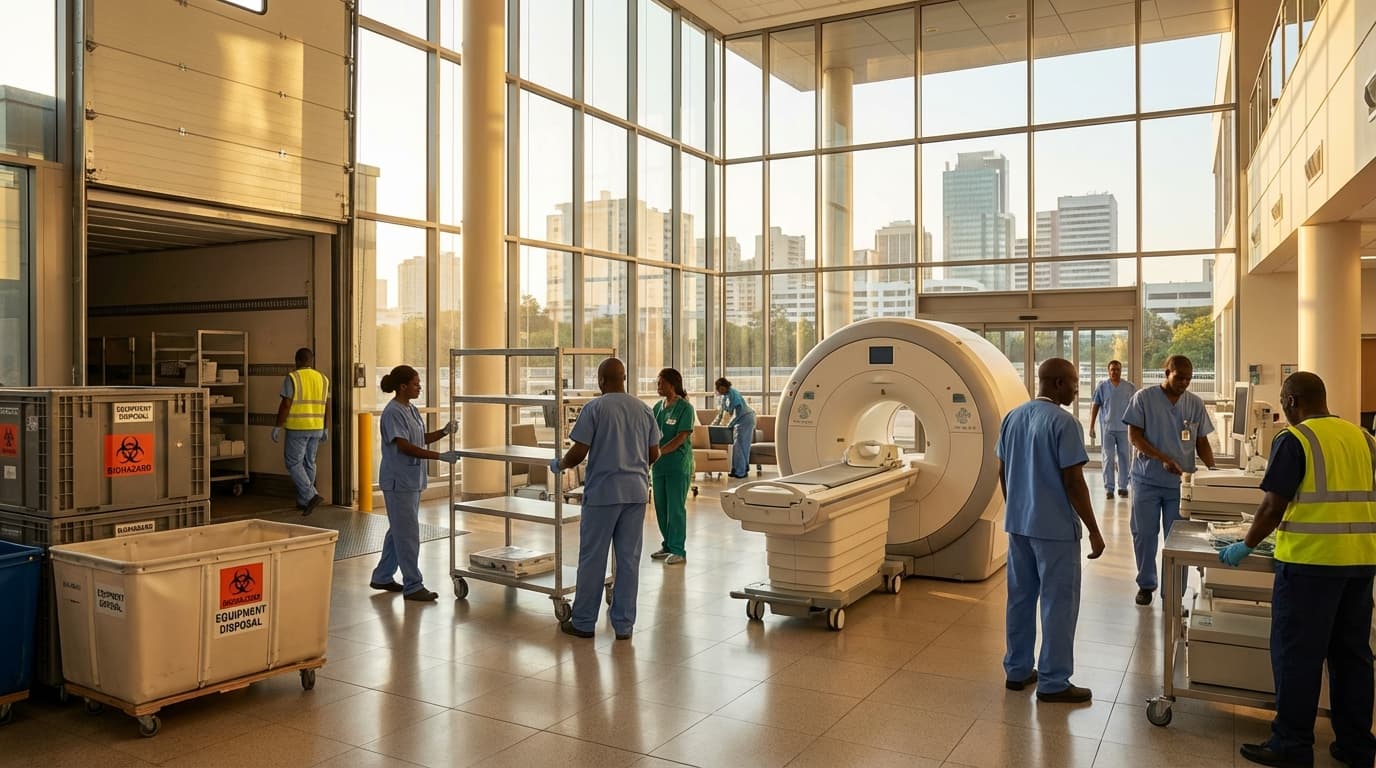
Heavy Medical Equipment De-Installation Service (MRI/CT/Cath Lab) in Mali
Engineering Excellence & Technical Support
Heavy Medical Equipment De-Installation Service (MRI/CT/Cath Lab) High-standard technical execution following OEM protocols and local regulatory frameworks.
Specialized De-Installation for High-Value Imaging Systems
Our expert technicians possess deep knowledge of complex MRI, CT, and Cath Lab systems, ensuring meticulous and safe de-installation. We follow manufacturer-specific protocols to preserve component integrity and prepare for secure transport, safeguarding your significant investment in Mali's healthcare infrastructure.
Hazardous Material Handling & Environmental Compliance
We strictly adhere to international safety standards for handling potentially hazardous materials inherent in medical imaging equipment. Our trained personnel in Mali ensure all waste and components are managed and disposed of responsibly, minimizing environmental impact and complying with all regulatory requirements.
Turnkey Project Management & Secure Logistics
From initial site assessment to final handover, we provide comprehensive project management for your de-installation in Mali. This includes secure packaging, specialized transportation coordination, and meticulous documentation, ensuring a seamless and risk-free process for your valuable medical equipment.
What Is Heavy Medical Equipment De-installation Service (Mri/ct/cath Lab) In Mali?
Heavy Medical Equipment De-Installation Service (MRI/CT/Cath Lab) in Mali refers to the specialized process of safely and systematically dismantling, disconnecting, and preparing large-scale, high-value medical imaging and interventional diagnostic equipment for relocation, disposal, or storage. This service is critical for ensuring that complex systems like Magnetic Resonance Imaging (MRI) scanners, Computed Tomography (CT) scanners, and Cardiac Catheterization (Cath Lab) suites are handled by qualified professionals with the necessary technical expertise and adherence to safety protocols. The de-installation process goes beyond simple disassembly; it involves the careful removal of sensitive components, precise disconnection of power, cooling, and data interfaces, and secure packaging of the equipment and its associated sub-systems. This specialized service is crucial for healthcare facilities undergoing renovations, upgrades, equipment replacement, or closure, as well as for entities involved in the resale or relocation of such sophisticated medical technology within Mali or internationally.
| Who Needs This Service? | Typical Use Cases | ||||
|---|---|---|---|---|---|
| Hospitals and Diagnostic Imaging Centers in Mali undergoing equipment upgrades or replacements. | Relocation of a functioning MRI, CT, or Cath Lab from one department to another within the same facility. | Healthcare facilities participating in equipment donation or resale programs. | Companies involved in the acquisition or divestment of medical imaging and interventional suites. | Institutions facing facility renovations or closures that necessitate the removal of installed medical equipment. | Government health ministries or agencies managing medical equipment assets. |
| De-installation of an MRI scanner to be replaced with a newer model. | Removal of a CT scanner to facilitate the construction of a new imaging suite. | Dismantling a Cath Lab prior to a major hospital renovation project. | Preparing an MRI system for shipment to another healthcare facility within Mali or for export. | Decommissioning a medical imaging department due to facility closure. | Acquisition of a used Cath Lab system that requires professional de-installation from its original site. |
Key Components of Heavy Medical Equipment De-Installation Service
- Site assessment and planning to determine logistics, access routes, and necessary safety precautions.
- Disconnection of all power, data, cooling, and ancillary systems (e.g., RF shielding, vacuum systems).
- Systematic disassembly of large components (e.g., gantry, magnet, patient table, X-ray tube).
- Safe handling and removal of heavy and delicate parts, often requiring specialized lifting equipment and trained personnel.
- Decommissioning and draining of cooling systems (e.g., helium for MRI, water for CT/Cath Lab).
- Secure packaging and crating of individual components to prevent damage during transit.
- Labeling and inventory management of all removed parts and accessories.
- Coordination with transport and logistics providers.
- Post-de-installation site cleanup and verification.
Who Needs Heavy Medical Equipment De-installation Service (Mri/ct/cath Lab) In Mali?
Heavy medical equipment de-installation, particularly for complex systems like MRI, CT scanners, and Cath Labs, is a specialized and critical service. In Mali, this service is essential for a range of healthcare facilities and organizations undergoing significant upgrades, relocations, or even closures. The meticulous process involves safely dismantling, packing, and preparing these high-value, sensitive machines for transport or long-term storage, minimizing risk of damage and ensuring future re-installation is feasible and cost-effective.
| Target Customer Group | Relevant Departments/Functions |
|---|---|
| Public Hospitals | Radiology Department, Cardiology Department, IT Department (for infrastructure), Engineering/Facilities Management, Procurement Department |
| Private Hospitals & Clinics | Radiology Department, Cardiology Department, Hospital Administration, Facilities Management, Biomedical Engineering |
| Specialized Imaging Centers | Center Director, Chief Radiologist, Biomedical Engineers, Operations Management |
| Government Health Ministries | Planning and Investment Department, Infrastructure and Equipment Division, Public Health Services |
| International Aid & NGOs | Program Managers, Logistics Coordinators, Technical Advisors, Healthcare Infrastructure Teams |
| Medical Equipment Manufacturers/Distributors | Service & Support Department, Logistics Department, Sales Department (for re-deployment) |
| Research Institutions | Research Directors, Laboratory Managers, Biomedical Engineering Staff |
Who Needs Heavy Medical Equipment De-Installation Service (MRI/CT/Cath Lab) in Mali?
- Hospitals undergoing renovations or expansions requiring the temporary or permanent removal of existing imaging equipment.
- Healthcare providers upgrading to newer, more advanced medical imaging technologies.
- Medical facilities relocating to new premises within Mali or to different countries.
- Manufacturers or distributors of medical equipment requiring de-installation for service, repair, or resale purposes.
- Government health ministries or organizations managing public healthcare infrastructure, overseeing asset management and upgrades.
- International aid organizations or NGOs involved in setting up or upgrading medical facilities in Mali.
- Research institutions with specialized imaging needs that are being reconfigured or decommissioned.
Heavy Medical Equipment De-installation Service (Mri/ct/cath Lab) Process In Mali
This document outlines the comprehensive workflow for the heavy medical equipment de-installation service (MRI/CT/Cath Lab) in Mali, from the initial inquiry to the final execution. This process is designed to ensure a smooth, safe, and efficient removal of complex imaging and diagnostic equipment, adhering to all relevant regulations and client requirements.
| Stage | Description | Key Activities | Deliverables/Outcomes |
|---|---|---|---|
| Inquiry & Initial Consultation | The client contacts the de-installation service provider to request services for removing heavy medical equipment. This stage involves understanding the client's needs and the scope of work. | Client contacts provider, discusses equipment details (type, model, location), explains reasons for de-installation (upgrade, relocation, decommissioning), preliminary timeline discussion. | Initial understanding of project scope, identification of client needs, preliminary information gathering. |
| Site Assessment & Planning | A detailed on-site evaluation is conducted by experienced technicians to assess the specific conditions and requirements for de-installation. | On-site visit, inspection of equipment, assessment of access routes (doors, corridors, elevators), power and utility disconnections, structural considerations, identification of potential hazards, development of a detailed de-installation plan. | Comprehensive site survey report, detailed de-installation plan, risk assessment, resource allocation plan. |
| Quotation & Contract Finalization | Based on the site assessment and de-installation plan, a formal quotation is provided, followed by contract negotiation and signing. | Preparation of detailed quotation (including labor, materials, logistics, insurance), negotiation of terms and pricing, formal contract agreement and signing. | Approved quotation, signed service contract, agreed-upon terms and conditions. |
| Pre-De-installation Preparations | All necessary preparations are made to ensure a safe and efficient de-installation process. | Procurement of specialized tools and equipment, mobilization of skilled technical team, confirmation of utility shutdowns (power, cooling, water), coordination with site management, communication with relevant authorities (if required), final safety briefings. | Readiness of equipment and personnel, confirmed utility status, established communication channels, site access authorization. |
| Equipment De-installation | The actual process of safely dismantling and removing the heavy medical equipment from its installed location. | Careful disconnection of all internal components, mechanical dismantling, specialized lifting and rigging operations, secure packaging of components, adherence to safety protocols throughout the process. | Dismantled and safely packaged medical equipment, minimized risk of damage to equipment and premises. |
| Logistics & Transportation | Arrangement and execution of the secure transportation of the de-installed equipment. | Securing appropriate transportation vehicles (trucks, specialized carriers), coordinated loading and transportation, adherence to transportation regulations, insurance coverage for transit, delivery to designated storage or relocation site. | Successfully transported equipment, delivery confirmation, insurance documentation. |
| Site Handover & Documentation | The final stage involves handing over the cleared site and providing all necessary documentation to the client. | Thorough cleaning of the de-installation area, final site inspection, provision of detailed de-installation report, including photographs and sign-offs, waste disposal (if applicable), final invoicing and payment processing. | Cleared and cleaned site, comprehensive project documentation, final project closure. |
Key Stages of Heavy Medical Equipment De-Installation Service
- Inquiry & Initial Consultation
- Site Assessment & Planning
- Quotation & Contract Finalization
- Pre-De-installation Preparations
- Equipment De-installation
- Logistics & Transportation
- Site Handover & Documentation
Heavy Medical Equipment De-installation Service (Mri/ct/cath Lab) Cost In Mali
De-installing heavy medical equipment like MRI, CT scanners, and Cath Labs is a complex and specialized process requiring trained technicians, proper handling equipment, and adherence to strict safety protocols. The cost of these services in Mali can vary significantly based on several factors. These installations often involve specialized tools, environmental controls (like temperature and humidity), and transportation considerations. The size, weight, and specific model of the equipment are primary determinants of the complexity and thus the cost. Furthermore, the location of the de-installation (e.g., a major city versus a remote area), the accessibility of the site, and the time sensitivity of the project will also influence the overall price. The need for specialized rigging, electrical disconnections, and potential environmental containment (for certain refrigerants in MRI machines, for example) adds to the labor and material costs. The expertise of the de-installation team is paramount; certified technicians with experience in these specific modalities command higher rates due to their specialized knowledge and the reduced risk of damage to the equipment or facility.
| Equipment Type | Estimated Cost Range (XOF) - Basic De-installation | Estimated Cost Range (XOF) - Complex/Full Service De-installation |
|---|---|---|
| CT Scanner | 1,500,000 - 3,500,000 | 3,000,000 - 7,000,000+ |
| MRI Machine (e.g., 1.5T) | 2,500,000 - 6,000,000 | 5,000,000 - 15,000,000+ |
| Cath Lab (includes associated components) | 2,000,000 - 5,000,000 | 4,000,000 - 10,000,000+ |
Key Pricing Factors for Heavy Medical Equipment De-Installation in Mali
- Type and Model of Equipment (MRI, CT, Cath Lab, specific manufacturer)
- Size and Weight of the Equipment
- Accessibility of the De-installation Site
- Geographical Location within Mali (urban vs. rural, travel costs)
- Complexity of the De-installation Process (e.g., presence of superconducting magnets, intricate cabling)
- Required Specialized Tools and Equipment (e.g., cranes, specialized lifting gear)
- Labor Costs (number of technicians, their skill level and experience)
- Time Sensitivity and Urgency of the Project
- Need for Environmental Controls and Handling of Refrigerants (especially for MRI)
- Disassembly and Reassembly Complexity (if applicable, though de-installation focuses on removal)
- Logistics and Transportation of Equipment components
- Permits and Regulatory Compliance
- Potential Site Preparation or Restoration Costs
Affordable Heavy Medical Equipment De-installation Service (Mri/ct/cath Lab) Options
De-installing heavy medical equipment like MRI, CT scanners, and Cath Labs can be a significant undertaking, involving specialized expertise, precise handling, and careful logistics. For facilities looking to manage these costs effectively, understanding service options, value bundles, and strategic approaches is crucial. This guide outlines affordable service tiers and cost-saving strategies to make your next de-installation project more budget-friendly.
| Value Bundle | Inclusions | Cost-Saving Strategies | Ideal For |
|---|---|---|---|
| DIY-Friendly Package | Basic de-installation, disconnection, component breakdown. You handle the rest. | Leverage internal maintenance staff, self-manage transportation, negotiate shipping rates independently. | Hospitals with in-house facilities and logistics teams; budget-conscious projects where control over the entire process is desired. |
| Logistics Lite Bundle | Basic de-installation + coordination with pre-approved 3rd party movers. | Bundle de-installation with your chosen logistics provider for potential volume discounts; provide clear site access and utility shutdown schedules to minimize on-site time. | Facilities that have strong relationships with logistics companies or prefer to manage the final destination setup internally. |
| Turnkey Relocation Bundle | Full de-installation, secure packaging/crating, transportation, and basic site readiness at destination. | Schedule during off-peak seasons for potential lower rates; negotiate long-term contracts for recurring needs; inquire about 'empty leg' shipping opportunities. | Organizations seeking a complete, hassle-free solution; those with remote or complex relocation destinations. |
| Decommission & Recycle Bundle | De-installation, environmental compliance, and certified e-waste recycling services. | Partner with service providers who offer rebates for salvageable components; ensure compliance to avoid future fines; explore refurbishment options for resale. | Facilities decommissioning old equipment, focusing on environmental responsibility, and seeking to recoup some value from obsolete machinery. |
Understanding Your De-Installation Service Options
- {"title":"Basic De-Installation","description":"This entry-level service typically includes the dismantling of the equipment down to manageable components, disconnection from utilities, and basic packaging for transport preparation. It's ideal for organizations with internal teams capable of managing the subsequent logistics and disposal/relocation themselves."}
- {"title":"Standard De-Installation & Logistics Coordination","description":"This package expands on the basic service by adding coordination with third-party logistics providers for transportation. The de-installation team will ensure the equipment is prepared and ready for pickup by your chosen movers, streamlining the handover process."}
- {"title":"Full-Service De-Installation & Relocation","description":"This comprehensive option covers de-installation, meticulous packaging, crating, and full logistical management, including transportation to a new site or storage facility. It's a turnkey solution for those who want minimal involvement and maximum peace of mind."}
- {"title":"Specialized De-Installation (e.g., Shielded Rooms)","description":"For equipment requiring extensive structural modifications (like lead-lined MRI rooms), specialized de-installation services are essential. These often involve demolition, structural reinforcement removal, and meticulous waste management. While more costly, they are unavoidable for certain projects."}
Verified Providers In Mali
In Mali, ensuring access to reliable and high-quality healthcare is paramount. Verified providers, particularly those with strong credentials like Franance Health, offer a crucial layer of assurance to individuals seeking medical services. Understanding what makes a provider 'verified' and why Franance Health stands out can help you make informed decisions about your health.
Being a 'verified provider' in the healthcare sector typically means that an entity has undergone a rigorous vetting process by a recognized authority or organization. This verification often encompasses checks on:
- Professional Licensure and Certifications: Ensuring that medical professionals possess the necessary and current licenses to practice.
- Educational Background and Training: Confirming the academic qualifications and specialized training of healthcare practitioners.
- Operational Standards and Compliance: Assessing if the facility adheres to established safety, hygiene, and treatment protocols.
- Reputation and Patient Feedback: Reviewing past performance and patient satisfaction to gauge the quality of care.
Franance Health distinguishes itself as a premier choice for healthcare services in Mali due to its unwavering commitment to these verification principles. Their dedication to maintaining the highest standards translates into tangible benefits for patients.
| Credential Category | Franance Health Standard | Patient Benefit |
|---|---|---|
| Professional Licensing | All practitioners hold valid Malian medical licenses and relevant international certifications. | Ensures care is provided by legally recognized and competent professionals. |
| Specialized Training | Doctors and nurses undergo continuous specialized training and are board-certified in their respective fields. | Access to expert care for a wide range of medical conditions. |
| Facility Accreditation | Facilities meet stringent national and international health and safety standards. | Safe and hygienic environment for treatment and recovery. |
| Technology & Equipment | Invests in modern medical technology and diagnostic equipment. | Accurate diagnoses and effective treatment options. |
| Patient Care Philosophy | Emphasizes empathy, respect, and patient involvement in decision-making. | A supportive and empowering healthcare experience. |
Why Franance Health is the Best Choice in Mali
- Rigorous credentialing of all medical staff, ensuring highly qualified and licensed professionals.
- Adherence to international best practices in healthcare delivery and patient safety protocols.
- State-of-the-art facilities and equipment, providing access to advanced diagnostic and treatment options.
- A patient-centric approach, prioritizing compassionate care and personalized treatment plans.
- Transparent pricing and clear communication, fostering trust and empowering patients.
- Continuous professional development for their healthcare team, staying at the forefront of medical advancements.
Scope Of Work For Heavy Medical Equipment De-installation Service (Mri/ct/cath Lab)
This Scope of Work (SOW) outlines the requirements for the professional de-installation of heavy medical equipment, specifically MRI, CT scanners, and Cath Lab systems. The service includes the safe and systematic dismantling, disconnection, and preparation of these complex systems for transport. This SOW also details the technical deliverables and standard specifications expected from the service provider.
| Technical Deliverable | Standard Specification / Description | Applicable Equipment (MRI/CT/Cath Lab) |
|---|---|---|
| Pre-De-installation Site Survey Report | Detailed report assessing site access, power requirements, environmental controls, structural integrity, and required clearances. Includes proposed de-installation methodology and timeline. Must be submitted within 5 business days of site visit. | All |
| De-installation Method Statement | Comprehensive document outlining the step-by-step process for dismantling each specific equipment type, including safety protocols, tools, and personnel required. Must adhere to manufacturer guidelines where applicable. Requires client approval prior to commencement. | All |
| Electrical Disconnection Certificate | Formal certification by a licensed electrician confirming safe and compliant disconnection of all power sources, grounding, and emergency shut-offs. Includes documentation of circuits isolated. | All |
| Cooling System Purge & Disconnection Report | Documentation of the safe purging and disconnection of any coolant loops (e.g., helium, water, freon). Includes verification of pressure release and environmental containment. | MRI, CT |
| RF Shielding De-installation Report (MRI) | Confirmation that RF shielding (if applicable) has been carefully removed or temporarily modified to allow equipment removal, without damage to the room structure. Includes photographic evidence. | MRI |
| Component Labeling & Inventory | All removed components are to be clearly labeled with equipment type, serial number, and de-installation date. A detailed inventory list of all removed parts and their condition shall be provided. | All |
| Component Protection & Packaging | Major components are to be protected with appropriate padding, shrink wrap, or custom crates to prevent damage during handling and transport. Specifications for packaging will be provided for critical components. | All |
| Rigging & Lifting Plan | Detailed plan for the safe lifting and movement of heavy components, including specified rigging points, weight calculations, and required lifting equipment. Must be approved by client and site safety officer. | All |
| Environmental Compliance Documentation | Proof of proper disposal of any hazardous materials (e.g., refrigerants, oils) in accordance with local and national regulations. Includes waste manifests and certificates of disposal. | All |
| Post-De-installation Site Condition Report | Report detailing the condition of the de-installation area, including any modifications made and confirmation that all waste has been removed and the site is clean and safe for subsequent activities. Includes photographic evidence. | All |
| De-installation Completion Certificate | Formal document signed by the service provider and client confirming the successful and compliant de-installation of the equipment as per the agreed SOW. | All |
Key Service Areas
- Site assessment and pre-planning.
- Equipment disconnection (electrical, data, cooling, RF shielding, etc.).
- Mechanical dismantling of major components.
- Component containment and protection.
- Preparation for transportation (crating, rigging points, etc.).
- Waste disposal and environmental compliance.
- Documentation and certification.
Service Level Agreement For Heavy Medical Equipment De-installation Service (Mri/ct/cath Lab)
This Service Level Agreement (SLA) outlines the response times and uptime guarantees for the de-installation of heavy medical equipment, specifically MRI, CT, and Cath Lab systems. This agreement is between [Service Provider Name] and [Client Name] (hereinafter referred to as "the Client").
| Service Type | Service Request Priority | Response Time (Business Hours) | Response Time (Outside Business Hours/Emergency) | Typical De-installation Duration (Estimated) | Uptime Guarantee (N/A for De-installation) |
|---|---|---|---|---|---|
| MRI De-installation | Standard | 8 Business Hours | 4 Business Hours (Prioritized) | 2-5 Days (depending on system complexity) | N/A |
| CT De-installation | Standard | 8 Business Hours | 4 Business Hours (Prioritized) | 1-3 Days (depending on system complexity) | N/A |
| Cath Lab De-installation | Standard | 8 Business Hours | 4 Business Hours (Prioritized) | 2-4 Days (depending on system complexity) | N/A |
| Emergency De-installation (e.g., facility evacuation, critical upgrade timeline) | Emergency | 2 Business Hours | 2 Business Hours | As per agreed-upon project plan | N/A |
Key Definitions
- De-installation Service: The process of safely and systematically disconnecting, disassembling, and preparing for transport heavy medical imaging equipment (MRI, CT, Cath Lab).
- Service Request: A formal notification from the Client to the Service Provider requesting de-installation services.
- Business Hours: Monday to Friday, 8:00 AM to 5:00 PM [Client's Time Zone], excluding public holidays.
- Uptime Guarantee: Not directly applicable to de-installation as the equipment is being taken offline. However, this SLA focuses on timely initiation and completion of the de-installation process and the integrity of the equipment and facility during the service.
- Response Time: The maximum allowable time from the Service Provider's receipt of a valid Service Request to the commencement of service execution or acknowledgment of the request with a definitive next step.
- Service Commencement: The point at which the Service Provider's technicians physically begin the de-installation process at the Client's site.
- Completion of De-installation: The point at which the equipment is fully disconnected, disassembled, and prepared for transport according to agreed-upon specifications.
Frequently Asked Questions

Ready when you are
Let's scope your Heavy Medical Equipment De-Installation Service (MRI/CT/Cath Lab) in Mali project in Mali.

Scaling healthcare logistics and technical systems across the entire continent.