
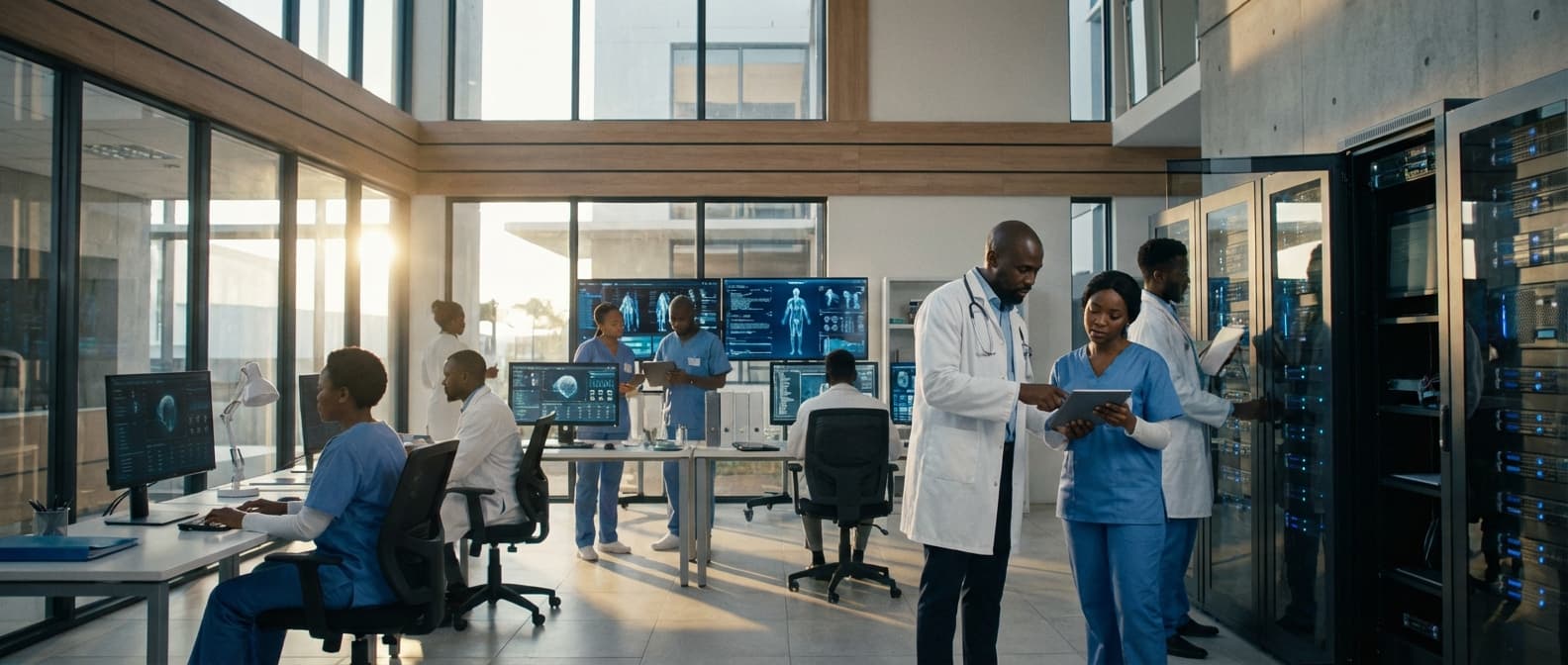
Medical IT Consultation in Mali
Engineering Excellence & Technical Support
Strategic technology consulting to optimize healthcare operations, streamline workflows, and integrate cutting-edge medical information systems. High-standard technical execution following OEM protocols and local regulatory frameworks.
Infrastructure Modernization & Cloud Migration
Assessing and upgrading existing IT infrastructure, including network hardware, data storage, and cybersecurity measures. Facilitating secure and efficient migration to cloud-based solutions to enhance scalability, accessibility, and disaster recovery capabilities for healthcare facilities in Mali.
EHR/EMR Implementation & Optimization
Designing and deploying Electronic Health Record (EHR) and Electronic Medical Record (EMR) systems tailored to the specific needs of Malian healthcare providers. Providing training and ongoing support to optimize data management, improve patient care coordination, and ensure compliance with national health informatics standards.
Cybersecurity Enhancement & Data Protection
Implementing robust cybersecurity protocols and solutions to protect sensitive patient data from breaches and cyber threats. Conducting risk assessments, vulnerability testing, and providing staff training on best practices for data security and privacy in the Malian healthcare landscape.
What Is Medical It Consultation In Mali?
Medical IT consultation in Mali refers to the provision of expert advisory services focused on the strategic planning, implementation, optimization, and management of information technology within the healthcare sector. This encompasses a broad spectrum of technological solutions designed to enhance patient care, improve operational efficiency, ensure data security and privacy, and facilitate regulatory compliance. These services are critical for healthcare providers in Mali seeking to leverage technology for improved health outcomes and sustainable operational models.
| Stakeholder Group | Needs Addressed | Typical Use Cases |
|---|---|---|
| Public Hospitals and Clinics | Modernizing legacy systems, improving patient record management, enhancing inter-departmental communication, implementing telemedicine for remote areas, ensuring data security. | Deploying an Electronic Health Record (EHR) system, establishing a Picture Archiving and Communication System (PACS), implementing a hospital information system (HIS). |
| Private Healthcare Facilities | Improving patient experience, optimizing billing and administrative processes, implementing advanced diagnostic IT solutions, enhancing cybersecurity, adopting cloud-based solutions. | Implementing a patient portal for appointment booking and access to results, upgrading to a modern clinic management system, integrating diagnostic equipment with IT systems. |
| Non-Governmental Organizations (NGOs) and International Health Organizations | Establishing robust data collection and reporting mechanisms for public health initiatives, implementing mobile health (mHealth) solutions for remote data collection, ensuring interoperability across diverse project sites, capacity building for local IT staff. | Developing a mobile application for disease surveillance, implementing a database for tracking vaccination campaigns, establishing secure data sharing protocols for research projects. |
| Ministry of Health and National Health Agencies | Developing national e-health strategies, standardizing health information systems, ensuring data interoperability across the nation, strengthening health data analytics capabilities for policy-making, establishing national cybersecurity frameworks. | Developing a national health information exchange platform, implementing a centralized disease registry, defining standards for EHR interoperability. |
| Medical Training and Research Institutions | Implementing advanced simulation technologies, facilitating research data management, providing access to digital libraries and research platforms, integrating IT for distance learning. | Setting up a virtual anatomy lab, implementing a research data repository, deploying an online learning management system (LMS). |
Key Components of Medical IT Consultation in Mali
- Needs Assessment and Gap Analysis: Evaluating existing IT infrastructure and identifying areas for improvement or technology adoption.
- System Selection and Procurement: Advising on the selection and acquisition of appropriate healthcare IT systems (e.g., EHR/EMR, PACS, LIS, HIS).
- Implementation and Integration: Overseeing the deployment and seamless integration of new IT systems with existing workflows and legacy systems.
- Network and Infrastructure Design: Planning and optimizing the IT infrastructure, including hardware, software, and network architecture.
- Data Management and Security: Developing strategies for data storage, backup, disaster recovery, and ensuring compliance with data privacy regulations (e.g., HIPAA equivalents, local data protection laws).
- Cybersecurity Assessment and Implementation: Identifying vulnerabilities and implementing robust security measures to protect sensitive patient data.
- Telemedicine and Remote Care Solutions: Designing and implementing platforms for remote patient monitoring, consultations, and delivery of care.
- IT Policy and Governance Development: Establishing clear IT policies, procedures, and governance frameworks.
- Training and Change Management: Developing and delivering training programs for healthcare staff and managing the adoption of new technologies.
- Regulatory Compliance Advisory: Ensuring IT systems and practices adhere to national and international healthcare regulations.
- Budgeting and ROI Analysis: Developing IT budgets and evaluating the return on investment for technology initiatives.
- Ongoing Support and Optimization: Providing continuous support, maintenance, and performance optimization of IT systems.
Who Needs Medical It Consultation In Mali?
In Mali, the need for specialized Medical IT consultation is growing as healthcare providers strive to modernize their infrastructure, improve patient care, and enhance operational efficiency. This consultation is crucial for organizations looking to leverage technology effectively within the unique context of Mali's healthcare landscape. The services offered typically include strategic planning, system implementation, cybersecurity, data management, and training, all tailored to address local challenges and opportunities. Identifying the right clients and understanding their specific needs is key to delivering impactful IT solutions in the Malian medical sector.
| Target Customer Type | Key Departments/Areas Requiring Consultation | Specific Needs/Challenges |
|---|---|---|
| Public Hospitals | Administration, Patient Records, Pharmacy, Radiology, IT Department | Upgrading legacy systems, implementing Electronic Health Records (EHR), improving data security, network infrastructure enhancement, telemedicine integration, staff training. |
| Private Clinics and Hospitals | Reception, Clinical Services, Billing, IT Department | Implementing efficient patient management systems, optimizing billing processes, enhancing data privacy, cloud migration, cybersecurity, adopting new diagnostic technologies. |
| NGOs with Healthcare Programs | Program Management, Data Collection, Field Operations, IT Support | Developing robust data management systems for aid tracking, mobile health solutions for remote areas, secure communication channels, cloud-based reporting tools, capacity building for local staff. |
| Ministry of Health | Health Information Systems, Public Health Programs, Policy & Planning, IT Infrastructure | Developing national health information strategies, implementing interoperable health systems, cybersecurity for national health data, data analytics for public health surveillance, digital transformation of health services. |
| Medical Training Institutions | IT Department, Academic Administration, Research Departments | Setting up IT infrastructure for e-learning, managing student information systems, providing access to digital medical resources, cybersecurity for academic data, training on health informatics. |
| Diagnostic Laboratories | Laboratory Information Systems (LIS), Administration, IT Support | Implementing or upgrading LIS, integrating with EHR systems, ensuring data accuracy and integrity, cybersecurity for sensitive patient data, optimizing workflow automation. |
| Specialized Medical Centers | Research, Administration, Patient Care Specifics, IT Department | Developing specialized databases for research, implementing secure data sharing protocols, managing advanced imaging systems, cybersecurity tailored to specific medical technologies, IT support for specialized equipment. |
Target Customers for Medical IT Consultation in Mali
- Public Hospitals
- Private Clinics and Hospitals
- Non-Governmental Organizations (NGOs) with Healthcare Programs
- Ministry of Health and its affiliated agencies
- Medical Training Institutions
- Diagnostic Laboratories
- Specialized Medical Centers (e.g., research facilities, rehabilitation centers)
Medical It Consultation Process In Mali
The Medical IT Consultation Process in Mali outlines the systematic workflow undertaken when a healthcare facility or organization in Mali initiates an inquiry for IT consulting services specifically tailored to the medical sector. This process is designed to ensure that the unique needs and regulatory landscape of Malian healthcare are effectively addressed. It typically begins with an initial inquiry, followed by detailed needs assessment, proposal development, agreement, implementation, and finally, ongoing support and evaluation.
| Stage | Description | Key Activities | Deliverables/Outcomes | Responsible Parties |
|---|---|---|---|---|
| Inquiry & Initial Contact | The potential client (healthcare facility) expresses interest in IT consulting services. | Receiving inquiry (email, phone call, referral), initial discussions to understand basic needs, scheduling a preliminary meeting. | Confirmed interest, initial understanding of the client's context. | Client, IT Consulting Firm |
| Needs Assessment & Requirement Gathering | A deep dive into the client's current IT infrastructure, operational workflows, and specific medical IT requirements. | On-site visits, interviews with stakeholders (doctors, administrators, IT staff), analysis of existing systems, identification of pain points, understanding of regulatory compliance needs (e.g., data privacy, patient record management). | Detailed needs assessment report, documented functional and non-functional requirements, gap analysis. | IT Consulting Firm, Client Stakeholders |
| Solution Design & Proposal Development | Developing tailored IT solutions and outlining the project scope, timeline, and costs. | Brainstorming IT solutions (EHR implementation, network upgrades, cybersecurity, telemedicine), developing a detailed project plan, cost estimation, defining key performance indicators (KPIs), creating a formal proposal document. | Comprehensive IT solution proposal, including scope of work, technical specifications, implementation plan, budget, and timeline. | IT Consulting Firm |
| Contract Negotiation & Agreement | Formalizing the engagement through a legally binding contract. | Reviewing the proposal, negotiating terms and conditions (payment schedules, deliverables, service level agreements), signing the contract. | Signed service agreement/contract. | Client, IT Consulting Firm |
| Implementation & Deployment | Putting the agreed-upon IT solutions into practice. | Procurement of hardware/software, system installation and configuration, data migration, integration with existing systems, rigorous testing, quality assurance. | Fully deployed and functional IT system(s), integrated workflows, tested and validated solutions. | IT Consulting Firm, Client IT Staff, Vendors |
| Training & Knowledge Transfer | Ensuring that the client's staff can effectively use and manage the new IT systems. | Developing training materials, conducting user training sessions (doctors, nurses, administrators, IT personnel), providing user manuals and documentation. | Trained staff, comprehensive user documentation. | IT Consulting Firm, Client Staff |
| Monitoring, Evaluation & Support | Ensuring the ongoing performance, security, and success of the implemented IT solutions and providing post-implementation assistance. | System monitoring, performance analysis, user feedback collection, troubleshooting, regular system updates and maintenance, post-implementation review, ongoing technical support. | Stable and optimized IT systems, resolved issues, client satisfaction, documented performance metrics. | IT Consulting Firm, Client IT Staff |
Key Stages in the Medical IT Consultation Process in Mali:
- Inquiry & Initial Contact
- Needs Assessment & Requirement Gathering
- Solution Design & Proposal Development
- Contract Negotiation & Agreement
- Implementation & Deployment
- Training & Knowledge Transfer
- Monitoring, Evaluation & Support
Medical It Consultation Cost In Mali
Medical IT consultation costs in Mali are influenced by several factors, leading to a range of pricing. These factors include the complexity of the IT needs, the duration of the consultation, the expertise and specialization of the IT consultant or firm, and the specific services required. For instance, a basic consultation on network setup will differ significantly from a comprehensive assessment of a hospital's electronic health record (EHR) system integration. Location within Mali (e.g., Bamako versus a more rural area) can also play a role due to varying operational costs and availability of specialized consultants.
Key Pricing Factors:
- Scope and Complexity of IT Needs: Simple troubleshooting versus strategic planning and implementation.
- Consultant's Experience and Specialization: General IT support versus specialized medical IT expertise (e.g., cybersecurity for healthcare data, EHR implementation).
- Duration of Consultation: Hourly rates versus project-based fees.
- Type of Services: Assessment, planning, implementation, training, ongoing support.
- Location: Major cities often have higher rates.
- Reputation of the Consulting Firm: Established firms may command higher fees.
Pricing Ranges (Approximate):
It's important to note that these are estimates, and actual costs can vary. The Malian Franc (XOF) is the local currency. Exchange rates can fluctuate, but as of recent data, 1 USD is approximately 590 XOF.
| Service Type/Duration | Estimated Cost Range (XOF) |
|---|---|
| Hourly Rate (General IT Support) | 20,000 - 40,000 |
| Hourly Rate (Specialized Medical IT - e.g., EHR, Cybersecurity) | 35,000 - 70,000+ |
| Half-Day Consultation (4 hours, general) | 75,000 - 150,000 |
| Full-Day Consultation (8 hours, general) | 150,000 - 300,000 |
| Project-Based (e.g., small clinic IT assessment) | 500,000 - 1,500,000+ |
| Project-Based (e.g., hospital EHR feasibility study) | 2,000,000 - 10,000,000+ (depending on scale) |
Factors Influencing Medical IT Consultation Costs in Mali
- Complexity of IT requirements (e.g., basic network setup, EHR integration, cybersecurity assessment)
- Duration of the consultation (hourly, daily, or project-based)
- Experience and specialization of the IT consultant or firm
- Specific services requested (e.g., system audit, software selection, implementation support, staff training)
- Geographic location within Mali (e.g., Bamako versus other regions)
- Reputation and track record of the consulting provider
Affordable Medical It Consultation Options
Navigating the complex landscape of Medical IT can be daunting for healthcare organizations, especially when budget constraints are a significant concern. Fortunately, there are various affordable medical IT consultation options available. These often leverage value bundles and strategic cost-saving measures to deliver essential expertise without breaking the bank. Understanding these options can empower healthcare providers to make informed decisions and optimize their IT investments.
| Cost-Saving Strategy | Description | Benefits for Healthcare Organizations |
|---|---|---|
| Value-Based Pricing Models | Consulting fees tied to achieving specific, measurable outcomes or improvements in IT efficiency and patient care. | Ensures tangible results, aligns consultant incentives with organizational goals, and can lead to significant ROI. |
| Subscription or Retainer Models (Tiered) | Regular, predictable monthly fees for a defined set of services, often with different tiers offering varying levels of support and access. | Budget predictability, proactive IT management, access to ongoing expertise, and potentially lower per-hour costs than ad-hoc engagements. |
| On-Demand or Ad-Hoc Consultation | Engaging consultants as needed for specific issues or projects without a long-term commitment. | Flexibility, cost-effectiveness for short-term needs, and avoids paying for services not currently required. |
| Remote & Hybrid Consultation Models | Utilizing video conferencing, remote desktop access, and shared documentation platforms to conduct consultations, minimizing travel. | Significant reduction in travel expenses, faster response times, and access to a wider pool of expertise regardless of location. |
| Shared Services & Consortium Models | Collaborating with other healthcare organizations to jointly engage IT consultants, sharing costs. | Reduced individual expenditure, access to specialized expertise that might be unaffordable alone, and shared best practices. |
| Focus on Optimization & Efficiency | Consultants help identify and implement strategies to optimize existing IT systems and processes, rather than recommending entirely new solutions. | Maximizes return on existing investments, reduces the need for costly new hardware/software, and improves operational workflows. |
| Phased Implementation & Pilot Projects | Breaking down large IT projects into smaller, manageable phases with pilot programs to test solutions before full rollout. | Manages budget flow, allows for adjustments based on real-world performance, and reduces the risk of large-scale, costly failures. |
| Leveraging Internal Talent & Training | Consultants focus on upskilling internal IT staff, enabling them to manage and maintain systems, reducing future reliance on external help. | Long-term cost savings, improved internal IT capabilities, and greater control over IT operations. |
Understanding Affordable Medical IT Consultation Options
- Value Bundles: These are pre-packaged service offerings that combine multiple IT consultation services at a discounted rate. They often cater to specific needs or stages of IT maturity, providing a comprehensive solution.
- Project-Based Consultations: Instead of ongoing retainers, engage consultants for specific, well-defined projects. This limits expenditure to immediate needs.
- Remote/Virtual Consultations: Leveraging teleconferencing and remote access tools can significantly reduce travel and on-site costs associated with traditional consultations.
- Tiered Service Models: Many providers offer different levels of service, allowing you to choose a package that aligns with your budget and required expertise.
- Niche & Specialized Consultants: Consider smaller, specialized IT firms or independent consultants who may have lower overhead and offer more competitive pricing for specific expertise.
- Knowledge Transfer & Training: Some consultations focus on empowering your internal IT staff through training and knowledge transfer, reducing reliance on external support long-term.
- Leveraging Existing Technologies: Consultants can help optimize and maximize the use of your current IT infrastructure, avoiding unnecessary new purchases.
- Open-Source Solutions: Explore the possibility of implementing and integrating open-source medical IT solutions where appropriate, which can reduce licensing costs.
Verified Providers In Mali
When seeking healthcare services in Mali, identifying trusted and credentialed providers is paramount. Franance Health stands out as a leader, offering a robust network of verified professionals who adhere to the highest standards of medical care. Their commitment to rigorous credentialing processes ensures that patients have access to skilled and ethical healthcare practitioners. This dedication translates to superior patient outcomes, enhanced safety, and greater peace of mind. Choosing Franance Health means opting for a healthcare experience where quality, integrity, and patient well-being are the top priorities. Their comprehensive verification system not only builds confidence but also fosters a more reliable and accessible healthcare ecosystem for everyone in Mali.
| Credential Component | Franance Health Verification Standard | Importance for Patients |
|---|---|---|
| Medical License Verification | Confirms current and valid licensure with Malian medical authorities. | Ensures the provider is legally authorized to practice medicine. |
| Educational Background Check | Validates medical degrees and certifications from accredited institutions. | Confirms foundational knowledge and training in medical sciences. |
| Professional Experience Review | Assesses the duration and scope of practical experience in relevant medical fields. | Indicates practical skills and familiarity with various medical conditions and treatments. |
| Ethical Conduct and Disciplinary History | Screens for any past disciplinary actions or ethical breaches. | Guarantees that providers adhere to professional and moral standards. |
| Continuing Medical Education (CME) | Ensures providers are actively engaged in ongoing learning and skill enhancement. | Confirms that providers stay updated with the latest medical advancements and best practices. |
Why Franance Health is the Best Choice for Verified Providers in Mali:
- Rigorous Vetting Process: Franance Health employs a multi-stage verification process that examines medical licenses, educational qualifications, professional experience, and ethical standing of all affiliated providers.
- Commitment to Quality Care: By partnering with only the most qualified professionals, Franance Health ensures a high standard of medical treatment and patient care across all specialties.
- Enhanced Patient Safety: Thorough background checks and continuous monitoring contribute to a safer healthcare environment, minimizing risks and maximizing positive health outcomes.
- Access to Expertise: Franance Health's network includes a diverse range of specialists and general practitioners, providing access to a wide spectrum of medical expertise.
- Building Trust and Reliability: Their transparent credentialing ensures patients can trust the medical professionals they are referred to, fostering stronger patient-provider relationships.
- Focus on Ethical Practices: Franance Health prioritizes providers who demonstrate a strong commitment to ethical medical conduct and patient advocacy.
Scope Of Work For Medical It Consultation
This Scope of Work (SOW) outlines the technical deliverables and standard specifications for a Medical IT Consultation. The objective of this consultation is to assess, recommend, and plan for improvements in the client's medical IT infrastructure, ensuring compliance with healthcare regulations, enhancing operational efficiency, and improving patient care through technology. The consultation will cover network infrastructure, cybersecurity, electronic health records (EHR) systems, medical device integration, data management, and disaster recovery/business continuity.
Phase 1: Assessment and Analysis
This phase involves a comprehensive review of the current IT environment. Deliverables include a detailed report on system performance, security posture, compliance gaps, and user feedback.
Phase 2: Recommendations and Planning
Based on the assessment, specific recommendations for hardware, software, security measures, and process improvements will be developed. This phase culminates in a strategic IT roadmap.
Phase 3: Implementation Support (Optional)
This phase, if engaged, will involve providing guidance and oversight for the implementation of approved recommendations.
| Deliverable | Description | Standard Specifications / Compliance Requirements | Format |
|---|---|---|---|
| Network Infrastructure Assessment Report | Analysis of current network architecture, performance, capacity, and reliability. | HIPAA, HITRUST, FHIR (where applicable for interoperability), industry best practices for network segmentation and security. | PDF Document |
| Cybersecurity Vulnerability Assessment Report | Identification of security weaknesses, threats, and risks across all IT systems and data. | HIPAA Security Rule (45 CFR § 164.308, § 164.310, § 164.312), NIST Cybersecurity Framework, OWASP Top 10. | PDF Document |
| EHR System Performance and Utilization Analysis | Evaluation of EHR system speed, stability, user adoption, and integration with other systems. | Meaningful Use/Promoting Interoperability requirements, vendor-specific best practices, user experience metrics. | PDF Document |
| Medical Device Integration Feasibility Study | Assessment of current medical device connectivity and potential for integration with EHR and other systems. | DICOM, HL7 standards, FDA guidance on medical device cybersecurity, interoperability standards. | PDF Document |
| Data Management and Storage Strategy Review | Analysis of data lifecycle, storage solutions, backup procedures, and data retention policies. | HIPAA Privacy Rule (45 CFR § 164.500 et seq.), data retention laws, cloud security best practices (if applicable). | PDF Document |
| DR/BCP Gap Analysis | Review of existing disaster recovery and business continuity plans against potential threats and regulatory requirements. | HIPAA Breach Notification Rule (45 CFR § 164.400 et seq.), RTO/RPO objectives, regulatory compliance. | PDF Document |
| Recommended IT Infrastructure Upgrade Plan | Detailed proposal for hardware, software, and infrastructure enhancements. | Scalability, reliability, security, cost-effectiveness, vendor-agnostic recommendations where appropriate. | PDF Document |
| Proposed Cybersecurity Enhancement Strategy | Actionable plan for implementing new security controls, policies, and training. | Zero Trust Architecture principles, multi-factor authentication (MFA), endpoint detection and response (EDR), security awareness training. | PDF Document |
| EHR System Optimization Recommendations | Suggestions for improving EHR workflows, user interface, and interoperability. | Clinical workflow analysis, user feedback incorporation, FHIR API utilization. | PDF Document |
| Medical Device Integration Roadmap | Phased approach for integrating medical devices into the IT infrastructure. | Project management principles, risk assessment for device integration, phased rollout. | PDF Document |
| Data Governance and Compliance Framework | Guidelines for managing, protecting, and ensuring the privacy of health data. | HIPAA, GDPR (if applicable), organizational policies, data access controls. | PDF Document |
| Revised DR/BCP Document | Updated plans incorporating identified gaps and best practices. | Clear roles and responsibilities, communication protocols, testing procedures, regular review cycles. | PDF Document |
| Strategic IT Roadmap for Healthcare IT Enhancement | Long-term plan outlining IT investments, initiatives, and milestones. | Alignment with organizational goals, budget considerations, phased implementation, measurable outcomes. | PDF Document, Presentation Slides |
Technical Deliverables & Standard Specifications
- Network Infrastructure Assessment Report
- Cybersecurity Vulnerability Assessment Report
- EHR System Performance and Utilization Analysis
- Medical Device Integration Feasibility Study
- Data Management and Storage Strategy Review
- Disaster Recovery and Business Continuity Plan (DR/BCP) Gap Analysis
- Recommended IT Infrastructure Upgrade Plan
- Proposed Cybersecurity Enhancement Strategy
- EHR System Optimization Recommendations
- Medical Device Integration Roadmap
- Data Governance and Compliance Framework
- Revised DR/BCP Document
- Strategic IT Roadmap for Healthcare IT Enhancement
Service Level Agreement For Medical It Consultation
This Service Level Agreement (SLA) outlines the terms and conditions regarding response times and uptime guarantees for Medical IT Consultation services provided by [Your Company Name] (hereinafter referred to as "Provider") to [Client Name] (hereinafter referred to as "Client"). This SLA is an integral part of the Master Service Agreement (MSA) between the Provider and the Client.
| Service Component | Priority Level | Definition | Response Time Guarantee | Uptime Guarantee (for supported systems) |
|---|---|---|---|---|
| IT Consultation Access | Critical (System Down, Patient Care Impact) | Urgent need for immediate IT support impacting patient care or critical system operations. | 15 minutes (initial response) | 99.9% Monthly |
| IT Consultation Access | High (Significant Performance Degradation) | Major performance issues affecting multiple users or significant business operations. | 1 hour (initial response) | 99.9% Monthly |
| IT Consultation Access | Medium (Standard Request) | Routine IT requests, non-critical issues, or general inquiries. | 4 business hours (initial response) | 99.5% Monthly |
| IT Consultation Access | Low (Information Request) | Requests for information, documentation, or non-urgent advice. | 8 business hours (initial response) | 99.0% Monthly |
| Supported Critical Systems | Critical (System Down) | Core medical systems (e.g., EHR, PACS, Lab Information System) that are completely inaccessible or non-functional. | N/A (focus is on uptime of the system itself) | 99.9% Monthly |
| Supported Critical Systems | High (Major Functionality Impaired) | Significant loss of functionality in critical medical systems, impacting key workflows. | N/A (focus is on uptime of the system itself) | 99.5% Monthly |
Key Service Components
- 24/7 Availability: The IT Consultation service will be available to the Client on a 24/7 basis, except for scheduled maintenance.
- Response Times: The Provider guarantees specific response times for different categories of IT issues.
- Uptime Guarantees: The Provider guarantees a minimum uptime for critical IT systems and consultation access.
- Exclusions: Certain events and circumstances are excluded from the scope of this SLA.
Frequently Asked Questions

Ready when you are
Let's scope your Medical IT Consultation in Mali project in Mali.

Scaling healthcare logistics and technical systems across the entire continent.