
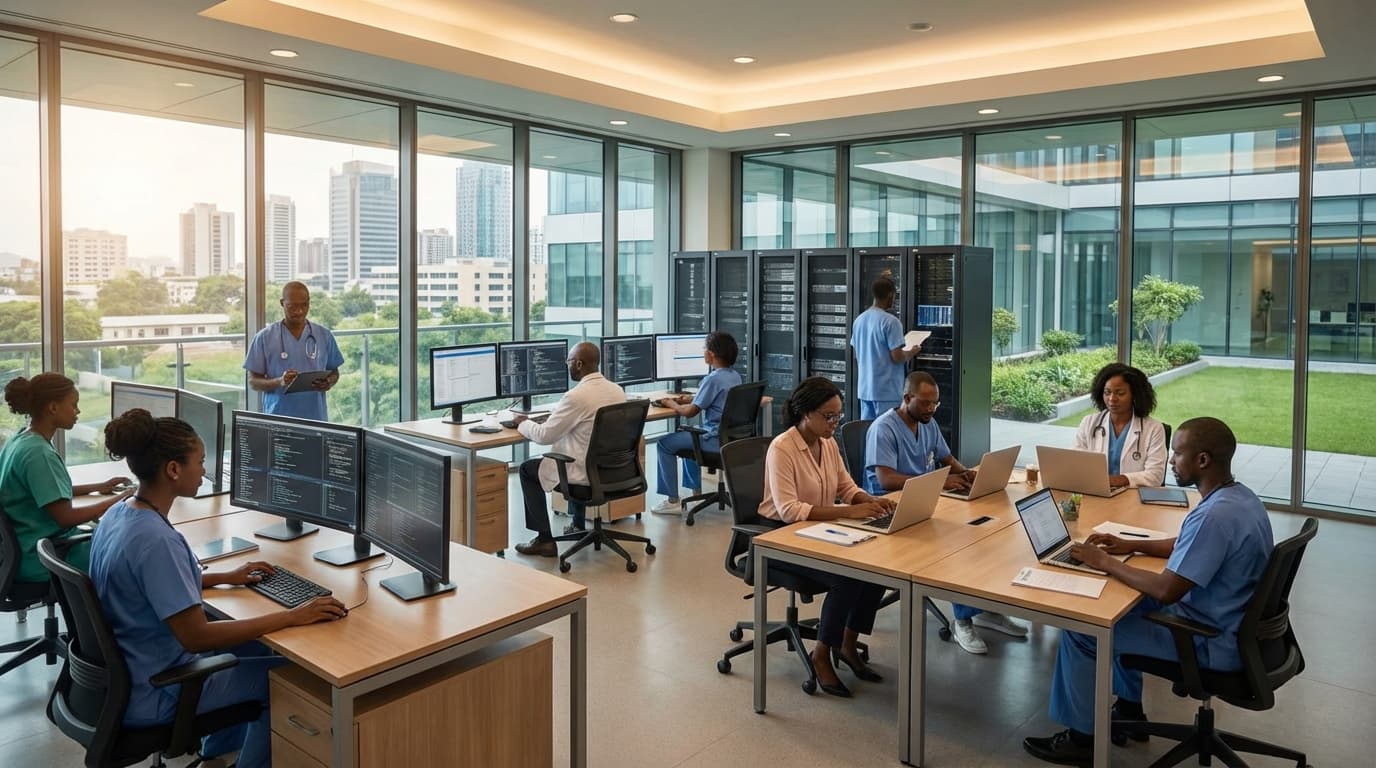
Radiology Reader & Reporting Support in Mali
Engineering Excellence & Technical Support
Remote radiology reading and reporting services High-standard technical execution following OEM protocols and local regulatory frameworks.
Centralized DICOM Repository
Establishes a secure, cloud-based DICOM archive for all radiological images in Mali, ensuring accessibility for authorized readers and facilitating efficient data retrieval for reporting and analysis, regardless of geographical location.
AI-Powered Preliminary Read Assistance
Integrates advanced Artificial Intelligence algorithms to perform initial image analysis, flagging potential abnormalities for radiologists, thereby reducing turnaround time for critical diagnoses and optimizing workload distribution for reporting specialists.
Secure Remote Reading Platform
Implements a robust and encrypted platform enabling qualified radiologists to access and interpret medical images remotely, expanding reporting capacity and improving diagnostic reach to underserved regions across Mali.
What Is Radiology Reader & Reporting Support In Mali?
Radiology Reader & Reporting Support in Mali refers to a specialized service providing expert interpretation of medical imaging studies and the generation of comprehensive diagnostic reports by qualified radiologists. This service aims to augment local healthcare capabilities, particularly in regions with a scarcity of trained radiologists or specialized imaging expertise. It typically involves the remote or on-site analysis of various imaging modalities, including X-ray, CT, MRI, ultrasound, and mammography, followed by the creation of detailed, clinically relevant reports that guide patient management and treatment decisions. The service is crucial for ensuring accurate diagnoses, improving patient outcomes, and optimizing the utilization of limited medical resources within the Malian healthcare landscape.
| Stakeholder/Entity | Need for Support | Typical Use Cases |
|---|---|---|
| Hospitals and Clinics in Remote/Underserved Areas of Mali: | Lack of qualified on-site radiologists, limited access to specialized interpretation, need for timely diagnostic services to prevent patient travel and delays. | Interpretation of routine X-rays for fractures, CT scans for trauma, ultrasounds for obstetric/gynecological conditions, MRI scans for neurological assessments. |
| Healthcare Facilities Facing Radiologist Shortages: | Overburdened local radiologists, extended report turnaround times, need for supplementary interpretive capacity. | Managing high volumes of imaging studies during peak periods, providing second opinions on complex cases, covering for vacationing/sick radiologists. |
| Specialized Medical Centers (e.g., Oncology, Cardiology): | Requirement for highly specific interpretations for advanced diagnostics and treatment planning, access to subspecialty radiologists. | Detailed analysis of oncological imaging for staging and response assessment, interpretation of cardiac MRI for structural heart disease, neuroradiological assessment for stroke or tumors. |
| Government Health Initiatives and NGOs: | Improving the overall quality and accessibility of diagnostic imaging across the nation, supporting public health programs. | Mass screening programs (e.g., tuberculosis detection via chest X-rays), disaster response imaging, deployment of mobile imaging units with remote reporting capabilities. |
| Private Medical Practitioners: | Need for efficient and reliable diagnostic support for their patients, especially for advanced imaging modalities. | Referral of patients for CT/MRI scans and subsequent interpretation of findings to guide treatment. |
Key Components of Radiology Reader & Reporting Support
- Image Interpretation: Expert analysis of medical images by certified radiologists.
- Report Generation: Creation of detailed, structured, and actionable diagnostic reports.
- Quality Assurance: Review of interpretations and reports for accuracy and completeness.
- Turnaround Time Optimization: Timely delivery of reports to facilitate prompt clinical decision-making.
- Subspecialty Expertise: Access to radiologists with specialized knowledge in areas like neuroradiology, musculoskeletal radiology, or pediatric radiology.
- Tele-Radiology Capabilities: Remote transmission and interpretation of images, bridging geographical gaps.
- Education and Training Support (Optional): Providing learning opportunities for local medical professionals.
- Technological Integration: Compatibility with existing PACS (Picture Archiving and Communication System) and EMR (Electronic Medical Record) systems.
Who Needs Radiology Reader & Reporting Support In Mali?
Radiology reader and reporting support services are crucial for enhancing diagnostic capabilities and improving patient care in Mali's healthcare system. These services offer expertise in interpreting medical images and generating comprehensive reports, addressing potential shortages of specialized radiologists and improving turnaround times. The target customers and departments are those that generate or require medical imaging data for diagnosis and treatment planning.
| Customer Type | Key Departments/Users | Specific Needs/Challenges | Potential Impact of Support |
|---|---|---|---|
| Public Hospitals and Clinics | Radiology Departments, Emergency Rooms, Internal Medicine, Surgery, Pediatrics, Oncology | Limited number of radiologists, high patient volume, potential for delayed diagnoses, need for standardized reporting. | Improved diagnostic accuracy, faster report turnaround, reduced radiologist workload, enhanced training for local staff. |
| Private Hospitals and Diagnostic Centers | Radiology Departments, all clinical specialties requiring imaging | Desire for specialized subspecialty interpretation (e.g., neuroimaging, musculoskeletal), efficient workflow, competitive service offerings. | Access to subspecialist expertise, enhanced service quality, increased patient trust, potential for regional leadership in advanced diagnostics. |
| Referral Centers and University Hospitals | Radiology Departments, Teaching Programs, Research Units | Complex case interpretation, need for expert second opinions, support for medical education and research, ensuring high-quality image interpretation for training. | Advanced diagnostic support for complex cases, enriched learning environment for trainees, contribution to medical research, improved consistency in teaching interpretations. |
| Non-Governmental Organizations (NGOs) with Medical Missions | Mobile clinics, field hospitals, general medical departments | Interpreting images in resource-limited settings, rapid diagnosis for urgent cases, supporting diverse medical needs during missions. | Timely and accurate diagnoses in challenging environments, effective treatment planning for mission patients, efficient use of limited resources. |
| Remote or Underserved Healthcare Facilities | Basic health centers, small clinics without dedicated radiology services | Lack of any in-house radiology expertise, reliance on external support for basic imaging interpretation, improving access to diagnostic services. | Bridging the diagnostic gap, enabling basic diagnostic capabilities where none exist, improving patient outcomes through timely interpretation. |
Target Customers and Departments in Mali Requiring Radiology Reader & Reporting Support
- Public Hospitals and Clinics
- Private Hospitals and Diagnostic Centers
- Referral Centers and University Hospitals
- Non-Governmental Organizations (NGOs) with Medical Missions
- Remote or Underserved Healthcare Facilities
Radiology Reader & Reporting Support Process In Mali
The Radiology Reader & Reporting Support Process in Mali outlines a structured workflow designed to ensure efficient and accurate interpretation of medical imaging studies and timely generation of reports. This process is crucial for patient diagnosis and treatment planning, especially in regions where radiologist availability might be limited. It typically involves the collaboration of referring physicians, imaging technologists, radiologists (on-site or remote), and administrative staff.
| Stage | Description | Key Personnel Involved | Tools & Technologies | Potential Challenges |
|---|---|---|---|---|
| Inquiry & Request Initiation | A referring physician identifies the need for a radiological examination and submits a request, often via an Electronic Health Record (EHR) or a dedicated radiology request system. Information includes patient demographics, clinical history, and the specific imaging modality required. | Referring Physician, Clinic/Hospital Administrator | EHR System, Paper Requisition Forms | Incomplete clinical information, unclear request, communication breakdowns |
| Image Acquisition & Pre-processing | The patient undergoes the requested imaging study. Technologists ensure proper protocol selection, image quality, and patient positioning. Images are then transferred to the Picture Archiving and Communication System (PACS). | Radiology Technologist/Technician | Imaging Modalities (X-ray, CT, MRI, Ultrasound), PACS | Technical errors, equipment malfunction, poor image quality |
| Case Triage & Prioritization | Urgent or critical cases are identified and prioritized for immediate reading. This can be done manually by senior radiologists or through automated flagging within the PACS/RIS based on predefined criteria. | Radiologist (Senior), PACS Administrator | PACS/RIS, Triage Protocols | Subjectivity in prioritization, lack of standardized criteria |
| Radiologist Reading & Interpretation | A qualified radiologist reviews the images on a dedicated workstation. They analyze findings, correlate with clinical history, and formulate a diagnostic impression. This can involve on-site radiologists or remote teleradiology services. | Radiologist | PACS Workstation, Interpretation Software | Radiologist workload, complex cases, limited subspecialty expertise |
| Report Generation & Review | The radiologist dictates or types their findings and conclusions. A draft report is generated, which may undergo review by a senior radiologist for quality control and consistency. | Radiologist, Senior Radiologist (optional) | Voice Recognition Software, RIS, Word Processors | Transcription errors, report ambiguity, delays in review |
| Report Dissemination & Archival | The final, signed report is transmitted back to the referring physician, typically through the EHR or a secure portal. Reports are then archived in the PACS/RIS for future reference. | Radiologist, Administrative Staff | EHR System, PACS/RIS, Secure Communication Channels | Delivery delays, misdirected reports, data security breaches |
| Feedback & Quality Assurance | Mechanisms are in place for referring physicians to provide feedback on report clarity and timeliness. Regular audits and case reviews ensure ongoing quality improvement and adherence to best practices. | Referring Physicians, Radiologists, Quality Improvement Team | Feedback Forms, Audit Tools, Case Review Meetings | Lack of structured feedback, infrequent quality audits |
Workflow Stages
- Inquiry & Request Initiation
- Image Acquisition & Pre-processing
- Case Triage & Prioritization
- Radiologist Reading & Interpretation
- Report Generation & Review
- Report Dissemination & Archival
- Feedback & Quality Assurance
Radiology Reader & Reporting Support Cost In Mali
Radiology reader and reporting support in Mali can vary significantly in cost due to several factors. These include the complexity and type of imaging study (e.g., X-ray, CT scan, MRI), the experience and specialization of the radiologist providing the report, the urgency of the report turnaround time, and the location and infrastructure of the healthcare facility. Reporting support often involves professional fees for radiologists, administrative costs for report generation and dissemination, and potentially technology fees if teleradiology services are utilized. Prices are typically quoted in Malian Francs (XOF).
| Service Type | Estimated Price Range (XOF) | Notes |
|---|---|---|
| Basic X-ray Interpretation & Report | 10,000 - 25,000 | Standard interpretation, typically for simple fractures or chest X-rays. |
| CT Scan Interpretation & Report | 25,000 - 75,000 | Can vary based on the number of slices and anatomical regions examined. |
| MRI Scan Interpretation & Report | 50,000 - 150,000+ | Higher cost due to complexity and equipment. Price can escalate for specialized MRI sequences. |
| Ultrasound Interpretation & Report | 15,000 - 40,000 | Varies with the anatomical area and whether Doppler studies are included. |
| Urgent Report Fee (additional) | 5,000 - 15,000 | For same-day or within-hours reporting. |
| Teleradiology Service Fee (per study) | 15,000 - 60,000 | May include interpretation by remote radiologists, platform access, and secure data transmission. Cost can be per study or a subscription model. |
Key Pricing Factors for Radiology Reader & Reporting Support in Mali
- Type and Complexity of Imaging Study
- Radiologist's Experience and Specialization
- Report Turnaround Time (Routine vs. Urgent)
- Geographic Location and Facility Infrastructure
- Technology and Teleradiology Utilization
- Administrative and Overhead Costs
Affordable Radiology Reader & Reporting Support Options
Finding affordable radiology reading and reporting support is crucial for many healthcare facilities. This can involve outsourcing some or all of your radiology services, especially for after-hours coverage, subspecialty reads, or to manage fluctuating workloads. Exploring value bundles and implementing cost-saving strategies can significantly reduce expenses while maintaining high-quality patient care. Value bundles often combine multiple services into a single package, offering discounts compared to purchasing them individually. Cost-saving strategies focus on optimizing processes, leveraging technology, and negotiating favorable terms with providers.
| Strategy/Bundle Type | Description | Potential Cost Savings | Value Proposition |
|---|---|---|---|
| Tiered Reading Services Bundle | Packages offering different turnaround times and service levels (e.g., routine, STAT, critical findings). | 15-30% by avoiding dedicated staff for less frequent needs. | Scalable support, predictable costs, access to various expertise levels. |
| After-Hours & Weekend Coverage Bundle | Dedicated remote radiologists for overnight and weekend reads. | Significant savings compared to hiring internal staff for 24/7 coverage. | Ensured patient care continuity, reduced internal staff burnout. |
| Subspecialty Consultation Bundle | Access to subspecialists (e.g., neuroradiology, musculoskeletal, pediatric radiology) for complex cases or second opinions. | Avoids high recruitment and retention costs for niche specialties. | Improved diagnostic accuracy, enhanced patient outcomes, better physician satisfaction. |
| Workload Balancing & Overflow Support Bundle | Flexible capacity to handle increased imaging volumes, covering staff shortages. | Avoids overstaffing during slow periods. | Maintained efficiency, reduced report backlogs, improved throughput. |
| Integrated IT & Reading Services | Provider offers both teleradiology reading and PACS/RIS support or integration. | Reduced IT overhead and potential integration issues. | Streamlined workflow, improved operational efficiency, single point of contact. |
| Fixed Price Per Study/Volume Agreements | Negotiating a fixed rate for a certain volume of studies or a set number of reads per month. | Predictable budgeting, protection against price increases. | Budget certainty, straightforward billing. |
| Performance-Based Contracts | Tying a portion of the provider's payment to specific quality metrics (e.g., turnaround time, accuracy rates). | Incentivizes high performance, ensures alignment with facility goals. | High-quality outcomes, reduced risk of errors. |
| Leveraging AI-Assisted Reading Tools (as part of a bundle) | Some providers may incorporate AI for initial flagging or pre-reading, reducing radiologist time on routine tasks. | Potential for faster reads, improved efficiency, cost reduction in the long term. | Enhanced diagnostic capabilities, faster report generation. |
Key Considerations for Affordable Radiology Support
- Remote Radiology Services (Teleradiology): Outsourcing reads to remote radiologists is a common and cost-effective solution, especially for off-hours coverage.
- Subspecialty Expertise: Accessing subspecialists on-demand without the overhead of full-time hiring.
- Workload Management: Supplementing existing staff during peak times or to cover vacations and sick leave.
- Technology Integration: Ensuring seamless integration with your existing PACS and RIS systems.
- Quality Assurance: Establishing clear quality metrics and reporting structures.
- Contract Flexibility: Seeking providers who offer adaptable contracts to meet evolving needs.
Verified Providers In Mali
In Mali's evolving healthcare landscape, ensuring access to credible and competent medical services is paramount. This is where Franance Health credentials emerge as a significant marker of quality and reliability. Understanding what these credentials signify, and why they represent the best choice for patients, is crucial for navigating the healthcare system effectively.
| Provider Type | Franance Health Verified Advantages | Patient Benefit |
|---|---|---|
| Hospitals & Clinics | Certified for advanced diagnostic equipment, quality management systems, and patient complaint resolution mechanisms. | Access to state-of-the-art facilities, consistent quality of care, and a responsive approach to concerns. |
| Specialist Doctors | Verified qualifications, peer-reviewed research contributions, and a history of successful patient outcomes. | Confidence in receiving expert diagnosis and treatment from highly skilled professionals. |
| Diagnostic Laboratories | Accredited for accuracy in testing, use of calibrated equipment, and adherence to quality control standards. | Reliable and precise test results crucial for accurate diagnosis and treatment planning. |
| Pharmacies | Screened for proper medication storage, dispensing accuracy, and knowledgeable pharmacist consultation. | Safe and accurate procurement of prescribed medications with expert advice. |
What Franance Health Credentials Represent:
- Rigorous Vetting Process: Franance Health undertakes a comprehensive assessment of healthcare providers, scrutinizing their educational background, professional experience, and adherence to ethical standards.
- Adherence to International Standards: Credentials often indicate compliance with globally recognized healthcare protocols and best practices, ensuring a high level of patient care.
- Specialized Expertise: Verified providers typically possess demonstrated expertise in their respective medical fields, often backed by advanced training and certifications.
- Commitment to Patient Safety: The verification process includes checks on safety protocols, infection control measures, and a commitment to providing a secure and effective healthcare environment.
- Professional Integrity: Franance Health credentials serve as a testament to a provider's dedication to ethical practice, transparency, and patient well-being.
Scope Of Work For Radiology Reader & Reporting Support
This Scope of Work (SOW) outlines the requirements for Radiology Reader & Reporting Support services. The primary objective is to provide qualified radiologists to review medical imaging studies and generate accurate, timely, and comprehensive diagnostic reports. These services are crucial for patient care, treatment planning, and clinical decision-making. This SOW details the technical deliverables and standard specifications expected from the service provider.
| Category | Specification | Details/Requirements |
|---|---|---|
| Reporting Standards | ACR Appropriateness Criteria / Appropriate Use Criteria (AUC) | Reports should consider and document justification for imaging procedures based on established guidelines. |
| Reporting Standards | RadLex Terminology | Utilization of standardized terminology for consistent and searchable reporting. |
| Reporting Standards | Standardized Report Templates | Use of client-approved or industry-standard templates for clarity and uniformity. |
| Turnaround Time (TAT) | Routine Reports | Within 24-48 business hours of study completion. |
| Turnaround Time (TAT) | STAT/Urgent Reports | Within 1-4 business hours of study completion, with immediate verbal notification for critical findings. |
| Turnaround Time (TAT) | Critical Findings Notification | Immediate verbal notification to the referring physician or designated contact for critical/life-threatening findings. |
| Data Security | Encryption Standards | All data transmissions (reports, images, metadata) must be encrypted using AES-256 or equivalent standards. |
| Data Security | HIPAA/GDPR Compliance | Full adherence to all applicable data privacy and security regulations. |
| Data Security | Access Controls | Strict access controls to patient data, with audit trails for all access and modifications. |
| Integration | PACS Integration | Seamless integration with client's PACS for image retrieval and report upload. |
| Integration | EHR Integration | Capability to push reports directly into the client's EHR system. |
| Radiologist Qualifications | Board Certification | All reporting radiologists must be board-certified or eligible in their respective specialties (e.g., ABR for diagnostic radiology). |
| Radiologist Qualifications | Licensure | Valid and unrestricted medical licenses in the relevant jurisdictions. |
| Radiologist Qualifications | Experience | Demonstrated experience in reading and reporting on a wide range of imaging modalities and pathologies. |
| Quality Assurance | Peer Review | Implementation of a robust peer review process for a percentage of reports (e.g., 5-10%). |
| Quality Assurance | Error Tracking | System for tracking and analyzing reporting errors and implementing corrective actions. |
| Quality Assurance | Performance Metrics | Regular reporting on key performance indicators (KPIs) such as TAT, accuracy, and client satisfaction. |
Key Technical Deliverables
- Diagnostic radiology interpretations for a defined set of imaging modalities (e.g., X-ray, CT, MRI, Ultrasound, Mammography).
- Comprehensive, accurate, and concise diagnostic reports, adhering to established medical and reporting standards.
- Timely reporting of findings, with specific turnaround times (TAT) for different urgency levels.
- Secure and encrypted transmission of reports and associated data.
- Integration capabilities with the client's Picture Archiving and Communication System (PACS) and Electronic Health Record (EHR) system.
- Adherence to all relevant healthcare regulations and compliance standards (e.g., HIPAA, GDPR).
- Provision of qualified and credentialed radiologists.
- Quality assurance and peer review processes for reporting accuracy and consistency.
Service Level Agreement For Radiology Reader & Reporting Support
This Service Level Agreement (SLA) outlines the guaranteed response times and uptime for the Radiology Reader & Reporting Support service. This SLA applies to all services provided by the vendor to the client for the duration of the agreed-upon contract period.
| Service Component | Uptime Guarantee | Response Time (Critical Issue) | Response Time (Routine Issue) |
|---|---|---|---|
| Reporting Platform Availability | 99.8% Uptime (excluding scheduled maintenance) | Immediate acknowledgement, resolution within 4 business hours | Acknowledgement within 8 business hours, resolution within 24 business hours |
| Radiologist Availability for Reading | Guaranteed availability during contracted hours | Immediate notification of delay, re-assignment within 1 hour | Notification of delay, re-assignment within 4 business hours |
| Report Turnaround Time (TAT) | N/A (governed by TAT clauses in the Master Service Agreement) | N/A | N/A |
| PACS Integration Stability | 99.5% Uptime (excluding client-side issues) | Immediate acknowledgement, resolution within 6 business hours | Acknowledgement within 12 business hours, resolution within 48 business hours |
| Technical Support (Platform) | 99.8% Uptime (for support access) | Acknowledgement within 1 business hour, resolution within 4 business hours | Acknowledgement within 4 business hours, resolution within 12 business hours |
Scope of Services
- Remote reading of radiological images by qualified radiologists.
- Generation of comprehensive and accurate radiology reports.
- Availability of reporting platform and PACS integration.
- Technical support for reader and reporting platform.
Frequently Asked Questions

Ready when you are
Let's scope your Radiology Reader & Reporting Support in Mali project in Mali.

Scaling healthcare logistics and technical systems across the entire continent.