
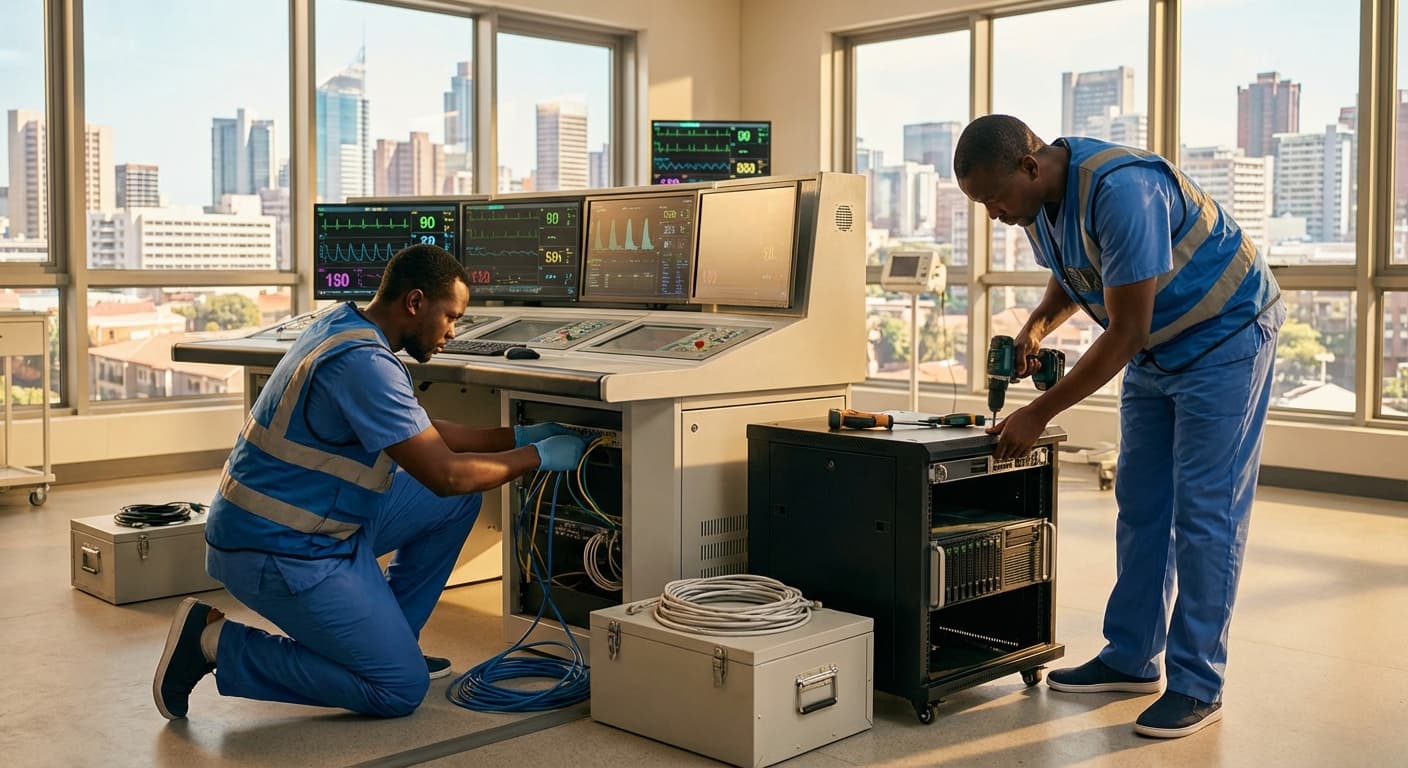
ICU Central Monitoring Station Installation Service in Mali
Engineering Excellence & Technical Support
ICU Central Monitoring Station Installation Service High-standard technical execution following OEM protocols and local regulatory frameworks.
Robust Network Infrastructure
We engineer resilient and secure IP-based network infrastructures specifically designed for the demanding environment of Mali, ensuring reliable, low-latency transmission of critical patient data from bedside monitors to the central ICU station, even in challenging logistical conditions.
Redundant Power & Cooling Solutions
Our installations incorporate multi-layered redundant power supply systems (UPS, generators) and advanced cooling solutions to guarantee uninterrupted operation of the central monitoring station, safeguarding against power outages and environmental fluctuations prevalent in Mali.
Expert Localized Training & Support
We provide comprehensive, hands-on training for your clinical staff in Mali on the operation and maintenance of the central monitoring system, coupled with readily available remote and on-site technical support to ensure seamless adoption and sustained performance.
What Is Icu Central Monitoring Station Installation Service In Mali?
ICU Central Monitoring Station Installation Service in Mali refers to the comprehensive process of designing, procuring, deploying, integrating, and commissioning a centralized system for real-time monitoring of critical patient parameters within Intensive Care Units (ICUs) in Malian healthcare facilities. This service ensures that vital signs and other physiological data from multiple ICU beds are collected, processed, displayed, and analyzed at a central console, enabling enhanced clinical oversight and rapid intervention.
| Who Needs This Service? | Typical Use Cases | ||||||
|---|---|---|---|---|---|---|---|
| Hospitals and Healthcare Facilities in Mali with Intensive Care Units (ICUs): This includes public hospitals, private clinics, and specialized medical centers requiring advanced patient monitoring capabilities. | Real-time patient surveillance: Continuous observation of vital signs (heart rate, blood pressure, SpO2, respiratory rate, temperature) and other critical parameters for critically ill patients. | Early detection of patient deterioration: Prompt identification of adverse physiological trends or critical events through centralized alarm systems. | Enhanced clinical decision-making: Providing clinicians with a consolidated view of patient status to facilitate timely and informed treatment adjustments. | Improved workflow efficiency: Reducing the need for manual chart checks and allowing staff to monitor multiple patients from a single location. | Data logging and analysis: Recording patient data for trend analysis, research, and quality improvement initiatives. | Remote monitoring capabilities (optional): Enabling off-site or physician review of patient data in certain configurations. | Disaster preparedness and surge capacity: Facilitating efficient management of a large influx of critically ill patients during public health emergencies. |
| Healthcare administrators and IT departments: Responsible for infrastructure upgrades and patient care technology adoption. | ICU medical directors and nursing managers: Overseeing patient care quality and operational efficiency within the ICU. | Government health ministries and agencies: Setting standards for critical care and supporting the modernization of public healthcare facilities. |
Key Components and Processes Involved:
- System Design & Planning: Architectural planning, network topology definition, hardware and software selection based on facility requirements and local infrastructure.
- Hardware Procurement & Installation: Acquisition and physical installation of patient monitors, central monitoring workstations, servers, networking equipment, and associated cabling.
- Software Deployment & Configuration: Installation, setup, and customization of the central monitoring software platform, including alarm management, data trending, and reporting functionalities.
- Network Integration: Establishing secure and reliable network connectivity between individual patient monitors and the central station, adhering to IT infrastructure standards.
- System Testing & Calibration: Rigorous testing of all components and functionalities, including alarm verification, data accuracy checks, and system performance benchmarking.
- User Training & Support: Comprehensive training for clinical staff (physicians, nurses) and IT personnel on system operation, maintenance, and troubleshooting.
- Commissioning & Handover: Final system validation, documentation, and formal handover to the healthcare facility.
- Post-Installation Support: Ongoing maintenance, software updates, and technical assistance as per service level agreements.
Who Needs Icu Central Monitoring Station Installation Service In Mali?
ICU Central Monitoring Station Installation Service in Mali caters to healthcare facilities that require advanced patient monitoring capabilities. These services are crucial for hospitals and clinics that manage critically ill patients, enabling real-time oversight of multiple patients' vital signs from a centralized location. This not only improves patient care by allowing for rapid intervention but also optimizes the workload of nursing staff.
| Customer Type | Key Departments Involved | Needs Addressed |
|---|---|---|
| Hospitals (Public and Private) | Intensive Care Unit (ICU), Critical Care Units (CCU), Post-Anesthesia Care Unit (PACU), Emergency Department (ED) with critical care capabilities. | Enhanced patient safety, improved clinical decision-making, efficient staff allocation, reduction in adverse events, compliance with modern healthcare standards. |
| Large Clinics and Medical Centers | Dedicated critical care bays or units within the facility, specialized treatment areas requiring continuous observation. | Centralized oversight for a higher volume of critical patients, streamlined communication between care teams, proactive management of patient status. |
| Specialty Hospitals (e.g., Cardiac, Neurological) | Specific ICUs for cardiac surgery recovery, neurological trauma, stroke units, or other critical specialties. | Tailored monitoring solutions for specific physiological parameters, advanced waveform analysis, integration with specialized diagnostic equipment. |
| Government Health Initiatives and Programs | Public hospitals and regional health centers designated for critical care services, especially in areas with limited advanced healthcare infrastructure. | Improving the standard of critical care across the nation, ensuring access to modern monitoring for a broader population, capacity building for healthcare professionals. |
| NGOs and Humanitarian Organizations | Field hospitals, emergency response medical units, and clinics operating in remote or disaster-affected areas requiring robust critical care capabilities. | Rapid deployment of effective patient monitoring, reliable operation in challenging environments, support for medical teams in resource-limited settings. |
Target Customers & Departments Requiring ICU Central Monitoring Station Installation Service in Mali:
- Hospitals (Public and Private)
- Large Clinics and Medical Centers
- Specialty Hospitals (e.g., Cardiac, Neurological)
- Government Health Initiatives and Programs
- NGOs and Humanitarian Organizations operating medical facilities
Icu Central Monitoring Station Installation Service Process In Mali
This document outlines the standard workflow for the Installation Service Process of an ICU Central Monitoring Station in Mali, from the initial client inquiry to the successful completion of the installation and post-installation support.
| Stage | Description | Key Activities | Deliverables | Timeline (Approx.) |
|---|---|---|---|---|
| The client expresses interest in installing an ICU Central Monitoring Station. This stage involves understanding their basic requirements and providing initial information. | Receive client inquiry, initial discussion of needs, product overview, and preliminary scope definition. | Initial understanding of client requirements, basic product information provided. | 1-3 Business Days |
| A detailed assessment of the client's facility in Mali to understand the specific technical requirements, existing infrastructure, and environmental factors. | On-site visit (if feasible, or detailed remote assessment via video/photos), evaluation of power, network, space, existing equipment, and specific monitoring needs. | Detailed site assessment report, confirmed technical specifications, identification of potential challenges. | 3-7 Business Days |
| Based on the site assessment, a comprehensive proposal outlining the proposed solution, equipment, services, and associated costs is prepared. | Develop technical solution, select appropriate hardware/software, calculate equipment and labor costs, define service scope, prepare detailed quotation. | Formal proposal document, detailed quotation with itemized costs, project timeline overview. | 5-10 Business Days |
| Review and finalization of the proposal, including terms and conditions, payment schedules, and service level agreements. | Client review of proposal, negotiation of terms, contract drafting, legal review, contract signing. | Signed contract agreement, purchase order issued. | 7-14 Business Days |
| Detailed planning of the installation project, including resource allocation, logistics, and a precise timeline. | Develop detailed project plan, define roles and responsibilities, schedule installation dates, coordinate with client's internal teams, plan for any necessary permits or local approvals. | Detailed project schedule, resource allocation plan, communication plan. | 3-5 Business Days |
| Ordering, sourcing, and transporting all necessary equipment and materials to Mali. | Order equipment from manufacturers/suppliers, manage customs clearance, arrange international and local transportation, ensure secure delivery to site. | All necessary equipment and materials delivered to the installation site in Mali. | Varies based on equipment availability and shipping times (typically 4-12 Weeks) |
| Ensuring the installation site is prepared and ready to receive the equipment and undergo the installation process. | Prepare installation space, ensure power and network infrastructure is ready, finalize any required structural modifications, confirm accessibility for installation team. | Site readiness confirmation, clean and prepared installation area. | 1-3 Business Days (prior to installation start) |
| The physical installation and initial setup of the ICU Central Monitoring Station hardware and software by the certified technical team. | Install monitoring devices, central server, workstations, network cabling, configure software, integrate with existing hospital systems (if applicable). | Installed and physically connected hardware, basic software configuration completed. | 5-15 Business Days (depending on system complexity) |
| Thorough testing of all components and the integrated system to ensure optimal performance and functionality. | Perform system diagnostics, calibrate devices, conduct functional tests, simulate patient scenarios, verify data accuracy and connectivity, resolve any identified issues. | Fully functional and calibrated ICU Central Monitoring Station, performance test reports. | 3-7 Business Days |
| Training hospital staff on the operation, maintenance, and troubleshooting of the new system, followed by formal handover. | Conduct comprehensive training sessions for clinical and technical staff, provide user manuals and documentation, address any queries, obtain client acceptance. | Trained staff, complete user documentation, signed handover certificate. | 2-5 Business Days |
| Ongoing support, troubleshooting, and planned maintenance to ensure the long-term reliability of the system. | Provide remote and on-site support, address any post-installation issues, perform regular maintenance checks, offer software updates and upgrades as needed. | Ongoing system reliability, documented support requests and resolutions, service level agreement (SLA) adherence. | Ongoing (as per contract) |
ICU Central Monitoring Station Installation Service Process in Mali
- Inquiry & Initial Consultation
- Site Assessment & Needs Analysis
- Proposal Development & Quotation
- Contract Negotiation & Signing
- Project Planning & Scheduling
- Equipment Procurement & Logistics
- Pre-Installation Preparation & Site Readiness
- On-site Installation & Configuration
- Testing & Commissioning
- Client Training & Handover
- Post-Installation Support & Maintenance
Icu Central Monitoring Station Installation Service Cost In Mali
Installing an ICU central monitoring station in Mali involves several cost components. The price can fluctuate significantly based on the specific needs of the hospital, the chosen technology, the vendor, and the complexity of the installation. Key factors influencing the cost include the number of beds to be monitored, the type of patient monitoring equipment (e.g., vital signs monitors, ventilators, ECG machines), the networking infrastructure required, software licensing, training, and post-installation support. Prices are typically quoted in Malian Francs (XOF).
| Cost Component | Estimated Range (XOF) |
|---|---|
| Basic ICU Monitoring Station (e.g., 4-6 beds, standard equipment) | 5,000,000 - 15,000,000 |
| Mid-Range ICU Monitoring Station (e.g., 8-12 beds, advanced features, some integration) | 15,000,000 - 35,000,000 |
| High-End ICU Monitoring Station (e.g., 15+ beds, state-of-the-art equipment, full EHR integration, advanced analytics) | 35,000,000 - 70,000,000+ |
| Per-Bed Monitoring Module (additional) | 500,000 - 1,500,000 |
| Software Licensing (annual, depending on features) | 1,000,000 - 5,000,000+ |
| Installation & Configuration Labor (estimated) | 1,500,000 - 5,000,000 |
| Training (per session/group) | 500,000 - 1,500,000 |
Key Pricing Factors for ICU Central Monitoring Station Installation in Mali:
- Number of ICU Beds to Monitor: Each additional bed increases the hardware and software requirements.
- Type and Brand of Patient Monitoring Equipment: High-end, advanced equipment will be more expensive.
- Networking Infrastructure: Requirements for wired or wireless networking, cabling, switches, and routers.
- Central Server and Software: The cost of the central server hardware and the licensing fees for the monitoring software.
- Data Storage and Archiving: Requirements for storing patient data over time.
- Integration with Existing Hospital Systems: Compatibility and integration efforts with Electronic Health Records (EHR) or other hospital information systems.
- Installation and Configuration Labor: The cost of skilled technicians and engineers for setup and customization.
- Training: Essential for medical staff to effectively use the new system.
- Warranty and Maintenance Contracts: Ongoing support and potential repair costs.
- Geographic Location within Mali: Transportation costs for equipment and personnel can vary.
- Vendor Reputation and Service Level Agreements (SLAs): Established vendors may command higher prices for their expertise and support.
- Customization and Specific Features: Any unique requirements beyond standard functionality.
- Import Duties and Taxes: Applicable to imported medical equipment.
Affordable Icu Central Monitoring Station Installation Service Options
Setting up an Intensive Care Unit (ICU) central monitoring station is a critical investment for patient safety and efficient healthcare delivery. This service focuses on providing accessible and cost-effective solutions for hospitals and clinics. We offer flexible installation options designed to meet various budgetary constraints while ensuring high-quality, reliable systems. Understanding the complexities of ICU monitoring, our service prioritizes seamless integration, user-friendly interfaces, and long-term operational efficiency. We achieve this through a combination of smart value bundles and proven cost-saving strategies, making advanced patient monitoring more attainable.
| Value Bundle Name | Key Components Included | Target Audience | Estimated Cost Range (USD) | Cost-Saving Strategies Employed |
|---|---|---|---|---|
| Essential Monitoring Package | Core central monitoring unit, 5-10 patient bedside monitors, basic data logging, standard network integration. | Small to medium-sized ICUs, budget-conscious facilities. | $15,000 - $30,000 | Bulk purchasing of standardized equipment, simplified installation process, focus on essential features. |
| Advanced Care Bundle | High-performance central monitoring unit, 10-20 advanced patient monitors (with advanced parameter support), comprehensive data archiving, integration with EMR, basic remote viewing. | Medium to large ICUs, facilities requiring more detailed patient data and integration. | $30,000 - $60,000 | Negotiated bulk discounts with manufacturers, modular system design for phased upgrades, bundled training packages. |
| Comprehensive Critical Care Suite | Enterprise-grade central monitoring station, unlimited patient connections, advanced hemodynamic and respiratory monitoring modules, full EMR integration, advanced analytics and reporting, robust remote access with multi-level security. | Large ICUs, teaching hospitals, facilities with complex monitoring needs and research aspirations. | $60,000+ | Customized solutions to avoid over-provisioning, optimized network infrastructure, tiered support agreements, lease-to-own options, refurbished equipment options for non-critical components. |
Affordable ICU Central Monitoring Station Installation Service Options
- Comprehensive Needs Assessment: We begin with a thorough evaluation of your ICU's current infrastructure, patient volume, and specific monitoring requirements to tailor the most appropriate solution.
- Scalable System Design: Our installations are designed for future growth, allowing you to expand your monitoring capabilities as your needs evolve without necessitating a complete system overhaul.
- Expert Integration and Configuration: Our certified technicians ensure seamless integration with existing hospital IT networks and medical devices, minimizing disruption and maximizing functionality.
- User Training and Support: We provide comprehensive training for your medical staff on operating and maintaining the central monitoring station, along with ongoing technical support.
- Remote Monitoring Capabilities: Explore options for remote access and monitoring, enhancing oversight and enabling timely interventions from various locations.
- Data Security and Compliance: All installations adhere to stringent data privacy and security regulations (e.g., HIPAA), ensuring patient information is protected.
Verified Providers In Mali
In Mali's healthcare landscape, discerning reliable and high-quality medical services is paramount. Franance Health has established itself as a leading entity, offering a robust network of verified providers that adhere to stringent standards. This commitment to quality assurance ensures that patients receive competent and compassionate care. Understanding the credentials and the meticulous vetting process employed by Franance Health reveals why they represent the best choice for medical services in Mali.
| Provider Type | Franance Health Verification Criteria | Benefits for Patients |
|---|---|---|
| Doctors (Specialists & General) | Valid medical license, Board certification (where applicable), Verified degrees and diplomas, Clean disciplinary record, Minimum years of experience. | Access to qualified and experienced medical professionals, Reduced risk of misdiagnosis or improper treatment, Peace of mind knowing you are receiving care from accredited practitioners. |
| Hospitals & Clinics | Accreditation status (local and/or international), Compliance with safety and hygiene standards, Availability of essential medical equipment, Qualified nursing staff, Emergency response capabilities. | Safe and well-equipped healthcare facilities, Access to a range of medical services under one roof, Assurance of a sterile and secure environment for treatment and recovery. |
| Laboratories & Diagnostic Centers | Certified by relevant health authorities, Calibration and maintenance of equipment, Trained and qualified laboratory technicians, Adherence to quality control protocols for test accuracy. | Accurate and reliable diagnostic test results, Timely identification of health conditions, Crucial for effective treatment planning. |
| Pharmacies | Valid operating license, Verified dispensing of authentic medications, Qualified pharmacists on duty, Proper storage and handling of pharmaceuticals. | Access to safe and genuine medications, Professional advice on medication usage, Reduced risk of counterfeit or substandard drugs. |
Key Franance Health Credentials & Benefits:
- Rigorous Provider Vetting: Franance Health implements a comprehensive screening process for all affiliated healthcare professionals and facilities. This includes verification of medical licenses, certifications, educational backgrounds, and professional experience.
- Adherence to International Standards: Franance Health aligns its operational protocols and quality benchmarks with internationally recognized healthcare best practices, ensuring a high level of care.
- Patient-Centric Approach: The network prioritizes patient well-being, focusing on accessible, affordable, and culturally sensitive healthcare delivery.
- Continuous Quality Improvement: Franance Health actively monitors provider performance and patient feedback to ensure ongoing improvement and maintenance of service excellence.
- Comprehensive Network: Access to a diverse range of specialists and general practitioners, covering various medical needs.
- Transparency and Trust: Franance Health builds trust through its commitment to transparency in provider qualifications and service offerings.
Scope Of Work For Icu Central Monitoring Station Installation Service
This Scope of Work (SOW) outlines the requirements for the installation service of an Intensive Care Unit (ICU) Central Monitoring Station (CMS). The service includes the physical installation, configuration, testing, and commissioning of all hardware and software components of the ICU CMS, ensuring seamless integration with existing ICU equipment and network infrastructure. The objective is to establish a reliable and efficient system for real-time patient monitoring, data acquisition, and alarm management within the ICU.
The project will encompass the following key phases: site preparation, hardware installation, network configuration, software deployment and configuration, system testing, and user training. The contractor will be responsible for providing all necessary tools, equipment, and skilled personnel to complete the installation to the highest industry standards.
| Component/System | Standard Specification/Requirement | Verification Method |
|---|---|---|
| Central Monitoring Workstations | High-performance workstations with at least Intel Core i7 processor or equivalent, 16GB RAM, 512GB SSD. Dual 24-inch HD displays (1920x1080) with adjustable stands. Ergonomic keyboard and mouse. Latest stable operating system (e.g., Windows 10 Pro or later). | Visual inspection, system information verification, performance benchmark tests. |
| Server Infrastructure (if applicable) | Rack-mountable servers with redundant power supplies, RAID configuration for storage, ECC RAM. Minimum dual Intel Xeon E5 or equivalent processors. Sufficient storage for historical patient data (specify capacity based on projected needs). | Visual inspection, server configuration reports, storage capacity verification. |
| Network Switches & Cabling | Managed Gigabit Ethernet switches with sufficient port density. Cat6a or higher Ethernet cabling for all connections. Structured cabling adhering to TIA-568 standards. POE capability for relevant devices. | Visual inspection of switch configuration, cable testing (e.g., Fluke certification), network connectivity tests. |
| CMS Software | Latest stable version of the vendor-provided CMS software. Secure authentication and authorization mechanisms. Customizable display layouts and alarm thresholds. Remote access capabilities (if specified). | Software version verification, user role testing, alarm configuration checks, remote access test. |
| Integration Interfaces | HL7 or other standardized protocols for data exchange with EMR/HIS. Direct integration protocols for specific bedside monitor manufacturers (e.g., Philips, GE, Spacelabs). DICOM compatibility for imaging integration (if applicable). | Data transmission tests (HL7 message validation), simulated data flow tests from bedside devices, image retrieval tests. |
| Alarm Management System | Configurable alarm priorities and audible/visual alerts. Centralized alarm log with timestamps and acknowledgment records. Integration with nurse call systems (if required). | Simulated alarm generation and verification of alerts, alarm log review, nurse call integration test. |
| Power and Battery Backup | Uninterruptible Power Supply (UPS) for all CMS components, providing a minimum of 30 minutes of runtime. Surge protection for all connected equipment. | UPS load testing, runtime verification during simulated power outage, surge protector inspection. |
| Environmental Considerations | All equipment to be installed in accordance with hospital environmental guidelines, including temperature, humidity, and EMI/RFI shielding. | Visual inspection of installation environment, verification of adherence to hospital environmental policies. |
| Security | Role-based access control. Data encryption for data in transit and at rest (if specified). Regular security patching and updates. Compliance with relevant healthcare data privacy regulations (e.g., HIPAA). | User access control testing, encryption verification (if applicable), security audit report review, compliance checklist. |
Technical Deliverables
- Fully installed and commissioned ICU Central Monitoring Station (CMS) hardware.
- Configured and operational CMS software with predefined patient monitoring parameters and alarm settings.
- Integrated CMS with existing ICU bedside monitors, ventilators, and other relevant medical devices.
- Established and secured network connectivity for CMS data transmission.
- Comprehensive system test reports, including functionality, performance, and security testing.
- User manuals and technical documentation for the installed CMS.
- As-built documentation, including equipment placement, cabling diagrams, and network topology.
- Completed user training sessions for ICU clinical staff and IT personnel.
- Warranty and support documentation for all installed components.
Service Level Agreement For Icu Central Monitoring Station Installation Service
This Service Level Agreement (SLA) outlines the response times and uptime guarantees for the installation of the ICU Central Monitoring Station service. This SLA is effective upon the successful completion of the installation and acceptance testing of the ICU Central Monitoring Station.
| Incident Severity | Response Time Guarantee | Resolution Time Guarantee | Uptime Guarantee (excluding Scheduled Downtime) |
|---|---|---|---|
| Critical Incident | 15 minutes | 2 hours | 99.9% (monthly) |
| Major Incident | 30 minutes | 4 hours | 99.9% (monthly) |
| Minor Incident | 2 business hours | 8 business hours | 99.9% (monthly) |
Definitions
- Critical Incident: An event that renders the ICU Central Monitoring Station entirely inoperable, impacting all monitored ICU beds and their associated data streams, or a significant security breach of patient data.
- Major Incident: An event that significantly degrades the functionality of the ICU Central Monitoring Station, affecting a substantial portion of monitored ICU beds or core monitoring functionalities, but not rendering the entire system inoperable.
- Minor Incident: An event that affects a limited number of ICU beds or non-critical functionalities, causing inconvenience but not a significant disruption to patient care monitoring.
- Scheduled Downtime: Pre-planned maintenance or upgrade periods for the ICU Central Monitoring Station, communicated to the client in advance.
- Unscheduled Downtime: Any period of time when the ICU Central Monitoring Station is not available to the client due to reasons other than Scheduled Downtime.
- Response Time: The time taken from the moment a service request is logged by the client to the moment the service provider's support team acknowledges the request and begins active investigation.
- Resolution Time: The time taken from the moment a service request is logged by the client to the moment the issue is resolved and the ICU Central Monitoring Station is fully functional.
- Uptime: The percentage of time the ICU Central Monitoring Station is operational and accessible, excluding Scheduled Downtime.
Frequently Asked Questions

Ready when you are
Let's scope your ICU Central Monitoring Station Installation Service in Mali project in Mali.

Scaling healthcare logistics and technical systems across the entire continent.