
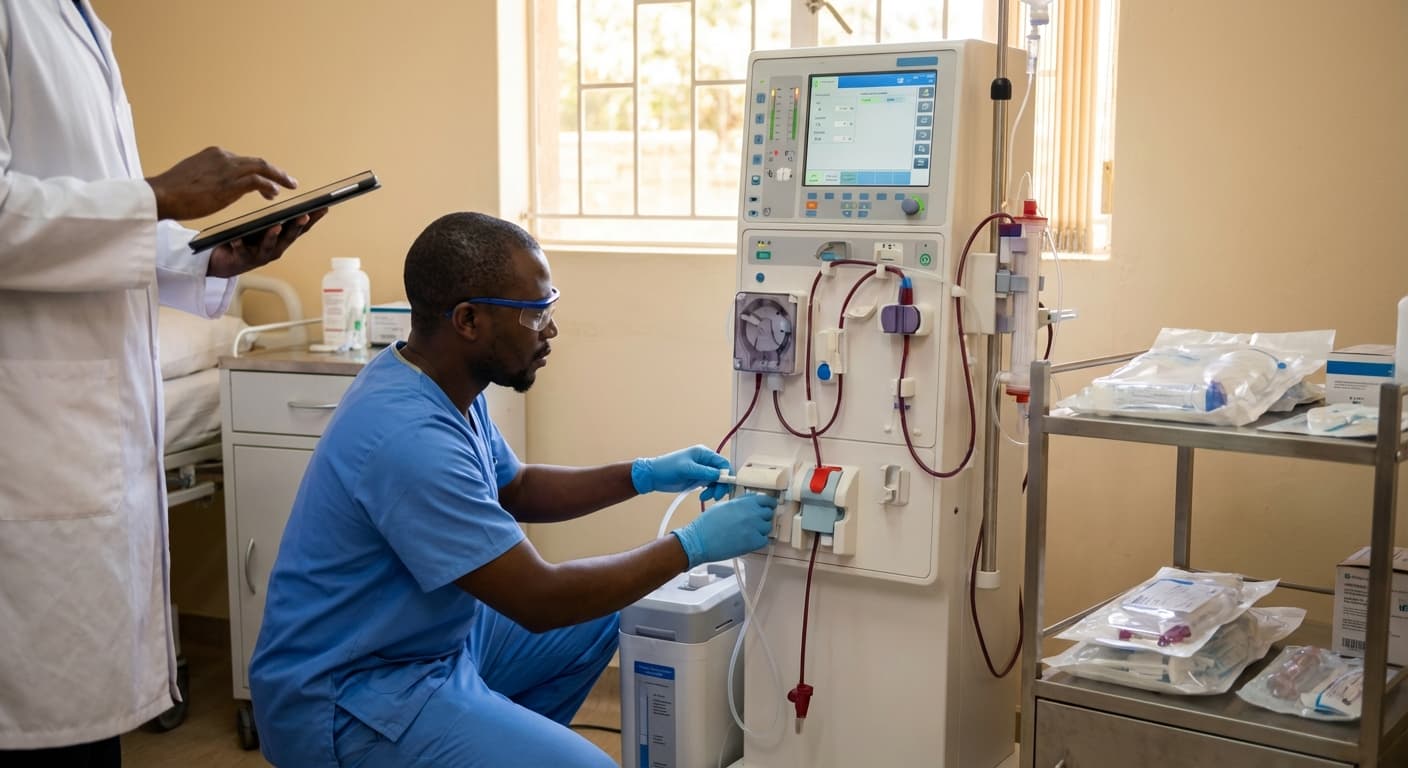
Hemodialysis Machine Installation Service in Mali
Engineering Excellence & Technical Support
Hemodialysis Machine Installation Service High-standard technical execution following OEM protocols and local regulatory frameworks.
Certified Hemodialysis Machine Installation & Calibration
Our certified technicians provide expert installation and precision calibration of hemodialysis machines across Mali, ensuring optimal performance and patient safety according to international standards.
Comprehensive On-Site Training & Support
We offer comprehensive on-site training for your medical staff on machine operation, maintenance, and troubleshooting, coupled with ongoing technical support to maximize uptime and efficiency.
Regulatory Compliance & Site Readiness Assessment
Our service includes a thorough site readiness assessment and ensures all installations meet local Malian health regulations and international guidelines for safe and effective hemodialysis treatment.
What Is Hemodialysis Machine Installation Service In Mali?
Hemodialysis machine installation service in Mali refers to the professional provision of setting up, calibrating, and testing hemodialysis equipment within healthcare facilities in Mali. This service ensures that the machines are correctly integrated with the facility's infrastructure, adhere to all safety and operational standards, and are ready for patient use. It encompasses a range of technical procedures and logistical considerations specific to the Malian healthcare environment, including supply chain management for components and training for local biomedical personnel.
| Requirement | Description | Relevance in Mali |
|---|---|---|
| Healthcare Facilities Requiring Dialysis | Hospitals (public and private), specialized kidney centers, and dialysis clinics that offer or plan to offer hemodialysis treatment. | Increasing demand for renal replacement therapy in Mali necessitates the establishment and upgrading of dialysis units in urban and peri-urban centers. |
| Established Dialysis Programs | Facilities expanding their existing dialysis capacity or replacing outdated equipment. | Upgrades are crucial for maintaining service quality and accommodating growing patient populations. |
| New Healthcare Infrastructure Projects | Newly constructed hospitals or clinics that are incorporating dialysis services as part of their core offerings. | Ensures that new facilities are equipped with state-of-the-art and properly installed hemodialysis technology from inception. |
| Government Health Initiatives | Public health programs aimed at improving access to renal care across the country. | Facilitates the deployment of essential medical equipment to underserved regions or public health institutions. |
Key Components of Hemodialysis Machine Installation Service in Mali
- Site Assessment and Preparation: Evaluating the chosen installation site for suitability, including power supply, water quality, drainage, and physical space. Modifications may be required to meet manufacturer specifications and local regulations.
- Equipment Delivery and Unpacking: Secure transportation and careful unpacking of the hemodialysis machines and associated accessories to prevent damage.
- Physical Installation and Connection: Mounting the machines, connecting them to the facility's purified water system, electrical outlets, and waste disposal systems according to technical manuals and safety protocols.
- Calibration and Testing: Performing rigorous calibration of all machine parameters (e.g., blood flow rate, dialysate composition, ultrafiltration) using validated testing fluids and procedures. This includes verifying alarm functionalities and safety interlocks.
- Integration with Facility Systems: Ensuring seamless integration with existing medical gas systems (if applicable), patient monitoring equipment, and data management systems.
- Water Treatment System Setup: Installation and commissioning of the required water purification system (e.g., reverse osmosis units) to produce ultrapure dialysate, a critical component for patient safety.
- User Training: Providing comprehensive technical training to the facility's biomedical engineering staff and nursing personnel on machine operation, basic maintenance, troubleshooting, and emergency procedures.
- Documentation and Handover: Completing all necessary installation reports, certifications, and providing operational manuals to the healthcare facility, signifying the successful handover of the equipment.
- Post-Installation Support: Offering initial troubleshooting assistance and warranty claim facilitation during the early operational phase.
Who Needs Hemodialysis Machine Installation Service In Mali?
Hemodialysis machine installation services are crucial for ensuring the proper setup, calibration, and initial operation of these life-saving medical devices. In Mali, like in many developing nations, the demand for such specialized services is driven by the growing need for accessible and effective kidney disease treatment.
| Customer Type | Typical Facility | Department(s) Involved in Installation | Need for Service | Key Considerations |
|---|---|---|---|---|
| Public Hospitals | Large regional hospitals, University Teaching Hospitals | Nephrology, Biomedical Engineering, Procurement | Expanding dialysis capacity, replacing old machines, establishing new units | Budget constraints, public health priorities, training of local staff |
| Private Hospitals and Clinics | Urban private medical centers, specialized clinics | Nephrology, Administration, Biomedical Engineering | Meeting patient demand, offering comprehensive services, competitive advantage | Service quality, speed of installation, cost-effectiveness |
| NGOs | Health centers in underserved areas, mobile clinics | Program Management, Clinical Staff, Technical Support | Providing essential healthcare in remote or low-resource settings | Sustainability, accessibility, community impact |
| Renal Centers/Dialysis Units | Dedicated facilities for chronic dialysis | Clinical Director, Head Nurse, Biomedical Technician | Increasing patient load, upgrading to newer technologies, ensuring operational efficiency | Patient safety, workflow optimization, regulatory compliance |
| Equipment Suppliers/Distributors | Warehouses, client healthcare facilities | Sales, Technical Service, Logistics | Fulfilling contractual obligations with their buyers, ensuring proper product deployment | Manufacturer specifications, client satisfaction, warranty management |
| International Aid Organizations | Newly built or renovated healthcare facilities | Project Managers, Health System Specialists, Procurement Teams | Establishing or enhancing kidney care infrastructure as part of larger health programs | Alignment with national health strategies, long-term sustainability, capacity building |
Target Customers and Departments for Hemodialysis Machine Installation Service in Mali
- {"items":["Public Hospitals (Ministry of Health-owned)","Private Hospitals and Clinics","Non-Governmental Organizations (NGOs) operating healthcare facilities","Renal Centers and Dialysis Units (independent or affiliated)","Medical Equipment Suppliers and Distributors (for their clients)","International Aid Organizations establishing or upgrading healthcare infrastructure"],"title":"Primary Target Customers"}
- {"items":["Nephrology Department/Unit","Internal Medicine Department (often housing dialysis services)","Critical Care Unit/Intensive Care Unit (ICU) (for acute dialysis needs)","Surgical Department (in some cases, for pre- or post-operative dialysis)","Biomedical Engineering Department (for oversight and maintenance)","Procurement and Logistics Department (for acquisition and coordination)"],"title":"Key Departments within Facilities"}
Hemodialysis Machine Installation Service Process In Mali
This document outlines the typical workflow for Hemodialysis Machine Installation Services in Mali, from initial customer inquiry to the successful execution of the installation. The process is designed to ensure efficient, safe, and compliant installation of vital medical equipment.
| Stage | Key Activities | Responsible Party | Key Deliverables | Notes/Considerations for Mali |
|---|---|---|---|---|
| Receive customer request (clinic, hospital, NGO). Discuss machine model, quantity, and specific needs. Provide preliminary information. | Service Provider | Initial understanding of project scope. | Language barriers may require local liaison. Understanding of specific Malian healthcare regulations is crucial. |
| Visit the installation site. Assess power supply (voltage, stability, backup options), water quality and supply, space availability, ventilation, and access for equipment. Develop a detailed installation plan. | Service Provider (Technical Team), Client Representative | Site assessment report, detailed installation plan, technical requirements list. | Reliability of power and water infrastructure in Mali can vary significantly. Need to plan for potential UPS or generator integration. Water purification system requirements are critical. |
| Prepare a detailed quotation including machine costs (if applicable), installation labor, materials, travel, and any necessary modifications. Finalize contract terms and conditions. | Service Provider | Formal quotation, signed service contract. | Ensure clear payment terms and currency (CFA Franc). Understand import duties and taxes for medical equipment. |
| Order the hemodialysis machine(s) and all necessary installation materials (piping, electrical components, water treatment filters, safety equipment). | Service Provider, Supplier(s) | Procured equipment and materials. | Lead times for specialized medical equipment can be long. Sourcing reliable suppliers with efficient shipping to Mali is important. |
| Arrange secure and insured transportation of the machine(s) and materials to the installation site in Mali. Coordinate customs clearance. | Service Provider, Logistics Partner | Equipment and materials delivered to site. | Navigating Malian customs procedures can be complex and time-consuming. Working with experienced customs brokers is advisable. |
| Unpack and physically install the hemodialysis machine according to manufacturer specifications and the approved installation plan. Connect power, water, and drainage systems. | Service Provider (Installation Technicians) | Physically installed machine. | Ensure technicians are trained on the specific models being installed. Adherence to electrical safety standards is paramount. |
| Perform comprehensive functional tests to ensure all machine operations are correct. Calibrate sensors and safety features. Verify water purity and flow rates. | Service Provider (Calibration Technicians) | Successful test results, calibration reports. | Requires access to calibrated testing equipment. Verification of critical parameters for patient safety. |
| Provide hands-on training to the medical staff who will operate the machine. Cover basic operation, maintenance, emergency procedures, and troubleshooting. | Service Provider (Clinical Support/Trainer) | Trained medical staff, training completion certificates. | Training materials should be adapted to the local language where possible or translated. Focus on practical application and common scenarios. |
| Compile all relevant documentation: installation reports, test results, calibration certificates, user manuals, and warranty information. Formally hand over the installed system to the client. | Service Provider | Complete documentation package, signed handover form. | Ensure all documents are legible and complete. Client representative should thoroughly review documentation. |
| Provide ongoing technical support, including troubleshooting, routine maintenance, and emergency assistance as per the service contract. Plan for future service visits. | Service Provider | Ongoing operational system, maintenance records. | Establish clear communication channels for support requests. Availability of spare parts in Mali should be considered. |
Hemodialysis Machine Installation Service Workflow in Mali
- Inquiry & Initial Consultation
- Site Assessment & Planning
- Quotation & Contract Agreement
- Machine & Material Procurement
- Logistics & Transportation
- Installation & Setup
- Testing & Calibration
- User Training
- Documentation & Handover
- Post-Installation Support
Hemodialysis Machine Installation Service Cost In Mali
The cost of installing a hemodialysis machine in Mali is subject to several factors, making it difficult to provide a single definitive price. These factors generally revolve around the complexity of the installation, the specific model of the hemodialysis machine, the geographical location within Mali, and the service provider chosen. Understanding these elements is crucial for budgeting and planning for such a critical medical service. Local currency prices are typically quoted in West African CFA franc (XOF).
| Installation Component | Estimated Cost Range (XOF) |
|---|---|
Key Pricing Factors for Hemodialysis Machine Installation in Mali
- {"item":"Type and Model of Hemodialysis Machine","description":"More advanced or specialized hemodialysis machines with integrated features (e.g., advanced monitoring, specific treatment capabilities) will generally incur higher installation costs. Basic models might be less expensive to set up."}
- {"item":"Site Preparation Requirements","description":"The existing infrastructure of the healthcare facility plays a significant role. If the location requires extensive electrical upgrades, plumbing modifications, dedicated ventilation, or specialized water purification systems, the installation cost will increase substantially."}
- {"item":"Geographical Location","description":"Installation costs can vary depending on the remoteness of the location within Mali. Sites in major urban centers like Bamako might have more readily available technicians and resources, potentially leading to lower travel and logistical costs for the service provider compared to rural or remote areas."}
- {"item":"Service Provider and Expertise","description":"The reputation, experience, and operational costs of the installation service provider will influence pricing. Larger, established companies with specialized technicians may charge more than smaller, local providers, but often offer greater reliability and warranty."}
- {"item":"Training and Commissioning","description":"The cost often includes the essential training for medical staff on operating and maintaining the machine. Comprehensive training packages or extended commissioning periods can add to the overall expense."}
- {"item":"Warranty and After-Sales Support","description":"The duration and scope of the warranty, as well as the availability and cost of ongoing technical support and maintenance plans, can be factored into the initial installation price."}
- {"item":"Customization and Integration","description":"If the installation requires integration with existing hospital information systems or specific customization for unique patient needs, this will likely increase the complexity and cost."}
Affordable Hemodialysis Machine Installation Service Options
Acquiring and installing a hemodialysis machine is a significant undertaking for healthcare facilities. To make this process more manageable and cost-effective, various service options and strategies are available. This guide explores affordable installation service options, emphasizing the value of bundled services and practical cost-saving measures to ensure accessibility and efficient deployment of critical medical equipment.
| Strategy/Service | Description | Cost-Saving Benefit | Considerations |
|---|---|---|---|
| Value Bundles | Combining installation with initial maintenance contracts, spare parts kits, or extended warranties. | Reduces per-service cost, simplifies vendor management, predictable budgeting. | Ensure the bundled services align with actual needs. Compare bundled price against individual component costs. |
| Phased Installation | Breaking down the installation process into manageable stages, potentially spreading costs over time. | Alleviates immediate financial strain, allows for gradual resource allocation. | Requires careful project management to ensure continuity and avoid delays. May incur additional logistics costs. |
| Bulk Purchasing | Acquiring multiple machines or related equipment from a single vendor at a discounted rate. | Leverages economies of scale for significant upfront savings. | Requires upfront capital investment and capacity to manage multiple installations. |
| Negotiation and Quotes | Actively soliciting and comparing quotes from multiple reputable providers. | Drives competitive pricing and allows for selection of best value. | Thoroughly vet all providers for experience, certifications, and references. Understand the scope of work for each quote. |
| Used/Refurbished Equipment | Purchasing pre-owned, certified hemodialysis machines from trusted vendors. | Substantially lower capital expenditure compared to new equipment. | Ensure warranty, serviceability, and availability of spare parts. Verify certification and condition. |
| Long-Term Service Agreements | Committing to a longer-term service and maintenance contract in exchange for reduced installation fees or discounted service rates. | Secures predictable maintenance costs and can lead to lower initial installation charges. | Evaluate the long-term commitment and ensure the provider's reliability and responsiveness. |
| Training Integration | Bundling comprehensive user and technical training with the installation service. | Reduces separate training costs and ensures efficient equipment operation from day one. | Verify the quality and depth of training provided. Ensure it covers all essential aspects. |
Affordable Hemodialysis Machine Installation Service Options
- Manufacturer Direct Installation: Often the most comprehensive, this includes delivery, setup, calibration, and initial training. While seemingly pricier upfront, it ensures adherence to manufacturer specifications and often comes with extended warranty benefits.
- Third-Party Biomedical Service Companies: Specializing in medical equipment, these companies offer installation, maintenance, and repair services. They can be a cost-effective alternative, especially for facilities already contracting for other biomedical services.
- Refurbished Machine Packages: Purchasing a certified refurbished hemodialysis machine from a reputable vendor often includes installation as part of the package, significantly reducing the initial capital expenditure.
- Rental or Leasing Agreements: Some providers offer rental or leasing of hemodialysis machines that include installation and maintenance. This is ideal for facilities with fluctuating patient needs or those exploring the technology before a full purchase.
- In-House Installation with External Support: For facilities with a skilled biomedical engineering team, purchasing the machine and then contracting for specific calibration, validation, and troubleshooting support can be a highly cost-efficient approach.
- Government or Non-Profit Grants and Programs: Explore funding opportunities that may subsidize the cost of equipment acquisition and installation for underserved regions or specific patient populations.
Verified Providers In Mali
In Mali's burgeoning healthcare landscape, distinguishing between legitimate and fraudulent service providers is paramount for patient safety and effective treatment. Verified providers, particularly those with recognized credentials like those offered by Franance Health, represent the gold standard. This document outlines the significance of these credentials and explains why Franance Health certified providers are the optimal choice for your healthcare needs in Mali.
| Credential Type | Significance in Mali | Franance Health Verification |
|---|---|---|
| Medical Licenses & Certifications | Confirms a provider has met the basic educational and professional requirements to practice medicine within Mali. However, these can be obtained by various individuals, some with questionable training. | Franance Health goes beyond basic licensing. We verify the authenticity of all medical licenses and professional certifications, cross-referencing with issuing bodies and conducting background checks on their educational institutions. |
| Specialty Board Certifications | Indicates a provider has undergone advanced training and testing in a specific medical field. Important for complex conditions, but the rigor of these certifications can vary. | We meticulously review the accreditation and recognition of specialty board certifications. Our process ensures that these certifications are from reputable and internationally recognized organizations, guaranteeing a high level of specialized knowledge. |
| Continuing Medical Education (CME) Records | Demonstrates a provider's commitment to staying updated with the latest medical advancements and practices. While important, ensuring the quality and relevance of CME can be challenging. | Franance Health verifies the completion and quality of CME programs. We prioritize providers who engage in evidence-based and relevant continuous learning, ensuring they are at the forefront of medical innovation. |
| Peer Reviews & Disciplinary History | Provides insights into a provider's reputation among their colleagues and any past professional misconduct. Access to reliable and unbiased peer review data can be limited in Mali. | Our comprehensive verification includes thorough checks of professional conduct, including inquiries into disciplinary actions and verified peer feedback where available. This ensures ethical practice and patient-centered care. |
| Facility Accreditation | For hospitals and clinics, this signifies adherence to safety, quality, and operational standards. The availability and stringency of facility accreditation in Mali can be inconsistent. | Franance Health assesses and verifies the accreditation status of healthcare facilities. We partner with providers whose facilities meet or exceed recognized national and international standards for patient safety and operational efficiency. |
Why Choose Franance Health Verified Providers in Mali?
- Unwavering Commitment to Quality Care: Franance Health rigorously vets its accredited providers, ensuring they meet stringent international standards for medical expertise, ethical practices, and patient well-being.
- Enhanced Patient Safety: By choosing a Franance Health verified provider, you significantly reduce the risk of encountering unqualified practitioners or facilities that may compromise your health.
- Access to Specialized Expertise: Our verification process identifies providers with specific specializations, allowing you to find the most skilled professional for your unique medical requirements.
- Transparent and Reliable Information: Franance Health provides clear and accessible information about its verified providers, empowering you to make informed decisions about your healthcare.
- Trust and Peace of Mind: Partnering with Franance Health certified healthcare professionals offers a significant level of trust and reassurance, knowing you are in capable and ethical hands.
Scope Of Work For Hemodialysis Machine Installation Service
This Scope of Work (SOW) outlines the requirements for the installation of hemodialysis machines at [Hospital/Clinic Name], located at [Address]. The service provider will be responsible for the complete installation, testing, and commissioning of the specified hemodialysis machines, ensuring they meet all relevant technical specifications and operational standards. This includes site preparation, equipment placement, connection to utilities, functional testing, user training, and documentation.
The primary objective is to ensure that each hemodialysis machine is installed correctly, safely, and efficiently, ready for immediate clinical use, adhering to the highest industry standards and manufacturer guidelines. This SOW covers all aspects from the delivery of the machines to the final handover to the hospital staff.
| Task/Activity | Description | Technical Deliverable(s) | Standard Specification(s) | Acceptance Criteria |
|---|---|---|---|---|
| Site Assessment and Planning | On-site visit to assess installation location, utility availability (power, water, drainage, compressed air if applicable), and space requirements. Develop a detailed installation plan. | Installation Plan Document, Site Survey Report | Manufacturer's site preparation guidelines, local building codes, electrical safety standards (e.g., IEC 60601 series) | Approved Installation Plan, confirmed utility capacity and accessibility. |
| Equipment Delivery and Unpacking | Receive, inspect, and carefully unpack all delivered hemodialysis machines and associated accessories. Verify against the delivery manifest. | Delivery Confirmation Note, Unpacking Report | Manufacturer's shipping and handling instructions, ISO 13485 (Quality Management for Medical Devices) | No visible damage to equipment upon unpacking, all items accounted for as per manifest. |
| Site Preparation and Utility Connections | Prepare the designated installation area. Connect the machines to the required utilities (e.g., dedicated electrical circuits, purified water supply, drain lines, potentially compressed air). Ensure all connections are secure and compliant. | Completed utility connections, Electrical grounding certification | Manufacturer's installation manual, local plumbing and electrical codes, water quality standards (e.g., AAMI standards for dialysate water) | Successful connection and confirmation of utility supply to each machine. Water conductivity and pressure within specified ranges. |
| Machine Installation and Calibration | Position the hemodialysis machines in their final locations. Perform initial setup, configuration, and calibration according to manufacturer specifications. | Installed and configured hemodialysis machines | Manufacturer's operational manual, calibration protocols | Machines are powered on, systems initialized, and all settings configured as per manufacturer's defaults or agreed-upon hospital protocols. |
| System Testing and Validation | Conduct comprehensive functional tests, including leak tests, pressure tests, flow rate verification, alarm system checks, and disinfection cycles. Validate performance against manufacturer specifications. | Functional Test Report, Calibration Certificates, Validation Report | Manufacturer's diagnostic procedures, performance specifications outlined in machine manuals, relevant ISO standards for medical electrical equipment (e.g., IEC 60601-1-2 for EMC) | All test parameters within acceptable ranges, successful completion of all diagnostic checks and simulated treatment cycles. |
| User Training and Handover | Provide hands-on training to hospital biomedical engineers and nursing staff on the operation, routine maintenance, troubleshooting, and safety procedures for the hemodialysis machines. | Training attendance records, Training completion certificates (optional) | Manufacturer's operator manual, hospital training protocols | Designated staff demonstrate competence in operating and performing basic maintenance of the machines. |
| Documentation and Reporting | Provide all necessary documentation, including installation reports, test results, calibration records, user manuals, warranty information, and a final sign-off document. | Complete Installation and Commissioning Report, As-built diagrams (if applicable), O&M Manuals | Manufacturer's documentation standards, hospital record-keeping policies | All required documentation is complete, accurate, and submitted to the hospital within the agreed timeframe. |
Key Project Phases and Activities
- Site Assessment and Planning
- Equipment Delivery and Unpacking
- Site Preparation and Utility Connections
- Machine Installation and Calibration
- System Testing and Validation
- User Training and Handover
- Documentation and Reporting
Service Level Agreement For Hemodialysis Machine Installation Service
This Service Level Agreement (SLA) outlines the response times and uptime guarantees for the Hemodialysis Machine Installation Service provided by [Your Company Name] (hereinafter referred to as 'Provider') to [Client Name] (hereinafter referred to as 'Client').
| Service Component | Response Time (Business Hours) | Resolution Target (Business Hours) | Uptime Guarantee |
|---|---|---|---|
| Initial Response to Installation Issue | 2 Business Hours | 8 Business Hours | N/A (Installation is a one-time event) |
| Critical Machine Malfunction (Post-Installation, within warranty period) | 4 Business Hours | 24 Business Hours | 95% |
| Non-Critical Machine Malfunction (Post-Installation, within warranty period) | 8 Business Hours | 48 Business Hours | 98% |
Scope of Service
- Installation of new hemodialysis machines as per manufacturer specifications.
- Configuration and testing of installed hemodialysis machines.
- Basic user training on machine operation and maintenance procedures.
- Troubleshooting and repair of installation-related issues within the defined response times.
Frequently Asked Questions

Ready when you are
Let's scope your Hemodialysis Machine Installation Service in Mali project in Mali.

Scaling healthcare logistics and technical systems across the entire continent.