
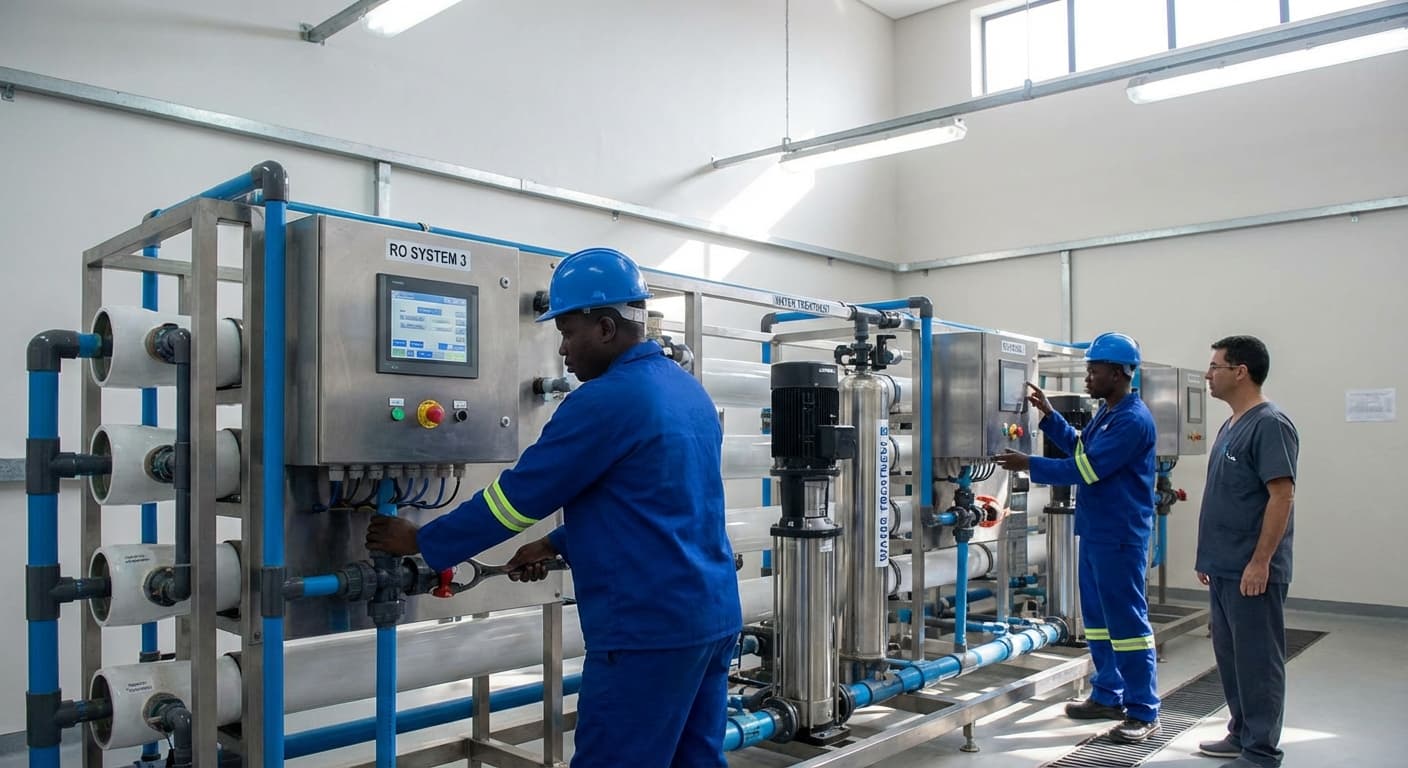
Dialysis RO/Water Treatment Plant Installation Service in Mali
Engineering Excellence & Technical Support
Dialysis RO/Water Treatment Plant Installation Service High-standard technical execution following OEM protocols and local regulatory frameworks.
Optimized Water Purity for Dialysis
We deliver state-of-the-art Reverse Osmosis (RO) and advanced water treatment plant installations in Mali, ensuring ultra-pure water essential for patient safety and optimal dialysis treatment efficacy. Our systems meet stringent international standards for hemodialysis water.
Robust System Design & Reliable Operation
Our expert engineers design and install durable, energy-efficient water treatment solutions tailored to Mali's unique environmental and infrastructure conditions. We focus on long-term reliability and minimal downtime for your critical healthcare operations.
Local Expertise, Global Standards
Leveraging deep understanding of local water sources and regulatory landscapes in Mali, we provide seamless installation, commissioning, and ongoing technical support. We bridge the gap between global best practices and localized operational realities for your dialysis facility.
What Is Dialysis Ro/water Treatment Plant Installation Service In Mali?
Dialysis RO/Water Treatment Plant Installation Service in Mali refers to the specialized process of designing, procuring, assembling, commissioning, and testing Reverse Osmosis (RO) and associated water treatment systems specifically for medical dialysis facilities within the Republic of Mali. This service is critical for ensuring the production of ultra-pure water, a fundamental requirement for hemodialysis and peritoneal dialysis procedures, thereby safeguarding patient health and operational integrity. The service encompasses a comprehensive technical approach, beginning with site assessment and fluid analysis, followed by system design tailored to local water quality, regulatory standards, and facility capacity. Installation involves the physical setup of RO units, pre-treatment filtration (e.g., sediment filters, carbon filters), post-treatment processes (e.g., UV sterilization, deionization if required), and integration with the dialysis machines' water supply lines. Commissioning and validation are crucial phases, involving rigorous testing of water quality parameters (conductivity, total dissolved solids, microbial load, endotoxins) to meet stringent medical standards such as those set by AAMI (Association for the Advancement of Medical Instrumentation) or equivalent international guidelines. Post-installation support, including operator training and maintenance protocols, is typically part of the service offering.
| Who Needs This Service? | Typical Use Cases and Applications | |||
|---|---|---|---|---|
| Dialysis Centers and Hospitals: Facilities, both public and private, offering hemodialysis and peritoneal dialysis services to patients with renal failure. | New Clinic Construction: Installation of a new, compliant water treatment system for newly established dialysis units. | Existing Facility Upgrades/Replacements: Modernizing or replacing outdated, inefficient, or non-compliant RO/water treatment systems in operational dialysis centers. | Remote or Underserved Areas: Establishing essential medical infrastructure in regions of Mali where reliable access to purified water for dialysis is limited. | Emergency/Disaster Relief Operations: Setting up temporary or mobile dialysis units requiring immediate and reliable water purification solutions. |
| Hemodialysis Treatment: Production of purified water for dilution of dialysate concentrate and rinsing of dialysis equipment. | Peritoneal Dialysis Solution Preparation (Indirectly): While PD solutions are typically purchased pre-made, the infrastructure for healthcare facilities offering PD often includes dialysis water treatment for other purposes or for in-house preparation of specific solutions where regulations permit. | Meeting Regulatory Standards: Ensuring compliance with national and international standards for dialysis water purity to prevent patient complications (e.g., pyrogenic reactions, electrolyte imbalances). | Improving Patient Outcomes: Directly contributing to the safety and efficacy of dialysis treatments by providing consistently high-quality water. | Operational Efficiency and Cost Reduction: Implementing efficient systems that minimize water wastage and energy consumption, and reduce the risk of equipment damage due to poor water quality. |
Key Components and Phases of Dialysis RO/Water Treatment Plant Installation:
- Site Assessment and Water Quality Analysis
- System Design and Engineering (including flow rates, pressure, material compatibility)
- Component Sourcing and Procurement (RO membranes, pumps, filters, control systems)
- Mechanical and Electrical Installation
- Plumbing and Piping Integration
- Pre-treatment System Installation (sedimentation, chlorination/dechlorination, carbon filtration)
- Reverse Osmosis Unit Installation
- Post-treatment System Installation (e.g., UV sterilization, polishing filters)
- Instrumentation and Control System Setup
- Electrical Power Supply and Earthing
- Leak Testing and Pressure Integrity Checks
- System Flushing and Sanitization
- Commissioning and Performance Validation
- Water Quality Testing and Certification (TDS, conductivity, TOC, microbial counts, endotoxins)
- Operator Training and Documentation
- Handover and Warranty Provision
Who Needs Dialysis Ro/water Treatment Plant Installation Service In Mali?
Installing a Reverse Osmosis (RO) and water treatment plant for dialysis is a critical infrastructure requirement for ensuring the safety and efficacy of hemodialysis treatments. In Mali, where access to clean and reliable water sources can be a challenge, these specialized plants are essential for healthcare facilities that provide kidney dialysis services. The primary purpose of these plants is to purify municipal or well water to ultra-pure standards, removing all contaminants, dissolved solids, bacteria, and endotoxins that could pose a severe risk to dialysis patients.
| Target Customer Group | Key Departments/Roles Involved | Specific Needs |
|---|---|---|
| Hospitals & Dialysis Centers | Biomedical Engineering Department, Facilities Management, Procurement Department, Medical Director, Nephrology Department | Reliable supply of ultrapure water meeting AAMI/ISO standards for hemodialysis, equipment maintenance, patient safety, compliance with health regulations. |
| Government Health Ministries | Public Health Infrastructure Division, Planning and Investment Department, Procurement Unit, Regulatory Affairs | Expansion of dialysis services, equitable access to healthcare, cost-effective solutions, national health strategy alignment, public health standards enforcement. |
| NGOs & International Aid | Program Management, Procurement and Logistics, Health Sector Specialists, Project Managers | Humanitarian aid, disease control programs, capacity building, provision of essential medical equipment, sustainable healthcare solutions, project implementation. |
| Private Healthcare Investors | Operations Management, Finance Department, Development Team, Quality Assurance | Establishing profitable and reputable dialysis centers, meeting patient demand, ensuring high-quality patient care, return on investment, regulatory compliance. |
| Educational Institutions | Medical Faculty, Department of Biomedical Sciences, Facilities Management | Training facilities for medical professionals, practical learning environments, research capabilities, student education. |
Who Needs Dialysis RO/Water Treatment Plant Installation Service in Mali?
- {"title":"Healthcare Facilities Providing Dialysis Services","description":"This is the most direct and primary target customer. Any hospital, clinic, or specialized dialysis center in Mali that offers hemodialysis treatments will require a dedicated RO and water treatment plant."}
- {"title":"Government Health Ministries and Departments","description":"As the primary governing bodies responsible for public health infrastructure, these departments often fund, approve, and oversee the establishment of new healthcare facilities or upgrades to existing ones, including dialysis units. They would be key stakeholders in ensuring access to such services in underserved regions."}
- {"title":"Non-Governmental Organizations (NGOs) and International Aid Organizations","description":"Organizations focused on improving healthcare access and quality in developing countries like Mali are significant potential clients. They may fund or directly manage the installation of dialysis units and their associated water treatment systems as part of their humanitarian efforts."}
- {"title":"Private Healthcare Investors and Operators","description":"With the growing demand for specialized medical services, private investors and companies looking to establish or expand healthcare networks in Mali will need these installations for their dialysis centers."}
- {"title":"Research and Educational Institutions","description":"While less common, universities or research centers with medical programs that include nephrology or dialysis training might require such facilities for practical learning and research purposes."}
Dialysis Ro/water Treatment Plant Installation Service Process In Mali
This document outlines the typical workflow for installing a Dialysis Reverse Osmosis (RO) / Water Treatment Plant in Mali, from the initial client inquiry to the final execution and handover. The process is designed to ensure a smooth, efficient, and compliant installation that meets the specific needs of the healthcare facility.
| Stage | Description | Key Activities | Deliverables/Outcomes |
|---|---|---|---|
| The process begins when a healthcare facility in Mali expresses interest in a Dialysis RO/Water Treatment Plant. | Initial discussion about needs, capacity, type of plant, budget, and timeline. Clarification of client's existing water sources and quality. | Understanding of client's basic requirements and preliminary scope of work. |
| A thorough evaluation of the client's facility and specific water treatment needs. | On-site visit (if feasible) or detailed remote assessment. Measurement of available space, power supply, water source quality (testing), and existing infrastructure. Detailed discussion of dialysis machine types and patient volume. | Comprehensive site report, detailed technical specifications, and finalized plant requirements. |
| Based on the assessment, a tailored proposal is prepared. | Development of a detailed technical proposal outlining the proposed RO system, components, features, and compliance with relevant standards (e.g., WHO guidelines for dialysis water). Preparation of a formal quotation including equipment, installation, training, and any associated services. | Formal proposal document, detailed quotation with pricing and payment terms. |
| Formalization of the agreement between the client and the service provider. | Review and negotiation of the proposal and quotation. Signing of a comprehensive contract detailing scope of work, responsibilities, payment schedule, warranty, and support terms. | Signed contract, confirmed order. |
| The necessary components for the RO plant are sourced or manufactured. | Ordering of standard components. Custom manufacturing of specific modules or systems as per design. Quality control checks during manufacturing. | All necessary RO plant components and spares ready for shipment. |
| Efficient and secure transportation of equipment to the installation site in Mali. | Packaging of equipment according to international shipping standards. Arranging for freight (air or sea) and customs clearance in Mali. Coordination of local transport to the client's facility. | Equipment safely delivered to the client's site in Mali. |
| Ensuring the installation location is ready for the plant. | Preparation of the designated area (e.g., flooring, drainage, ventilation). Installation of necessary electrical connections, plumbing, and any required structural modifications. | Site ready for plant installation. |
| The physical installation and setup of the RO/Water Treatment Plant. | Unpacking and positioning of all plant components. Connecting various modules, piping, and electrical wiring. Assembly of the complete system. | Fully assembled and interconnected RO/Water Treatment Plant. |
| Verification of the plant's performance and water quality. | Pre-commissioning checks. Flushing and sanitization of the system. Running the plant under operational conditions. Testing water quality parameters (TDS, conductivity, microbial count, etc.) against established standards. Adjusting settings for optimal performance. | Fully functional RO plant producing water that meets dialysis standards. Commissioning report. |
| Empowering the client's staff to operate and maintain the plant. | On-site training sessions for biomedical engineers, technicians, and relevant staff. Covering plant operation, routine maintenance, troubleshooting, and safety procedures. Providing operational manuals and troubleshooting guides. | Trained personnel capable of operating and performing basic maintenance on the plant. |
| Official transfer of the installed plant and related documents to the client. | Final inspection and walk-through with the client. Handover of all operational manuals, maintenance logs, warranty certificates, and relevant certifications. Formal sign-off on project completion. | Client takes possession of the fully installed and functional RO/Water Treatment Plant. Complete documentation package. |
| Ongoing support to ensure the plant's longevity and optimal performance. | Provision of warranty support. Offering scheduled preventive maintenance services. Availability of spare parts and technical assistance for any issues that may arise. | Continued reliable operation of the RO/Water Treatment Plant. Client satisfaction and long-term partnership. |
Dialysis RO/Water Treatment Plant Installation Service Process in Mali: Workflow
- Initial Inquiry and Consultation
- Site Assessment and Requirements Gathering
- Proposal and Quotation Development
- Contract Negotiation and Agreement
- Equipment Procurement and Manufacturing
- Logistics and Transportation to Mali
- Site Preparation and Civil Works
- Plant Installation and Assembly
- System Testing and Commissioning
- Staff Training and Knowledge Transfer
- Final Handover and Documentation
- Post-Installation Support and Maintenance
Dialysis Ro/water Treatment Plant Installation Service Cost In Mali
Installing a Reverse Osmosis (RO) and water treatment plant for dialysis in Mali is a significant undertaking, and the costs involved can vary widely. These plants are crucial for ensuring the availability of safe, pure water essential for hemodialysis procedures, protecting patients from waterborne contaminants that could lead to serious health complications. The pricing is influenced by several key factors, making it difficult to provide a single definitive cost. Understanding these factors is vital for budgeting and selecting the right system. Factors include the capacity of the plant, the type and complexity of the treatment processes required, the brand and quality of the equipment, installation labor, site preparation, ongoing maintenance, and the specific geographic location within Mali.
| Cost Component | Estimated Range (XOF) | Notes |
|---|---|---|
| Small Dialysis Unit (e.g., 1-2 Dialysis Machines) | 5,000,000 - 15,000,000 | Basic RO system with pre-treatment, potentially for a smaller clinic or satellite unit. Costs are highly dependent on water quality. |
| Medium Dialysis Center (e.g., 3-6 Dialysis Machines) | 15,000,000 - 40,000,000 | Includes more robust pre-treatment, a higher-capacity RO unit, potentially double-pass RO, and essential monitoring systems. Installation complexity increases. |
| Large Dialysis Facility (e.g., 7+ Dialysis Machines) | 40,000,000 - 100,000,000+ | Advanced multi-stage treatment, high-capacity RO, sophisticated automation and monitoring, redundancy, and extensive site preparation. May involve imported, specialized equipment. |
| Pre-treatment Systems (e.g., filters, softeners, UF) | 1,000,000 - 10,000,000+ | Cost varies greatly based on the number of stages and the contaminants being addressed. |
| RO Membranes and Pumps | 1,000,000 - 5,000,000+ | Depends on capacity and brand. Higher flow rates and better quality mean higher costs. |
| Installation Labor & Site Prep | 2,000,000 - 15,000,000+ | Significant variation based on the complexity of the site and the required infrastructure work. |
| Ancillary Equipment (Tanks, UV, monitoring) | 1,000,000 - 7,000,000+ | Includes storage, sterilization, and real-time quality control. |
Key Factors Influencing Dialysis RO/Water Treatment Plant Installation Costs in Mali
- Plant Capacity: The volume of purified water the plant needs to produce daily or hourly directly impacts the size and cost of the RO membranes, pumps, tanks, and other components. Larger capacities require more sophisticated and expensive systems.
- Water Source Quality: The initial quality of the raw water (e.g., groundwater, municipal supply) is a major determinant. Water with high levels of impurities, salinity, or specific contaminants may necessitate multi-stage pre-treatment processes (e.g., sand filtration, activated carbon, ion exchange, ultrafiltration) before RO, increasing complexity and cost.
- Treatment Technology: While RO is the core technology, additional treatment stages like UV sterilization, deionization, or specific chemical dosing systems may be required to meet stringent dialysis water standards. The number and type of these stages significantly affect the overall price.
- Equipment Brand and Quality: Reputable international brands known for reliability and adherence to medical-grade standards generally command higher prices than locally sourced or less established brands. The quality of pumps, membranes, control systems, and monitoring equipment plays a crucial role.
- Installation Labor and Expertise: The complexity of the installation, the need for specialized technicians (both local and potentially international), and the duration of the installation process contribute to labor costs. Site preparation, including plumbing, electrical work, and potentially structural modifications, also adds to this.
- Site Preparation and Infrastructure: The existing infrastructure at the installation site matters. This includes the availability of adequate power supply, water intake points, drainage, and space for the plant itself. If significant upgrades or new construction are needed, costs will rise.
- Ancillary Equipment and Services: This can include water storage tanks, distribution piping, water quality monitoring systems, backup power (generators), spare parts, and initial training for plant operators.
- Permits and Approvals: Obtaining necessary permits and regulatory approvals for installing a medical water treatment system can incur fees and require time, adding to the indirect costs.
- Warranty and Maintenance Packages: The terms of the warranty and any included initial maintenance or service agreements will be factored into the upfront cost. Long-term maintenance contracts can also be a significant consideration.
Affordable Dialysis Ro/water Treatment Plant Installation Service Options
Installing a Reverse Osmosis (RO) and water treatment plant for dialysis is a critical investment in patient safety and healthcare facility efficiency. Finding affordable options requires understanding the components, service models, and cost-saving strategies available. This guide explores how value bundles and smart planning can significantly reduce the overall expenditure without compromising on quality or regulatory compliance.
| Value Bundle Type | Inclusions | Benefits | Cost-Saving Strategies |
|---|---|---|---|
| Basic Package | Standard RO unit, essential pre-treatment, basic monitoring, installation, and initial training. | Cost-effective for smaller facilities or those with existing basic infrastructure. | Opt for standard, reliable components over high-end features. Negotiate installation costs based on site readiness. |
| Comprehensive Package | High-capacity RO, advanced pre-treatment, redundant RO membranes, UV/EDI, advanced monitoring, integrated alarm systems, installation, extensive training, and a basic maintenance contract. | Offers higher reliability, better water quality, and reduced downtime. Ideal for larger facilities or those prioritizing uninterrupted operation. | Bundle maintenance with installation. Consider phased upgrades if budget is a constraint. Explore long-term service agreements for bulk discounts. |
| Customized Solution | Tailored to specific water analysis, patient volume, and facility layout. Can include specialized pre-treatment for unique water sources. | Optimizes performance for specific needs, potentially reducing operational costs by addressing specific contaminants efficiently. | Thorough water testing is crucial to avoid over-specifying or under-specifying. Partner with experienced consultants for accurate system design. Compare quotes from multiple vendors for custom builds. |
| Service & Maintenance Bundle | Includes scheduled preventive maintenance, filter replacements, water quality testing, and emergency service calls. | Ensures optimal system performance, extends equipment lifespan, and minimizes costly unexpected breakdowns. Essential for regulatory compliance. | Negotiate longer-term service contracts for discounted rates. Explore remote monitoring options to reduce on-site visit frequency. Train in-house staff for basic troubleshooting to reduce emergency call-outs. |
Key Components of a Dialysis RO/Water Treatment Plant
- Pre-treatment Filters (Sediment, Carbon): Remove particulate matter and chlorine.
- RO Membrane(s): The core of the system, removing dissolved solids and contaminants.
- Post-treatment (UV Sterilization, Electrodeionization - EDI): Ensures microbial inactivation and ultra-pure water.
- Storage Tank: Holds purified water for immediate use.
- Piping and Distribution System: Delivers water to dialysis machines.
- Monitoring and Control Systems: Ensure water quality parameters are met.
Verified Providers In Mali
In Mali's evolving healthcare landscape, identifying trusted and credentialed providers is paramount for ensuring quality and reliable medical services. Franance Health stands out as a leading organization committed to upholding the highest standards in healthcare provision. Their rigorous credentialing process and unwavering dedication to patient well-being make them the definitive choice for individuals and families seeking exceptional medical care.
| Benefit | Franance Health Advantage | Why it Matters for Patients |
|---|---|---|
| Quality Assurance | Franance Health's stringent credentialing identifies only highly competent and ethical healthcare professionals. | Guarantees access to skilled doctors, nurses, and specialists, reducing the risk of misdiagnosis or substandard treatment. |
| Patient Safety | Verified providers have met rigorous standards for practice and patient care. | Minimizes the potential for medical errors and ensures that treatments are administered safely and effectively. |
| Trust and Reliability | The credentialing process builds a foundation of trust in the healthcare system. | Patients can have confidence in the expertise and integrity of the providers they engage with. |
| Access to Expertise | Franance Health facilitates access to a network of specialists and sub-specialists. | Ensures that complex medical needs can be met by the most qualified professionals available. |
| Continuous Improvement | Ongoing monitoring ensures providers maintain their high standards and continue to develop their skills. | Patients benefit from up-to-date medical knowledge and the latest advancements in healthcare. |
Key Aspects of Franance Health's Credentialing Process
- Comprehensive background checks, including verification of medical licenses, educational qualifications, and professional affiliations.
- Thorough review of clinical experience, performance history, and peer evaluations.
- Adherence to strict ethical guidelines and professional conduct standards.
- Ongoing monitoring and re-credentialing to ensure continued compliance and excellence.
Scope Of Work For Dialysis Ro/water Treatment Plant Installation Service
This Scope of Work (SOW) outlines the requirements for the installation services of a Reverse Osmosis (RO) and Water Treatment Plant specifically designed for dialysis facilities. It details the technical deliverables expected from the vendor and references standard specifications to ensure the highest quality and compliance. The objective is to ensure a fully functional, safe, and efficient water treatment system capable of producing high-purity water essential for hemodialysis procedures, meeting all relevant regulatory and health standards.
| Phase | Activities | Technical Deliverables | Standard Specifications/References |
|---|---|---|---|
| Site survey to assess space, utilities (power, water, drainage), and existing infrastructure. Detailed system design review. Material procurement and logistics planning. | Detailed site assessment report. Finalized system layout drawings and P&IDs (Piping and Instrumentation Diagrams). Procurement and delivery schedule. | AAMI RD52: 2019 (Recommended Practice for the Reuse of Dialyzers), AAMI TIR33:2018 (Water Treatment for Hemodialysis – 2018), Local building codes, Electrical codes, Plumbing codes. |
| Unloading and positioning of RO unit, pre-treatment modules, storage tanks, distribution loop, and associated piping. Electrical wiring and control panel integration. Plumbing connections (inlet water, treated water outlet, drain). | Physically installed RO/Water Treatment Plant components. Completed electrical connections. Properly connected piping for water inlet, outlet, and drainage. Functional control panel. | ASME B31.3 (Process Piping), NSF/ANSI 58 (Reverse Osmosis Drinking Water Treatment Systems), NSF/ANSI 61 (Drinking Water System Components – Health Effects). |
| Flushing and sanitization of the entire system. Initial system startup and performance checks. Water quality testing (physical, chemical, microbiological). Pressure testing of piping and vessels. | Fully sanitized system. Verified operational parameters (flow rates, pressures, conductivity, etc.). Initial water quality test results (pre-filtration, post-RO, post-polishing). Pressure test reports. | AAMI RD52: 2019, AAMI TIR33:2018, Manufacturer's commissioning protocol. |
| Comprehensive validation of the RO/Water Treatment Plant to ensure consistent production of dialysis-grade water. Microbiological testing and TOC (Total Organic Carbon) analysis. Verification of alarm systems and interlocks. | Validation report including all test results and certifications. Documented proof of system performance meeting AAMI standards. Verified functionality of all safety and operational features. | AAMI RD52: 2019, AAMI TIR33:2018, FDA 21 CFR Part 820 (Quality System Regulation - applicable if considered a medical device component). |
| On-site training for facility biomedical engineers and technicians on system operation, routine maintenance, basic troubleshooting, and emergency procedures. Provision of all relevant documentation. | Trained facility personnel. Completed training sign-off sheets. Comprehensive Operations & Maintenance (O&M) manuals. System schematics and P&IDs. As-built drawings. Warranty information. | Manufacturer's O&M manuals. Facility-specific training materials. |
| Remote or on-site support during the initial operational period (e.g., first 30-60 days). Addressing any unforeseen issues or adjustments required. | Resolved operational issues. Documented support interventions and resolutions. | As per service agreement and warranty terms. |
Key Objectives
- To successfully install and commission a complete RO/Water Treatment Plant system at the designated dialysis facility.
- To ensure the system consistently produces water meeting or exceeding AAMI (Association for the Advancement of Medical Instrumentation) standards for dialysis water.
- To provide comprehensive training to facility staff on the operation, maintenance, and troubleshooting of the installed system.
- To ensure all installations are performed safely, adhering to local building codes and regulations.
- To deliver all required documentation, including schematics, manuals, and validation reports.
Service Level Agreement For Dialysis Ro/water Treatment Plant Installation Service
This Service Level Agreement (SLA) outlines the response times and uptime guarantees for the installation and initial setup services of a Dialysis Reverse Osmosis (RO)/Water Treatment Plant. This SLA is an addendum to the main Service Agreement between [Your Company Name] and [Client Name] dated [Date of Main Agreement].
| Service Element | Response Time Target | Uptime Guarantee |
|---|---|---|
| Initial System Startup & Testing | Within 4 business hours of site readiness confirmation. | N/A (Focus on successful completion) |
| Critical Issue Resolution (System Malfunction post-installation) | Remote diagnosis within 2 business hours. On-site technician dispatch within 8 business hours (for issues requiring physical intervention, subject to technician availability and travel time). | 99.5% operational uptime for the water treatment system during the warranty period, measured monthly. Uptime excludes scheduled maintenance and planned outages. |
| Non-Critical Issue Resolution (Minor adjustments, performance tuning) | Remote diagnosis within 4 business hours. On-site technician dispatch within 24 business hours (if remote resolution is not feasible). | N/A |
| Routine Scheduled Maintenance (Post-installation, during warranty) | As per the agreed-upon maintenance schedule provided by [Your Company Name]. | N/A |
| Operator Training Session Scheduling | Within 5 business days of successful system installation and initial handover. | N/A |
Scope of Service
- Installation of the Dialysis RO/Water Treatment Plant as per the agreed-upon specifications and design.
- Connection to existing water supply and electrical infrastructure (if applicable and as per scope).
- Initial system testing and calibration.
- Basic operator training on system operation and routine maintenance.
- Verification of water quality parameters to meet [Specify relevant standards, e.g., AAMI, ISO] for dialysis use.
Frequently Asked Questions

Ready when you are
Let's scope your Dialysis RO/Water Treatment Plant Installation Service in Mali project in Mali.

Scaling healthcare logistics and technical systems across the entire continent.