
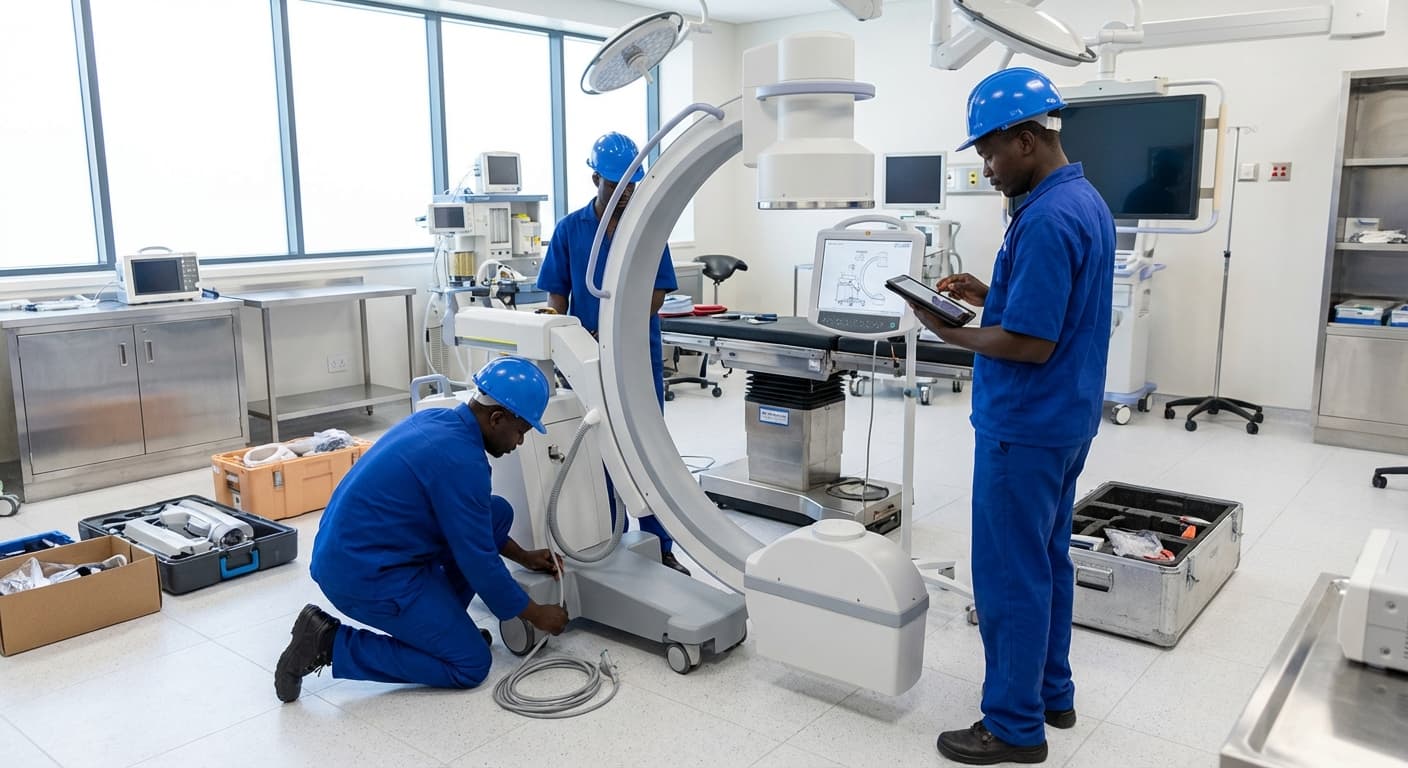
C-Arm Installation Service in Mali
Engineering Excellence & Technical Support
C-Arm Installation Service High-standard technical execution following OEM protocols and local regulatory frameworks.
Certified C-Arm Installation & Calibration
Expert installation and precise calibration of C-arm systems by certified technicians, ensuring optimal imaging performance and adherence to international standards. We guarantee seamless integration with your existing hospital infrastructure.
Site Readiness Assessment & Planning
Comprehensive site assessment and detailed planning to identify power, space, and environmental requirements for your C-arm. Our proactive approach minimizes installation delays and ensures a safe, compliant operating environment.
Post-Installation Training & Remote Support
Thorough operator training and ongoing remote technical support to maximize your C-arm's lifespan and efficiency. Benefit from rapid issue resolution and expert guidance, keeping your diagnostic capabilities at peak performance.
What Is C-arm Installation Service In Mali?
C-Arm installation service in Mali refers to the specialized process of setting up, configuring, and validating a C-arm fluoroscopy imaging system within a healthcare facility in Mali. This service ensures the C-arm is operational, integrated with existing hospital infrastructure, and compliant with relevant safety and performance standards for diagnostic and interventional procedures. The installation encompasses the physical placement of the C-arm unit, connection to power and imaging networks, calibration, and initial testing.
| Who Needs C-Arm Installation Service in Mali? | Typical Use Cases in Mali | ||||||
|---|---|---|---|---|---|---|---|
| Hospitals and Clinics: Both public and private healthcare institutions requiring advanced imaging capabilities for surgical and diagnostic purposes. | Orthopedic Surgery: Intraoperative imaging for fracture reduction, spinal surgery, and joint replacements. | Pain Management Centers: Fluoroscopically guided injections and nerve blocks. | Emergency Departments: Rapid imaging for trauma assessment and management. | Radiology Departments: Advanced diagnostic imaging and interventional procedures. | Surgical Centers: Facilities performing minimally invasive procedures requiring real-time X-ray visualization. | Cardiology Departments (where applicable): Fluoroscopy for diagnostic catheterization and interventional cardiology procedures. | Veterinary Clinics (specialized): In regions with advanced veterinary care, specialized C-arms may require professional installation. |
Key Components of C-Arm Installation Service in Mali
- Site assessment and preparation: Evaluating the installation environment for power, space, and shielding requirements.
- Physical setup: Unpacking, positioning, and securing the C-arm system.
- Electrical and network integration: Connecting the C-arm to hospital power grids and PACS (Picture Archiving and Communication System) or other relevant IT infrastructure.
- System configuration and calibration: Adjusting imaging parameters, optimizing detector settings, and performing quality assurance tests.
- Operator training: Providing basic training on the C-arm's operation, safety features, and routine maintenance.
- Documentation and validation: Generating installation reports, certificates of performance, and ensuring adherence to manufacturer specifications and local regulations.
Who Needs C-arm Installation Service In Mali?
C-Arm installation services are crucial for a wide range of healthcare facilities in Mali, ensuring that advanced imaging technology is correctly set up, calibrated, and integrated into existing medical workflows. This specialized service is essential for optimizing the performance and safety of C-Arm machines, which are vital for diagnostic and interventional procedures.
| Customer Type | Key Departments/Applications | Rationale for C-Arm Installation |
|---|---|---|
| Hospitals (Public & Private) | Orthopedics, Urology, General Surgery, Cardiology, Pain Management, Emergency/Trauma, Radiology | Essential for real-time intraoperative imaging, guiding procedures, fracture reduction, and pain interventions. Ensures proper integration with PACS/RIS and adherence to safety standards. |
| Surgical Centers | Orthopedic Surgery, Pain Management Procedures, Minor Surgical Interventions | Enables minimally invasive surgeries and precise needle placement for injections, biopsies, and pain relief, improving patient outcomes and reducing recovery time. |
| Specialty Clinics (Orthopedics, Urology, Cardiology, Pain Management) | Orthopedic Procedures (e.g., joint replacements, fracture repair), Urological Interventions (e.g., stent placement), Cardiac Catheterization (though often larger systems), Pain Management Injections | Provides critical imaging support for specialized procedures that require precise anatomical visualization during interventions. |
| Diagnostic Imaging Centers | Fluoroscopy, Interventional Radiology Procedures | Supports diagnostic imaging needs and allows for minimally invasive diagnostic and therapeutic procedures. |
| Trauma Centers | Emergency Surgery, Fracture Management, Foreign Body Removal | Crucial for rapid assessment and treatment of trauma patients, allowing for immediate intraoperative imaging to guide surgical decisions. |
| University Teaching Hospitals | All Surgical and Interventional Departments, Research | Facilitates training of medical professionals, supports complex procedures, and may be used in research involving imaging. |
| Military Hospitals | Trauma Surgery, Orthopedics, General Surgery | Provides essential imaging capabilities for treating battlefield injuries and other medical needs of military personnel. |
| NGO Healthcare Facilities | Surgical Interventions, Diagnostic Imaging (in equipped facilities) | Enables the provision of advanced medical services in areas where such technology might otherwise be inaccessible. |
Target Customers and Departments for C-Arm Installation Service in Mali
- Hospitals (Public and Private)
- Surgical Centers
- Specialty Clinics (Orthopedics, Urology, Cardiology, Pain Management)
- Diagnostic Imaging Centers
- Trauma Centers
- University Teaching Hospitals
- Military Hospitals
- Non-Governmental Organization (NGO) Healthcare Facilities
- Remote and Rural Healthcare Outposts (if equipped with advanced imaging capabilities)
C-arm Installation Service Process In Mali
This document outlines the comprehensive workflow for C-Arm installation services in Mali, from the initial client inquiry to the successful execution and post-installation support. The process is designed to ensure efficiency, compliance with local regulations, and client satisfaction.
| Phase | Key Activities | Responsible Parties | Deliverables/Outcomes |
|---|---|---|---|
| Phase 1: Inquiry & Initial Consultation | Receive client's request for C-Arm installation. Understand client's specific needs, intended use, and preferred C-Arm model. Discuss preliminary timelines and budget. Provide initial information on services offered. | Client, Sales Representative/Project Manager | Understanding of client requirements, preliminary scope definition, initial interest confirmation. |
| Phase 2: Site Assessment & Feasibility Study | Conduct a detailed on-site assessment of the installation location. Evaluate room dimensions, power supply, radiation shielding requirements, ventilation, network connectivity, and access for equipment delivery. Assess compliance with Malian healthcare regulations and safety standards. | Technical Engineer/Site Assessor, Client Representative | Detailed site report, identification of any potential challenges or modifications needed, confirmation of feasibility. |
| Phase 3: Quotation & Contract Negotiation | Prepare a comprehensive quotation based on the C-Arm model, installation scope, site assessment findings, and any required accessories or modifications. Negotiate terms, pricing, payment schedules, and service level agreements with the client. Finalize and sign the installation contract. | Sales Representative/Project Manager, Client | Formal quotation, signed installation contract, agreed-upon project scope and financials. |
| Phase 4: Order Placement & Equipment Procurement | Place the order for the selected C-Arm system and any associated equipment or consumables. Coordinate with the manufacturer or supplier to ensure timely delivery. Secure all necessary import permits and documentation for Mali. | Procurement Department/Project Manager, Supplier/Manufacturer | Confirmed equipment order, scheduled production/delivery, necessary import documentation. |
| Phase 5: Logistics & Transportation | Plan and manage the secure transportation of the C-Arm system from the point of origin to the installation site in Mali. This includes customs clearance, freight forwarding, and local delivery arrangements. Ensure proper handling and packaging to prevent damage during transit. | Logistics Coordinator, Freight Forwarders, Customs Brokers | Equipment safely delivered to the installation site, all customs procedures completed. |
| Phase 6: Pre-Installation Preparations | Prepare the installation site according to the site assessment report. This may involve electrical work, structural modifications, radiation shielding installation, and ensuring network infrastructure is ready. Verify that all required tools and equipment for installation are on-site. | Installation Team, Facility Management (Client), Electrical/Construction Contractors | Site fully prepared for installation, all necessary infrastructure in place and functional. |
| Phase 7: On-site Installation & Configuration | Unpack and physically install the C-Arm system. Connect all components, including the X-ray generator, image intensifier/detector, workstation, and any peripherals. Configure software settings, network parameters, and user interfaces according to client specifications and manufacturer guidelines. | Certified Installation Technicians, Project Manager | C-Arm system physically installed and connected, basic configuration complete. |
| Phase 8: Testing & Calibration | Perform rigorous system diagnostics and functional tests to ensure all components are operating optimally. Calibrate the C-Arm for image quality, radiation output, and accuracy according to medical standards. Conduct preliminary image acquisition tests. | Certified Technicians, Quality Assurance Specialist | System fully tested and calibrated, optimal image quality achieved, all performance parameters within specifications. |
| Phase 9: Client Training & Handover | Provide comprehensive training to the client's medical and technical staff on the operation, basic maintenance, and safety procedures for the C-Arm system. Address any user questions and concerns. Formal handover of the installed system to the client. | Application Specialist/Trainer, Project Manager, Client Personnel | Trained personnel, understanding of system operation, formal acceptance of the installed system. |
| Phase 10: Post-Installation Support & Documentation | Provide ongoing technical support, troubleshooting, and maintenance services as per the service contract. Supply all relevant documentation, including user manuals, service records, calibration certificates, and warranty information. Conduct a post-installation review meeting. | Technical Support Team, Project Manager | Client satisfaction, access to ongoing support and documentation, project closure. |
C-Arm Installation Service Process Workflow
- Inquiry & Initial Consultation
- Site Assessment & Feasibility Study
- Quotation & Contract Negotiation
- Order Placement & Equipment Procurement
- Logistics & Transportation
- Pre-Installation Preparations
- On-site Installation & Configuration
- Testing & Calibration
- Client Training & Handover
- Post-Installation Support & Documentation
C-arm Installation Service Cost In Mali
Installing a C-arm in Mali involves several cost considerations. The overall price is a composite of the equipment itself, the complexity of the installation, site preparation, necessary accessories, and the expertise of the service provider. Prices can fluctuate significantly based on these factors and the specific location within Mali. It's crucial for healthcare facilities to obtain detailed quotes from qualified vendors and installers to ensure transparency and accurate budgeting.
| Factor | Estimated Cost Range (Malian Francs - XOF) | Notes |
|---|---|---|
| Basic C-arm Installation (Standard Model, minimal site prep) | 500,000 - 1,500,000 XOF | Includes standard assembly, basic calibration, and initial operator training. |
| Mid-Range C-arm Installation (Advanced Features, moderate site prep) | 1,000,000 - 3,000,000 XOF | May involve some minor electrical upgrades or initial radiation shielding consultation. |
| High-End C-arm Installation (State-of-the-art, significant site prep) | 2,500,000 - 7,000,000+ XOF | Likely includes substantial electrical work, advanced radiation shielding, and complex IT integration (PACS). Costs can escalate significantly with extensive customization. |
| Site Preparation (per day, average technician) | 50,000 - 150,000 XOF | This is a rough estimate and can vary based on the complexity of the work and the professionals involved (electricians, builders). |
| Additional Training (per day) | 40,000 - 100,000 XOF | For extended or specialized training beyond the initial basic package. |
| Travel and Logistics (per site visit) | 20,000 - 100,000 XOF | Varies based on distance from major urban centers and the duration of the visit. |
Key Factors Influencing C-Arm Installation Service Cost in Mali:
- Type and Model of C-arm: Advanced models with higher resolutions, more functionalities (like fluoroscopy with pulsed modes, digital radiography integration), and sophisticated imaging capabilities will naturally command higher installation service fees due to the increased complexity of setup and calibration.
- Site Preparation: The existing infrastructure of the healthcare facility plays a significant role. Costs can increase if extensive modifications are needed, such as reinforcing floors for heavy equipment, upgrading electrical systems to handle power demands, installing specialized radiation shielding (lead-lined walls, protective screens), or improving ventilation and climate control for sensitive electronics.
- Installation Complexity: This includes the accessibility of the installation site, the number of components to be assembled and connected, and the integration with existing hospital IT networks and Picture Archiving and Communication Systems (PACS). Difficult access or the need for intricate integration will drive up labor costs.
- Required Accessories and Peripherals: The installation service cost may also encompass the setup of essential accessories like image printers, storage devices, ultrasound probes, or specialized surgical accessories. The number and type of these peripherals will influence the overall service charge.
- Training and Calibration: Most installation services include initial operator training and system calibration. The duration and depth of training required, as well as the complexity of calibration for optimal image quality, will contribute to the final price.
- Geographic Location within Mali: While not as pronounced as in larger countries, there can be minor variations in service costs between major cities like Bamako and more remote regions due to transportation logistics and the availability of specialized technicians.
- Service Provider Expertise and Reputation: Reputable and experienced C-arm installation service providers, particularly those with manufacturer certifications, may charge a premium for their expertise, reliability, and adherence to international standards. Uncertified or less experienced providers might offer lower prices but with potential risks.
- Warranty and Post-Installation Support: The scope of warranty offered and the availability of prompt post-installation support can also be factored into the overall service cost. Comprehensive support packages are generally more expensive.
Affordable C-arm Installation Service Options
Investing in a C-arm for your medical facility is a significant decision, and the installation process is equally crucial for ensuring its optimal performance and longevity. Affordable C-arm installation services aim to provide professional setup without breaking the bank. Understanding value bundles and implementing cost-saving strategies can make this essential service more accessible.
| Cost-Saving Strategy | Description | Potential Savings |
|---|---|---|
| Bundle Services | Combine installation with other services like initial maintenance, warranty extensions, or staff training. This often unlocks discounted pricing compared to purchasing services individually. | 5-15% reduction on bundled items. |
| Off-Peak Scheduling | Scheduling installation during less busy periods or at times that minimize disruption to patient care can sometimes lead to lower service rates from providers. | Negotiable discounts, potentially 5-10%. |
| Compare Multiple Quotes | Obtain detailed quotes from at least three reputable C-arm installation providers. Compare not just the price but also the scope of services included. | Significant price variance, potentially 10-25% or more. |
| Negotiate Contract Terms | Don't be afraid to negotiate on pricing, payment terms, or the inclusion of specific deliverables. Clearly define what's expected. | Variable, depends on negotiation skills and provider flexibility. |
| Consider Refurbished C-Arms with Installation Packages | Purchasing a certified refurbished C-arm often comes with a more affordable installation package. Ensure the refurbishment is reputable and comes with a warranty. | Lower overall cost for equipment and installation combined. |
| Local vs. National Providers | Local installation companies may have lower overheads and travel costs, potentially translating to more competitive pricing for services within their region. | Reduced travel and logistical expenses for the provider, potentially passed on to the client. |
| Clear Site Preparation | Ensure the installation site is fully prepared according to the manufacturer's specifications (power, ventilation, space, flooring) before the technicians arrive. This avoids costly delays and rework. | Avoids hourly charges for delays and prevents extra visits. |
Key Considerations for Affordable C-Arm Installation
- Professional Installation: Ensures proper alignment, calibration, and integration with existing hospital infrastructure, crucial for diagnostic accuracy and patient safety.
- Minimizing Downtime: Expert installers work efficiently to reduce the time your facility is without this vital diagnostic tool.
- Compliance and Safety: Adherence to all relevant safety regulations and manufacturer guidelines is paramount.
- Extended Equipment Lifespan: Correct installation prevents premature wear and tear, ultimately saving on future repair costs.
- Training and Familiarization: Many installation services include basic training for your staff on operating the C-arm safely and effectively.
Verified Providers In Mali
In Mali, ensuring access to reliable and qualified healthcare is paramount. 'Verified Providers' signifies a commitment to upholding the highest standards of medical practice, patient safety, and ethical conduct. Franance Health stands as a beacon in this regard, meticulously credentialing its network of healthcare professionals. This rigorous process goes beyond basic qualifications, encompassing a comprehensive evaluation of experience, expertise, and adherence to international best practices. Choosing a Franance Health verified provider means opting for a healthcare experience characterized by trust, competence, and a genuine dedication to patient well-being.
| Verification Aspect | Franance Health Standard | Benefit to Patient |
|---|---|---|
| Medical Licensure and Accreditation | Mandatory verification of all relevant professional licenses and accreditations. | Ensures providers are legally qualified and recognized to practice medicine. |
| Professional Experience and Specialization | Thorough review of past practice history, areas of specialization, and case management experience. | Guarantees access to experienced specialists relevant to your health needs. |
| Clinical Competence Assessment | May involve peer reviews, practical assessments, or evaluation of clinical outcomes. | Confirms providers possess up-to-date and effective medical skills. |
| Ethical Conduct and Patient Feedback | Review of professional ethics, disciplinary records, and patient satisfaction surveys. | Ensures providers uphold ethical standards and prioritize patient comfort and trust. |
| Continuing Medical Education (CME) | Verification of ongoing participation in CME programs to stay updated with medical knowledge. | Access to healthcare professionals informed by the latest medical research and techniques. |
Why Franance Health Verified Providers are the Best Choice in Mali:
- Unwavering Commitment to Quality: Franance Health's verification process is designed to identify and onboard only those providers who consistently demonstrate exceptional medical skills and knowledge.
- Patient-Centric Approach: Verified providers are not just medically proficient, but also deeply committed to a patient-centered approach, prioritizing clear communication, empathy, and individual care needs.
- Adherence to International Standards: We ensure our providers meet and often exceed established international healthcare benchmarks, bringing world-class medical care to Mali.
- Continuous Professional Development: Franance Health encourages and supports ongoing training and education for its verified providers, ensuring they remain at the forefront of medical advancements.
- Enhanced Patient Safety: The credentialing process includes thorough background checks and reviews, contributing to a safer healthcare environment for all patients.
- Trust and Transparency: Our verification system provides patients with the confidence that they are receiving care from legitimate and highly qualified medical professionals.
Scope Of Work For C-arm Installation Service
This Scope of Work (SOW) outlines the services required for the professional installation of a C-Arm imaging system. It details the technical deliverables and standard specifications to ensure a successful and compliant integration into the healthcare facility. The installation process will encompass site preparation, equipment delivery, system assembly and connection, initial testing, calibration, and final handover with comprehensive training.
| Category | Technical Deliverable | Standard Specification/Requirement | Verification Method |
|---|---|---|---|
| Site Preparation | Adequate Power Supply and Grounding | Dedicated 20A/120V circuit with medical-grade receptacle and proper grounding, meeting local electrical codes and manufacturer specifications. | Electrical inspection, documentation review. |
| Site Preparation | Sufficient Space and Access | Clearance of at least [X] meters around the C-arm footprint, with unobstructed access for installation and maintenance. | On-site measurement, visual inspection. |
| Site Preparation | Environmental Controls | Temperature and humidity within manufacturer-recommended operating range ([Y]°C to [Z]°C, [A]% to [B]% RH). | Environmental monitoring logs, visual inspection. |
| Equipment Delivery | Undamaged Equipment | All C-arm components (gantry, monitor cart, workstation, etc.) delivered without physical damage, securely packaged. | Visual inspection upon delivery, unpacking inspection checklist. |
| Assembly & Connection | Correct Component Assembly | All components assembled according to manufacturer's guidelines, ensuring secure connections. | Visual inspection, adherence to assembly manual. |
| Assembly & Connection | Network Connectivity | Successful network connection for PACS/RIS integration (if applicable), meeting DICOM standards. | Network ping tests, DICOM conformance statement verification, PACS/RIS interface test. |
| Assembly & Connection | Power and Data Cabling | Neatly routed and secured power and data cables, adhering to safety and aesthetic standards. | Visual inspection, cable management check. |
| Testing & Calibration | System Power-Up and Initialization | Successful system boot-up and initialization without error messages. | Observation during power-up, system logs review. |
| Testing & Calibration | Image Acquisition and Quality | Generation of diagnostic-quality images across all standard imaging modes and protocols, meeting resolution and contrast specifications. | Acquisition of test images (phantoms), review by qualified personnel, manufacturer's QA protocols. |
| Testing & Calibration | Collimator and Beam Alignment | Accurate collimator alignment and precise beam centering, verified against established standards. | Collimation tests, laser alignment verification, use of alignment tools. |
| Testing & Calibration | Radiation Output and Dose Management | Radiation output within manufacturer specifications and compliance with radiation safety regulations. | Dosimetry measurements, review of dose reports, compliance checks. |
| Integration | PACS/RIS Integration (if applicable) | Successful transmission and reception of images and patient data between C-arm and PACS/RIS systems. | Test image transfer, data verification, PACS administrator confirmation. |
| Verification & Acceptance | Full System Functionality Test | All system features and functionalities tested and confirmed to be operating as per manufacturer specifications. | Comprehensive test plan execution, sign-off by technical lead and client representative. |
| Verification & Acceptance | Installation Report | Documented report detailing the installation process, tests performed, results, and any deviations. | Review and approval of installation report. |
| Training | Operator Training | Hands-on training for designated clinical staff on system operation, image acquisition, and basic troubleshooting. | Training attendance records, post-training assessment (if applicable). |
| Training | Technical Training | Basic maintenance and troubleshooting training for designated biomedical engineering staff. | Training attendance records, review of training materials. |
| Training | User Manuals and Documentation | Provision of all relevant user manuals, service guides, and warranty information. | Delivery of physical or digital documentation. |
Key Stages of C-Arm Installation
- Site Assessment and Preparation
- Equipment Delivery and Unpacking
- C-Arm System Assembly and Connection
- System Testing and Calibration
- Integration with Existing Infrastructure
- Final System Verification and Acceptance
- User Training and Documentation Handover
Service Level Agreement For C-arm Installation Service
This Service Level Agreement (SLA) outlines the terms and conditions regarding the installation services for C-Arm imaging systems provided by [Your Company Name] to [Client Company Name]. This SLA focuses specifically on response times for critical issues and uptime guarantees for the installed C-Arm systems post-installation.
| Service Level | Description | Response Time Target | Resolution Time Target | Uptime Guarantee |
|---|---|---|---|---|
| Critical Incident | Complete system failure preventing imaging procedures. | 1 hour (from notification) | 4 business hours (for initial assessment and troubleshooting) | 99.5% monthly uptime |
| Major Incident | Partial system malfunction significantly impacting imaging quality or workflow, but not a complete failure. | 2 business hours (from notification) | 8 business hours (for initial assessment and troubleshooting) | 99.0% monthly uptime |
| Minor Incident | Non-critical issue affecting minor functionalities or user interface. | 4 business hours (from notification) | 2 business days (for resolution) | N/A (generally doesn't impact core uptime) |
Scope of Services
- Installation of C-Arm imaging systems.
- On-site technical support for troubleshooting and issue resolution.
- Preventative maintenance scheduling and execution (as per separate agreement).
- Remote monitoring of C-Arm system status (where applicable).
Frequently Asked Questions

Ready when you are
Let's scope your C-Arm Installation Service in Mali project in Mali.

Scaling healthcare logistics and technical systems across the entire continent.