
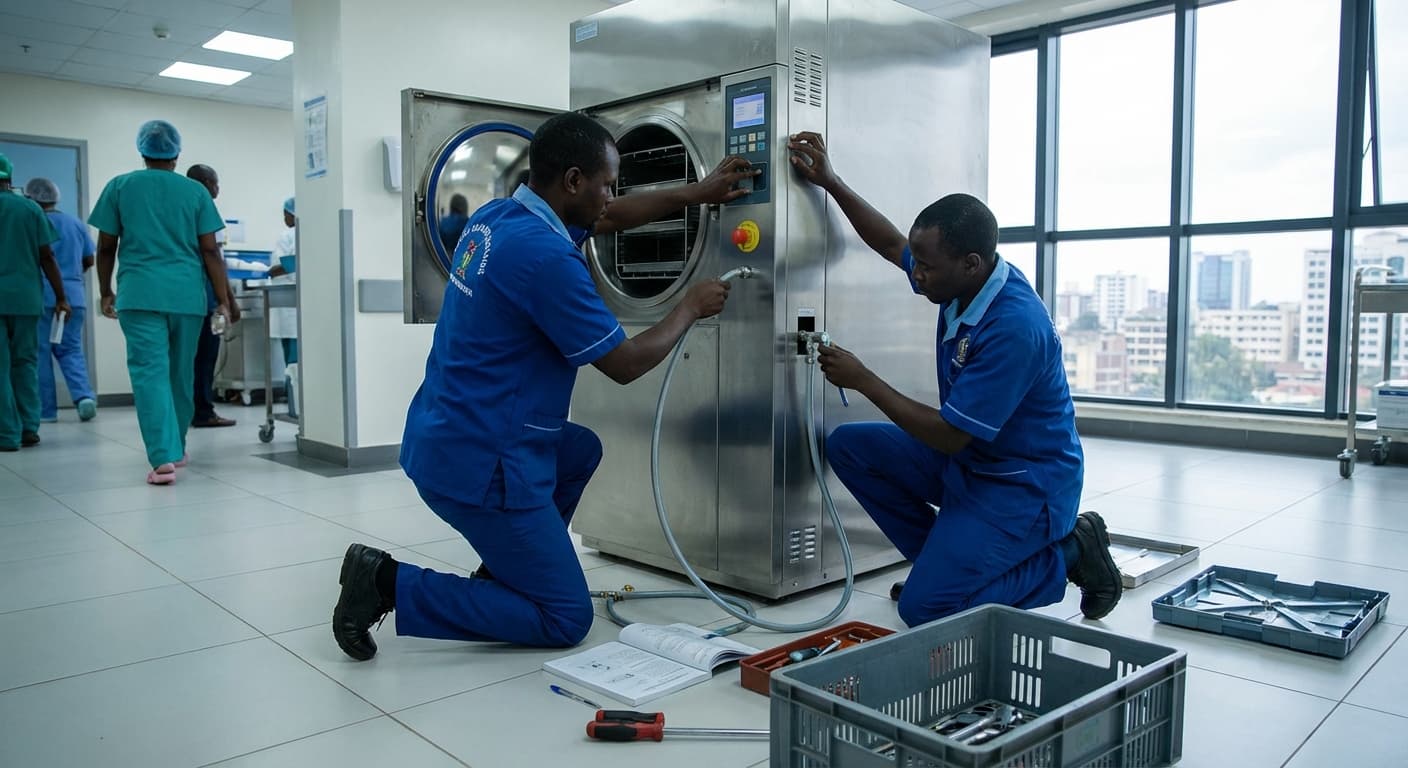
Autoclave & Sterilizer Installation Service in Mali
Engineering Excellence & Technical Support
Autoclave & Sterilizer Installation Service High-standard technical execution following OEM protocols and local regulatory frameworks.
Precision Installation for Optimal Sterilization
Our certified technicians ensure Autoclave and Sterilizer installations in Mali meet stringent international standards, guaranteeing precise temperature, pressure, and cycle controls for effective microbial inactivation and patient safety.
Rapid Deployment & Minimal Downtime
We offer swift and efficient installation services across Mali, minimizing operational downtime for your healthcare facility or laboratory. Our logistics are optimized to get your essential sterilization equipment up and running quickly.
Compliance & Safety Assurance
Adhering to all relevant Malian health and safety regulations, our installations include comprehensive safety checks and operator training, providing your facility with certified compliance and peace of mind for reliable sterilization.
What Is Autoclave & Sterilizer Installation Service In Mali?
Autoclave & Sterilizer Installation Service in Mali refers to the professional and technical undertaking of setting up, configuring, and commissioning autoclaves and various sterilization equipment within healthcare facilities, laboratories, and other relevant institutions located in the Republic of Mali. This service ensures that sterilization equipment is installed correctly, calibrated to manufacturer specifications, and ready for safe and effective operation to achieve the necessary microbial inactivation for preventing infection transmission and ensuring product sterility.
| Who Needs This Service? | Typical Use Cases | |||||
|---|---|---|---|---|---|---|
| Healthcare Facilities: Hospitals, clinics, dental offices, veterinary clinics, and surgical centers. | Laboratories: Research laboratories, clinical diagnostic laboratories, and industrial quality control labs. | Pharmaceutical and Medical Device Manufacturers: For sterilizing raw materials, finished products, and reusable components. | Food and Beverage Industry: For sterilizing equipment and packaging materials in certain production processes. | Cosmetic and Personal Care Product Manufacturers: For ensuring the sterility of products and packaging. | Research and Educational Institutions: For sterilizing laboratory equipment and materials. | |
| Sterilization of Surgical Instruments: Ensuring reusable surgical tools are free from viable microorganisms before patient use. | Disinfection of Medical Devices: Sterilizing critical and semi-critical medical equipment such as endoscopes, catheters, and respiratory therapy devices. | Decontamination of Laboratory Glassware and Consumables: Ensuring a sterile environment for experiments and preventing cross-contamination. | Sterilization of Pharmaceutical Preparations: Ensuring the safety and efficacy of injectable drugs and other sterile medications. | Sterilization of Biologics and Vaccines: Maintaining the integrity and effectiveness of biological products. | Waste Management: Sterilization of biohazardous waste to render it safe for disposal. | Routine Maintenance and Upgrades: Installation of new replacement units or upgrades to existing sterilization infrastructure. |
Key Components of Autoclave & Sterilizer Installation Service:
- Site Assessment and Planning: Evaluating the installation site for power, water, drainage, ventilation, and space requirements. Planning the optimal placement of the equipment.
- Unpacking and Inspection: Carefully unpacking the sterilizer and its accessories, performing visual inspections for any transit damage.
- Mechanical and Electrical Connections: Connecting the sterilizer to the appropriate utility sources (e.g., electrical power, water supply, drain lines) in compliance with local electrical codes and manufacturer guidelines.
- Plumbing and Drainage: Installing and connecting water inlet and outlet lines, ensuring proper drainage to prevent water accumulation and potential contamination.
- Ventilation System Integration (if applicable): Connecting to or installing dedicated ventilation systems for steam exhaust or other potentially hazardous byproducts.
- Calibration and Commissioning: Adjusting and verifying critical operating parameters such as temperature, pressure, and cycle times to meet established sterilization standards (e.g., ISO, AAMI) and manufacturer specifications.
- Functional Testing: Performing test cycles to confirm the sterilizer's ability to achieve and maintain the required sterilization conditions across various programmed cycles.
- Operator Training: Providing comprehensive training to facility personnel on the proper operation, routine maintenance, safety procedures, and troubleshooting of the installed equipment.
- Documentation and Certification: Providing installation reports, calibration certificates, and user manuals. Assisting with any necessary regulatory approvals or inspections.
- Post-Installation Support: Offering initial troubleshooting and answering any immediate questions or concerns after the installation is complete.
Who Needs Autoclave & Sterilizer Installation Service In Mali?
Ensuring the sterility of medical and laboratory equipment is paramount for patient safety and reliable research. In Mali, where healthcare infrastructure and research capabilities are developing, the proper installation of autoclaves and sterilizers is a critical service. This ensures that these vital pieces of equipment function at their optimal performance, preventing the spread of infections and guaranteeing the integrity of scientific experiments. This service is essential for a wide range of organizations that rely on sterile instruments and materials.
| Customer Segment | Key Departments / Areas of Need | Primary Reasons for Installation Service |
|---|---|---|
| Hospitals and Clinics | Operating Theaters, Central Sterile Supply Departments (CSSD), Outpatient Clinics, Dental Wards, Maternity Wards | Preventing surgical site infections, ensuring patient safety, compliance with healthcare regulations, efficient reprocessing of surgical instruments. |
| Laboratories (Medical, Research, Industrial) | Microbiology Labs, Pathology Labs, Molecular Biology Labs, Quality Control Labs, Environmental Testing Labs | Maintaining sterile environments for accurate experimental results, preventing cross-contamination, ensuring biosafety, sterilization of media and glassware. |
| Dental Practices | Treatment Rooms, Sterilization Areas | Preventing transmission of infectious diseases, ensuring patient and staff safety, compliance with dental hygiene standards, efficient turnaround of dental instruments. |
| Veterinary Clinics | Operating Rooms, Treatment Areas | Sterilizing surgical instruments for animal care, preventing the spread of zoonotic diseases, ensuring animal welfare. |
| Health Centers and Dispensaries | Treatment Rooms, Minor Surgery Areas | Providing basic sterile healthcare services, preventing infections in underserved communities, ensuring the safety of essential medical equipment. |
| NGOs and Humanitarian Organizations | Mobile Clinics, Field Hospitals, Health Outreach Programs | Establishing sterile practices in resource-limited settings, ensuring the safety of medical interventions during humanitarian crises, rapid deployment of sterile equipment. |
| Educational Institutions (Medical and Science Faculties) | Teaching Laboratories, Research Facilities | Training future healthcare professionals on sterile techniques, enabling accurate scientific research, ensuring the safety of students and researchers. |
| Pharmaceutical Companies | Quality Control Labs, Manufacturing Facilities (for specific processes) | Sterilizing equipment for drug development and quality testing, maintaining aseptic conditions in pharmaceutical production. |
| Food and Beverage Industry | Quality Control, Packaging Lines (for certain products) | Ensuring the sterility of equipment used in food processing and packaging to prevent spoilage and contamination. |
| Beauty and Tattoo Parlors | Treatment Rooms | Sterilizing needles, tools, and equipment to prevent the transmission of blood-borne pathogens and ensure client safety. |
Target Customers and Departments Requiring Autoclave & Sterilizer Installation Service in Mali:
- Hospitals and Clinics
- Laboratories (Medical, Research, and Industrial)
- Dental Practices
- Veterinary Clinics
- Health Centers and Dispensaries
- NGOs and Humanitarian Organizations
- Educational Institutions (Medical and Science Faculties)
- Pharmaceutical Companies
- Food and Beverage Industry (for sterilization processes)
- Beauty and Tattoo Parlors (for instrument sterilization)
Autoclave & Sterilizer Installation Service Process In Mali
This document outlines the standard workflow for Autoclave & Sterilizer Installation Service in Mali, from initial customer inquiry to the successful completion of the installation.
| Phase | Key Activities | Responsible Party | Timeline (Approx.) | Deliverables/Outcomes |
|---|---|---|---|---|
| Phase 1: Inquiry & Consultation | Customer contacts service provider with interest in autoclave/sterilizer installation. Provider gathers initial information about equipment type, intended use, and location. Initial consultation to understand customer needs and provide preliminary advice. | Customer, Service Provider (Sales/Technical Team) | 1-3 Business Days | Understanding of customer requirements, initial advice on equipment suitability. |
| Phase 2: Site Assessment & Quotation | Scheduled site visit by technical expert to assess installation location, power/water/ventilation requirements, space availability, and potential challenges. Detailed technical assessment. Preparation and submission of a formal quotation including equipment, labor, materials, and timelines. | Service Provider (Technical Team, Sales) | 3-7 Business Days (after inquiry) | Detailed site assessment report, comprehensive quotation, proposal discussion. |
| Phase 3: Order Confirmation & Scheduling | Customer reviews and accepts quotation. Formal order placement. Negotiation and agreement on installation schedule. Deposit payment (if applicable). | Customer, Service Provider (Sales/Admin) | 2-5 Business Days (after quotation acceptance) | Confirmed order, agreed-upon installation date, initial payment received. |
| Phase 4: Pre-Installation Preparation | Procurement of necessary parts, consumables, and tools. Logistics planning for equipment delivery. Pre-installation checks of site readiness (e.g., power, water connections). Communication of pre-installation requirements to the customer. | Service Provider (Logistics, Technical Team) | 5-15 Business Days (depending on equipment lead time) | All necessary materials and tools on-site, customer informed of readiness checks. |
| Phase 5: Installation Execution | Delivery and unboxing of autoclave/sterilizer. Physical installation according to manufacturer specifications and site assessment. Electrical and plumbing connections. Mounting and securing of the unit. | Service Provider (Installation Technicians) | 1-5 Business Days (depending on equipment complexity) | Autoclave/sterilizer physically installed and connected. |
| Phase 6: Testing & Commissioning | Performing initial system checks. Running test cycles to verify functionality and performance parameters. Calibration and safety checks. Documentation of test results. | Service Provider (Commissioning Engineers/Technicians) | 1-3 Business Days | Fully functional and calibrated autoclave/sterilizer, verified performance data. |
| Phase 7: Training & Handover | Comprehensive training for the customer's staff on operation, basic maintenance, safety procedures, and troubleshooting. Formal handover of the installed equipment and user manuals. Final payment collection (if applicable). | Service Provider (Trainer/Lead Technician) | 0.5-1 Business Day | Trained personnel, signed handover document, completed payment. |
| Phase 8: Post-Installation Support | Provision of warranty period support. Availability for technical queries and minor adjustments. Scheduling of planned preventative maintenance (PPM) if part of the service agreement. | Service Provider (Customer Support, Technical Team) | Ongoing (during warranty/contract period) | Customer satisfaction, ongoing operational efficiency, maintenance plan initiation. |
Autoclave & Sterilizer Installation Service Workflow in Mali
- Phase 1: Inquiry & Consultation
- Phase 2: Site Assessment & Quotation
- Phase 3: Order Confirmation & Scheduling
- Phase 4: Pre-Installation Preparation
- Phase 5: Installation Execution
- Phase 6: Testing & Commissioning
- Phase 7: Training & Handover
- Phase 8: Post-Installation Support
Autoclave & Sterilizer Installation Service Cost In Mali
The cost of installing an autoclave and sterilizer in Mali can vary significantly based on several factors. These include the type and size of the sterilizer (e.g., tabletop, larger floor-standing, specific features), the complexity of the installation (e.g., requiring dedicated plumbing, electrical upgrades, ventilation), the location within Mali (urban centers often have more competitive pricing but higher travel costs for remote areas), and the chosen service provider (established companies vs. independent technicians).
| Service Component | Estimated Cost Range (Malian Francs - XOF) | Notes |
|---|---|---|
| Basic Tabletop Autoclave Installation | 50,000 - 150,000 | Includes standard electrical hook-up and initial setup. |
| Medium-Sized Autoclave Installation (e.g., wall-mounted or small floor-standing) | 100,000 - 300,000 | May include minor plumbing or electrical adjustments. |
| Large Floor-Standing Autoclave Installation | 200,000 - 750,000+ | Often requires dedicated plumbing, electrical circuits, and potentially ventilation. Costs can escalate with complexity. |
| Complex Installations (e.g., medical facilities, labs with specialized requirements) | 500,000 - 1,500,000+ | Involves extensive site preparation, custom solutions, and potentially multiple days of work. |
| Site Survey and Consultation | 20,000 - 50,000 | Often waived if installation is subsequently contracted. |
| Travel and Accommodation (for remote locations) | Variable (per diem, fuel) | Depends on distance and duration. |
| Calibration and Validation (post-installation) | 75,000 - 250,000 | Crucial for medical and laboratory applications. May be a separate service. |
Factors Influencing Autoclave & Sterilizer Installation Costs in Mali:
- Type and Capacity of Sterilizer: Larger, more advanced, or specialized sterilizers will naturally incur higher installation costs.
- Installation Complexity: Requirements for plumbing, electrical work, ventilation systems, or structural modifications will increase the price.
- Location within Mali: Installation in major cities like Bamako may have different cost structures compared to more remote regions.
- Service Provider's Reputation and Experience: Reputable and experienced installers may charge more but offer greater reliability.
- Ancillary Equipment and Services: This can include specialized piping, surge protectors, calibration services, or initial training.
- Site Survey and Preparation: Initial assessments and any necessary site modifications before installation.
- Travel and Logistics: For installations outside the primary service area of the provider.
Affordable Autoclave & Sterilizer Installation Service Options
Finding a reliable and affordable autoclave and sterilizer installation service is crucial for any medical, dental, veterinary, or laboratory facility. Proper installation ensures the equipment operates safely and effectively, preventing costly downtime and potential health hazards. This guide explores various service options, highlighting value bundles and cost-saving strategies to help you make an informed decision.
| Cost-Saving Strategy | Description | Potential Savings |
|---|---|---|
| Bundle Services | Opt for packages that combine installation with training, calibration, or preventative maintenance. These often offer a reduced overall price. | 10-20% off individual service costs |
| Request Multiple Quotes | Obtain detailed quotes from at least three reputable installation service providers. Compare not only price but also the scope of work and included services. | Varies greatly, but can identify significant price discrepancies |
| Prepare Utility Access | Ensure water, drain, and electrical connections are readily accessible and meet the manufacturer's specifications before the installer arrives. This minimizes on-site labor time. | 5-15% reduction in labor costs |
| Consider Off-Peak Scheduling | Inquire if installers offer discounts for scheduling during less busy periods (e.g., weekdays, avoiding holidays). | Potentially a small percentage off the total cost |
| Leverage Manufacturer Recommendations | Some autoclave manufacturers may have preferred or certified installers who offer competitive pricing or package deals when purchasing their equipment. | May include installation discounts or included services |
| Negotiate Long-Term Contracts | For facilities requiring frequent installations or maintenance, negotiate a long-term service contract that includes discounted rates for ongoing support. | Significant savings over the contract period |
Understanding Autoclave & Sterilizer Installation Service Options
- {"title":"Standard Installation","description":"This typically includes the physical placement of the unit, connecting it to existing water, drain, and electrical utilities (within a specified proximity), and a basic functional test. It's the most straightforward option for units with readily accessible utility hookups."}
- {"title":"Extended Installation","description":"For more complex setups or when new utility lines need to be run, extended installation becomes necessary. This can involve plumbing modifications, electrical upgrades, or the creation of dedicated ventilation systems."}
- {"title":"Custom Installation","description":"This is for specialized environments or unique equipment requirements. It might involve integrating the autoclave into existing cabinetry, designing specialized ventilation, or meeting specific regulatory compliance needs beyond standard requirements."}
- {"title":"Preventative Maintenance Packages","description":"Many installers offer bundled services that include the initial installation along with scheduled preventative maintenance. This proactive approach helps prevent breakdowns, extends equipment lifespan, and often comes at a discounted rate compared to purchasing services separately."}
- {"title":"Training & Calibration Services","description":"Proper user training and regular calibration are essential for safe and effective operation. Bundling these with installation ensures your staff is proficient from day one and your equipment is accurately calibrated for reliable sterilization cycles."}
Verified Providers In Mali
Navigating healthcare in a foreign country can be daunting, especially when it comes to finding trusted and qualified medical professionals. In Mali, the presence of verified healthcare providers is crucial for ensuring access to safe and effective medical services. Franance Health stands out as a premier organization that rigorously vets and credentializes healthcare professionals, offering a reliable pathway to finding the best care available.
| Category | Franance Health Verified Provider Advantages | Why This is the Best Choice |
|---|---|---|
| Medical Expertise | Confirmation of formal education, specialized training, and ongoing professional development. | Ensures you are treated by professionals with up-to-date knowledge and skills, leading to more accurate diagnoses and effective treatments. |
| Patient Safety | Verification of adherence to ethical medical practices and absence of disciplinary actions. | Minimizes risks associated with medical errors and ensures your well-being is prioritized throughout your care. |
| Professional Experience | Assessment of practical experience and track record in treating patients. | Provides assurance that providers have hands-on experience in managing a wide range of medical conditions. |
| Language Proficiency | Often includes verification of communication skills, crucial for effective patient-doctor interaction (especially for expatriates). | Facilitates clear communication, reducing misunderstandings and improving the overall patient experience. |
| Network Access | Access to a curated network of reputable healthcare facilities and specialists. | Streamlines the process of finding the right medical professional and facility, saving you time and effort in your search. |
Why Franance Health Credentials Matter
- Rigorous Vetting Process: Franance Health employs a multi-stage verification process that goes beyond basic licensing. This includes thorough background checks, verification of educational qualifications from accredited institutions, and assessment of practical experience and professional conduct.
- Commitment to Quality: The credentialing standards set by Franance Health are designed to ensure that providers meet and exceed established benchmarks for medical expertise, patient safety, and ethical practice.
- Enhanced Patient Trust: By providing a clear indicator of verified competence, Franance Health credentials build confidence and trust for patients seeking medical assistance. Knowing a provider has met these stringent requirements offers significant peace of mind.
- Access to Specialized Care: Franance Health's network often includes specialists across various medical fields, making it easier for individuals to find the specific expertise they require for complex health needs.
- International Recognition: While focused on Mali, Franance Health's commitment to high standards aligns with international best practices in healthcare credentialing, further bolstering the credibility of its verified providers.
Scope Of Work For Autoclave & Sterilizer Installation Service
This Scope of Work (SOW) outlines the services required for the professional installation of autoclaves and sterilizers at [Client Name]'s facilities. The objective is to ensure the safe, efficient, and compliant integration of new sterilization equipment into the existing infrastructure.
| Phase | Description | Key Activities | Deliverables | Standard Specifications/Notes |
|---|---|---|---|---|
| Phase 1: Planning & Preparation | Detailed site assessment, technical review, and resource allocation. | Site survey, equipment verification, utility assessment (power, water, drainage, ventilation), scheduling, safety plan development, material procurement. | Site readiness report, Installation plan, Procurement list, Safety plan. | Compliance with manufacturer's installation manual. All utilities to meet ANSI/ASME, NEC, local building codes. Ventilation to meet ASHRAE standards where applicable. All materials to be certified and traceable. |
| Phase 2: Equipment Delivery & Staging | Safe and secure transportation and temporary storage of new equipment. | Coordination of delivery, unloading, inspection for transit damage, and secure staging at the designated installation location. | Delivery confirmation, Damage inspection report, Staging area setup. | Equipment to be handled with care as per manufacturer's guidelines. Appropriate lifting equipment to be used. Staging area to be secure and protected from environmental factors. |
| Phase 3: Installation & Integration | Physical installation of the autoclave/sterilizer units and connection to utilities. | Positioning and securing of units, electrical connections, plumbing connections (water supply, drainage), ventilation hook-up (if applicable), control system integration. | Installed autoclave/sterilizer units, Completed utility connections, Integrated control system. | All electrical work to be performed by licensed electricians, complying with NEC and local codes. Plumbing to comply with local plumbing codes. All connections to be leak-free and pressure-tested. Proper grounding and bonding to be implemented. All sealants and materials to be compatible with the equipment and environment. |
| Phase 4: Testing & Commissioning | Verification of correct operation and performance of the installed equipment. | Power-on testing, Functional testing (e.g., cycle runs, temperature/pressure checks), Safety feature testing, Calibration, Performance verification against manufacturer specifications. | Test logs, Calibration certificates, Commissioning report, Performance validation report. | All tests to be conducted according to manufacturer's recommended procedures and industry best practices. Test equipment used for calibration and verification to be certified. Critical parameters (temperature, pressure, time) to be within specified tolerances as per ISO 17665, ANSI/AAMI ST55, or applicable standards. |
| Phase 5: Documentation & Training | Provision of all necessary documentation and training to client personnel. | Handover of operation and maintenance manuals, As-built drawings, Training sessions on equipment operation, basic troubleshooting, and routine maintenance. | Operations & Maintenance Manuals, As-built drawings, Training attendance records, Training materials. | Manuals to be current versions. As-built drawings to accurately reflect the final installation. Training to be tailored to the specific equipment and client's operational needs. Content to cover daily checks, cycle selection, alarm resolution, and basic cleaning procedures. |
| Phase 6: Project Closeout | Finalization of the project and formal acceptance by the client. | Site cleanup, Final inspection, Project sign-off, Warranty information handover. | Certificate of Completion, Final invoice, Warranty documentation. | All debris and waste generated during installation to be removed from the site. Client to formally accept the completed installation. Warranty period and terms to be clearly communicated. |
Key Objectives
- Seamless integration of new autoclave/sterilizer units.
- Adherence to all relevant safety regulations and industry standards.
- Minimization of operational downtime during installation.
- Provision of comprehensive documentation and training.
- Verification of successful installation and functional testing.
Service Level Agreement For Autoclave & Sterilizer Installation Service
This Service Level Agreement (SLA) outlines the guaranteed response times and uptime for the Autoclave & Sterilizer Installation Service provided by [Your Company Name]. This SLA is intended to ensure prompt and reliable support for our valued clients, minimizing disruption to their operations.
| Service Level | Response Time Guarantee | Uptime Guarantee |
|---|---|---|
| Critical Incident (Installation Related - Post Handover) | 4 Business Hours - For incidents reported during Service Hours. We will acknowledge the incident and begin troubleshooting or schedule a site visit. | 99.5% Uptime - During the first 90 days post-installation, provided the unit is operated and maintained according to manufacturer guidelines. |
| Minor Issue (Installation Related - Post Handover) | 8 Business Hours - For incidents reported during Service Hours. We will acknowledge the issue and schedule a remote or on-site follow-up. | N/A (Focus on Critical) |
| Scheduled Installation Appointment | 1 Business Day Prior Confirmation - Confirmation of scheduled installation date and time. | N/A (Pre-operational) |
Key Service Components
- Service Scope: This SLA covers the installation of new autoclaves and sterilizers, including initial setup, testing, calibration, and basic user training. It does not cover ongoing maintenance, repairs, or replacement parts, which are covered under separate agreements.
- Service Hours: Standard installation services are available Monday through Friday, 9:00 AM to 5:00 PM [Your Time Zone], excluding public holidays.
- Definition of Incident: An incident is defined as a failure or malfunction of the installed autoclave/sterilizer that prevents it from performing its intended sterilization function, as reported by the client.
- Definition of Response Time: Response time is the period between the client reporting a critical incident (via the designated support channel) and the initiation of troubleshooting or scheduling of a technician by [Your Company Name].
- Definition of Uptime: Uptime refers to the period during which the installed autoclave/sterilizer is operational and capable of performing its intended sterilization function, as confirmed by the client and/or [Your Company Name]'s remote monitoring (if applicable).
- Exclusions: This SLA does not apply to issues caused by misuse, neglect, unauthorized modifications, power surges, natural disasters, or any other force majeure events.
Frequently Asked Questions

Ready when you are
Let's scope your Autoclave & Sterilizer Installation Service in Mali project in Mali.

Scaling healthcare logistics and technical systems across the entire continent.