
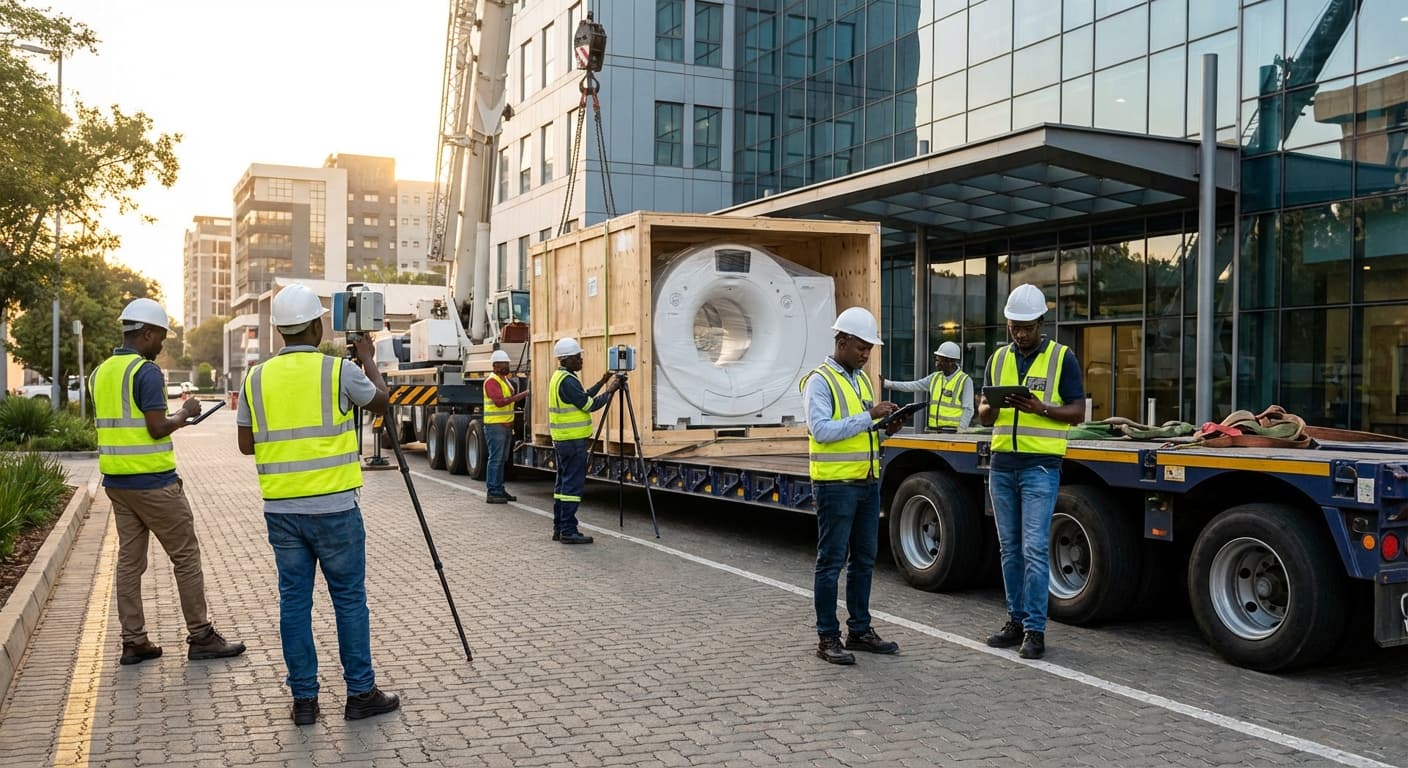
Route Survey & Rigging Plan Service for Heavy Medical Equipment in Mali
Engineering Excellence & Technical Support
Route Survey & Rigging Plan Service for Heavy Medical Equipment High-standard technical execution following OEM protocols and local regulatory frameworks.
Precision Route Assessment & Obstacle Mitigation
Leveraging advanced GIS and real-time satellite imagery, our service meticulously analyzes potential transport routes for heavy medical equipment across Mali's diverse terrain. We identify and map critical obstacles like narrow roads, low bridges, and unstable ground, developing comprehensive detour strategies and recommending necessary infrastructure modifications or specialized transport solutions to ensure safe and efficient passage.
Specialized Rigging Engineering & Load Stabilization
Our expert rigging engineers conduct detailed structural integrity assessments of the medical equipment and develop bespoke rigging plans. Utilizing specialized lifting gear, custom-engineered cradles, and advanced load-balancing techniques, we guarantee secure attachment, controlled movement, and precise placement of sensitive, high-value medical assets, minimizing risk of damage during transit and installation.
Comprehensive Risk Analysis & Contingency Planning
We perform in-depth risk assessments encompassing environmental factors, local infrastructure limitations, security considerations, and logistical challenges unique to Mali. This enables the creation of robust contingency plans, including emergency response protocols, alternative transport options, and on-site support strategies, ensuring project continuity and successful delivery of critical medical equipment even in unpredictable conditions.
What Is Route Survey & Rigging Plan Service For Heavy Medical Equipment In Mali?
Route Survey & Rigging Plan Service for Heavy Medical Equipment in Mali refers to a specialized engineering and logistics process designed to facilitate the safe and efficient transportation and installation of large, complex, and often sensitive medical apparatus within Mali. This service encompasses a comprehensive assessment of transportation routes, site conditions, and the development of detailed rigging and lifting strategies. The primary objective is to mitigate risks associated with moving and positioning exceptionally heavy or dimensionally challenging medical equipment, such as MRI scanners, CT scanners, linear accelerators, or large-scale laboratory machinery, from their point of arrival (e.g., port, airport) to their final operational location within a healthcare facility or research institution. The service integrates civil engineering, structural analysis, mechanical engineering, and advanced logistics planning to ensure the integrity of both the equipment and the surrounding infrastructure throughout the entire process.
| Who Needs This Service? | Typical Use Cases in Mali |
|---|---|
| Healthcare Facilities (Public and Private): Hospitals, clinics, diagnostic centers, and specialized medical centers undertaking the procurement and installation of new or replacement heavy medical equipment. | Installation of Magnetic Resonance Imaging (MRI) scanners in urban and remote healthcare facilities, requiring careful route planning due to the equipment's size, weight, and sensitivity to magnetic interference. |
| Medical Equipment Suppliers and Manufacturers: Companies responsible for delivering and installing complex medical systems for their clients in Mali. | Deployment of Computed Tomography (CT) scanners within existing hospital wings, necessitating assessment of internal structural capacities and passage through narrow corridors. |
| Government Health Ministries and Agencies: Entities overseeing the development and upgrading of national healthcare infrastructure, including the acquisition of critical medical technologies. | Transportation and installation of Linear Accelerators for radiotherapy departments, demanding precise rigging and structural considerations due to immense weight and sensitive alignment requirements. |
| Construction and Engineering Firms: Companies involved in building or renovating medical facilities that are procuring heavy medical equipment. | Siting of large-scale X-ray or angiography suites, requiring evaluation of floor loading, vibration control, and shielding integrity. |
| Research Institutions and Universities: Organizations acquiring advanced diagnostic or laboratory equipment for scientific research. | Relocation and installation of advanced laboratory equipment, such as electron microscopes or mass spectrometers, which often have specialized environmental and handling needs. |
| International Aid Organizations and NGOs: Groups involved in establishing or enhancing medical capacity in underserved regions of Mali. | Delivery of essential medical imaging equipment to remote areas where infrastructure may be limited, requiring comprehensive route surveys and adaptable rigging solutions. |
Key Components of Route Survey & Rigging Plan Service:
- Route Feasibility Assessment: Involves detailed inspection and analysis of all potential transportation routes, considering factors such as road surface integrity, bridge load capacities, overhead clearances (bridges, power lines, signs), tunnel dimensions, turning radii, traffic restrictions, and potential environmental obstacles. GPS mapping, Lidar scanning, and on-site physical inspections are employed.
- Site Access and Condition Survey: Evaluation of the specific access points to the installation site, including entryways, corridors, elevators, and stairwells within the facility. This includes assessing structural load-bearing capacities of floors, walls, and ceilings where equipment will be positioned or lifted. Consideration is given to potential modifications required for site access.
- Equipment Dimensional and Weight Analysis: Precise measurement and documentation of the dimensions, weight distribution, and center of gravity of the heavy medical equipment. This is critical for determining appropriate lifting equipment, transport cradles, and bracing mechanisms.
- Rigging and Lifting Plan Development: Creation of detailed schematics and procedures for lifting, maneuvering, and lowering the equipment. This includes specifying the type and capacity of cranes, hoists, jacks, and other lifting gear, as well as rigging hardware (slings, shackles, spreader bars). Load calculations and stress analyses are performed.
- Securing and Transport Methodology: Design of specialized transport frames, cradles, or skids to securely hold and protect the equipment during transit. This also includes specifying towing vehicles and methods for controlled movement on uneven terrain.
- Risk Assessment and Mitigation: Identification of potential hazards at all stages of the process (e.g., equipment damage, personnel injury, structural compromise, utility disruption) and the development of specific protocols and contingency plans to mitigate these risks.
- Permitting and Regulatory Compliance: Assistance with obtaining necessary permits for oversized or overweight transport, road closures, and specialized lifting operations from local and national authorities in Mali.
- Post-Installation Support: Guidance on the final placement, leveling, and initial securing of the equipment in its operational position.
Who Needs Route Survey & Rigging Plan Service For Heavy Medical Equipment In Mali?
Transporting and installing heavy medical equipment in Mali presents unique logistical and safety challenges. Specialized route survey and rigging plan services are crucial for ensuring the safe, efficient, and compliant delivery and setup of these vital assets. This service is indispensable for a range of organizations and individuals involved in healthcare infrastructure and operations within Mali.
| Customer Type | Key Departments/Stakeholders | Specific Needs/Roles | Importance of Service |
|---|---|---|---|
| Hospitals & Healthcare Facilities | Procurement Department, Facilities Management, Biomedical Engineering, Clinical Departments (Radiology, Surgery, etc.) | Receiving and installing new high-value equipment (MRI, CT scanners, linear accelerators, etc.), ensuring minimal disruption to operations, safe placement and integration. | Ensures continuity of patient care, protects significant capital investment, prevents damage to sensitive equipment and infrastructure. |
| Government Health Ministries & Agencies | Procurement, Infrastructure Development, Public Health Programs, Regional Health Offices | Overseeing large-scale equipment procurement for public health initiatives, ensuring compliance with safety standards, facilitating distribution to remote areas. | Promotes equitable access to healthcare, ensures public funds are utilized efficiently and safely, upholds national health standards. |
| Non-Governmental Organizations (NGOs) | Program Management, Logistics and Operations, Medical Coordinators | Implementing health projects in challenging environments, delivering essential medical technology to underserved populations, often requiring transport through difficult terrain. | Facilitates the successful delivery of life-saving equipment to vulnerable communities, mitigates risks associated with remote deployments. |
| International Aid Organizations | Logistics and Supply Chain Management, Project Implementation, Disaster Relief Teams | Responding to health crises, supporting post-conflict reconstruction, deploying critical medical infrastructure in areas with limited existing capacity. | Enables rapid and safe deployment of essential medical resources in emergency situations, ensuring aid reaches its intended beneficiaries effectively. |
| Medical Equipment Manufacturers & Suppliers | Installation & Commissioning Teams, Project Management, After-Sales Service | Ensuring their products are installed correctly and safely at client sites, fulfilling contractual obligations, maintaining brand reputation. | Guarantees successful product delivery and client satisfaction, minimizes warranty claims due to improper installation, ensures product performance. |
| Logistics & Transportation Companies | Specialized Transport Divisions, Project Cargo Teams, Operations Management | Handling the physical movement of oversized, overweight, and sensitive medical equipment, planning optimal routes, managing permits and escorts. | Provides expertise in specialized transport, ensures compliance with transportation regulations, reduces transit risks and delays. |
| Construction & Engineering Firms | Project Management, Site Supervisors, Civil & Structural Engineers | Preparing hospital wings or new facilities for equipment installation, ensuring structural integrity, coordinating with installation teams for access and space. | Ensures the physical environment is ready and safe for heavy equipment, integrates infrastructure with equipment needs, prevents construction-related installation issues. |
Target Customers and Departments for Route Survey & Rigging Plan Services (Mali)
- Hospitals & Healthcare Facilities
- Government Health Ministries & Agencies
- Non-Governmental Organizations (NGOs)
- International Aid Organizations
- Medical Equipment Manufacturers & Suppliers
- Logistics & Transportation Companies
- Construction & Engineering Firms
Route Survey & Rigging Plan Service For Heavy Medical Equipment Process In Mali
This document outlines the comprehensive workflow for our Route Survey & Rigging Plan Service, specifically tailored for the challenging process of transporting and installing heavy medical equipment in Mali. Our service ensures meticulous planning, risk mitigation, and safe execution from initial inquiry to final handover.
| Stage | Description | Key Activities | Deliverables | Timeline (Typical) |
|---|---|---|---|---|
| Inquiry & Initial Consultation | Understanding client needs and project scope. | Receive client inquiry, discuss equipment specifications, destination, budget, and timeline. Provide initial project overview and service details. | Project brief, preliminary quotation, service proposal. | 1-3 business days |
| Site Assessment & Route Reconnaissance | Detailed on-the-ground survey of the intended transport route and installation site. | Conduct physical inspection of the route (road conditions, bridges, obstacles, turns, height/width restrictions). Assess the installation site (access points, floor loading capacity, space for rigging operations). Obtain precise measurements. Identify potential hazards and mitigation strategies. | Detailed route survey report (with maps, photos, measurements), site assessment report, risk assessment matrix. | 5-15 business days (depending on route complexity and accessibility) |
| Rigging Plan Development | Creating a comprehensive plan for safe lifting and placement of the heavy medical equipment. | Based on route survey and equipment specifications, design detailed rigging procedures. Select appropriate lifting equipment (cranes, hoists, forklifts), rigging gear (slings, shackles, spreader bars). Develop lift plans, considering weight distribution, center of gravity, and environmental factors. Create detailed schematics and sequence of operations. | Comprehensive Rigging Plan (including lift schematics, equipment list, safety protocols, personnel roles, emergency procedures). | 7-14 business days |
| Client Review & Approval | Ensuring client satisfaction and formal authorization of the plan. | Present the developed Route Survey and Rigging Plan to the client for review. Address any client queries or concerns. Incorporate feedback and finalize the plan. Obtain formal client sign-off. | Approved Route Survey & Rigging Plan. | 2-5 business days |
| Pre-Execution Preparations | Mobilizing resources and confirming all logistical arrangements. | Procure and transport all necessary rigging equipment and specialized vehicles. Mobilize and brief the rigging team, ensuring they have the required certifications and experience. Obtain necessary permits and permissions for transport and site access. Conduct pre-operation safety briefings and equipment checks. | Mobilized equipment and personnel, secured permits, confirmed logistics. | 3-7 business days |
| On-Site Execution | Implementing the approved rigging and transport plan. | Execute the transport of the medical equipment along the surveyed route, adhering strictly to the plan. Conduct safe lifting, positioning, and installation of the equipment at the designated site. Constant supervision and adherence to safety protocols. Real-time adjustments as needed, within the scope of the approved plan. | Successfully transported and installed medical equipment. | 1-5 business days (depending on equipment size and installation complexity) |
| Post-Execution & Handover | Concluding the project and providing final documentation. | Conduct a final inspection of the installed equipment and the site. Demobilize equipment and personnel. Provide a post-execution report. Hand over all relevant documentation to the client. Conduct a final walk-through and client debrief. | Post-execution report, project closure documentation, final invoice. | 2-3 business days |
Workflow Stages
- Inquiry & Initial Consultation
- Site Assessment & Route Reconnaissance
- Rigging Plan Development
- Client Review & Approval
- Pre-Execution Preparations
- On-Site Execution
- Post-Execution & Handover
Route Survey & Rigging Plan Service For Heavy Medical Equipment Cost In Mali
Estimating the precise cost for Route Survey and Rigging Plan services for heavy medical equipment in Mali requires a detailed understanding of several influencing factors. These services are crucial to ensure the safe and efficient transportation and installation of sensitive and heavy medical machinery, such as MRI scanners, CT scanners, or large X-ray units. The pricing will vary significantly based on the complexity of the route, the nature of the equipment, and the specific requirements of the project. Below, we outline the key pricing factors and provide estimated cost ranges in Malian Francs (XOF).
| Service Component | Estimated Cost Range (XOF) |
|---|---|
| Route Survey (per kilometer or per project) | 50,000 - 250,000+ XOF |
| Basic Rigging Plan Development | 100,000 - 300,000 XOF |
| Complex Rigging Plan Development (for multiple lifts or intricate maneuvers) | 250,000 - 750,000+ XOF |
| On-site Rigging Supervision (daily rate) | 40,000 - 100,000+ XOF |
| Specialized Survey Equipment Rental (if required) | 20,000 - 80,000+ XOF per day |
| Permit Facilitation Fees (variable) | 50,000 - 200,000+ XOF |
| Contingency Budget (recommended) | 10-20% of total service cost |
Key Pricing Factors for Route Survey & Rigging Plan Services in Mali:
- Equipment Specifications: The weight, dimensions, fragility, and specific handling requirements of the medical equipment are paramount. Larger, heavier, or more delicate items will necessitate more robust rigging and more extensive route planning.
- Route Complexity and Distance: The length and terrain of the transport route are significant cost drivers. Routes involving unpaved roads, bridges with weight restrictions, narrow city streets, or remote locations will incur higher costs due to specialized transport needs and potentially longer survey times.
- Site Accessibility and Preparation: The ease of access to both the delivery point and the installation site is critical. If significant site preparation (e.g., widening roads, reinforcing floors, clearing obstacles) is required, this will add to the overall cost.
- Rigging Complexity: The number and type of rigging operations required (e.g., lifting, tilting, maneuvering through tight spaces) directly impact the labor, equipment, and time involved.
- Specialized Equipment and Personnel: The need for specialized cranes, lifting gear, transport vehicles, or highly skilled rigging technicians will increase the price.
- Risk Assessment and Contingency Planning: Thorough route surveys and rigging plans involve identifying potential risks and developing mitigation strategies. The level of detail and the inherent risks associated with the project will influence the cost.
- Permits and Authorizations: Obtaining necessary permits for oversized or overweight transport from local authorities in Mali can be time-consuming and may involve associated fees.
- Geographical Location within Mali: Costs can vary slightly between major cities like Bamako and more remote regions due to logistical challenges and the availability of specialized services.
- Timeline and Urgency: Expedited services or projects requiring work during non-standard hours may incur additional charges.
- Insurance: Comprehensive insurance coverage for the transportation and rigging operations is essential and will be factored into the overall cost.
Affordable Route Survey & Rigging Plan Service For Heavy Medical Equipment Options
Navigating the complexities of moving heavy medical equipment requires meticulous route surveys and expertly crafted rigging plans. Our service ensures a safe, efficient, and cost-effective transportation process. We understand the unique challenges associated with medical equipment, from intricate calibration requirements to extreme weight and fragility. Our team of experienced professionals will meticulously plan every step, from initial site assessment to final placement, minimizing risks and avoiding costly delays or damages. This service is crucial for hospitals, clinics, research facilities, and manufacturers involved in the relocation or installation of high-value medical machinery.
| Value Bundle | Included Services | Key Benefits | Estimated Cost Savings Strategy |
|---|---|---|---|
| Basic Survey & Plan | On-site route assessment, basic rigging recommendations, preliminary plan generation. | Essential safety overview, identifies major logistical challenges. | Avoids unforeseen access issues and minor route conflicts. |
| Comprehensive Survey & Rigging Design | Detailed site analysis, advanced rigging design, risk assessment, initial stakeholder consultation. | Minimizes risk of equipment damage, ensures structural integrity during lifting, addresses complex maneuvers. | Prevents costly equipment repairs or replacements, reduces insurance claims, optimizes rigging hardware selection. |
| Full-Service Relocation Integration | Comprehensive survey & rigging design, integration with logistics, on-site supervision, post-installation review. | Seamless project execution, end-to-end accountability, ensures operational readiness post-installation. | Eliminates multiple vendor coordination overhead, reduces potential for delays and associated penalties, optimizes project timelines. |
Our Affordable Route Survey & Rigging Plan Service
- Comprehensive Site Assessments: Thorough evaluation of origin and destination points, including access routes, doorways, elevator capacity, floor load limits, and potential obstacles.
- Detailed Route Planning: Identifying the safest and most efficient pathways, considering traffic patterns, road closures, bridge weight limits, and overhead clearances.
- Specialized Rigging Design: Custom-engineered rigging solutions for precise lifting, maneuvering, and securing of heavy and sensitive medical equipment.
- Risk Mitigation Strategies: Proactive identification and mitigation of potential hazards throughout the transportation and installation process.
- Coordination with Stakeholders: Seamless communication and collaboration with facility managers, logistics providers, and equipment manufacturers.
- Documentation and Reporting: Detailed reports including route maps, rigging schematics, safety protocols, and risk assessments.
Verified Providers In Mali
When seeking healthcare in Mali, particularly for services requiring a high degree of trust and competence, identifying 'Verified Providers' is paramount. This designation signifies that a healthcare professional or facility has undergone rigorous vetting, ensuring they meet established standards of quality, safety, and ethical practice. Franance Health has emerged as a leading entity in establishing and upholding these verification standards within Mali, making their credentialed providers the best choice for patients prioritizing reliable and effective care.
| Credential Aspect | Franance Health Verification Means | Benefit to Patients |
|---|---|---|
| Professional Qualifications | Validated academic degrees, certifications, and specialized training. | Ensures providers possess the necessary knowledge and skills. |
| Clinical Experience | Verified duration and scope of practical experience in relevant medical fields. | Guarantees hands-on proficiency and exposure to diverse cases. |
| Ethical Conduct & Professionalism | Scrutiny of past conduct, adherence to medical ethics, and absence of disciplinary actions. | Promotes patient trust and a safe, respectful healthcare environment. |
| Continuing Medical Education (CME) | Confirmation of ongoing participation in learning and skill-enhancement programs. | Ensures providers stay updated with the latest medical advancements. |
| Facility Standards (if applicable) | Verification of infrastructure, equipment, hygiene, and safety protocols. | Provides assurance of a safe and well-equipped healthcare setting. |
| Patient Feedback & Outcomes | Incorporation of anonymized patient satisfaction data and, where feasible, outcome tracking. | Demonstrates a commitment to patient well-being and continuous improvement. |
Why Franance Health Credentials Represent the Best Choice for Verified Providers in Mali:
- Rigorous Vetting Process: Franance Health employs a comprehensive evaluation system that scrutinizes qualifications, experience, ethical conduct, and adherence to best medical practices. This goes beyond basic licensing, ensuring providers are truly exceptional.
- Commitment to Patient Safety and Quality: Their credentialing process is fundamentally designed to protect patients. By verifying that providers meet high standards, Franance Health actively reduces the risk of medical errors, malpractice, and substandard care.
- Enhanced Trust and Transparency: Patients can have greater confidence in seeking care from Franance Health-verified providers. The transparent nature of their verification process builds trust, empowering individuals to make informed healthcare decisions.
- Promotion of Excellence: By recognizing and endorsing top-tier healthcare professionals and facilities, Franance Health incentivizes continued professional development and a culture of excellence within the Malian healthcare landscape.
- Access to Specialized Expertise: Franance Health's verification often extends to specialists, ensuring that when you need advanced medical attention, you are connected with practitioners who have proven their proficiency in their respective fields.
- International Standards Alignment: Their credentialing frameworks are often developed with an eye towards international best practices, ensuring that Malian healthcare services are aligning with global benchmarks for quality and safety.
- Streamlined Patient Navigation: For individuals unfamiliar with the Malian healthcare system, the Franance Health 'Verified Provider' designation acts as a crucial navigational tool, simplifying the search for reliable care.
Scope Of Work For Route Survey & Rigging Plan Service For Heavy Medical Equipment
This Scope of Work (SOW) outlines the requirements for route survey and rigging plan services for the transportation and installation of heavy medical equipment. The objective is to ensure safe, efficient, and compliant movement and placement of specialized medical apparatus from its delivery point to its final installation location within the healthcare facility. This document details the technical deliverables, standard specifications, and responsibilities of the service provider.
| Section | Description | Deliverables | Standard Specifications/Requirements |
|---|---|---|---|
| Physical inspection and assessment of the proposed transport route from the delivery point (e.g., loading dock, receiving area) to the final installation site within the facility. This includes internal corridors, doorways, elevators, stairs, and any external pathways if applicable. | Detailed Route Survey Report including:
| All measurements to be accurate to within +/- 1 cm. Report to be submitted in PDF format. Survey to be conducted by qualified personnel with experience in handling heavy loads. Consideration of equipment dimensions, weight, and center of gravity. Compliance with relevant national and local building codes and safety standards. Identification of electrical conduits, HVAC systems, and other existing infrastructure along the route. |
| Creation of a comprehensive plan detailing the methods, equipment, and procedures for safely lifting, moving, and positioning the heavy medical equipment. This includes pre-rigging checks, rigging calculations, and emergency procedures. | Detailed Rigging Plan including:
| Plan to be developed by certified rigging engineers or qualified personnel. All calculations to be clearly documented and verifiable. Equipment specifications and load ratings to be provided. Compliance with OSHA (or equivalent) standards for lifting operations. Consideration of environmental factors (e.g., floor conditions, accessibility). Plan to be submitted in PDF format, with individual steps clearly illustrated with diagrams or sketches. |
| Liaison with facility management, clinical staff, and other relevant stakeholders to ensure smooth execution of the rigging operations. | Regular progress updates to the client. Coordination of access and temporary power requirements. On-site presence of a rigging supervisor during all movement and installation activities. | Communication protocols to be established and followed. Minimum 24-hour notice for any site access changes. Availability of a designated point of contact from the service provider. |
| Provision of all final documentation related to the route survey and rigging plan, ensuring a clear record of the process. | Final consolidated report containing both the Route Survey Report and the Rigging Plan. As-built diagrams, if any significant route modifications were made. Certificates of competence for rigging personnel (upon request). | All documentation to be provided in electronic (PDF) and/or hard copy format as specified by the client. Handover meeting to discuss the completed work and address any questions. |
Key Objectives
- To identify and mitigate potential risks associated with the transportation and rigging of heavy medical equipment.
- To develop a detailed and practical rigging plan that adheres to industry best practices and safety regulations.
- To provide a comprehensive route survey report that identifies all potential obstacles and constraints along the proposed transport path.
- To ensure all lifting and movement operations are conducted by qualified personnel using appropriate equipment.
- To minimize disruption to facility operations during the movement and installation process.
- To provide clear and concise documentation of all survey findings and rigging procedures.
Service Level Agreement For Route Survey & Rigging Plan Service For Heavy Medical Equipment
This Service Level Agreement (SLA) outlines the response times and uptime guarantees for the Route Survey & Rigging Plan Service provided for the delivery and installation of heavy medical equipment. This service is critical to ensuring safe and efficient operations, and this SLA defines the expected service levels.
| Service Component | Response Time (Business Hours) | Uptime Guarantee |
|---|---|---|
| Initial Route Survey Assessment (upon request submission) | Within 8 business hours | N/A |
| Delivery of Preliminary Route Survey Report | Within 3 business days of site visit | N/A |
| Development of Rigging Plan (following approval of preliminary report) | Within 5 business days | N/A |
| Availability of Service Personnel for Urgent Queries (during planning/preparation phases) | Within 2 business hours | 99.5% |
| On-Site Supervision (as per agreed schedule) | Guaranteed presence at scheduled times | 99.9% availability during scheduled on-site supervision period |
| Coordination with External Authorities (for permit applications) | Initiation of contact within 1 business day of receiving necessary information | N/A |
| Emergency Support (for unforeseen critical issues during rigging) | Within 1 business hour for critical operational disruptions | On-demand response as per emergency contact protocol |
Scope of Services
- Comprehensive route survey to identify optimal and safe delivery pathways for heavy medical equipment.
- Development of detailed rigging plans, including equipment specifications, lifting points, and weight distribution.
- On-site supervision during critical rigging phases as specified in the plan.
- Coordination with relevant stakeholders (e.g., building management, traffic authorities) for route clearance and permits.
Frequently Asked Questions

Ready when you are
Let's scope your Route Survey & Rigging Plan Service for Heavy Medical Equipment in Mali project in Mali.

Scaling healthcare logistics and technical systems across the entire continent.