
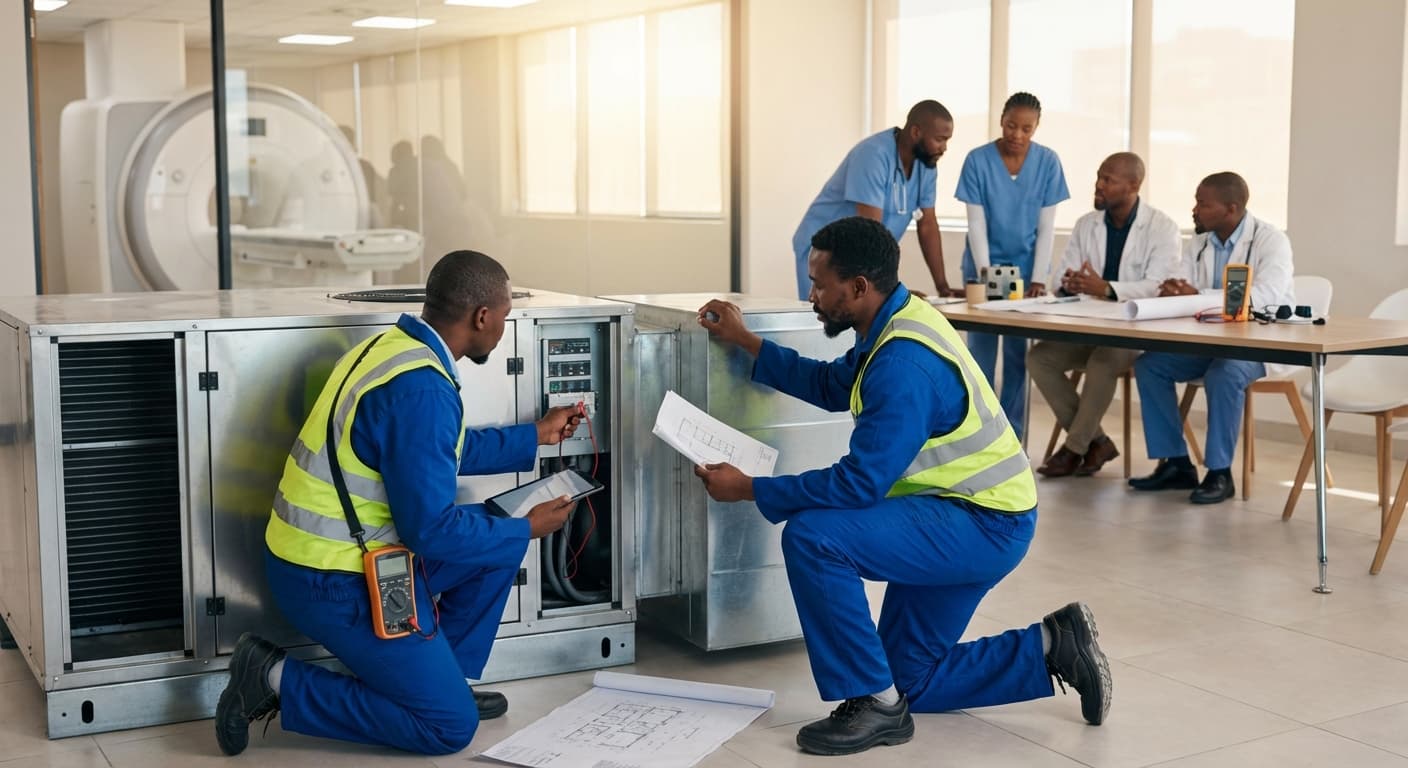
Site Readiness Assessment Service (Space/Access/HVAC/Power/Shielding) in Mali
Engineering Excellence & Technical Support
Site Readiness Assessment Service (Space/Access/HVAC/Power/Shielding) High-standard technical execution following OEM protocols and local regulatory frameworks.
Precision Site Selection for Satellite Connectivity
Our expert analysis ensures optimal satellite dish placement in Mali, minimizing signal obstruction and maximizing throughput. We meticulously assess terrain, potential interference sources (including atmospheric conditions and existing infrastructure), and provide recommendations for secure, high-availability communication links.
Climate-Resilient HVAC Design for Remote Operations
We engineer robust HVAC solutions tailored to Mali's extreme temperatures and dusty environments. Our assessments identify critical cooling and ventilation needs for sensitive equipment, ensuring operational integrity and longevity in challenging climates, with a focus on energy efficiency and ease of maintenance.
Comprehensive RF Shielding for Secure Deployments
Protecting sensitive data and ensuring operational security is paramount. Our service includes thorough assessments of electromagnetic interference (EMI) and radio frequency interference (RFI) risks. We design and recommend effective shielding strategies for your Malian installations, safeguarding against unauthorized access and signal leakage.
What Is Site Readiness Assessment Service (Space/access/hvac/power/shielding) In Mali?
The Site Readiness Assessment Service (Space/Access/HVAC/Power/Shielding) in Mali refers to a comprehensive evaluation of a proposed or existing site's infrastructure and environmental suitability for specific technical operations, particularly those involving sensitive electronic equipment, data centers, or specialized industrial processes. This service meticulously analyzes key parameters including physical space allocation, accessibility for personnel and equipment, Heating, Ventilation, and Air Conditioning (HVAC) system capabilities, electrical power supply reliability and capacity, and electromagnetic or radiation shielding effectiveness. The objective is to identify potential deficiencies or risks that could impact operational performance, equipment longevity, security, or compliance with relevant standards. This assessment is critical for mitigating project delays, cost overruns, and operational failures by ensuring the site meets the stringent requirements of the intended application before significant investments are made.
| Who Needs Site Readiness Assessment? | Typical Use Cases in Mali | ||
|---|---|---|---|
| Telecommunications Providers: Planning for new base stations, data centers, or network infrastructure deployments. | Deployment of new cellular towers and associated power/cooling infrastructure in remote or challenging terrains. | Establishment of new internet exchange points (IXPs) or data center facilities. | Upgrading existing network infrastructure requiring specific environmental controls. |
| Financial Institutions & Enterprises: Setting up new branch offices, data recovery sites, or secure IT facilities. | Installation of secure server rooms or data processing centers in urban or semi-urban areas. | Relocation or expansion of existing IT infrastructure with specific environmental and power requirements. | Implementation of point-of-sale (POS) systems and associated networking in retail environments. |
| Government & Military: Establishing secure communication hubs, command centers, or sensitive research facilities. | Construction of secure communication nodes for national security or disaster management. | Setting up specialized sensor arrays or monitoring stations requiring specific environmental conditions. | Deployment of critical infrastructure requiring robust power and cooling solutions. |
| Industrial & Manufacturing Companies: Implementing new production lines, control rooms, or specialized processing units. | Installation of industrial automation and control systems in manufacturing plants. | Setting up laboratories requiring controlled environments for research and development. | Deployment of specialized machinery with strict power and environmental tolerances. |
| Cloud Service Providers & Data Center Operators: Planning for new data center construction or expansion. | Site selection and validation for hyperscale or colocation data centers. | Ensuring compliance with international standards for data center infrastructure. | Assessing feasibility of renewable energy integration for power supply. |
| Research & Development Institutions: Establishing laboratories or experimental facilities. | Setting up advanced research labs with precise environmental control requirements. | Deployment of sensitive scientific equipment requiring minimal vibration and stable power. | Assessing interference potential for experimental setups. |
Key Components of Site Readiness Assessment:
- Space Assessment: Evaluation of physical dimensions, layout, load-bearing capacity, and environmental controls of the intended area to accommodate equipment and operational workflows.
- Access Assessment: Analysis of ingress/egress routes for personnel, large equipment (including rigging and transport considerations), and emergency services, considering security protocols and potential bottlenecks.
- HVAC Assessment: Review of existing or required heating, ventilation, and air conditioning systems for their capacity to maintain stable temperature, humidity, and air quality parameters crucial for sensitive electronics or specialized environments.
- Power Assessment: Determination of available electrical capacity, reliability (including backup power solutions like UPS and generators), power quality (voltage stability, frequency), and distribution infrastructure to meet the demands of proposed equipment.
- Shielding Assessment: Evaluation of the site's ability to provide adequate electromagnetic interference (EMI), radio frequency interference (RFI), or radiation shielding, depending on the operational requirements and local environmental factors.
Who Needs Site Readiness Assessment Service (Space/access/hvac/power/shielding) In Mali?
A Site Readiness Assessment (SRA) service, specifically addressing Space, Access, HVAC, Power, and Shielding, is crucial for any organization planning to establish or upgrade critical infrastructure in Mali. This assessment ensures that a proposed site is physically and technically capable of supporting the intended equipment, operations, and future growth. It identifies potential risks, costs, and timelines associated with site preparation, thereby preventing costly delays and operational failures. The service is particularly vital in regions like Mali where infrastructure may be less developed or subject to specific environmental challenges.
| Target Customer Type | Relevant Departments/Functions | Specific Needs Addressed by SRA |
|---|---|---|
| Telecommunications Companies | Network Operations, Infrastructure Planning, Site Acquisition, Engineering | Adequate space for base stations/data centers, reliable power supply, secure access, efficient HVAC for equipment cooling, electromagnetic shielding for sensitive equipment. |
| Data Center Operators | Operations, Facilities Management, Engineering, IT Infrastructure | Sufficient physical space for racks and cooling, robust power redundancy, secure physical access, advanced HVAC for temperature/humidity control, electromagnetic shielding to prevent interference. |
| Government Agencies (e.g., Defense, National Security) | Facilities Management, Security Operations, IT Infrastructure, Procurement | Secure and discreet locations, resilient power and communication infrastructure, controlled access, specialized shielding for sensitive command and control systems, adequate space for personnel and equipment. |
| Financial Institutions | IT Operations, Facilities Management, Risk Management, Security | Secure and reliable data processing centers, robust power backup, controlled physical access, climate-controlled environments, potential shielding for sensitive financial transaction systems. |
| Mining and Resource Extraction Companies | Operations, IT Infrastructure, Logistics, Site Development | Space for on-site processing and communication hubs, reliable power for equipment, secure access to remote locations, HVAC for control rooms and IT, potential shielding for communication systems in harsh environments. |
Target Customers for Site Readiness Assessment Services in Mali
- Telecommunications Companies (Mobile Network Operators, Internet Service Providers)
- Data Center Operators and Cloud Service Providers
- Government Agencies (National Security, Defense, Civil Administration)
- Financial Institutions (Banks, Payment Processors)
- Mining and Resource Extraction Companies
- Healthcare Providers (Hospitals, Diagnostic Centers)
- Energy Sector Companies (Power Generation, Distribution)
- Logistics and Supply Chain Management Firms
- International Organizations and NGOs
- Research and Development Institutions
- Technology Integrators and System Installers
Site Readiness Assessment Service (Space/access/hvac/power/shielding) Process In Mali
The Site Readiness Assessment Service in Mali for spaces like data centers, communication hubs, or specialized research facilities involves a comprehensive workflow to ensure all critical infrastructure is adequate before deployment. This process, encompassing Space, Access, HVAC, Power, and Shielding, guides clients from initial inquiry to the successful execution of the assessment.
| Phase | Description | Key Activities | Deliverables | Mali-Specific Considerations |
|---|---|---|---|---|
| Inquiry & Initial Consultation | The client initiates contact regarding their need for a site readiness assessment. | Client expresses requirements, discusses project goals, and provides preliminary site information. Initial risk assessment based on available data. | Understanding of client's needs, preliminary site overview. | Understanding of local regulatory requirements, potential logistical challenges (transport, communication). |
| Scope Definition & Proposal | Based on the initial consultation, a detailed scope of work and a formal proposal are developed. | Defining specific assessment criteria for Space, Access, HVAC, Power, and Shielding. Estimating timelines and costs. Presenting the proposal to the client for approval. | Detailed Scope of Work (SOW), Formal Project Proposal (including cost, timeline, methodology). | Ensuring the SOW aligns with any national or regional standards for critical infrastructure. |
| Site Visit & Data Collection | On-site assessment by qualified engineers and technicians. | Physical inspection of the space, measurement of dimensions, evaluation of access points (physical security, weight limits). Assessment of existing HVAC capacity, airflow, and redundancy. Verification of power availability, capacity, circuit breaker configurations, and grounding. Inspection for any existing shielding or requirements for new shielding. | Detailed site survey report, photographic evidence, raw data (measurements, readings). | Logistics for international travel and local site access, availability of local translators or guides, awareness of local construction practices and material availability. |
| Analysis & Reporting | Comprehensive analysis of collected data against defined requirements and industry best practices. | Evaluating space utilization and potential for expansion. Assessing the adequacy of access routes for equipment installation and maintenance. Analyzing HVAC performance and identifying potential bottlenecks or single points of failure. Reviewing power supply stability, capacity, and safety features. Determining the necessity and feasibility of specific shielding measures. | Comprehensive Site Readiness Assessment Report (detailing findings, identifying gaps, and highlighting risks). | Cross-referencing findings with any available local building codes or environmental regulations. |
| Recommendations & Remediation Planning | Developing actionable recommendations to address identified deficiencies. | Proposing specific upgrades or modifications for Space, Access, HVAC, Power, and Shielding. Outlining potential solutions, estimated costs, and implementation timelines. Developing a phased remediation plan if extensive work is required. | List of prioritized recommendations, remediation plan with cost estimates and timelines. | Considering the availability and cost of local materials and skilled labor for remediation. |
| Execution of Remediation (if applicable) | Implementation of the approved remediation plan. | Overseeing or directly managing the execution of recommended upgrades and modifications. This may involve coordination with local contractors. | Completed upgrades, modified infrastructure. | Managing local contractors, ensuring compliance with local safety regulations during construction/installation. |
| Final Verification & Sign-off | A final assessment to confirm that all remediation measures have been successfully implemented and meet the required standards. | Re-measurement and re-testing of critical infrastructure components. Final report documenting the successful completion of the assessment and any remediation. Client sign-off. | Final Verification Report, Project Completion Certificate. | Ensuring that any installed equipment or modified infrastructure complies with the latest local certifications or standards. |
Site Readiness Assessment Service Workflow in Mali
- Inquiry & Initial Consultation
- Scope Definition & Proposal
- Site Visit & Data Collection
- Analysis & Reporting
- Recommendations & Remediation Planning
- Execution of Remediation (if applicable)
- Final Verification & Sign-off
Site Readiness Assessment Service (Space/access/hvac/power/shielding) Cost In Mali
Assessing site readiness for projects in Mali, particularly those requiring specialized infrastructure like space, access, HVAC, power, and shielding, involves a nuanced pricing structure. The cost is influenced by several critical factors, ranging from the geographical location within Mali to the complexity and specific requirements of the project. These assessments are crucial for ensuring that a chosen site can adequately support the intended operations, whether for data centers, research facilities, industrial plants, or other infrastructure-intensive ventures.
The 'Site Readiness Assessment Service' is designed to evaluate the suitability of a potential location across several key domains. These include:
- Space/Footprint: Evaluating the available land or building area, its suitability for expansion, and any zoning or environmental restrictions.
- Access: Assessing the ease of transportation for personnel and materials, proximity to major roads, ports, or airports, and the availability of public utilities and emergency services.
- HVAC (Heating, Ventilation, and Air Conditioning): Determining the existing or required HVAC capacity, energy efficiency, and reliability, especially critical for temperature-sensitive operations.
- Power: Evaluating the availability, stability, and capacity of the local power grid, as well as the feasibility of backup power solutions (generators, UPS).
- Shielding: Assessing the need for and feasibility of implementing electromagnetic shielding, radiation shielding, or other forms of protection depending on the project's nature.
Pricing Factors in Mali:
The cost of such an assessment in Mali is not fixed and can fluctuate significantly. Key determinants include:
- Location Specificity: Sites in major urban centers like Bamako will likely have different cost structures compared to remote or rural areas due to variations in labor costs, travel expenses, and the availability of specialized consultants.
- Project Scale and Complexity: A small-scale IT deployment will require a less in-depth assessment than a large industrial facility or a sensitive research laboratory. The more specialized the requirements (e.g., advanced shielding, extremely high power demands), the higher the cost.
- Scope of Work: The specific components of the assessment requested will directly impact the price. A comprehensive assessment covering all five areas will be more expensive than an assessment focused on just power and access.
- Consultant Expertise and Reputation: The experience, qualifications, and reputation of the assessment firm or individual consultants will influence their fees. Highly specialized engineers or firms with proven track records in similar projects will command higher rates.
- Travel and Accommodation: For sites located outside major cities, travel and accommodation expenses for the assessment team will be a significant cost component.
- Data Collection and Analysis: The extent of site surveys, data logging (e.g., for power stability), and the complexity of the analysis required will affect the time and resources needed.
- Reporting and Deliverables: The level of detail and format of the final report (e.g., detailed technical specifications, risk assessments, recommendations) will also play a role in pricing.
- Local Regulations and Permitting: Understanding and navigating local regulations related to construction, environmental impact, and utilities can add to the assessment's scope and cost.
Estimated Cost Ranges in Malian Francs (XOF):
It's important to note that these are estimates and actual costs can vary considerably. The Malian Franc (XOF) is the currency used in Mali. The exchange rate fluctuates, but as of late 2023/early 2024, approximately 655 XOF to 1 EUR and around 600 XOF to 1 USD.
Disclaimer: These figures are indicative and should be used for general planning purposes only. It is highly recommended to obtain detailed quotes from reputable assessment firms based on your specific project requirements.
- Basic Assessment (Limited Scope, Urban Area): This might cover a general overview of space and basic power availability.
* **Range:** 500,000 XOF - 1,500,000 XOF
- Standard Assessment (Moderate Scope, Urban/Suburban): This would likely include detailed analysis of space, access, power, and basic HVAC considerations.
* **Range:** 1,500,000 XOF - 4,000,000 XOF
- Comprehensive Assessment (Full Scope, Complex Requirements, Remote Areas): This covers all five areas in depth, including specialized shielding analysis, remote site logistics, and extensive data gathering.
* **Range:** 4,000,000 XOF - 15,000,000+ XOF
Factors affecting the upper end of the range:
- Need for detailed seismic, environmental, or radiation shielding studies.
- Requirement for advanced power quality and reliability assessments, including grid impact studies.
- Extensive travel to multiple remote sites.
- Engaging highly specialized international consultants.
- Very large or complex industrial facilities with unique infrastructure needs.
| Assessment Type | Estimated Cost Range (XOF) | Typical Scope |
|---|---|---|
| Basic Assessment | 500,000 - 1,500,000 | General overview of space and basic power availability. |
| Standard Assessment | 1,500,000 - 4,000,000 | Detailed analysis of space, access, power, and basic HVAC. |
| Comprehensive Assessment | 4,000,000 - 15,000,000+ | In-depth analysis of all five areas, including specialized needs and remote logistics. |
Key Factors Influencing Site Readiness Assessment Costs in Mali
- Location within Mali (Urban vs. Rural, Accessibility)
- Project Scale and Complexity
- Specific Components of the Assessment (Space, Access, HVAC, Power, Shielding)
- Consultant Expertise and Reputation
- Travel and Accommodation Expenses
- Depth of Data Collection and Analysis Required
- Detail and Format of Deliverables
- Local Regulatory Environment
Affordable Site Readiness Assessment Service (Space/access/hvac/power/shielding) Options
Our affordable Site Readiness Assessment service provides a comprehensive evaluation of your potential facility's suitability for your specific needs. We focus on critical infrastructure elements including Space (layout, dimensions, expansion potential), Access (entry/exit points, loading docks, transportation links), HVAC (capacity, zoning, redundancy, filtration), Power (capacity, reliability, redundancy, backup systems), and Shielding (EMI/RFI, acoustic, physical security, radiation). We offer tiered value bundles designed to meet varying project scopes and budgets, ensuring you receive the most cost-effective solution. Our goal is to identify potential challenges and opportunities early in the process, enabling informed decision-making and preventing costly overruns during build-out and operation. Leveraging our expertise, we help you avoid unforeseen expenses and ensure your chosen site aligns perfectly with your operational requirements.
| Assessment Element | Key Considerations | Potential Cost Impact (If Unaddressed) | Our Value Proposition |
|---|---|---|---|
| Space | Layout, dimensions, ceiling heights, column spacing, potential for expansion, loading dock access. | Incorrect footprint leading to inefficient workflow, costly structural modifications, inability to accommodate equipment, missed expansion opportunities. | Optimized layout recommendations, feasibility of modifications, identification of expansion potential. |
| Access | Entry/exit points, ingress/egress for large equipment, loading dock size and capacity, proximity to transportation hubs. | Delays in equipment installation, inability to move critical assets, increased logistics costs, operational bottlenecks. | Assessment of current access and recommendations for improvements, evaluation of logistical pathways. |
| HVAC | Capacity for heat load, temperature/humidity control, zoning, redundancy, air filtration (e.g., HEPA), air changes per hour (ACH). | Equipment failure due to overheating/overcooling, compromised product integrity, health and safety risks, increased energy consumption. | Capacity analysis, redundancy recommendations, air quality assessment, energy efficiency strategies. |
| Power | Available electrical capacity (amps/volts), reliability of utility feed, redundancy (e.g., dual feeds), backup power (generator) requirements, distribution. | Inability to power equipment, operational downtime due to power outages, costly upgrades to electrical infrastructure, fire hazards. | Capacity verification, redundancy assessment, backup power feasibility, recommendations for upgrades. |
| Shielding | EMI/RFI shielding for sensitive equipment, acoustic insulation for noise control, physical security, radiation shielding (if applicable). | Data corruption, equipment malfunction, operational disruptions due to noise, security breaches, compliance issues. | Identification of shielding needs, assessment of existing conditions, recommendations for mitigation strategies. |
Value Bundles & Cost-Saving Strategies
- {"items":["Essentials Bundle: Covers core assessment of Space, Access, and basic HVAC/Power capacity. Ideal for preliminary site selection and early-stage feasibility.","Standard Bundle: Expands on Essentials with detailed HVAC/Power analysis, including redundancy and basic shielding considerations. Suitable for projects requiring more in-depth technical review.","Premium Bundle: The most comprehensive option, encompassing all elements (Space, Access, HVAC, Power, Shielding) with advanced analysis, risk assessment, and detailed recommendations for optimization and cost savings during build-out. Includes future-proofing considerations.","Custom Bundle: Tailored assessment based on your specific project requirements and budget. We can mix and match elements from other bundles to create a perfect fit."],"title":"Value Bundles"}
- {"items":["Early Intervention: Identifying site limitations before lease/purchase drastically reduces the cost of rectifying issues later.","Phased Assessment: For larger projects, we can conduct phased assessments, allowing you to make decisions at key milestones and defer full assessment costs.","Focus on Critical Needs: Our team prioritizes assessing the elements most critical to your operations, avoiding unnecessary investigations.","Leveraging Existing Infrastructure: We identify opportunities to utilize existing site features and infrastructure, minimizing the need for new installations.","Informed Negotiation: Our assessment provides objective data to support your negotiations with landlords or sellers regarding necessary upgrades and improvements.","Predictive Maintenance Insights: For HVAC and Power, our assessment can highlight potential maintenance needs and recommend strategies to extend equipment life.","Energy Efficiency Recommendations: We can provide insights into energy-efficient HVAC and power solutions, leading to long-term operational cost savings.","Streamlined Build-Out: Clear understanding of site readiness minimizes delays and unexpected costs during the construction or fit-out phase."],"title":"Cost-Saving Strategies"}
Verified Providers In Mali
In Mali, ensuring access to quality healthcare relies heavily on partnering with verified providers. Franance Health stands out as a leading organization, meticulously vetting and credentialing healthcare professionals and facilities. This rigorous process guarantees that their network comprises practitioners who meet the highest standards of medical expertise, ethical conduct, and patient care. Choosing Franance Health-credentialed providers means opting for reliability, safety, and a commitment to your well-being.
| Credentialed Provider Type | Franance Health Verification Focus | Benefits for Patients |
|---|---|---|
| Doctors & Specialists | Medical licenses, board certifications, clinical experience, patient reviews | Access to expert diagnosis and treatment, specialized care |
| Hospitals & Clinics | Facility licensing, adherence to safety standards, equipment quality, staff qualifications | Safe and well-equipped medical environments, comprehensive services |
| Nurses & Allied Health Professionals | Professional certifications, training in specific fields, ethical conduct | Reliable support care, specialized health services |
| Pharmacies | Drug licensing, proper storage of medications, dispensing accuracy | Access to genuine and safe medications |
Why Franance Health Credentials Matter in Mali
- Rigorous Vetting: Franance Health employs a comprehensive evaluation process that scrutinizes educational background, professional experience, licensing, and adherence to ethical guidelines.
- Quality Assurance: Their credentialing ensures that providers are up-to-date with the latest medical advancements and best practices.
- Patient Safety: A key focus is on verifying that providers maintain impeccable safety records and follow stringent protocols.
- Access to Trusted Care: Franance Health's network provides a reliable pathway to skilled and trustworthy healthcare professionals across Mali.
- Enhanced Patient Trust: The Franance Health seal of approval offers patients peace of mind, knowing they are receiving care from accredited and capable individuals.
Scope Of Work For Site Readiness Assessment Service (Space/access/hvac/power/shielding)
This Scope of Work (SOW) outlines the services for a comprehensive Site Readiness Assessment (SRA) focusing on Space, Access, HVAC, Power, and Shielding. The objective is to evaluate the suitability of a designated site for specific equipment or operational needs and identify any necessary remediation or upgrades. The SRA will involve a detailed on-site inspection, data collection, analysis, and the generation of technical deliverables. Standard specifications for each assessment area are provided.
| Assessment Area | Description | Key Considerations | Technical Deliverables | Standard Specifications |
|---|---|---|---|---|
| Space and Layout | Evaluating the physical dimensions, layout, and configuration of the site to ensure adequate room for equipment, personnel, and future expansion. | Equipment footprint, clearance requirements, future growth potential, aisle space, ceiling height, rack density, cabling pathways. | Site layout diagrams (existing and proposed), equipment placement plans, cubic footage calculations, spatial constraint report. | Compliance with relevant building codes and industry best practices for equipment spacing and airflow (e.g., ASHRAE standards for data centers). |
| Access and Logistics | Assessing the ease of entry and movement of personnel, equipment, and materials to and within the site. | Loading docks, freight elevators, door sizes and clearances, floor load capacity, security checkpoints, parking availability, delivery routes. | Access route diagrams, equipment transportation plan, site access matrix, accessibility report. | ADA (Americans with Disabilities Act) compliance for personnel access, appropriate load-bearing capacities for floors and elevators, security protocols for material handling. |
| HVAC (Heating, Ventilation, and Air Conditioning) | Evaluating the existing HVAC system's capacity, performance, and suitability for maintaining required environmental conditions. | Temperature control, humidity control, air filtration, airflow rates, redundant cooling systems, ventilation adequacy, noise levels. | HVAC system capacity report, environmental monitoring data analysis, airflow diagrams, recommended HVAC upgrades or modifications. | ASHRAE standards for temperature and humidity ranges in data centers and sensitive equipment environments (e.g., 20-25°C, 40-60% RH), N+1 redundancy for critical cooling components. |
| Power Infrastructure | Assessing the available electrical power capacity, distribution, and reliability to support the intended load. | Incoming power capacity (kVA/kW), distribution panels, circuit breakers, UPS (Uninterruptible Power Supply) capacity and redundancy, generator availability, grounding, PDU (Power Distribution Unit) configuration. | Electrical load assessment, power distribution diagrams, UPS and generator capacity report, power quality analysis, recommended power upgrades or redundancies. | Compliance with local electrical codes (e.g., NEC - National Electrical Code), N+1 or 2N redundancy for UPS and generators as per criticality, appropriate grounding resistance values. |
| Shielding Requirements | Evaluating the need for and the existing provision of electromagnetic, RF, or other forms of shielding based on the equipment's sensitivity or regulatory requirements. | EMF (Electromagnetic Field) levels, RF interference sources, acoustic noise levels, radiation shielding (if applicable), vibration isolation. | Shielding effectiveness report, acoustic assessment, vibration analysis, recommendations for shielding materials or treatments. | Industry standards for electromagnetic compatibility (e.g., FCC Part 15), specific shielding attenuation requirements (dB) for different frequency ranges, acoustic noise limits (dBA) for occupied spaces. |
Key Assessment Areas:
- Space and Layout
- Access and Logistics
- HVAC (Heating, Ventilation, and Air Conditioning)
- Power Infrastructure
- Shielding Requirements
Service Level Agreement For Site Readiness Assessment Service (Space/access/hvac/power/shielding)
This Service Level Agreement (SLA) outlines the terms and conditions for the Site Readiness Assessment Service (SRAS). The SRAS provides a comprehensive evaluation of critical site infrastructure, including Space, Access, HVAC, Power, and Shielding, to ensure suitability for proposed deployments.
This SLA defines the expected response times for critical incident notifications and the guaranteed uptime for the SRAS portal and associated communication channels. Failure to meet these commitments will result in specified remedies for the Client.
| Service Component | Response Time Guarantee (Critical Incident) | Uptime Guarantee |
|---|---|---|
| Site Readiness Assessment Service (SRAS) Portal | N/A (Portal is informational) | 99.5% |
| Communication Channels (Email/Phone for Escalations) | 1 Business Hour | N/A (Not a continuous service) |
| On-site Assessment Scheduling (Initial Contact) | 2 Business Days | N/A |
| Report Delivery (Post-Assessment) | 5 Business Days | N/A |
Service Components
- Space Assessment: Evaluation of physical dimensions, layout, and suitability for equipment installation.
- Access Assessment: Review of entry points, pathways, and security protocols for equipment and personnel.
- HVAC Assessment: Analysis of heating, ventilation, and air conditioning systems for temperature, humidity, and airflow control.
- Power Assessment: Verification of power capacity, redundancy, distribution, and grounding.
- Shielding Assessment: Evaluation of electromagnetic, RF, and other necessary shielding requirements.
Frequently Asked Questions

Ready when you are
Let's scope your Site Readiness Assessment Service (Space/Access/HVAC/Power/Shielding) in Mali project in Mali.

Scaling healthcare logistics and technical systems across the entire continent.