
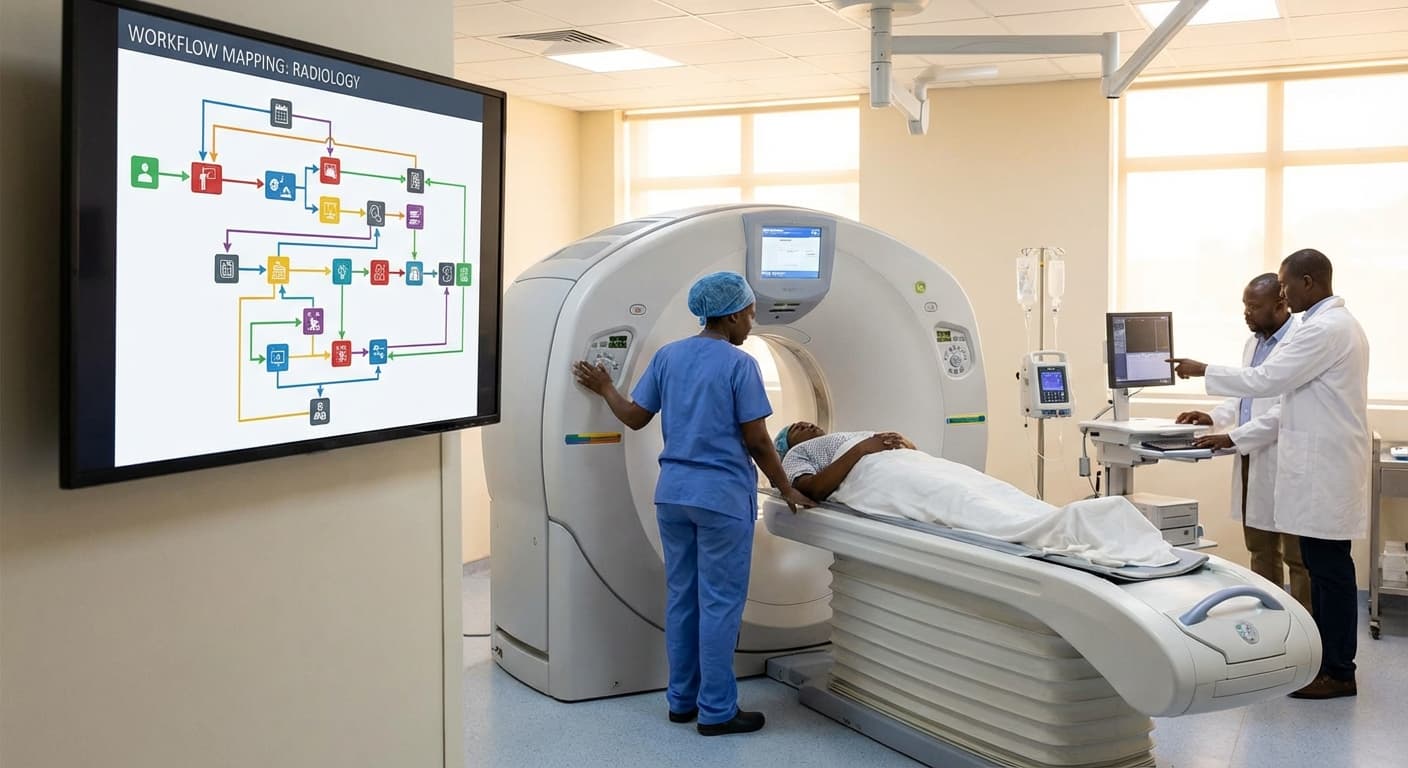
Department Workflow Mapping Service (Radiology/ICU/OT/Lab/Dialysis) in Mali
Engineering Excellence & Technical Support
Department Workflow Mapping Service (Radiology/ICU/OT/Lab/Dialysis) High-standard technical execution following OEM protocols and local regulatory frameworks.
Radiology Workflow Optimization
Streamline patient imaging requests, scheduling, and reporting to reduce turnaround times and enhance diagnostic accuracy, ensuring faster patient care pathways in Malian hospitals.
ICU Patient Flow Management
Visualize and optimize critical patient pathways within the Intensive Care Unit, from admission to discharge or transfer, improving resource allocation and patient outcomes in resource-constrained environments.
Operating Theatre Efficiency Mapping
Map out surgical procedures, from pre-operative preparation to post-operative recovery, identifying bottlenecks and inefficiencies to maximize theatre utilization and surgical throughput.
What Is Department Workflow Mapping Service (Radiology/icu/ot/lab/dialysis) In Mali?
Department Workflow Mapping Service (Radiology/ICU/OT/Lab/Dialysis) in Mali refers to a systematic process of documenting, analyzing, and optimizing the operational sequences and interdependencies within specific hospital departments. This service aims to identify bottlenecks, inefficiencies, and areas for improvement in the patient care pathway and administrative processes. The core objective is to visualize the flow of patients, information, resources, and tasks from initiation to completion, enabling data-driven decision-making for enhanced service delivery, resource utilization, and patient safety. This methodology is particularly relevant in healthcare settings like Radiology, Intensive Care Units (ICU), Operating Theatres (OT), Laboratories, and Dialysis centers, where complex, time-sensitive, and often multidisciplinary workflows are critical to patient outcomes.
| Who Needs Department Workflow Mapping Service? | Typical Use Cases | |||
|---|---|---|---|---|
| Radiology Departments: To optimize patient scheduling, imaging acquisition, image interpretation, reporting, and PACS integration. | Streamlining patient throughput for diagnostic imaging procedures (e.g., CT, MRI, X-ray). | Reducing report turnaround times. | Improving radiologist workload distribution and efficiency. | Enhancing communication between referring physicians and the radiology department. |
| Intensive Care Units (ICU): To improve patient admission, transfer, and discharge processes, as well as critical care management protocols. | Optimizing bed allocation and patient flow within the ICU. | Enhancing communication and coordination among multidisciplinary care teams (physicians, nurses, respiratory therapists, etc.). | Reducing medication administration errors through streamlined processes. | Improving response times for critical events. |
| Operating Theatres (OT): To streamline surgical scheduling, patient preparation, procedure execution, and post-operative care handoffs. | Improving operating room utilization and reducing cancellations. | Minimizing patient waiting times for surgery. | Ensuring efficient instrument and equipment availability. | Enhancing communication and coordination between surgical teams, anesthesia, and nursing staff. |
| Laboratories: To optimize sample collection, transport, processing, analysis, and reporting of laboratory tests. | Reducing specimen turnaround times (TAT) for critical tests. | Improving laboratory workflow efficiency and reagent management. | Enhancing quality control processes and reducing errors in testing. | Streamlining communication of results to clinicians. |
| Dialysis Centers: To manage patient scheduling, dialysis session protocols, equipment maintenance, and data recording. | Optimizing patient scheduling for dialysis treatments to maximize machine utilization. | Ensuring timely and efficient patient preparation and treatment delivery. | Streamlining the management of dialysis consumables and medications. | Improving the accuracy and completeness of patient records and billing data. |
| Hospital Administration & IT Departments: To support strategic planning, resource allocation, and technology implementation. | Identifying opportunities for technology adoption (e.g., EMR integration, automation). | Supporting Lean Six Sigma or other quality improvement initiatives. | Developing business cases for new services or equipment. | Facilitating inter-departmental collaboration and process standardization. |
Key Components of Department Workflow Mapping Service:
- Process Identification: Defining the scope and boundaries of the workflow to be mapped within a specific department.
- Data Collection: Gathering information through interviews, observations, document analysis, and system logs to understand current practices.
- Visualization: Creating graphical representations (e.g., flowcharts, swimlane diagrams, BPMN models) of the existing workflow.
- Analysis and Bottleneck Identification: Examining the mapped workflow to pinpoint delays, redundancies, manual handoffs, and resource constraints.
- Optimization and Redesign: Developing strategies and proposing changes to improve efficiency, reduce errors, and enhance patient flow.
- Implementation Support: Assisting in the rollout of redesigned workflows and associated system or procedural changes.
- Performance Monitoring: Establishing metrics and mechanisms to track the effectiveness of implemented changes.
Who Needs Department Workflow Mapping Service (Radiology/icu/ot/lab/dialysis) In Mali?
A Department Workflow Mapping Service is crucial for improving efficiency, identifying bottlenecks, and optimizing resource allocation within specialized hospital departments. In Mali, where healthcare infrastructure and resource management are critical, such a service can have a significant impact. This service focuses on understanding the current processes within key departments like Radiology, Intensive Care Units (ICU), Operating Theatres (OT), Laboratories, and Dialysis centers, and then developing streamlined, evidence-based workflows. The ultimate goal is to enhance patient care delivery, reduce wait times, minimize errors, and ensure the optimal utilization of equipment and personnel.
| Target Customer Type | Specific Institutions in Mali | Key Benefits of Workflow Mapping |
|---|---|---|
| Public Hospitals | University Teaching Hospitals (e.g., CHU Gabriel Touré), Regional Hospitals | Improved patient throughput, reduced operational costs, better resource allocation, enhanced training opportunities. |
| Private Hospitals & Clinics | Larger private healthcare providers, specialized clinics | Competitive advantage through enhanced efficiency, improved patient satisfaction, optimized profit margins. |
| Non-Governmental Organizations (NGOs) & International Aid Organizations | Organizations involved in healthcare development and delivery in Mali | More effective program implementation, measurable impact on healthcare access and quality, sustainable operational improvements. |
| Ministry of Health & Public Health Agencies | National health authorities responsible for policy and oversight | Data-driven decision-making for resource allocation and policy development, identification of nationwide best practices, standardization of departmental operations. |
Target Departments & Their Needs
- {"title":"Radiology Department","description":"Needs to optimize patient flow from referral to imaging to report generation. Mapping can identify delays in scheduling, equipment availability, and radiologist turnaround times. This leads to faster diagnosis and treatment initiation."}
- {"title":"Intensive Care Units (ICU)","description":"Crucial for critical patients. Workflow mapping can improve the coordination of multidisciplinary teams, medication administration, patient monitoring, and timely interventions. This enhances patient outcomes and reduces the risk of complications."}
- {"title":"Operating Theatres (OT)","description":"Efficient OT operations are vital for surgical success. Mapping can streamline patient pre-op preparation, surgical team coordination, equipment sterilization and availability, and post-operative recovery. This reduces surgery cancellations and improves patient safety."}
- {"title":"Laboratories","description":"Accurate and timely lab results are essential for diagnosis and treatment. Workflow mapping can optimize sample collection, processing, analysis, and reporting. This ensures faster turnaround times for critical tests and reduces the potential for errors."}
- {"title":"Dialysis Centers","description":"Essential for patients with kidney failure. Workflow mapping can improve patient scheduling, machine utilization, staff allocation, and patient safety protocols. This maximizes the number of patients who can receive treatment and ensures a consistent quality of care."}
Department Workflow Mapping Service (Radiology/icu/ot/lab/dialysis) Process In Mali
This document outlines the standard workflow for the Department Workflow Mapping Service (Radiology/ICU/OT/Lab/Dialysis) within healthcare facilities in Mali. The service aims to analyze, document, and optimize operational processes within critical departments to improve efficiency, patient care, and resource utilization. The process begins with an initial inquiry from a department head or hospital administration and concludes with the delivery of a comprehensive workflow map and recommendations.
| Stage | Description | Key Activities | Responsible Parties | Deliverables/Outcomes |
|---|---|---|---|---|
| Initial contact from a department or administration expressing a need for workflow analysis. | Briefing on current challenges, department scope, and desired outcomes. Initial discussion of objectives. | Department Head, Hospital Administration, Workflow Mapping Service Provider | Understanding of the problem, initial agreement on the need for the service. |
| The service provider develops and presents a formal proposal. Agreement on the scope of work. | Detailed service offering, methodology, timelines, resource requirements, and cost. Negotiation and contract finalization. | Workflow Mapping Service Provider, Department Head, Hospital Administration | Formal proposal accepted, contract signed, scope of work clearly defined (e.g., which sub-processes within Radiology are mapped). |
| Gathering detailed information about the current workflow. | Interviews with staff, observation of processes, review of existing documentation (SOPs, forms), data analysis (patient flow, turnaround times, equipment utilization). | Workflow Mapping Service Provider Team, Department Staff (Radiologists, Technicians, Nurses, Administrators) | Comprehensive understanding of current state, identification of bottlenecks, inefficiencies, and areas for improvement. |
| Visually representing the current processes. | Creating flowcharts, process diagrams, swim lane diagrams to illustrate each step, decision points, roles, and handoffs within the department (e.g., from patient registration to image acquisition to reporting in Radiology). | Workflow Mapping Service Provider Team | Detailed current-state workflow maps for the specified department(s). |
| Ensuring the accuracy and completeness of the mapped workflows. | Presenting the draft workflow maps to department staff for review and feedback. Incorporating corrections and clarifications. | Workflow Mapping Service Provider Team, Department Staff | Validated and accurate current-state workflow maps. |
| Synthesizing findings and proposing solutions. | Developing a comprehensive report including the validated workflow maps, analysis of findings, identification of key issues, and actionable recommendations for process improvement (e.g., streamlining patient scheduling, optimizing equipment usage, improving communication protocols). | Workflow Mapping Service Provider Team | Final report with workflow maps and strategic recommendations. |
| Assisting the department in putting the recommendations into practice. | Providing guidance, training, and project management for the implementation of proposed changes. Development of new SOPs or training materials. | Workflow Mapping Service Provider Team, Department Staff, Hospital Administration | Successful adoption of new processes and procedures. |
| Monitoring the impact of implemented changes. | Periodic check-ins to assess the effectiveness of implemented recommendations, measure key performance indicators (KPIs), and identify any further adjustments needed. | Workflow Mapping Service Provider Team, Department Staff, Hospital Administration | Demonstrated improvement in departmental efficiency, patient care, or resource utilization. |
Department Workflow Mapping Service Process in Mali
- Inquiry and Needs Assessment
- Proposal and Scoping
- Data Collection and Analysis
- Workflow Mapping
- Validation and Feedback
- Report Generation and Recommendations
- Implementation Support (Optional)
- Follow-up and Evaluation
Department Workflow Mapping Service (Radiology/icu/ot/lab/dialysis) Cost In Mali
Establishing efficient workflows is paramount in critical medical departments like Radiology, Intensive Care Units (ICU), Operating Theatres (OT), Laboratories, and Dialysis. A Department Workflow Mapping Service aims to analyze, document, and optimize these processes to improve patient care, reduce errors, and enhance resource utilization. The cost of such a service in Mali will be influenced by several factors, leading to a range of potential pricing. Understanding these factors is crucial for healthcare institutions seeking to invest in workflow improvement.
| Service Scope / Department Type | Estimated Cost Range (Malian Franc CFA) | Notes |
|---|---|---|
| Basic Workflow Mapping (Single Department - e.g., Lab Sample Processing) | 300,000 - 750,000 CFA | Focus on 'as-is' process documentation, identification of obvious redundancies. |
| Detailed Workflow Analysis & Optimization (Single Department - e.g., ICU Patient Flow) | 750,000 - 2,000,000 CFA | Includes in-depth analysis, bottleneck identification, root cause analysis, and initial recommendations for improvement. May include 1-2 departments. |
| Comprehensive Workflow Mapping & Re-engineering (Multiple Departments - e.g., Radiology, OT, Dialysis) | 2,000,000 - 6,000,000+ CFA | Extensive analysis across multiple departments, development of optimized 'to-be' workflows, potential for implementation planning. Larger/more complex institutions will fall at the higher end. |
| Specialized Workflow Consulting (e.g., Advanced OT Sterilization Processes) | 500,000 - 1,500,000 CFA (per specialization) | Targeted expertise for highly specific and critical processes. Cost depends on the complexity of the specialization. |
| Ongoing Support & Monitoring (Per Quarter/Year) | 200,000 - 800,000+ CFA | Follow-up assessments, performance monitoring, and adjustments to optimized workflows. |
Key Pricing Factors for Department Workflow Mapping Services in Mali:
- {"item":"Scope and Complexity of the Department:","description":"Larger departments with more intricate processes, higher patient volumes, and multiple sub-specialties will naturally require more extensive analysis and thus incur higher costs. For instance, mapping an entire ICU with its diverse patient acuity and multidisciplinary interventions will be more complex than mapping a single specialized radiology procedure."}
- {"item":"Number of Departments to be Mapped:","description":"If an institution requires workflow mapping for multiple departments (e.g., Radiology and ICU concurrently), the total cost will be aggregated, potentially with some economies of scale depending on the service provider."}
- {"item":"Level of Detail Required:","description":"Basic 'as-is' process mapping will be less expensive than comprehensive mapping that includes detailed task analysis, identification of bottlenecks, root cause analysis of inefficiencies, and development of 'to-be' optimized workflows with proposed technological integrations or staffing adjustments."}
- {"item":"Service Provider's Expertise and Reputation:","description":"Highly reputable consulting firms with proven experience in healthcare workflow optimization, particularly in similar healthcare systems or regions, will command higher fees. Local expertise in the Malian healthcare context can also be a significant differentiator."}
- {"item":"Duration of the Engagement:","description":"The time required for on-site observation, interviews, data collection, analysis, and report generation directly impacts the cost. Longer engagements due to larger scope or more in-depth analysis will increase the overall price."}
- {"item":"Deliverables:","description":"The nature of the final deliverables plays a role. This could range from simple process flowcharts to detailed implementation plans, training materials, and ongoing support. More comprehensive and actionable deliverables will be priced higher."}
- {"item":"Geographical Location within Mali:","description":"While less impactful than other factors, travel and accommodation costs for the service provider if they are not based in the immediate vicinity of the healthcare facility might be factored into the overall price."}
- {"item":"Technology and Tools Used:","description":"Some service providers may utilize specialized software for workflow modeling and analysis, which can contribute to their pricing structure."}
Affordable Department Workflow Mapping Service (Radiology/icu/ot/lab/dialysis) Options
Our Affordable Department Workflow Mapping Service offers a comprehensive solution to optimize operations across key hospital departments including Radiology, Intensive Care Unit (ICU), Operating Theatre (OT), Laboratory, and Dialysis. We understand that efficiency directly impacts patient care, resource utilization, and ultimately, your bottom line. Our service provides a clear, visual representation of your current workflows, identifies bottlenecks, and proposes actionable improvements to streamline processes, reduce waste, and enhance overall productivity. This leads to improved patient throughput, reduced staff frustration, and significant cost savings.
| Service Component | Standard Offering | Premium Offering | Cost-Saving Strategies Explained |
|---|---|---|---|
| Initial Consultation & Needs Assessment | Included | Included | Ensures we understand your specific pain points and goals, preventing wasted effort on irrelevant solutions. |
| On-site/Remote Workflow Observation & Data Gathering | Up to 2 days per department | Up to 3 days per department | Accurate data collection is crucial for identifying genuine inefficiencies. Minimizing observation time without sacrificing accuracy is key. |
| Process Mapping & Documentation | Basic Flowcharts | Detailed Process Maps with Swimlanes | Clear visualization allows for easy identification of redundant steps, delays, and miscommunications. |
| Bottleneck Identification & Root Cause Analysis | Top 3-5 Bottlenecks | Top 5-7 Bottlenecks with Deeper Analysis | Targeting the most impactful issues yields the quickest and most significant improvements. |
| Recommendations for Improvement | Actionable, low-cost recommendations | Prioritized recommendations with ROI estimates, technology suggestions | Focus on practical, implementable solutions that deliver tangible results. Quantifying potential savings helps in decision-making. |
| Post-Implementation Review (Optional) | 1 Follow-up Meeting | 2 Follow-up Meetings + Remote Monitoring | Ensures implemented changes are effective and addresses any new challenges that arise, maximizing the long-term benefits of the mapping. |
| Technology Integration Assessment | Basic assessment | In-depth assessment with vendor recommendations | Leveraging appropriate technology (e.g., scheduling software, automated reporting) can dramatically improve efficiency and reduce manual errors. |
| Staff Training & Change Management | Basic guidance | Customized training modules, change management strategy | Effective adoption of new workflows by staff is critical. Investing in training prevents resistance and ensures sustained improvement. |
| Benchmarking Against Best Practices | General insights | Detailed comparative analysis | Learning from successful implementations in similar departments helps avoid reinventing the wheel and adopts proven efficiencies. |
| Cost-Saving Strategy Focus | Identifies areas for waste reduction (e.g., redundant steps, unnecessary travel) | Quantifies potential savings in staff time, material use, and reduced errors. Explores opportunities for automation and improved resource allocation. | By directly addressing inefficiencies, we help you reduce operational costs. Examples include: reducing patient waiting times (leading to higher throughput), minimizing wasted supplies, optimizing staff scheduling, and decreasing error rates that lead to rework or adverse events. |
Value Bundles for Workflow Mapping
- {"title":"Core Workflow Analysis (Single Department)","includes":["On-site/Remote Workshop","Process Flowchart Creation","Bottleneck Identification Report","Basic Improvement Recommendations"],"description":"Ideal for departments needing targeted improvements. Includes detailed mapping of existing processes, identification of 3-5 key bottlenecks, and recommendations for immediate fixes."}
- {"title":"Interdepartmental Synergy Bundle","includes":["Two Department Core Analyses","Interdepartmental Handover Analysis","Communication Improvement Strategies","Joint Process Optimization Recommendations"],"description":"Focuses on optimizing the flow of patients and information between two connected departments (e.g., OT to ICU, Radiology to Ward). Enhances coordination and reduces handover delays."}
- {"title":"Comprehensive Departmental Optimization Suite (All Departments)","includes":["Core Workflow Analysis for all listed departments","Facility-wide Process Integration Mapping","Technology Integration Recommendations","Staff Training & Change Management Support (Optional Add-on)"],"description":"A holistic approach to maximize efficiency across your entire facility. Integrates insights from all mapped departments for a facility-wide efficiency boost."}
- {"title":"Department-Specific Deep Dive (Choose 1-2 Departments)","includes":["Extended On-site/Remote Engagement","Advanced Data Analysis (e.g., cycle times, resource utilization)","Benchmarking Against Best Practices","Detailed Technology/Automation Recommendations"],"description":"Tailored to address unique challenges within specific high-demand or complex departments."}
Verified Providers In Mali
In Mali, ensuring access to reliable and high-quality healthcare is paramount. The term 'Verified Providers' signifies healthcare professionals and institutions that have undergone rigorous scrutiny and meet established standards of competence, ethics, and operational excellence. Franance Health, a leading entity in health services and information dissemination, plays a crucial role in identifying and credentialing these verified providers. Their stringent evaluation process goes beyond basic licensing, encompassing a comprehensive review of clinical expertise, patient care protocols, infrastructure, and adherence to international best practices. Choosing a Franance Health-verified provider in Mali offers a significant advantage to patients, guaranteeing a higher level of trust, safety, and effectiveness in their medical journey.
| Provider Type | Franance Health Verification Highlights |
|---|---|
| Hospitals & Clinics | State-of-the-art facilities, adherence to infection control, qualified medical staff, comprehensive diagnostic services, patient care protocols. |
| Specialist Doctors | Board certification, proven track record, advanced training, patient testimonials, ethical practice. |
| General Practitioners | Licensing, continuous professional development, patient-centered approach, accessibility, referral network. |
| Diagnostic Laboratories | Accreditation, quality control measures, advanced equipment, timely and accurate results, qualified technicians. |
| Pharmacies | Licensed pharmacists, proper medication storage, drug interaction checks, patient counseling, availability of essential medicines. |
Why Franance Health Credentials Represent the Best Choice:
- Rigorous Verification Process: Franance Health employs a multi-faceted evaluation system that scrutinizes qualifications, experience, ethical conduct, and patient outcomes.
- Commitment to Quality: Verified providers demonstrate a dedication to upholding the highest standards of medical care, safety, and patient satisfaction.
- Enhanced Trust and Reliability: The credentialing assures patients that they are receiving care from competent and trustworthy professionals and facilities.
- Access to Best Practices: Franance Health ensures that verified providers adhere to evidence-based medicine and up-to-date medical advancements.
- Patient Safety Focus: The verification process prioritizes patient safety through assessment of infrastructure, hygiene, and emergency preparedness.
- Transparency and Accountability: Verified providers are held to a standard of transparency, making it easier for patients to make informed decisions about their healthcare.
Scope Of Work For Department Workflow Mapping Service (Radiology/icu/ot/lab/dialysis)
This Scope of Work (SOW) outlines the services to be provided for a comprehensive workflow mapping initiative across critical hospital departments. The primary objective is to analyze, document, and optimize current operational processes within the Radiology, Intensive Care Unit (ICU), Operating Theatre (OT), Laboratory, and Dialysis departments. This will enable the identification of bottlenecks, inefficiencies, and opportunities for improvement, leading to enhanced patient care, resource utilization, and operational effectiveness. The service includes detailed process mapping, stakeholder engagement, and the delivery of standardized documentation and recommendations.
| Phase | Activities | Key Deliverables | Department Focus |
|---|---|---|---|
| Phase 1: Project Initiation & Planning | Kick-off meeting, stakeholder identification, project plan development, data collection strategy definition. | Project Charter, Stakeholder Register, Detailed Project Plan, Communication Plan. | All Departments |
| Phase 2: Current State Workflow Analysis | Observation of processes, interviews with staff, review of existing documentation, data gathering. | As-Is Workflow Maps (BPMN 2.0 compliant), Process Narratives, Stakeholder Feedback Summary. | Radiology, ICU, OT, Lab, Dialysis |
| Phase 3: Bottleneck & Opportunity Identification | Analysis of As-Is workflows, identification of pain points, root cause analysis, brainstorming sessions. | Bottleneck Analysis Report, Opportunity Register, Preliminary Improvement Concepts. | Radiology, ICU, OT, Lab, Dialysis |
| Phase 4: Future State Workflow Design | Development of To-Be workflow models based on identified opportunities, stakeholder validation. | To-Be Workflow Maps (BPMN 2.0 compliant), Proposed Process Changes Documentation. | Radiology, ICU, OT, Lab, Dialysis |
| Phase 5: Recommendation Development & Reporting | Consolidation of findings, development of actionable recommendations, final report generation, presentation to stakeholders. | Final Project Report (including As-Is & To-Be maps, analysis, recommendations), Executive Summary, Presentation Slides. | All Departments |
Service Objectives
- To meticulously document the end-to-end workflows for each specified department (Radiology, ICU, OT, Lab, Dialysis).
- To identify and analyze current process bottlenecks, redundancies, and areas of inefficiency.
- To gather requirements and feedback from key stakeholders across all involved departments.
- To develop optimized workflow models and recommendations for improvement.
- To deliver comprehensive and standardized technical documentation of current and proposed workflows.
- To establish a baseline for future process improvement initiatives and performance monitoring.
Service Level Agreement For Department Workflow Mapping Service (Radiology/icu/ot/lab/dialysis)
This Service Level Agreement (SLA) outlines the performance expectations and guarantees for the Department Workflow Mapping Service, specifically covering Radiology, Intensive Care Unit (ICU), Operating Theatre (OT), Laboratory, and Dialysis departments. This SLA defines the acceptable response times for support requests and the guaranteed uptime for the workflow mapping platform.
| Service Component | Response Time (Business Hours) | Resolution Target (Business Hours) | Guaranteed Uptime | Service Credits (per 24-hour period of downtime) |
|---|---|---|---|---|
| Workflow Mapping Platform Availability | N/A (continuous operation) | N/A | 99.5% | 5% of monthly service fee |
| Technical Support - Critical Issue (System outage affecting >25% of users) | 1 Hour | 4 Business Hours | N/A | 10% of monthly service fee |
| Technical Support - High Issue (System performance degradation affecting >10% of users) | 2 Business Hours | 8 Business Hours | N/A | 5% of monthly service fee |
| Technical Support - Medium Issue (Individual user issue, minor functionality impact) | 4 Business Hours | 24 Business Hours | N/A | 2% of monthly service fee |
| Technical Support - Low Issue (General inquiry, documentation request) | 8 Business Hours | 48 Business Hours | N/A | 1% of monthly service fee |
| Workflow Consultation & Analysis Request (Initial Contact) | 2 Business Days | N/A | N/A | N/A |
Service Scope
- Workflow mapping analysis and documentation for Radiology department processes.
- Workflow mapping analysis and documentation for Intensive Care Unit (ICU) patient flow and procedures.
- Workflow mapping analysis and documentation for Operating Theatre (OT) scheduling and patient management.
- Workflow mapping analysis and documentation for Laboratory sample handling and testing processes.
- Workflow mapping analysis and documentation for Dialysis patient treatment and scheduling.
Frequently Asked Questions

Ready when you are
Let's scope your Department Workflow Mapping Service (Radiology/ICU/OT/Lab/Dialysis) in Mali project in Mali.

Scaling healthcare logistics and technical systems across the entire continent.