
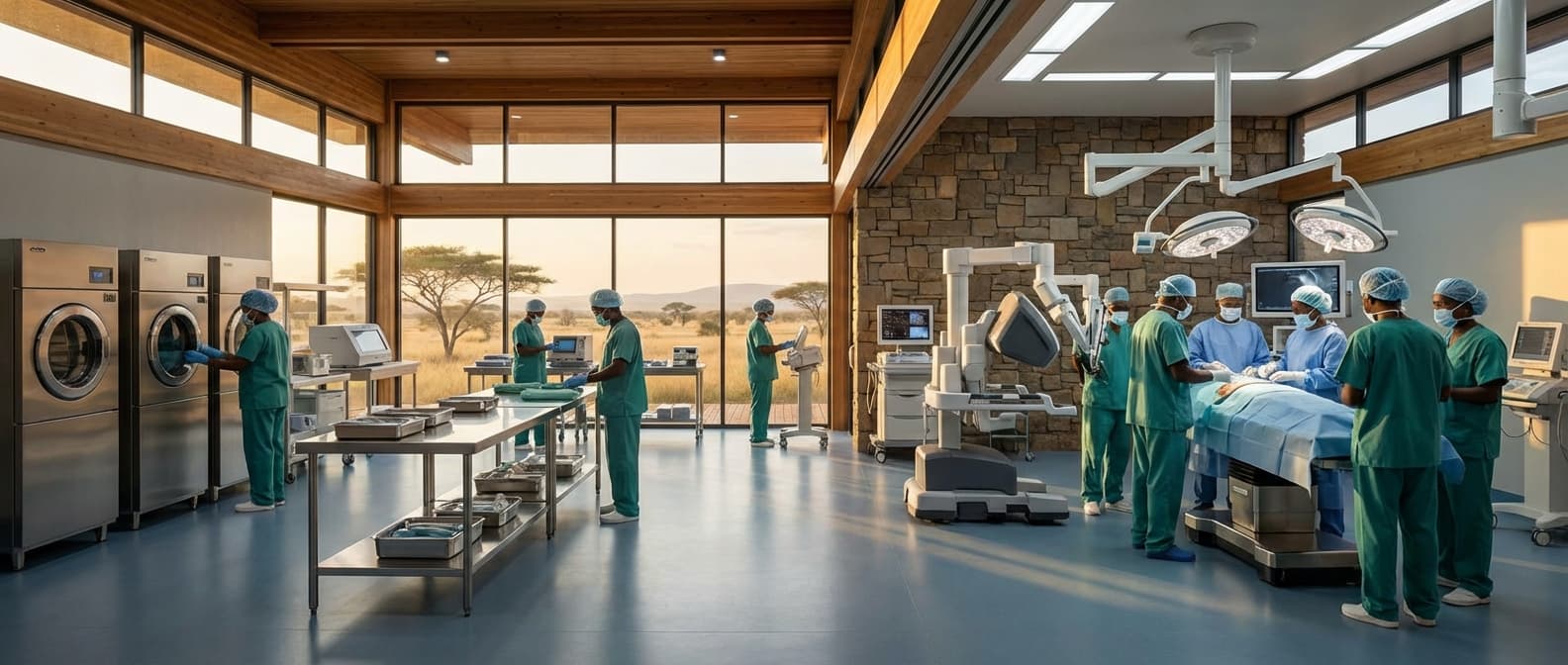
CSSD Design & Validation in Mali
Engineering Excellence & Technical Support
CSSD workflow design, validation and process development High-standard technical execution following OEM protocols and local regulatory frameworks.
Optimized Sterilization Cycle Validation
Implemented advanced validation protocols for sterilization cycles (e.g., autoclaves, ETO) in CSSD facilities across Mali, ensuring adherence to international standards and demonstrating efficacy against critical pathogens. This involved meticulous calibration of equipment, rigorous load testing, and comprehensive documentation of cycle parameters.
Streamlined CSSD Workflow Design
Developed and validated efficient workflow designs for Central Sterile Supply Departments (CSSD) in Mali, focusing on material flow, personnel movement, and infection control. This included designing segregated areas for decontamination, preparation, sterilization, and sterile storage, minimizing cross-contamination risks and improving operational throughput.
Ensuring Regulatory Compliance and Traceability
Established and validated robust quality management systems within Malian CSSDs to ensure compliance with national and international regulatory requirements for sterile medical devices. This encompassed implementing comprehensive tracking and traceability systems for instruments and supplies throughout the sterilization process, guaranteeing patient safety.
What Is Cssd Design & Validation In Mali?
CSSD (Central Sterile Supply Department) design and validation in Mali, as in any healthcare setting, is a critical and multifaceted service aimed at ensuring the safety, efficacy, and compliance of sterile processing operations. It encompasses the systematic planning, architectural design, equipment selection, workflow optimization, and subsequent verification and ongoing monitoring of a CSSD to meet international standards and local healthcare regulations. The core objective is to establish and maintain an environment and processes that guarantee the sterilization and safe delivery of medical devices, thereby preventing healthcare-associated infections (HAIs).
| Stakeholder/Entity | Need for CSSD Design & Validation | Typical Use Cases |
|---|---|---|
| Hospitals & Healthcare Facilities (Public & Private) | To establish or upgrade sterile processing capabilities, ensure patient safety, reduce HAIs, maintain accreditation, and comply with healthcare standards. | Construction of new CSSD facilities, renovation of existing CSSD areas, procurement of new sterilization equipment, implementation of new sterilization modalities, preparation for accreditation audits, response to recurring infection outbreaks. |
| Medical Device Manufacturers & Suppliers | To understand the requirements for their equipment to function effectively within a validated CSSD environment, and to ensure their devices can be safely reprocessed. | Providing equipment for new CSSD installations, offering validation services for their specific equipment, advising on device reprocessing compatibility with various sterilization methods. |
| Government Health Ministries & Regulatory Bodies | To set and enforce standards for sterile processing, ensure public health is protected, and oversee the quality of healthcare services provided within the country. | Developing national guidelines for CSSD operations, conducting inspections and audits of healthcare facilities, licensing and accreditation of medical facilities. |
| Consulting Firms & Engineering Companies (Specializing in Healthcare) | To provide expertise in the design, planning, and validation of CSSD facilities and processes for healthcare clients. | Undertaking feasibility studies, developing conceptual and detailed designs, managing CSSD construction projects, executing validation protocols, providing training and QMS development. |
| International Health Organizations & NGOs | To support the development and improvement of healthcare infrastructure, including sterile processing capabilities, in regions with limited resources. | Funding and supporting the construction or refurbishment of CSSDs in public hospitals, providing technical assistance and training, implementing infection prevention and control programs. |
Key Components of CSSD Design & Validation
- Needs Assessment: Evaluating current and future sterilization needs based on hospital size, patient demographics, surgical specialties, and anticipated growth.
- Architectural Design: Developing floor plans that adhere to the unidirectional flow principle (dirty to clean to sterile), incorporating appropriate space allocation for receiving, cleaning, disinfection, packaging, sterilization, storage, and distribution.
- Equipment Specification & Selection: Identifying and specifying appropriate sterilization technologies (e.g., steam, ethylene oxide, low-temperature plasma), washer-disinfectors, drying cabinets, sealing machines, and ancillary equipment based on throughput, device compatibility, and budget.
- Workflow & Process Engineering: Designing efficient and ergonomic workflows to minimize contamination risks, optimize staff movement, and enhance productivity.
- HVAC & Environmental Controls: Specifying appropriate ventilation, air changes per hour (ACH), humidity control, and temperature regulation for different zones within the CSSD to maintain sterile environments and prevent microbial growth.
- Material Selection & Finishes: Choosing durable, non-porous, and easily cleanable materials for walls, floors, and work surfaces to facilitate effective decontamination and infection control.
- Validation Protocols Development: Creating comprehensive protocols for Installation Qualification (IQ), Operational Qualification (OQ), and Performance Qualification (PQ) of all equipment and processes.
- Installation Qualification (IQ): Verifying that equipment is installed according to manufacturer specifications and relevant standards.
- Operational Qualification (OQ): Testing equipment at its operational limits to ensure it functions as intended under various conditions.
- Performance Qualification (PQ): Demonstrating through documented evidence that the sterilization process consistently achieves the required lethality for a range of challenging loads and under routine operating conditions.
- Validation Execution & Reporting: Conducting the validation studies and documenting all results, deviations, and corrective actions in detailed validation reports.
- Training Programs: Developing and implementing training for CSSD staff on proper procedures, equipment operation, and infection control practices.
- Quality Management System (QMS) Integration: Ensuring the CSSD's processes are integrated into the hospital's overarching QMS, including standard operating procedures (SOPs), record-keeping, and continuous improvement initiatives.
- Regulatory Compliance: Ensuring adherence to relevant international standards (e.g., ISO 13485, ISO 17665, AAMI ST series) and any specific Malian healthcare regulations.
Who Needs Cssd Design & Validation In Mali?
Central Sterile Supply Departments (CSSDs) are critical for infection control and patient safety. In Mali, like in many developing nations, robust CSSD design and validation are essential to ensure that sterilization processes are effective and that healthcare-associated infections are minimized. This requires specialized expertise to address local challenges such as resource limitations, infrastructure constraints, and the need for sustainable, user-friendly solutions. Investing in proper CSSD design and validation directly impacts the quality of healthcare services and improves patient outcomes by preventing the transmission of pathogens through inadequately sterilized medical equipment.
| Target Customer/Department | Specific Needs/Rationale for CSSD Design & Validation | Key Personnel Involved | |
|---|---|---|---|
| Public Hospitals | High patient volume, diverse range of procedures, need for cost-effective and reliable sterilization systems, adherence to national infection control guidelines, staff training on new equipment and processes. | Hospital Administrators, Infection Control Nurses, CSSD Technicians, Biomedical Engineers, Surgeons. | |
| Private Hospitals | Emphasis on patient safety and international accreditation standards, investment in advanced sterilization technologies, need for efficient workflow design to optimize turnaround times, training for specialized staff. | Hospital Owners/Management, Chief Medical Officers, Infection Control Specialists, CSSD Managers, Procurement Officers. | |
| Specialized Clinics (Surgical, Dental, etc.) | Specific sterilization requirements for instruments, need for dedicated smaller-scale CSSD solutions, compliance with specialized regulatory standards, efficient space utilization. | Clinic Directors, Lead Clinicians (Surgeons, Dentists), CSSD Supervisors, Nurses. | |
| NGO Healthcare Facilities | Operating in resource-limited settings, need for robust, low-maintenance, and adaptable CSSD designs, training for local staff with varying technical backgrounds, ensuring sterility for essential medical services. | NGO Project Managers, Facility Managers, Healthcare Staff, Local Community Health Workers. | Country Representatives (NGOs), Medical Coordinators. |
| Research and Training Institutions | Need for compliant sterilization of instruments used in research and training, ensuring consistency in sterilization for reproducible results, training future healthcare professionals in sterile techniques. | Deans/Directors of Institutions, Heads of Departments, Laboratory Managers, Clinical Educators, CSSD Staff. | Research Coordinators. |
| Government Health Ministries/Agencies | Developing and enforcing national infection control policies and standards, overseeing public health infrastructure, planning and funding for healthcare facility upgrades including CSSDs, establishing training programs. | Minister of Health, Directors of Public Health, National Infection Control Program Managers, Technical Advisors, Procurement and Logistics Officers. |
Target Customers and Departments in Mali Requiring CSSD Design & Validation
- Hospitals (Public and Private)
- Specialized Clinics (e.g., Surgical Centers, Dental Clinics, Eye Clinics)
- Non-Governmental Organization (NGO) Healthcare Facilities
- Research and Training Institutions with Clinical Components
- Government Health Ministries and Agencies
Cssd Design & Validation Process In Mali
The design and validation process for a Central Sterile Supply Department (CSSD) in Mali follows a structured workflow, ensuring that the facility meets international standards for sterilization and infection control. This process begins with an initial inquiry and culminates in the operational validation of the CSSD.
| Phase | Description | Key Activities | Deliverables | Typical Duration |
|---|---|---|---|---|
| Inquiry & Needs Assessment | Initial contact to understand the client's requirements, existing infrastructure, and scope of the CSSD project. | Site visits, stakeholder interviews, definition of service volume, types of sterilization required, budget discussion. | Needs assessment report, preliminary scope definition, budget estimate. | 1-2 weeks |
| Feasibility Study & Conceptual Design | Evaluating the viability of the project and developing a high-level concept for the CSSD layout and workflow. | Analysis of technical, financial, and operational feasibility. Development of initial layout sketches, equipment list, and workflow diagrams. | Feasibility study report, conceptual design document, preliminary budget breakdown. | 2-4 weeks |
| Detailed Design & Planning | Developing comprehensive architectural, mechanical, electrical, and plumbing (MEP) designs, along with detailed equipment specifications. | Creation of detailed blueprints, specifications for all equipment (autoclaves, washer-disinfectors, packaging machines, etc.), material selection, safety features, ventilation requirements, waste management plan, validation protocols. | Complete design package (drawings, specifications, BOQ), detailed project schedule, risk assessment. | 4-8 weeks |
| Procurement of Equipment & Materials | Sourcing and acquiring all necessary equipment, consumables, and construction materials. | Tendering process, supplier selection, order placement, quality control checks of procured items. | Procurement contracts, delivery schedules, proof of quality. | 8-16 weeks (can be concurrent with construction) |
| Construction & Installation | Building and fitting out the CSSD space according to the detailed design, and installing all equipment. | Civil works, MEP installations, flooring, wall finishes, lighting, ventilation system installation, equipment placement and connection. | Completed CSSD facility, installed equipment. | 12-24 weeks |
| Commissioning & Qualification (IQ/OQ/PQ) | Systematic verification that the installed equipment and systems function as intended and meet specified requirements. | Installation Qualification (IQ): Verifying correct installation. Operational Qualification (OQ): Verifying equipment operates within defined parameters. Performance Qualification (PQ): Verifying the system performs reliably under normal operating conditions and produces sterile products. | IQ, OQ, and PQ reports, validation certificates, standard operating procedures (SOPs). | 4-6 weeks |
| Training & Handover | Training CSSD staff on the operation, maintenance, and quality control procedures, followed by formal handover of the facility. | On-site and theoretical training sessions, practical demonstrations, development of training materials, operational manual, final inspection and sign-off. | Trained personnel, comprehensive operational manual, signed handover certificate. | 2-3 weeks |
| Ongoing Monitoring & Validation | Ensuring the continued optimal performance and compliance of the CSSD through regular checks and re-validation. | Routine performance monitoring, preventative maintenance, calibration of equipment, periodic re-validation (e.g., annual or bi-annual), internal and external audits. | Maintenance logs, calibration records, re-validation reports, audit findings and corrective actions. | Continuous |
CSSD Design & Validation Workflow in Mali
- Inquiry & Needs Assessment
- Feasibility Study & Conceptual Design
- Detailed Design & Planning
- Procurement of Equipment & Materials
- Construction & Installation
- Commissioning & Qualification (IQ/OQ/PQ)
- Training & Handover
- Ongoing Monitoring & Validation
Cssd Design & Validation Cost In Mali
Designing and validating a Central Sterile Supply Department (CSSD) in Mali involves a complex interplay of factors influencing cost. These include the scale and complexity of the CSSD, the specific equipment chosen, the level of automation, the required certifications and compliance standards, and the local availability of skilled labor and materials. The pricing is typically discussed in West African CFA Franc (XOF).
| Cost Component | Estimated Range (XOF) |
|---|---|
| Preliminary Design & Feasibility Study | 500,000 - 2,000,000 |
| Detailed Design & Engineering (per m²) | 10,000 - 30,000 |
| Basic Sterilization Equipment (per unit) | 5,000,000 - 20,000,000 |
| Automated Sterilization Equipment (per unit) | 20,000,000 - 70,000,000+ |
| Washer-Disinfectors (per unit) | 3,000,000 - 15,000,000 |
| Infrastructure & Construction Modifications (per m²) | 50,000 - 150,000 |
| Initial Validation & Testing (IQ/OQ/PQ per equipment type) | 1,000,000 - 5,000,000 |
| Project Management & Consultancy Fees | 5% - 15% of total project cost |
| Total Project Cost (Small to Medium CSSD) | 50,000,000 - 200,000,000+ |
| Total Project Cost (Large/Advanced CSSD) | 200,000,000 - 1,000,000,000+ |
Key Pricing Factors for CSSD Design & Validation in Mali
- Scale and Scope of the CSSD: The size of the facility, the number of surgical suites it serves, and the volume of instruments to be processed directly impact design complexity and material requirements.
- Equipment Selection & Quality: High-end, automated, and specialized sterilization equipment (e.g., steam sterilizers, low-temperature sterilizers, washer-disinfectors, ultrasonic cleaners) will significantly increase costs compared to basic manual systems.
- Level of Automation: Fully automated systems with integrated tracking and workflow management are more expensive upfront but can offer long-term operational efficiencies.
- Design & Engineering Services: The fees for architects, engineers, and CSSD consultants who specialize in healthcare facility design.
- Infrastructure Requirements: Costs associated with necessary utilities (water, electricity, steam, ventilation), structural modifications, and specialized finishes (e.g., seamless flooring, antimicrobial surfaces).
- Validation & Testing Services: Expenses for qualified personnel to perform initial qualification (IQ), operational qualification (OQ), and performance qualification (PQ) of the equipment and processes, ensuring compliance with international standards.
- Regulatory Compliance: Meeting Malian healthcare regulations and potentially international standards (e.g., ISO, AAMI) can necessitate specific design features and validation protocols, adding to the cost.
- Local Labor & Material Costs: While potentially lower than in Western countries, the availability and cost of skilled construction labor, specialized trades, and imported materials for the CSSD are crucial determinants.
- Project Management: The cost of overseeing the entire design and validation process, ensuring it stays on schedule and within budget.
- Contingency: A percentage allocated for unforeseen expenses during the project lifecycle.
Affordable Cssd Design & Validation Options
Designing and validating a Central Sterile Supply Department (CSSD) is a critical investment in patient safety and operational efficiency. While comprehensive, state-of-the-art facilities can be expensive, numerous affordable design and validation options exist. These strategies focus on maximizing functionality, minimizing waste, and leveraging cost-effective technologies and processes. Value bundles offer integrated services at a predictable cost, while strategic planning can significantly reduce upfront and ongoing expenses.
| Value Bundle Component | Description | Cost-Saving Benefit |
|---|---|---|
| Pre-Designed Layout Templates | Pre-developed, adaptable CSSD layouts based on best practices and common facility sizes. | Reduces architectural and design consultation fees. Faster project initiation. |
| Integrated Equipment Packages | Bundled procurement of essential CSSD equipment (decontamination, sterilization, sterile storage) from preferred vendors. | Volume discounts, streamlined purchasing, and predictable equipment costs. |
| Phased Validation Services | Validation activities segmented into logical stages (e.g., IQ, OQ, PQ) aligned with construction and commissioning timelines. | Spreads validation costs over time, allows for easier troubleshooting, and reduces the risk of expensive re-validation. |
| Workflow Analysis & Optimization Consulting | Expert assessment of existing or planned workflows to identify inefficiencies and recommend improvements. | Minimizes space requirements, reduces processing times, and lowers labor costs. |
| Standardized Operating Procedure (SOP) Development Support | Assistance in creating comprehensive and compliant SOPs for all CSSD processes. | Ensures consistent practice, reduces errors, and simplifies training, leading to fewer reprocessing incidents. |
| Staff Training Modules (On-site/Remote) | Bundled training programs covering equipment operation, infection control principles, and validation requirements. | Reduces the need for external trainers and minimizes downtime during staff onboarding or upskilling. |
| Compliance & Regulatory Review Packages | Services focused on ensuring adherence to relevant standards and regulations during design and validation. | Avoids costly fines or facility shutdowns due to non-compliance. Streamlines the approval process. |
Key Cost-Saving Strategies & Value Bundle Components
- {"title":"Modular & Scalable Design","description":"Employing modular design principles allows for phased implementation and future expansion without major structural overhauls. This reduces initial capital outlay and accommodates growing needs incrementally."}
- {"title":"Optimized Workflow & Space Utilization","description":"Streamlined workflows minimize movement, reduce the risk of cross-contamination, and require less physical space. Efficient layout planning is paramount. This includes proper zoning for dirty, clean, and sterile areas."}
- Energy-Efficient Equipment & Lighting
- Sustainable Material Selection
- Phased Validation & Commissioning
- Leveraging Existing Infrastructure (where feasible)
- Training & Competency Programs
- Outsourced or Hybrid Validation Services
Verified Providers In Mali
Finding reliable and qualified healthcare providers is paramount in Mali. Franance Health stands out as a trusted platform for verifying medical professionals, offering a robust system that ensures patients receive high-quality care. Their credential verification process is thorough, examining qualifications, licenses, and professional experience, giving patients the confidence they need to make informed decisions about their health.
| Provider Attribute | Franance Health Verification | Benefit to Patients |
|---|---|---|
| Medical Licenses | Confirmed and Validated | Ensures legal and recognized practice |
| Specialty Certifications | Verified against recognized bodies | Confirms specific expertise |
| Educational Background | Documented and cross-referenced | Validates academic qualifications |
| Professional History | Checked for relevant experience | Assesses practical application of skills |
| Reputation and Ethics | Considered through professional references | Promotes responsible healthcare delivery |
Why Franance Health Credentials Matter:
- Rigorous Verification Process: Franance Health employs a multi-faceted approach to confirm the authenticity of a provider's qualifications.
- Licensed and Certified Professionals: Only providers who meet stringent licensing and certification requirements are listed.
- Verified Experience: The platform assesses and confirms the practical experience of healthcare professionals.
- Patient Safety Focus: The primary goal is to ensure patient safety by connecting them with competent and trustworthy practitioners.
- Transparency and Trust: Franance Health promotes transparency in the healthcare sector, building trust between patients and providers.
Scope Of Work For Cssd Design & Validation
This document outlines the Scope of Work (SOW) for the Design and Validation of a Central Sterile Supply Department (CSSD). It details the technical deliverables required and the standard specifications that will govern the design and operational processes. The aim is to ensure a fully functional, compliant, and efficient CSSD that meets all relevant international and local standards for infection prevention and control.
| Deliverable Title | Description | Standard Specification Reference |
|---|---|---|
| CSSD Layout and Workflow Design | Detailed architectural drawings of the CSSD layout, including functional zones (decontamination, preparation, packaging, sterilization, storage), workflow paths, and material flow to optimize efficiency and minimize cross-contamination. | ISO 13485, ISO 17665, AAMI ST79, HTM 01-01, Local Health Authority Guidelines |
| Equipment Specification and Selection Report | Detailed technical specifications for all CSSD equipment (e.g., washer-disinfectors, sterilizers, ultrasonic cleaners, drying cabinets, packaging machines, monitoring systems). Includes performance criteria, capacity, and utility requirements. | Manufacturer Specifications, CE Marking, FDA Approval (if applicable), EN/IEC Standards for specific equipment |
| HVAC Design Report | Specifications for the Heating, Ventilation, and Air Conditioning (HVAC) system, focusing on maintaining appropriate air pressure differentials between zones, air changes per hour, temperature, and humidity to prevent contamination and ensure staff comfort. | ASHRAE Standards, ISO 14644 (Cleanroom Standards), Local Building Codes |
| Water Quality Report and Treatment System Design | Requirements for purified water quality for cleaning and sterilization processes, including the design of the water treatment system (e.g., reverse osmosis, deionization) to meet specific purity standards. | ISO 13485, ISO 17665, AAMI ST55, USP Purified Water Standards |
| Lighting and Electrical Design | Specifications for adequate lighting levels throughout the CSSD to facilitate proper cleaning and inspection. Includes electrical load calculations and safety features. | Local Electrical Codes, IES Lighting Standards |
| Materials and Finishes Specification | Selection of appropriate materials for floors, walls, ceilings, and work surfaces that are non-porous, easy to clean and disinfect, and resistant to cleaning agents and sterilizing agents. | ASTM Standards, Healthcare Facility Design Guidelines |
| Commissioning Plan and Reports | Detailed plan for testing and verifying the correct installation and functioning of all CSSD equipment and systems. Includes pre-functional checks, functional performance tests, and integrated systems testing. | Manufacturer's Installation and Commissioning Manuals, IQ/OQ/PQ Protocols |
| Validation Master Plan (VMP) | A comprehensive plan outlining the overall validation strategy for the CSSD, including protocols for Installation Qualification (IQ), Operational Qualification (OQ), and Performance Qualification (PQ). | GHTF/IMDRF Guidelines, FDA Guidance on Process Validation |
| Installation Qualification (IQ) Protocols and Reports | Protocols to verify that all equipment and systems are installed correctly according to design specifications and manufacturer requirements. Reports documenting the successful completion of IQ. | ISO 13485, AAMI ST79, Manufacturer's Installation Manuals |
| Operational Qualification (OQ) Protocols and Reports | Protocols to verify that the installed equipment and systems operate correctly and consistently within their defined operating ranges under normal and worst-case conditions. Reports documenting the successful completion of OQ. | ISO 13485, ISO 17665, AAMI ST79, Manufacturer's Operating Manuals |
| Performance Qualification (PQ) Protocols and Reports | Protocols to demonstrate that the CSSD processes, equipment, and systems consistently perform as intended under actual operating conditions, using representative loads and cycles. Reports documenting the successful completion of PQ. | ISO 13485, ISO 17665, AAMI ST79, Risk Assessment Reports |
| Cleaning and Disinfection Validation Reports | Documentation proving the efficacy of cleaning and disinfection processes for surgical instruments and other medical devices, ensuring the removal of organic matter and reduction of microbial load. | AAMI ST58, EN ISO 15883 Series, Manufacturer's Recommendations |
| Sterilization Cycle Validation Reports | Documentation verifying the efficacy of sterilization processes (e.g., steam, low-temperature) to achieve the required sterility assurance level (SAL) for all processed items. | ISO 17665 (Steam), ISO 11135 (EO), ISO 11137 (Radiation), AAMI ST46 (Steam), AAMI ST52 (EO) |
| Staff Training and Competency Assessment Program | A documented program for training CSSD personnel on all aspects of CSSD operations, including safe handling of instruments, decontamination, cleaning, packaging, sterilization, and quality control. Includes competency assessments. | Organizational HR Policies, Infection Control Guidelines, Manufacturer's Training Materials |
| Standard Operating Procedures (SOPs) Manual | A comprehensive manual detailing all routine operational procedures within the CSSD, ensuring consistency, safety, and compliance. Includes SOPs for receiving, decontamination, cleaning, inspection, packaging, sterilization, storage, and distribution. | ISO 13485, AAMI ST79, HTM 01-01, Organizational Policies |
Key Phases of CSSD Design & Validation
- Phase 1: Conceptualization and Feasibility Study
- Phase 2: Detailed Design and Engineering
- Phase 3: Procurement and Construction/Renovation
- Phase 4: Equipment Installation and Commissioning
- Phase 5: Validation and Qualification
- Phase 6: Training and Handover
- Phase 7: Ongoing Monitoring and Performance Review
Service Level Agreement For Cssd Design & Validation
This Service Level Agreement (SLA) outlines the performance expectations and guarantees for the CSSD (Central Sterile Supply Department) Design & Validation services. It defines response times for critical issues and guarantees a specified level of service availability.
| Service Component | Response Time (Business Hours) | Uptime Guarantee (N/A for design, applies to support/availability of personnel) |
|---|---|---|
| Critical Design/Validation Issue (e.g., major workflow blockage, critical equipment failure impacting validation schedule) | 2 Business Hours | N/A |
| Major Design/Validation Issue (e.g., significant design flaw requiring rework, delay in validation execution) | 4 Business Hours | N/A |
| Minor Design/Validation Issue (e.g., clarification on documentation, minor design adjustment) | 8 Business Hours | N/A |
| Availability of Designated Validation Lead/Project Manager | During Business Hours | 99.5% |
| Availability of Technical Support for Design Software/Tools | 8 Business Hours | 99.0% |
Scope of Service
- CSSD facility layout and workflow design
- Equipment selection and integration planning
- Validation protocols development (IQ/OQ/PQ)
- Validation execution and documentation
- Troubleshooting and support during design and validation phases
Frequently Asked Questions

Ready when you are
Let's scope your CSSD Design & Validation in Mali project in Mali.

Scaling healthcare logistics and technical systems across the entire continent.