
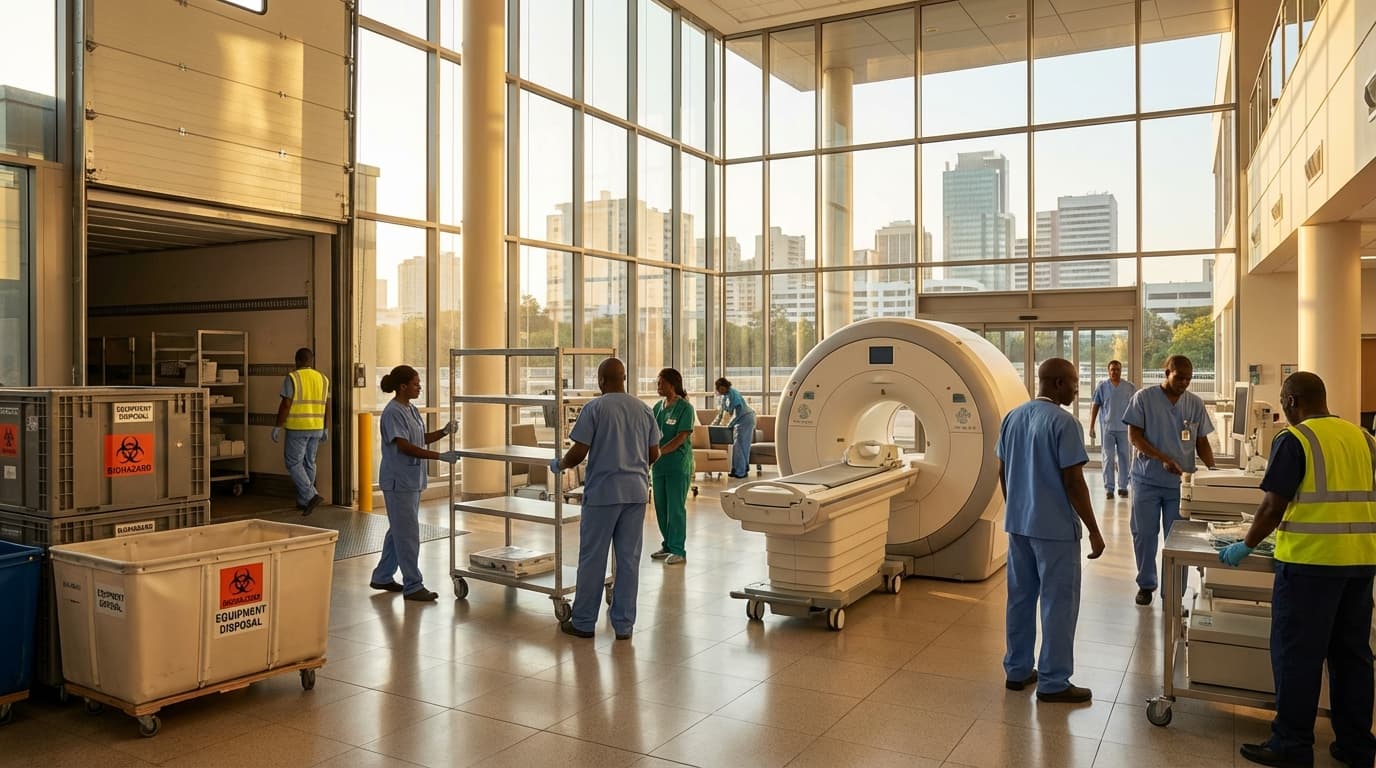
Heavy Medical Equipment De-Installation Service (MRI/CT/Cath Lab) in Malawi
Engineering Excellence & Technical Support
Heavy Medical Equipment De-Installation Service (MRI/CT/Cath Lab) High-standard technical execution following OEM protocols and local regulatory frameworks.
Specialized De-Installation Expertise
Our certified technicians possess deep expertise in safely and meticulously de-installing complex medical imaging equipment like MRI, CT, and Cath Labs. We adhere to international standards and manufacturer guidelines, ensuring the integrity of the equipment and site during the process.
Secure Transportation & Logistics for Malawi
We manage the entire logistical chain, from careful disconnection and packing to secure transport across Malawi. Our team is experienced with the unique challenges of local infrastructure, ensuring your valuable medical assets reach their destination safely and on schedule.
Regulatory Compliance & Site Restoration
We prioritize compliance with all relevant health and safety regulations in Malawi. Post de-installation, our services include responsible site remediation and restoration, leaving your facility in excellent condition and ready for its next phase.
What Is Heavy Medical Equipment De-installation Service (Mri/ct/cath Lab) In Malawi?
Heavy medical equipment de-installation service in Malawi refers to the professional process of safely and systematically dismantling, packaging, and preparing large-format diagnostic imaging and interventional systems, such as Magnetic Resonance Imaging (MRI) scanners, Computed Tomography (CT) scanners, and Cardiac Catheterization (Cath Lab) suites, for relocation, disposal, or storage. This specialized service is crucial due to the complex nature, significant weight, precise calibration, and potential environmental hazards associated with these advanced medical technologies. It necessitates trained technicians, specialized tools, and adherence to strict safety protocols to prevent damage to the equipment, infrastructure, and personnel.
| Service Recipient (Who Needs It) | Typical Use Cases | |||||
|---|---|---|---|---|---|---|
| Hospitals and Healthcare Facilities in Malawi | Equipment upgrades or replacements | Facility renovations or expansions | Temporary closure of a department or facility | Relocation of a hospital or clinic | Transfer of equipment between healthcare institutions | Disposal or sale of retired medical equipment |
| Medical Equipment Manufacturers and Distributors | Facilitating the decommissioning of older models to make way for new installations | Managing the logistics of equipment returns or repossessions | Providing end-of-life de-installation services as part of a lifecycle management program | |||
| Government Health Ministries and Agencies | Managing national medical equipment inventories and asset lifecycle | Coordinating the decommissioning of public healthcare facilities |
Key Components of Heavy Medical Equipment De-Installation Service:
- Site Assessment and Planning: Comprehensive evaluation of the existing installation, including structural integrity, access routes, power requirements, cooling systems, and potential obstacles.
- Systematic Disassembly: Expert dismantling of equipment components, often requiring specialized lifting equipment, controlled disconnections of electrical, hydraulic, and pneumatic lines.
- Component Labeling and Inventory: Meticulous labeling of all removed parts for accurate reassembly and detailed inventory management.
- Environmental Containment: Management and safe removal of refrigerants (e.g., helium from MRI), oils, or other hazardous substances as per regulatory guidelines.
- Packaging and Protection: Robust packaging of sensitive components using anti-static materials, custom crating, and shock-absorbing materials to ensure protection during transit.
- Transportation Logistics: Coordination of specialized transportation, including heavy-haul trucking and crane services if necessary, to move the de-installed equipment.
- Documentation: Provision of detailed documentation of the de-installation process, including condition reports, inventory lists, and compliance records.
- Site Restoration (Optional): Reinstatement of the installation site to its original condition or preparation for new equipment installation.
Who Needs Heavy Medical Equipment De-installation Service (Mri/ct/cath Lab) In Malawi?
Heavy medical equipment de-installation, particularly for complex imaging and interventional suites like MRI, CT scanners, and Cath Labs, is a specialized and critical service. This process requires meticulous planning, skilled technicians, specialized tools, and adherence to stringent safety and regulatory standards. The need for such a service in Malawi arises from various scenarios, including equipment upgrades, facility renovations, relocation of medical institutions, or the decommissioning of outdated technology. Ensuring the safe and efficient removal of these sensitive and high-value assets is paramount to minimize downtime, prevent damage, and prepare for the installation of new equipment or repurposing of space.
| Target Customer Group | Relevant Departments / Areas |
|---|---|
| Public Hospitals & Tertiary Referral Centers | Radiology Department (MRI Suite, CT Scan Room), Cardiology Department (Cath Lab), Radiology Special Procedures, Engineering/Facilities Management |
| Private Hospitals & Diagnostic Centers | Radiology/Imaging Department, Cardiology Department, Biomedical Engineering, Operations Management |
| Specialized Medical Clinics (e.g., Cardiac) | Interventional Suite, Imaging Department, Clinic Administration |
| Government Health Ministries | Procurement & Logistics Department, Hospital Infrastructure Division, Planning Department |
| International Health Organizations & NGOs | Project Management Team, Procurement Officers, Technical Support Units |
| Medical Equipment Suppliers & Service Providers | Decommissioning & Relocation Teams, Technical Services, Sales & Project Management |
Who Needs Heavy Medical Equipment De-Installation Service (MRI/CT/Cath Lab) in Malawi?
- Hospitals and large healthcare facilities undergoing upgrades or renovations.
- Medical imaging centers and diagnostic clinics.
- Specialized cardiac and interventional centers.
- Government health ministries and public health institutions managing medical infrastructure.
- Private medical providers expanding or relocating services.
- International aid organizations involved in equipping or upgrading healthcare facilities.
- Companies specializing in medical equipment refurbishment and resale.
- Research institutions requiring the movement or decommissioning of advanced medical equipment.
Heavy Medical Equipment De-installation Service (Mri/ct/cath Lab) Process In Malawi
This document outlines the detailed workflow for the Heavy Medical Equipment De-Installation Service (MRI/CT/Cath Lab) in Malawi, covering the entire process from initial inquiry to successful execution. The service ensures the safe, efficient, and compliant removal of complex, high-value medical imaging and diagnostic equipment.
| Stage | Key Activities | Responsible Parties | Deliverables/Outcomes | Notes/Considerations (Malawi Specific) |
|---|---|---|---|---|
| Inquiry and Initial Consultation | Client contacts service provider with de-installation needs. Discussion of equipment type, location, urgency, and desired outcomes (e.g., relocation, disposal, sale). | Client, Service Provider | Understanding of project scope, preliminary information gathering. | Initial contact might be via phone, email, or through a hospital procurement department. Clarity on equipment make, model, and serial numbers is crucial. |
| Site Assessment and Planning | On-site visit by service provider's technical team. Detailed survey of the equipment room, access routes, structural integrity, power requirements, cooling systems, and surrounding infrastructure. Risk assessment. | Service Provider (Technical Team, Project Manager), Client (Facility Manager, Biomedical Engineer) | Detailed site survey report, proposed de-installation plan, identification of potential challenges, safety protocols. | Access routes might be narrow or have structural limitations. Coordination with hospital maintenance and security is vital. Understanding local customs and practices regarding site access. |
| Quotation and Agreement | Development of a comprehensive quotation based on the site assessment. Includes labor, specialized tools, consumables, transportation, insurance, waste disposal, and any required permits. Formal agreement (contract) is signed. | Service Provider, Client | Detailed quotation, signed contract/service agreement. | Payment terms and schedules need to be clearly defined. Inquire about import/export regulations if equipment is being moved internationally. Clarity on liability and insurance coverage is paramount. |
| Pre-De-Installation Preparations | Scheduling of the de-installation. Procurement of specialized tools and equipment. Disconnection and isolation of power, cooling, and ancillary systems by qualified personnel. Crate and packaging material preparation. Site preparation (e.g., clearing access routes). | Service Provider (Technical Team, Logistics), Client (Biomedical Engineer, Maintenance) | Prepared site, disconnected and secured equipment, ready for dismantling. | Ensuring power is safely shut off and confirmed is critical. Local regulations regarding hazardous waste (if any) need to be considered. Availability of adequate space for temporary storage of components. |
| De-Installation Execution | Systematic dismantling of the equipment by trained technicians. Careful removal of components. Secure packaging and labeling of all parts. Loading onto specialized transport. | Service Provider (De-Installation Team) | Dismantled and safely packaged equipment, ready for transport. | Adherence to manufacturer's guidelines and safety standards. Use of appropriate lifting equipment. Minimizing disruption to ongoing hospital operations. Documentation of the de-installation process (photos/videos). |
| Post-De-Installation and Handover | Final inspection of the de-installation area. Removal of all debris and waste. Provision of a de-installation report to the client. Confirmation of successful completion and handover of documentation. | Service Provider, Client | Cleaned site, de-installation report, signed handover documentation. | Waste disposal must comply with Malawian environmental regulations. Obtaining necessary permits for transport and disposal if applicable. Client verification of all components being accounted for. |
Key Stages in the De-Installation Process:
- Inquiry and Initial Consultation
- Site Assessment and Planning
- Quotation and Agreement
- Pre-De-Installation Preparations
- De-Installation Execution
- Post-De-Installation and Handover
Heavy Medical Equipment De-installation Service (Mri/ct/cath Lab) Cost In Malawi
De-installing heavy medical equipment like MRI, CT scanners, and Cath Labs in Malawi is a specialized service requiring expertise, precision, and adherence to strict safety protocols. The cost is influenced by several factors, leading to a significant range in pricing. This service is crucial for equipment relocation, upgrades, or disposal, and requires trained technicians, specialized tools, and often logistics management for safe transport. Factors like the complexity of the equipment, site accessibility, and the urgency of the service all contribute to the final quotation.
| Equipment Type | Estimated Cost Range (Malawian Kwacha - MWK) | Notes |
|---|---|---|
| MRI Scanner (1.5T - 3T) | MWK 500,000 - MWK 2,500,000+ | Highly dependent on magnet size, field strength, site complexity, and inclusion of related systems (e.g., chillers). Includes specialized magnetic field safety precautions. |
| CT Scanner (e.g., 16-slice, 64-slice) | MWK 350,000 - MWK 1,500,000+ | Cost varies with slice count, manufacturer, and need for radiation shielding dismantling. May include gantry and table disassembly. |
| Cath Lab (Interventional X-ray System) | MWK 400,000 - MWK 1,800,000+ | Includes C-arm, table, generator, and associated imaging/control consoles. Complexity of cabling and mounting affects price. |
| Ancillary Heavy Medical Equipment (e.g., large X-ray units) | MWK 150,000 - MWK 600,000+ | Simpler systems with less complex components. Cost is more predictable. |
Key Pricing Factors for Heavy Medical Equipment De-Installation in Malawi
- Equipment Type and Complexity: MRI and CT scanners, due to their magnetic fields and intricate components, are generally more complex and thus more expensive to de-install than Cath Lab equipment. The number of components, required disassembly, and the need for specialized shielding removal all play a role.
- Site Assessment and Accessibility: The ease of access to the installation site (e.g., ground floor vs. upper floor, narrow corridors, existing structural limitations) significantly impacts labor and equipment needs. Difficult access may require additional lifting equipment or structural modifications, increasing costs.
- Dismantling and Packing Requirements: The extent of disassembly required for safe transport and the type of packing materials needed (e.g., specialized crates, protective wrapping) will affect the labor and material costs.
- Technician Expertise and Team Size: The de-installation requires highly skilled and certified technicians. The size of the team required will depend on the equipment's complexity and the urgency of the job.
- Tools and Equipment: Specialized tools, cranes, forklifts, hydraulic jacks, and transportation vehicles are often necessary. The rental or provision of these specialized resources contributes to the overall cost.
- Logistics and Transportation: While de-installation is the primary service, many providers also offer associated logistics, including internal movement and preparation for external transport. The distance to the next location or storage facility will influence these costs.
- Safety and Regulatory Compliance: Adherence to health and safety regulations, including potential radiation safety protocols for CT scanners, adds to the service cost. This includes ensuring safe handling and disposal of certain components.
- Urgency and Time Constraints: Rush jobs or tight deadlines can incur premium charges due to the need to mobilize resources quickly and potentially work outside standard hours.
- Geographical Location within Malawi: Costs may vary slightly based on the region within Malawi due to travel and logistical considerations for the de-installation team and equipment.
Affordable Heavy Medical Equipment De-installation Service (Mri/ct/cath Lab) Options
Relocating or decommissioning large medical equipment like MRI, CT scanners, and Cath Labs is a complex and costly undertaking. This service focuses on providing affordable and efficient de-installation solutions. We understand the critical need for precision, safety, and minimal disruption. Our services cater to hospitals, imaging centers, and medical equipment dealers looking for cost-effective ways to manage these significant assets. We offer flexible options to fit various budgets and project scopes.
| Value Bundle Option | Included Services | Cost-Saving Strategy | Ideal For |
|---|---|---|---|
| Basic De-installation | Mechanical de-installation of core components (e.g., magnet, gantry), basic rigging, and secure packaging for transit. | Focus on essential steps to reduce labor hours and specialized equipment usage. | Facilities with their own in-house logistics or those partnering with separate transport providers. |
| Standard De-installation & Preparation | Includes Basic De-installation plus electrical disconnection, coolant removal (if applicable), detailed component labeling, and comprehensive photographic documentation. | Bundling essential preparatory steps reduces the need for multiple site visits and associated travel costs. | Most common scenarios requiring a complete and well-documented de-installation for resale or internal transfer. |
| Full-Service De-installation & Site Prep | Includes Standard De-installation & Preparation plus minor site remediation, immediate equipment securing for transit, and coordination with a pre-approved transport partner. | Streamlined process with a single point of contact for de-installation and initial logistics, reducing administrative overhead and potential delays. | Facilities seeking a turnkey solution to minimize their management burden and ensure a smooth transition. |
| Bulk/Portfolio De-installation | Customized packages for multiple equipment de-installations across one or several locations. | Volume discounts, optimized scheduling for technicians, and consolidated travel arrangements lead to significant per-unit cost reductions. | Healthcare networks, large medical equipment dealers, or asset management companies with multiple assets to decommission. |
Key De-Installation Services & Value Propositions
- Expert De-installation: Certified technicians specializing in high-field MRI, CT, and Cath Lab systems.
- Safety Compliance: Strict adherence to all safety regulations and manufacturer guidelines.
- Logistical Coordination: Seamless planning and execution from start to finish.
- Damage Prevention: Utilizing specialized tools and techniques to protect equipment during disassembly.
- Minimal Downtime: Efficient processes designed to reduce operational disruption for your facility.
- Environmentally Responsible Disposal/Relocation: Options for sustainable practices.
- Post-De-installation Support: Documentation and consultation for subsequent steps.
Verified Providers In Malawi
In Malawi's evolving healthcare landscape, identifying truly dependable and qualified medical service providers is paramount for individuals seeking quality care. Franance Health stands out as a premier organization, distinguished by its rigorous credentialing process and unwavering commitment to excellence. This document outlines Franance Health's credentials and elucidates why they represent the best choice for healthcare services in Malawi.
| Criterion | Franance Health's Standard | Benefit to Patients |
|---|---|---|
| Provider Qualifications | Verified medical degrees, licenses, and board certifications from recognized institutions. | Ensures patients receive care from highly trained and legally authorized professionals. |
| Experience & Competence | Thorough review of clinical experience, professional history, and peer references. | Guarantees that providers possess the practical skills and knowledge to effectively manage diverse medical conditions. |
| Adherence to Ethical Standards | Mandatory commitment to a strict code of medical ethics and patient rights. | Protects patients from malpractice and ensures respectful, unbiased treatment. |
| Continuous Quality Improvement | Regular performance reviews and participation in quality assurance programs. | Ensures providers consistently deliver up-to-date and optimal medical care. |
| Specialty Alignment | Matching patients with providers whose expertise directly addresses their specific medical needs. | Leads to more accurate diagnoses and effective treatment plans. |
Franance Health's Key Credentials and Strengths
- Accreditation and Recognition: Franance Health is recognized and accredited by leading national and international healthcare bodies. This signifies adherence to stringent quality standards, patient safety protocols, and ethical practices.
- Rigorous Provider Vetting: Every healthcare professional affiliated with Franance Health undergoes a comprehensive vetting process. This includes verifying medical licenses, certifications, educational qualifications, and professional experience.
- Specialized Expertise: Franance Health partners with a diverse network of specialists across various medical fields. This ensures that patients have access to the most appropriate and skilled practitioners for their specific health needs.
- Commitment to Continuing Professional Development: The organization actively promotes and supports ongoing training and development for its affiliated providers, keeping them abreast of the latest medical advancements and best practices.
- Patient-Centric Approach: Franance Health prioritizes patient well-being and satisfaction. Their providers are dedicated to delivering compassionate, ethical, and high-quality care, fostering trust and long-term health partnerships.
- Technological Integration: Franance Health embraces modern healthcare technologies to enhance service delivery, from digital health records to advanced diagnostic tools, ensuring efficient and effective patient management.
Scope Of Work For Heavy Medical Equipment De-installation Service (Mri/ct/cath Lab)
This Scope of Work (SOW) outlines the requirements for the de-installation of heavy medical equipment, specifically Magnetic Resonance Imaging (MRI) scanners, Computed Tomography (CT) scanners, and Cardiac Catheterization (Cath Lab) systems. This service includes all necessary activities to safely and efficiently disconnect, dismantle, and prepare the equipment for relocation or disposal. The technical deliverables and standard specifications are detailed below to ensure a successful project.
| Equipment Type | Key De-Installation Considerations | Potential Hazards | Required Expertise |
|---|---|---|---|
| MRI Scanner | Magnet quench procedures, helium management, RF shielding, cryogen handling, heavy magnet removal, patient table, console. | Magnetic field hazards, cryogenic burns, electrical shock, heavy object injury, asphyxiation (helium). | MRI technician with cryogenic handling certification, electrical safety, heavy rigging. |
| CT Scanner | Gantry rotation mechanism, X-ray tube cooling system, high-voltage power supply, patient table, console, detector array. | Electrical shock (high voltage), radiation hazards (residual), heavy object injury, mechanical pinch points. | CT technician with high-voltage safety training, radiation safety awareness, electrical safety, heavy rigging. |
| Cath Lab System | X-ray generator, C-arm rotation and movement, patient table, image acquisition systems, contrast media injection system, sterile field considerations. | Electrical shock (high voltage), radiation hazards, heavy object injury, mechanical movement hazards, fluid spills. | Cath lab technician with high-voltage safety training, radiation safety awareness, electrical safety, mechanical system understanding. |
Scope of Work - Heavy Medical Equipment De-Installation Service (MRI/CT/Cath Lab)
- 1. Project Overview: De-installation of specified heavy medical imaging and interventional equipment.
- 2. Equipment Covered: MRI Scanners, CT Scanners, Cath Lab Systems.
- 3. Objective: To safely and efficiently de-install, disconnect, dismantle, and prepare equipment for transport, ensuring no damage to the equipment or the facility.
- 4. Responsibilities:
- 4.1 Service Provider:
* **4.1.1 Planning and Preparation:** Develop a detailed de-installation plan, including a timeline, risk assessment, and required resources.* **4.1.2 Site Survey:** Conduct a thorough pre-de-installation site survey to identify access routes, power requirements, structural considerations, and potential hazards.* **4.1.3 Personnel:** Deploy experienced and qualified technicians with expertise in de-installing the specific types of equipment.* **4.1.4 Tools and Equipment:** Provide all necessary specialized tools, lifting equipment (e.g., cranes, forklifts), rigging, safety gear, and consumables.* **4.1.5 Disconnection:** Safely disconnect all power, data, coolant, and other associated lines according to manufacturer specifications and industry best practices.* **4.1.6 Dismantling:** Carefully dismantle the equipment into manageable sections, adhering to manufacturer guidelines to preserve integrity and facilitate reassembly.* **4.1.7 Packaging and Protection:** Package and protect all dismantled components and sensitive parts to prevent damage during handling and transport.* **4.1.8 Waste Management:** Properly dispose of any waste materials generated during the de-installation process.* **4.1.9 Site Restoration:** Leave the de-installation area clean and free of debris, restoring it to a safe and presentable condition.* **4.1.10 Documentation:** Provide a detailed de-installation report, including photographs, checklists, and confirmation of safe disconnection.- 4.2 Client:
* **4.2.1 Access:** Provide necessary access to the equipment and the de-installation area.* **4.2.2 Information:** Furnish all relevant equipment documentation, including service manuals and site plans.* **4.2.3 Coordination:** Facilitate internal coordination with facility management, IT, and other relevant departments.* **4.2.4 Approvals:** Obtain all necessary internal and external approvals for the de-installation activities.- 5. Deliverables:
- 5.1 De-Installation Plan: A comprehensive plan outlining the methodology, timeline, and safety protocols.
- 5.2 Site Survey Report: A detailed assessment of the site conditions and any potential challenges.
- 5.3 Dismantled Equipment Components: All equipment parts safely dismantled, cataloged, and protected.
- 5.4 Packaged Components: Components appropriately packaged for transport.
- 5.5 De-Installation Report: A final report documenting the completed work, including photographs and sign-offs.
- 6. Standard Specifications:
- 6.1 Safety: All de-installation activities shall be performed in strict adherence to OSHA (or equivalent) safety regulations and the manufacturer's safety guidelines.
- 6.2 Environmental Controls: Maintain appropriate environmental conditions (temperature, humidity) as specified by the manufacturer for sensitive components.
- 6.3 Manufacturer Compliance: All de-installation procedures must comply with the original equipment manufacturer's (OEM) specifications and recommendations.
- 6.4 Quality Assurance: Implement quality checks throughout the process to ensure the integrity and safety of the de-installed equipment.
- 6.5 Documentation Standards: All documentation shall be clear, concise, and in a format agreed upon by both parties.
- 6.6 Personnel Qualifications: Technicians must possess OEM-specific training or demonstrated equivalent experience for the equipment being de-installed.
- 7. Acceptance Criteria:
- Equipment is safely and completely de-installed as per the approved plan.
- All components are accounted for and protected.
- The de-installation area is left clean and safe.
- A comprehensive de-installation report is provided.
- 8. Project Timeline: (To be defined in the detailed de-installation plan following the site survey.)
Service Level Agreement For Heavy Medical Equipment De-installation Service (Mri/ct/cath Lab)
This Service Level Agreement (SLA) outlines the response times and uptime guarantees for the de-installation of heavy medical equipment, specifically MRI, CT, and Cath Lab systems. This agreement is between [Client Name] (hereinafter referred to as 'Client') and [Service Provider Name] (hereinafter referred to as 'Provider').
| Service Type | Response Time (Business Hours) | Uptime Guarantee (During Active De-installation) |
|---|---|---|
| MRI De-installation (Initial Site Assessment & Planning) | 4 Business Hours | N/A (Planning Phase) |
| MRI De-installation (Execution - Magnet Handling) | 2 Business Hours | 98% (Excludes scheduled downtime for equipment cooling/stabilization) |
| MRI De-installation (Execution - General Components) | 4 Business Hours | 99% (Excludes scheduled downtime for equipment cooling/stabilization) |
| CT Scanner De-installation (Initial Site Assessment & Planning) | 4 Business Hours | N/A (Planning Phase) |
| CT Scanner De-installation (Execution) | 3 Business Hours | 99% |
| Cath Lab System De-installation (Initial Site Assessment & Planning) | 4 Business Hours | N/A (Planning Phase) |
| Cath Lab System De-installation (Execution) | 3 Business Hours | 99% |
Scope of Service
- De-installation of MRI machines (including magnet removal and shielding).
- De-installation of CT scanners (including gantry, table, and associated components).
- De-installation of Cath Lab systems (including C-arm, table, consoles, and imaging components).
- Safe and secure dismantling of all associated wiring, plumbing, and structural modifications.
- Packaging and preparation of equipment for transport (as per separate agreement).
- Site cleanup and restoration to a safe, de-energized state.
Frequently Asked Questions

Ready when you are
Let's scope your Heavy Medical Equipment De-Installation Service (MRI/CT/Cath Lab) in Malawi project in Malawi.

Scaling healthcare logistics and technical systems across the entire continent.