
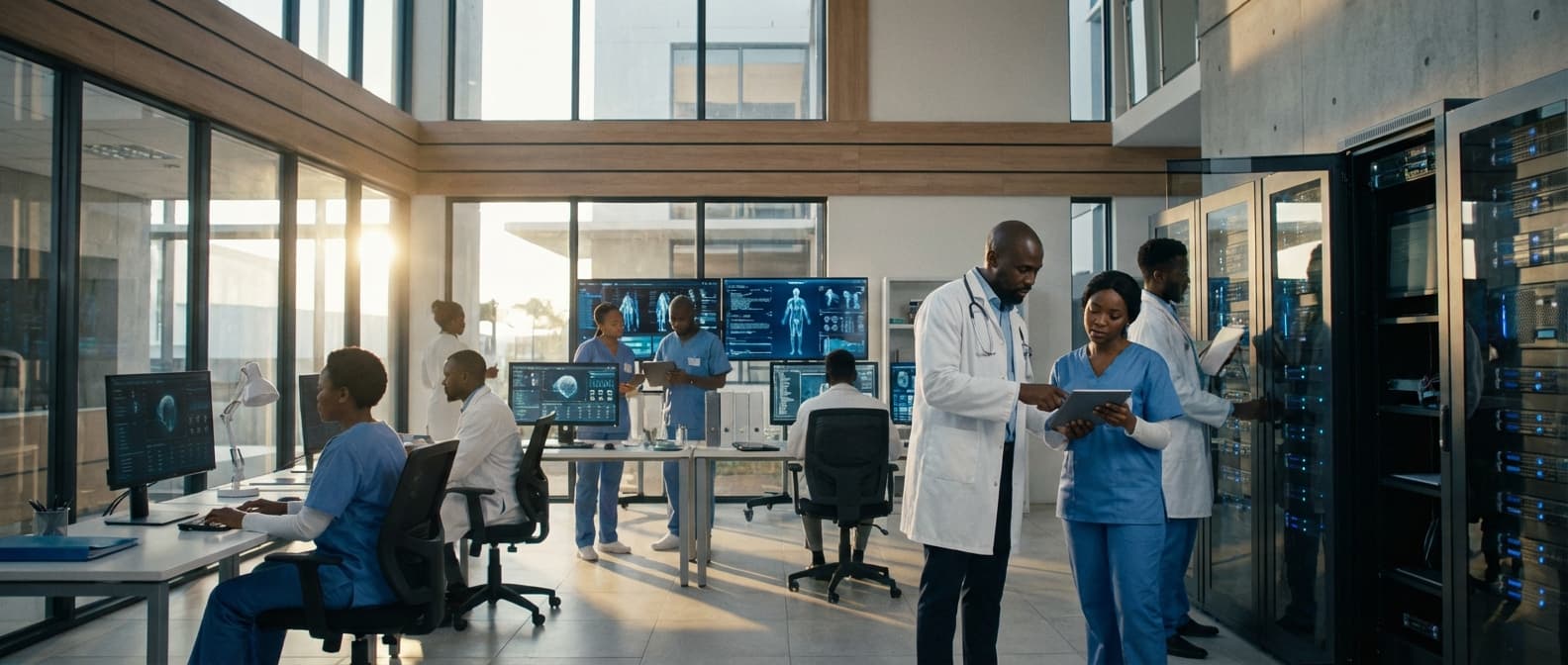
Tele-Radiology in Malawi
Engineering Excellence & Technical Support
24/7 access to certified radiologists providing rapid, accurate remote interpretation of diagnostic imaging studies. High-standard technical execution following OEM protocols and local regulatory frameworks.
Expanding Diagnostic Reach
Leveraging satellite and robust internet infrastructure, Tele-Radiology connects remote Malawian clinics to specialist radiologists, enabling timely and accurate diagnostic interpretations for X-rays, CT scans, and MRIs, regardless of geographical barriers.
Bridging the Specialist Gap
Tele-Radiology addresses Malawi's critical shortage of skilled radiologists by creating a virtual network. Local healthcare providers can upload imaging studies for expert analysis by radiologists located anywhere, improving patient care and reducing diagnostic delays.
AI-Powered Triage & Support
Integrating Artificial Intelligence (AI) algorithms for initial image analysis and abnormality detection. This allows local clinicians to prioritize urgent cases and provides AI-assisted insights to radiologists, enhancing efficiency and diagnostic confidence in resource-limited settings.
What Is Tele-radiology In Malawi?
Tele-radiology in Malawi refers to the practice of transmitting radiological images (such as X-rays, CT scans, and MRIs) from one location to another for the purpose of interpretation and diagnosis by a radiologist. This service leverages telecommunications technology and digital imaging to overcome geographical barriers, enhance access to specialist expertise, and improve the quality and efficiency of diagnostic imaging services within the country. It is a crucial component of digital health initiatives aiming to strengthen healthcare delivery in resource-constrained settings.
| Who Needs Tele-radiology in Malawi? | Typical Use Cases | |||||
|---|---|---|---|---|---|---|
| Rural and Remote Healthcare Facilities: Clinics and hospitals lacking on-site radiologists or advanced imaging equipment. | Primary Diagnosis of Common X-ray Examinations: Screening for tuberculosis, pneumonia, fractures, and other common conditions in peripheral areas. | Secondary and Tertiary Referral Centers: Facilities in urban areas that experience high patient volumes and require additional radiologist support for subspecialty interpretations or to reduce turnaround times. | Emergency Department Triage: Rapid interpretation of trauma imaging (e.g., CT head, chest X-ray) to guide immediate patient management. | Specialty Clinics (e.g., Oncology, Cardiology): Access to expert interpretation of complex imaging modalities like CT angiography, MRI brain, or mammography. | Public Health Initiatives: Supporting national screening programs (e.g., TB screening) by enabling widespread image collection and centralized interpretation. | Educational and Training Purposes: Facilitating remote learning for radiology residents and technologists, and enabling peer review of complex cases. |
Key Aspects of Tele-radiology in Malawi:
- Remote Image Acquisition and Transmission: Digital radiological images are captured at a healthcare facility and transmitted securely over networks to a remote reading center or directly to a radiologist's workstation.
- Remote Interpretation and Reporting: Specialist radiologists, who may be located in urban centers or even internationally, analyze the transmitted images and provide diagnostic reports back to the referring clinician.
- Integration with PACS and RIS: Typically integrated with Picture Archiving and Communication Systems (PACS) for image storage and retrieval, and Radiology Information Systems (RIS) for workflow management.
- Digital Workflow and Data Security: Employs secure data transfer protocols (e.g., DICOM over secure channels like VPNs) to ensure patient confidentiality and data integrity.
- Training and Capacity Building: Often includes components for training local healthcare professionals in image acquisition and basic interpretation, thereby building local capacity.
- Quality Assurance Mechanisms: Incorporates quality control measures to ensure accuracy and consistency in interpretation.
Who Needs Tele-radiology In Malawi?
Tele-radiology offers a powerful solution to address the critical shortage of radiologists and advanced imaging equipment in Malawi. By connecting local healthcare facilities with remote radiology expertise, it can significantly improve diagnostic accuracy, patient outcomes, and access to essential medical imaging services across the nation. This technology is particularly beneficial in resource-limited settings where specialized medical professionals and equipment are scarce.
| Target Customer/Department | Specific Needs Addressed by Tele-Radiology | Potential Benefits |
|---|---|---|
| Rural/Remote Health Centers | Lack of radiologists for X-ray, ultrasound interpretation. Delays in diagnosis and treatment initiation. | Improved access to diagnostic imaging, faster diagnosis, reduced patient travel, better management of acute conditions. |
| District Hospitals | Limited radiologist availability, high workload for existing radiologists, reliance on external referrals for complex cases. | Timely interpretation of routine and complex studies, reduced referral burden, improved diagnostic turnaround time, enhanced clinical decision-making. |
| Referral Hospitals | Need for sub-specialty radiology expertise (e.g., pediatric, neuro, interventional radiology) not available locally. | Access to highly specialized diagnostic opinions, improved management of complex pathologies, opportunity for professional development for local staff. |
| Private Clinics/Diagnostic Centers | Desire to offer a wider range of imaging interpretations, attract more patients, compete with larger facilities. | Expanded service offerings, increased patient volume, enhanced reputation, ability to offer more comprehensive diagnostic services. |
| Emergency Departments | Urgent need for rapid interpretation of critical imaging (e.g., trauma, stroke, suspected appendicitis). | Faster diagnosis and treatment initiation in life-threatening situations, improved patient survival rates, reduced complications. |
| Public Health Programs (e.g., TB, Cancer Screening) | Challenges in screening large populations due to limited radiology infrastructure and personnel. | Scalable and efficient screening programs, early detection of diseases, improved public health outcomes, better disease surveillance. |
Target Customers and Departments for Tele-Radiology in Malawi
- Rural and Remote Health Centers lacking on-site radiologists.
- District Hospitals with basic radiology equipment but limited interpretation capacity.
- Referral Hospitals needing specialized radiological sub-specialty support (e.g., neuro-radiology, pediatric radiology).
- Private Clinics and Diagnostic Centers seeking to expand their imaging services.
- Emergency Departments requiring rapid interpretation of critical imaging studies.
- Public Health Programs focused on disease screening and monitoring (e.g., tuberculosis, cancer).
Tele-radiology Process In Malawi
Tele-radiology in Malawi is a developing field aimed at bridging the gap in expert radiological interpretation, especially in remote or underserved areas. The process typically begins with a referral or inquiry from a healthcare facility lacking on-site radiologists. Images are acquired using standard X-ray, CT, or MRI machines and then transmitted digitally to a tele-radiology hub or a remote radiologist. The remote radiologist reviews the images, provides a diagnostic report, and transmits it back to the referring facility. This workflow is crucial for timely diagnoses and improved patient care.
| Step | Description | Key Actors | Technology/Tools | Challenges/Considerations |
|---|---|---|---|---|
| Inquiry & Referral | A healthcare facility without immediate access to a radiologist identifies a patient requiring radiological examination and initiates a request for interpretation. | Referring clinician, Healthcare facility administrator | Phone, Email, Fax, Secure messaging platform | Clear communication protocols, Referral form completeness, Initial patient information availability. |
| Image Acquisition | Radiological images (X-ray, CT, MRI) are taken at the referring facility using existing equipment. | Radiographer, Medical imaging technologist | X-ray machine, CT scanner, MRI scanner, DICOM compliant imaging devices | Image quality standards, Equipment maintenance, Training of imaging staff. |
| Digital Transmission | Acquired images are digitized and securely transmitted to a central tele-radiology hub or directly to a remote radiologist. | IT support, Radiographer, Tele-radiology platform administrator | Picture Archiving and Communication System (PACS), Vendor-neutral archive (VNA), Secure internet connection, VPN, Encrypted transmission protocols (e.g., HL7, DICOM over IP) | Internet connectivity reliability and speed, Data security and privacy (HIPAA/GDPR compliance, local regulations), Data compression techniques, File size limitations. |
| Remote Interpretation | A qualified radiologist, located elsewhere, accesses and reviews the transmitted images. | Remote radiologist | Workstation with high-resolution monitors, Tele-radiology software, PACS viewer | Radiologist availability and workload, Quality of viewing stations, Diagnostic accuracy, Interoperability of platforms. |
| Report Generation | The remote radiologist analyzes the images, formulates a diagnostic report, and may include recommendations for further management. | Remote radiologist | Speech recognition software, Dictation tools, Electronic health record (EHR) integration, Standardized reporting templates | Clarity and conciseness of reports, Timeliness of report generation, Need for standardization of reporting. |
| Report Transmission | The finalized diagnostic report is securely transmitted back to the referring healthcare facility. | Tele-radiology platform administrator, Remote radiologist | Secure email, EHR integration, Tele-radiology platform portal, Fax (less common) | Ensuring timely delivery, Verifying receipt of the report, Secure storage of reports. |
| Clinical Action & Follow-up | The referring clinician reviews the report, integrates the findings into patient management, and plans any necessary follow-up actions. | Referring clinician, Patient | Patient chart, EHR, Clinical decision support tools | Effective communication between referring clinician and radiologist, Patient understanding of results, Accessibility of follow-up care. |
Tele-Radiology Workflow in Malawi
- Inquiry & Referral
- Image Acquisition
- Digital Transmission
- Remote Interpretation
- Report Generation
- Report Transmission
- Clinical Action & Follow-up
Tele-radiology Cost In Malawi
Tele-radiology, the interpretation of medical images remotely, is a burgeoning field in Malawi, offering a potential solution to the country's radiologist shortage. However, the cost of these services is influenced by a variety of factors, making it difficult to pinpoint a single, universal price. Understanding these pricing dynamics is crucial for healthcare providers, policymakers, and patients seeking to access this vital diagnostic tool. The following discussion outlines key cost drivers and provides an estimated range for tele-radiology services in Malawi, denominated in Malawian Kwacha (MWK).
| Imaging Modality | Estimated Cost Range (MWK) - Routine | Estimated Cost Range (MWK) - Complex/Urgent |
|---|---|---|
| X-ray (Single View) | 10,000 - 25,000 | 20,000 - 40,000 |
| X-ray (Multiple Views/Series) | 15,000 - 40,000 | 30,000 - 70,000 |
| Ultrasound (Abdomen, Pelvis, etc.) | 20,000 - 50,000 | 40,000 - 90,000 |
| CT Scan (Head, Chest, Abdomen/Pelvis - per study) | 60,000 - 150,000 | 100,000 - 250,000+ |
| MRI Scan (Head, Spine, Joint - per study) | 100,000 - 300,000 | 180,000 - 500,000+ |
Key Pricing Factors for Tele-Radiology in Malawi
- Type of Imaging Modality: Different imaging types (X-ray, CT, MRI, Ultrasound) require varying levels of expertise and reporting time from radiologists, thus influencing cost. X-rays are generally the least expensive, while CT and MRI scans are significantly more costly.
- Complexity of the Case: Simple, straightforward interpretations (e.g., a routine chest X-ray) will be cheaper than complex cases requiring in-depth analysis, comparison with previous studies, or consultation with other specialists. Incidental findings or the need for detailed measurements also add to the cost.
- Radiologist's Specialization and Experience: Highly specialized radiologists (e.g., neuroradiologists, interventional radiologists) or those with extensive experience may command higher fees.
- Turnaround Time (TAT): Urgent or STAT interpretations, requiring immediate attention and faster reporting, typically incur a premium compared to routine reports with a standard turnaround time.
- Volume of Studies: Healthcare facilities or organizations that contract for a high volume of tele-radiology services may be able to negotiate bulk discounts.
- Technology and Infrastructure Costs: While the cost is primarily for the interpretation service, the underlying technology (PACS systems, secure networks, cloud storage) used by the tele-radiology provider also contributes to their overall operational expenses, which are then factored into pricing.
- Provider's Location and Business Model: Tele-radiology providers operating internationally may have different pricing structures compared to local Malawian entities, influenced by currency exchange rates and local operational costs.
- Subscription vs. Per-Study Pricing: Some providers offer subscription models for a set number of studies per month, which can be cost-effective for high-usage facilities. Others charge on a per-study basis.
- Ancillary Services: Costs might increase if additional services are bundled, such as direct consultation with the referring physician, detailed report summaries, or image archiving beyond the standard period.
Affordable Tele-radiology Options
Tele-radiology offers a cost-effective solution for medical practices seeking expert diagnostic imaging interpretation. By leveraging remote radiologists, facilities can reduce overhead associated with in-house staff, such as salaries, benefits, and office space. This service is particularly beneficial for smaller clinics, rural hospitals, or facilities with fluctuating imaging volumes. Understanding value bundles and implementing cost-saving strategies are key to maximizing the benefits of tele-radiology.
| Value Bundle Type | Description | Potential Cost Savings |
|---|---|---|
| Comprehensive Modality Bundle | Includes interpretation for a wide range of imaging modalities (e.g., X-ray, CT, MRI, Ultrasound). | Simplified contracting, potential for volume discounts, reduced administrative overhead for managing multiple contracts. |
| Subspecialty Bundle | Focuses on specific areas of expertise like neuroradiology, musculoskeletal radiology, or women's imaging. | Ensures high-quality interpretation for complex cases, potentially more cost-effective than hiring multiple in-house subspecialists. |
| 24/7 Coverage Bundle | Provides round-the-clock interpretation services for emergency or critical findings. | Reduces the need for expensive in-house overnight staffing, ensures timely diagnosis for urgent cases. |
| STAT Interpretation Add-on | A premium service for urgent reads with guaranteed rapid turnaround times. | While an add-on, it can prevent downstream costs associated with delayed diagnoses in critical situations. |
| On-Demand Reporting | Pay-per-study model with flexible scheduling based on imaging volume. | Ideal for facilities with unpredictable or low imaging volumes, avoiding fixed costs of employed radiologists. |
Key Tele-Radiology Cost-Saving Strategies
- Optimize Report Turnaround Times: Faster reports lead to quicker patient management and reduced potential for downstream costs.
- Negotiate Volume-Based Pricing: Larger imaging volumes often unlock better per-study rates.
- Consider Specialized Services: Bundle common modalities like X-ray, CT, and MRI to simplify contracting and potentially receive bundled discounts.
- Leverage AI Integration: AI tools can pre-screen images, flagging abnormalities and reducing radiologist review time, thus lowering per-study costs.
- Flexible Staffing Models: Explore options for after-hours or subspecialty coverage that align with your specific needs and budget.
- Clear Communication Protocols: Establish efficient communication channels to minimize delays and misunderstandings, preventing costly rework.
- Data Analytics and Performance Monitoring: Track key metrics to identify areas for improvement and ensure you're getting the most value from your tele-radiology provider.
Verified Providers In Malawi
In Malawi's dynamic healthcare landscape, identifying reliable and qualified healthcare providers is paramount. Franance Health stands out as a leader, offering a comprehensive network of verified providers who adhere to the highest standards of medical practice, ethical conduct, and patient care. Their rigorous credentialing process ensures that every practitioner associated with Franance Health has undergone thorough background checks, verification of medical licenses, and confirmation of specialized training and experience. This commitment to meticulous vetting is what makes Franance Health's network the best choice for individuals seeking trustworthy and expert medical services in Malawi. By choosing Franance Health, patients gain access to a curated selection of healthcare professionals dedicated to delivering exceptional outcomes and a superior patient experience.
| Credential Type | Franance Health Verification Process | Benefit to Patients |
|---|---|---|
| Medical Licenses | Thoroughly checked against official regulatory bodies in Malawi. | Guarantees practitioners are legally permitted to practice medicine. |
| Specialist Certifications | Verified with relevant professional associations and training institutions. | Ensures providers possess advanced knowledge and skills in their respective fields. |
| Continuing Medical Education (CME) | Proof of ongoing professional development is required. | Confirms providers stay updated with the latest medical advancements and techniques. |
| Professional References | Contacted to assess a provider's reputation and work ethic. | Provides an additional layer of assurance regarding a provider's competence and reliability. |
| Disciplinary Record Checks | Scrutinized for any past malpractice suits or professional sanctions. | Safeguards patients by identifying and excluding providers with a history of misconduct. |
Why Franance Health Credentials Matter:
- Rigorous Background Checks: Ensuring a clean professional history.
- License and Certification Verification: Confirming all necessary qualifications.
- Specialty Training and Experience Validation: Access to proven expertise.
- Commitment to Ethical Practice: Upholding the highest moral and professional standards.
- Patient-Centric Approach: Prioritizing patient well-being and satisfaction.
Scope Of Work For Tele-radiology
This Scope of Work (SOW) outlines the requirements for the provision of Tele-Radiology services, encompassing both technical deliverables and standard specifications. The primary objective is to establish a reliable and efficient framework for remote radiological image interpretation and reporting.
| Deliverable/Specification | Description | Technical Requirement/Standard |
|---|---|---|
| Radiological Image Interpretation Service | On-demand interpretation of various radiological modalities (X-ray, CT, MRI, Ultrasound, etc.) by licensed and board-certified radiologists. | Minimum qualifications for radiologists: board certification in relevant specialties, active medical licenses in the service jurisdiction, and proven experience in tele-radiology. Turnaround time for critical findings: within 1 hour; for routine findings: within 12-24 hours (as agreed upon). |
| Diagnostic Report Generation | Comprehensive, clear, and concise diagnostic reports including findings, impressions, and recommendations. | Reports to be generated using standardized reporting templates and delivered electronically. HL7 compliant structured reporting is preferred. Secure, auditable report distribution mechanism. |
| Image Transmission and Viewing Platform | Secure and efficient platform for transmitting DICOM images from referring sites to the tele-radiology provider and for radiologists to access and interpret images. | Platform must support DICOM standards (DICOM 3.0). Secure VPN or encrypted transmission protocols (e.g., TLS 1.2+). Real-time viewing capabilities with appropriate image manipulation tools (windowing, leveling, zoom, pan, measurements). HIPAA/GDPR compliant data handling. |
| PACS/EHR Integration | Seamless integration with the client's existing PACS and EHR systems for image and report workflow. | Integration via HL7 messages for worklist management and report distribution. DICOM integration for image retrieval/storage. Robust error handling and logging mechanisms. |
| Data Security and Privacy | Ensuring the confidentiality, integrity, and availability of all patient data. | Compliance with HIPAA, GDPR, or relevant local data protection regulations. Encryption of data in transit and at rest (AES-256 or equivalent). Role-based access control. Regular security audits and penetration testing. |
| Technical Support and Maintenance | Provision of timely technical assistance and ongoing maintenance for the tele-radiology platform and services. | 24/7 technical support for critical issues. Service Level Agreement (SLA) for issue resolution time. Regular software updates and patching. |
| Quality Assurance and Performance Monitoring | A structured program to ensure the quality and accuracy of interpretations and reports. | Regular peer review of reports, discrepancy analysis, and case audits. Key Performance Indicators (KPIs) to be tracked include turnaround time, report accuracy, and client satisfaction. Monthly/quarterly performance reports. |
| Disaster Recovery and Business Continuity | Plans to ensure service continuity in the event of unforeseen disruptions. | Redundant systems, offsite data backups, and clearly defined disaster recovery procedures. RTO (Recovery Time Objective) and RPO (Recovery Point Objective) to be defined. |
Key Service Areas
- Remote image acquisition and transmission support.
- Radiological image interpretation by qualified radiologists.
- Generation and delivery of accurate and timely diagnostic reports.
- Integration with existing Picture Archiving and Communication Systems (PACS) and Electronic Health Records (EHR).
- Secure data transmission and storage.
- Technical support and maintenance.
- Quality assurance and performance monitoring.
Service Level Agreement For Tele-radiology
This Service Level Agreement (SLA) outlines the response times and uptime guarantees for the Tele-Radiology services provided by [Your Company Name] (hereinafter referred to as 'Provider') to [Client Company Name] (hereinafter referred to as 'Client'). This SLA is an integral part of the Master Service Agreement between the Provider and the Client.
| Service Component | Performance Metric | Target Level | Measurement Period | Exclusions |
|---|---|---|---|---|
| Tele-Radiology Platform Uptime | System Availability | 99.9% | Monthly | Scheduled maintenance, force majeure events, Client-caused network issues. |
| Report Turnaround Time (TAT) - Standard Studies | Time from image receipt to report availability | 8 business hours | Monthly | Complex cases requiring consultation, client-requested delays, technical issues beyond Provider's control. |
| Report Turnaround Time (TAT) - Critical Studies | Time from image receipt to report availability for critical findings | 2 business hours | Monthly | Complex critical cases requiring extensive review, client-confirmed critical status required. |
| Image Transmission Success | Percentage of successfully transmitted and received images | 99.8% | Monthly | Network issues at the Client site, corrupted image files provided by the Client. |
| Radiologist Availability | Percentage of scheduled coverage hours with available radiologists | 99.5% | Monthly | Unforeseen radiologist unavailability due to illness or emergencies, subject to reasonable mitigation efforts by the Provider. |
Key Service Level Objectives
- Availability: The Tele-Radiology platform will be available and operational 99.9% of the time, measured monthly.
- Report Turnaround Time (TAT): Standard radiology reports will be delivered within the agreed-upon timeframe.
- Critical Report Turnaround Time (TAT): Reports identified as critical will be prioritized and delivered with expedited turnaround times.
- Image Transmission Success Rate: All transmitted images will be received successfully by the Provider's PACS system.
- Image Quality Assurance: Images will be reviewed for diagnostic quality prior to interpretation.
- Radiologist Availability: Qualified radiologists will be available for interpretations during scheduled coverage hours.
Frequently Asked Questions

Ready when you are
Let's scope your Tele-Radiology in Malawi project in Malawi.

Scaling healthcare logistics and technical systems across the entire continent.