
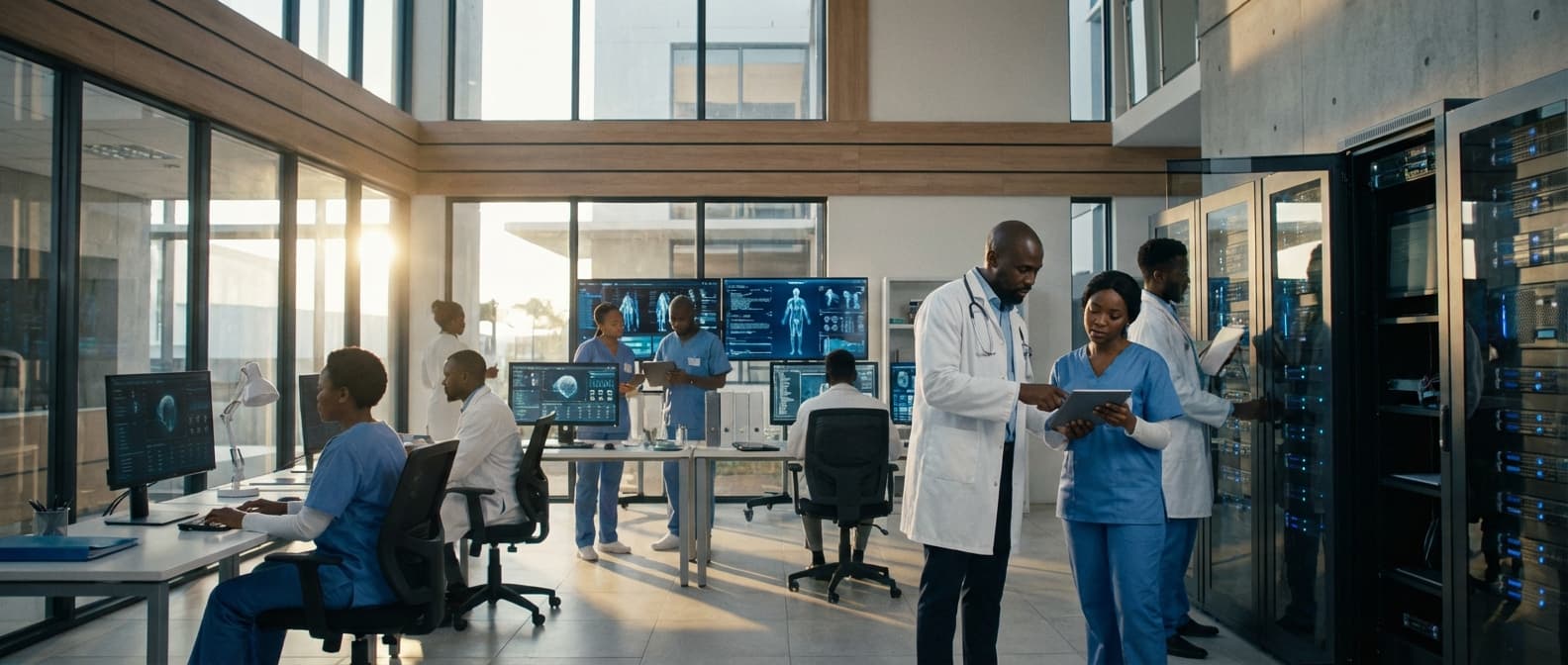
Medical IT Consultation in Malawi
Engineering Excellence & Technical Support
Strategic technology consulting to optimize healthcare operations, streamline workflows, and integrate cutting-edge medical information systems. High-standard technical execution following OEM protocols and local regulatory frameworks.
Robust Server Infrastructure Deployment
We design, implement, and maintain secure, scalable server infrastructure tailored for Malawian healthcare facilities. This ensures reliable data storage, system uptime, and efficient access to critical patient information, even in resource-constrained environments.
Secure Healthcare Network Integration
Our expertise extends to building secure and resilient local area networks (LANs) and wide area networks (WANs) for seamless communication between healthcare departments and remote clinics across Malawi. We prioritize data privacy and compliance with health regulations.
Cloud-Based EMR/EHR Solutions
We facilitate the adoption of secure and accessible cloud-based Electronic Medical Record (EMR) and Electronic Health Record (EHR) systems. This empowers Malawian healthcare providers with digital patient histories, improved diagnostics, and enhanced public health monitoring capabilities.
What Is Medical It Consultation In Malawi?
Medical IT Consultation in Malawi refers to the provision of specialized information technology expertise and strategic guidance to healthcare organizations within the Malawian context. This service encompasses the assessment, design, implementation, and optimization of IT systems and solutions to enhance the efficiency, effectiveness, and accessibility of healthcare delivery. It addresses the unique challenges and opportunities present in Malawi's healthcare landscape, including resource constraints, infrastructure limitations, and the imperative to leverage technology for improved patient outcomes and public health initiatives.
| Who Needs Medical IT Consultation | Typical Use Cases |
|---|---|
| Public Hospitals & Health Centers: Government-funded facilities at national, district, and rural levels seeking to improve patient management, data collection, and service delivery. | Implementing Electronic Health Records (EHRs) to replace paper-based systems, establishing telemedicine services for specialist consultations, improving supply chain management for medicines, and developing public health surveillance systems. |
| Mission Hospitals & Faith-Based Organizations: Healthcare providers often operating with limited budgets but serving significant portions of the population. | Optimizing existing IT infrastructure for cost-efficiency, implementing patient registration and billing systems, enhancing data reporting to government bodies, and exploring affordable digital health solutions. |
| Private Healthcare Providers & Clinics: For-profit entities aiming to enhance patient experience, operational efficiency, and competitive advantage. | Deploying advanced Practice Management Software (PMS), integrating diagnostic imaging systems (PACS/RIS), improving patient portals for appointment scheduling and record access, and implementing cybersecurity measures. |
| Non-Governmental Organizations (NGOs) & International Development Partners: Organizations involved in health program implementation and capacity building. | Designing and deploying IT solutions for specific health programs (e.g., HIV/AIDS, maternal health), establishing data collection and reporting frameworks for grant management, and supporting digital health initiatives in public facilities. |
| Ministry of Health & Government Agencies: Central bodies responsible for national health policy and coordination. | Developing national health IT strategies and standards, implementing national health information exchange platforms, supporting the digitalization of health statistics for policy-making, and managing national disease surveillance systems. |
| Medical Training & Research Institutions: Universities, colleges, and research centers involved in educating healthcare professionals and conducting health research. | Establishing robust IT infrastructure for educational platforms, implementing research databases, facilitating data analysis for research projects, and enabling digital learning environments. |
What Medical IT Consultation in Malawi Involves:
- Needs Assessment & Gap Analysis: Evaluating existing IT infrastructure, workflows, and data management practices against current and future healthcare requirements.
- Strategic Planning & Roadmapping: Developing long-term IT strategies aligned with organizational goals, national health policies, and technological advancements.
- System Design & Architecture: Planning and designing robust, scalable, and secure IT systems, including Electronic Health Records (EHRs), Picture Archiving and Communication Systems (PACS), Laboratory Information Systems (LIS), and other clinical and administrative software.
- Infrastructure Development & Management: Advising on and overseeing the procurement, installation, configuration, and maintenance of hardware (servers, workstations, networking equipment) and software.
- Data Management & Security: Implementing strategies for data integrity, confidentiality, availability, and compliance with relevant data protection regulations.
- Interoperability & Data Exchange: Facilitating seamless data flow between different healthcare facilities and systems, including the development and adoption of interoperability standards.
- Telemedicine & Remote Health Solutions: Designing and deploying telemedicine platforms and infrastructure to extend healthcare access to remote and underserved populations.
- Training & Capacity Building: Developing and delivering training programs for healthcare professionals and IT staff to ensure effective utilization of IT systems.
- Project Management & Implementation: Overseeing the lifecycle of IT projects from inception to successful deployment and post-implementation support.
- Vendor Management & Procurement: Assisting in the selection and management of IT vendors and the procurement of hardware and software solutions.
- Compliance & Regulatory Adherence: Ensuring IT systems meet national and international healthcare IT standards and regulations.
- Digital Transformation Guidance: Advising on the adoption of emerging technologies such as artificial intelligence (AI), machine learning (ML), and blockchain for healthcare applications.
Who Needs Medical It Consultation In Malawi?
In Malawi, robust and reliable medical IT infrastructure is no longer a luxury but a necessity for providing quality healthcare. Medical IT consultation plays a crucial role in ensuring that healthcare providers can leverage technology effectively to improve patient care, streamline operations, and enhance data security. This consultation is particularly vital for organizations facing challenges with outdated systems, insufficient technical expertise, or a lack of strategic IT planning. Medical IT consultants offer specialized knowledge and experience to address these issues, enabling Malawian healthcare institutions to modernize their operations and achieve better health outcomes.
| Target Customer Group | Key Departments/Units Requiring Consultation |
|---|---|
| Hospitals and Clinics (Public and Private) | IT Department, Administration, Clinical Departments (e.g., Radiology, Pathology, Pharmacy), Records Management, Finance |
| Government Health Ministries and Agencies | Health Information Systems Unit, Planning and Policy Department, Procurement, Public Health Programs |
| Non-Governmental Organizations (NGOs) in Healthcare | Program Management, Data Management, Operations, Project Implementation Teams |
| Research Institutions | IT Support, Data Analysis Units, Research Project Teams |
| Pharmaceutical and Medical Device Companies | IT Departments, Supply Chain Management, Regulatory Affairs (for digital health tools) |
| Telemedicine Providers | Operations, IT Infrastructure, Patient Services, Technical Support |
| Diagnostic Laboratories | Laboratory Information System (LIS) Management, IT Support, Quality Assurance |
Who Needs Medical IT Consultation in Malawi?
- Hospitals and Clinics (Public and Private)
- Government Health Ministries and Agencies
- Non-Governmental Organizations (NGOs) in Healthcare
- Research Institutions
- Pharmaceutical and Medical Device Companies
- Telemedicine Providers
- Diagnostic Laboratories
Medical It Consultation Process In Malawi
The Medical IT Consultation process in Malawi is a structured workflow designed to address the information technology needs of healthcare facilities. It begins with an initial inquiry from a client, progresses through needs assessment and proposal development, and culminates in the execution and ongoing support of IT solutions. This process ensures that medical facilities receive tailored and effective technology implementations to enhance their operations and patient care.
| Stage | Description | Key Activities | Responsible Parties |
|---|---|---|---|
| Inquiry and Initial Contact | The client (e.g., a hospital, clinic, or health ministry department) expresses interest in IT consultation services. | Initial phone call, email, or formal letter of inquiry. Clarification of basic service offerings and availability. | Client, Medical IT Consulting Firm |
| Needs Assessment and Discovery | Understanding the client's current IT infrastructure, challenges, and future requirements. | On-site visits, interviews with stakeholders (IT staff, clinicians, administrators), review of existing systems and documentation. | Medical IT Consulting Firm (Consultants, Analysts), Client Staff |
| Solution Design and Proposal | Developing a tailored IT strategy and proposing specific solutions to meet the identified needs. | Defining scope of work, recommending hardware/software, outlining project timelines, estimating costs, presenting options and justification. | Medical IT Consulting Firm (Technical Architects, Project Managers), Client (for feedback) |
| Approval and Contract Negotiation | Formalizing the agreement between the client and the consulting firm. | Client review and approval of the proposal, contract negotiation (terms, payment schedule, deliverables), signing of the contract. | Client (Decision Makers), Medical IT Consulting Firm (Legal/Management) |
| Implementation and Deployment | Putting the approved IT solutions into practice. | Procurement of hardware/software, installation, configuration, network setup, software deployment, data migration. | Medical IT Consulting Firm (Technical Team), Vendor Partners (if applicable), Client IT Staff (for collaboration) |
| Testing and Quality Assurance | Ensuring that the implemented solutions function correctly and meet the specified requirements. | Unit testing, integration testing, user acceptance testing (UAT), performance testing, security testing. | Medical IT Consulting Firm (QA Team), Client Staff (for UAT) |
| Training and Handover | Equipping the client's staff with the knowledge to effectively use and manage the new IT systems. | Developing training materials, conducting user training sessions, providing system documentation, formal handover. | Medical IT Consulting Firm (Trainers), Client Staff (End Users, IT Administrators) |
| Ongoing Support and Maintenance | Providing continuous assistance and system upkeep to ensure optimal performance. | Help desk support, remote monitoring, regular system updates and patches, troubleshooting, preventative maintenance. | Medical IT Consulting Firm (Support Team), Client IT Staff |
| Review and Optimization | Periodically evaluating the IT systems and identifying opportunities for improvement. | Performance reviews, user feedback collection, system audits, recommending upgrades or new solutions, strategic IT planning. | Medical IT Consulting Firm (Consultants), Client Management and IT Staff |
Workflow Stages
- Inquiry and Initial Contact
- Needs Assessment and Discovery
- Solution Design and Proposal
- Approval and Contract Negotiation
- Implementation and Deployment
- Testing and Quality Assurance
- Training and Handover
- Ongoing Support and Maintenance
- Review and Optimization
Medical It Consultation Cost In Malawi
The cost of Medical IT consultation in Malawi can vary significantly based on several factors. These factors include the complexity of the IT needs, the experience and specialization of the consultant, the duration of the consultation, and the specific services required. For instance, a basic assessment of existing infrastructure will be less expensive than a comprehensive implementation plan for a new Electronic Health Record (EHR) system. Consultants with deep expertise in healthcare-specific IT solutions, cybersecurity, or data analytics will generally command higher rates. The engagement model also plays a role; a one-off project will differ in pricing from an ongoing advisory retainer. Travel expenses within Malawi for on-site consultations can also add to the overall cost.
| Service Type | Estimated Price Range (MWK) | Notes |
|---|---|---|
| Initial IT Assessment (Basic) | 30,000 - 75,000 | Includes review of current infrastructure and identification of immediate needs. |
| IT Strategy Development (Healthcare Focused) | 80,000 - 250,000 | Developing a roadmap for technology adoption aligned with healthcare goals. |
| EHR System Selection & Implementation Planning | 150,000 - 750,000+ | Can be significantly higher for large-scale projects and complex integrations. |
| Cybersecurity Risk Assessment (Healthcare) | 70,000 - 200,000 | Focus on patient data protection and compliance. |
| IT Infrastructure Upgrade Planning | 50,000 - 150,000 | Recommendations for hardware, software, and network improvements. |
| Data Analytics & Reporting Strategy | 60,000 - 180,000 | Guidance on leveraging data for improved patient care and operational efficiency. |
| Hourly Consulting Rate (General) | 15,000 - 40,000 | Varies greatly with consultant's seniority and expertise. |
Key Pricing Factors for Medical IT Consultation in Malawi
- Complexity of IT Needs (e.g., basic assessment vs. EHR implementation)
- Consultant's Experience and Specialization (e.g., healthcare IT, cybersecurity, data analytics)
- Duration and Scope of Consultation
- On-site vs. Remote Consultation
- Specific Services Required (e.g., strategy development, system selection, vendor management)
- Travel and Accommodation Expenses (for on-site)
- Reputation and Track Record of the Consulting Firm/Individual
Affordable Medical It Consultation Options
Navigating the complexities of Medical IT can be daunting and expensive. This guide explores affordable consultation options, focusing on value bundles and cost-saving strategies to ensure healthcare organizations can access essential expertise without breaking the bank. Understanding these approaches allows for strategic investment in technology that enhances patient care, improves operational efficiency, and ensures regulatory compliance.
| Consultation Option | Description | Value Proposition | Cost-Saving Strategy |
|---|---|---|---|
| Project-Based Consultation | Engaging a consultant for a specific, defined project (e.g., EHR implementation, network upgrade). | Addresses immediate needs with focused expertise, leading to tangible outcomes. | Clear scope prevents scope creep and associated costs. Pay only for what you need. |
| Retainer/Ongoing Support | A pre-agreed monthly fee for access to IT expertise and support for a set number of hours or specific services. | Provides continuous guidance, proactive maintenance, and rapid problem resolution, preventing minor issues from becoming costly emergencies. | Often includes discounted hourly rates compared to ad-hoc services. Predictable budgeting. |
| Value Bundles | Pre-packaged service offerings that combine multiple IT services at a discounted rate. Examples: Cybersecurity bundle (risk assessment, policy development, employee training), Cloud migration bundle (assessment, planning, implementation, ongoing management). | Streamlines complex IT initiatives by providing integrated solutions. Ensures all components of a project are addressed by experts. | Significant cost savings compared to purchasing individual services. Efficient project execution due to integrated planning. |
| "Virtual CIO" or Fractional CIO Services | Part-time access to experienced IT leadership without the overhead of a full-time executive. | Provides strategic IT direction, vendor management, and budget oversight, crucial for informed decision-making. | Much more affordable than a full-time CIO. Access to high-level expertise on demand. |
| Training & Knowledge Transfer | Consultants train internal IT staff on new systems or best practices. | Empowers your internal team to manage systems independently, reducing reliance on external support for day-to-day operations. | Reduces long-term consulting fees. Builds internal capacity and expertise. |
Key Considerations for Affordable Medical IT Consultation
- Define Your Needs Clearly: Before seeking consultation, pinpoint your specific IT challenges and goals. Are you looking to implement an EHR system, improve cybersecurity, migrate to the cloud, or enhance telehealth capabilities? Clarity leads to targeted and more cost-effective consultations.
- Evaluate Consultant Experience: Seek consultants with proven experience in the healthcare sector, specifically within your specialty if possible. This expertise translates to faster problem-solving and more relevant solutions, saving time and resources.
- Consider Niche or Specialized Firms: While large IT consulting firms can be comprehensive, smaller, specialized firms may offer more competitive pricing for specific needs. Their focused expertise can be highly valuable.
- Look for Referral Discounts or Packages: Some consulting firms offer discounts for referrals or bundle services for ongoing support, which can significantly reduce overall costs.
- Prioritize ROI: Focus on consultations that promise a clear return on investment, whether through increased efficiency, reduced errors, or improved patient outcomes. Quantifiable benefits justify the expenditure.
- Explore Remote/Virtual Consultations: Many IT consulting needs can be addressed effectively through remote meetings and communication, eliminating travel costs for both parties.
Verified Providers In Malawi
When seeking healthcare services in Malawi, identifying and trusting verified providers is paramount. Franance Health stands out as a leading platform committed to ensuring that all listed healthcare professionals and facilities meet rigorous credentialing standards. This meticulous verification process not only guarantees the quality of care but also offers peace of mind to patients. Understanding Franance Health's credentials and the benefits they bring reveals why they represent the best choice for accessing reliable healthcare in Malawi.
| Credential Type | Verification Standard | Importance for Patients |
|---|---|---|
| Medical Licenses | Validation with the Medical Council of Malawi (or relevant governing body) | Ensures providers are legally authorized to practice medicine. |
| Professional Certifications | Confirmation of specialized training and board certifications | Guarantees expertise in specific medical fields. |
| Educational Qualifications | Verification of degrees and diplomas from recognized institutions | Confirms foundational medical knowledge and training. |
| Facility Accreditation | Assessment against national health standards and safety protocols | Ensures a safe, clean, and well-equipped environment for treatment. |
| Reputation and Feedback | Monitoring of patient reviews and professional conduct | Provides insight into patient experiences and ethical practices. |
Franance Health's Verification Process & Benefits
- Rigorous Credentialing: Franance Health employs a multi-stage verification process that includes checking medical licenses, professional certifications, educational qualifications, and background checks for all listed providers.
- Accreditation of Facilities: Healthcare facilities are assessed for adherence to national and international standards for safety, hygiene, and operational efficiency.
- Continuous Monitoring: Provider credentials and facility compliance are subject to ongoing review to ensure sustained quality and adherence to ethical practices.
- Patient Empowerment: By providing verified information, Franance Health empowers patients to make informed decisions about their healthcare, reducing the risk of encountering unqualified practitioners.
- Enhanced Trust and Safety: The platform builds trust by removing the uncertainty associated with finding healthcare, ensuring that patients are connected with competent and legitimate medical professionals.
- Improved Access to Quality Care: Franance Health streamlines the process of finding quality healthcare, making it more accessible and efficient for everyone.
Scope Of Work For Medical It Consultation
This document outlines the Scope of Work (SOW) for a Medical IT Consultation engagement. The primary objective is to provide expert guidance and technical solutions to improve the efficiency, security, and compliance of a healthcare organization's information technology infrastructure. This SOW details the key activities, expected technical deliverables, and standard specifications to ensure successful project completion.
| Deliverable ID | Deliverable Name | Description | Standard Specification/Format | Acceptance Criteria |
|---|---|---|---|---|
| TD-001 | Current IT Infrastructure Assessment Report | A detailed report analyzing the existing IT assets, their performance, security vulnerabilities, and compliance status. | PDF document, Executive Summary, Detailed Findings, Recommendations section. | Report accurately reflects the current state of the IT infrastructure, identifies key risks and opportunities, and is presented in a clear, concise manner. |
| TD-002 | IT Strategy and Roadmap Document | A strategic document outlining the short-term and long-term IT goals, technology adoption plans, and implementation timelines. | PDF document, including Vision Statement, Strategic Objectives, Technology Pillars, Budgetary Considerations, and phased implementation plan. | Strategy aligns with organizational objectives, is technically feasible, and includes actionable steps for implementation. |
| TD-003 | Security Architecture Design | A comprehensive design document detailing the proposed security framework, including network security, data encryption, access controls, and intrusion detection/prevention systems. | PDF document, including Network Diagrams, Security Policies, Recommended Technologies, and Implementation Guidelines. | Design meets or exceeds industry best practices for healthcare IT security and complies with relevant regulations. |
| TD-004 | Disaster Recovery (DR) and Business Continuity (BC) Plan | A detailed plan outlining procedures for data backup, recovery, and maintaining essential business operations in the event of a disaster. | PDF document, including Recovery Point Objectives (RPO), Recovery Time Objectives (RTO), Backup Procedures, Restoration Steps, and Communication Protocols. | Plan is comprehensive, actionable, and tested against simulated scenarios. |
| TD-005 | System Implementation/Migration Plan (if applicable) | A detailed project plan for the implementation or migration of new IT systems or upgrades. | PDF document, including Project Scope, Timelines, Resource Allocation, Risk Management Plan, and Testing Strategy. | Plan is realistic, includes clear milestones, and addresses potential challenges. |
| TD-006 | Technical Documentation and Training Materials | Documentation for implemented systems and training materials for IT staff and end-users. | PDF documents, SOPs, User Manuals, Training Presentations, and Knowledge Base Articles. | Documentation is accurate, easy to understand, and training materials effectively convey necessary knowledge. |
Key Activities
- Assessment of current IT infrastructure, including hardware, software, network, and security posture.
- Identification of pain points, inefficiencies, and areas for improvement within the existing IT environment.
- Development of a comprehensive IT strategy aligned with organizational goals and regulatory requirements (e.g., HIPAA).
- Recommendation of appropriate hardware, software, and cloud solutions for optimization.
- Design and planning for IT system upgrades, migrations, or implementations.
- Development of robust security protocols and data protection strategies.
- Evaluation and enhancement of disaster recovery and business continuity plans.
- Training and knowledge transfer for internal IT staff and relevant stakeholders.
- Ongoing support and consultation for IT system maintenance and future development.
Service Level Agreement For Medical It Consultation
This Service Level Agreement (SLA) outlines the response times and uptime guarantees for Medical IT Consultation services provided by [Your Company Name] to [Client Name]. This SLA is an addendum to the Master Service Agreement (MSA) executed between the parties on [Date of MSA].
| Service Level | Response Time Target (Business Hours) | Resolution Target (Business Hours) | Uptime Guarantee |
|---|---|---|---|
| Critical Incident (e.g., System Outage, Data Breach) | 15 minutes | 4 hours | 99.9% |
| High Priority Incident (e.g., Performance Degradation, Major Feature Malfunction) | 30 minutes | 8 business hours | 99.5% |
| Medium Priority Incident (e.g., Minor Software Bug, User Access Issue) | 1 hour | 2 business days | 99.0% |
| Low Priority Incident (e.g., Feature Request, General Inquiry) | 4 business hours | 5 business days | N/A (Best Effort) |
| Routine Maintenance/Proactive Monitoring | N/A | Scheduled by agreement | N/A (Scheduled downtime will be communicated in advance) |
Scope of Services
- On-demand IT support for medical software and hardware.
- Proactive system monitoring and maintenance.
- IT infrastructure planning and consultation.
- Data security and HIPAA compliance guidance.
- User training and support for medical IT systems.
Frequently Asked Questions

Ready when you are
Let's scope your Medical IT Consultation in Malawi project in Malawi.

Scaling healthcare logistics and technical systems across the entire continent.