
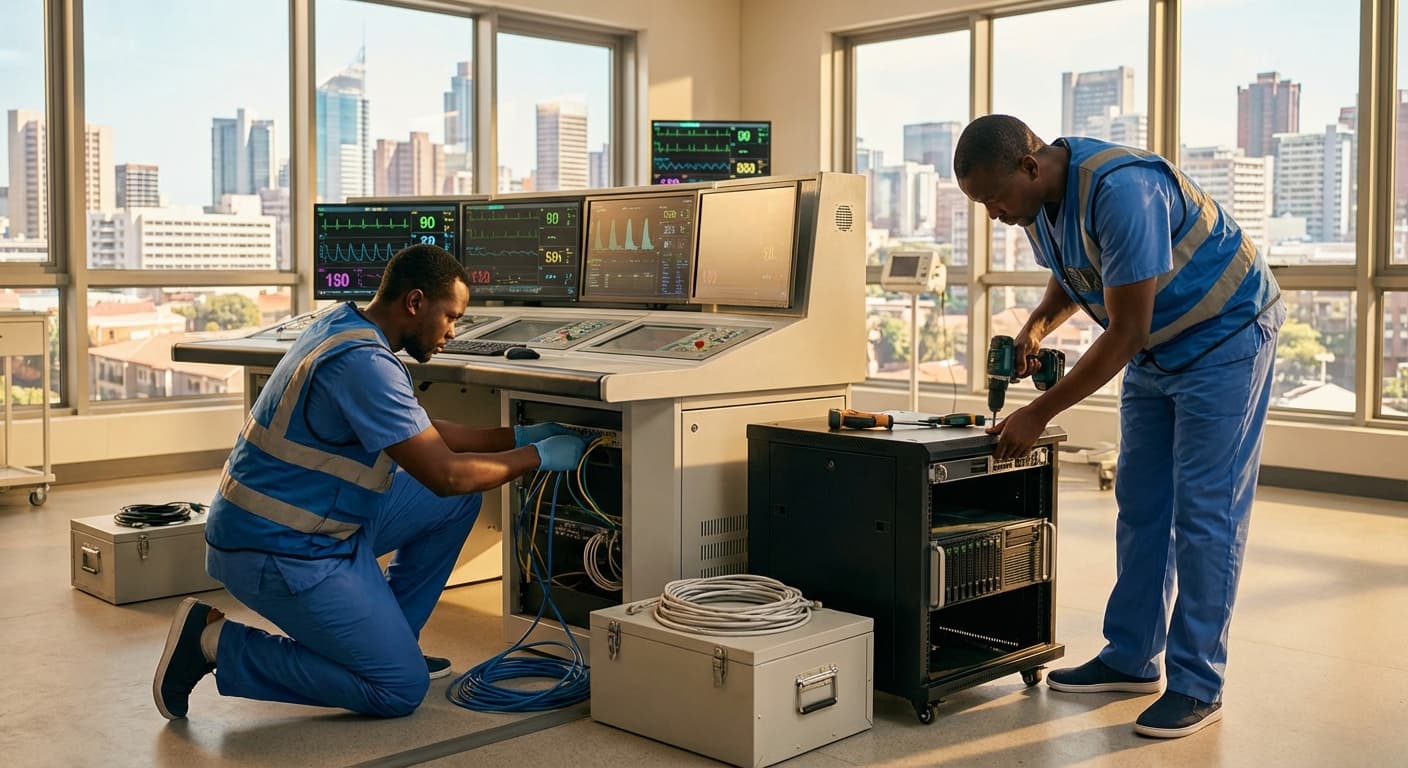
ICU Central Monitoring Station Installation Service in Malawi
Engineering Excellence & Technical Support
ICU Central Monitoring Station Installation Service High-standard technical execution following OEM protocols and local regulatory frameworks.
Robust Network Infrastructure
We design and implement high-availability, secure network infrastructures tailored to the unique demands of Malawian healthcare environments, ensuring reliable and uninterrupted data flow from patient monitors to the central station. This includes robust cabling, dedicated network segments, and advanced firewall configurations.
Seamless Device Integration
Our expert technicians expertly integrate a wide range of critical care monitoring devices from various manufacturers with the central monitoring system. We ensure compatibility, accurate data transmission, and proper alarm management across all connected equipment, enhancing real-time patient oversight.
Localised Support & Training
We provide comprehensive on-site installation, configuration, and user training for clinical staff in Malawi. Our commitment extends to ongoing local technical support and maintenance, ensuring swift issue resolution and maximizing the long-term operational efficiency of your ICU Central Monitoring Station.
What Is Icu Central Monitoring Station Installation Service In Malawi?
ICU Central Monitoring Station Installation Service in Malawi refers to the comprehensive process of setting up, configuring, and commissioning a centralized hub for real-time patient monitoring within Intensive Care Units (ICUs). This service is critical for enhancing patient care by providing clinicians with immediate access to vital sign data from multiple ICU beds, facilitating timely interventions and improving clinical decision-making. The installation typically involves the integration of patient monitoring devices, network infrastructure, central server hardware and software, and display units in a dedicated command center. This enables a consolidated view of patient status, alarms, and trends, often supported by data archiving and retrieval capabilities. The service ensures that the system is fully operational, calibrated, and integrated with existing hospital IT infrastructure, adhering to relevant healthcare technology standards and best practices.
| Requirement | Description | Affected Parties | Typical Use Cases |
|---|---|---|---|
| Critical Care Facilities | Hospitals with established or expanding Intensive Care Units requiring advanced patient oversight. | Hospital Administration, ICU Department Heads, Biomedical Engineering Departments. | Continuous monitoring of critically ill patients, early detection of patient deterioration, efficient management of high patient load in ICUs, improved response times to critical events. |
| New Hospital Construction/Renovation | Healthcare facilities undertaking the design or upgrade of their ICU infrastructure to incorporate modern monitoring solutions. | Project Managers, Architects, Healthcare Planners, IT Departments. | Ensuring state-of-the-art patient monitoring capabilities are integrated from the design phase, optimizing workflow and data management for new ICU units. |
| Technology Upgrade Initiatives | Hospitals seeking to replace outdated or inefficient patient monitoring systems with a centralized, integrated solution. | Biomedical Engineering, IT Departments, Clinical Department Managers. | Consolidating disparate monitoring systems, enhancing data accessibility, improving alarm management, and reducing the burden on individual bedside staff for constant vigilance. |
| Remote Patient Monitoring Needs | In scenarios where advanced clinical oversight is required but direct, continuous physical presence at every bedside may be limited. | ICU Nursing Supervisors, Telemedicine Providers, Healthcare IT Strategists. | Enabling a smaller team of experienced clinicians to oversee a larger number of ICU patients effectively, especially in resource-constrained environments or during off-hours. |
Key Components of ICU Central Monitoring Station Installation Service:
- Site assessment and network infrastructure review (cabling, power, network connectivity).
- Installation and configuration of central monitoring server and software.
- Deployment and integration of patient monitors at individual ICU beds.
- Setup and calibration of the central display console (workstation, monitors, workstations on wheels - WOWs).
- Network configuration for data transmission and security.
- Integration with existing hospital information systems (HIS) or electronic health records (EHR) where applicable.
- System testing, validation, and performance optimization.
- User training for clinical staff and IT support personnel.
- Post-installation support and maintenance planning.
Who Needs Icu Central Monitoring Station Installation Service In Malawi?
Installation services for ICU central monitoring stations are crucial for healthcare facilities in Malawi aiming to enhance patient care, particularly for critically ill individuals. These stations allow for the simultaneous and continuous monitoring of multiple Intensive Care Unit (ICU) patients from a centralized location, providing real-time vital sign data and alerts to a dedicated team of nurses and physicians. This centralized approach significantly improves response times to deteriorating patient conditions, optimizes resource allocation, and supports better clinical decision-making. The service is essential for facilities looking to upgrade their existing ICU infrastructure, expand their critical care capacity, or establish new ICU units.
| Department/Area | Key Needs/Benefits |
|---|---|
| Intensive Care Unit (ICU) | Continuous, real-time monitoring of multiple patients' vital signs (heart rate, blood pressure, oxygen saturation, respiration rate, etc.). Immediate alerts for critical changes. Centralized data logging for trend analysis and patient history. Improved workflow for nursing staff, allowing them to monitor more patients efficiently. |
| Critical Care Units (CCU) / High Dependency Units (HDU) | Similar to ICU, these units benefit from enhanced monitoring for patients requiring closer observation than general wards but not necessarily full ICU care. |
| Anesthesiology Department | In some facilities, the central monitoring station might be linked to or used by anesthesiologists during complex surgical procedures or post-operative recovery in critical care settings. |
| Emergency Department (ED) | While not always directly integrated, a central monitoring station can be beneficial for immediate post-resuscitation stabilization and decision-making for patients likely to require ICU admission. |
| Medical Records/Information Technology (IT) Department | Integration of patient monitoring data into electronic health records (EHRs). Ensuring data security, system uptime, and network connectivity for the monitoring system. |
| Biomedical Engineering Department | Installation, calibration, maintenance, and troubleshooting of the central monitoring station hardware and associated patient monitors. Ensuring compliance with medical device regulations. |
Target Customers and Departments in Malawi for ICU Central Monitoring Station Installation Service:
- Public Hospitals: Government-funded hospitals that serve the majority of the population and often face resource constraints. Upgrading their ICU monitoring capabilities can dramatically improve outcomes for critically ill patients.
- Private Hospitals and Clinics: Privately owned healthcare providers that cater to a segment of the population seeking higher quality or specialized care. They are often early adopters of advanced medical technology.
- Mission Hospitals: Healthcare facilities established by religious organizations, which play a significant role in providing medical services, especially in remote or underserved areas.
- Tertiary and Referral Hospitals: Hospitals that handle complex cases and serve as referral centers for other healthcare facilities. These institutions are prime candidates for advanced monitoring systems.
- Teaching Hospitals/Medical Schools: Hospitals affiliated with medical education programs that require state-of-the-art equipment to train future healthcare professionals and conduct research.
- New Healthcare Facility Developments: Any new hospital or clinic being built in Malawi that plans to include an Intensive Care Unit or expand its critical care services.
Icu Central Monitoring Station Installation Service Process In Malawi
This document outlines the standard workflow for the installation of an ICU Central Monitoring Station service in Malawi, from the initial client inquiry to the final execution and handover. The process is designed to ensure a seamless and efficient deployment, meeting the specific needs of healthcare facilities.
| Phase | Key Activities | Description | Responsible Parties | Timeline (Indicative) |
|---|---|---|---|---|
| Initial Contact, Needs Assessment, Preliminary Discussion | The client (hospital/clinic) contacts the service provider with their requirement for an ICU Central Monitoring Station. A preliminary discussion identifies the client's specific needs, existing infrastructure, and desired functionalities. | Client, Service Provider Sales/Technical Team | 1-3 Business Days |
| On-site Survey, Technical Evaluation, Requirement Gathering | A technical team visits the intended installation site (ICU) to assess space availability, power supply, network infrastructure, existing equipment compatibility, and environmental factors. Detailed requirements are gathered and documented. | Service Provider Technical Team, Client IT/Biomedical Engineers | 3-7 Business Days |
| System Design, Equipment Selection, Cost Estimation, Proposal Generation | Based on the site assessment and gathered requirements, a detailed proposal is prepared. This includes system design, recommended hardware and software, installation plan, project timeline, and a comprehensive quotation. | Service Provider Technical & Sales Team | 5-10 Business Days |
| Client Approval, Contract Signing, Equipment Ordering | Upon client acceptance of the proposal and quotation, a formal contract is signed. The service provider then procures the necessary equipment and software from manufacturers or suppliers. | Client, Service Provider Procurement Team | Varies based on equipment lead times (typically 4-12 weeks) |
| Hardware Setup, Cabling, Software Installation, Network Integration | The technical installation team arrives on-site to set up the central monitoring station hardware, run necessary cabling, install the operating system and monitoring software, and integrate it with existing hospital networks and bedside monitors. | Service Provider Installation Team, Client IT/Biomedical Engineers | 5-15 Business Days (depending on scale) |
| System Verification, Performance Testing, Calibration, Quality Assurance | Thorough testing of the entire system is conducted to ensure all components are functioning correctly, data is being received accurately, alarms are operational, and the system meets all specified performance criteria. Calibration with existing patient monitors is performed. | Service Provider Technical Team, Client Biomedical Engineers | 3-7 Business Days |
| User Training, Documentation Provision, Final Sign-off | Comprehensive training is provided to the clinical staff (nurses, doctors) and biomedical engineers on how to operate, manage, and maintain the central monitoring station. All relevant documentation and user manuals are handed over, and the project is formally signed off. | Service Provider Training & Project Management Team, Client Clinical Staff & Biomedical Engineers | 2-5 Business Days |
| Warranty, Maintenance, Troubleshooting, Ongoing Technical Assistance | The service provider offers post-installation support, including warranty services, scheduled maintenance, and prompt troubleshooting for any issues that may arise. This ensures the long-term optimal performance of the central monitoring station. | Service Provider Support Team, Client Biomedical Engineers | Ongoing (as per contract) |
ICU Central Monitoring Station Installation Service Process
- Phase 1: Inquiry & Consultation
- Phase 2: Site Assessment & Planning
- Phase 3: Proposal & Quotation
- Phase 4: Order Confirmation & Procurement
- Phase 5: Installation & Configuration
- Phase 6: Testing & Commissioning
- Phase 7: Training & Handover
- Phase 8: Post-Installation Support
Icu Central Monitoring Station Installation Service Cost In Malawi
The cost of installing an ICU Central Monitoring Station (CMS) in Malawi can vary significantly due to several factors. A CMS is a critical piece of medical equipment that allows healthcare professionals to remotely monitor vital signs of multiple ICU patients simultaneously, improving patient care and response times. The installation process itself involves not just the hardware but also network infrastructure, software integration, training, and ongoing support. Understanding these components is crucial for budgeting.
| Cost Component | Estimated Range (Malawian Kwacha - MWK) | Notes |
|---|---|---|
| Central Monitoring System Hardware (per bed unit) | MWK 5,000,000 - MWK 25,000,000+ | Varies significantly by brand, features (e.g., ECG, SpO2, NIBP, IBP, EtCO2 modules), and quantity. |
| Central Station/Server Unit | MWK 10,000,000 - MWK 40,000,000+ | Includes the main display, data storage, and processing capabilities. Higher capacity and advanced features increase cost. |
| Network Cabling and Infrastructure | MWK 2,000,000 - MWK 15,000,000+ | Dependent on the size of the ICU, existing infrastructure, and the need for upgrades or new installations. |
| Software Installation, Configuration, and Integration | MWK 3,000,000 - MWK 20,000,000+ | Includes system setup, integration with HIS/EHR, and potential customization. |
| Professional Installation and Project Management | MWK 5,000,000 - MWK 25,000,000+ | Covers labor, travel, and oversight by experienced technicians and project managers. |
| Staff Training (Doctors, Nurses, IT) | MWK 1,000,000 - MWK 7,000,000+ | Duration and depth of training required will influence cost. |
| Warranty and Post-Installation Support (Annual) | MWK 2,000,000 - MWK 10,000,000+ | Typically a percentage of the total system cost, providing ongoing maintenance and technical assistance. |
| Total Estimated Installation Cost (for a moderately sized ICU) | MWK 28,000,000 - MWK 142,000,000+ | This is a broad estimate. A detailed site assessment and specific vendor quotes are essential for accurate budgeting. |
Key Factors Influencing ICU Central Monitoring Station Installation Cost in Malawi:
- Scope of Installation: This includes the number of patient beds to be monitored, the complexity of the existing hospital infrastructure (electrical, network cabling), and the need for new construction or renovations.
- Type and Brand of CMS Equipment: Different manufacturers offer varying levels of technology, features, and reliability, which directly impacts the initial hardware cost. High-end, feature-rich systems will naturally be more expensive.
- Integration with Existing Systems: If the CMS needs to interface with other hospital information systems (HIS) or electronic health records (EHR), this requires specialized software development and configuration, adding to the cost.
- Network Infrastructure Requirements: A robust and reliable network is essential for CMS. The cost can increase if existing network cabling is inadequate and requires upgrades or if new Wi-Fi infrastructure is needed.
- Software Licensing and Customization: Beyond the initial purchase, ongoing software licenses and any custom reports or functionalities required by the hospital will contribute to the overall expenditure.
- Training and Support: Comprehensive training for medical staff and IT personnel is vital for effective system utilization. Post-installation support and maintenance contracts also represent a recurring cost.
- Geographic Location within Malawi: While less significant than other factors, accessibility to the hospital for installation teams and the availability of local technical expertise can have minor impacts on logistics and travel costs.
- Vendor and Supplier Markups: Different suppliers and installers will have their own pricing structures and profit margins, leading to variations in quotes.
Affordable Icu Central Monitoring Station Installation Service Options
Installing an Intensive Care Unit (ICU) central monitoring station is a critical investment for any healthcare facility. Ensuring reliable and continuous patient data is paramount for timely interventions and improved patient outcomes. This guide outlines affordable installation service options, focusing on value bundles and cost-saving strategies to help you maximize your budget without compromising quality.
| Service Bundle Option | Description | Key Features | Typical Cost Range (USD) | Value Proposition |
|---|---|---|---|---|
| Basic Installation & Setup | Core setup of the CMU, network connectivity, and workstation configuration. | CMU installation, basic network cabling, workstation setup, initial system testing. | $5,000 - $15,000 | Most budget-friendly for smaller ICUs or facilities with existing infrastructure. |
| Standard Installation & Integration | Includes basic setup plus integration with a limited number of EMR/EHR fields. | Basic setup, network configuration, workstation setup, basic EMR/EHR data integration, user training. | $10,000 - $25,000 | Good balance of cost and functionality for facilities needing some EMR integration. |
| Comprehensive Installation & Optimization | Full installation, advanced EMR/EHR integration, system optimization, and extended training. | Standard installation, advanced EMR/EHR integration (bi-directional data flow), custom alarming setup, performance optimization, comprehensive clinician training, initial system validation. | $20,000 - $50,000+ | Ideal for facilities prioritizing seamless workflow, advanced features, and robust training for maximum ROI. |
| Phased Rollout & Training | Installation spread over time, allowing for learning and adaptation between phases. | Installation in stages (e.g., one unit at a time), modular training sessions, flexibility for budget allocation. | Variable (depends on scope of each phase) | Manages budget effectively and allows staff to adapt gradually. |
Understanding Central Monitoring Station Components and Installation Needs
- Central Monitoring Unit (CMU): The core of the system, aggregating data from bedside monitors.
- Bedside Patient Monitors: Devices that collect vital signs (ECG, SpO2, NIBP, Respiration, Temperature, etc.).
- Networking Infrastructure: Cables, switches, and servers to transmit data securely.
- Workstations/Displays: Where clinicians view and analyze patient data.
- Software: For data management, alarming, and trending.
- Installation Services: Professional setup, configuration, testing, and training.
- Integration with existing EMR/EHR systems: Crucial for seamless workflow.
- Ongoing maintenance and support: Essential for long-term operational efficiency.
Verified Providers In Malawi
In Malawi, ensuring access to quality healthcare is paramount. This is where verified healthcare providers and trusted financial partners like Franfinance Health play a crucial role. Franfinance Health's commitment to stringent credentialing and ethical practices makes them stand out as a reliable source for healthcare services. Their thorough vetting process ensures that partnering institutions and individual providers meet high standards of professionalism, competence, and patient safety. Choosing a provider accredited or affiliated with Franfinance Health offers patients peace of mind, knowing they are receiving care from qualified and trustworthy professionals. This focus on verified quality directly translates to better health outcomes and a more secure healthcare experience for individuals and families across Malawi.
| Credential Aspect | Franfinance Health's Approach | Benefit to Patients |
|---|---|---|
| Provider Vetting | Rigorous background checks, license verification, and experience assessment. | Guaranteed care from qualified and legitimate professionals. |
| Quality Assurance | Ongoing monitoring of service delivery and patient feedback. | Consistent high-quality medical care and continuous improvement. |
| Ethical Standards | Adherence to strict ethical guidelines and best practices. | Trustworthy and patient-centric healthcare services. |
| Financial Transparency | Clear and upfront financial arrangements for healthcare services. | Predictable costs and avoidance of hidden fees. |
| Accessibility | Partnerships with a network of diverse healthcare facilities and practitioners. | Easier access to a range of necessary medical treatments and consultations. |
Why Franfinance Health Credentials Matter:
- Ensures adherence to high professional standards.
- Prioritizes patient safety and well-being.
- Builds trust and confidence in healthcare providers.
- Facilitates access to quality, vetted medical services.
- Supports a more robust and reliable healthcare ecosystem in Malawi.
Scope Of Work For Icu Central Monitoring Station Installation Service
This Scope of Work (SOW) outlines the services required for the complete installation and commissioning of an Intensive Care Unit (ICU) Central Monitoring Station (CMS). This includes the setup of all necessary hardware, software, cabling, and integration with existing or new bedside patient monitors. The objective is to provide a robust, reliable, and user-friendly CMS that enhances patient care by enabling continuous observation and immediate response to critical changes in patient vital signs. This SOW covers the technical deliverables, standard specifications, and project phases involved in this installation.
| Deliverable | Description | Standard Specifications / Requirements |
|---|---|---|
| Central Monitoring Station Hardware | Supply and installation of dedicated workstations, servers, and displays for the CMS. Includes redundant power supplies and network connectivity. | High-availability servers with sufficient processing power and storage for historical data. Redundant power supplies (UPS) for all critical components. High-resolution, medical-grade displays (minimum 24-inch). Secure rack-mountable equipment where applicable. |
| Central Monitoring Software | Installation, configuration, and licensing of the CMS software. This includes patient data acquisition, alarm management, waveform display, and historical trending. | Latest stable version of the CMS software. Compliance with relevant healthcare IT security standards (e.g., HIPAA). Robust alarm notification system with customizable thresholds and audible/visual alerts. Secure data storage with backup and recovery mechanisms. |
| Network Infrastructure | Installation and configuration of new or integration with existing hospital network infrastructure to support CMS communication. This includes cabling, switches, and network security measures. | Gigabit Ethernet connectivity for all CMS components. Structured cabling compliant with TIA/EIA-568 standards. Network segmentation for enhanced security. Firewalls and intrusion detection/prevention systems as per hospital IT policy. |
| Bedside Patient Monitor Integration | Establishment of seamless data flow from bedside patient monitors to the CMS. This may involve hardware adapters, software drivers, or direct network integration. | Compatibility with existing bedside monitor models and communication protocols (e.g., HL7, proprietary protocols). Reliable data transmission with minimal latency. Verification of accurate data acquisition for all monitored parameters. |
| Alarm Management System | Configuration of alarm parameters, notification pathways, and escalation protocols for critical patient events. | Configurable alarm priorities (e.g., high, medium, low). Multiple notification methods (e.g., visual on screen, audible alarms, pager integration, mobile alerts). Defined escalation procedures for unattended alarms. Audit trail of all alarms and acknowledgments. |
| Data Archiving and Retrieval | Implementation of a system for long-term storage and easy retrieval of patient monitoring data. | Secure, compliant data archiving solution. Ability to retrieve historical data for a defined period (e.g., 7 years or as per hospital policy). Data integrity verification during storage and retrieval. |
| System Documentation | Provision of comprehensive documentation for the installed CMS, including network diagrams, configuration details, user manuals, and maintenance guides. | Detailed network topology maps. Configuration settings for all hardware and software components. User-friendly manuals for nurses and technicians. Troubleshooting guides and maintenance procedures. |
| User Training | Provision of training sessions for ICU nursing staff, technicians, and IT support personnel on the operation, maintenance, and troubleshooting of the CMS. | Role-based training tailored to different user groups. Hands-on practical exercises. Assessment of training effectiveness. Provision of training materials. |
| Commissioning Report | A formal report detailing the successful installation, testing, and operational readiness of the CMS. | Includes results of all functional tests, integration tests, and user acceptance testing. Sign-off by hospital representatives and the service provider. |
Project Phases
- Phase 1: Planning and Design
- Phase 2: Procurement and Staging
- Phase 3: Installation and Cabling
- Phase 4: System Configuration and Integration
- Phase 5: Testing and Commissioning
- Phase 6: Training and Handover
- Phase 7: Post-Installation Support
Service Level Agreement For Icu Central Monitoring Station Installation Service
This Service Level Agreement (SLA) outlines the response times and uptime guarantees for the installation service of the ICU Central Monitoring Station. It is designed to ensure the continuous and reliable operation of the monitoring system, which is critical for patient care.
| Service Component | Response Time (for critical issues) | Uptime Guarantee | Remedy for Downtime |
|---|---|---|---|
| ICU Central Monitoring Station (Core System - Data Display & Recording) | 1 hour (acknowledgement) | 99.9% (monthly average) | Service credits (1% of monthly service fee per hour of downtime exceeding 0.1%) |
| Network Connectivity to Monitoring Devices | 2 hours (acknowledgement) | 99.5% (monthly average) | Service credits (0.5% of monthly service fee per hour of downtime exceeding 0.5%) |
| Alarm Notification System | 30 minutes (acknowledgement) | 99.9% (monthly average) | Service credits (1% of monthly service fee per hour of downtime exceeding 0.1%) |
| Data Archiving & Retrieval | 4 hours (acknowledgement) | 99.8% (monthly average) | Service credits (0.8% of monthly service fee per hour of downtime exceeding 0.2%) |
| Critical Software Updates/Patches | 4 business hours (for deployment after notification) | N/A (handled as per agreed-upon maintenance schedule, with minimal disruption) | Not applicable as planned maintenance |
Key Service Metrics
- This SLA applies to the initial installation of the ICU Central Monitoring Station hardware and software, as well as any subsequent critical software updates and hardware component replacements during the agreed-upon service period.
- The service provider is committed to providing a functional and operational ICU Central Monitoring Station upon successful completion of the installation and within the defined uptime parameters.
- Downtime is defined as the period during which the ICU Central Monitoring Station is not functional or operational, preventing the display and recording of vital patient data.
- Scheduled maintenance will be communicated to the hospital at least 48 hours in advance and will be performed during off-peak hours to minimize disruption.
Frequently Asked Questions

Ready when you are
Let's scope your ICU Central Monitoring Station Installation Service in Malawi project in Malawi.

Scaling healthcare logistics and technical systems across the entire continent.