
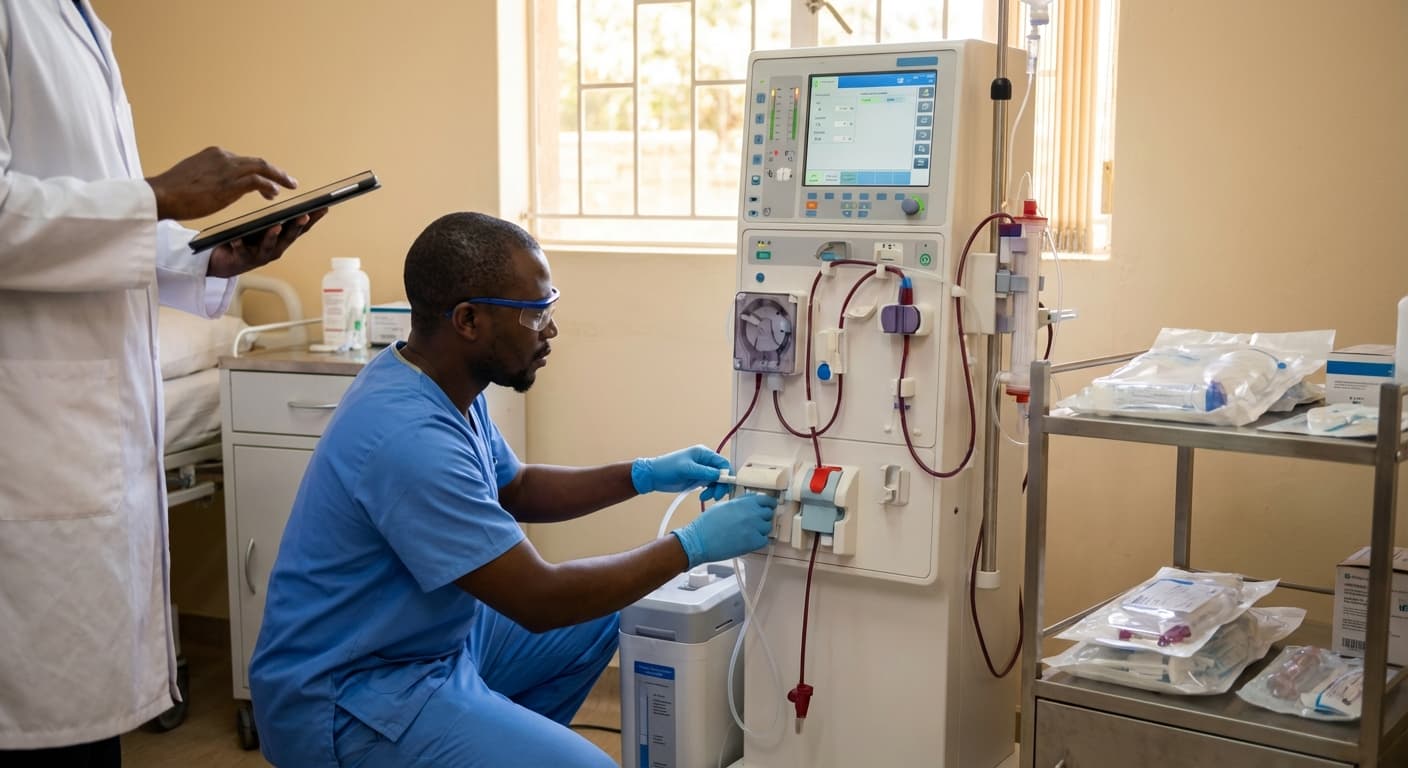
Hemodialysis Machine Installation Service in Malawi
Engineering Excellence & Technical Support
Hemodialysis Machine Installation Service High-standard technical execution following OEM protocols and local regulatory frameworks.
Certified Installation Technicians
Our team comprises highly trained and certified technicians with extensive experience in installing a wide range of hemodialysis machines. We adhere to stringent international standards and manufacturer guidelines to ensure optimal machine performance and patient safety from day one.
Rigorous Pre-Installation Assessments
Before installation, we conduct thorough site assessments to verify power, water, and environmental conditions meet the specific requirements of your hemodialysis machines. This proactive approach minimizes installation delays and potential operational issues.
Comprehensive Post-Installation Support
Our service extends beyond physical installation. We provide comprehensive machine calibration, functional testing, and initial operator training to empower your healthcare staff. We also offer follow-up support to ensure smooth integration into your clinical workflow.
What Is Hemodialysis Machine Installation Service In Malawi?
Hemodialysis machine installation service in Malawi refers to the specialized process of setting up and commissioning hemodialysis machines within healthcare facilities in the country. This service ensures that these complex medical devices are correctly integrated into existing infrastructure, calibrated for optimal performance, and made ready for patient use, adhering to established medical and safety standards. It encompasses a range of technical and logistical activities crucial for the safe and effective operation of dialysis units. The service is vital for the provision of renal replacement therapy to patients suffering from end-stage renal disease (ESRD).
| Who Needs Hemodialysis Machine Installation Service? | Typical Use Cases | |||||
|---|---|---|---|---|---|---|
| Public Hospitals and Government-funded Healthcare Facilities: To equip or upgrade existing renal units and establish new dialysis centers to serve a larger patient population. | Establishing New Dialysis Units: In hospitals or specialized clinics to offer comprehensive renal care. | Private Hospitals and Diagnostic Centers: To expand their service offerings and cater to patients requiring dialysis. | Upgrading Existing Dialysis Centers: Replacing older or obsolete machines with newer, more advanced models. | NGOs and International Aid Organizations: When implementing healthcare projects focused on chronic disease management and life support in Malawi. | Emergency or Disaster Relief Situations: To quickly set up temporary dialysis facilities where infrastructure may be compromised. | Research Institutions: For clinical research involving hemodialysis technology and patient outcomes. |
Key Components of Hemodialysis Machine Installation Service:
- Site Assessment and Planning: Evaluating the facility's infrastructure (power, water, waste management, physical space) to determine suitability for machine installation and identify any required modifications.
- Unpacking and Physical Setup: Carefully unpacking the hemodialysis machine and its accessories, followed by precise physical placement according to manufacturer guidelines and facility layout.
- Electrical and Plumbing Connections: Connecting the machine to appropriate power outlets and ensuring seamless integration with the facility's water treatment and delivery systems (e.g., reverse osmosis units).
- Water Quality Testing and Verification: Rigorous testing of the purified water used for dialysis to ensure it meets stringent international and national standards for purity and conductivity.
- System Calibration and Configuration: Adjusting machine parameters (e.g., blood flow rates, dialysate composition, ultrafiltration settings) to manufacturer specifications and physician orders.
- Functional Testing and Performance Verification: Conducting comprehensive operational checks and test runs to confirm all machine functions, safety features, and alarm systems are operating correctly.
- Operator Training and Competency Assessment: Providing hands-on training to healthcare professionals (nurses, technicians) on the operation, maintenance, and troubleshooting of the installed hemodialysis machines.
- Documentation and Handover: Completing all necessary installation records, providing user manuals, service histories, and formally handing over the operational system to the facility's management.
- Post-Installation Support and Follow-up: Offering initial support and potentially scheduled follow-up visits to address any immediate post-installation issues and ensure smooth operation.
Who Needs Hemodialysis Machine Installation Service In Malawi?
Hemodialysis machine installation services are crucial for ensuring the proper functioning and longevity of these life-saving medical devices. In Malawi, these services are essential for various healthcare facilities and organizations that operate or plan to operate hemodialysis units. The primary goal is to guarantee that the machines are set up correctly, calibrated, and integrated into existing infrastructure to provide safe and effective treatment for patients with kidney failure.
| Target Customer Type | Relevant Departments/Units | Reason for Installation Service |
|---|---|---|
| Government Hospitals | Nephrology Department, Renal Unit, Internal Medicine | Establishment of new units, expansion of existing services, replacement of outdated machines, ensuring compliance with national healthcare standards. |
| Missionary/Faith-Based Hospitals | Medical Services, Nephrology Unit (if established) | Providing critical dialysis services to communities, often in resource-limited settings, requiring reliable and properly functioning equipment. |
| Private Hospitals and Clinics | Nephrology Department, Critical Care Unit, Dialysis Center | Offering advanced patient care, attracting patients seeking specialized treatment, ensuring optimal performance of high-end equipment. |
| Dialysis Centers | Operations Management, Clinical Services | Core business relies on functional dialysis machines; initial setup, upgrades, and regular maintenance are paramount for patient safety and treatment efficiency. |
| NGOs and International Aid Organizations | Program Management, Healthcare Implementation Teams | Facilitating access to dialysis in underserved regions, ensuring donated or purchased equipment is operational and safe for patient use. |
| Medical Equipment Suppliers | Technical Support, Sales and Installation Teams | Fulfilling contractual obligations to clients, ensuring customer satisfaction, providing expert setup for the machines they sell. |
| Research and Training Institutions | Research Department, Medical Education Unit, Simulation Centers | Setting up equipment for clinical trials, practical training for medical professionals, demonstration of advanced dialysis techniques. |
Target Customers and Departments Requiring Hemodialysis Machine Installation Service in Malawi:
- Government Hospitals: These are the backbone of public healthcare in Malawi and often have dedicated nephrology or dialysis units. Installation is needed for new facilities, expansions, or replacements of existing equipment.
- Missionary and Faith-Based Hospitals: Many mission hospitals provide essential healthcare services, particularly in rural or underserved areas. They frequently establish dialysis units to cater to local populations.
- Private Hospitals and Clinics: As healthcare access expands, private entities are increasingly offering specialized services like hemodialysis. They require professional installation for their state-of-the-art equipment.
- Dialysis Centers: Standalone dialysis centers, whether public, private, or non-profit, are entirely reliant on the correct installation and maintenance of their hemodialysis machines.
- Non-Governmental Organizations (NGOs) and International Aid Organizations: Organizations focused on improving healthcare in Malawi often fund and support the establishment of dialysis units, necessitating installation services.
- Medical Equipment Suppliers and Distributors: Companies that sell hemodialysis machines to healthcare facilities in Malawi will often contract installation services as part of their sales package or recommend certified installers.
- Research and Training Institutions: Facilities involved in medical research or training future nephrologists and dialysis technicians may require installation services for specialized or research-grade equipment.
Hemodialysis Machine Installation Service Process In Malawi
This document outlines the comprehensive workflow for Hemodialysis Machine Installation Services in Malawi, covering the entire process from initial client inquiry to the successful execution and handover of the installed machine.
| Phase | Stage | Key Activities | Deliverables/Outcomes | Responsibility |
|---|---|---|---|---|
| Inquiry & Needs Assessment | Receive client inquiry regarding hemodialysis machine installation. Discuss client's specific needs, machine type, quantity, and location. Assess existing infrastructure (power, water, drainage). | Understanding of client requirements. Initial assessment report. Quotation/Proposal. | Client, Service Provider Sales/Technical Team |
| Site Survey & Technical Assessment | Conduct a detailed on-site survey. Verify power supply capacity, plumbing (water inlet, drainage), ventilation, and space requirements. Identify any potential installation challenges. | Detailed site survey report. Confirmation of site readiness. Identification of necessary modifications. | Service Provider Technical Team |
| Quotation & Agreement | Prepare a comprehensive quotation based on the assessment, including machine cost (if applicable), installation labor, materials, and any required infrastructure modifications. Negotiate terms and finalize the service agreement. | Formal quotation. Signed service agreement. Payment schedule. | Service Provider Sales/Management, Client |
| Logistics & Procurement | Procure the hemodialysis machine and any necessary installation materials (cables, pipes, fittings, testing equipment). Coordinate logistics for machine delivery to the site. | Ordered and delivered machine. Acquired installation materials. Delivery schedule. | Service Provider Logistics/Procurement, Manufacturer/Supplier |
| Site Preparation | Implement any required infrastructure modifications identified during the site survey (e.g., electrical upgrades, plumbing adjustments). Ensure the installation area is clean and safe. | Prepared installation site. Verified infrastructure readiness. | Service Provider Technical Team, Client (if modifications are client responsibility) |
| Machine Unpacking & Positioning | Carefully unpack the hemodialysis machine. Position it in the designated installation area according to manufacturer guidelines and site layout. | Unpacked machine. Machine positioned correctly. | Service Provider Technical Team |
| Connections & Wiring | Connect the machine to the main power supply. Install water inlet and outlet plumbing. Connect any necessary networking or data cables. | Electrical connections made. Water supply and drainage connected. Data cables installed. | Service Provider Technical Team |
| Initial Power-On & System Check | Perform an initial power-on to check for basic functionality and error codes. Verify that all components are receiving power. | Machine powers on successfully. No immediate critical errors. | Service Provider Technical Team |
| Water Treatment System Integration & Testing | If a water treatment system is part of the installation, connect and test its functionality. Ensure it meets hemodialysis water quality standards. | Functional water treatment system. Water quality test results. | Service Provider Technical Team |
| System Calibration & Functional Tests | Perform detailed system calibration according to manufacturer specifications. Conduct a series of functional tests to ensure all operational modes work correctly (e.g., dialysate preparation, ultrafiltration, blood pump speed). | Calibrated machine. Successful completion of all functional tests. Calibration reports. | Service Provider Technical Team |
| Safety Checks & Alarms Testing | Thoroughly test all safety features and alarms to ensure they are functioning as expected. | Verified safety features. Tested and confirmed alarm systems. | Service Provider Technical Team |
| Performance Validation | Run a simulated dialysis treatment or a test run to validate overall machine performance and stability. | Validated machine performance. Test run completion report. | Service Provider Technical Team |
| User Training | Provide comprehensive training to the client's clinical staff on the operation, basic maintenance, and troubleshooting of the hemodialysis machine. | Trained clinical staff. Training materials provided. | Service Provider Technical Trainer |
| Documentation & Handover | Provide all relevant documentation, including the user manual, service records, warranty information, and calibration certificates. Formally hand over the installed and commissioned machine to the client. | Complete documentation package. Signed handover certificate. Warranty activation. | Service Provider Project Manager, Client Representative |
| Post-Installation Support & Follow-up | Offer post-installation support to address any immediate questions or issues. Schedule a follow-up visit to ensure continued smooth operation. | Resolved initial queries. Confirmed operational status. Scheduled follow-up. | Service Provider Technical Support |
Hemodialysis Machine Installation Service Process in Malawi
- The process is designed to ensure a smooth, efficient, and compliant installation of hemodialysis machines, meeting both client needs and regulatory standards.
- Key stakeholders include the client (hospital/clinic), the service provider (installation company), and potentially regulatory bodies and manufacturers.
- Communication, documentation, and quality assurance are critical at every stage.
Hemodialysis Machine Installation Service Cost In Malawi
The installation of a hemodialysis machine in Malawi involves several cost components, making it crucial to understand these factors to anticipate the overall expense. The price is not a fixed figure and can fluctuate based on the specific needs of the healthcare facility, the type and model of the hemodialysis machine chosen, and the complexity of the installation. Factors influencing the cost include:
- Machine Type and Brand: Different hemodialysis machines, from basic to advanced models with integrated features, will have varying purchase and, consequently, installation costs. High-end machines with more sophisticated technology generally command higher prices.
- Site Preparation and Infrastructure: This is a significant cost driver. It involves ensuring the designated area meets the stringent requirements for a dialysis unit. This can include:
* **Plumbing and Water Treatment:** Installing specialized water purification systems (reverse osmosis) is essential for dialysis to ensure the water is free from impurities. This is a critical and often expensive component.
* **Electrical Work:** Dedicated, stable power supply with backup generators is a must. This may require upgrading existing electrical systems.
* **Ventilation and Air Conditioning:** Maintaining a controlled environment for both patients and the equipment is vital.
* **Space Modification:** Minor or major structural changes to the room to accommodate the machines, patient chairs, and support systems.
- Installation Labor and Expertise: The cost of hiring qualified biomedical engineers and technicians for the physical setup, calibration, and initial testing of the machine. The level of expertise required can influence the hourly rates or project fees.
- Training: Providing comprehensive training to the healthcare staff (nurses, technicians) on the operation, maintenance, and troubleshooting of the new hemodialysis machine. This is often bundled with the installation but can be a separate cost if additional training is required.
- Consumables and Initial Setup: While not strictly installation, the initial purchase of essential consumables (dialyzers, tubing, fluids) for the first few treatments and any necessary accessory equipment (e.g., patient chairs, monitoring devices) can add to the overall initial outlay.
- Warranty and Maintenance Contracts: The duration and coverage of the warranty, as well as the cost of optional ongoing maintenance contracts, can influence the initial investment.
- Location within Malawi: While not as significant as other factors, transportation costs for equipment and personnel to more remote locations might slightly impact the total.
Pricing Ranges in Malawi (Local Currency - Malawian Kwacha - MWK):
It is challenging to provide exact figures without specific details, but a broad estimation for the installation service cost (excluding the machine's purchase price) can range from MWK 5,000,000 to MWK 25,000,000+. This range is highly dependent on the factors mentioned above.
- Basic Installation (Minimal Site Prep): For facilities with pre-existing suitable infrastructure and straightforward machine setup, costs might be at the lower end, perhaps MWK 5,000,000 - MWK 10,000,000.
- Standard Installation (Moderate Site Prep): This would include some plumbing, electrical upgrades, and standard water treatment setup, potentially ranging from MWK 10,000,000 - MWK 20,000,000.
- Complex Installation (Extensive Site Prep): Facilities requiring significant infrastructure overhauls, advanced water purification systems, and extensive modifications could see costs exceeding MWK 20,000,000, potentially reaching MWK 25,000,000 or more.
It is highly recommended for healthcare providers to obtain detailed quotes from multiple reputable suppliers and installation companies in Malawi, specifying all requirements to get accurate pricing.
| Installation Cost Category | Estimated Range (MWK) |
|---|---|
| Basic Installation (Minimal Site Prep) | 5,000,000 - 10,000,000 |
| Standard Installation (Moderate Site Prep) | 10,000,000 - 20,000,000 |
| Complex Installation (Extensive Site Prep) | 20,000,000 + |
Key Factors Influencing Hemodialysis Machine Installation Costs in Malawi
- Machine Type and Brand
- Site Preparation and Infrastructure (Plumbing, Water Treatment, Electrical, HVAC, Space Modification)
- Installation Labor and Expertise
- Training for Healthcare Staff
- Consumables and Initial Setup
- Warranty and Maintenance Contracts
- Geographical Location within Malawi
Affordable Hemodialysis Machine Installation Service Options
Installing a hemodialysis machine is a critical step for dialysis centers and healthcare facilities. Finding an affordable and reliable installation service is paramount to ensuring patient care continuity and managing operational costs. This guide explores valuable service options, focusing on bundled packages and smart cost-saving strategies. Our aim is to help you navigate the installation process efficiently and economically, from initial assessment to final calibration.
| Value Bundle/Strategy | Description | Potential Cost Savings |
|---|---|---|
| Comprehensive Installation Package | Includes all essential services from initial consultation to post-installation training, often provided by the machine manufacturer or a certified third-party vendor. May include basic water treatment setup. | Reduced vendor management overhead; streamlined process; potential for discounted package pricing compared to à la carte services. |
| Phased Installation Approach | Breaks down the installation into manageable stages (e.g., plumbing first, then electrical, then machine setup). This can be beneficial for facilities with budget constraints or ongoing construction. | Allows for spreading costs over time; flexibility in scheduling to match internal resource availability. |
| Bundled Water Treatment and Machine Installation | Integrates the installation of the hemodialysis machine with the setup and calibration of its accompanying water treatment system. This is crucial for machine longevity and patient safety. | Often more cost-effective than separate installations; ensures compatibility between machine and water system; reduces potential for costly re-work. |
| Long-Term Service and Maintenance Agreements | Negotiating a service contract that includes installation, preventative maintenance, and potentially emergency repair for a set period. This is often bundled with the machine purchase. | Predictable operating costs; reduced risk of unexpected repair bills; priority service response; potential discounts on parts and labor. |
| Third-Party Certified Technicians (vs. Manufacturer) | Utilizing independent, certified technicians who specialize in installing and servicing multiple brands of hemodialysis machines. Careful vetting is crucial. | Potentially lower labor rates than manufacturer-exclusive technicians; increased flexibility in scheduling; competitive pricing from multiple service providers. |
| Refurbished Machine Installation | Installing a high-quality, certified refurbished hemodialysis machine. These machines undergo rigorous testing and refurbishment by specialized companies. | Significant upfront cost savings on the machine itself; installation costs are generally comparable to new machines. |
| DIY Infrastructure Preparation (with professional oversight) | Handling basic tasks like site clearing, minor wall modifications, or pre-wiring for power (if local regulations permit and with certified electricians) under the guidance of the installation professional. | Reduces labor costs for tasks that don't require specialized dialysis equipment knowledge. |
| Bulk Purchasing and Installation Discounts | If multiple machines are being installed simultaneously, negotiate a volume discount with the service provider. | Significant percentage-based discounts on overall installation costs. |
Key Components of Hemodialysis Machine Installation
- Site assessment and consultation
- Plumbing and water treatment system installation/modification
- Electrical wiring and power supply setup
- Ventilation and environmental controls
- Machine delivery, unboxing, and positioning
- Calibration and functional testing
- Staff training on machine operation and basic maintenance
- Ongoing technical support and maintenance contracts
Verified Providers In Malawi
In Malawi's rapidly evolving healthcare landscape, ensuring access to reliable and skilled medical professionals is paramount. Franance Health stands out as a beacon of trust, meticulously vetting its network of healthcare providers to guarantee quality, ethical practice, and patient well-being. This commitment to excellence makes Franance Health's verified providers the most dependable choice for your healthcare needs in Malawi.
| Provider Category | Franance Health Verification Focus | Benefits for Patients |
|---|---|---|
| General Practitioners | Valid medical license, up-to-date CPD, clean disciplinary record. | Reliable primary care, early diagnosis, personalized health management. |
| Specialist Doctors (e.g., Surgeons, Cardiologists, Pediatricians) | Verified specialist qualifications, relevant experience, hospital affiliations. | Expert diagnosis and treatment for complex conditions, access to advanced medical procedures. |
| Nurses and Midwives | Registered nursing/midwifery credentials, proven competence in practice. | Quality bedside care, safe childbirth services, essential health monitoring. |
| Pharmacists | Licensed pharmacist, adherence to dispensing regulations, ethical compounding practices. | Accurate medication dispensing, drug interaction checks, expert pharmaceutical advice. |
| Therapists (e.g., Physiotherapists, Counselors) | Certified and licensed in their respective fields, demonstrated therapeutic skills. | Rehabilitation services, mental health support, improved quality of life. |
Why Franance Health Verified Providers are the Best Choice:
- Rigorous Credentialing Process: Each provider undergoes a comprehensive verification of their qualifications, licenses, and professional history, ensuring they meet the highest standards.
- Commitment to Ethical Practice: Franance Health prioritizes providers who adhere to strict ethical guidelines and patient-centered care principles.
- Specialized Expertise: Access a diverse range of specialists and general practitioners, all carefully selected for their proven expertise.
- Enhanced Patient Safety: Our verification process contributes to a safer healthcare environment by minimizing risks associated with unqualified practitioners.
- Seamless Access to Quality Care: Franance Health simplifies the process of finding and engaging with trusted healthcare professionals, saving you time and worry.
Scope Of Work For Hemodialysis Machine Installation Service
This Scope of Work (SOW) outlines the requirements for the installation of hemodialysis machines at [Client Facility Name and Location]. The service includes the delivery, setup, connection, testing, and commissioning of the hemodialysis machines to ensure they are fully operational and meet all specified technical and safety standards. This SOW also details the technical deliverables and standard specifications to be adhered to during the installation process.
| Item | Description | Standard Specification/Requirement |
|---|---|---|
| Hemodialysis Machine Model | Installation of [Specify Machine Model(s) and Manufacturer] | Must be the exact model(s) as per purchase order. All components must be present and in good working condition. |
| Power Supply Requirements | Connection to dedicated, grounded, and surge-protected electrical outlets. | Dedicated circuits with appropriate amperage and voltage as per machine manufacturer's specifications. Compliance with local electrical codes (e.g., NEC, IEC). |
| Plumbing and Water Supply | Connection to potable water supply and drainage. | Minimum water pressure: [Specify PSI/Bar]. Water quality to meet AAMI/ISO standards for dialysis water. Dedicated, non-return valves for water inlet and outlet. |
| Environmental Conditions | Installation in a controlled environment. | Temperature: [Specify Range]°C ([Specify Range]°F). Humidity: [Specify Range]%. Adequate ventilation and lighting. Ambient noise levels below [Specify dB] dB. |
| Ancillary Equipment Integration | Integration with any specified ancillary equipment (e.g., dialysate delivery systems, patient monitors). | All connections must be secure and compatible. Signal integrity and data flow verification. |
| Safety Features | Verification of all safety features. | Alarm systems, pressure relief valves, emergency stop functions, electrical grounding continuity. |
| Calibration | Pre-installation and post-installation calibration. | Calibration traceable to national/international standards. Verification of accuracy for all critical parameters (e.g., conductivity, temperature, pressure). |
| Performance Testing | Full functional and performance testing. | Execution of all pre-programmed test cycles. Verification of dialysate preparation accuracy, blood pump speed, ultrafiltration control, and anti-coagulation systems. |
| User Training | On-site training for designated clinical staff. | Comprehensive training on machine operation, basic troubleshooting, cleaning, disinfection procedures, and essential safety protocols. |
| Documentation | Provision of all necessary documentation. | User manuals, service manuals, installation certificates, test reports, calibration certificates, warranty information. |
| Waste Disposal | Proper disposal of packaging materials. | All packaging materials to be removed from the site and disposed of according to local environmental regulations. |
Key Activities and Responsibilities
- Site Preparation and Assessment
- Delivery and Unpacking of Hemodialysis Machines
- Machine Placement and Anchoring
- Electrical and Plumbing Connections
- Water Treatment System Integration (if applicable)
- Calibration and System Configuration
- Functional Testing and Performance Verification
- User Training on Machine Operation and Basic Maintenance
- Documentation and Handover
- Post-Installation Support (as per agreement)
Service Level Agreement For Hemodialysis Machine Installation Service
This Service Level Agreement (SLA) outlines the service commitments for the installation and ongoing maintenance of Hemodialysis Machines provided by [Your Company Name] to [Client Name]. This SLA is an addendum to the Master Service Agreement dated [Date of Master Agreement].
| Service Component | Response Time (Business Hours) | Resolution Time (Target) | Uptime Guarantee (Monthly) |
|---|---|---|---|
| New Hemodialysis Machine Installation Scheduling | Within 2 business days of receiving a complete installation request. | Installation completion within 10 business days of scheduled start date, depending on site readiness and equipment availability. | N/A (Post-installation uptime applies) |
| Critical Equipment Malfunction (Machine Unusable) | Within 2 hours of reported issue. | 8 business hours (for on-site repair). Remote troubleshooting will commence immediately. | 95% |
| Non-Critical Equipment Malfunction (Machine Impaired but Usable) | Within 4 business hours of reported issue. | 24 business hours (for on-site repair). | 98% |
| Preventive Maintenance (Scheduled) | Scheduled in advance with client at least 7 days prior. | As per agreed maintenance schedule. | N/A (Preventive maintenance contributes to uptime) |
| Technical Support (Non-Urgent Inquiry) | Within 8 business hours of reported issue. | 16 business hours (for information/guidance). | N/A |
Key Service Objectives
- To ensure the prompt and efficient installation of Hemodialysis Machines.
- To guarantee the reliable operation and availability of installed Hemodialysis Machines.
- To provide timely technical support and issue resolution.
- To maintain a high standard of service quality throughout the lifecycle of the installation and maintenance contract.
Frequently Asked Questions

Ready when you are
Let's scope your Hemodialysis Machine Installation Service in Malawi project in Malawi.

Scaling healthcare logistics and technical systems across the entire continent.