
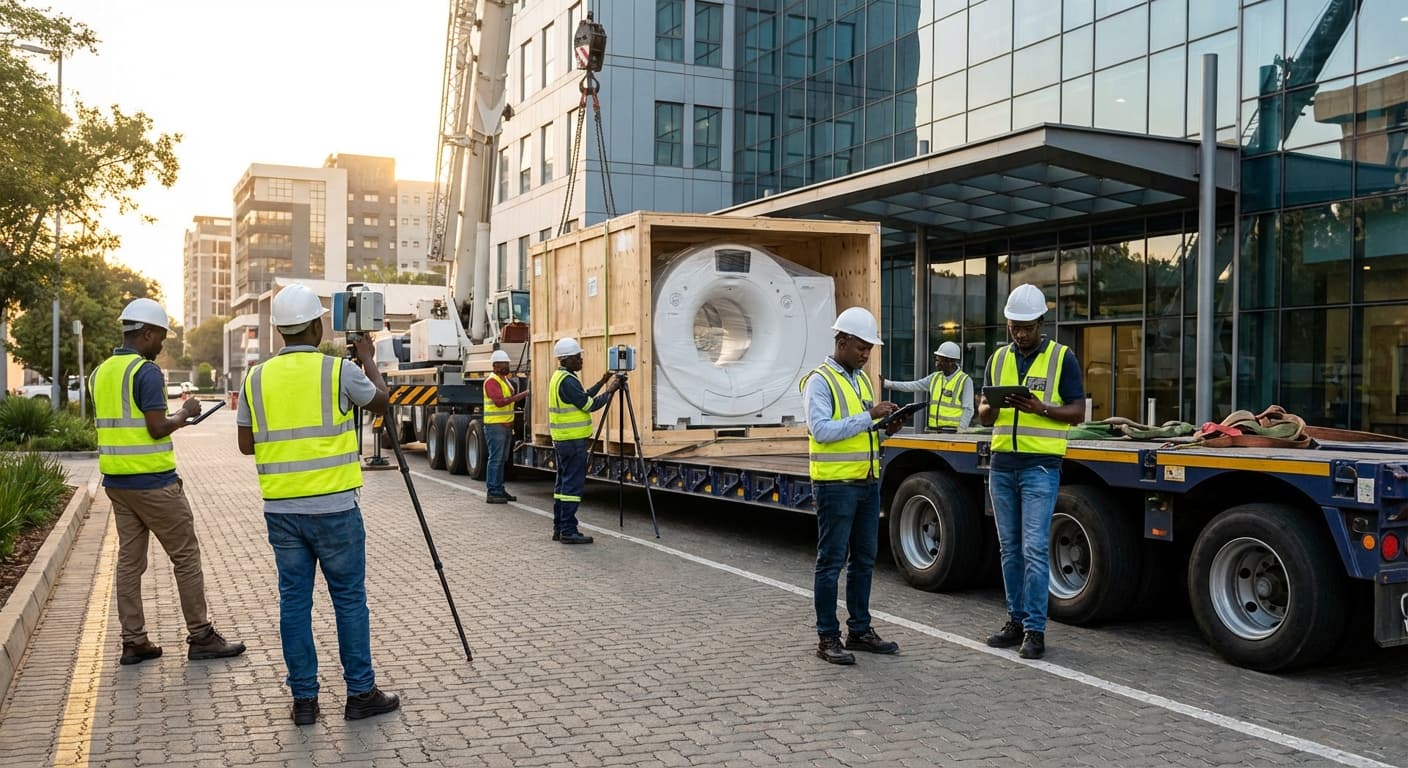
Route Survey & Rigging Plan Service for Heavy Medical Equipment in Malawi
Engineering Excellence & Technical Support
Route Survey & Rigging Plan Service for Heavy Medical Equipment High-standard technical execution following OEM protocols and local regulatory frameworks.
Optimized Route Assessment & Clearance
Our specialized team conducts meticulous on-ground surveys to identify and map the safest, most efficient routes for transporting heavy medical equipment across Malawi's diverse terrain. This includes precise identification of all potential obstacles such as bridges with weight/height restrictions, narrow roads, overhead power lines, and tight urban turns, ensuring regulatory compliance and minimizing transit risks.
Precision Rigging & Lift Planning
We develop bespoke rigging and lift plans tailored to the unique dimensions, weight, and center of gravity of each medical unit. Utilizing advanced engineering principles and state-of-the-art equipment, our certified riggers ensure secure loading, unloading, and positioning, safeguarding valuable equipment and personnel during complex handling operations at origin, transit points, and final installation sites.
Comprehensive Risk Analysis & Mitigation
Our service incorporates a proactive approach to risk identification and mitigation for every phase of the operation. We conduct thorough site assessments, environmental condition analysis (including weather patterns and ground stability), and develop contingency plans to address unforeseen challenges, thereby guaranteeing the integrity of the medical equipment and the safety of all stakeholders involved in its transport and installation in Malawi.
What Is Route Survey & Rigging Plan Service For Heavy Medical Equipment In Malawi?
Route Survey & Rigging Plan Service for Heavy Medical Equipment in Malawi refers to a specialized engineering and logistics undertaking focused on the safe and efficient transportation and installation of large, complex, and often delicate medical apparatus within Malawi. This service encompasses a multi-faceted approach to identify, assess, and mitigate all potential risks associated with moving such high-value assets from their point of origin (e.g., port of entry, warehouse) to their final operational destination within a healthcare facility. It is a critical component of project management for major medical infrastructure upgrades and the introduction of advanced diagnostic and therapeutic technologies.
| Who Needs This Service? | Typical Use Cases in Malawi |
|---|---|
| Healthcare Facilities (Public & Private): Hospitals, clinics, diagnostic centers, and specialized medical institutions undertaking upgrades or acquiring new advanced medical technology. | Installation of MRI scanners, CT scanners, linear accelerators, X-ray machines, large-scale laboratory equipment, and specialized surgical systems. |
| Government Ministries & Agencies: Ministries of Health responsible for national healthcare infrastructure development, public procurement of medical equipment, and ensuring equitable access to healthcare services. | Procurement and deployment of large medical equipment for public hospitals in remote or underserved areas, requiring extensive logistical planning. |
| International Development Organizations & NGOs: Organizations involved in supporting healthcare initiatives in Malawi through equipment donations or project funding. | Importation and installation of donated medical equipment to enhance local healthcare capacity, often requiring specialized logistical support due to limited local resources. |
| Medical Equipment Manufacturers & Suppliers: Companies responsible for delivering and installing their products to clients in Malawi. | Ensuring the safe and successful delivery and installation of complex medical equipment as part of their contractual obligations. |
| Project Management Firms: Companies overseeing large-scale construction or renovation projects involving the integration of new medical facilities or equipment. |
Key Components of Route Survey & Rigging Plan Service:
- Route Assessment: This involves a comprehensive survey of all potential transportation routes. It analyzes road conditions (surface quality, width, gradient, load-bearing capacity), bridge clearances, tunnel restrictions, overhead obstructions (power lines, tree branches), traffic patterns, and any necessary road modifications or temporary closures. The objective is to identify the most feasible and safest path, considering the dimensions, weight, and fragility of the medical equipment.
- Site Survey & Access Analysis: This component focuses on the destination facility. It includes detailed examination of building access points (doorways, corridors, elevators, stairwells), internal pathways, floor loading capacities, and the space available at the final installation site. Obstacles such as structural elements, existing equipment, and utility lines are meticulously documented. The survey also assesses the suitability of the installation environment for the specific equipment's operational requirements (e.g., environmental controls, power supply, radiation shielding).
- Rigging & Lifting Plan Development: Based on the route and site surveys, a detailed rigging and lifting plan is formulated. This plan specifies the types of lifting equipment (cranes, gantries, forklifts), slings, shackles, and other rigging gear required. It includes detailed schematics and procedures for lifting, maneuvering, and positioning the equipment, considering its center of gravity, weight distribution, and any sensitive components. Safety protocols and risk mitigation strategies are paramount in this stage.
- Transportation Logistics & Permitting: This involves the planning and execution of the actual movement of the equipment. It includes selecting appropriate transport vehicles (specialized trailers, trucks), coordinating with transport providers, and securing all necessary permits and authorizations from local authorities for oversized or overweight loads. Contingency planning for unforeseen delays or issues is also integral.
- Installation & Commissioning Support: While not always directly part of the 'survey and plan' phase, this service often extends to providing oversight and technical guidance during the actual installation and initial commissioning of the medical equipment to ensure it aligns with the developed plan.
- Risk Assessment & Mitigation: Throughout the entire process, a thorough risk assessment is conducted, identifying potential hazards such as equipment damage, personnel injury, infrastructure damage, and project delays. Corresponding mitigation strategies are then implemented.
Who Needs Route Survey & Rigging Plan Service For Heavy Medical Equipment In Malawi?
Ensuring the safe and precise installation of heavy medical equipment in Malawi requires specialized expertise. This is where comprehensive Route Survey and Rigging Plan Services become indispensable. These services are crucial for identifying potential obstacles, calculating load capacities, and designing the safest and most efficient pathways for transport and placement of sensitive and often oversized medical machinery. Without such meticulous planning, risks of damage to the equipment, infrastructure, and personnel are significantly elevated, leading to costly delays and potential health risks to patients.
| Customer Type | Key Departments/Personnel Involved | Specific Needs Addressed |
|---|---|---|
| Hospitals (Public & Private) | Facilities Management, Biomedical Engineering, Procurement Department, Clinical Department Heads (e.g., Radiology, Oncology), Operations Management | Safe delivery and installation of MRI scanners, CT scanners, linear accelerators, large X-ray machines, surgical robots, and other high-value, heavy equipment. Minimizing disruption to patient care during installation. Ensuring equipment is positioned optimally for clinical workflow and maintenance access. |
| Specialty Clinics & Diagnostic Centers | Clinic Administrators, Technical Staff, Procurement Officers, Operations Managers | Installation of specialized diagnostic imaging equipment (e.g., advanced ultrasound machines, PET scanners), laboratory equipment, and specialized treatment units. Ensuring secure and stable placement for accurate diagnostics and treatments. |
| Medical Equipment Suppliers/Distributors | Logistics Department, Project Managers, Installation Teams, Sales Representatives | Providing pre-installation surveys to confirm feasibility for their clients. Developing safe rigging and transportation plans to prevent damage during transit and installation. Meeting contractual obligations for 'turnkey' installations. |
| Government Health Ministries/Agencies | Procurement Units, Planning Departments, Infrastructure Divisions, Public Health Program Managers | Facilitating the rollout of new medical technologies across public health facilities. Ensuring that infrastructure upgrades and site preparations align with the requirements of procured heavy equipment. Standardizing safe installation practices for public health investments. |
| NGOs & International Aid Organizations | Program Managers, Logistics Coordinators, Project Engineers, Healthcare Advisors | Deploying essential medical equipment to remote or underserved areas. Assessing the accessibility of facilities and planning for challenging transportation routes. Ensuring the long-term functionality and safety of donated or procured medical technology. |
Target Customers and Departments for Route Survey & Rigging Plan Services for Heavy Medical Equipment in Malawi
- Hospitals (Public and Private)
- Specialty Clinics
- Diagnostic Centers
- Medical Equipment Suppliers/Distributors
- Government Health Ministries/Agencies
- Non-Governmental Organizations (NGOs) involved in healthcare provision
- International Aid Organizations
Route Survey & Rigging Plan Service For Heavy Medical Equipment Process In Malawi
This document outlines the comprehensive workflow for our Route Survey & Rigging Plan Service, specifically tailored for the transportation and installation of heavy medical equipment in Malawi. Our service ensures a safe, efficient, and compliant process from the initial client inquiry to the final execution and handover. We address the unique challenges of Malawi's infrastructure, including road conditions, bridge capacities, and site accessibility, to provide a robust and detailed plan.
| Phase | Description | Key Activities | Deliverables | Duration (Typical) |
|---|---|---|---|---|
| Understanding the client's specific needs, the type of medical equipment, and the intended destination in Malawi. | Receive client inquiry, understand equipment specifications (dimensions, weight, fragility), confirm destination details, discuss budget and timeline. | Initial project brief, preliminary scope of work. | 1-2 business days |
| Gathering critical on-the-ground information about the transportation route and the installation site. | Detailed site survey of destination (access points, building clearances, installation space), road network assessment (road conditions, bridge load capacities, overhead obstructions, turning radii), stakeholder consultations (local authorities, site personnel). | Comprehensive site survey report, photographic and video evidence, GPS coordinates. | 3-7 business days (depending on complexity and location) |
| Developing the safest and most efficient transportation route from port of entry/origin to the final installation site. | Analyzing survey data, identifying potential route constraints, selecting optimal routes, defining staging points, assessing feasibility of specialized transport (e.g., abnormal load vehicles). | Detailed route plan with maps, critical points of passage, estimated transit times, identified risks and mitigation strategies. | 2-4 business days |
| Creating a detailed plan for the safe and precise lifting, maneuvering, and installation of the medical equipment. | Calculating load weights and centers of gravity, selecting appropriate lifting equipment (cranes, hoists), designing rigging configurations, developing detailed lifting procedures, emergency response planning for rigging operations. | Comprehensive rigging and lifting plan, including method statements, equipment specifications, load charts, safety checklists, and personnel qualifications. | 3-5 business days |
| Obtaining all necessary permits and ensuring adherence to Malawian regulations for heavy transport and specialized installations. | Identifying required permits (e.g., road permits, escorts, weight/dimension clearances), submitting applications to relevant authorities (e.g., Ministry of Transport, local councils), liaising with police and traffic departments. | Approved permits, clearance letters from regulatory bodies, documentation of compliance. | Variable (can be significant, 1-4 weeks or more) |
| Preparing all resources and personnel for the execution phase. | Procuring and staging specialized transport vehicles, assembling rigging equipment, mobilizing trained personnel (riggers, crane operators, drivers, supervisors), conducting pre-job safety briefings. | Mobilization plan, equipment readiness reports, personnel deployment schedules. | 2-3 business days |
| Implementing the approved route and rigging plans to safely transport and install the equipment. | Executing transportation according to the route plan (including escorts and potential traffic management), conducting rigging and lifting operations as per the plan, real-time monitoring of safety and progress, immediate issue resolution. | Successful transportation and installation of equipment, site safety reports, progress updates. | Variable (depends on distance, complexity, and number of lifts) |
| Finalizing the project, ensuring client satisfaction, and closing out all documentation. | Site cleanup, equipment positioning confirmation, final safety inspection, client walk-through and acceptance, submission of final project report, documentation of any deviations or lessons learned. | Project completion certificate, final report, as-built drawings (if applicable), all project documentation. | 1-2 business days |
Service Workflow: Heavy Medical Equipment in Malawi
- Inquiry & Initial Consultation
- Site Assessment & Data Collection
- Route Planning & Optimization
- Rigging & Lifting Plan Development
- Permitting & Regulatory Compliance
- Pre-Execution Mobilization
- Execution: Transportation & Rigging
- Post-Execution & Handover
Route Survey & Rigging Plan Service For Heavy Medical Equipment Cost In Malawi
Providing comprehensive route survey and rigging plan services for heavy medical equipment in Malawi is a specialized undertaking. The cost is influenced by a multitude of factors, making precise pricing challenging without specific project details. However, understanding these factors allows for an informed estimation of potential costs. These services are critical to ensure the safe and efficient transport and installation of sensitive and often extremely heavy equipment, such as MRI machines, CT scanners, linear accelerators, and large hospital beds. The complexity of the route, the dimensions and weight of the equipment, the accessibility of the final destination, and the level of expertise required all contribute to the overall cost.
| Service Component | Estimated Cost Range (MWK - Malawi Kwacha) | Notes |
|---|---|---|
| Initial Route Survey & Assessment | 200,000 - 800,000 MWK | Covers initial site visits, data collection, and preliminary feasibility. |
| Detailed Rigging Plan Development | 300,000 - 1,500,000 MWK | Includes detailed schematics, load calculations, and step-by-step procedures. Varies with equipment complexity. |
| Specialized Transport & Logistics (Example: MRI/CT Scanner) | 1,500,000 - 10,000,000+ MWK | This is a significant portion, covering specialized vehicles, escorts, and potential road adaptations. Highly dependent on distance and route. |
| Rigging Crew & Equipment Hire (Example: Crane Hire) | 500,000 - 3,000,000+ MWK | Cost per day/week for skilled rigging team and necessary lifting machinery. Varies by equipment size and duration. |
| Permits, Approvals & Insurance | 200,000 - 1,000,000 MWK | Includes official fees and comprehensive insurance coverage. |
| Contingency Buffer | 10% - 20% of total project cost | Recommended for unforeseen issues. |
| Total Estimated Project Cost (Ballpark for Complex Medical Equipment) | 5,000,000 - 25,000,000+ MWK | This is a very broad estimate. Actual costs will be determined by a detailed proposal based on specific project requirements. |
Key Pricing Factors for Route Survey & Rigging Plan Services in Malawi:
- Equipment Specifications: The size, weight, fragility, and specific handling requirements of the medical equipment are paramount. Larger, heavier, or more delicate items necessitate more specialized equipment and expertise.
- Route Complexity and Distance: The length of the route, road conditions (paved, unpaved, mountainous, urban, rural), potential obstacles (bridges, power lines, narrow streets, traffic congestion), and the need for temporary road modifications or permits will significantly impact costs.
- Site Accessibility: The ease of access to the final installation site is crucial. This includes the presence of suitable entry points, sufficient clearance, and the need for specialized lifting equipment at the destination.
- Survey and Planning Rigor: The depth of the route survey, the level of detail in the rigging plan, and the number of site visits required will influence the professional time involved.
- Specialized Equipment and Personnel: The type and quantity of specialized rigging equipment (cranes, forklifts, dollies, specialized transport vehicles) and the number of experienced rigging technicians and engineers required will be factored in.
- Permits and Approvals: Obtaining necessary permits for oversized loads, road closures, and any local authority approvals will add to the administrative and potentially direct costs.
- Insurance: Adequate insurance coverage for the equipment, transport, and personnel is a non-negotiable cost component.
- Contingency Planning: The complexity of the operation may necessitate contingency plans for unforeseen circumstances, adding to the planning cost.
- Geographical Location within Malawi: The cost might vary slightly depending on the remoteness of the delivery location within Malawi, influencing logistics and travel time for the team.
- Urgency and Timeline: Expedited services or tight deadlines may incur premium charges.
Affordable Route Survey & Rigging Plan Service For Heavy Medical Equipment Options
Navigating the complex logistics of transporting and installing heavy medical equipment requires a specialized approach. Our Affordable Route Survey & Rigging Plan Service is designed to provide comprehensive solutions tailored to your specific needs, ensuring safety, compliance, and cost-effectiveness. We understand that budget is a critical factor for healthcare facilities, and our service prioritizes delivering high-quality planning at competitive prices. This includes meticulous route assessment to identify the safest and most efficient pathways, detailed rigging plans for secure lifting and maneuvering, and expert guidance to navigate regulatory requirements. Our value proposition lies in proactive planning, minimizing risks, and ultimately saving you significant costs associated with unforeseen challenges, damages, delays, and non-compliance.
| Cost-Saving Strategy | Description | Example Benefit |
|---|---|---|
| Proactive Risk Assessment | Identifying potential hazards and challenges before they occur during transport and installation. | Avoids costly delays, equipment damage, and potential injuries. |
| Optimized Route Selection | Choosing the most efficient and safest transport path, considering bridge clearances, road conditions, and traffic. | Reduces fuel consumption, wear and tear on transport vehicles, and transit time. |
| Detailed Rigging Methodologies | Developing precise plans for lifting, securing, and maneuvering heavy equipment, utilizing appropriate tools and techniques. | Prevents damage to the equipment and the facility, minimizes installation time, and ensures worker safety. |
| Regulatory Compliance Guidance | Ensuring all plans adhere to local, state, and federal regulations and permit requirements. | Avoids fines, legal issues, and project stoppations. |
| Reduced Demurrage & Storage Costs | Efficient planning leads to timely delivery and installation, minimizing the need for extended equipment storage. | Saves money on storage fees and avoids potential spoilage or damage in storage. |
| Minimized Need for Emergency Services | Thorough planning reduces the likelihood of accidents or unforeseen issues requiring costly emergency interventions. | Avoids expenses related to emergency repairs, specialized transport, or medical assistance. |
Understanding Our Value Bundles and Cost-Saving Strategies
- Core Route Survey & Rigging Plan: This foundational package includes a detailed assessment of your transport route, identifying potential obstacles, clearance issues, and necessary permits. It also encompasses a comprehensive rigging plan outlining the equipment, techniques, and safety protocols required for the installation. This bundle is ideal for standard equipment and straightforward installations, offering a cost-effective baseline for your project.
- Comprehensive Logistics Integration Bundle: This advanced package builds upon the core service by integrating route and rigging planning with broader logistical considerations. This can include coordination with third-party transport providers, preliminary site assessments at both origin and destination, and communication strategies for all stakeholders. This bundle is best suited for complex equipment or projects involving multiple locations and dependencies, offering a more holistic approach to minimize overall project costs.
- Expedited Planning & On-Site Support Bundle: For urgent installations or projects with tight deadlines, this bundle prioritizes rapid assessment and planning. It includes accelerated survey timelines and the option for on-site consultation during critical rigging phases. While this may have a higher upfront cost due to expedited services, it can prevent costly delays and the financial repercussions of extended downtime for critical medical equipment.
- Customized Solution Design: We recognize that every project is unique. We offer the flexibility to tailor any of our bundles or create a bespoke service package to precisely match your equipment, site conditions, and budget. This consultative approach ensures you only pay for the services you truly need.
- Risk Mitigation & Insurance Optimization: Our detailed route surveys and rigging plans are crucial for identifying and mitigating potential risks. This proactive approach can lead to lower insurance premiums by demonstrating a commitment to safety and preventing costly incidents that would otherwise impact your insurance claims and costs.
- Technology Integration & Efficiency: We leverage advanced surveying tools and software to ensure accuracy and efficiency in our planning. This reduces the time and resources required for on-site assessments and allows for more precise plan development, translating into cost savings for you.
- Expert Consultation & Knowledge Transfer: Our experienced team provides invaluable insights and guidance throughout the process. This expertise helps avoid costly mistakes and ensures compliance with all relevant regulations, preventing potential fines or project setbacks.
Verified Providers In Malawi
In Malawi, finding reliable and accredited healthcare providers is crucial for ensuring quality care. Franance Health has established itself as a leading organization that rigorously vets and verifies healthcare professionals and facilities. This commitment to credentialing offers patients peace of mind, knowing they are engaging with providers who meet the highest standards of competence, ethical practice, and patient safety. This document outlines Franance Health's verification process and highlights why their credentialed providers are the superior choice for your healthcare needs in Malawi.
| Verification Component | Description | Benefit to Patient |
|---|---|---|
| Licensing and Certification Review | Thorough examination of current and valid medical licenses and board certifications from recognized regulatory bodies. | Confirms legal authorization to practice and specialized expertise. |
| Educational Background Verification | Confirmation of degrees, diplomas, and training from accredited institutions. | Ensures a strong foundational education in medical sciences. |
| Professional Experience Assessment | Review of work history, including roles, responsibilities, and duration of practice. | Guarantees practical experience and familiarity with diverse patient cases. |
| Sanctions and Disciplinary History Check | Inquiries into any past or present disciplinary actions from professional boards or regulatory agencies. | Protects patients from practitioners with a history of misconduct. |
| Criminal Background Checks (where applicable) | Screening for any relevant criminal convictions that could impact patient trust and safety. | Promotes a safe and secure healthcare environment. |
| Peer Reviews and References | Gathering feedback from colleagues and supervisors to assess clinical competence and professional conduct. | Provides qualitative insights into a provider's capabilities and ethical standing. |
| Continuing Professional Development (CPD) Compliance | Verification of ongoing participation in educational activities to maintain and enhance skills. | Ensures providers are up-to-date with the latest medical advancements and practices. |
Why Choose Franance Health Verified Providers:
- Uncompromised Quality of Care: Franance Health's stringent verification process ensures that all credentialed providers possess the necessary qualifications, experience, and ongoing professional development required to deliver excellent healthcare.
- Enhanced Patient Safety: Verification includes checks on licensing, certifications, and adherence to ethical guidelines, minimizing risks and ensuring a safe healthcare environment.
- Trust and Transparency: Franance Health provides a transparent system where patients can confidently identify and access healthcare professionals who have undergone rigorous scrutiny.
- Access to Specialized Expertise: The verification process extends to specialized medical fields, allowing patients to find highly skilled professionals for specific health concerns.
- Reduced Risk of Medical Errors: By partnering with verified providers, patients are more likely to receive accurate diagnoses and effective treatment plans, reducing the likelihood of errors.
Scope Of Work For Route Survey & Rigging Plan Service For Heavy Medical Equipment
This Scope of Work (SOW) outlines the services required for a comprehensive route survey and rigging plan for the transportation and installation of heavy medical equipment. The objective is to ensure the safe, efficient, and compliant movement and placement of critical medical assets from their delivery point to their final installation location within the facility. This document details the technical deliverables and standard specifications to be adhered to throughout the project.
| Deliverable | Description | Standard Specifications / Requirements |
|---|---|---|
| Detailed Route Survey Report | Comprehensive documentation of the proposed transportation routes, including all internal and external pathways, potential obstacles, and access points. | Minimum scale of 1:500, clear identification of all physical constraints (e.g., door widths, ceiling heights, floor load capacities, aisle widths, turn radii, elevator dimensions, ramp gradients), photographic evidence of key challenges, and identification of any required temporary modifications. |
| Rigging Plan | A detailed, step-by-step plan outlining the procedures for lifting, moving, and positioning the heavy medical equipment safely. | Includes equipment specifications (weight, dimensions, center of gravity), lifting points, rigging gear selection (slings, shackles, spreader bars), load calculations, required personnel with roles and responsibilities, safety procedures, emergency response plan, and method statements for each critical lift. |
| Risk Assessment and Mitigation Plan | Identification of potential risks associated with the route survey and rigging operations, along with proposed mitigation strategies. | Includes hazard identification, risk analysis (likelihood and severity), control measures, contingency plans, and safety protocols. Must comply with relevant occupational health and safety regulations. |
| Equipment Specification Sheet | Detailed technical specifications of the heavy medical equipment to be moved, including weight, dimensions, center of gravity, and any special handling requirements. | Provided by the equipment manufacturer, including drawings and CAD models if available. |
| Final Report and As-Built Documentation | A comprehensive report summarizing all project activities, including any deviations from the original plan, lessons learned, and as-built drawings or site modifications. | Includes photographic evidence of the final installation, confirmation of successful equipment placement, and sign-off by all relevant stakeholders. |
| Site Preparation Recommendations | Recommendations for any necessary site modifications or preparations to facilitate the safe movement and installation of the equipment. | Clear, actionable recommendations for structural reinforcements, temporary pathway clearing, or electrical/mechanical service adjustments. |
| Communication Plan | A plan outlining communication protocols and contact points for all stakeholders throughout the project. | Includes regular progress reports, escalation procedures, and contact information for key personnel. |
Project Phases and Activities
- Phase 1: Route Survey and Assessment
- Phase 2: Rigging Plan Development
- Phase 3: Site Preparation and Equipment Loading
- Phase 4: Transportation
- Phase 5: Equipment Unloading and Placement
- Phase 6: Documentation and Handover
Service Level Agreement For Route Survey & Rigging Plan Service For Heavy Medical Equipment
This Service Level Agreement (SLA) outlines the response times and uptime guarantees for the Route Survey & Rigging Plan Service for Heavy Medical Equipment provided by [Your Company Name] (hereinafter referred to as 'Provider') to [Client Company Name] (hereinafter referred to as 'Client'). This SLA is an integral part of the Master Service Agreement (MSA) between the Provider and the Client.
| Service Component | Response Time Target (Business Hours) | Uptime Guarantee |
|---|---|---|
| Acknowledgement of Service Request | 2 Business Hours | N/A |
| Initial Consultation/Information Gathering | 8 Business Hours (after acknowledgement) | N/A |
| On-site Route Survey (Dependent on Client Availability and Site Access) | Within 3 Business Days of Site Availability Confirmation | N/A |
| Delivery of Draft Rigging Plan | 5 Business Days (after completion of on-site survey) | N/A |
| Revision of Rigging Plan (based on Client feedback) | 2 Business Days (per round of revisions) | N/A |
| Final Delivery of Rigging Plan | Upon Client Approval of Draft | N/A |
| Service Availability (for submission and access to plans) | N/A | 99.5% |
Key Service Definitions
- Service Request: A formal request submitted by the Client to the Provider for a Route Survey & Rigging Plan for specific heavy medical equipment.
- Initiation of Response Time: The point at which the Provider acknowledges receipt of a complete and valid Service Request.
- Resolution: The completion of the Route Survey & Rigging Plan to the agreed-upon specifications and delivery to the Client.
- Downtime: Any period during which the Client is unable to access or utilize the Provider's service for submitting and receiving Route Survey & Rigging Plans due to an error or failure on the Provider's part.
- Uptime: The percentage of time the Provider's service is available and operational for the Client.
Frequently Asked Questions

Ready when you are
Let's scope your Route Survey & Rigging Plan Service for Heavy Medical Equipment in Malawi project in Malawi.

Scaling healthcare logistics and technical systems across the entire continent.