
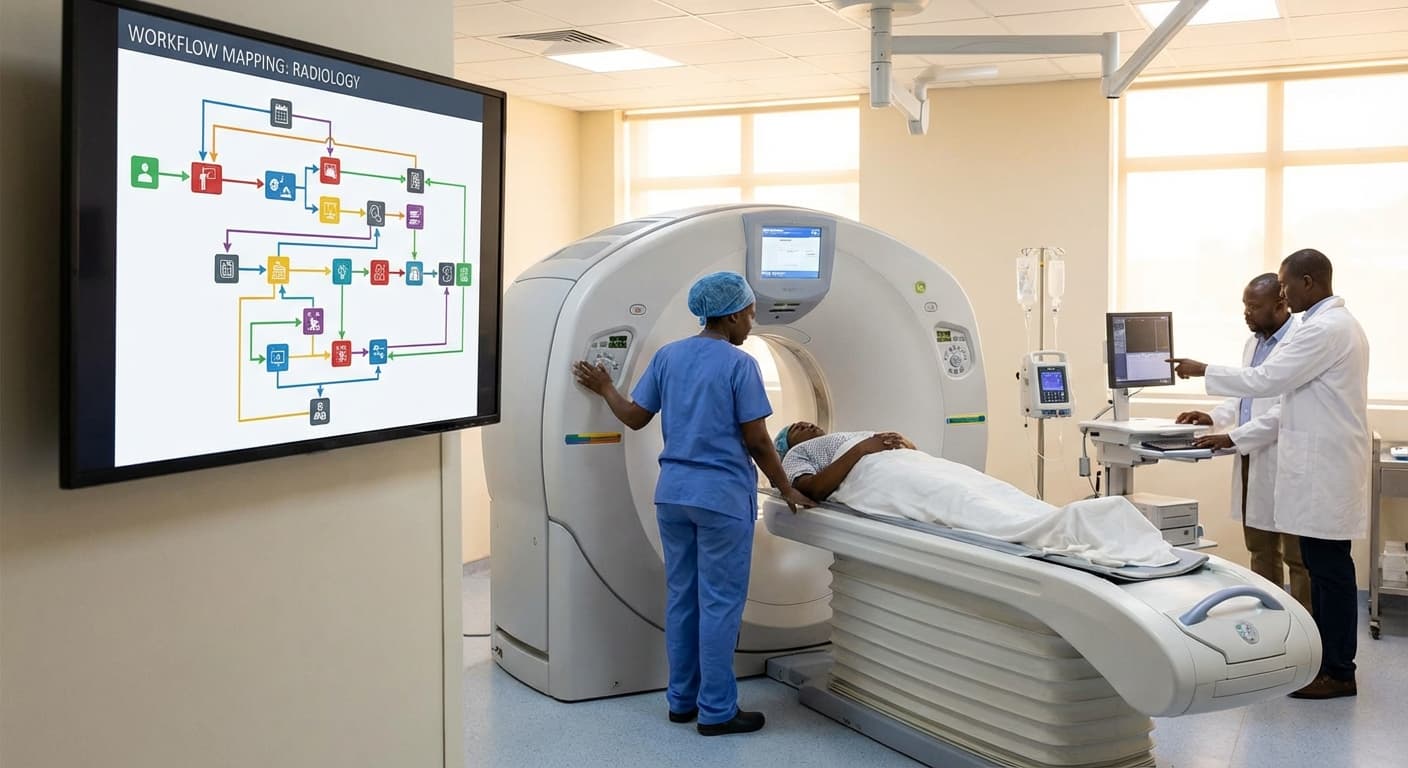
Department Workflow Mapping Service (Radiology/ICU/OT/Lab/Dialysis) in Malawi
Engineering Excellence & Technical Support
Department Workflow Mapping Service (Radiology/ICU/OT/Lab/Dialysis) High-standard technical execution following OEM protocols and local regulatory frameworks.
Streamlined Radiology Patient Journey
Visualizing the entire patient pathway from referral to image interpretation and reporting in Malawian hospitals. This highlights bottlenecks, improves turnaround times for critical diagnostics, and ensures timely patient management, especially in resource-limited settings.
Optimized ICU Patient Flow and Resource Allocation
Mapping the complex movement of critically ill patients within Malawian ICUs. Identifies critical care unit capacity, equipment availability, and staff deployment needs, leading to more efficient patient care, reduced waiting times, and better outcomes.
Enhanced Operating Theatre (OT) Scheduling and Efficiency
Detailed mapping of OT workflows, from patient pre-op assessment to post-operative recovery. Pinpoints inefficiencies in scheduling, resource utilization (staff, equipment), and patient throughput, enabling smoother surgical procedures and increased capacity in Malawian surgical units.
What Is Department Workflow Mapping Service (Radiology/icu/ot/lab/dialysis) In Malawi?
Department Workflow Mapping Service (Radiology/ICU/OT/Lab/Dialysis) in Malawi refers to a systematic process of documenting, analyzing, and optimizing the operational sequences and interdependencies within critical hospital departments. This service leverages standardized methodologies and often employs specialized software tools to visualize the flow of patients, information, materials, and staff through various stages of care delivery. The primary objective is to identify bottlenecks, inefficiencies, redundancies, and potential points of failure, thereby enabling informed decision-making for process improvement, resource allocation, and enhanced service quality. The service is crucial for healthcare institutions seeking to standardize practices, improve patient outcomes, reduce operational costs, and ensure compliance with national and international healthcare standards within the Malawian context.
| Department | Who Needs the Service? | Typical Use Cases |
|---|---|---|
| Radiology | Radiology departments facing long patient wait times for imaging, inconsistent reporting turnaround, or challenges with equipment utilization. | Optimizing patient throughput for X-ray, CT, MRI, and ultrasound examinations; improving report generation and distribution workflows; enhancing referral management. |
| Intensive Care Unit (ICU) | ICUs experiencing high staff workload, medication errors, communication breakdowns between shifts, or delays in critical care interventions. | Mapping critical care pathways; optimizing patient handover protocols; streamlining equipment and supply management; improving interdisciplinary team communication. |
| Operating Theatre (OT) | OTs with scheduling conflicts, long patient preparation times, instrument sterilization bottlenecks, or inefficiencies in post-operative patient transfer. | Streamlining pre-operative patient assessment and preparation; optimizing surgical scheduling and room utilization; improving instrument turnaround time; enhancing post-anesthesia care unit (PACU) integration. |
| Laboratory | Laboratories with delayed test results, high error rates in sample handling or analysis, or inefficient specimen collection and transportation. | Optimizing specimen accessioning and tracking; improving sample processing and testing workflows; standardizing quality control procedures; enhancing result reporting and communication. |
| Dialysis | Dialysis centers with long patient waitlists, inefficient patient scheduling, challenges with equipment maintenance, or issues with medication administration. | Improving patient scheduling and chair utilization; streamlining pre- and post-dialysis procedures; optimizing fluid and medication management; enhancing staff-patient interaction efficiency. |
Service Components and Activities
- Process Identification and Definition: Detailed breakdown of all sub-processes within a specific department (e.g., patient registration in Radiology, pre-operative checks in OT).
- Data Collection and Observation: Gathering data through direct observation, interviews with staff, review of existing documentation, and potentially system logs.
- Workflow Visualization: Creation of graphical representations (e.g., flowcharts, swimlane diagrams, process maps) illustrating the sequence of activities, decision points, and roles.
- Analysis and Evaluation: Identification of performance metrics, critical paths, idle times, resource utilization patterns, and deviations from intended workflows.
- Bottleneck and Inefficiency Identification: Pinpointing areas of delay, congestion, or non-value-adding activities.
- Recommendations for Improvement: Development of actionable strategies to streamline processes, reduce errors, improve communication, and optimize resource allocation.
- Implementation Support: Guidance and facilitation in implementing the proposed workflow changes.
- Monitoring and Re-evaluation: Establishing mechanisms for ongoing assessment of implemented changes and periodic re-mapping to ensure sustained efficiency.
Who Needs Department Workflow Mapping Service (Radiology/icu/ot/lab/dialysis) In Malawi?
In Malawi, optimizing operational efficiency within critical hospital departments is paramount to delivering high-quality patient care. A dedicated Department Workflow Mapping Service for Radiology, Intensive Care Units (ICU), Operating Theatres (OT), Laboratories, and Dialysis centers offers significant benefits. This service helps identify bottlenecks, streamline processes, improve resource allocation, and enhance overall patient throughput and safety. By visualizing and analyzing current workflows, these departments can implement targeted improvements, leading to reduced wait times, minimized errors, and more effective utilization of skilled personnel and expensive equipment.
| Department | Key Challenges Addressed by Workflow Mapping | Specific Benefits |
|---|---|---|
| Radiology | Long patient wait times for imaging appointments and results; inefficient equipment scheduling; communication gaps between radiologists and referring physicians; inadequate patient preparation protocols. | Reduced turnaround times for imaging reports; optimized equipment utilization; improved radiologist-clinician communication; enhanced patient satisfaction. |
| ICU | Inconsistent patient handover procedures; communication breakdowns between nursing staff, physicians, and specialists; delays in critical interventions; suboptimal medication administration pathways; inefficient bed management. | Improved patient safety during handovers; standardized critical care protocols; faster response to patient deterioration; reduced medical errors; efficient ICU bed utilization. |
| Operating Theatres (OT) | Delays in patient scheduling and room turnover; insufficient or poorly coordinated surgical team communication; issues with instrument and supply management; bottlenecks in post-operative recovery. | Increased surgical case throughput; reduced operating room downtime; enhanced surgical team efficiency and safety; optimized instrument and supply availability; smoother patient transition to recovery. |
| Laboratory | Specimen collection and transport delays; inefficient sample processing workflows; long turnaround times for test results; reagent and equipment maintenance issues; communication issues with clinical staff. | Faster and more accurate diagnostic test results; reduced sample rejection rates; optimized laboratory resource allocation; improved communication of critical results; enhanced laboratory staff productivity. |
| Dialysis | Long patient wait times for dialysis sessions; inefficient scheduling of dialysis machines and staff; issues with patient preparation and post-treatment monitoring; challenges in managing patient flow within the unit. | Minimized patient wait times for dialysis; maximized dialysis machine and staff utilization; improved patient comfort and safety during treatment; streamlined patient flow within the dialysis unit; increased dialysis capacity. |
Who Needs Department Workflow Mapping Service in Malawi? (Target Customers & Departments)
- {"items":["Public Hospitals (Ministry of Health)","Private Hospitals","Tertiary Referral Centers","Mission Hospitals","Hospital Administration and Management Teams","Department Heads and Managers","Quality Improvement and Patient Safety Officers"],"title":"Target Customers:"}
- {"items":["Radiology Departments (X-ray, CT scans, MRI, Ultrasound)","Intensive Care Units (ICUs)","Operating Theatres (OTs)","Clinical Laboratories (Pathology, Hematology, Biochemistry, Microbiology)","Dialysis Units"],"title":"Target Departments:"}
Department Workflow Mapping Service (Radiology/icu/ot/lab/dialysis) Process In Malawi
This document outlines the standard workflow for the Department Workflow Mapping Service, specifically tailored for key departments within healthcare facilities in Malawi, including Radiology, Intensive Care Unit (ICU), Operating Theatre (OT), Laboratory, and Dialysis. The service aims to analyze, document, and optimize existing departmental processes. The workflow begins with an initial inquiry from a healthcare facility and culminates in the delivery of a comprehensive workflow map and recommendations.
| Stage | Activity | Description | Responsible Party | Deliverable/Outcome |
|---|---|---|---|---|
| Initial Contact | Healthcare facility expresses interest in workflow mapping services. | Client (Facility) | Expression of Interest |
| Needs Discussion | Understanding the specific departmental challenges, objectives, and desired outcomes of the mapping exercise. | Client (Facility) & Service Provider | Initial understanding of needs | |
| Scope Identification | Clearly defining the departments, processes, and boundaries to be mapped. | Service Provider & Client (Facility) | Agreed scope of work |
| Proposal Development | Outlining methodology, timeline, resources required, and cost for the service. | Service Provider | Formal proposal | |
| Agreement and Contract | Formal agreement on terms, deliverables, and payment schedule. | Client (Facility) & Service Provider | Signed contract | |
| Process Observation | Direct observation of daily operations within the targeted departments (Radiology, ICU, OT, Lab, Dialysis). | Service Provider | First-hand process understanding |
| Stakeholder Interviews | Conducting interviews with staff at all levels (clinicians, technicians, administrators, support staff) to gather insights. | Service Provider | Qualitative data on roles, tasks, and pain points | |
| Document Review | Examining existing SOPs, guidelines, forms, and relevant documentation. | Service Provider | Understanding of documented procedures | |
| Data Synthesis | Consolidating and organizing all collected data. | Service Provider | Organized raw data | |
| Process Flowchart Creation | Developing detailed visual representations (flowcharts, diagrams) of current state workflows using standard notation (e.g., BPMN). | Service Provider | Current State Workflow Maps |
| Identification of Bottlenecks and Inefficiencies | Analyzing the maps to pinpoint areas of delay, duplication, or suboptimal resource utilization. | Service Provider | List of identified bottlenecks and inefficiencies | |
| Draft Map Presentation | Presenting the draft workflow maps and initial findings to departmental stakeholders. | Service Provider | Draft workflow maps and preliminary analysis |
| Feedback Collection | Gathering feedback and verifying the accuracy and completeness of the mapped workflows. | Client (Facility) & Service Provider | Validated workflow maps | |
| Revision | Incorporating stakeholder feedback and making necessary adjustments to the maps. | Service Provider | Revised workflow maps | |
| Final Report Compilation | Creating a comprehensive report including detailed workflow maps, analysis of inefficiencies, and recommendations for improvement. | Service Provider | Comprehensive Workflow Mapping Report |
| Presentation of Findings | Presenting the final report and recommendations to the facility management and relevant department heads. | Service Provider | Understanding of proposed improvements | |
| Delivery of Final Artifacts | Providing the final digital and/or hard copies of the workflow maps and report. | Service Provider | Final Workflow Maps and Report | |
| Implementation Planning | Assisting the facility in developing a plan to implement recommended process improvements. | Service Provider & Client (Facility) | Implementation plan (if requested) |
| Training | Providing training to staff on new or revised workflows and best practices. | Service Provider | Trained staff | |
| Monitoring and Evaluation | Assisting in tracking the impact and effectiveness of implemented changes. | Service Provider & Client (Facility) | Performance metrics and evaluation reports |
Workflow Stages
- Inquiry and Needs Assessment
- Scope Definition and Proposal
- Data Collection and Analysis
- Workflow Mapping and Visualization
- Validation and Feedback
- Report Generation and Delivery
- Implementation Support (Optional)
Department Workflow Mapping Service (Radiology/icu/ot/lab/dialysis) Cost In Malawi
The cost of Department Workflow Mapping services in Malawi for specialized units like Radiology, Intensive Care Unit (ICU), Operating Theatre (OT), Laboratory, and Dialysis can vary significantly. This service is crucial for optimizing efficiency, reducing errors, and improving patient outcomes within these critical healthcare departments. The pricing is not standardized and is influenced by several key factors.
Key Pricing Factors:
| Department Type | Estimated Cost Range (MWK) |
|---|---|
| Small to Medium Radiology Department | MWK 1,500,000 - MWK 4,000,000 |
| Large/Comprehensive Radiology Department | MWK 3,000,000 - MWK 7,000,000 |
| Small to Medium ICU | MWK 1,800,000 - MWK 4,500,000 |
| Large/High-Capacity ICU | MWK 3,500,000 - MWK 8,000,000 |
| Small to Medium OT | MWK 2,000,000 - MWK 5,000,000 |
| Large/Multi-Theatre OT | MWK 4,000,000 - MWK 9,000,000 |
| Small to Medium Laboratory | MWK 1,200,000 - MWK 3,500,000 |
| Large/Specialized Laboratory (e.g., Public Health Reference Lab) | MWK 2,500,000 - MWK 6,000,000 |
| Small to Medium Dialysis Unit | MWK 1,000,000 - MWK 3,000,000 |
| Large/Multi-station Dialysis Unit | MWK 2,000,000 - MWK 5,000,000 |
Factors Influencing Department Workflow Mapping Costs in Malawi:
- {"title":"Scope and Complexity of the Department:","description":"Larger departments with more intricate processes, a higher volume of patient throughput, and a greater number of staff will naturally require more time and resources to map, thus increasing costs. For example, mapping a comprehensive Radiology department with multiple imaging modalities and specialized procedures will be more involved than a smaller, focused laboratory."}
- {"title":"Number of Staff Involved:","description":"The number of personnel whose workflows need to be observed, interviewed, and analyzed directly impacts the time investment. More staff means more data collection and more stakeholders to engage."}
- {"title":"Current State of Documentation:","description":"If the department has well-documented existing workflows, the mapping process might be faster. Conversely, departments with little to no formal documentation will require extensive observation and information gathering, driving up costs."}
- {"title":"Consultant Expertise and Experience:","description":"The reputation, experience, and specialized knowledge of the consulting firm or individual performing the mapping are critical. Highly experienced consultants with a proven track record in healthcare workflow optimization will command higher fees."}
- {"title":"Duration of the Project:","description":"The time required for the entire mapping project, from initial assessment to final report and recommendations, will directly influence the overall cost. This includes time for site visits, data analysis, report writing, and stakeholder meetings."}
- {"title":"Deliverables Required:","description":"The depth and format of the final deliverables will impact pricing. This could range from basic flowcharts to detailed process maps, standard operating procedures (SOPs), and implementation roadmaps. The inclusion of training or change management support will also add to the cost."}
- {"title":"Geographic Location within Malawi:","description":"While less of a primary driver, travel and accommodation expenses for consultants if the facility is in a remote location can contribute to the overall cost."}
- {"title":"Technology and Tools Used:","description":"Some consultants may utilize specialized software or tools for workflow mapping and analysis, which can be factored into their pricing."}
Affordable Department Workflow Mapping Service (Radiology/icu/ot/lab/dialysis) Options
Our Affordable Department Workflow Mapping Service offers a comprehensive solution for optimizing operations across critical hospital departments. We understand the unique challenges and demands of Radiology, Intensive Care Units (ICU), Operating Theatres (OT), Laboratories, and Dialysis centers. Our service provides detailed analysis and visualization of existing workflows, identifying bottlenecks, inefficiencies, and areas for improvement. By mapping your current processes, we empower your department to streamline operations, reduce waste, enhance patient care, and achieve significant cost savings.
| Cost-Saving Strategy | Description | Impact on Workflow |
|---|---|---|
| Bottleneck Identification & Resolution | Pinpointing areas of congestion in processes to ensure smooth and continuous flow. | Reduces patient wait times, improves staff productivity, and accelerates service delivery. |
| Redundant Process Elimination | Identifying and removing unnecessary or overlapping steps in existing workflows. | Saves staff time, reduces errors, and minimizes resource expenditure. |
| Resource Optimization | Analyzing the utilization of equipment, staff, and supplies to ensure efficient allocation. | Minimizes idle time, reduces overtime, and lowers equipment wear and tear. |
| Improved Communication Pathways | Mapping and clarifying communication channels to prevent information silos and delays. | Enhances interdepartmental collaboration, reduces medical errors, and speeds up decision-making. |
| Standardized Procedures | Developing clear, documented, and repeatable procedures for common tasks. | Ensures consistency, reduces variation, and simplifies training. |
| Technology Integration Analysis | Assessing opportunities to leverage technology for automation and data management. | Increases efficiency, improves data accuracy, and frees up staff for higher-value tasks. |
Value Bundles for Department Workflow Mapping
- {"title":"Core Workflow Mapping","description":"Basic mapping of key departmental processes, including patient flow, resource allocation, and communication pathways. Ideal for departments seeking initial insights and a foundational understanding of their operations."}
- {"title":"Enhanced Optimization Bundle","description":"Includes Core Workflow Mapping plus detailed analysis of specific pain points, identification of redundant steps, and preliminary recommendations for improvement. Suitable for departments ready to tackle specific inefficiencies."}
- {"title":"Comprehensive Transformation Package","description":"Our most extensive offering, encompassing full workflow mapping, in-depth bottleneck analysis, root cause identification, development of optimized workflows, and implementation guidance. Designed for departments seeking a complete operational overhaul and sustainable efficiency gains."}
- {"title":"Department-Specific Packages","description":"Tailored packages for Radiology (imaging throughput, reporting), ICU (patient admission/discharge, critical care pathways), OT (scheduling, surgical team coordination), Lab (sample processing, result turnaround), and Dialysis (patient scheduling, treatment protocols). These bundles focus on the most impactful workflows for each specialized area."}
Verified Providers In Malawi
Finding reliable and trustworthy healthcare providers is paramount, especially when navigating a new health system. In Malawi, Franance Health has emerged as a leading entity dedicated to connecting individuals with verified, high-quality healthcare professionals and facilities. This commitment to vetting and credentialing sets Franance Health apart, ensuring that their listed providers meet rigorous standards of expertise, ethical practice, and patient safety. Choosing a provider recommended by Franance Health means opting for assurance, transparency, and ultimately, the best possible care.
| Provider Type | Franance Health Verification Criteria | Benefits of Choosing a Franance Health Verified Provider |
|---|---|---|
| General Practitioners | Valid medical license, at least 3 years of clinical experience, clean disciplinary record. | Reliable first point of contact for common ailments, access to referrals for specialized care. |
| Specialist Physicians (e.g., Cardiologists, Pediatricians) | Board certification in their specialty, extensive experience in their field, demonstrable expertise. | Access to expert diagnosis and treatment for complex medical conditions, advanced care options. |
| Hospitals & Clinics | Accreditation by relevant health bodies, adherence to safety protocols, qualified medical staff, modern facilities. | Safe and sterile environment, comprehensive medical services, access to advanced diagnostic and treatment equipment. |
| Dentists | Dental license, continuing education in dentistry, adherence to sterilization and infection control standards. | Effective oral health management, pain relief, preventative dental care. |
| Pharmacists | Pharmacy license, knowledge of drug interactions and dosages, patient counseling skills. | Safe dispensing of medications, expert advice on prescriptions and over-the-counter drugs. |
Why Franance Health Credentials Matter:
- Rigorous Vetting Process: Franance Health employs a comprehensive screening process that goes beyond basic qualifications, examining professional licenses, educational backgrounds, and practical experience.
- Commitment to Ethical Standards: Providers listed by Franance Health are expected to adhere to the highest ethical codes of conduct, prioritizing patient well-being and confidentiality.
- Focus on Patient Outcomes: The credentialing process often includes an assessment of a provider's track record and commitment to achieving positive patient health outcomes.
- Enhanced Patient Trust and Confidence: Knowing that a provider has been verified by a reputable organization like Franance Health significantly boosts patient confidence and reduces anxiety.
- Access to Specialized Care: Franance Health helps identify specialists with specific expertise, ensuring you are matched with the right professional for your unique medical needs.
- Up-to-Date Information: Franance Health maintains up-to-date databases, providing access to current credentials and contact information for their network of providers.
Scope Of Work For Department Workflow Mapping Service (Radiology/icu/ot/lab/dialysis)
This Scope of Work outlines the services required for a comprehensive workflow mapping initiative across key hospital departments: Radiology, Intensive Care Unit (ICU), Operating Theatre (OT), Laboratory (Lab), and Dialysis. The objective is to systematically document, analyze, and identify opportunities for optimization within existing departmental processes. This will provide a foundational understanding for process improvement, technology integration, and enhanced operational efficiency. The service will encompass detailed workflow capture, analysis, and the delivery of specific technical artifacts.
| Deliverable | Description | Standard Specifications/Format | Purpose |
|---|---|---|---|
| Current State Workflow Maps | Visual representations of existing processes within each department, detailing activities, roles, decision points, and system interactions. | BPMN 2.0 (Business Process Model and Notation) compliant diagrams, or equivalent graphical flowcharting software (e.g., Visio, Lucidchart). Each map will include a legend and descriptive annotations. Minimum resolution of 300 DPI for export. | To provide a clear and standardized understanding of how work is currently performed, identify bottlenecks, redundancies, and areas of inefficiency. |
| Process Narratives/Documentation | Detailed textual descriptions accompanying each workflow map, elaborating on the steps, responsibilities, timelines, and any associated documents or forms. | Microsoft Word or equivalent word processing format (.docx). Clear, concise language with consistent terminology. Each narrative will be cross-referenced with its corresponding workflow map. | To complement visual maps with in-depth information, ensuring all nuances of the process are captured and understood by stakeholders. |
| Gap Analysis Report | An analysis identifying discrepancies between the current state and desired future state or best practices. This includes identifying pain points, inefficiencies, risks, and opportunities for improvement. | Microsoft Word or equivalent word processing format (.docx). Structured report format with executive summary, methodology, findings, and recommendations. Data points for quantification of issues should be presented where possible. | To highlight areas requiring intervention and to provide evidence-based justification for proposed changes. |
| Stakeholder Interview Summaries | Summarized notes from interviews conducted with key personnel in each department to gather information and validate workflow data. | Microsoft Word or equivalent word processing format (.docx) or structured meeting minutes. Anonymized where necessary. Focus on key takeaways and insights. | To document the human perspective and operational realities of each workflow, ensuring comprehensive data collection. |
| Data Dictionary/Glossary | A centralized repository of all terms, acronyms, and definitions used within the workflow maps and documentation, ensuring consistent understanding across all deliverables. | Microsoft Excel (.xlsx) or a dedicated glossary document. Columns for Term, Definition, Acronym, and Departmental Relevance. Alphabetical order. | To standardize terminology and prevent misinterpretations during analysis and implementation phases. |
| Optimized Future State Workflow Recommendations (Conceptual) | High-level conceptual proposals for improved workflows based on the gap analysis. These may include suggested changes to processes, roles, or technology enablement. | Microsoft Word or equivalent word processing format (.docx) or presentation slides (.pptx). Focus on clarity of proposed changes and expected benefits. High-level diagrams may be included. | To outline potential solutions and provide a basis for further detailed design and implementation planning. |
| Final Project Report | A comprehensive report summarizing the entire project, including methodology, findings, all delivered artifacts, and overall recommendations. | Microsoft Word or equivalent word processing format (.docx) with accompanying digital copies of all other deliverables in their native and/or PDF formats. Executive summary, detailed sections for each department, and overall conclusions. | To provide a complete and accessible record of the workflow mapping initiative and its outcomes. |
Key Departments for Workflow Mapping:
- Radiology (e.g., diagnostic imaging, interventional radiology)
- Intensive Care Unit (ICU) (e.g., patient admission, monitoring, care pathways)
- Operating Theatre (OT) (e.g., pre-operative, intra-operative, post-operative processes)
- Laboratory (Lab) (e.g., sample collection, processing, analysis, reporting)
- Dialysis (e.g., patient scheduling, treatment administration, post-treatment care)
Service Level Agreement For Department Workflow Mapping Service (Radiology/icu/ot/lab/dialysis)
This Service Level Agreement (SLA) outlines the terms and conditions for the Department Workflow Mapping Service provided by [Your Department/Provider Name]. This service aims to optimize and document workflows within critical hospital departments, including Radiology, Intensive Care Unit (ICU), Operating Theatre (OT), Laboratory, and Dialysis.
The SLA defines the agreed-upon response times for service requests and critical issue resolution, as well as the uptime guarantees for the workflow mapping tools and support systems.
| Service Component | Response Time (Business Hours) | Uptime Guarantee |
|---|---|---|
| Initial Response to Non-Critical Service Request (e.g., new mapping project inquiry, minor clarification) | 4 Business Hours | N/A |
| Response to Critical Issue (e.g., system outage of mapping tool, critical workflow blockage identified) | 1 Business Hour | N/A |
| Resolution Target for Non-Critical Service Request | 2 Business Days | N/A |
| Resolution Target for Critical Issue | 4 Business Hours (depending on complexity) | N/A |
| Workflow Mapping Tool/Platform Availability | N/A | 99.5% Uptime (excluding scheduled maintenance) |
| Scheduled Maintenance Window Notification | Minimum 48 hours in advance | N/A |
Scope of Service
- Workflow analysis and documentation for Radiology departments.
- Workflow analysis and documentation for Intensive Care Units (ICU).
- Workflow analysis and documentation for Operating Theatres (OT).
- Workflow analysis and documentation for Laboratory departments.
- Workflow analysis and documentation for Dialysis departments.
- Provision and maintenance of workflow mapping tools and platforms.
- Technical support and issue resolution related to the workflow mapping service.
Frequently Asked Questions

Ready when you are
Let's scope your Department Workflow Mapping Service (Radiology/ICU/OT/Lab/Dialysis) in Malawi project in Malawi.

Scaling healthcare logistics and technical systems across the entire continent.