
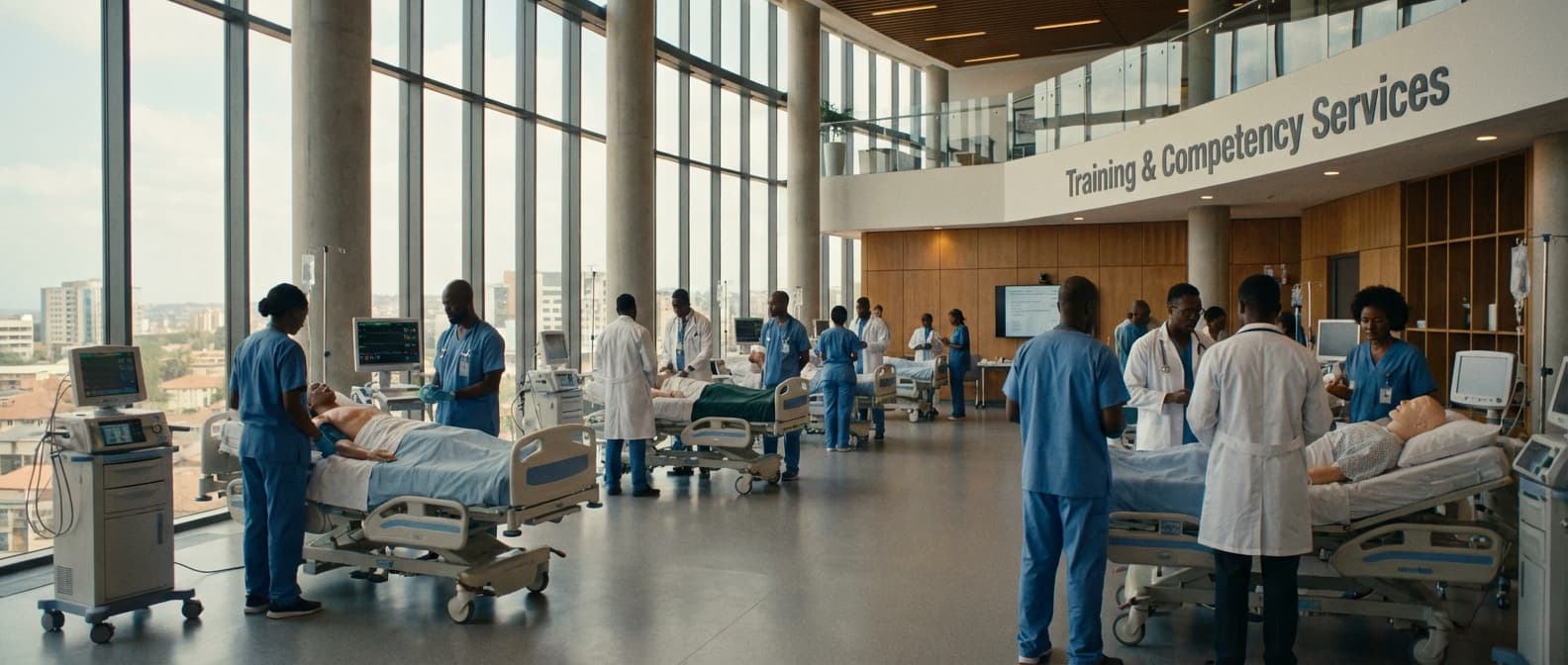
Ventilator User Training Service (Nurses) in Madagascar
Engineering Excellence & Technical Support
Ventilator User Training Service (Nurses) High-standard technical execution following OEM protocols and local regulatory frameworks.
Mastering Ventilation Modes
Deep dive into essential ventilation modes (e.g., AC/VC, SIMV, PSV) and their application in specific pediatric and adult respiratory distress scenarios common in Madagascar's healthcare settings. Learn to select the optimal mode based on patient condition and resource availability.
Recognizing and Responding to Alarms
Understand the meaning and implications of critical ventilator alarms. This module focuses on rapid identification of alarm causes, effective troubleshooting techniques, and appropriate interventions to ensure patient safety and optimize ventilation in resource-limited environments.
Ventilator Settings Optimization & Titration
Gain expertise in setting and adjusting key ventilator parameters (e.g., tidal volume, respiratory rate, PEEP, FiO2). Learn evidence-based strategies for weaning and titrating support, focusing on protocols adapted for local availability of diagnostic tools and monitoring capabilities.
What Is Ventilator User Training Service (Nurses) In Madagascar?
Ventilator User Training Service (Nurses) in Madagascar refers to a specialized educational program designed to equip registered nurses with the necessary knowledge and practical skills to safely and effectively operate mechanical ventilators in clinical settings within Madagascar. This service is crucial for ensuring optimal patient outcomes, minimizing complications associated with mechanical ventilation, and adhering to international standards of respiratory care. The training focuses on fundamental principles of respiratory physiology, ventilator mechanics, modes of ventilation, patient-ventilator synchrony, monitoring parameters, troubleshooting common issues, and the management of ventilated patients within the Malagasy healthcare infrastructure. It addresses the unique challenges and resource limitations that may be present in the Malagasy context, aiming to build local capacity in critical care respiratory support.
| Target Audience | Need For Training | Typical Use Cases |
|---|---|---|
| Registered Nurses (RNs) working in critical care units (ICUs, CCUs, ERs) | To provide safe and competent care to patients requiring mechanical ventilation, reduce patient morbidity and mortality, ensure optimal utilization of limited resources, and comply with healthcare regulations. | Management of patients with acute respiratory failure (e.g., ARDS, pneumonia, COPD exacerbations, sepsis-induced respiratory distress), post-operative respiratory support, neurological emergencies affecting respiration, and during mass casualty events or public health emergencies. |
| Nurses in general wards or step-down units who may be involved in the ongoing care of a ventilated patient or during patient transfer | To maintain vigilance, recognize early signs of deterioration or complications, and communicate effectively with critical care teams. | Monitoring patients transitioning from mechanical ventilation, managing patients on non-invasive ventilation (NIV), and assisting in the safe transfer of ventilated patients within the facility. |
| Newly graduated nurses entering critical care specialties | To provide foundational knowledge and practical skills necessary for independent practice in critical care settings. | Initial management and ongoing care of mechanically ventilated patients across various pathologies. |
| Nurses working in resource-limited settings or rural hospitals | To enhance the capacity of local healthcare professionals to manage critically ill patients requiring advanced respiratory support, thereby improving access to quality care. | Providing essential respiratory support in settings where specialist intensivists may not be readily available. |
Key Components of Ventilator User Training Service (Nurses) in Madagascar
- Theoretical instruction on respiratory physiology and pathophysiology.
- Detailed explanation of ventilator principles of operation and hardware.
- Comprehensive overview of various ventilation modes (e.g., AC, SIMV, CPAP, PSV) and their indications.
- Practical sessions on ventilator setup, circuit management, and patient interface (e.g., endotracheal tubes, tracheostomy tubes, non-invasive masks).
- Training on initiating and managing mechanical ventilation, including initial settings and titration.
- Emphasis on patient-ventilator synchrony and strategies for optimizing it.
- Instruction on monitoring key respiratory parameters (e.g., tidal volume, respiratory rate, PEEP, pressures, FiO2) and interpreting ventilator waveforms and alarms.
- Identification, troubleshooting, and management of common ventilator-associated complications (e.g., barotrauma, volutrauma, ventilator-associated pneumonia, oxygen toxicity).
- Weaning protocols and strategies for liberating patients from mechanical ventilation.
- Infection control principles related to mechanical ventilation.
- Ethical considerations and legal aspects of mechanical ventilation.
- Context-specific training on available ventilator models and resource management in Madagascar.
Who Needs Ventilator User Training Service (Nurses) In Madagascar?
This document outlines the critical need for Ventilator User Training Services specifically for nurses in Madagascar. The objective is to ensure that nurses are proficient in the safe and effective operation of mechanical ventilators, thereby improving patient outcomes and reducing the risks associated with their use. This training is essential across various healthcare settings, especially in light of increasing demands on critical care services and the potential for respiratory emergencies.
| Department/Unit | Rationale for Training Need | Specific Ventilator Needs | Potential Impact of Untrained Staff |
|---|---|---|---|
| Intensive Care Units (ICUs) / Critical Care Units (CCUs) | High volume of critically ill patients requiring mechanical ventilation for prolonged periods. Complex ventilator modes and settings are routinely used. | Advanced invasive and non-invasive ventilators; understanding of complex ventilation strategies (e.g., ARDS management, weaning protocols). | Improper settings leading to ventilator-induced lung injury (VILI), prolonged ventilation duration, increased mortality, and ventilator-associated pneumonia (VAP). |
| Emergency Departments (EDs) / Accident & Emergency (A&E) | Rapid assessment and initiation of ventilation for acute respiratory failure, trauma, sepsis, and exacerbations of chronic conditions. Need for quick decision-making under pressure. | Basic to advanced invasive and non-invasive ventilators; rapid setup and initial parameter selection. | Delayed or incorrect ventilation initiation, exacerbation of respiratory distress, increased risk of cardiopulmonary arrest. |
| Operating Theatres (OTs) / Surgical Recovery | Ventilation during anesthesia and immediate post-operative recovery. Management of patients with pre-existing respiratory conditions. | Anesthesia ventilators, post-operative ventilators; understanding of anesthetic gas delivery integration and lung protection strategies. | Airway complications, inadequate ventilation during surgery, delayed recovery, post-operative respiratory complications. |
| Neonatal Intensive Care Units (NICUs) / Pediatric ICUs (PICUs) | Specialized ventilation requirements for neonates and children with immature respiratory systems. Need for precise and sensitive settings. | High-frequency oscillatory ventilation (HFOV), conventional ventilators with specific pediatric/neonatal modes; understanding of lung development and physiology. | Barotrauma, volutrauma, bronchopulmonary dysplasia (BPD), increased mortality in vulnerable populations. |
| Respiratory Wards / Specialized Respiratory Care Units | Management of patients with chronic respiratory diseases (e.g., COPD, asthma) requiring ventilation, or those recovering from acute respiratory illnesses. | Invasive and non-invasive ventilators; understanding of disease-specific ventilation principles and weaning. | Poor symptom control, frequent exacerbations, prolonged hospital stays, and decreased quality of life. |
| General Wards (with basic support roles) | Monitoring patients on simple oxygen therapy or basic non-invasive support, recognizing early signs of respiratory deterioration requiring escalation. | Basic oxygen delivery systems, potentially simple non-invasive devices (e.g., CPAP/BiPAP). | Failure to recognize respiratory distress, delayed escalation of care, progression to severe respiratory failure. |
Target Customers & Departments Requiring Ventilator User Training for Nurses in Madagascar
- Nurses working in Intensive Care Units (ICUs) and Critical Care Units (CCUs).
- Nurses in Emergency Departments (EDs) or Accident & Emergency (A&E) departments.
- Nurses in Operating Theatres (OTs) or Surgical Recovery Units.
- Nurses in Neonatal Intensive Care Units (NICUs) and Pediatric ICUs (PICUs).
- Nurses in respiratory wards or specialized respiratory care units.
- Nurses in general wards who may be responsible for monitoring patients on non-invasive ventilation or basic respiratory support.
- Nurses in public hospitals at regional and national levels.
- Nurses in private healthcare facilities and clinics.
- Nurses in non-governmental organization (NGO) run healthcare facilities.
- Nurses involved in pre-hospital emergency medical services (EMS) if equipped with portable ventilators.
Ventilator User Training Service (Nurses) Process In Madagascar
This document outlines the standard operating procedure for the Ventilator User Training Service specifically tailored for nurses in Madagascar. It details the entire workflow, from the initial inquiry to the successful execution and completion of the training.
| Stage | Key Activities | Responsible Parties | Deliverables/Outcomes |
|---|---|---|---|
| Inquiry & Needs Assessment | Initial contact, communication of requirements, needs assessment | Healthcare Facility/Nursing Association, Training Service Provider | Understanding of training needs, confirmation of scope |
| Proposal & Agreement | Proposal development, negotiation, contract signing | Training Service Provider, Healthcare Facility/Nursing Association | Signed contract/MOU, agreed upon terms and conditions |
| Pre-Training Preparations | Curriculum finalization, trainer allocation, logistics, material preparation, participant registration, communication | Training Service Provider, Healthcare Facility/Nursing Association | Prepared training materials, confirmed schedule, registered participants |
| Training Execution | Theoretical sessions, practical demonstrations, hands-on practice, Q&A, case studies | Trainers, Participating Nurses | Acquired knowledge and practical skills in ventilator operation |
| Assessment & Evaluation | Knowledge assessment, practical skills assessment, feedback collection | Trainers, Participating Nurses | Evaluation of learning outcomes, identification of areas for improvement, participant feedback |
| Post-Training & Certification | Debriefing, certification, reporting, optional follow-up | Trainers, Training Service Provider, Healthcare Facility/Nursing Association | Certified nurses, training report, established post-training support |
| Record Keeping | Maintaining all training-related documentation | Training Service Provider | Complete and organized training records |
Ventilator User Training Service (Nurses) Workflow in Madagascar
- 1. Inquiry & Needs Assessment:
- Initial contact from a healthcare facility (hospital, clinic) or nursing association regarding the need for ventilator user training.
- Representatives from the inquiring entity communicate their specific training requirements (e.g., number of nurses, specific ventilator models in use, desired training duration, available dates).
- The training service provider assesses the needs, confirming the target audience (nurses), the scope of training, and logistical considerations.
- 2. Proposal & Agreement:
- The training service provider develops a detailed proposal outlining the training curriculum, learning objectives, duration, venue requirements (if applicable), trainer qualifications, materials provided, and associated costs.
- The proposal is submitted to the inquiring healthcare facility/association for review.
- Negotiation of terms, pricing, and scheduling may occur.
- Upon agreement, a formal contract or Memorandum of Understanding (MOU) is signed by both parties.
- 3. Pre-Training Preparations:
- Curriculum Customization: The training curriculum is finalized based on the specific ventilator models and clinical scenarios relevant to the Malagasy healthcare context and the facility's needs.
- Trainer Allocation: Qualified and experienced trainers, familiar with ventilator operation and adult education principles, are assigned to the training.
- Logistics & Scheduling Confirmation: Exact training dates, times, and location (on-site at the facility or designated training center) are confirmed.
- Material Preparation: Training manuals, presentations, practical demonstration equipment (functional ventilators or simulators), assessment tools (quizzes, practical evaluation forms), and any necessary PPE are procured and prepared.
- Participant Registration: The healthcare facility/association provides a list of participating nurses, including their names, contact information, and any relevant prior experience.
- Pre-Training Communication: Participants receive detailed information about the training, including the schedule, objectives, and any pre-reading materials.
- 4. Training Execution:
- Welcome & Introduction: The training commences with an introduction to the trainers, the training objectives, and the overall agenda.
- Theoretical Sessions: Lectures and presentations covering ventilator principles, modes of ventilation, patient assessment, setting up and managing ventilators, troubleshooting common issues, and infection control related to ventilation.
- Practical Demonstrations: Trainers demonstrate the operation of the specific ventilator models, including setup, parameter adjustments, alarm management, and disconnections.
- Hands-on Practice: Nurses engage in hands-on practice sessions with ventilators or simulators, applying theoretical knowledge under direct supervision of the trainers. This includes scenario-based exercises.
- Q&A and Discussion: Ample time is allocated for nurses to ask questions, clarify doubts, and engage in discussions with the trainers and peers.
- Case Studies & Scenario Analysis: Real-life or simulated clinical case studies are presented and analyzed to reinforce learning and decision-making skills.
- 5. Assessment & Evaluation:
- Knowledge Assessment: Written or online quizzes to evaluate the understanding of theoretical concepts.
- Practical Skills Assessment: Observation and evaluation of nurses' ability to correctly set up, operate, and manage ventilators during simulated patient scenarios.
- Feedback Collection: Participants are provided with feedback forms to evaluate the training content, trainers' effectiveness, and overall training experience. Trainers may also provide individual feedback to participants.
- 6. Post-Training & Certification:
- Debriefing: A final session to summarize key learnings, address any remaining questions, and reinforce best practices.
- Certification: Upon successful completion of the training and passing the assessments, participants receive a certificate of completion, validating their competency in operating the specific ventilator models.
- Reporting: The training service provider submits a comprehensive report to the healthcare facility/association, including attendance records, assessment results, and a summary of the training conducted.
- Follow-up (Optional): Depending on the agreement, a follow-up support mechanism may be established to address any immediate post-training challenges encountered by the nurses.
- 7. Record Keeping:
- All training records, including participant lists, assessment results, and certificates issued, are maintained by the training service provider for future reference and audit purposes.
Ventilator User Training Service (Nurses) Cost In Madagascar
Providing accurate cost estimates for ventilator user training services for nurses in Madagascar is challenging due to a multitude of influencing factors. The price can vary significantly depending on the provider, the scope of training, the duration, the location within Madagascar, and the specific equipment being covered. Local economic conditions and the availability of qualified trainers also play a crucial role. However, we can explore the key pricing factors and provide estimated ranges in Malagasy Ariary (MGA).
| Training Type/Scope | Estimated Range (MGA) |
|---|---|
| Basic Introduction to Ventilator Operation (e.g., 1-day workshop) | 300,000 - 750,000 MGA per participant |
| Intermediate Ventilator Management (e.g., 2-3 day course, including common modes) | 600,000 - 1,500,000 MGA per participant |
| Advanced Ventilator Training & Troubleshooting (e.g., 4-5 day course, including specialized modes and diagnostics) | 1,000,000 - 3,000,000+ MGA per participant |
| On-site Training (may include additional travel/logistics fees) | Variable, often a package price for a group (e.g., 2,000,000 - 10,000,000+ MGA per training session for a hospital) |
| Training specific to a particular ventilator brand/model | Can vary widely, often integrated into purchase agreements or offered by the manufacturer's representatives |
Key Pricing Factors for Ventilator User Training in Madagascar:
- Provider Type: Training can be offered by medical equipment suppliers, specialized training institutions, NGOs with healthcare programs, or directly by hospitals with in-house expertise. Private entities may charge higher rates than non-profit organizations or government-sponsored initiatives.
- Scope and Depth of Training: A basic overview of ventilator operation will be less expensive than comprehensive training covering advanced modes, troubleshooting, patient monitoring, and emergency procedures. The number of ventilator models covered will also impact cost.
- Duration of Training: The length of the training program, whether it's a half-day workshop, a multi-day course, or a longer certification program, directly influences the overall price.
- Location of Training: Training delivered on-site at a hospital or clinic might incur additional travel and accommodation costs for trainers, which would be factored into the price. Training held at a central training facility might be more cost-effective.
- Number of Participants: While some training providers might offer a per-person rate, others may have a fixed fee for a group, making it more economical for larger numbers of nurses.
- Trainer Qualifications and Experience: Highly experienced and specialized trainers, particularly those with international credentials, may command higher fees.
- Training Materials and Resources: The provision of detailed manuals, practical simulation equipment, and access to online resources can add to the overall cost.
- Certification and Assessment: If the training includes formal assessment and leads to a recognized certification, this will likely increase the price compared to non-certified training.
- Equipment Availability: If the training requires the use of specific, often expensive, ventilator models for hands-on practice, this cost might be integrated into the service fee.
- Negotiation and Contracts: For larger institutions or ongoing training needs, there may be room for negotiation and customized contract pricing.
- External Funding/Grants: Training initiatives supported by international grants or government funding might offer subsidized or free training, impacting the perceived cost to the individual institution.
Affordable Ventilator User Training Service (Nurses) Options
Providing accessible and effective ventilator user training for nurses is crucial for patient care and hospital efficiency. This service aims to equip nurses with the necessary knowledge and skills to operate and manage various ventilator models safely and effectively. We offer flexible training options designed to meet diverse institutional needs and budgets, focusing on value-added bundles and strategic cost-saving measures.
| Cost-Saving Strategy | Description | Benefits |
|---|---|---|
| Group Training Discounts | Reduced per-participant cost when multiple nurses from the same institution register for the same training session. | Lower overall training expenditure for the facility, increased peer learning opportunities. |
| On-Site Training Packages | Bringing certified trainers to your facility, eliminating travel and accommodation costs for nurses. | Convenience, reduced downtime for staff, cost savings on travel expenses. |
| Blended Learning (Online + In-Person) | Utilizing online modules for theoretical knowledge dissemination, followed by focused in-person practical sessions. | Increased flexibility, reduced on-site training duration, potential for lower overall costs. |
| Train-the-Trainer Programs | Equipping select nurses within your organization to deliver ongoing training to their peers. | Long-term cost-effectiveness, capacity building within the institution, consistency in training. |
| Subscription-Based Access | Annual or multi-year access to a library of online training modules and updates for a fixed fee. | Predictable budgeting, continuous learning opportunities, access to new content as it becomes available. |
| Volume-Based Pricing | Tiered pricing structures that offer greater discounts for a higher number of trained personnel. | Significant cost savings for larger institutions or those with high staff turnover. |
| Partnerships & Collaborations | Collaborating with other healthcare facilities for joint training initiatives to share resources and costs. | Shared expenses, expanded training capacity, networking opportunities. |
Key Training Modules & Value Bundles
- {"title":"Core Ventilator Principles & Modes","description":"Fundamental concepts of mechanical ventilation, including gas exchange, pressure, volume, and flow. Covers essential modes like Volume Control (VC), Pressure Control (PC), Assist/Control (A/C), and Synchronized Intermittent Mandatory Ventilation (SIMV)."}
- {"title":"Advanced Ventilator Modes & Settings","description":"Exploration of more complex modes such as Pressure Support Ventilation (PSV), Bi-level Positive Airway Pressure (BiPAP), and high-frequency ventilation. Focus on optimizing settings for patient comfort and clinical outcomes."}
- {"title":"Ventilator Graphics Interpretation","description":"Training on understanding and interpreting ventilator waveforms (pressure-time, flow-time, volume-time) to assess patient-ventilator synchrony and make informed adjustments."}
- {"title":"Troubleshooting & Alarm Management","description":"Practical skills in identifying common ventilator malfunctions, responding to alarms effectively, and implementing corrective actions to ensure patient safety."}
- {"title":"Ventilator Weaning Strategies","description":"Understanding the process of mechanical ventilation liberation, including assessment criteria, weaning protocols, and methods for transitioning patients off the ventilator."}
- {"title":"Value Bundle 1: 'Foundation Essentials'","description":"Includes Core Ventilator Principles & Modes, Troubleshooting & Alarm Management. Ideal for new staff or those requiring a refresher."}
- {"title":"Value Bundle 2: 'Clinical Proficiency'","description":"Includes Core Ventilator Principles & Modes, Advanced Ventilator Modes & Settings, Ventilator Graphics Interpretation. For nurses requiring a comprehensive understanding of ventilator management."}
- {"title":"Value Bundle 3: 'Comprehensive Care'","description":"Includes all modules: Core Principles, Advanced Modes, Graphics, Troubleshooting, and Weaning Strategies. Offers the most complete training package."}
- {"title":"Customizable Bundles","description":"Institutions can tailor bundles by selecting specific modules based on their patient population, equipment, and staff experience levels."}
Verified Providers In Madagascar
In the realm of healthcare services in Madagascar, the identification of Verified Providers is paramount for ensuring quality, safety, and efficacy. Among these, Franance Health credentials stand out as a significant marker of excellence. This document aims to illuminate what Franance Health credentials represent and why they position these providers as the best choice for your health needs in Madagascar.
| Benefit of Choosing Franance Health Verified Providers | Description |
|---|---|
| Enhanced Patient Safety | Franance Health verification confirms that providers adhere to stringent safety protocols and best practices, minimizing risks and ensuring a secure healthcare experience. |
| Superior Quality of Care | Accredited providers are demonstrably committed to delivering high-quality medical services, backed by qualified professionals and up-to-date medical knowledge. |
| Trust and Reliability | The Franance Health credential acts as a seal of trust, assuring patients that they are engaging with ethical, competent, and reputable healthcare professionals. |
| Access to Specialized Expertise | Verified providers often highlight their specialized skills and experience, making it easier for patients to find the right specialist for their specific medical needs. |
| Peace of Mind | Knowing that your chosen provider has undergone rigorous verification by a reputable body like Franance Health provides significant peace of mind during potentially stressful health situations. |
| Improved Patient Outcomes | By adhering to higher standards and best practices, Franance Health verified providers are more likely to contribute to positive patient outcomes and recovery. |
What are Franance Health Credentials?
- Rigorous Vetting Process: Franance Health employs a comprehensive and multi-layered vetting process for all healthcare providers seeking their accreditation. This involves scrutinizing educational qualifications, professional licenses, and a clean disciplinary record.
- Adherence to International Standards: Accreditation signifies that a provider meets or exceeds internationally recognized benchmarks for healthcare quality, patient safety, and ethical practice.
- Commitment to Continuous Improvement: Franance Health credentials are not a one-time achievement. Providers are typically required to undergo regular re-evaluation and demonstrate ongoing commitment to professional development and updated best practices.
- Patient-Centric Approach: A core component of Franance Health's evaluation is the provider's dedication to patient well-being, clear communication, and respectful treatment.
- Transparency and Accountability: Verified providers are committed to transparency in their services, fees, and patient outcomes, fostering trust and accountability.
- Specialized Expertise Verification: Depending on the specialty, Franance Health may also verify specific expertise and advanced training, ensuring patients receive care from highly qualified professionals.
Scope Of Work For Ventilator User Training Service (Nurses)
This Scope of Work (SOW) outlines the requirements for providing comprehensive ventilator user training services specifically tailored for nursing staff. The objective is to equip nurses with the knowledge and practical skills necessary for safe and effective operation, monitoring, and troubleshooting of specified ventilator models. This SOW details the technical deliverables, standard specifications, and training methodologies to be employed.
| Deliverable | Description | Specification / Standard |
|---|---|---|
| Training Curriculum | Detailed outline of all training modules, learning objectives, and assessment methods. | Must be comprehensive, evidence-based, and aligned with current clinical guidelines. Content to be provided in English. |
| Training Materials (Participant) | Handouts, presentations, reference guides, and case studies for each participant. | High-quality, easily readable print or digital format. Includes user manuals for specified ventilator models. |
| Training Materials (Instructor) | Instructor guide, lesson plans, answer keys for assessments, and demonstration protocols. | Detailed and comprehensive to ensure consistent delivery across training sessions. |
| Hands-on Training Equipment | Access to functional ventilators (specified models) for simulation and practical exercises. Manikins or simulated patient scenarios as appropriate. | Ventilators must be in good working condition, calibrated, and equipped with necessary accessories (e.g., circuits, humidifiers). Minimum of 1:4 trainer-to-student ratio for hands-on sessions. |
| Competency Assessment Tools | Written examinations, practical skills checklists, and scenario-based assessments to evaluate learning. | Must objectively measure knowledge acquisition and skill proficiency. Pass rate of at least 85% for each assessment component. |
| Training Certificate | Certificate of completion issued to each nurse who successfully completes the training. | Includes participant name, training title, date, duration, and trainer's signature. Clearly states the ventilator models covered. |
| Post-Training Support (Optional) | Access to subject matter experts for follow-up questions or clarification. | Defined communication channels (e.g., email, phone) and response time (e.g., within 24-48 business hours). |
| Trainer Qualifications | Experienced clinical educators with expertise in respiratory therapy and critical care nursing, and proficiency in the specified ventilator models. | Minimum of 3 years of experience in ventilator management and adult education. Demonstrated proficiency in the specific ventilator models to be trained on. |
| Training Location | On-site at the client's facility or designated off-site location. | Must be a suitable environment with adequate space, seating, audio-visual equipment, and access to power for training equipment. |
| Training Schedule | Flexible scheduling to accommodate nursing shift patterns. | Proposals to include morning, afternoon, and potentially night/weekend sessions based on client needs. Minimum training duration to be specified for each module. |
Training Modules & Content
- Introduction to Mechanical Ventilation: Principles, indications, and contraindications.
- Ventilator Anatomy and Function: Identification of key components, controls, and user interface.
- Basic Ventilator Modes: Understanding and application of common modes (e.g., AC, SIMV, CPAP/PSV).
- Advanced Ventilator Modes (as applicable): Training on modes like APRV, BiPAP, NAVA, etc., based on equipment provided.
- Setting and Adjusting Ventilator Parameters: Tidal volume, respiratory rate, PEEP, FiO2, flow rate, I:E ratio.
- Waveform Analysis: Interpretation of pressure, volume, and flow waveforms.
- Alarms and Troubleshooting: Identification, prioritization, and management of common ventilator alarms and associated patient care interventions.
- Ventilator Weaning and Discontinuation: Principles and protocols.
- Infection Control and Maintenance: Cleaning, disinfection, and circuit management.
- Special Considerations: Ventilation in specific patient populations (e.g., pediatrics, neonates, bariatrics) and conditions.
- Emergency Procedures: Actions during power failure, circuit disconnections, and other critical events.
- Hands-on Practice with Ventilator Simulation and/or actual equipment.
Service Level Agreement For Ventilator User Training Service (Nurses)
This Service Level Agreement (SLA) outlines the guaranteed response times and uptime for the Ventilator User Training Service specifically designed for nurses. It defines the expectations and responsibilities of both the Service Provider and the Client (healthcare facility) regarding the delivery and availability of this critical training.
| Service Component | Response Time Guarantee | Uptime Guarantee |
|---|---|---|
| Urgent Technical Support (e.g., immediate system malfunction during training) | Within 1 hour of reported issue during business hours (08:00 - 17:00 Local Time, Monday-Friday) | N/A (Focus is on response for immediate issue resolution) |
| Non-Urgent Technical Support (e.g., query about training content, minor software issue) | Within 4 business hours of reported issue during business hours | N/A (Focus is on response for issue resolution) |
| Training Session Scheduling Requests | Within 2 business days of request submission | N/A (Focus is on scheduling efficiency) |
| Access to Online Training Modules (for registered users) | N/A (Self-service access) | 99.5% uptime, measured monthly. Scheduled maintenance will be communicated at least 48 hours in advance and will occur outside of peak training hours. |
| Availability of Virtual Instructor-Led Training (VILT) Sessions (when scheduled) | N/A (Session begins at scheduled time) | 100% uptime during scheduled VILT session duration. Any unavoidable technical disruptions will be addressed immediately, and rescheduled sessions will be offered if significant impact occurs. |
Key Service Components
- Scope of Training: Covers theoretical knowledge and practical, hands-on training on the operation, monitoring, and basic troubleshooting of specified ventilator models.
- Training Delivery Methods: Includes on-site training sessions, virtual instructor-led training (VILT), and access to online training modules.
- Trainer Qualifications: Trainers will be certified respiratory therapists or experienced nurses with specialized training and proven expertise in mechanical ventilation.
- Training Materials: Provision of comprehensive training manuals, practical demonstration equipment, and access to digital resources.
Frequently Asked Questions

Ready when you are
Let's scope your Ventilator User Training Service (Nurses) in Madagascar project in Madagascar.

Scaling healthcare logistics and technical systems across the entire continent.