
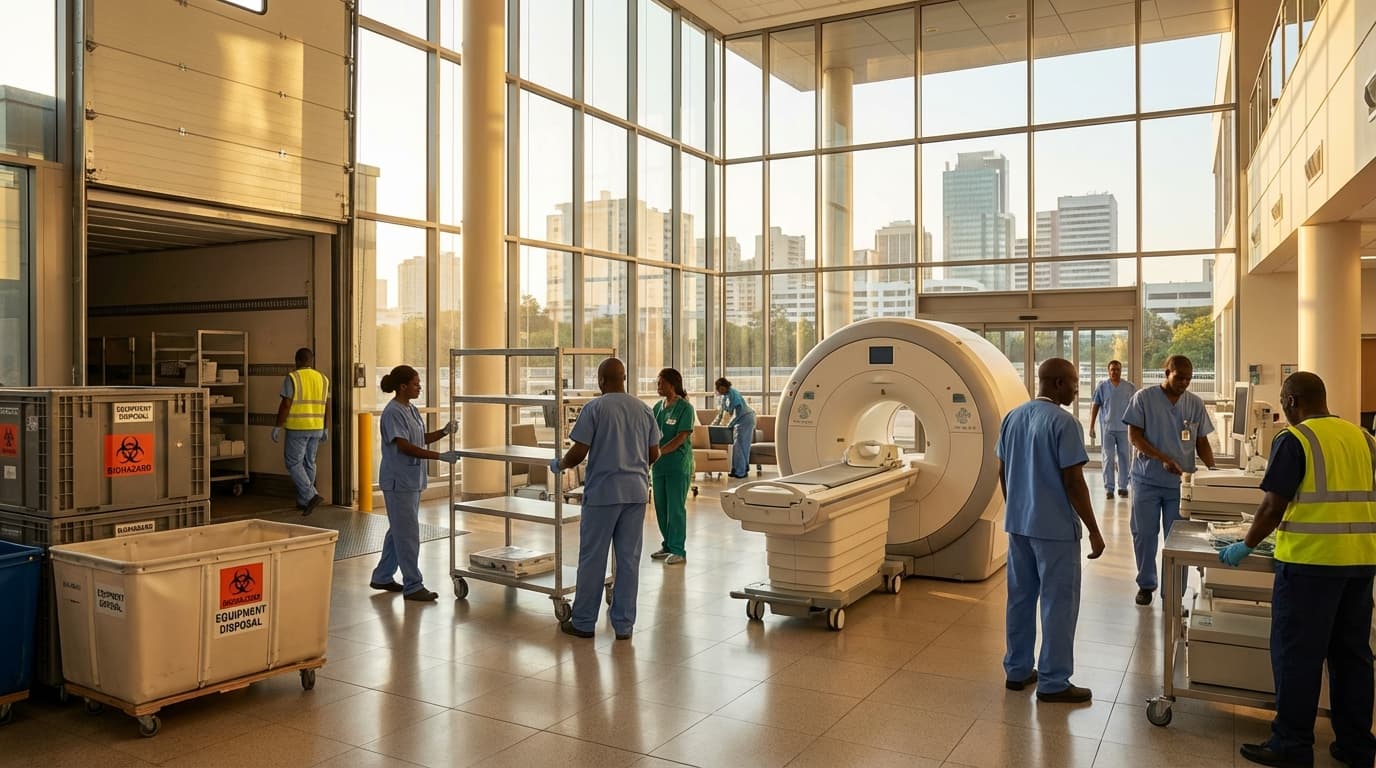
Patient Data Wiping Service (Medical Equipment Storage) in Madagascar
Engineering Excellence & Technical Support
Patient Data Wiping Service (Medical Equipment Storage) High-standard technical execution following OEM protocols and local regulatory frameworks.
HIPAA & GDPR Compliant Data Sanitization
Ensuring complete and secure erasure of all patient data from medical equipment according to international standards like HIPAA and GDPR, mitigating the risk of sensitive information breaches for healthcare providers in Madagascar.
Auditable Chain of Custody & Reporting
Providing a transparent and auditable chain of custody for all wiped equipment, coupled with detailed destruction reports, offering Madagascar's healthcare facilities irrefutable proof of data sanitization and compliance.
On-Site & Secure Off-Site Wiping Solutions
Offering flexible data wiping services with secure, localized logistics across Madagascar, including on-site equipment sanitization and secure transport to certified off-site facilities, minimizing disruption to healthcare operations.
What Is Patient Data Wiping Service (Medical Equipment Storage) In Madagascar?
Patient Data Wiping Service (Medical Equipment Storage) in Madagascar refers to the secure and certified process of irretrievably deleting sensitive patient information stored on medical devices prior to their transfer, resale, disposal, or storage. This service is critical for maintaining patient privacy and complying with data protection regulations, especially in the context of evolving healthcare data security standards.
| Who Needs It? | Typical Use Cases | Regulatory Implications |
|---|---|---|
| Hospitals and Clinics (public and private) | Decommissioning of imaging equipment (MRI, CT scanners) | Failure to comply can result in significant fines and legal repercussions. |
| Diagnostic Laboratories | Upgrading or replacing patient monitoring systems | Breaches of patient data can lead to loss of patient trust and reputational damage. |
| Medical Device Manufacturers and Resellers | Return of leased or refurbished equipment | Adherence to Madagascar's data protection laws (if any specific to healthcare) and international standards (e.g., GDPR principles for sensitive data). |
| Healthcare IT Service Providers | End-of-life disposal of electronic health record (EHR) systems | Ensuring data security throughout the device lifecycle is paramount for patient confidentiality. |
| Research Institutions utilizing medical devices | Transfer of equipment between departments or facilities | Maintaining the integrity and confidentiality of research data derived from patient devices. |
Service Components:
- Data Identification and Assessment: Cataloging all data storage media within the medical equipment.
- Data Sanitization/Wiping: Employing certified data erasure methods (e.g., DoD 5220.22-M, NIST 800-88) to render data unrecoverable.
- Physical Destruction (if necessary): For media that cannot be reliably wiped, physical destruction methods (shredding, disintegration) are employed.
- Verification and Certification: Providing a certificate of data destruction, confirming compliance and service completion.
- Chain of Custody: Maintaining a documented log of the equipment and data throughout the process.
- Regulatory Compliance: Adhering to national and international data privacy laws applicable to healthcare data.
Who Needs Patient Data Wiping Service (Medical Equipment Storage) In Madagascar?
In Madagascar, the need for a secure patient data wiping service for medical equipment storage is critical for healthcare facilities to ensure compliance with data privacy regulations, protect sensitive patient information from unauthorized access, and maintain the integrity of their IT infrastructure. As medical devices increasingly become interconnected and store electronic health records, proper data sanitization becomes paramount before disposal, resale, or repurposing.
| Target Customer/Department | Specific Needs/Concerns | Types of Equipment Involved |
|---|---|---|
| Hospitals (e.g., CHU, CHR, Hôpitaux Privés) | HIPAA/local data privacy compliance, prevention of data breaches, secure asset disposal/resale. | Patient monitors, ventilators, ultrasound machines, CT/MRI scanners, laboratory analyzers, EMR systems (server-side storage). |
| Clinics (e.g., Polycliniques, Cabinets Médicaux) | Protection of patient confidentiality, compliance with emerging data protection laws, cost-effective equipment lifecycle management. | ECG machines, diagnostic imaging devices, patient management software terminals, small laboratory equipment. |
| Diagnostic Laboratories | Ensuring the integrity and privacy of patient samples and test results, compliance with laboratory standards. | Automated analyzers, centrifuges with data logging, laboratory information systems (LIS). |
| Medical Imaging Centers | Securing sensitive patient imaging data (DICOM files), compliance with radiology data regulations. | X-ray machines, CT scanners, MRI machines, ultrasound devices, PACS (Picture Archiving and Communication System). |
| Government Health Ministries/Agencies | National data security standards, management of public health data across various facilities, disaster recovery planning. | Centralized EMR systems, public health surveillance equipment, legacy medical devices in public facilities. |
| IT Departments (within Healthcare Facilities) | Implementing data security policies, managing device lifecycles, risk mitigation, ensuring regulatory compliance. | All networked medical devices, servers, workstations connected to medical equipment, mobile health devices. |
| Procurement/Asset Management Departments | Ensuring that retired or sold equipment does not pose a data security risk, optimizing asset value. | Any medical equipment being decommissioned, sold, or transferred. |
| Biomedical Engineering Departments | Maintaining equipment, preparing devices for repair or maintenance, ensuring data integrity during service. | All types of medical equipment with embedded software and storage. |
Target Customers and Departments for Patient Data Wiping Services in Madagascar
- {"title":"Hospitals and Clinics","description":"All sizes of healthcare institutions, from large public hospitals to smaller private clinics, that utilize medical equipment with data storage capabilities."}
- {"title":"Diagnostic Laboratories","description":"Facilities performing medical tests and diagnostics that rely on equipment storing patient results and identification."}
- {"title":"Medical Imaging Centers","description":"Centers employing X-ray, MRI, CT scan, and ultrasound machines that capture and store patient imaging data."}
- {"title":"Specialty Healthcare Providers","description":"Organizations focusing on specific medical areas like cardiology, oncology, or neurology, which often use specialized equipment with extensive data logging."}
- {"title":"Government Health Ministries and Agencies","description":"Entities responsible for managing public health infrastructure and ensuring data security across the nation."}
- {"title":"Medical Equipment Manufacturers and Resellers","description":"Companies that handle refurbished or traded-in medical equipment requiring data erasure before resale."}
- {"title":"Third-Party IT Service Providers (for Healthcare)","description":"Companies managing IT infrastructure for healthcare organizations, needing to ensure secure data handling of medical devices."}
Patient Data Wiping Service (Medical Equipment Storage) Process In Madagascar
This document outlines the standard operating procedure for a Patient Data Wiping Service specifically for medical equipment intended for storage within Madagascar. The service ensures that all sensitive patient information is securely and irretrievably removed from medical devices before they are stored. The process is designed to be transparent, secure, and compliant with relevant data privacy considerations.
| Stage | Description | Key Activities | Responsible Party | Deliverables/Outcomes |
|---|---|---|---|---|
| Initial contact from the client requesting data wiping services for medical equipment prior to storage. | Client expresses need, discusses equipment types, data sensitivity, and volume. Service provider explains capabilities, security protocols, and preliminary requirements. | Client, Service Provider (Sales/Consulting) | Understanding of client needs, initial assessment of service feasibility. |
| Formalizing the service scope, terms, and costs. | Service provider provides a detailed quotation based on equipment types, number of devices, and required wiping standards. Client reviews and accepts the quotation, leading to a signed Service Agreement outlining responsibilities, timelines, and data protection clauses. | Service Provider (Sales/Legal), Client | Signed Service Agreement, Approved Quotation. |
| Secure transfer of the medical equipment to the service provider's facility and meticulous recording. | Client delivers equipment to the designated secure facility. Service provider conducts a thorough inventory, documenting each piece of equipment, its serial number, model, and current condition. A Chain of Custody document is initiated. | Client, Service Provider (Logistics/Technical) | Securely received equipment, detailed inventory list, initiated Chain of Custody document. |
| The core process of securely erasing patient data from the medical equipment. | Technicians use approved data wiping software and/or hardware methods (e.g., degaussing for magnetic media, secure erase commands, physical destruction of storage media if necessary) to irretrievably remove all patient data. Wiping protocols are followed based on industry standards (e.g., NIST 800-88). | Service Provider (Technical Team) | Data successfully wiped from all storage media on the equipment. |
| Confirming the successful erasure of data and providing official documentation. | The technical team performs verification checks to ensure data is unrecoverable. A Certificate of Data Destruction is issued for each device, detailing the equipment, method used, date of wiping, and confirming complete data erasure. | Service Provider (Technical Team, Quality Assurance) | Verified data erasure, Certificate of Data Destruction for each unit. |
| Preparing the wiped equipment for secure storage. | Equipment is cleaned, inspected for any damage incurred during the wiping process, and packaged appropriately for long-term storage according to client or storage facility requirements. Any accompanying accessories are also inventoried and secured. | Service Provider (Technical/Logistics) | Cleaned, inspected, and packaged medical equipment ready for storage. |
| The completion of the service and transfer of responsibility for storage. | The service provider formally hands over the data-wiped and storage-ready equipment to the client or the designated storage facility. All relevant documentation, including the Service Agreement, inventory lists, and Certificates of Data Destruction, is provided to the client. The Chain of Custody document is finalized. | Service Provider (Logistics/Administration), Client | Returned equipment to client/storage, complete service documentation package, finalized Chain of Custody. |
Patient Data Wiping Service Workflow - Madagascar
- Inquiry & Consultation
- Service Agreement & Quotation
- Equipment Handover & Inventory
- Data Wiping Execution
- Verification & Certification
- Equipment Storage Preparation
- Final Handover & Documentation
Patient Data Wiping Service (Medical Equipment Storage) Cost In Madagascar
Patient data wiping services for medical equipment in Madagascar are essential for data privacy and regulatory compliance. The cost of these services can vary significantly due to several factors. It's crucial for healthcare facilities to understand these pricing determinants to budget effectively. The typical approach involves secure deletion of sensitive patient information from medical devices before they are repurposed, resold, or disposed of.
The primary pricing factors influencing the cost of patient data wiping in Madagascar include:
- Type and Volume of Equipment: Different medical devices (e.g., MRI machines, CT scanners, ultrasound devices, patient monitors, electronic health record systems) store data in varying formats and capacities. The complexity and time required to wipe data increase with the sophistication and storage size of the equipment. A higher volume of devices naturally leads to a higher overall cost, though per-unit costs might decrease with bulk orders.
- Data Sensitivity and Regulatory Requirements: The level of data sensitivity dictates the rigor of the wiping process. Compliance with national (Madagascar's Ministry of Public Health regulations, if any specific to data wiping) and international (e.g., GDPR if patient data from international sources is involved) standards will necessitate more robust and verifiable methods, potentially increasing costs.
- Wiping Method: Services can offer different wiping methodologies. These range from basic file deletion to multi-pass overwriting (e.g., DoD 5220.22-M standard) or even physical destruction of storage media. More secure and certified methods typically come at a higher price point.
- On-site vs. Off-site Services: Performing data wiping on-site at the healthcare facility can incur additional costs for technician travel, time, and potentially equipment mobilization. Off-site services might offer economies of scale but require secure transportation of the equipment, which can also add to the cost.
- Certification and Reporting: Many healthcare providers require a certificate of data destruction as proof of compliance. Services that provide detailed reports, audit trails, and certifications for each wiped device will generally charge more than those offering basic erasure.
- Service Provider Reputation and Expertise: Established service providers with a proven track record, specialized equipment, and skilled technicians often command higher prices due to their reliability and expertise.
- Urgency: If the data wiping service is needed urgently, expedited service fees may apply.
Cost Ranges in Malagasy Ariary (MGA):
It is challenging to provide precise figures without a detailed scope of work, as the market for specialized data wiping services for medical equipment is not as developed or transparent as in larger economies. However, based on general IT data sanitization principles and potential local service provider pricing, we can estimate a range. These are estimates and should be confirmed with actual service providers.
For standard data wiping (e.g., software-based overwriting) on a single, moderately sized medical device with standard storage, one might expect costs ranging from 50,000 MGA to 250,000 MGA. For more complex equipment, larger storage capacities, or more stringent wiping standards, the cost per device could escalate to 300,000 MGA to 1,000,000 MGA or more. Bulk discounts are common for larger quantities of equipment.
| Service Type/Complexity | Estimated Cost Range (MGA) |
|---|---|
| Standard Wipe (Single, moderate device) | 50,000 - 250,000 |
| Advanced Wipe (Complex device, large storage, high security) | 300,000 - 1,000,000+ |
| Bulk Discounts | Negotiable (Lower per-unit cost) |
Key Factors Influencing Patient Data Wiping Service Costs in Madagascar
- Type and Volume of Medical Equipment
- Data Sensitivity and Regulatory Compliance
- Data Wiping Methodology Employed
- On-site vs. Off-site Service Provision
- Need for Certification and Detailed Reporting
- Service Provider's Reputation and Expertise
- Service Urgency
Affordable Patient Data Wiping Service (Medical Equipment Storage) Options
Ensuring secure and compliant patient data wiping for medical equipment is a critical, yet often overlooked, aspect of healthcare IT and equipment management. When medical devices are decommissioned, sold, leased, or transferred, any residual patient health information (PHI) must be completely and irretrievably erased to comply with HIPAA and other privacy regulations. This section explores affordable options for patient data wiping services, focusing on value bundles and cost-saving strategies for medical equipment storage facilities.
| Service Component | Standard Offering | Value Bundle Option | Cost-Saving Strategy | Description |
|---|---|---|---|---|
| Data Wiping Method | Standard NIST 800-88 compliant erasure | Certified physical destruction for highly sensitive devices | Bulk processing discounts, automated wiping | Ensures data is unrecoverable through physical or software means. |
| Verification and Certification | Standard wipe completion certificate | Detailed audit trail with device serial numbers and timestamps | Digital certificates for faster processing | Proof of successful data destruction for compliance. |
| Equipment Handling | On-site wiping for facilities with compatible infrastructure | Secure transportation of equipment to wiping facility | Scheduled pickups to optimize logistics | Safe and secure management of devices during the wiping process. |
| Reporting | Basic wipe confirmation report | Comprehensive compliance reports with risk assessments | Customizable reporting formats | Provides documentation for audits and internal records. |
| Turnaround Time | Standard business days | Expedited wiping services | Off-peak service scheduling | Ensures timely data erasure to meet operational needs. |
| Disposal/Recycling Integration | Separate service | Integrated wipe and responsible e-waste disposal | Volume-based pricing for combined services | Streamlines the entire equipment end-of-life process. |
Why Data Wiping is Crucial for Medical Equipment Storage
- HIPAA Compliance: Preventing breaches and avoiding hefty fines.
- Patient Privacy: Protecting sensitive personal health information.
- Reputation Management: Maintaining trust with patients and partners.
- Asset Lifecycle Management: Enabling secure reuse, resale, or disposal of equipment.
- Data Security: Mitigating the risk of data theft or unauthorized access.
Verified Providers In Madagascar
In Madagascar's evolving healthcare landscape, identifying trusted and verified providers is paramount for individuals seeking quality medical care. Franance Health has emerged as a leading organization dedicated to credentialing and assuring the competence of healthcare professionals. This commitment to rigorous verification processes ensures that patients are connected with practitioners who meet the highest standards of medical expertise, ethical conduct, and patient safety. Choosing a Franance Health-credentialed provider in Madagascar signifies a commitment to receiving care from individuals who have undergone thorough scrutiny, offering peace of mind and confidence in the medical services received.
| Provider Type | Franance Health Verification Focus | Benefits to Patients |
|---|---|---|
| Doctors (General Practitioners & Specialists) | Medical school accreditation, residency completion, board certifications, licensure, disciplinary record checks. | Access to qualified physicians with verified expertise in their respective fields. |
| Nurses | Nursing school credentials, licensure, ongoing training verification, practical skills assessment. | Assurance of competent and ethical nursing care, vital for patient recovery and well-being. |
| Pharmacists | Pharmacy degree verification, licensure, regulatory compliance checks, safe medication handling practices. | Reliable dispensing of medications and expert advice on drug interactions and usage. |
| Dentists | Dental school qualifications, licensure, specialized training verification, adherence to dental best practices. | Trusted dental care, from routine check-ups to complex procedures. |
| Therapists (Physio, Occupational, etc.) | Relevant degree and certification verification, licensure, practical experience assessment. | Effective rehabilitation and therapeutic interventions from qualified professionals. |
Why Franance Health Credentials Represent the Best Choice:
- Rigorous Verification Process: Franance Health employs a comprehensive vetting system that includes academic background checks, professional license validation, peer reviews, and continuous professional development assessments.
- Commitment to Quality and Safety: The credentialing process focuses on ensuring that providers possess the necessary skills, knowledge, and experience to deliver safe and effective patient care, minimizing risks.
- Upholding Ethical Standards: Franance Health emphasizes ethical conduct and professional integrity, ensuring that credentialed providers adhere to a strict code of ethics in their practice.
- Promoting Patient Trust: By providing a clear indicator of verified competence, Franance Health empowers patients to make informed decisions and fosters greater trust in the healthcare system.
- Access to Competent Professionals: Franance Health's network comprises dedicated healthcare professionals who are committed to ongoing learning and staying abreast of the latest medical advancements.
- Enhanced Patient Outcomes: The assurance of working with credentialed providers can contribute to better diagnostic accuracy, more effective treatment plans, and ultimately, improved patient health outcomes.
Scope Of Work For Patient Data Wiping Service (Medical Equipment Storage)
This Scope of Work (SOW) outlines the requirements for a patient data wiping service specifically for medical equipment intended for storage. The objective is to ensure that all Protected Health Information (PHI) and other sensitive patient data is securely and irreversibly erased from the devices prior to their storage. This service must comply with relevant data privacy regulations (e.g., HIPAA in the United States, GDPR in Europe) and industry best practices. The vendor will be responsible for the secure collection, wiping, and return of medical equipment, or for performing the wiping service at the client's designated location.
| Technical Deliverable | Description | Standard Specification / Requirement | Acceptance Criteria |
|---|---|---|---|
| Data Sanitization Report | A comprehensive report detailing the data wiping process for each individual piece of equipment. | Includes unique equipment identifier (serial number, asset tag), type of equipment, method of wiping used, date of wiping, technician responsible, and confirmation of successful erasure. | Report is accurate, complete, and verifiable for all wiped devices. |
| Wiping Certificate | A certificate of data destruction for each device or batch of devices, signed by an authorized representative of the vendor. | Indicates that all PHI and sensitive data has been permanently erased according to the agreed-upon method. | Certificate is provided for all wiped devices and is legally sound. |
| Compliance Documentation | Documentation demonstrating the vendor's adherence to relevant data privacy regulations and industry standards. | Includes evidence of secure data handling procedures, personnel training, and any relevant certifications (e.g., NIST 800-88, NAID AAA Certification). | Documentation is up-to-date, relevant, and satisfactory to the client. |
| Data Wiping Method Validation | Proof that the chosen data wiping methods meet or exceed industry standards for secure data erasure. | Specific methods used (e.g., DoD 5220.22-M, NIST 800-88 Purge/Clear, Secure Erase commands) must be clearly documented and validated. | Chosen wiping methods are demonstrably effective for the types of storage media present in the medical equipment. |
| Equipment Condition Report (Pre-Wipe) | A report documenting the physical condition of each piece of equipment prior to the wiping service. | Includes photographic evidence of any existing damage or defects. | Report accurately reflects the equipment's condition before the service begins. |
| Equipment Condition Report (Post-Wipe) | A report documenting the physical condition of each piece of equipment after the wiping service. | Includes photographic evidence of the equipment's condition post-service. | Report accurately reflects the equipment's condition after the service and shows no new damage attributable to the wiping process. |
| Chain of Custody Log | A detailed log tracking the movement and possession of all equipment from pickup to return. | Includes timestamps, locations, responsible individuals, and signatures for each transfer of custody. | Log is complete, accurate, and provides an unbroken chain of custody for all devices. |
Objectives
- To securely and irrevocably erase all patient data from medical equipment.
- To ensure compliance with applicable data privacy regulations (e.g., HIPAA, GDPR).
- To prevent unauthorized access to or disclosure of sensitive patient information.
- To maintain the integrity and functionality of the medical equipment post-wiping.
- To provide auditable proof of data erasure.
Service Level Agreement For Patient Data Wiping Service (Medical Equipment Storage)
This Service Level Agreement (SLA) outlines the performance standards for the Patient Data Wiping Service provided for medical equipment during its storage phase. It defines response times for critical incidents and guarantees uptime for the data wiping process.
| Service Component | Severity Level | Response Time Target | Resolution Time Target | Uptime Guarantee |
|---|---|---|---|---|
| Patient Data Wiping Service (Core Functionality) | Critical (Service Unavailable/Data Compromise Risk) | 1 Hour | 4 Business Hours | 99.9% (Monthly) |
| Patient Data Wiping Service (Core Functionality) | High (Service Degraded/Significant Performance Impact) | 2 Business Hours | 8 Business Hours | 99.9% (Monthly) |
| Patient Data Wiping Service (Core Functionality) | Medium (Minor Performance Impact/Non-critical Issue) | 4 Business Hours | 2 Business Days | 99.9% (Monthly) |
| Reporting and Audit Trail Access | Critical (Unable to access reports) | 2 Business Hours | 4 Business Hours | 99.9% (Monthly) |
| Scheduled Data Wiping Operations | N/A (Operations are scheduled) | N/A | N/A | 100% of scheduled operations completed successfully |
Definitions
- Patient Data: Any personally identifiable health information (PHI) stored on medical equipment that requires secure deletion.
- Data Wiping: The secure and irreversible deletion of all patient data from medical equipment storage devices according to industry best practices and relevant regulations (e.g., HIPAA, GDPR).
- Incident: Any event that prevents or degrades the ability to perform the data wiping service, including but not limited to equipment malfunction, software errors, or access control issues.
- Critical Incident: An incident that renders the data wiping service completely unavailable or causes a significant risk of data compromise.
- Response Time: The maximum time allowed for the service provider to acknowledge and begin working on an incident after it has been reported.
- Resolution Time: The maximum time allowed for the service provider to resolve a reported incident.
- Uptime Guarantee: The percentage of scheduled time during which the data wiping service is available and functional.
Frequently Asked Questions

Ready when you are
Let's scope your Patient Data Wiping Service (Medical Equipment Storage) in Madagascar project in Madagascar.

Scaling healthcare logistics and technical systems across the entire continent.