
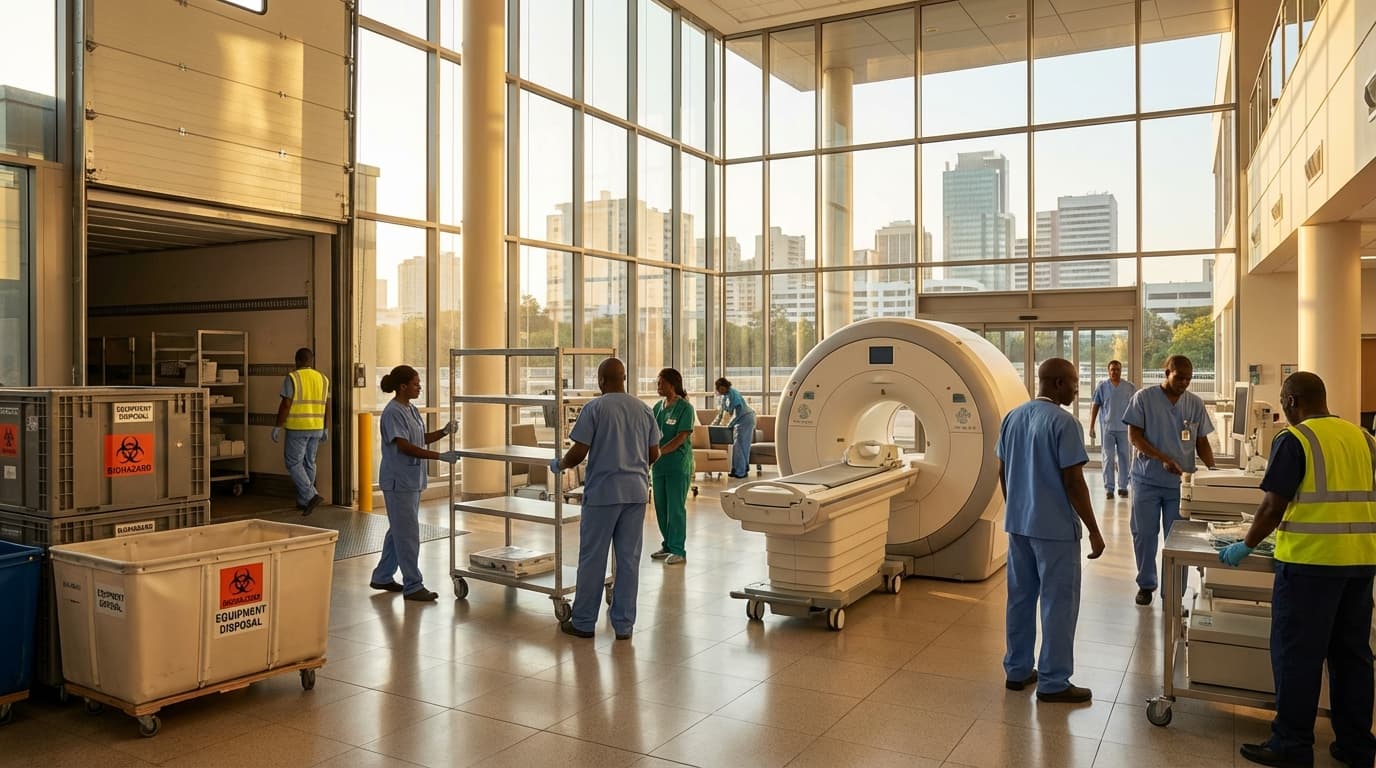
Heavy Medical Equipment De-Installation Service (MRI/CT/Cath Lab) in Madagascar
Engineering Excellence & Technical Support
Heavy Medical Equipment De-Installation Service (MRI/CT/Cath Lab) High-standard technical execution following OEM protocols and local regulatory frameworks.
Specialized MRI/CT Decommissioning Expertise
Leveraging extensive experience in safely dismantling and preparing high-field MRI and CT scanners for transport. Our certified technicians meticulously follow manufacturer-specific protocols, ensuring the integrity of sensitive superconducting magnets and complex imaging components during de-installation in Madagascar's unique logistical landscape.
Cath Lab Systems & Radiation Safety
Proficient in the secure de-installation of complex Cardiac Catheterization Lab systems, including X-ray generators, imaging detectors, and associated interventional equipment. We prioritize stringent radiation safety measures throughout the process, adhering to international standards for equipment handling and site remediation in Madagascar.
Logistics & International Shipping Preparedness
Expertly managing the entire de-installation lifecycle, from initial site assessment to preparing heavy medical equipment for international shipment from Madagascar. Our team coordinates specialized rigging, secure packaging, and documentation required for customs and transit, minimizing downtime and ensuring compliant relocation.
What Is Heavy Medical Equipment De-installation Service (Mri/ct/cath Lab) In Madagascar?
Heavy Medical Equipment De-Installation Service (MRI/CT/Cath Lab) in Madagascar refers to the specialized process of safely and systematically dismantling, preparing for transport, and potentially relocating complex, high-value, and often large-scale medical imaging and interventional diagnostic equipment. These systems, including Magnetic Resonance Imaging (MRI) scanners, Computed Tomography (CT) scanners, and Cardiac Catheterization (Cath) Laboratories, require expert handling due to their intricate engineering, sensitivity to environmental factors, and significant weight and size. The service encompasses a comprehensive workflow, from meticulous planning and hazard assessment to the physical disconnection of power, cooling, and data systems, followed by precise component disassembly, packaging, and readiness for logistics. This specialized service is critical for healthcare facilities undertaking equipment upgrades, relocations, decommissioning, or responding to catastrophic equipment failures. It ensures the preservation of equipment integrity, compliance with manufacturer specifications, and minimization of operational downtime and associated risks during transitions.
| Who Needs This Service? | Typical Use Cases | ||||||
|---|---|---|---|---|---|---|---|
| Hospitals and large medical centers in Madagascar managing MRI, CT, or Cath Lab suites. | Replacement of outdated or malfunctioning MRI, CT, or Cath Lab equipment with newer models. | Relocation of existing imaging or interventional suites within the same facility or to a new hospital campus. | Decommissioning of medical facilities or specific departments housing these high-value assets. | Acquisition of pre-owned but functional MRI, CT, or Cath Lab systems requiring expert removal from their original location. | Response to facility renovations or expansions that necessitate the temporary or permanent removal of these systems. | End-of-lease agreements for specialized medical equipment requiring professional decommissioning. | Responding to unforeseen events (e.g., natural disasters, infrastructure failures) impacting the operational status and required relocation of these systems. |
Key Aspects of Heavy Medical Equipment De-Installation:
- Planning and Site Survey: Comprehensive assessment of the existing installation, including spatial constraints, access routes, structural integrity, and utility requirements. Development of a detailed de-installation plan.
- Hazardous Material Management: Identification and safe removal/containment of potentially hazardous materials such as refrigerants (e.g., helium in MRI systems) and specialized oils.
- Systematic Disassembly: Precision dismantling of complex components, following manufacturer guidelines and utilizing specialized tools and techniques to avoid damage.
- Electrical and Data Disconnection: Safe and compliant disconnection of all power supplies, network cabling, and control systems.
- Cooling System Decommissioning: Proper draining, flushing, and securing of dedicated cooling systems (e.g., liquid helium for MRI, chillers for CT/Cath Labs).
- Component Handling and Packaging: Secure lifting, maneuvering, and specialized packaging of individual components to protect against shock, vibration, and environmental contamination during transit.
- Documentation and Certification: Detailed record-keeping of the de-installation process, including photographic evidence and certificates of de-installation to comply with regulatory and warranty requirements.
- Coordination with Logistics: Seamless handover to specialized transportation providers for onward movement.
Who Needs Heavy Medical Equipment De-installation Service (Mri/ct/cath Lab) In Madagascar?
In Madagascar, the need for specialized heavy medical equipment de-installation services for MRI, CT scanners, and Cath Labs arises primarily when facilities are undergoing significant upgrades, relocations, or decommissioning. This intricate process demands expertise to ensure the safe dismantling, packaging, and transport of these highly sensitive and valuable machines. The primary beneficiaries of such services are healthcare institutions, research centers, and potentially even private medical groups that operate or intend to operate advanced diagnostic and interventional imaging equipment.
| Customer Type | Primary Departments Involved | Specific Needs for De-Installation |
|---|---|---|
| Public Hospitals | Radiology/Medical Imaging Department, Cardiology Department, Facilities Management, Procurement Department | Equipment upgrades, relocation of departments, hospital renovations, decommissioning of old units before new installations. |
| Private Hospitals & Clinics | Radiology/Imaging Department, Cardiology Department, Administration, Technical Services | Facility expansion, technology upgrades to remain competitive, relocation to new premises, sale of used equipment. |
| University Teaching Hospitals | Radiology Department, Cardiology Department, Biomedical Engineering Department, Research Departments | Integration of new research-grade equipment, departmental reconfigurations for teaching and research, asset management and disposal. |
| Specialized Medical Centers | Dedicated Imaging/Cath Lab Departments, Interventional Cardiology, Interventional Radiology, Administration | Modernization of cath lab suites, installation of newer generation MRI/CT scanners, relocation of specialized units. |
| Diagnostic Imaging Centers | Imaging Operations, Technical Management, Business Development | Relocation to larger facilities, upgrading to higher resolution scanners, decommissioning older machines to make space for new technology. |
| Government Health Ministries | Infrastructure Planning Department, Public Health Services, Procurement Unit | Overseeing large-scale public health projects involving the deployment or modernization of imaging equipment across multiple facilities. |
Target Customers and Departments in Madagascar Needing Heavy Medical Equipment De-Installation Services
- Hospitals (Public and Private)
- University Teaching Hospitals
- Specialized Medical Centers (e.g., Cardiology Centers, Oncology Centers)
- Diagnostic Imaging Centers
- Research Institutions with Medical Imaging Facilities
- Government Health Ministries (for public health infrastructure projects)
- Medical Equipment Suppliers/Manufacturers (for trade-ins or end-of-life management)
- International NGOs and Aid Organizations involved in healthcare infrastructure development
Heavy Medical Equipment De-installation Service (Mri/ct/cath Lab) Process In Madagascar
This document outlines the comprehensive workflow for the Heavy Medical Equipment De-Installation Service (MRI/CT/Cath Lab) in Madagascar. It details the process from the initial inquiry stage to the successful execution of the de-installation, ensuring minimal disruption and adherence to safety and regulatory standards. The service caters to complex and high-value imaging and interventional equipment, requiring specialized expertise and logistics.
| Phase | Key Activities | Responsible Party | Deliverables/Outcomes | Notes/Considerations |
|---|---|---|---|---|
| Client contacts service provider with de-installation needs. Discussion of equipment type, location, timeline, and preliminary requirements. | Client, Service Provider | Understanding of client's needs, initial scope definition. | Gather detailed equipment model numbers, manufacturer, and current operational status. |
| On-site inspection of the equipment and its surrounding environment. Assessment of access routes, power requirements, structural integrity, and potential hazards. | Service Provider (Technical Team) | Detailed site report, identification of logistical challenges, preliminary safety plan. | Involve building management and facilities staff. Assess space for staging and temporary storage. |
| Development of a detailed proposal outlining scope of work, timeline, cost, terms, and conditions. Negotiation and finalization of the contract. | Service Provider, Client | Signed contract, agreed-upon budget and schedule. | Clearly define responsibilities for power disconnection, shielding removal, and any necessary civil works. |
| Creation of a comprehensive project plan. Coordination of specialized technical teams, rigging crews, transportation, and equipment. | Service Provider (Project Management) | Detailed project schedule, resource allocation plan, logistics manifest. | Consider local availability of specialized lifting equipment and skilled labor. |
| Identification and application for any necessary permits for equipment movement, transport, or disposal according to Malagasy regulations. | Service Provider (with Client support) | Acquired permits and compliance documentation. | Liaise with relevant government ministries and local authorities. Understand regulations for hazardous materials if applicable. |
| Disconnection of power and essential services. Removal of any surrounding infrastructure (e.g., shielding, wall penetrations). Final safety briefings. | Service Provider (Technical Team) | Equipment safely prepared for de-installation. Site secured. | Ensure all necessary tools and safety equipment are on-site. Communicate clearly with site personnel about planned interruptions. |
| Careful dismantling of the heavy medical equipment by certified technicians. Following manufacturer guidelines and safety protocols. | Service Provider (Technical Team) | Equipment components safely disassembled and categorized. | Document each step with photographs and videos. Manage any residual refrigerants or hazardous materials professionally. |
| Professional packaging and crating of all equipment components to protect them during transit. Secure loading onto transport vehicles. | Service Provider (Technical Team & Logistics) | All components securely packaged and ready for transport. | Use appropriate materials to prevent damage, especially to sensitive electronic parts and imaging components. |
| Coordination of transportation of the de-installed equipment from the site in Madagascar to its next destination (storage, new facility, disposal site). | Service Provider (Logistics Team) | Equipment safely transported to the designated location. | Ensure compliance with international shipping regulations if applicable. Track the shipment throughout its journey. |
| Provision of a final report detailing the de-installation process, any encountered issues, and confirmation of successful handover. Final client sign-off. | Service Provider, Client | Completion certificate, final project report. | Include photographic evidence of the state of the equipment and site post-de-installation. |
De-Installation Service Workflow
- Inquiry & Initial Consultation
- Site Assessment & Feasibility Study
- Proposal & Contractual Agreement
- Planning & Logistics
- Permitting & Regulatory Compliance
- Pre-De-installation Preparations
- Equipment De-installation Execution
- Equipment Packaging & Securing
- Transportation & Logistics (Onward)
- Post-De-installation Reporting & Handover
Heavy Medical Equipment De-installation Service (Mri/ct/cath Lab) Cost In Madagascar
De-installing heavy medical equipment like MRI, CT scanners, and Cath Labs in Madagascar is a specialized service that requires technical expertise, precise handling, and often involves significant logistical considerations. The cost for such services is influenced by several factors, leading to a variable price range. It's crucial to obtain detailed quotes from qualified service providers to understand the specific costs associated with your project. These costs are typically quoted in Malagasy Ariary (MGA).
| Equipment Type | Estimated Cost Range (MGA) | Notes |
|---|---|---|
| Small to Medium CT Scanner | 5,000,000 - 15,000,000 | Excludes significant structural modifications or complex transport. |
| Large CT Scanner / MRI (Low Field) | 15,000,000 - 40,000,000 | May involve specialized lifting, magnet handling (for MRI), and more extensive dismantling. |
| High-Field MRI | 30,000,000 - 80,000,000+ | Magnet safety, specialized shielding, extensive component separation, and advanced safety protocols are critical. |
| Basic Cath Lab | 10,000,000 - 30,000,000 | Focuses on the removal of imaging equipment, control consoles, and related components. |
| Full Cath Lab Suite (including associated infrastructure) | 30,000,000 - 100,000,000+ | Involves complex plumbing, electrical, lead shielding, and potentially structural considerations. |
Key Pricing Factors for Medical Equipment De-installation in Madagascar:
- Equipment Type and Size: Larger and more complex machines (e.g., MRI with its powerful magnet, CT scanners with intricate components, Cath Labs with extensive plumbing and electrical systems) will naturally incur higher de-installation costs due to the specialized tools, manpower, and time required.
- Accessibility of the Site: The physical location of the equipment within the hospital or clinic plays a significant role. Difficult access, confined spaces, or the need for specialized lifting equipment (cranes, forklifts) will increase labor and equipment rental costs.
- Dismantling Complexity: The number of components to be dismantled, the complexity of their interconnections, and the need for specialized tools or procedures for each part directly impact the labor hours and skill level required.
- Packaging and Crating: Proper packaging and crating of delicate and heavy equipment for transport are essential. The cost will depend on the size and fragility of the components and the materials needed for secure packaging.
- Logistics and Transportation: If the de-installed equipment needs to be moved to another location within Madagascar or prepared for international shipping, transportation costs (fuel, vehicle rental, specialized transport) will be a significant factor.
- Permits and Approvals: Depending on the location and the nature of the work, certain permits or approvals might be required from local authorities, adding to the administrative and potentially legal costs.
- Specialized Personnel: The de-installation often requires a team of highly skilled technicians, engineers, and sometimes even specialized riggers. Their expertise and daily rates will be factored into the overall cost.
- Dismantling Timeframe: Rush jobs or tight deadlines can sometimes incur premium charges due to the need for overtime or prioritizing the project.
- Decommissioning and Disposal (if applicable): If the equipment is being decommissioned and needs to be disposed of in an environmentally sound manner, this will involve additional costs for waste management and compliance.
- Geographic Location within Madagascar: Costs can vary slightly based on the specific city or region in Madagascar where the de-installation is taking place due to differences in local labor rates, availability of specialized equipment, and transportation challenges.
Affordable Heavy Medical Equipment De-installation Service (Mri/ct/cath Lab) Options
Our affordable heavy medical equipment de-installation service specializes in the safe and efficient removal of MRI, CT, and Cath Lab systems. We understand the significant investment these machines represent and are committed to providing cost-effective solutions without compromising on safety or expertise. We offer flexible service packages designed to meet your specific needs and budget, from basic de-installation to comprehensive site restoration. Our value bundles are structured to provide the best possible outcome at a competitive price, and we employ several cost-saving strategies to keep your expenses down. When considering de-installation, it's crucial to partner with a provider who prioritizes meticulous planning, experienced technicians, and efficient execution to minimize disruption and maximize your return on investment.
| Cost-Saving Strategy | Description | Benefit |
|---|---|---|
| Early Planning & Assessment | Conducting a thorough on-site assessment and detailed planning phase to identify potential challenges and streamline the de-installation process. | Reduces unexpected delays and costly on-site adjustments. |
| Experienced & Certified Technicians | Employing highly skilled and certified technicians with extensive experience in de-installing complex medical imaging and interventional equipment. | Ensures efficient and safe operations, minimizing the risk of damage to equipment and facility. |
| Optimized Logistics Coordination | Working closely with your chosen logistics providers or recommending trusted partners to ensure efficient scheduling and transportation. | Minimizes downtime and can lead to competitive shipping rates. |
| Bulk Service Discounts | Offering discounts for de-installing multiple pieces of equipment or for scheduling de-installations across multiple sites. | Significant cost reduction when handling larger projects. |
| Flexible Scheduling Options | Accommodating off-peak hours or weekend de-installations to minimize disruption to your facility's operations, often at a more favorable rate. | Reduces impact on patient care and potentially lowers overall service costs. |
| Pre-De-Installation Equipment Review | Performing a detailed review of the equipment's specific model and configuration to anticipate unique de-installation requirements. | Prevents last-minute issues and ensures the right tools and expertise are readily available. |
Value Bundles for Medical Equipment De-Installation
- {"title":"Basic De-Installation Package","description":"Includes core de-installation of equipment, disconnection from utilities, and basic preparation for transport. Ideal for facilities with in-house capabilities for subsequent logistics."}
- {"title":"Standard De-Installation & Site Prep Package","description":"Builds on the basic package by including site preparation for safe equipment removal, minor wall repairs, and general cleaning of the de-installation area."}
- {"title":"Comprehensive De-Installation & Relocation Prep Package","description":"Our most complete offering, encompassing full de-installation, advanced site restoration (including floor and wall repairs), thorough cleaning, and preparation of the equipment for immediate transport to a new location or storage. Can include coordination with logistics partners."}
- {"title":"Customizable Bundles","description":"We can tailor a package to your exact requirements, combining specific services from our offerings to create the most cost-effective solution for your unique situation."}
Verified Providers In Madagascar
When seeking healthcare services in Madagascar, ensuring the credibility and expertise of your providers is paramount. Franance Health has emerged as a leading organization, setting a high standard for medical professionals and facilities across the nation. Their rigorous credentialing process and commitment to quality mean that choosing a Franance Health-verified provider offers a significant advantage in terms of patient safety, treatment efficacy, and overall healthcare experience. This document outlines the key aspects of Franance Health's verification process and explains why their certified providers represent the most reliable and best choice for your health needs in Madagascar.
| Franance Health Verification Component | What it Entails | Benefit to the Patient |
|---|---|---|
| Professional Licensing and Accreditation | Confirmation of valid and current medical licenses from recognized national and international bodies. | Guarantees that the provider is legally authorized to practice medicine and meets fundamental competency requirements. |
| Educational and Training Background | Thorough review of medical school diplomas, postgraduate training certificates, and specialized certifications. | Ensures the provider possesses the necessary foundational knowledge and specialized skills for their practice. |
| Clinical Experience and Competence | Assessment of practical experience in relevant medical fields, often including peer reviews or case study evaluations. | Confirms the provider's ability to apply theoretical knowledge effectively in real-world clinical scenarios. |
| Ethical Conduct and Professionalism | Background checks for any disciplinary actions or ethical violations, and adherence to a strict code of conduct. | Provides assurance of trustworthy and patient-centered care, prioritizing patient well-being and confidentiality. |
| Facility Standards (for clinics/hospitals) | Inspection of physical infrastructure, equipment, hygiene protocols, and administrative processes. | Ensures a safe, clean, and well-equipped environment conducive to effective medical treatment. |
| Continuing Medical Education (CME) | Verification of participation in ongoing training and educational programs to stay updated with medical advancements. | Indicates a commitment to providing up-to-date and evidence-based medical care. |
Why Choose Franance Health Verified Providers:
- Uncompromising Quality Standards: Franance Health employs stringent criteria to assess the qualifications, experience, and ethical conduct of all healthcare professionals and institutions they verify. This ensures that only those meeting the highest benchmarks are recognized.
- Enhanced Patient Safety: Verification by Franance Health signifies adherence to established safety protocols, proper sanitation practices, and the use of appropriate medical equipment, minimizing risks to patients.
- Access to Competent Professionals: Their verification process thoroughly scrutinizes educational backgrounds, professional licenses, and ongoing professional development of practitioners, guaranteeing a high level of medical competence.
- Transparent and Trustworthy Healthcare: Franance Health provides a clear and accessible system for identifying trusted healthcare providers, empowering patients to make informed decisions about their care.
- Commitment to Continuous Improvement: Franance Health actively encourages and supports its verified providers in their pursuit of ongoing training and the adoption of best practices, ensuring they remain at the forefront of medical advancements.
- Improved Patient Outcomes: By connecting patients with thoroughly vetted and competent providers, Franance Health contributes directly to better diagnostic accuracy, effective treatment plans, and ultimately, improved health outcomes for individuals.
Scope Of Work For Heavy Medical Equipment De-installation Service (Mri/ct/cath Lab)
This Scope of Work (SOW) outlines the requirements for the de-installation of heavy medical equipment, specifically MRI, CT, and Cath Lab systems. The service includes the safe and efficient disconnection, disassembly, and preparation of these complex systems for transport. This document details the technical deliverables and standard specifications to be adhered to by the service provider.
| Task/Deliverable | Description | Standard Specifications/Requirements | Deliverable Format |
|---|---|---|---|
| Site Assessment and Planning | On-site evaluation of the installation environment, equipment accessibility, and logistical considerations for de-installation and removal. | Detailed site survey report including photographs, measurements, power requirements, potential hazards, and proposed de-installation sequence. Compliance with facility access protocols and safety regulations. | Written Report (PDF) |
| Equipment De-installation (MRI, CT, Cath Lab) | Safe and systematic disconnection of power, data, cooling, and RF/X-ray shielding (if applicable) for the specified medical imaging systems. | Adherence to manufacturer's de-installation guidelines, local electrical codes, and safety standards (e.g., lockout/tagout procedures, radiation safety protocols). Qualified and certified technicians for each equipment type. | N/A |
| Component Disassembly and Labeling | Dismantling of large, modular components of MRI, CT, and Cath Lab systems to facilitate transport. | Proper labeling of all removed components with unique identifiers, origin equipment designation, and handling instructions. Use of anti-static and protective materials for sensitive components. | Labeled components, associated packing lists |
| Removal of Ancillary Equipment | De-installation and disconnection of associated equipment such as patient tables, gantry components, control consoles, RF/X-ray shielding, and cooling systems. | Safe disconnection and preparation for transport, following similar specifications as the main equipment de-installation. | N/A |
| Containment and Protection | Protection of de-installed components and the surrounding facility environment during the de-installation process. | Use of appropriate protective coverings, padding, and containment measures to prevent damage to equipment and the facility. Secure packaging for sensitive components. | Visually confirmed during site inspections |
| Documentation and Reporting | Comprehensive documentation of the entire de-installation process. | Detailed de-installation report including photographs of critical steps, component list with labels, exceptions, and confirmation of successful disconnection. Sign-off sheets from facility representative. | Written Report (PDF), Photographic Log |
| Project Management and Communication | Overall coordination, supervision, and communication throughout the de-installation project. | Designated project manager, regular progress reports, immediate escalation of issues, and adherence to agreed-upon timelines. | Progress Reports (Email/PDF), Meeting Minutes |
Scope of Work Tasks and Deliverables
- Site Assessment and Planning
- Equipment De-installation (MRI, CT, Cath Lab)
- Component Disassembly and Labeling
- Removal of Ancillary Equipment
- Containment and Protection
- Documentation and Reporting
- Project Management and Communication
Service Level Agreement For Heavy Medical Equipment De-installation Service (Mri/ct/cath Lab)
This Service Level Agreement (SLA) outlines the terms and conditions for the de-installation of heavy medical equipment, specifically MRI, CT, and Cath Lab systems. It details response times and uptime guarantees related to the services provided by [Your Company Name] to [Client Name].
| Service Element | Response Time (Target) | Uptime Guarantee (Post De-installation) |
|---|---|---|
| Initial Response to Support Request (Critical Incident) | Within 2 business hours of notification during business hours. | N/A (Focus is on immediate remediation of issues caused by de-installation) |
| On-Site Commencement of Remediation (Critical Incident) | Within 8 business hours of initial response. | N/A |
| Response to Non-Critical Support Request | Within 4 business hours of notification during business hours. | N/A |
| Site Readiness Guarantee (Post De-installation) | N/A | 99.5% availability of the de-installed space for its next intended use, assuming no client-induced interference or pre-existing site conditions. |
| Guarantee for Infrastructure Damage (Directly Attributable to De-installation) | N/A | 100% commitment to repair or restore any infrastructure damage caused by the de-installation process to its pre-de-installation state within [Specify timeframe, e.g., 7 days]. |
| Post-De-installation Support Window | N/A | Support for issues directly related to the de-installation process will be provided for [Specify duration, e.g., 30 days] following the completion of the de-installation. |
Key Definitions
- De-installation Service: The process of safely and professionally disconnecting, disassembling, and preparing heavy medical equipment (MRI, CT, Cath Lab) for relocation or disposal.
- Downtime: Any period during which the equipment is unavailable for its intended use due to issues directly attributable to the de-installation service or its aftermath, excluding scheduled maintenance, planned upgrades, or client-caused issues.
- Response Time: The maximum time allowed from the initiation of a support request to the commencement of service engagement by [Your Company Name].
- Critical Incident: An event that renders the de-installed site unusable or poses an immediate safety hazard directly related to the de-installation process.
- Scheduled Service Window: A pre-arranged period during which de-installation activities will take place.
- Workaround: A temporary solution that allows for partial or limited functionality while a permanent resolution is implemented.
Frequently Asked Questions

Ready when you are
Let's scope your Heavy Medical Equipment De-Installation Service (MRI/CT/Cath Lab) in Madagascar project in Madagascar.

Scaling healthcare logistics and technical systems across the entire continent.