
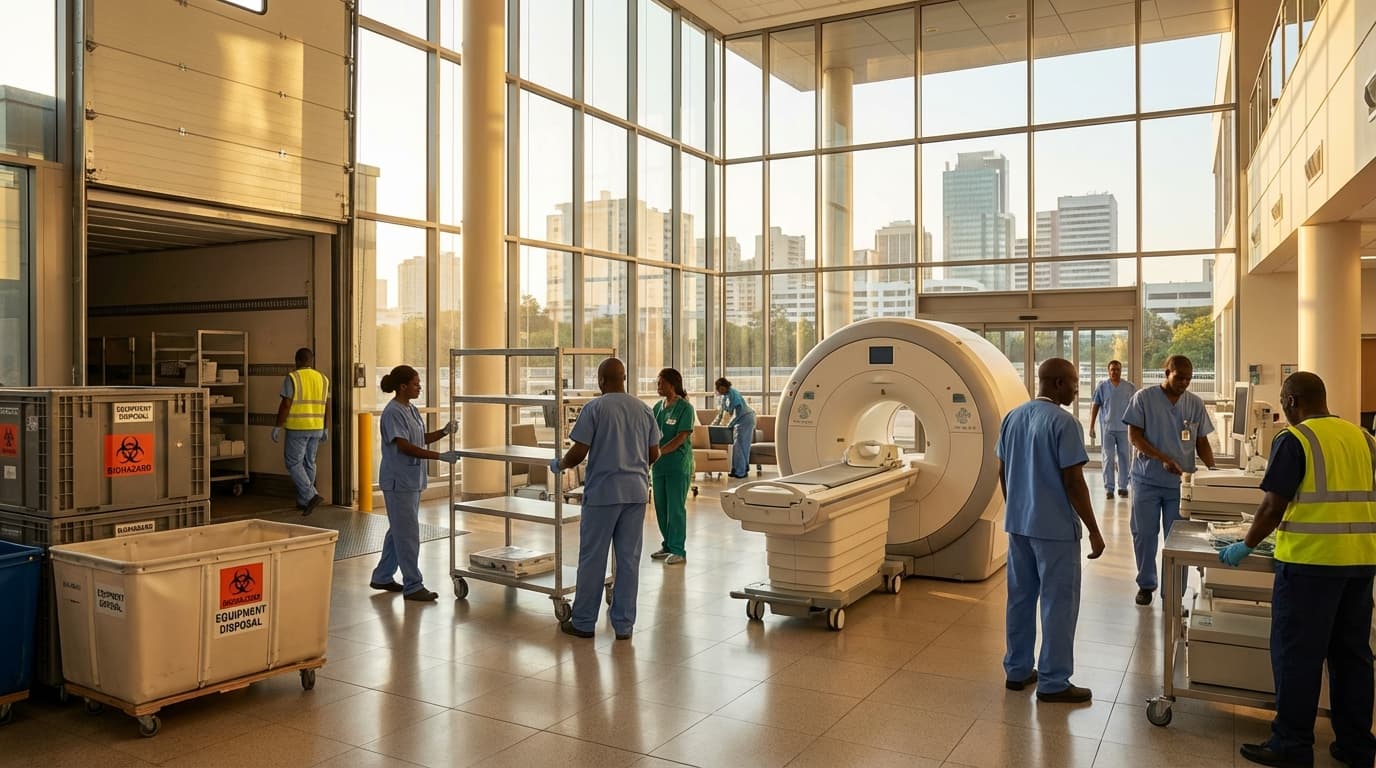
Decommissioning Service for Medical Devices in Madagascar
Engineering Excellence & Technical Support
Decommissioning Service for Medical Devices High-standard technical execution following OEM protocols and local regulatory frameworks.
Environmentally Responsible Decommissioning
Ensures strict adherence to global and local environmental regulations for hazardous material handling and disposal of decommissioned medical devices, preventing pollution and protecting Madagascar's delicate ecosystems.
Secure Data Eradication & Compliance
Implements certified data sanitization protocols for devices with sensitive patient information, guaranteeing complete erasure and compliance with data privacy standards, safeguarding confidentiality.
Optimized Asset Lifecycle Management
Facilitates the responsible recovery of valuable components and materials from retired medical equipment, contributing to a circular economy and maximizing residual value through sustainable recycling and repurposing initiatives.
What Is Decommissioning Service For Medical Devices In Madagascar?
Decommissioning service for medical devices in Madagascar refers to the formal process of safely and environmentally responsibly retiring a medical device from active service. This involves a comprehensive set of procedures designed to ensure the device is no longer functional, its data is securely erased or destroyed, and its components are managed according to regulatory and environmental standards. This service is crucial for maintaining patient safety, data privacy, regulatory compliance, and minimizing environmental impact.
| Who Needs Decommissioning Service? | Typical Use Cases | ||||
|---|---|---|---|---|---|
| Healthcare facilities (hospitals, clinics, diagnostic centers) that are upgrading or replacing medical equipment. | End-of-life management of medical devices that have reached their operational lifespan. | Devices that are irreparably damaged or obsolete and no longer supported by the manufacturer. | Institutions undergoing facility closures or renovations where equipment needs to be removed. | Organizations transitioning to new technological platforms that render older equipment incompatible. | Any entity in Madagascar that possesses and operates medical devices and is subject to regulations governing their disposal. |
| Imaging equipment (e.g., X-ray machines, MRI scanners, CT scanners) reaching end-of-life or being replaced by newer models. | Surgical instruments and equipment that are worn out, damaged, or have reached their sterile lifecycle limit. | Laboratory and diagnostic devices (e.g., analyzers, microscopes) that are obsolete or replaced by advanced systems. | Patient monitoring systems and critical care equipment that are no longer functioning optimally or are superseded by more advanced technology. | Sterilization equipment that has failed to meet performance standards or has reached its operational limit. | Any medical device containing sensitive electronic data that requires secure erasure before disposal. |
Key Components of Medical Device Decommissioning in Madagascar:
- Functional Impairment: Physically rendering the device inoperable to prevent its reuse. This may involve disassembly, destruction of critical components, or component-level incapacitation.
- Data Sanitization/Destruction: Erasing or physically destroying any stored patient data, operational logs, or sensitive information resident on the device. This adheres to data privacy regulations and prevents unauthorized access to protected health information (PHI).
- Environmental Disposal: Managing the disposal of the device and its constituent materials (e.g., electronics, plastics, hazardous substances) in an environmentally sound manner, often involving specialized recycling or hazardous waste management facilities.
- Regulatory Compliance Documentation: Generating comprehensive records of the decommissioning process, including device details, method of decommissioning, date, personnel involved, and disposal certificates, to satisfy national and international regulatory requirements.
- Asset Management Update: Removing the device from inventory and updating asset management systems to reflect its retired status.
Who Needs Decommissioning Service For Medical Devices In Madagascar?
In Madagascar, as in many developing nations, the need for professional medical device decommissioning services is growing. This is driven by several factors, including the aging of existing medical equipment, the influx of new technologies, and the increasing regulatory emphasis on responsible disposal of medical waste. Decommissioning is not just about discarding old equipment; it involves a systematic process of safely removing, cleaning, data sanitizing, and environmentally sound disposal of medical devices to prevent the spread of infections, protect patient data, and comply with national and international environmental regulations.
| Customer Type | Key Departments Involved | Reasons for Decommissioning Need |
|---|---|---|
| Hospitals (Public and Private) | Biomedical Engineering Department, IT Department, Infection Control, Procurement, Administration, Environmental Services | Equipment obsolescence, technological upgrades, end-of-lease agreements, space optimization, compliance with disposal regulations, data security of networked devices. |
| Clinics and Health Centers | Clinical Staff, Administration, Maintenance (if applicable) | Similar to hospitals but often with fewer resources; need for safe disposal of smaller quantities of equipment, ensuring patient privacy. |
| Diagnostic Laboratories | Laboratory Technicians, IT Department, Facility Management | Replacement of outdated laboratory analyzers, testing equipment, and related infrastructure; data sanitization of diagnostic equipment. |
| Research Institutions | Research Scientists, IT Department, Laboratory Management | Technological advancements in research, obsolescence of specialized equipment, need for secure disposal of research data stored on devices. |
| Medical Equipment Suppliers/Distributors | Sales Department, Service Department, Logistics | Managing trade-ins, end-of-life support for sold equipment, fulfilling contractual obligations for disposal, responsible product stewardship. |
| Government Health Agencies | Public Health Department, Procurement, Waste Management Divisions | Overseeing public health infrastructure, managing disposal of government-owned equipment, setting and enforcing disposal standards for all facilities. |
Target Customers and Departments for Medical Device Decommissioning in Madagascar
- Hospitals (Public and Private)
- Clinics and Health Centers
- Diagnostic Laboratories
- Research Institutions
- Medical Equipment Suppliers/Distributors (for end-of-life management)
- Government Health Agencies
Decommissioning Service For Medical Devices Process In Madagascar
This document outlines the standardized workflow for decommissioning medical devices in Madagascar, ensuring compliance with national regulations and environmental safety standards. The process encompasses initial inquiry, detailed assessment, scheduling, execution, documentation, and final disposal or recycling.
| Step | Description | Key Activities | Responsible Party | Deliverables |
|---|---|---|---|---|
| Initial request for decommissioning services. | Submission of formal request, identification of devices, preliminary information gathering. | Healthcare Facility, Decommissioning Service Provider | Inquiry Request Form, Preliminary Device List |
| Evaluation of the medical device's status and potential hazards. | On-site inspection, functionality testing (if applicable), risk assessment (biohazards, chemical, radioactive), identification of components for reuse/recycling. | Decommissioning Service Provider (Technicians, Engineers) | Device Assessment Report, Hazard Identification Report |
| Development of a detailed plan and cost proposal. | Selection of appropriate decommissioning method (disassembly, neutralization, etc.), creation of a step-by-step plan, cost estimation, generation of quotation. | Decommissioning Service Provider | Decommissioning Plan, Service Quotation |
| Formal acceptance of the plan and quotation by the healthcare facility. | Review of plan and quotation, negotiation (if necessary), official approval. | Healthcare Facility Management | Signed Approval Form, Purchase Order |
| Arrangement of the service execution date and time. | Coordination with the healthcare facility, resource allocation (personnel, equipment), confirmation of date and time. | Decommissioning Service Provider | Service Schedule Confirmation |
| Physical decommissioning of the medical device. | Safe disassembly, removal of hazardous materials, decontamination, data wiping (if applicable), packaging for transport. | Decommissioning Service Provider (Certified Technicians) | Partially Decommissioned Device, Waste Segregation |
| Recording of all decommissioning activities and compliance information. | Completion of logbooks, preparation of certificates of destruction/transfer, record-keeping of waste manifests. | Decommissioning Service Provider | Decommissioning Logs, Certificates of Destruction/Transfer |
| Safe and compliant disposal or recycling of the decommissioned device and its components. | Transport to authorized disposal/recycling facilities, adherence to environmental regulations, confirmation of receipt by disposal/recycling center. | Decommissioning Service Provider, Authorized Disposal/Recycling Partners | Waste Manifests, Disposal/Recycling Certificates |
| Provision of a comprehensive report to the healthcare facility. | Compilation of all documentation, summary of activities, final disposal/recycling confirmation, invoicing. | Decommissioning Service Provider | Final Decommissioning Report, Final Invoice |
Decommissioning Service for Medical Devices Process in Madagascar
- The decommissioning process begins with an official inquiry from the healthcare facility requiring the service.
- A comprehensive assessment of the medical device is conducted, including its condition, functionality, and any residual hazards.
- Appropriate decommissioning methods are determined based on the device type and assessment findings.
- A detailed decommissioning plan, including a timeline and cost estimate, is submitted to the healthcare facility for approval.
- Once approved, the decommissioning service is scheduled at a mutually convenient time.
- The actual decommissioning is carried out by trained and certified technicians, adhering to all safety and environmental protocols.
- All documentation related to the decommissioning, including certificates of destruction or transfer, is meticulously prepared.
- The device is then disposed of or recycled according to the approved plan and in compliance with Madagascan regulations.
- A final report summarizing the entire process is provided to the healthcare facility.
Decommissioning Service For Medical Devices Cost In Madagascar
Decommissioning medical devices in Madagascar involves a range of costs influenced by several critical factors. These factors determine the overall expense for healthcare facilities and other organizations requiring this specialized service. The process itself is crucial for ensuring compliance with environmental regulations, data security, and the safe disposal of potentially hazardous materials.
| Device Category | Estimated Cost Range (MGA) | Notes |
|---|---|---|
| Small, Non-Hazardous Devices (e.g., examination lamps, basic diagnostic tools) | 15,000 - 75,000 | Basic disposal and transport. |
| Medium Complexity Devices (e.g., lab equipment, older patient monitors) | 75,000 - 300,000 | May involve basic data sanitization and specialized handling. |
| Large/Complex Imaging Equipment (e.g., X-ray machines, ultrasound units) | 300,000 - 1,500,000+ | Significant cost due to size, complexity, potential hazardous materials, and advanced data destruction. |
| Devices with Significant Hazardous Materials (e.g., older CRT monitors, some lab equipment) | 100,000 - 500,000+ | Costs are highly dependent on the type and quantity of hazardous materials and disposal methods. |
| Data-Intensive Devices Requiring Secure Destruction (e.g., servers, PACS systems) | 200,000 - 1,000,000+ | Focus on certified data erasure or physical shredding. |
| Bulk Decommissioning (per device, volume dependent) | Negotiable, often a percentage discount on individual rates | Significant cost savings for large projects. |
Key Pricing Factors for Medical Device Decommissioning in Madagascar
- {"title":"Type and Complexity of the Medical Device","description":"The nature of the device significantly impacts costs. Simple, non-hazardous devices like basic examination tables will be less expensive to decommission than complex imaging equipment (MRI, CT scanners) or devices containing hazardous materials (e.g., mercury thermometers, old CRT monitors). The size and weight also play a role in transportation and handling logistics."}
- {"title":"Volume of Devices","description":"Decommissioning a single device will generally have a higher per-unit cost than decommissioning a large batch. Service providers often offer tiered pricing or volume discounts, making it more economical for facilities to bundle their decommissioning needs."}
- {"title":"Data Destruction Requirements","description":"Medical devices, especially those with digital storage capabilities (e.g., electronic health record systems, imaging devices), require secure data sanitization or physical destruction. The level of data destruction mandated by regulations or desired by the client will influence the cost, often involving specialized software or hardware."}
- {"title":"Hazardous Material Content","description":"Devices containing hazardous materials such as mercury, lead, cadmium, or refrigerants require specialized handling, containment, and disposal procedures. This often involves higher fees due to the expertise and environmental precautions needed."}
- {"title":"Location and Accessibility","description":"The geographical location of the devices within Madagascar and the ease of access to the site will affect transportation costs. Remote locations or sites with difficult access may incur additional charges for logistics and personnel deployment."}
- {"title":"Certifications and Documentation","description":"Reputable decommissioning services often provide certificates of destruction or disposal, as well as detailed reports. The comprehensiveness of this documentation and any required certifications for compliance can be factored into the pricing."}
- {"title":"Service Provider's Reputation and Expertise","description":"Experienced and certified service providers with a proven track record in medical device decommissioning may command higher prices due to their reliability, adherence to best practices, and specialized knowledge."}
- {"title":"Regulatory Compliance","description":"Adherence to local and international environmental and data privacy regulations is paramount. Service providers who ensure full compliance will factor in the costs associated with meeting these standards."}
Affordable Decommissioning Service For Medical Devices Options
Decommissioning medical devices is a critical and often overlooked aspect of healthcare facility management. Ensuring proper disposal protects patient data, prevents the reintroduction of unsafe equipment, and complies with stringent regulations. Affordable decommissioning services are essential for budget-conscious organizations. This document outlines options for cost-effective medical device decommissioning, focusing on value bundles and smart cost-saving strategies.
| Cost-Saving Strategy | Description | Impact on Affordability |
|---|---|---|
| Volume Discounts | Negotiate lower per-unit costs by committing to decommissioning a larger quantity of devices over a set period. | Directly reduces the overall cost per device. |
| Bundled Services | Combine decommissioning with other services like asset management, secure data destruction, or equipment remarketing to achieve better pricing. | Maximizes value and reduces individual service costs. |
| Scheduled Decommissioning | Plan decommissioning proactively rather than reactively. This allows for more efficient scheduling of technicians and transportation, reducing urgency-related fees. | Minimizes rush fees and optimizes resource allocation. |
| Reputable, Certified Providers | Choose providers with proven track records, certifications (e.g., R2, e-Stewards), and transparent pricing. Avoid unknown or uncertified vendors who may cut corners. | Ensures compliance and avoids costly fines or rework due to improper disposal. |
| Data Sanitization Verification | Understand the provider's data sanitization methods and request verification. Choosing appropriate, but not excessive, sanitization levels can save costs while remaining compliant. | Avoids overspending on unnecessary data wiping protocols. |
| Equipment Remarketing Options | For devices with residual value, inquire about remarketing or resale services offered by the decommissioning provider. This can offset decommissioning costs. | Can generate revenue or significantly reduce net decommissioning expenses. |
| Local Service Providers | Whenever possible, utilize local decommissioning services to reduce transportation costs and environmental impact. | Lower logistical expenses and potentially faster service. |
| Clear Scope of Work | Define the exact services required upfront. Ambiguity can lead to scope creep and unexpected charges. | Prevents additional costs due to misunderstandings or unquoted work. |
Value Bundles for Affordable Decommissioning
- {"title":"Basic Decommissioning Package","description":"Includes essential services like physical disconnection, data sanitization (meeting HIPAA standards), and secure transportation to an approved recycling or disposal facility. Ideal for standard equipment with moderate data sensitivity."}
- {"title":"Comprehensive Decommissioning Package","description":"Builds upon the basic package with added features such as asset tagging and inventory updates, detailed chain-of-custody documentation, and environmental impact reporting. Suitable for facilities requiring thorough record-keeping and environmental stewardship."}
- {"title":"Specialized Equipment Decommissioning Bundle","description":"Tailored for high-value or complex medical equipment (e.g., MRI machines, CT scanners). Includes specialized handling, de-installation by certified technicians, and responsible disposal or remarketing options."}
- {"title":"Ongoing Service Agreement","description":"A contract for regular, scheduled decommissioning of devices as they reach end-of-life. Offers predictable budgeting, priority service, and potential volume-based discounts. Excellent for facilities with a consistent turnover of medical equipment."}
Verified Providers In Madagascar
In Madagascar, access to reliable and qualified healthcare is paramount. When seeking medical services, it's crucial to identify Verified Providers who meet stringent quality standards. Franance Health stands out as a premier credentialing body, ensuring that the healthcare professionals and facilities it endorses are not only licensed but also demonstrate a commitment to excellence in patient care, ethical practices, and continuous professional development. Choosing a provider credentialed by Franance Health offers peace of mind, knowing you are entrusting your well-being to individuals and institutions that have undergone rigorous evaluation and are dedicated to upholding the highest standards of medical practice in Madagascar.
| Franance Health Credentialing Component | What it Means for Patients |
|---|---|
| Licensure and Regulatory Compliance | Confirms that providers meet all legal and professional requirements to practice medicine in Madagascar. |
| Professional Experience and Competency | Ensures that providers possess the necessary skills and experience to deliver quality medical care. |
| Background Checks and Due Diligence | Provides an added layer of security by verifying the integrity and trustworthiness of healthcare professionals. |
| Peer Review and Performance Monitoring | Indicates that providers are subject to ongoing evaluation of their clinical performance and patient outcomes. |
| Commitment to Patient Rights and Privacy | Guarantees that providers respect patient autonomy, confidentiality, and provide care without discrimination. |
Why Franance Health Credentials Matter:
- Assurance of Quality: Franance Health's verification process involves a thorough assessment of qualifications, experience, and adherence to medical best practices.
- Patient Safety: Credentialed providers have demonstrated a commitment to patient safety protocols and risk management.
- Ethical Standards: Franance Health evaluates providers based on their ethical conduct and adherence to professional codes of conduct.
- Continuous Improvement: Verified providers are often expected to engage in ongoing professional development, ensuring they remain up-to-date with the latest medical advancements.
- Trust and Reliability: A Franance Health credential serves as a mark of trust, indicating a provider's dedication to delivering reliable and effective healthcare services.
Scope Of Work For Decommissioning Service For Medical Devices
This Scope of Work (SOW) outlines the requirements for the decommissioning of medical devices. It details the technical deliverables expected from the service provider and the standard specifications that must be adhered to throughout the process. The primary objective is to ensure the safe, secure, and compliant removal of medical devices from service, including data sanitization and proper disposal or refurbishment.
| Stage | Technical Deliverable | Standard Specifications / Requirements | Key Considerations |
|---|---|---|---|
| Planning and Assessment | Decommissioning Plan | Detailed step-by-step procedure for each device type, including timelines, resource allocation, safety protocols, and disposal routes. Risk assessment for each device. | Identification of all devices to be decommissioned, their classification, and potential hazards. |
| Data Sanitization and Security | Data Sanitization Report | Verification of complete data erasure using NIST 800-88 Rev. 1 (Clear, Purge, or Destroy methods) or equivalent industry standard. Encryption key management and destruction protocols. Secure chain of custody for data storage media. | Compliance with HIPAA, GDPR, and other relevant data privacy regulations. Prevention of unauthorized access to sensitive patient data. |
| Physical Decommissioning and Removal | Device Decommissioning Record | Safe disconnection and dismantling of devices. Proper handling of hazardous materials (e.g., mercury, radioactive components). Compliance with electrical safety standards. Secure packaging and transportation. | Minimizing disruption to ongoing operations. Ensuring the safety of personnel and the environment. |
| Documentation and Certification | Decommissioning Certificates | Certificate of Data Destruction (if applicable). Certificate of Disposal/Recycling. Inventory of decommissioned devices with serial numbers and final disposition. Compliance audit trail. | Proof of compliant decommissioning for regulatory purposes and internal record-keeping. |
| Disposal or Refurbishment | Waste Manifest / Transfer Documentation | Documentation of transfer to licensed disposal facilities. Proof of environmentally sound disposal or refurbishment by certified vendors. Compliance with e-waste regulations and hazardous waste management. | Ensuring responsible and sustainable end-of-life management of medical equipment. Maximizing asset recovery where feasible. |
Key Stages of Medical Device Decommissioning
- Planning and Assessment
- Data Sanitization and Security
- Physical Decommissioning and Removal
- Documentation and Certification
- Disposal or Refurbishment
Service Level Agreement For Decommissioning Service For Medical Devices
This Service Level Agreement (SLA) outlines the guaranteed response times and uptime for the Decommissioning Service for Medical Devices provided by [Your Company Name] (hereinafter referred to as 'Provider') to [Client Company Name] (hereinafter referred to as 'Client'). This SLA is an addendum to the Master Services Agreement between the parties, dated [Date of MSA].
| Service Component/Incident Type | Priority Level | Response Time Guarantee | Resolution Time Target (Best Effort) | Uptime Guarantee (Monthly) |
|---|---|---|---|---|
| Decommissioning Service Availability (Overall) | N/A | N/A | N/A | 99.9% |
| Critical Incident (e.g., Service Unavailability) | P1 - High | 15 minutes (Acknowledgement) | 4 Business Hours (Resolution) | N/A |
| Major Incident (e.g., Intermittent Access, Key Functionality Impaired) | P2 - Medium | 1 Hour (Acknowledgement) | 8 Business Hours (Resolution) | N/A |
| Minor Incident (e.g., UI Glitches, Non-critical Functionality Issues) | P3 - Low | 4 Business Hours (Acknowledgement) | 2 Business Days (Resolution) | N/A |
| Request for Standard Decommissioning Scheduling | N/A | 2 Business Hours (Acknowledgement) | N/A | N/A |
| Request for Urgent Decommissioning Scheduling (within defined scope) | N/A | 30 minutes (Acknowledgement) | N/A | N/A |
Definitions
- Decommissioning Service: The service of securely and verifiably rendering medical devices unusable and/or erasing sensitive data in accordance with regulatory requirements and industry best practices. This includes but is not limited to physical destruction, data sanitization, and certification of destruction/sanitization.
- Downtime: Any period during which the Provider's Decommissioning Service is unavailable to the Client, excluding Scheduled Maintenance. This unavailability is measured by the inability of the Client to initiate or track a decommissioning request through the designated portal or communication channels.
- Scheduled Maintenance: Planned downtime for system updates, upgrades, or preventative maintenance, which will be communicated to the Client at least [Number] days in advance.
- Response Time: The maximum time allowed for the Provider to acknowledge and begin addressing a reported issue or request.
- Uptime: The percentage of time during a given month that the Provider's Decommissioning Service is available to the Client.
- Critical Incident: An event that renders the Decommissioning Service completely unavailable, preventing the initiation or tracking of decommissioning requests.
- Major Incident: An event that significantly degrades the performance or functionality of the Decommissioning Service, but does not result in complete unavailability. This could include intermittent access issues or the inability to perform certain functions within the service.
- Minor Incident: An event that has a minimal impact on the Decommissioning Service's functionality or performance, where workarounds may be available.
Frequently Asked Questions

Ready when you are
Let's scope your Decommissioning Service for Medical Devices in Madagascar project in Madagascar.

Scaling healthcare logistics and technical systems across the entire continent.