
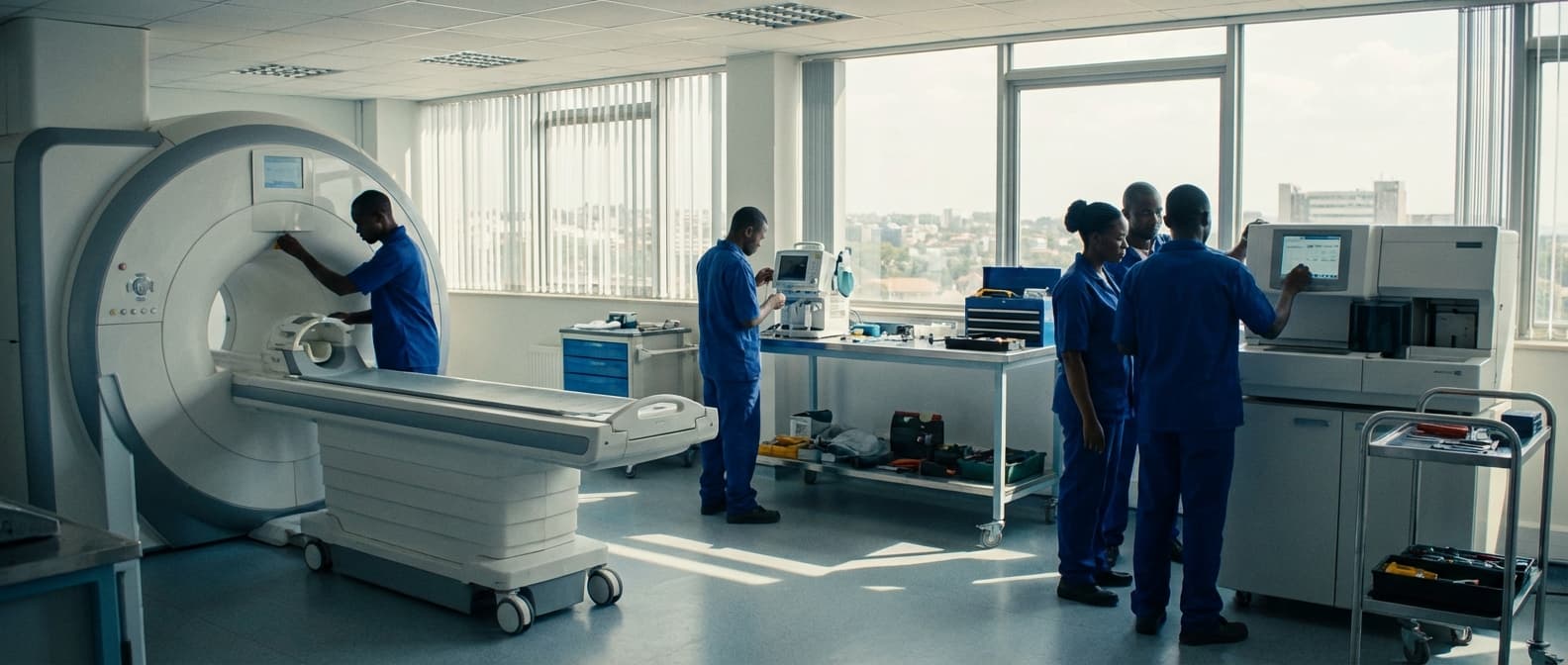
Uptime, Downtime & Root-Cause Analysis Reporting Service in Madagascar
Engineering Excellence & Technical Support
Uptime, Downtime & Root-Cause Analysis Reporting Service High-standard technical execution following OEM protocols and local regulatory frameworks.
Maximize Uptime with Real-time Monitoring in Madagascar
Gain unparalleled visibility into your critical infrastructure across Madagascar. Our service provides real-time uptime dashboards, proactive alerts, and historical performance data, ensuring your services remain accessible to your Malagasy customers 24/7.
Rapid Downtime Mitigation & Service Restoration in Madagascar
Minimize the impact of outages. Our sophisticated monitoring and alert system immediately flags downtime events across Madagascar, enabling rapid response teams to diagnose and restore services swiftly, reducing business disruption and revenue loss.
Pinpoint Root Causes for Enhanced Stability in Madagascar
Go beyond just knowing about an outage. Our comprehensive Root-Cause Analysis (RCA) reporting service meticulously identifies the underlying triggers of downtime across your Madagascan operations, providing actionable insights to prevent recurrence and build more resilient systems.
What Is Uptime, Downtime & Root-cause Analysis Reporting Service In Madagascar?
This document outlines Uptime, Downtime & Root-Cause Analysis (RCA) Reporting Services within the Madagascan operational context. These services are critical for maintaining the availability, performance, and reliability of IT infrastructure and business-critical applications. Uptime refers to the period during which a system or service is operational and accessible. Downtime signifies periods when a system or service is unavailable or malfunctioning. RCA Reporting provides a systematic process to identify the fundamental causes of these downtimes, enabling preventative measures and continuous improvement. The primary objective is to minimize service disruptions, reduce financial losses associated with outages, and enhance overall service quality for businesses operating in Madagascar.
| Target Audience | Needs Addressed | Typical Use Cases in Madagascar |
|---|---|---|
| Telecommunication Providers | Ensuring continuous network availability for voice, data, and mobile services; minimizing subscriber churn due to outages; optimizing network performance. | Monitoring cellular tower uptime; analyzing downtime for mobile broadband services; RCA for fiber optic network interruptions; performance reporting for call centers. |
| Financial Institutions (Banks, Insurance) | Maintaining secure and uninterrupted access to banking platforms, ATMs, and transaction processing systems; complying with regulatory uptime requirements; preventing financial fraud due to system unavailability. | Uptime monitoring of core banking systems; downtime analysis for ATM networks; RCA for payment gateway failures; reporting on service availability for online banking portals. |
| Government Agencies & Public Services | Ensuring the availability of critical public services (e.g., e-government portals, health systems, utilities); maintaining citizen trust; efficient resource allocation. | Monitoring uptime of national ID systems; analyzing downtime for public health record systems; RCA for disruptions to water or electricity grid management software; reporting on e-governance platform availability. |
| E-commerce & Retail Businesses | Maximizing online sales opportunities by ensuring website and application availability; preventing lost revenue due to cart abandonment or checkout failures; managing inventory and order fulfillment systems. | Uptime monitoring of e-commerce websites; downtime analysis for mobile ordering apps; RCA for payment processing issues; performance reporting for warehouse management systems. |
| Logistics & Transportation Companies | Ensuring the reliability of tracking systems, fleet management software, and supply chain platforms; minimizing delays and associated costs; maintaining operational efficiency. | Monitoring uptime of GPS tracking systems; downtime analysis for dispatching software; RCA for disruptions in cargo management platforms; reporting on vehicle availability and route optimization. |
| Mining & Extractive Industries | Maintaining the operational integrity of control systems, SCADA, and communication networks in remote and challenging environments; ensuring worker safety and production continuity. | Uptime monitoring of mine site operational control systems; downtime analysis for remote sensing equipment; RCA for communication link failures to offshore platforms or remote mining operations; performance reporting for industrial automation. |
| Hospitality Sector (Hotels, Tourism) | Ensuring uninterrupted access to reservation systems, property management software, and guest services; providing seamless customer experiences. | Uptime monitoring of hotel reservation systems; downtime analysis for point-of-sale (POS) systems; RCA for Wi-Fi network disruptions for guests; reporting on website availability for bookings. |
Service Components & Deliverables
- Uptime Monitoring: Continuous, real-time observation of system and application availability, performance metrics (latency, throughput, error rates), and resource utilization.
- Downtime Event Logging & Notification: Accurate recording of all service interruptions, including timestamps, duration, affected services, and severity levels, coupled with timely alerts to relevant stakeholders.
- Root-Cause Analysis (RCA): In-depth investigation of downtime events utilizing methodologies such as the '5 Whys,' Fishbone diagrams, or Fault Tree Analysis to pinpoint the primary causative factors.
- Impact Assessment: Quantification of the business and technical impact of downtime events, including financial losses, reputational damage, and operational inefficiencies.
- Corrective Action Recommendations: Development of actionable strategies to address identified root causes and prevent recurrence of similar issues.
- Preventative Maintenance Planning: Proactive identification of potential failure points and implementation of scheduled maintenance to mitigate risks.
- Performance Trend Analysis: Longitudinal study of system performance to identify degradation patterns and optimize resource allocation.
- Reporting & Dashboards: Generation of comprehensive reports and interactive dashboards detailing uptime statistics, downtime incidents, RCA findings, and recommended actions for strategic decision-making.
- Post-Mortem Reviews: Facilitation of collaborative review sessions with technical teams and business stakeholders to discuss incidents, lessons learned, and implemented solutions.
Who Needs Uptime, Downtime & Root-cause Analysis Reporting Service In Madagascar?
Organizations operating in Madagascar, regardless of industry or size, can significantly benefit from a comprehensive Uptime, Downtime & Root-Cause Analysis Reporting Service. This service provides critical insights into the availability and performance of IT systems and operational processes. By understanding the causes and impacts of downtime, businesses can proactively mitigate risks, optimize resource allocation, enhance customer satisfaction, and ultimately improve their bottom line. This is especially crucial in a developing economy like Madagascar, where reliable infrastructure and efficient operations are paramount for growth and competitiveness.
| Industry/Sector | Key Departments Benefiting | Specific Needs Addressed |
|---|---|---|
| Telecommunications | Network Operations Center (NOC), IT Operations, Customer Support | Ensuring network uptime, identifying causes of service disruptions, improving customer experience, optimizing infrastructure performance. |
| Banking & Financial Services | IT Operations, Risk Management, Compliance, Business Continuity Planning | Maintaining critical transaction systems availability, identifying fraud-related downtime, meeting regulatory compliance, minimizing financial losses due to outages. |
| Energy & Utilities | Operations Management, SCADA/Control Systems, IT Department, Maintenance Teams | Monitoring power grid stability, identifying causes of service interruptions, ensuring efficient resource distribution, optimizing operational uptime. |
| Manufacturing & Industrial | Production Management, Plant Operations, IT Infrastructure, Maintenance | Minimizing production line downtime, identifying root causes of equipment failure, optimizing manufacturing processes, improving overall equipment effectiveness (OEE). |
| Retail & E-commerce | E-commerce Operations, IT Department, Supply Chain Management, Customer Service | Ensuring website/app availability, optimizing transaction processing, preventing stock-outs due to system failures, enhancing customer purchasing experience. |
| Government & Public Sector | IT Departments, Administrative Offices, Citizen Service Centers, Public Works | Ensuring accessibility of public services, maintaining data integrity and availability, optimizing operational efficiency, improving citizen trust. |
| Healthcare | IT Department, Hospital Administration, Clinical Operations, Biomedical Engineering | Maintaining patient record systems availability, ensuring medical equipment functionality, safeguarding sensitive patient data, minimizing disruptions to patient care. |
| IT Service Providers / MSPs | Service Delivery, Technical Support, Operations Management | Proactively monitoring client systems, demonstrating service level agreement (SLA) compliance, identifying and resolving issues efficiently, improving client retention. |
Target Customers in Madagascar
- Large Enterprises (Telecommunications, Banking, Energy, Manufacturing, Retail)
- Government Agencies & Public Sector Organizations
- Small and Medium-sized Enterprises (SMEs) across various sectors
- IT Service Providers & Managed Service Providers (MSPs)
- E-commerce & Online Service Providers
- Logistics & Transportation Companies
- Healthcare Institutions
- Educational Institutions
Uptime, Downtime & Root-cause Analysis Reporting Service Process In Madagascar
This document outlines the workflow for an Uptime, Downtime & Root-Cause Analysis Reporting Service in Madagascar. The process details the steps from an initial client inquiry to the final execution and delivery of a comprehensive report. The service aims to provide clients with clear, actionable insights into their system availability and the underlying causes of any disruptions, enabling them to improve operational efficiency and resilience.
| Step | Description | Key Activities | Responsible Party | Output/Deliverable | Timeframe (Typical) |
|---|---|---|---|---|---|
| The client expresses interest in the reporting service. | Initial meeting/call, understanding client's needs, service overview, preliminary questions. | Client, Service Provider | Understanding of client's challenges, initial qualification. | 1-3 Business Days |
| Detailed understanding of the client's systems and reporting requirements. | In-depth technical discussion, identification of systems to monitor, definition of uptime/downtime metrics, SLA requirements, pricing discussion. | Client, Service Provider | Detailed scope document, tailored service proposal. | 3-7 Business Days |
| Formalization of the service agreement. | Review and signing of the contract, payment terms, service level agreements (SLAs). | Client, Service Provider | Signed contract, commencement of service. | 2-5 Business Days |
| Implementation of monitoring tools and data collection mechanisms. | Installation/configuration of monitoring agents/software, network access setup, defining data points for uptime/downtime, establishing alert thresholds. | Service Provider (with client cooperation) | Operational monitoring system, baseline data established. | 5-15 Business Days (depending on complexity) |
| Automatic detection and immediate notification of any system downtime. | System anomaly detected, alert generated, automated notification to client and/or service provider support team. | Monitoring System, Service Provider | Real-time downtime alert, initial incident timestamp. | Immediate (upon event occurrence) |
| Investigating the cause of the downtime event. | Review of logs, performance metrics, network traffic, system configurations, correlating events, expert analysis to pinpoint the root cause. | Service Provider | Identified root cause(s), contributing factors. | 1-48 Hours (depending on complexity) |
| Compilation of all collected data and analysis into a structured report. | Structuring uptime/downtime data, detailing incident timeline, presenting root-cause analysis findings, including relevant data visualizations. | Service Provider | Comprehensive Uptime, Downtime & Root-Cause Analysis Report. | 2-5 Business Days (post-analysis) |
| Sharing the findings with the client. | Scheduled meeting, presentation of the report, Q&A session, clarification of findings. | Service Provider, Client | Client understanding of system performance and downtime incidents. | 1-2 Business Days (post-report generation) |
| Providing guidance for improvement and tracking progress. | Developing practical recommendations to prevent future occurrences, assisting with implementation (if contracted), scheduling follow-up reviews. | Service Provider | Set of recommended actions, potential for improvement in system stability. | Ongoing (based on recommendations) |
| Concluding the reporting cycle and gathering client satisfaction. | Finalizing the reporting period, obtaining client feedback on the service, archiving data, potential for contract renewal or termination. | Service Provider, Client | Client satisfaction survey, record of service completion. | 1-3 Business Days |
Uptime, Downtime & Root-Cause Analysis Reporting Service Workflow
- Inquiry & Initial Consultation
- Scope Definition & Proposal
- Agreement & Contract
- Data Collection & Monitoring Setup
- Downtime Event Trigger & Notification
- Data Analysis & Root-Cause Identification
- Report Generation
- Report Presentation & Discussion
- Actionable Recommendations & Follow-up
- Service Closure & Feedback
Uptime, Downtime & Root-cause Analysis Reporting Service Cost In Madagascar
This report outlines the typical cost of Uptime, Downtime, and Root-Cause Analysis (RCA) reporting services in Madagascar. These services are crucial for businesses to monitor the availability of their IT infrastructure, quickly identify and resolve issues, and prevent future disruptions. The pricing is influenced by several factors, making it important to understand these elements when seeking quotations.
| Service Component | Typical Range (MGA) | Notes |
|---|---|---|
| Basic Uptime/Downtime Monitoring (Per Device/Service) | 20,000 - 75,000 MGA per month | Covers essential checks (e.g., ping, port availability). Suitable for smaller environments. |
| Comprehensive IT Infrastructure Monitoring (Per Server/Application) | 50,000 - 200,000 MGA per month | Includes CPU, memory, disk usage, process monitoring, and application-specific metrics. |
| Network Performance Monitoring (Per Device/Segment) | 40,000 - 150,000 MGA per month | Focuses on bandwidth, latency, packet loss, and device health. |
| Basic Incident Alerting & Notification | Included in monitoring packages | Standard email/SMS alerts for predefined thresholds. |
| Standard Root-Cause Analysis (RCA) Reporting (Per Incident) | 100,000 - 300,000 MGA per incident | Involves analyzing logs, basic diagnostics, and documenting immediate causes. |
| Advanced Root-Cause Analysis (RCA) Reporting (Per Incident) | 250,000 - 750,000+ MGA per incident | Requires deeper investigation, correlation of multiple data points, expert analysis, and recommendations for long-term fixes. Highly complex issues can exceed this range. |
| Custom Dashboard & Reporting Development | 200,000 - 1,000,000+ MGA (one-time or retainer) | Depends on the complexity and number of custom reports required. |
| SLA-Driven Support & Response (Add-on) | 15-30% of base monitoring cost | Guaranteed faster response times for critical incidents. |
| Initial Setup & Configuration Fee | 50,000 - 500,000+ MGA (one-time) | Varies significantly based on the size and complexity of the environment and the chosen vendor. |
| Managed Service Provider (MSP) Packages (Monthly Retainer) | 500,000 - 5,000,000+ MGA per month | Bundles monitoring, alerting, RCA, and proactive management for a fixed monthly fee. Scales with the size and criticality of the IT environment. |
Key Pricing Factors for Uptime, Downtime & Root-Cause Analysis Reporting Services in Madagascar:
- Scope of Monitoring: The number of systems, applications, servers, and network devices to be monitored directly impacts cost. A broader scope necessitates more resources and complex configurations.
- Monitoring Frequency & Granularity: How often is each metric checked? Higher frequency and more granular data collection will increase processing and storage needs, thus affecting price.
- Complexity of Infrastructure: The heterogeneity of your IT environment (e.g., cloud, on-premise, hybrid, virtualized, containerized) can influence the complexity of integration and monitoring setup.
- RCA Depth & Sophistication: Simple incident logging will be cheaper than in-depth RCA requiring advanced diagnostics, correlation of multiple data sources, and expert analysis for complex issues.
- Reporting Customization: The level of customization required for reports (e.g., dashboards, specific metrics, executive summaries) can add to the cost, especially if custom development is needed.
- Service Level Agreements (SLAs): Guaranteed response times for critical alerts and resolution times for issues will influence pricing, as they often require dedicated resources and robust infrastructure.
- Data Retention Period: The length of time historical monitoring data needs to be stored for analysis and compliance impacts storage costs.
- Vendor Expertise & Reputation: Established vendors with a proven track record and specialized expertise may command higher prices.
- On-site vs. Remote Support: While most services are remote, any requirement for on-site presence for setup or critical incident resolution will incur additional travel and labor costs.
- Integration with Existing Systems: The need to integrate reporting services with existing IT Service Management (ITSM) tools, ticketing systems, or other operational platforms can add to the implementation cost.
- Volume of Incidents: While not a direct pricing factor for the service itself, a very high volume of recurring incidents might lead to custom pricing or a re-evaluation of the monitoring strategy.
Affordable Uptime, Downtime & Root-cause Analysis Reporting Service Options
Reliable system uptime is critical for business continuity, and understanding downtime is essential for proactive improvement. Our service offers comprehensive reporting for uptime, downtime, and root-cause analysis, designed to be both effective and budget-friendly. We understand that different organizations have varying needs and budgets, which is why we've developed flexible value bundles and cost-saving strategies to ensure you get the most out of your investment.
| Cost-Saving Strategy | Description | Benefits |
|---|---|---|
| Tiered Service Levels | We offer distinct service tiers (Essentials, Professional, Enterprise) with escalating features. You can choose the tier that best fits your current needs, avoiding overspending on unused capabilities. | Pay only for what you need; scalable as your business grows. |
| Annual Subscription Discounts | Committing to an annual subscription for any of our bundles provides significant cost savings compared to monthly billing. This helps in budget predictability and overall expense reduction. | Reduced overall cost, predictable budgeting. |
| Bundled Feature Packages | Our value bundles group related services at a lower price point than purchasing them individually. This encourages a holistic approach to monitoring and analysis. | Greater value for money, integrated insights. |
| Self-Service Analytics Options | For clients who prefer hands-on analysis, we offer options for direct access to raw data and configurable dashboards within certain bundles, reducing the need for extensive manual reporting by our team. | Empowers internal teams, reduces reliance on external reporting resources. |
| Scalable Infrastructure | Our cloud-based reporting infrastructure is designed to scale efficiently. As your data volume increases, our costs don't inflate proportionally, passing savings onto you. | Cost-effective scaling, future-proof solution. |
| Focus on Actionable Insights | Our reporting emphasizes actionable insights that directly lead to improvements, reducing the frequency and duration of downtime. This preventative approach saves money in the long run by minimizing lost revenue and recovery costs. | Reduced operational costs, increased productivity. |
Value Bundles for Uptime & Downtime Reporting
- {"title":"Essentials Bundle","description":"Ideal for smaller businesses or those just starting with performance monitoring. Provides core uptime and downtime tracking with basic incident logging. Focuses on identifying recurring issues."}
- {"title":"Professional Bundle","description":"A balanced offering for growing businesses. Includes enhanced uptime/downtime metrics, detailed downtime reasons, and foundational root-cause analysis reports. Supports deeper issue investigation."}
- {"title":"Enterprise Bundle","description":"Comprehensive solution for large organizations with complex infrastructures. Offers advanced real-time monitoring, sophisticated root-cause analysis with trend identification, predictive insights, and customizable reporting dashboards."}
- {"title":"Custom Bundle","description":"Tailor-made solutions for unique requirements. We work with you to combine specific features and reporting levels to perfectly match your operational needs and budget constraints."}
Verified Providers In Madagascar
In Madagascar's evolving healthcare landscape, ensuring access to verified and trustworthy medical services is paramount. Franance Health stands as a beacon of reliability, offering a comprehensive network of healthcare providers who have undergone rigorous credentialing. This commitment to verification not only safeguards patient well-being but also streamlines the healthcare journey. Franance Health's credentialing process focuses on a provider's qualifications, experience, and adherence to ethical standards, ensuring that patients receive the highest quality of care. Choosing a provider accredited by Franance Health means opting for assurance, expertise, and a patient-centered approach that prioritizes your health and safety.
| Credential Area | Franance Health Verification Focus | Benefit to Patients |
|---|---|---|
| Medical Education & Training | Verification of degrees, diplomas, and specialized certifications from accredited institutions. | Ensures providers have a strong foundational understanding of medical principles and practices. |
| Professional Licenses & Registrations | Confirmation of valid and current licenses to practice medicine in Madagascar. | Guarantees that providers are legally authorized and meet regulatory requirements. |
| Clinical Experience | Assessment of years of practice, areas of specialization, and demonstrated patient care history. | Confirms practical application of knowledge and ability to handle various medical scenarios. |
| Continuing Medical Education (CME) | Requirement and verification of ongoing professional development to stay abreast of medical advancements. | Ensures providers are up-to-date with the latest treatments and diagnostic techniques. |
| Reputation & Peer Review | Where applicable, consideration of feedback and assessments from peers and regulatory bodies. | Provides an additional layer of assurance regarding a provider's professional conduct and competence. |
| Adherence to Ethical Standards | Commitment to a code of ethics and professional conduct. | Builds trust and ensures a patient-centered and respectful healthcare experience. |
Why Franance Health Credentials Matter:
- Uncompromising Quality Assurance: Franance Health's thorough vetting process guarantees that all listed providers meet stringent medical and ethical standards.
- Enhanced Patient Safety: Patients can have confidence in the expertise and qualifications of Franance Health-certified professionals, minimizing risks.
- Streamlined Healthcare Access: A verified network simplifies the search for reliable healthcare, saving valuable time and reducing stress.
- Focus on Expertise and Experience: Credentials confirm a provider's specialized knowledge and practical experience in their respective fields.
- Commitment to Ethical Practice: Franance Health ensures providers adhere to a code of conduct, fostering trust and accountability.
- Access to Specialized Care: The network includes a diverse range of specialists, ensuring patients can find the exact care they need.
- Improved Health Outcomes: By connecting patients with qualified professionals, Franance Health contributes to better and more consistent health results.
Scope Of Work For Uptime, Downtime & Root-cause Analysis Reporting Service
This Scope of Work outlines the requirements for a Uptime, Downtime & Root-Cause Analysis Reporting Service. The service aims to provide detailed, actionable reports on system availability, including identification and analysis of the underlying causes of any disruptions. This will enable proactive measures to improve system resilience and minimize future outages.
| Category | Technical Deliverables | Standard Specifications & Details |
|---|---|---|
| Uptime/Downtime Monitoring | Real-time Uptime Dashboard | 24/7 monitoring of critical system components. Visual representation of current uptime status (e.g., green for up, red for down). Accessible via a web portal. |
| Uptime/Downtime Monitoring | Historical Uptime/Downtime Reports | Monthly and quarterly reports detailing total uptime, total downtime (categorized by severity), and Mean Time Between Failures (MTBF). Data presented in graphical and tabular formats. Data retention for at least 12 months. |
| Incident Management & Reporting | Incident Notification & Ticketing | Automated alerts (email, SMS, integration with existing ticketing systems) upon detection of downtime. Unique incident ID generated for each event. Initial incident assessment and categorization within 30 minutes of detection. |
| Incident Management & Reporting | Downtime Incident Reports | Detailed reports for each downtime incident, including: Incident start and end times, duration, affected systems/services, impact assessment (business and technical), assigned severity level, and initial troubleshooting steps. |
| Root-Cause Analysis (RCA) | Formal Root-Cause Analysis Documentation | For all critical and major incidents, a formal RCA report. This report will include: detailed timeline of events leading up to the incident, contributing factors (e.g., software bugs, hardware failures, human error, configuration changes), evidence gathered (logs, metrics, traces), identified root cause(s), and lessons learned. |
| Root-Cause Analysis (RCA) | Actionable Recommendations & Remediation Plans | Each RCA report must include specific, actionable recommendations to prevent recurrence of the identified root cause(s). This includes proposed technical changes, process improvements, training needs, and clear ownership for each action item. Remediation plans with target completion dates. |
| Reporting & Communication | Executive Summary Reports | Concise monthly and quarterly reports for executive stakeholders, highlighting key uptime metrics, significant incidents, overall system health trends, and progress on major remediation efforts. Focus on business impact and strategic implications. |
| Reporting & Communication | Technical Deep-Dive Reports | Detailed reports for technical teams, providing in-depth analysis of incidents, RCA findings, and technical remediation steps. Includes raw data excerpts and technical diagrams where applicable. |
| Reporting & Communication | Trend Analysis & Predictive Insights | Analysis of historical incident data to identify recurring patterns and potential future risks. Proactive identification of areas for system improvement and preventative maintenance. |
| Service Level Agreement (SLA) Compliance | SLA Performance Reporting | Regular reporting on adherence to agreed-upon uptime SLAs, with clear explanations for any deviations. |
Key Objectives
- To establish a clear and consistent methodology for tracking and reporting system uptime and downtime.
- To conduct thorough root-cause analysis (RCA) for all identified downtime incidents.
- To provide comprehensive and actionable reports to stakeholders.
- To contribute to the continuous improvement of system reliability and performance.
Service Level Agreement For Uptime, Downtime & Root-cause Analysis Reporting Service
This Service Level Agreement (SLA) defines the service levels, response times, and guarantees for the Uptime, Downtime, and Root-Cause Analysis Reporting Service provided by [Your Company Name] (hereinafter referred to as 'Provider') to [Client Name] (hereinafter referred to as 'Client'). This SLA is an integral part of the Master Service Agreement between the Provider and the Client.
| Service Component | Uptime Guarantee | Response Time (for Incident Reporting) | RCA Report Delivery Timeframe (for critical incidents) |
|---|---|---|---|
| Uptime, Downtime, and Root-Cause Analysis Reporting Service | 99.9% per calendar month | 15 minutes for initial acknowledgement | Within 4 business hours |
Definitions
- Uptime: The percentage of time during a calendar month that the Uptime, Downtime, and Root-Cause Analysis Reporting Service is available and operational for the Client.
- Downtime: The total accumulated time during a calendar month that the Uptime, Downtime, and Root-Cause Analysis Reporting Service is unavailable or not operational for the Client.
- Scheduled Downtime: Planned maintenance periods announced by the Provider in advance, during which the Service may be unavailable. Scheduled downtime is excluded from Uptime calculations.
- Unscheduled Downtime: Any period of Downtime not classified as Scheduled Downtime.
- Root-Cause Analysis (RCA) Report: A detailed document provided by the Provider that identifies the underlying cause(s) of an incident, the impact, and the remediation steps taken or recommended.
- Incident: A situation where the Uptime, Downtime, and Root-Cause Analysis Reporting Service is not performing as expected or is unavailable.
Frequently Asked Questions

Ready when you are
Let's scope your Uptime, Downtime & Root-Cause Analysis Reporting Service in Madagascar project in Madagascar.

Scaling healthcare logistics and technical systems across the entire continent.