
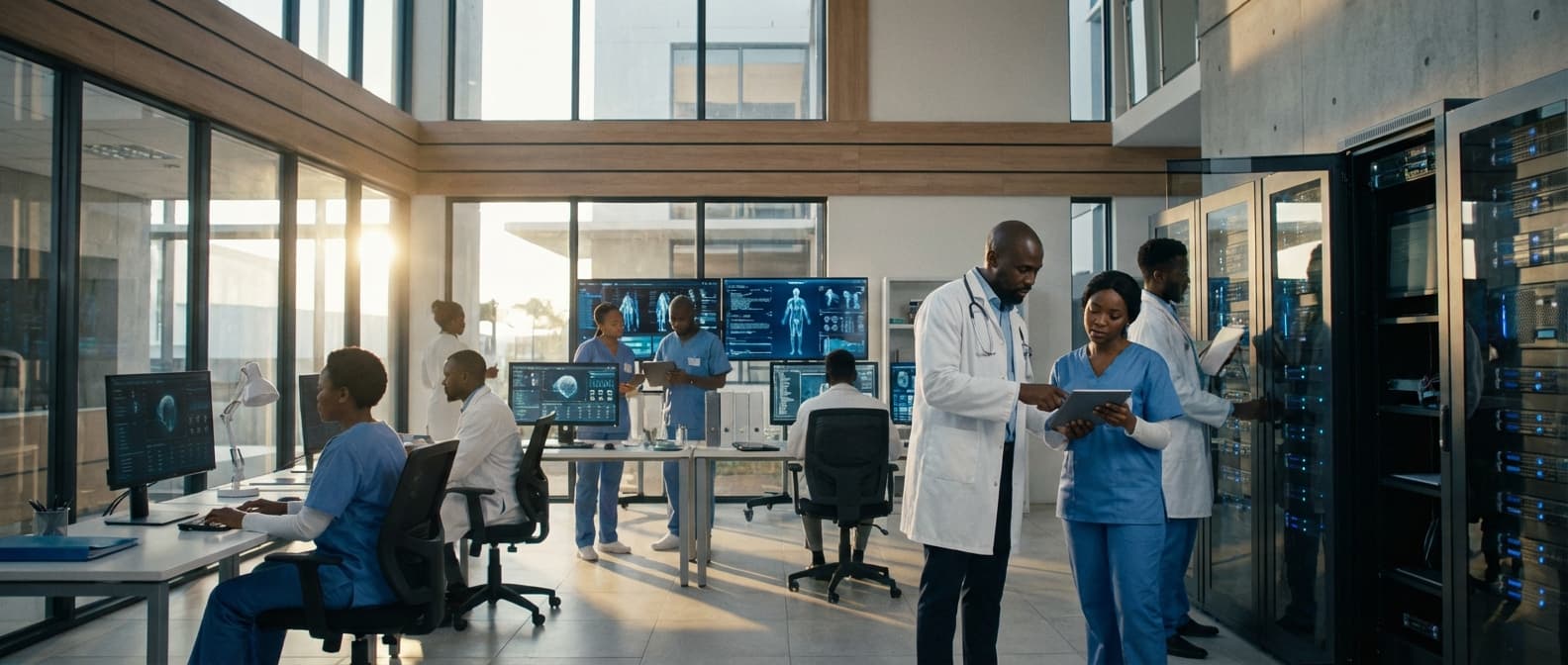
Medical IT Consultation in Madagascar
Engineering Excellence & Technical Support
Strategic technology consulting to optimize healthcare operations, streamline workflows, and integrate cutting-edge medical information systems. High-standard technical execution following OEM protocols and local regulatory frameworks.
Robust IT Infrastructure Development
Designing and implementing scalable, secure, and reliable IT infrastructures for healthcare facilities across Madagascar, ensuring seamless data flow and operational efficiency from server setup to network optimization.
Secure Data Management & Cloud Solutions
Implementing secure, compliant, and cost-effective cloud-based solutions for Electronic Health Records (EHR) and patient data management, tailored to Madagascar's unique connectivity landscape and regulatory requirements.
Remote Support & Training Platforms
Establishing and managing robust remote IT support systems and comprehensive training platforms to empower local healthcare professionals in utilizing new technologies, overcoming geographical challenges and ensuring continuous system uptime.
What Is Medical It Consultation In Madagascar?
Medical IT consultation in Madagascar refers to the provision of specialized information technology advisory services tailored to the unique healthcare landscape of the nation. This service aims to optimize the design, implementation, and management of IT systems within healthcare facilities, addressing specific infrastructural, financial, and regulatory challenges prevalent in Madagascar. It encompasses a broad spectrum of IT-related needs, from basic digital infrastructure assessment to the deployment of advanced health information systems and the adherence to evolving data security and privacy standards.
| Who Needs Medical IT Consultation? | Typical Use Cases |
|---|---|
| Public Hospitals and Health Centers: Facing resource constraints, outdated infrastructure, and the need to improve patient data management and service delivery efficiency. | Implementing a basic HIS/EHR to track patient demographics, medical history, and treatment plans. Establishing reliable internet connectivity for remote consultations and access to medical resources. |
| Private Clinics and Hospitals: Seeking to enhance patient experience, streamline operations, and adopt more sophisticated diagnostic and management tools. | Deploying a cloud-based HIS/EHR for improved accessibility and scalability. Integrating diagnostic imaging systems with the HIS. Implementing appointment scheduling and billing software. |
| Non-Governmental Organizations (NGOs) and International Health Agencies: Working on specific health programs in remote or underserved areas, requiring robust and adaptable IT solutions. | Setting up mobile health (mHealth) solutions for data collection and patient follow-up in rural communities. Establishing telemedicine links for specialist consultations in remote clinics. |
| Ministry of Health and other Government Health Bodies: Aiming to standardize health information systems, improve national health data analytics, and implement e-health strategies. | Developing a national health information exchange framework. Assessing and recommending national standards for HIS/EHR. Planning for the nationwide rollout of digital health initiatives. |
| Medical Training and Research Institutions: Requiring advanced IT infrastructure for educational purposes, research data management, and knowledge sharing. | Implementing learning management systems (LMS) for medical education. Setting up secure research databases and facilitating data sharing for collaborative studies. Providing access to digital medical libraries. |
Key Components of Medical IT Consultation in Madagascar
- Infrastructure Assessment and Planning: Evaluating existing hardware, software, network capabilities, and power stability. Developing strategic roadmaps for upgrades and new deployments.
- Health Information System (HIS) / Electronic Health Record (EHR) Implementation: Guiding the selection, customization, and deployment of HIS/EHR solutions suitable for local contexts, including cost-effectiveness and user training.
- Data Management and Security: Advising on data storage, backup, disaster recovery, and robust cybersecurity measures to protect sensitive patient information, often in alignment with emerging national data protection policies.
- Telemedicine and Remote Healthcare Solutions: Designing and implementing IT infrastructure to support remote consultations, diagnostics, and continuing medical education, crucial for reaching underserved populations.
- Interoperability Standards and Integration: Facilitating the integration of disparate IT systems and devices to ensure seamless data flow and interoperability, often in preparation for national health information exchange initiatives.
- IT Policy and Governance Development: Assisting in the creation of IT policies, procedures, and governance frameworks aligned with Ministry of Health regulations and international best practices.
- Training and Capacity Building: Developing and delivering training programs for healthcare professionals and IT staff on the effective use and maintenance of implemented IT solutions.
- Budgeting and Procurement: Providing expertise in IT project budgeting, vendor selection, and procurement processes to ensure cost-efficiency and value for money.
- Compliance and Regulatory Adherence: Ensuring that IT systems and practices comply with local health regulations, international standards (e.g., HIPAA, GDPR where applicable for data handling), and ethical considerations.
Who Needs Medical It Consultation In Madagascar?
In Madagascar, the demand for Medical IT consultation is growing across various healthcare sectors. As the country increasingly recognizes the importance of digital transformation in improving patient care, operational efficiency, and data management, specialized IT expertise is becoming crucial. This consultation is not limited to large government hospitals but extends to private clinics, NGOs, and even research institutions seeking to modernize their infrastructure and leverage technology effectively.
| Department/Area | Specific IT Needs | Consultation Focus |
|---|---|---|
| Administration & Management | Electronic Health Records (EHR) implementation, Hospital Information Systems (HIS), patient scheduling, billing systems, inventory management. | System selection, integration, training, data migration, workflow optimization. |
| Clinical Services (Doctors, Nurses, Specialists) | EHR usability, telemedicine platforms, diagnostic imaging systems (PACS), specialized medical software, data security and privacy. | User-friendly interface design, interoperability solutions, remote consultation setup, compliance with medical data regulations. |
| IT Department/Infrastructure | Network security, server management, data backup and recovery, cybersecurity protocols, cloud solutions, hardware and software procurement. | Network architecture design, security audits, disaster recovery planning, cloud migration strategy, vendor management. |
| Laboratory Services | Laboratory Information Management Systems (LIMS), automated diagnostic equipment integration, data analysis and reporting. | LIMS selection and implementation, data standardization, integration with EHRs, ensuring data integrity. |
| Pharmacy & Logistics | Inventory management systems, prescription tracking, drug procurement systems, supply chain management software. | Streamlining pharmaceutical processes, preventing stockouts, ensuring drug traceability, integration with HIS. |
| Public Health & Epidemiology | Data collection and analysis for disease surveillance, public health reporting systems, population health management tools. | Developing robust data collection mechanisms, implementing analytical tools, ensuring data accuracy for public health initiatives. |
Target Customers for Medical IT Consultation in Madagascar:
- Public Hospitals (Ministry of Public Health)
- Private Healthcare Facilities (Clinics, Hospitals, Diagnostic Centers)
- Non-Governmental Organizations (NGOs) focused on healthcare
- International Health Organizations operating in Madagascar
- Medical Research Institutions and Universities
- Pharmacies and Pharmaceutical Distributors
Medical It Consultation Process In Madagascar
The Medical IT Consultation process in Madagascar, from initial inquiry to final execution, is a structured approach designed to address the specific technology needs of healthcare facilities. This workflow ensures that client requirements are thoroughly understood, appropriate solutions are identified and implemented, and the client is supported throughout the process. The process can be broadly categorized into several key stages: Inquiry & Initial Assessment, Needs Analysis & Solution Design, Proposal & Agreement, Implementation & Deployment, and Post-Implementation Support.
| Stage | Key Activities | Output |
|---|---|---|
| Inquiry & Initial Assessment | Initial contact, information gathering, feasibility check. | Understanding of client's general needs, potential project scope. |
| Needs Analysis & Solution Design | Site visits, interviews, system audits, solution conceptualization. | Detailed understanding of requirements, proposed IT solution architecture. |
| Proposal & Agreement | Proposal creation, negotiation, contract signing. | Signed contract/SLA, clear project scope and terms. |
| Implementation & Deployment | Installation, configuration, testing, training. | Fully functional IT system, trained staff. |
| Post-Implementation Support & Evaluation | Ongoing support, maintenance, performance monitoring, feedback collection. | Sustained system performance, user satisfaction, identified areas for growth. |
Medical IT Consultation Workflow in Madagascar
- {"steps":["Receiving the initial inquiry.","Gathering preliminary information about the client.","Understanding the general area of concern (e.g., EMR implementation, network upgrade, cybersecurity).","Determining initial feasibility and potential engagement."],"title":"1. Inquiry & Initial Assessment","description":"The process begins when a healthcare facility (e.g., hospital, clinic, laboratory) expresses interest in medical IT consultation services. This initial contact can be via phone, email, or through a referral. The IT consulting firm gathers basic information about the client's organization, its current IT infrastructure, and the general nature of their needs or challenges. This stage aims to understand the scope of the potential project and determine if there's a mutual fit."}
- {"steps":["Conducting detailed site visits and system audits.","Interviewing stakeholders to understand workflows and challenges.","Analyzing existing IT infrastructure, software, and hardware.","Identifying specific needs, risks, and opportunities.","Developing conceptual and detailed IT solution designs.","Considering local infrastructure limitations (e.g., internet connectivity, power stability)."],"title":"2. Needs Analysis & Solution Design","description":"This is a critical phase where a deep dive into the client's specific requirements and existing systems takes place. Consultants conduct on-site visits (where feasible and safe), interviews with key personnel (doctors, administrators, IT staff), and an audit of current IT infrastructure, hardware, software, and workflows. The goal is to identify pain points, inefficiencies, and opportunities for improvement. Based on this analysis, the consultants develop tailored IT solutions that align with the client's budget, operational needs, and regulatory compliance requirements within the Malagasy context."}
- {"steps":["Developing a detailed project proposal.","Outlining scope, deliverables, timeline, and costs.","Presenting the proposal to the client.","Negotiating terms and conditions.","Signing of the contract or Service Level Agreement (SLA)."],"title":"3. Proposal & Agreement","description":"Once the needs analysis is complete and potential solutions are identified, the IT consulting firm prepares a comprehensive proposal. This document outlines the proposed solution, the scope of work, the project timeline, the deliverables, the estimated costs, and the terms and conditions. The proposal is presented to the client for review. Negotiations may occur, and once both parties agree on the terms, a formal contract or Service Level Agreement (SLA) is signed, officially commencing the project."}
- {"steps":["Procuring and installing necessary hardware.","Configuring and customizing software applications (e.g., EMR/EHR systems, PACS).","Setting up and optimizing network infrastructure.","Implementing cybersecurity protocols and measures.","Migrating data from old systems to new ones.","Integrating various IT systems.","Conducting comprehensive testing and quality assurance.","Providing end-user training and capacity building."],"title":"4. Implementation & Deployment","description":"This stage involves the actual execution of the agreed-upon IT solutions. This can include hardware procurement and installation, software configuration and customization, network setup, data migration, integration of new systems with existing ones, and cybersecurity measures. Throughout this phase, rigorous testing is conducted to ensure functionality and performance. Training for the healthcare facility's staff on new systems and procedures is also a crucial part of this stage, ensuring successful adoption."}
- {"steps":["Providing ongoing technical support and helpdesk services.","Performing regular system maintenance and updates.","Monitoring system performance and security.","Conducting post-implementation reviews and evaluations.","Gathering user feedback for continuous improvement.","Identifying opportunities for future enhancements or upgrades."],"title":"5. Post-Implementation Support & Evaluation","description":"After the successful deployment of the IT solutions, the process doesn't end. The consulting firm provides ongoing support, which may include technical assistance, troubleshooting, system maintenance, and regular performance monitoring. Periodic evaluations are conducted to assess the effectiveness of the implemented solutions, gather feedback from users, and identify any further areas for optimization or future upgrades. This ensures the long-term success and sustainability of the IT investments for the healthcare facility."}
Medical It Consultation Cost In Madagascar
Determining the exact cost of medical IT consultation in Madagascar can be complex due to a variety of factors. These costs are typically presented in Malagasy Ariary (MGA). Several elements influence the final price, including the consultant's experience, the complexity of the project, the duration of the engagement, and the specific services required. General IT support and basic network setup might be at the lower end, while implementing advanced EMR/EHR systems, cybersecurity assessments, or specialized telemedicine solutions will command higher fees. The consultant's reputation and their firm's overhead also play a significant role. Smaller, independent consultants may offer more competitive rates than larger IT firms. Travel expenses within Madagascar can also add to the overall cost, especially for consultations in remote areas. The demand for specialized medical IT expertise in Madagascar is growing, which can influence pricing as availability of highly skilled professionals may be limited.
| Service Type | Estimated Daily Rate (MGA) | Notes |
|---|---|---|
| Basic IT Support & Network Setup | 150,000 - 300,000 | For routine maintenance, troubleshooting, and basic network infrastructure. |
| IT Strategy & Planning | 250,000 - 500,000 | Involves assessing current IT infrastructure and recommending improvements. |
| EMR/EHR System Consultation (Selection & Implementation Support) | 400,000 - 800,000+ | Covers needs assessment, vendor selection, and initial implementation guidance. Can be significantly higher for full project management. |
| Cybersecurity Assessment & Recommendations | 350,000 - 700,000 | Focuses on identifying vulnerabilities and proposing security measures. |
| Telemedicine Solution Consultation | 300,000 - 600,000 | Advising on platform selection, integration, and workflow for remote patient care. |
| Custom Software Development Consultation | 500,000 - 1,000,000+ | For unique medical software needs; rates vary widely based on developer expertise. |
| IT Project Management | 400,000 - 900,000 | Overseeing the execution of IT projects, including medical-related ones. |
Factors Influencing Medical IT Consultation Costs in Madagascar
- Consultant's Experience and Expertise
- Project Complexity (e.g., basic IT vs. EMR implementation)
- Scope and Duration of the Engagement
- Specific Services Required (e.g., network setup, cybersecurity, telemedicine)
- Consultant's Reputation and Firm Size
- Travel and Accommodation Expenses (especially for remote locations)
- Demand for Specialized Skills in the Malagasy Market
Affordable Medical It Consultation Options
Navigating the complexities of medical IT can be daunting for healthcare organizations, especially when budget is a primary concern. Fortunately, there are numerous affordable medical IT consultation options available. Understanding value bundles and implementing cost-saving strategies are key to maximizing your IT investment without compromising on essential services.
| Cost-Saving Strategy | Description | Example in Medical IT |
|---|---|---|
| Leverage Open-Source Solutions | Utilize free or low-cost open-source software for certain IT functions, reducing licensing fees. | Implementing an open-source Electronic Health Record (EHR) system or a free, secure messaging platform for internal communications. |
| Phased Implementation | Break down large IT projects into smaller, manageable phases, allowing for budget allocation and evaluation at each stage. | Rolling out a new practice management system module by module, rather than a complete overhaul at once. |
| Remote and Virtual Consultation | Engage consultants who can provide services remotely, significantly reducing travel and accommodation expenses. | Conducting remote cybersecurity assessments, virtual user training sessions, or telehealth platform integration consultations. |
| Focus on Core Needs | Prioritize IT solutions and consultations that address the most critical operational and compliance requirements. | Investing in robust data backup and disaster recovery solutions before implementing advanced analytics features that are less immediately essential. |
| Managed Services Partnerships | Outsource day-to-day IT management and support to a third-party provider, often at a lower cost than hiring in-house IT staff. | Partnering with an IT managed service provider (MSP) for network monitoring, help desk support, and proactive system maintenance. |
| Group Purchasing Organizations (GPOs) | Join GPOs to gain access to discounted pricing on IT hardware, software, and consultation services through collective bargaining power. | Utilizing a healthcare-focused GPO to negotiate favorable rates for new server hardware or practice management software licenses. |
| Invest in Staff Training | Empower existing IT staff with specialized training to handle certain tasks that might otherwise require external consultants. | Providing training for IT personnel on EHR system administration and basic cybersecurity best practices. |
Understanding Value Bundles
- {"title":"What are Value Bundles?","description":"Value bundles are pre-packaged sets of IT consultation services offered at a combined, often discounted, price. Instead of purchasing individual services piecemeal, organizations can opt for a bundle that addresses a specific set of needs, such as EHR implementation, cybersecurity assessment, or cloud migration."}
- {"title":"Benefits of Value Bundles","description":"Bundles typically offer a more predictable cost structure, significant cost savings compared to à la carte services, streamlined procurement, and a holistic approach to problem-solving, ensuring all related aspects of a project are covered."}
- {"title":"Common Medical IT Consultation Bundles","description":"Examples include: \n* EHR Optimization Bundle: Includes needs assessment, system configuration, user training, and ongoing support.\n* Cybersecurity Readiness Bundle: Covers risk assessment, vulnerability testing, policy development, and employee training.\n* HIPAA Compliance Bundle: Focuses on audit preparation, policy review, technical safeguards, and breach notification planning.\n* Cloud Migration Bundle: Encompasses strategy development, data migration, security implementation, and post-migration support."}
Verified Providers In Madagascar
In Madagascar, ensuring access to quality healthcare is paramount. Verified healthcare providers offer a level of trust and assurance that is crucial for individuals seeking medical services. Franance Health stands out as a leading organization dedicated to credentialing and verifying these providers. Their rigorous vetting process ensures that all accredited professionals meet high standards of medical competence, ethical conduct, and adherence to best practices. Choosing a Franance Health verified provider means opting for reliability, expertise, and peace of mind, knowing you are in the hands of qualified and trustworthy medical professionals committed to your well-being.
| Provider Type | Franance Health Verification Focus | Benefits for Patients |
|---|---|---|
| Doctors (General Practitioners & Specialists) | Medical license validity, board certifications, clinical experience, malpractice history, disciplinary actions. | Accurate diagnosis, effective treatment plans, specialized medical expertise, reduced risk of medical errors. |
| Nurses | Nursing license, relevant training and certifications, clinical practice experience, adherence to nursing standards. | Quality patient care, safe administration of medications and treatments, patient education and support. |
| Hospitals & Clinics | Facility licensing, compliance with health regulations, quality of infrastructure and equipment, infection control protocols, patient satisfaction metrics. | Safe and well-equipped medical environment, access to advanced diagnostic and treatment technologies, efficient patient flow and service delivery. |
| Pharmacies | Pharmacy license, qualified pharmacists, secure storage and dispensing of medications, adherence to pharmaceutical regulations. | Access to genuine and safe medications, accurate prescription dispensing, professional pharmaceutical advice. |
| Diagnostic Laboratories | Laboratory licensing, qualified laboratory technicians and pathologists, adherence to quality control standards, accuracy of test results. | Reliable and accurate diagnostic information, timely test results, support for effective medical decision-making. |
Why Franance Health Credentials Matter
- Ensures Medical Competence: Franance Health verifies the educational background, licenses, and experience of healthcare professionals.
- Upholds Ethical Standards: All accredited providers are committed to a strict code of ethics and patient-centered care.
- Promotes Best Practices: Verification includes adherence to current medical guidelines and standards of care.
- Enhances Patient Safety: A rigorous vetting process minimizes risks and ensures a higher level of patient safety.
- Builds Trust and Confidence: Patients can feel secure knowing they are receiving care from a credentialed and trustworthy provider.
- Facilitates Access to Quality Care: Franance Health helps connect patients with reliable and skilled healthcare professionals.
- Supports Continuous Improvement: Accredited providers are often encouraged to engage in ongoing professional development.
Scope Of Work For Medical It Consultation
This document outlines the Scope of Work (SOW) for a Medical IT Consultation engagement. The primary objective is to provide expert guidance and technical recommendations to enhance the client's medical IT infrastructure, ensuring compliance, security, efficiency, and optimal patient care delivery. This SOW details the project objectives, deliverables, methodologies, and standard specifications.
| Phase | Activities | Key Technical Deliverables | Standard Specifications / Methodologies | |
|---|---|---|---|---|
| On-site and remote interviews with key stakeholders, system inventory, infrastructure review, security audit, workflow analysis. | Current State Assessment Report (including SWOT analysis), Risk Assessment Report, Compliance Gap Analysis. | ITIL framework for service management, NIST Cybersecurity Framework, ISO 27001 principles for security, HIPAA Security Rule. | Agile methodology for iterative feedback and adjustments. |
| Analysis of gathered data, identification of pain points and opportunities, development of strategic recommendations, vendor evaluation (if applicable). | Gap Analysis Report, Technology Recommendation Report (including ROI analysis), Proposed IT Roadmap. | Best practices in healthcare IT architecture, HL7 standards for interoperability, FHIR standards for data exchange. | Root Cause Analysis (RCA) for identified issues. |
| Detailed design of proposed solutions, implementation planning, security architecture design, project management plan development. | Technical Design Documents (TDDs), Implementation Plan, Security Architecture Diagram, Project Management Plan. | TOGAF Enterprise Architecture Framework, OWASP guidelines for web security, vendor-specific best practices. | Use of project management tools (e.g., Asana, Jira, Microsoft Project). |
| Final report compilation, presentation of findings and recommendations, knowledge transfer, documentation handover. | Final Consultation Report, Executive Summary, Presentation Slides, Knowledge Transfer Session, Project Documentation Archive. | Clear and concise technical documentation standards, version control for all documents. |
Project Objectives
- Assess current medical IT infrastructure, including hardware, software, network, and security.
- Identify areas for improvement in efficiency, scalability, and cost-effectiveness.
- Evaluate compliance with relevant healthcare regulations (e.g., HIPAA, HITECH).
- Provide actionable recommendations for system upgrades, software implementation, and security enhancements.
- Develop a roadmap for future IT development and integration.
- Ensure alignment of IT strategy with organizational goals and patient care objectives.
Service Level Agreement For Medical It Consultation
This Service Level Agreement (SLA) outlines the response times and uptime guarantees for IT consultation services provided to medical facilities. It defines the expected levels of performance and availability for critical IT systems and support. Adherence to these metrics is crucial for ensuring the seamless operation of healthcare services and patient care.
| Service Component | Severity Level | Response Time (Business Hours) | Target Resolution Time (Business Hours) | Uptime Guarantee |
|---|---|---|---|---|
| Core Electronic Health Record (EHR) System | Critical (System Outage, Patient Safety Risk) | 15 minutes | 2 hours | 99.9% |
| Core Electronic Health Record (EHR) System | High (Significant Functionality Impaired) | 30 minutes | 4 hours | 99.9% |
| Core Electronic Health Record (EHR) System | Medium (Minor Functionality Impaired) | 1 hour | 8 business hours | 99.9% |
| Core Electronic Health Record (EHR) System | Low (Cosmetic or Non-Essential Issue) | 2 business hours | 24 business hours | 99.9% |
| Practice Management Software | Critical (System Outage) | 30 minutes | 4 hours | 99.5% |
| Practice Management Software | High (Key Functionality Impaired) | 1 hour | 8 business hours | 99.5% |
| Practice Management Software | Medium (Minor Functionality Impaired) | 2 business hours | 16 business hours | 99.5% |
| Email & Communication Systems | Critical (Complete Outage) | 15 minutes | 1 hour | 99.9% |
| Email & Communication Systems | High (Intermittent Issues) | 30 minutes | 4 business hours | 99.9% |
| Network Infrastructure (LAN/WAN) | Critical (Complete Outage) | 15 minutes | 2 hours | 99.9% |
| Network Infrastructure (LAN/WAN) | High (Significant Performance Degradation) | 30 minutes | 4 business hours | 99.9% |
| Workstations & Peripherals (User Support) | Critical (Multiple Users Impacted) | 1 hour | 8 business hours | N/A (Focus on resolution) |
| Workstations & Peripherals (User Support) | High (Single User, Essential Function) | 2 business hours | 16 business hours | N/A (Focus on resolution) |
Key Performance Indicators (KPIs)
- Response Time: The maximum time allowed for a support team to acknowledge and begin actively addressing a reported issue.
- Resolution Time: The maximum time allowed to fully resolve a reported issue, depending on its severity.
- Uptime Guarantee: The percentage of time that critical IT systems are expected to be operational and accessible.
- Proactive Monitoring: Continuous monitoring of IT infrastructure for potential issues before they impact users.
- Escalation Procedures: Defined steps for raising issues that are not being resolved within the agreed-upon timeframes.
Frequently Asked Questions

Ready when you are
Let's scope your Medical IT Consultation in Madagascar project in Madagascar.

Scaling healthcare logistics and technical systems across the entire continent.