
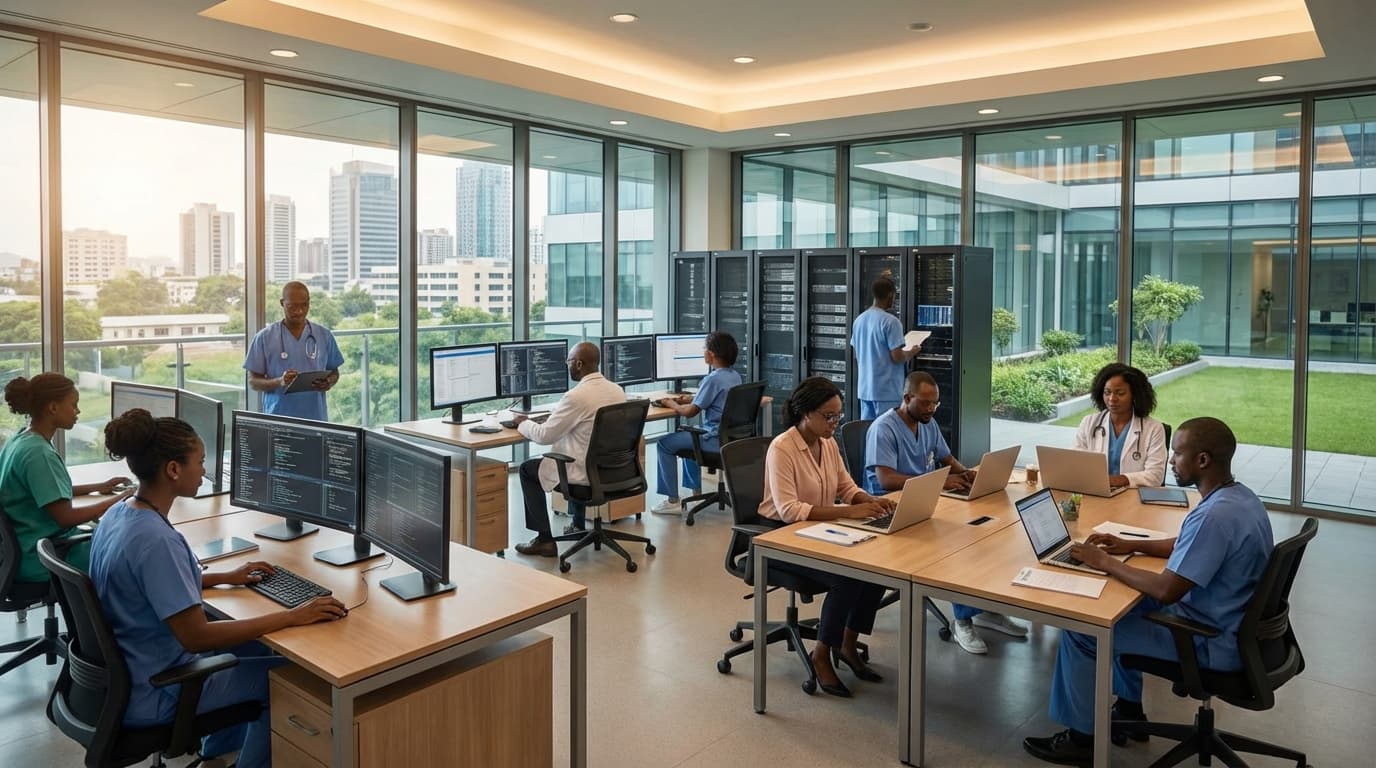
Radiology Reader & Reporting Support in Madagascar
Engineering Excellence & Technical Support
Remote radiology reading and reporting services High-standard technical execution following OEM protocols and local regulatory frameworks.
Remote Reading & Collaboration Platform
Empowering radiologists with a secure, cloud-based platform for remote image interpretation and seamless collaboration, overcoming geographical barriers and improving access to expert diagnoses across Madagascar.
AI-Powered Diagnostic Assistance
Leveraging cutting-edge Artificial Intelligence algorithms to enhance diagnostic accuracy and efficiency, providing automated detection of anomalies and flagging critical findings for radiologist review, especially in resource-limited settings.
Standardized Reporting & Data Archiving
Implementing standardized reporting templates and a robust digital archiving system to ensure consistent, high-quality reports and facilitate easy retrieval and analysis of radiological data for improved patient care and research.
What Is Radiology Reader & Reporting Support In Madagascar?
Radiology Reader & Reporting Support in Madagascar refers to the provision of expert interpretation of medical imaging studies and the generation of comprehensive diagnostic reports by qualified radiologists. This service is crucial in regions with a shortage of specialized medical personnel, enabling healthcare providers to access timely and accurate radiological diagnoses for patient care. The service typically involves the remote (teleradiology) or on-site review of various imaging modalities such as X-rays, CT scans, MRI scans, and ultrasounds, followed by the creation of detailed, structured reports that guide clinical decision-making and treatment planning. The technical workflow often includes secure image transmission, interpretation by certified radiologists, and delivery of reports through a secure platform.
| Who Needs Radiology Reader & Reporting Support? | Typical Use Cases |
|---|---|
| Hospitals and Clinics in Remote or Underserved Areas: Facilities lacking in-house radiologists. | Emergency Department Case Review: Urgent interpretation of critical imaging findings (e.g., stroke, trauma, acute abdomen). |
| Specialty Departments: Cardiology, neurology, oncology, orthopedics requiring specialized radiological interpretation. | Routine Diagnostic Imaging: Interpretation of X-rays for fractures, CT scans for organ-specific pathologies, MRI for musculoskeletal or neurological conditions. |
| Public Health Programs: Screening programs for tuberculosis, cancer, or other endemic diseases requiring large-scale image analysis. | Post-operative and Follow-up Imaging: Monitoring treatment response or detecting complications. |
| Teaching Hospitals: Supplementing local radiology departments with subspecialty expertise and supporting training initiatives. | Second Opinions and Consultations: Providing an independent review of complex or equivocal cases. |
| **Healthcare Organizations aiming to expand diagnostic capabilities without significant capital investment in on-site personnel. | Screening for specific conditions: E.g., mammography for breast cancer detection, lung CT for smokers. |
Key Components of Radiology Reader & Reporting Support:
- Image Acquisition and Transmission: Efficient and secure transfer of DICOM-compliant medical images from local healthcare facilities to the reporting radiologists.
- Expert Interpretation: Review of imaging studies by board-certified or fellowship-trained radiologists with expertise in relevant subspecialties.
- Report Generation: Creation of detailed, structured, and clinically relevant diagnostic reports including findings, impressions, and recommendations.
- Quality Assurance: Mechanisms for peer review and continuous quality improvement of interpretations and reports.
- Communication and Consultation: Facilitation of communication between reporting radiologists and referring clinicians for clarification or further consultation.
- Technology Infrastructure: Robust IT infrastructure for image storage, retrieval, viewing workstations, and secure communication.
Who Needs Radiology Reader & Reporting Support In Madagascar?
Madagascar's healthcare system, while growing, faces significant challenges in providing consistent and accessible radiology services. This is particularly true in rural and underserved areas where specialized expertise is scarce. Radiology reader and reporting support are crucial for accurate diagnosis, timely treatment, and improved patient outcomes. The demand for such services extends to various levels of the healthcare infrastructure and encompasses a range of healthcare professionals who directly or indirectly benefit from expert radiology interpretation.
| Customer Type | Key Departments Involved | Primary Needs | Benefit of Support |
|---|---|---|---|
| Public Hospitals | Radiology, Emergency Medicine, Surgery, Internal Medicine, Pediatrics | Expert interpretation of X-rays, ultrasounds, CT scans, MRIs; second opinions; specialized readings (e.g., oncology, neurology); timely reporting. | Improved diagnostic accuracy, reduced misdiagnosis, faster treatment initiation, better patient outcomes, reduced burden on existing radiologists. |
| District/Referral Hospitals | General Medicine, Surgery, Emergency, Pediatrics | Basic radiology interpretation, support for common imaging modalities, guidance on image acquisition. | Increased access to diagnostic imaging, essential for basic healthcare delivery in underserved areas, enables management of a wider range of conditions. |
| Private Clinics/Diagnostic Centers | Radiology, various clinical specialties | Supplementation of existing radiologist capacity, specialized case interpretation, quality control of reports, out-of-hours support. | Enhanced service offering, increased patient throughput, improved turnaround times for reports, competitive advantage. |
| Mobile Clinics/Outreach Programs | Clinical officers, general practitioners | Remote interpretation of acquired images, enabling diagnosis where no local radiologist is available. | Extends diagnostic capabilities to remote populations, crucial for early detection and management of diseases, reduces the need for patient travel. |
| Medical Training Institutions | Radiology residency programs, medical faculties | Case-based learning, expert review of student interpretations, access to diverse pathology for teaching. | Enhanced training quality for future radiologists and clinicians, improved diagnostic skills of trainees, better patient care within teaching hospitals. |
| Government Health Ministries | Public Health Departments, Planning and Monitoring Units | Aggregated reporting data for epidemiological surveillance, quality assurance of radiology services, policy development. | Informed public health strategies, improved national radiology standards, better resource allocation for healthcare. |
Target Customers and Departments for Radiology Reader & Reporting Support in Madagascar:
- Public Hospitals (Central and Regional): These facilities often handle a high volume of patients and may have a radiology department, but lack sufficient radiologists for comprehensive reading and reporting, especially for complex cases.
- District and Referral Hospitals: These hospitals serve larger populations and are critical referral points. They may have basic imaging equipment but often lack dedicated radiologists or specialized expertise.
- Private Clinics and Diagnostic Centers: While some may have their own radiologists, smaller or emerging centers might rely on external support for specialized readings or to supplement their existing capacity.
- Mobile Clinics and Outreach Programs: Serving remote populations, these initiatives can significantly benefit from teleradiology support to provide diagnostic imaging services that would otherwise be unavailable.
- Medical Training Institutions: Teaching hospitals and medical schools can leverage reader and reporting support for both patient care and the education of future radiologists and clinicians.
- Government Health Ministries and Agencies: These bodies can utilize reporting support for epidemiological studies, quality assurance initiatives, and to understand the prevalence of certain diseases through aggregated imaging data.
Radiology Reader & Reporting Support Process In Madagascar
This document outlines the workflow for the Radiology Reader & Reporting Support Process in Madagascar. It details the steps involved from the initial inquiry to the final execution of radiology reading and reporting, encompassing both on-site and remote support mechanisms.
| Stage | Description | Responsible Party/Actors | Key Activities | Tools/Systems Used | Key Outputs/Deliverables | Considerations/Notes |
|---|---|---|---|---|---|---|
| Inquiry and Request Initiation | The process begins when a healthcare facility or clinician identifies a need for radiology interpretation or reporting support. | Requesting Clinician/Facility, Referring Physician | Submit a request for radiology service, providing patient details, clinical history, and imaging modality used. | PACS (Picture Archiving and Communication System) or designated request portal, Email, Phone | Formal request logged in the system, Patient identification complete. | Clarity of information is crucial for accurate triage. |
| Case Triage and Prioritization | Requests are assessed to determine urgency, complexity, and the necessary expertise for interpretation. | Radiology Coordinator/Manager, Senior Radiologist | Review request details, assess urgency (e.g., STAT, routine), and identify potential complexities. | Triage protocols, PACS, Electronic Health Records (EHR) | Prioritized queue of cases, Assignment to appropriate radiologist level. | Adherence to established triage guidelines is essential. |
| Reader Assignment and Workload Management | Cases are assigned to available and qualified radiologists based on subspecialty, availability, and workload. | Radiology Coordinator/Manager, Lead Radiologist | Allocate cases to individual readers, ensuring equitable distribution and managing peak workloads. | Worklist management software, PACS, Tele-radiology platform dashboards | Assigned reading list for each radiologist, Real-time workload monitoring. | Consideration for language proficiency and specific subspecialty expertise. |
| Image Acquisition and Data Transmission | Radiology images are acquired by the referring facility and transmitted securely to the reading service. | Radiology Technologist, IT Support (Sending Facility) | Perform imaging procedures, ensure image quality, and securely transfer DICOM (Digital Imaging and Communications in Medicine) files. | PACS, DICOM viewers, Secure VPN (Virtual Private Network), HL7 (Health Level Seven) for data integration | Complete set of high-quality images transmitted, Metadata integrity. | Reliable network connectivity and data security are paramount. |
| Radiology Reading and Interpretation | Assigned radiologists review the images, integrate clinical information, and formulate a diagnostic interpretation. | Radiologist (On-site or Remote Reader) | Review patient history, examine images using specialized viewers, correlate findings, and identify abnormalities. | Advanced PACS workstations, DICOM viewers, Dictation software, AI-assisted tools (if available) | Preliminary findings, Diagnostic impression. | Critical findings should be flagged immediately. |
| Report Generation and Quality Assurance | A detailed report is generated based on the interpretation, followed by a review process to ensure accuracy and completeness. | Radiologist, Report Editor/QA Specialist, Senior Radiologist | Dictate or type the radiology report, include findings, impression, and recommendations; perform peer review or senior review. | Speech recognition software, Report templates, PACS reporting module, QA checklists | Draft report, Finalized and approved radiology report. | Standardized reporting templates enhance consistency. |
| Report Distribution and Communication | The finalized report is transmitted back to the requesting clinician/facility and communicated effectively. | Radiology Department Administration, IT Support (Receiving Facility) | Send the report via secure channels, ensure it is accessible in the requesting facility's EHR/PACS, and follow up on critical findings. | EHR, PACS, Secure email, Fax (if necessary), Secure messaging platforms | Report delivered to the requesting physician, Report integrated into patient record. | Timely communication of critical findings is vital. |
| Feedback and Continuous Improvement | Mechanisms are in place to gather feedback on the service and identify areas for improvement in the workflow and quality of service. | Requesting Clinician/Facility, Radiology Readers, Management | Provide feedback on report turnaround time, clarity, and overall service; analyze feedback to implement process enhancements. | Feedback forms, Surveys, Performance metrics, Case review meetings | Actionable insights for process improvement, Updated protocols and training materials. | A proactive approach to feedback fosters service excellence. |
Key Stages of the Radiology Reader & Reporting Support Process
- Inquiry and Request Initiation
- Case Triage and Prioritization
- Reader Assignment and Workload Management
- Image Acquisition and Data Transmission
- Radiology Reading and Interpretation
- Report Generation and Quality Assurance
- Report Distribution and Communication
- Feedback and Continuous Improvement
Radiology Reader & Reporting Support Cost In Madagascar
Providing radiology reader and reporting support services in Madagascar involves a range of pricing factors influenced by the complexity of the cases, the experience of the radiologists, the turnaround time required, and the technology used. These services are crucial for improving diagnostic accuracy and patient care, especially in regions with limited access to specialized medical expertise. The cost is typically quoted in Malagasy Ariary (MGA).
| Service Type | Estimated Price Range (MGA) per Study | Notes |
|---|---|---|
| Basic X-ray Interpretation | 20,000 - 50,000 | Standard findings, common pathologies |
| Ultrasound Interpretation (Abdomen, Pelvis) | 30,000 - 70,000 | Standard examinations |
| CT Scan Interpretation (e.g., Head, Chest, Abdomen) | 60,000 - 150,000 | Moderate complexity, standard protocols |
| MRI Scan Interpretation (e.g., Brain, Spine, Joints) | 80,000 - 250,000 | Moderate complexity, standard protocols |
| Complex/Sub-specialty Interpretation (e.g., Neuroradiology, Oncology) | 100,000 - 400,000+ | Requires highly specialized expertise |
| Urgent/STAT Reporting Surcharge | +20% - +50% | Added to the base interpretation cost |
| Archiving & Storage (per study/month) | 5,000 - 15,000 | Depends on storage duration and volume |
Factors Influencing Radiology Reader & Reporting Support Costs in Madagascar
- Radiologist Expertise & Specialization: More experienced radiologists or those with niche sub-specialties (e.g., neuroradiology, pediatric radiology) command higher fees.
- Case Complexity: Simple X-rays or ultrasounds will be less expensive than complex CT scans, MRIs, or interventional radiology procedures.
- Volume of Cases: Larger volumes of studies may lead to discounted per-case pricing through bulk agreements.
- Turnaround Time (TAT): Standard reporting times are generally cheaper than urgent or stat reporting, which require immediate attention and potentially overtime for the radiologist.
- Technology & Platform: The use of advanced AI-powered diagnostic tools or secure cloud-based reporting platforms can sometimes influence pricing, either adding to costs for the provider or enabling efficiency that is passed on to the client.
- Reporting Language: While Malagasy is the official language, reports are often required in French or English for international collaboration or patient records, which might affect pricing if translation or specialized reporting is needed.
- Geographic Location (within Madagascar): While less of a primary driver for remote reporting services, logistical considerations for any on-site involvement or data transfer could play a minor role.
- Contractual Agreements: Long-term contracts or service level agreements (SLAs) can offer more predictable and potentially lower per-unit costs compared to ad-hoc services.
Affordable Radiology Reader & Reporting Support Options
Radiology practices and healthcare facilities are constantly seeking ways to optimize operational costs without compromising the quality of diagnostic services. This pursuit often leads to exploring affordable radiology reader and reporting support options. These solutions aim to enhance efficiency, reduce turnaround times, and alleviate the burden on in-house radiologists, particularly in high-volume or specialized areas. Understanding value bundles and implementing cost-saving strategies are crucial for successful adoption.
| Value Bundle/Strategy | Description | Cost-Saving Benefit | Implementation Considerations |
|---|---|---|---|
| Teleradiology Package Deals | Bundled pricing for a set volume of reads, specific subspecialties, or 24/7 coverage. Often includes IT integration and quality assurance. | Reduced per-read cost compared to ad-hoc services. Predictable budgeting. Access to specialists without full-time hires. | Clear service level agreements (SLAs). Data security and HIPAA compliance. Integration with PACS/RIS. Scalability. |
| AI + Human Radiologist Collaboration | Software that flags potential findings, prioritizes studies, or suggests report content for radiologist review and finalization. | Increased radiologist throughput. Reduced interpretation time. Improved detection rates. Potential for reduced overtime costs. | AI vendor reputation and FDA clearance. Integration with PACS/RIS. Radiologist training and acceptance. Validation of AI performance. |
| Managed Reporting Services | Outsourcing the transcription, formatting, and initial structuring of radiology reports. May include radiologist review. | Reduced administrative burden on radiologists. Faster report turnaround. Consistent report quality and formatting. Lower cost than hiring dedicated reporting staff. | Clear dictation standards. Quality control mechanisms. Turnaround time guarantees. Compatibility with existing reporting systems. |
| Subspecialty Hub Models | Concentrating specific subspecialty reads (e.g., neuro, MSK) with a dedicated remote team or group of radiologists. | Economies of scale for specialized interpretation. Enhanced expertise. Reduced need for in-house subspecialists. | Robust communication channels. Defined subspecialty coverage. Quality assurance for specialized reads. Workflow management. |
| Tiered Pricing for Volume | Service providers offer lower per-unit costs as the volume of reads or services increases. | Direct cost reduction for high-volume facilities. Incentivizes efficient workflow to maximize volume. | Accurate forecasting of imaging volumes. Contractual agreement on volume tiers and pricing adjustments. |
| Shared Services/Consortia | Multiple smaller practices or facilities pooling resources to negotiate better rates with teleradiology or AI providers. | Leverages collective bargaining power for lower costs. Shared access to advanced technology and expertise. | Governance structure. Cost-sharing agreements. Standardized workflows across participating entities. |
Key Considerations for Affordable Radiology Reader & Reporting Support:
- Teleradiology Services: Outsourcing interpretation of imaging studies to remote radiologists. This can be particularly cost-effective for off-hours, subspecialty reads, or to manage overflow.
- AI-Powered Reading Support: Utilizing Artificial Intelligence tools to assist radiologists in detecting abnormalities, prioritizing urgent cases, and generating preliminary reports. AI can enhance accuracy and speed up the reading process.
- Hybrid Models: Combining in-house reading with outsourced services or AI support to create a flexible and cost-efficient workflow.
- Reporting Software & Templates: Implementing advanced reporting platforms with customizable templates to standardize report generation, improve clarity, and reduce dictation time.
- Second Opinions & Quality Assurance: Utilizing external reading services for a second opinion or quality assurance checks, ensuring diagnostic accuracy and patient safety at a controlled cost.
- Training & Workflow Optimization: Investing in training for existing staff and optimizing reporting workflows can significantly improve efficiency and reduce the need for external support.
Verified Providers In Madagascar
In Madagascar, access to reliable healthcare is paramount. Finding verified providers ensures you receive quality care and peace of mind. Franance Health stands out as a leading credentialing body, rigorously vetting healthcare professionals and facilities across the nation. Their meticulous process guarantees that providers meeting their standards are not only licensed but also adhere to best practices, possess up-to-date training, and maintain ethical conduct. Choosing a Franance Health-credentialed provider means opting for a level of assurance that is crucial for your well-being.
| Credentialing Aspect | Franance Health Verification |
|---|---|
| Medical Licensing | Confirmed and current with Malagasy medical boards. |
| Professional Experience | Verified through past employment and peer references. |
| Continuing Education | Proof of ongoing professional development and training required. |
| Ethical Conduct | Background checks and review of any disciplinary actions. |
| Facility Standards (where applicable) | Assessment of hygiene, equipment, and operational procedures. |
Why Franance Health Credentials Matter
- Ensured Quality of Care: Providers are assessed for their clinical expertise and adherence to established medical protocols.
- Patient Safety: Rigorous background checks and verification of qualifications minimize risks.
- Trust and Reliability: Franance Health's endorsement signifies a commitment to transparency and excellence.
- Access to Best Practices: Credentialed providers are up-to-date with the latest medical advancements and ethical guidelines.
- Peace of Mind: Knowing your healthcare provider has met stringent criteria offers significant reassurance.
Scope Of Work For Radiology Reader & Reporting Support
This Scope of Work (SOW) outlines the requirements for providing Radiology Reader & Reporting Support services. This includes the technical deliverables and standard specifications necessary to ensure high-quality, efficient, and secure radiological interpretation and reporting.
| Technical Deliverable | Description | Standard Specifications / Requirements |
|---|---|---|
| Radiology Reports | Finalized reports for interpreted imaging studies. | Electronic format (e.g., PDF, HL7 CDA). Reports must be clearly structured, including relevant clinical history, findings, impressions, and recommendations. Specific terminology and coding (e.g., ACR codes) as required. |
| Secure Access to PACS/RIS | Remote and secure access to view imaging studies and integrate reports. | VPN or secure cloud-based access. Compatible with client's existing PACS/RIS infrastructure. Must support standard DICOM viewing capabilities. Read-only access where appropriate. |
| Reporting Software/Platform | The system or interface used by radiologists to generate and submit reports. | Web-based or installable client application. User-friendly interface. Integration capabilities with PACS/RIS for report auto-population. Secure data transmission and storage. Audit trails for all report modifications. |
| Data Transmission Security | Protocols and methods for transmitting imaging data and reports securely. | Encryption (e.g., TLS/SSL for data in transit). Secure authentication mechanisms. Compliance with industry-standard security protocols. |
| Quality Assurance Metrics | Data and reports demonstrating the quality of interpretations and reporting. | Accuracy rates, TAT compliance, error rates, peer review feedback. Standardized reporting templates and style guides. |
| Audit Trails | Records of all access, viewing, interpretation, and reporting activities. | Immutable logs detailing user, timestamp, action performed, and affected data. Essential for security and compliance. |
| System Uptime and Availability | Guaranteed availability of the reporting platform and access to PACS/RIS. | Service Level Agreement (SLA) defining minimum uptime percentage (e.g., 99.9%). Disaster recovery and business continuity plans. |
| Integration with EMR/EHR | Optional, but preferred, integration for seamless report delivery. | HL7 messaging or FHIR API for report transfer to the client's Electronic Medical Record (EMR) or Electronic Health Record (EHR) system. |
Key Services and Deliverables
- On-demand radiology interpretation and reporting by qualified radiologists.
- Secure and reliable access to the client's Picture Archiving and Communication System (PACS) and/or Radiology Information System (RIS).
- Adherence to established reporting templates and turnaround time (TAT) agreements.
- Provision of clear, concise, and actionable radiology reports.
- Secure communication channels for queries and clarifications.
- Regular performance reporting and quality assurance metrics.
- Data security and privacy compliance (e.g., HIPAA, GDPR).
- Scalability to accommodate fluctuating study volumes.
Service Level Agreement For Radiology Reader & Reporting Support
This Service Level Agreement (SLA) outlines the terms and conditions for the Radiology Reader & Reporting Support services provided by [Your Company Name] to [Client Company Name]. It defines the expected response times, uptime guarantees, and service management procedures to ensure optimal performance and client satisfaction.
| Service Component | Uptime Guarantee | Response Time (Critical Incidents) | Response Time (Non-Critical Incidents) | Resolution Target (Critical Incidents) | Resolution Target (Non-Critical Incidents) |
|---|---|---|---|---|---|
| Radiology Reading Platform Availability | 99.9% | N/A | N/A | N/A | N/A |
| New Case Assignment Notification | N/A | < 15 minutes | < 30 minutes | N/A | N/A |
| Image Access and Viewing | 99.9% | < 10 minutes | < 20 minutes | Within 2 business hours | Within 1 business day |
| Report Generation Initiation (after image review) | N/A | < 30 minutes | < 60 minutes | Within 4 business hours | Within 2 business days |
| Report Finalization (post-initial draft) | N/A | < 60 minutes | < 120 minutes | Within 8 business hours | Within 3 business days |
| Urgent/STAT Report Turnaround | N/A | < 15 minutes (acknowledgement) | N/A | Within 60 minutes | N/A |
| Technical Support Access | N/A | < 5 minutes | < 15 minutes | Within 1 business hour | Within 4 business hours |
Key Service Objectives
- To provide timely and accurate radiology reading and reporting support.
- To ensure high availability of the radiology reading and reporting platform.
- To establish clear communication channels and escalation procedures.
- To monitor and report on service performance against agreed-upon metrics.
Frequently Asked Questions

Ready when you are
Let's scope your Radiology Reader & Reporting Support in Madagascar project in Madagascar.

Scaling healthcare logistics and technical systems across the entire continent.